Best Sofa Alternatives for Small Living Rooms
Quick answer: The best sofa alternatives small living rooms can use are a loveseat, a pair of armchairs, a daybed, a bench with cushions, a modular seat set, a window seat and floor seating. Choose by who sits, how long, and whether you need a guest bed. Measure the footprint, keep 30 to 36 inches of walkway where you can, and check seat height, depth and support before you buy.
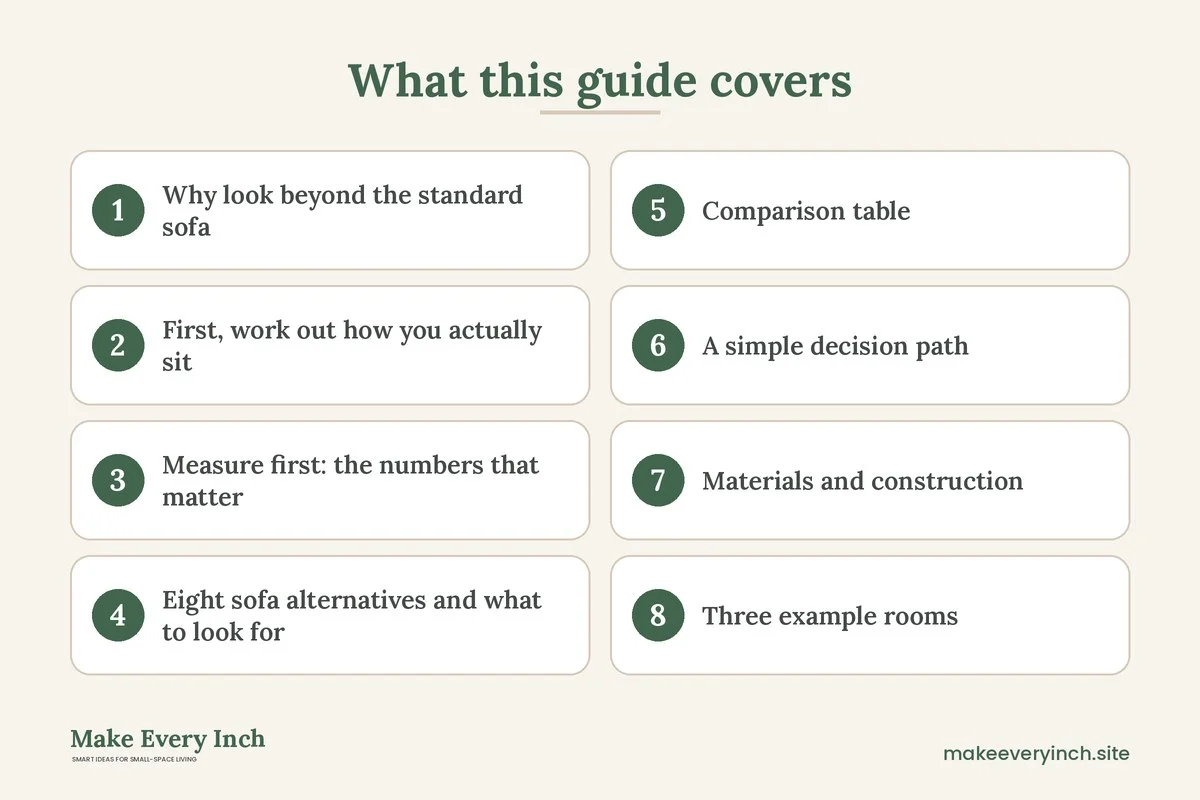
Sofa alternatives small living rooms can use are worth considering when a standard three-seat sofa swallows half the floor. A typical sofa is around 84 to 90 inches long and 35 to 40 inches deep, which leaves little room in a space of 10 by 12 feet. This guide is a buying guide, not a list of products. It explains what to look for, which sizes to measure, which materials last, and what each option gives up in exchange for a smaller footprint. It covers eight alternatives, a comparison table, seat-height and depth numbers, a decision path, three example rooms, safety notes and a checklist. For the wider picture, read our pillar on the best furniture for small apartments, and for pieces that serve two purposes, see the companion post on small space furniture ideas that do double duty.
Why look beyond the standard sofa
A sofa is designed for a medium or large room. In a small one it dominates sight lines, forces the rest of the layout around it, and often sits on the longest wall because nothing else fits. An alternative can give the same comfort in a smaller shape, add a second use such as a guest bed, or leave more floor visible, which makes the room feel bigger.
Alternatives are not always better. A sofa is the best answer for lying down with a blanket, for three people at once and for long movie nights. If you do those things weekly, shrink the sofa instead of removing it. Our guide to the best sofas for small apartments covers compact sofas. This post is for the moment you decide the full-size, three-seat sofa is not the right shape for your room.
First, work out how you actually sit
Before you shop, answer five questions.
- How many people sit at once, most days? If it is one or two, a loveseat or chairs may be enough.
- How long do they sit? An hour of reading differs from a four-hour movie. Long sitting needs back support and a deeper seat.
- Do you nap or lie down? A daybed, chaise or deep seat supports lying down. A bench or chair does not.
- Do you need a guest bed? If yes, a daybed, sleeper or futon may serve, or you can use a floor mattress stored elsewhere.
- Who is getting up and down? Older adults and people with joint pain usually want a higher seat, firm cushions and arms to push on.
Write the answers down and keep them as a filter. Many sofa alternatives fail on the third and fifth question.
Measure first: the numbers that matter
These measurements are general rules of thumb, not building rules, and comfort differs from person to person.
- Seat height: about 16 to 19 inches from the floor to the top of the cushion works for most adults. Lower feels relaxed but is harder to stand from, while higher suits people who need help getting up.
- Seat depth: about 20 to 24 inches suits upright sitting. 24 to 28 inches suits lounging, though you may need back cushions to avoid sliding forward.
- Seat width per person: around 20 to 24 inches. A 48-inch loveseat is cozy for two, and a 60-inch one is more comfortable.
- Walkway: keep roughly 30 to 36 inches where you walk often, and about 24 inches in a side path.
- Distance to the coffee table or side surface: 16 to 24 inches from the seat edge.
- Distance to the TV: roughly 6 to 9 feet in a small room, depending on screen size.
- Door and stair path: measure the narrowest point your piece must pass, and compare to the packaged size.
Mark each option’s footprint on the floor with painter’s tape. Sit on a dining chair in the taped area, and imagine passing, stretching and carrying a tray. If the tape makes the room feel tight, the option is too large.
Eight sofa alternatives and what to look for
1. A loveseat
A loveseat is the closest thing to a sofa, in a shape of about 52 to 72 inches wide. It seats two, fits under a window, and often passes through narrow doors.
What to look for: a frame that is solid, with a seat depth of at least 20 inches, firm foam with some resilience, and legs that lift the base so you can see floor beneath. Slim arms save width. A back that is about 30 to 33 inches tall keeps the profile light.
Trade-offs: not ideal for three people, and difficult to stretch out on. If you nap, test a deeper model.
2. A pair of armchairs
Two armchairs face each other or the TV, and they can be moved to suit a gathering. Each takes about 28 to 34 inches of width, so two take less than a three-seat sofa and give a sense of order.
What to look for: a seat depth of 19 to 22 inches, supportive arms, a back that offers lumbar support and legs that let the floor show. Swivel chairs turn between a screen and a conversation, but check that the base does not wobble and that the swivel cannot jam a carpet.
Trade-offs: no place to lie down, and guests may end up on the floor. Add a footstool or an ottoman for extra seats.
3. A daybed
A daybed has a frame with a back and two sides, and is sized like a twin mattress, about 38 to 40 inches by 75 inches. It works as a sofa by day and a bed at night.
What to look for: a sturdy frame with slats or a solid platform, a mattress thickness that suits sitting (firmer is easier for sitting), bolsters or pillows that stand in for a back, and optionally a trundle for a second sleeper. Check the height of the frame, since a high one is hard for people with limited mobility.
Trade-offs: sitting is more upright, and you often need many cushions. It looks best against a wall, and its length may be awkward in a narrow room.
4. A bench with cushions
A long bench along a wall seats three or four for short stretches. Add cushions and a back cushion rail, and it becomes a banquette.
What to look for: a seat height of 17 to 19 inches, a depth of at least 16 inches for short sitting, a top that is wide enough for cushions, and storage inside if possible. A lid that is supported when open protects fingers. Use sturdy fabric covers that you can remove.
Trade-offs: not supportive for long periods, so it works best for dining, a reading nook or a secondary seating zone. See our guide to the best storage ottomans for similar storage seats.
5. A modular or sectional set
Modular seats are separate units you arrange as a straight line, an L, or two facing lengths. You can start with two units and add one when the room or budget allows.
What to look for: connectors that keep units from sliding apart, removable covers, units narrow enough for your door and the option to turn a unit into a chaise or ottoman. Our guide to the best sectionals for small living rooms goes deeper.
Trade-offs: more pieces to keep aligned, and the L shape consumes a corner. It may be too big if your room is below about 10 feet wide.
6. A window seat or built-in banquette
A seat built into a bay or under a window uses space that is often wasted. It can have drawers or lift-up storage below, and cushions on top.
What to look for: a seat height of 17 to 19 inches, a depth of at least 18 inches, a firm cushion with an overall thickness of 3 to 4 inches, and a back cushion or the wall to lean on. Windows can be cold in winter, so add a throw, and keep curtains and cords away from the seat.
Trade-offs: it is a built-in change, so renters should ask the landlord first. A freestanding bench under the window gives a similar look without construction.
7. A futon or sleeper
A futon or sleeper turns from a seat to a bed and is a practical choice if guests stay overnight.
What to look for: a mechanism that is simple and stable, a seat that is comfortable in the sofa position, and a frame that is solid when folded and unfolded. Keep fingers clear of the frame joints and hinges when changing positions, because those are pinch points.
Trade-offs: a heavier piece that wears over time, and not always ideal for daily lounging. Ask how much space it needs when open. Our post on studio apartment ideas with a Murphy bed covers a similar space-saving idea.
8. Floor seating
Large floor cushions, a low platform with cushions or a pouf cluster form a relaxed Japanese-inspired seating area. They store easily and take almost no height.
What to look for: a firm, thick cushion, a washable cover, a rug that cushions the floor and a low back support such as a wall rail or a backrest. A folded blanket under the cushion helps insulate from a cold floor.
Trade-offs: hard to sit on for people with stiff joints, and less comfortable for long periods without a back. It suits a second living area, a kids’ corner or a flexible room.
Comparison table
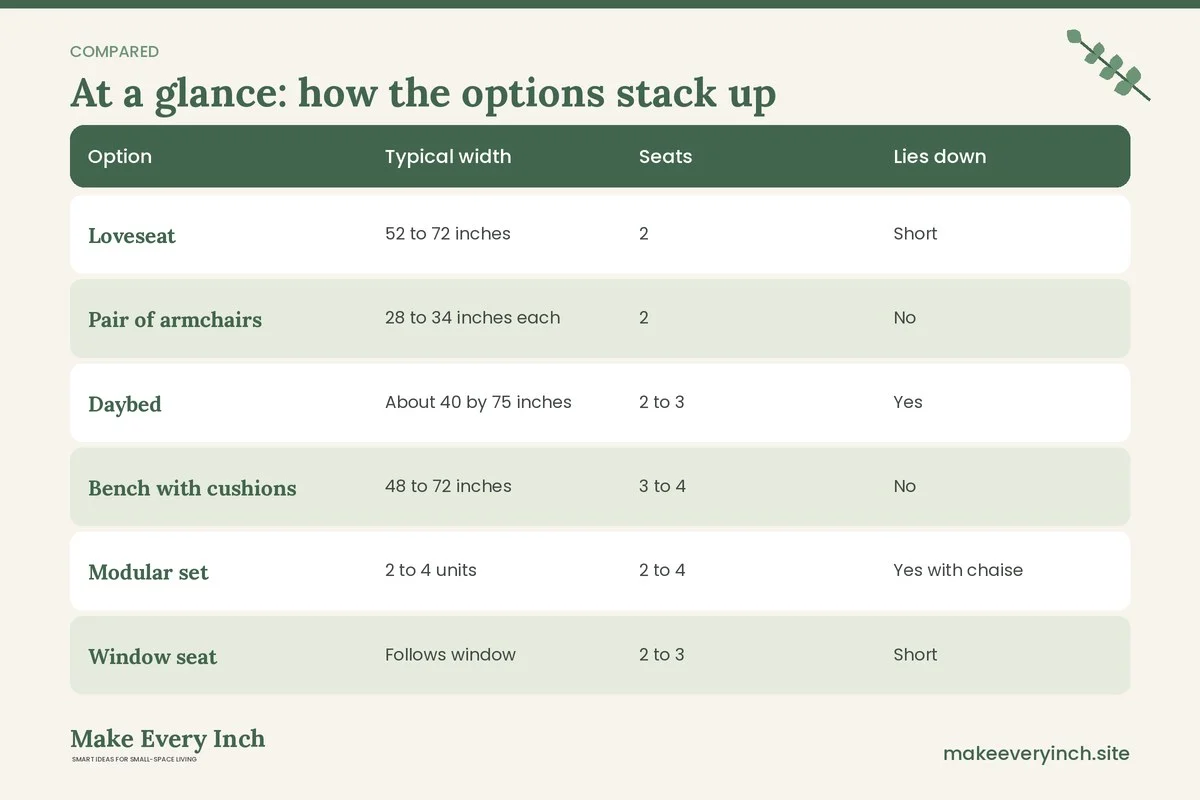
The table summarizes the alternatives. Sizes are rough and vary by model.
| Option | Typical width | Seats | Lies down | Guest bed | Main trade-off |
|---|---|---|---|---|---|
| Loveseat | 52 to 72 inches | 2 | Short | No | Not for three |
| Pair of armchairs | 28 to 34 inches each | 2 | No | No | No lounging |
| Daybed | About 40 by 75 inches | 2 to 3 | Yes | Yes | Upright seating |
| Bench with cushions | 48 to 72 inches | 3 to 4 | No | No | Short sits only |
| Modular set | 2 to 4 units | 2 to 4 | Yes with chaise | Rarely | Corner use |
| Window seat | Follows window | 2 to 3 | Short | No | Built-in, cold |
| Futon or sleeper | 54 to 80 inches | 2 to 3 | Yes | Yes | Heavy, wear |
| Floor seating | Flexible | 2 to 4 | Yes | Yes with cushions | Low support |
A simple decision path
Use these steps to narrow the list.
1. If you host overnight guests often, shortlist a daybed, futon or sleeper.
2. If you watch long movies, shortlist a loveseat or modular set with a deep seat.
3. If you mostly read or talk, shortlist armchairs, a bench or a window seat.
4. If the room is also a dining area or office, shortlist a bench, chairs or a daybed against a wall.
5. If your door is narrow or you move often, shortlist modular pieces, armchairs or floor seating.
6. If joints or mobility matter, pick a higher seat, firm cushions and arms, and avoid floor seating.
Often two answers apply. A loveseat plus an armchair is a classic small-room pairing, and a daybed plus a pouf covers guests and everyday sitting.
Materials and construction
For any seat you will use daily, the frame and the filling matter more than the fabric.
- Frames: solid wood or well made engineered wood with corner blocks tends to resist loosening. Metal frames are slim, but check the welds and the feet. Very thin boards may flex over time.
- Foam and fill: higher density foam keeps its shape longer, and a wrapped layer adds softness. Feather blends feel plush but need plumping. Loose cushions can be turned, which spreads wear.
- Springs and webbing: these support the seat. Ask the maker how the seat is supported, since sagging often begins here.
- Fabric: tightly woven fabrics resist pilling and snags, and performance fabrics wipe clean. Leather and faux leather are easy to wipe but can feel cool. Removable, washable covers help in homes with children or pets.
- Legs: visible legs at least 6 inches high let light and sight lines pass under the piece, which makes a room feel larger. They also make cleaning easier.
- Low-emission materials: if you are sensitive to smells, ask about low-VOC foams and finishes and let a new piece air out in a ventilated room before use. Keep windows open during the first days.
Three example rooms
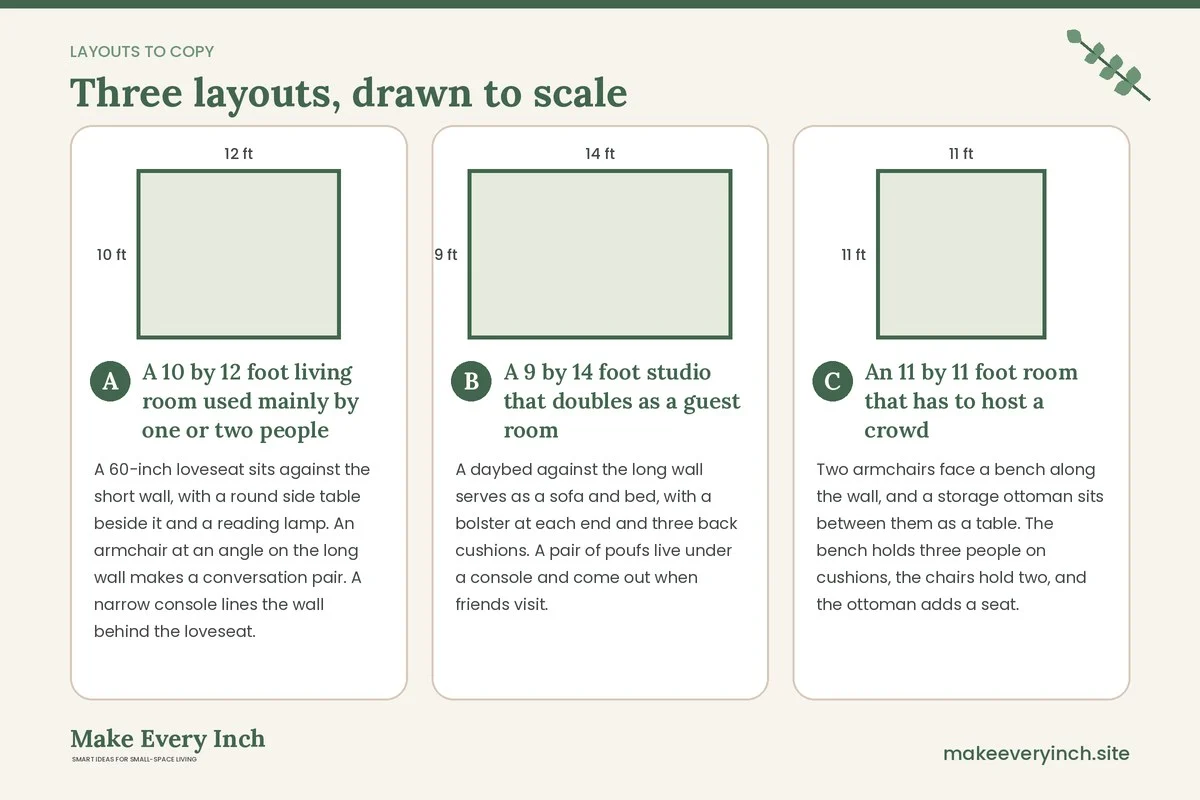
A 10 by 12 foot living room used mainly by one or two people
A 60-inch loveseat sits against the short wall, with a round side table beside it and a reading lamp. An armchair at an angle on the long wall makes a conversation pair. A narrow console lines the wall behind the loveseat. The walkway stays at about 36 inches, and the room feels open because the seat has visible legs. This plan suits a couple who rarely host more than one guest.
A 9 by 14 foot studio that doubles as a guest room
A daybed against the long wall serves as a sofa and bed, with a bolster at each end and three back cushions. A pair of poufs live under a console and come out when friends visit. A drop-leaf table by the window is the dining and work spot. The trundle stays tucked away. The layout leaves a 30-inch path along the open side. Read more about layouts in our guide to studio apartment ideas.
An 11 by 11 foot room that has to host a crowd
Two armchairs face a bench along the wall, and a storage ottoman sits between them as a table. The bench holds three people on cushions, the chairs hold two, and the ottoman adds a seat. There is no single sofa, yet the room seats six at a push. Stack the cushions in a basket when not in use. For more layouts, see our small living room layout ideas.
Safety and practical notes
- Anchor tall pieces. If you add a tall bookcase or shelf next to the seat, anchor it to the wall as the instructions say, and ask permission before drilling in a rental.
- Check pinch points. Sleeper and futon mechanisms, folding daybeds and lift-up bench lids can pinch fingers. Use them slowly, and keep children and pets away while they move.
- Keep weight limits in mind. Daybeds, benches and window seats have stated limits. Do not stand on cushions or stack heavy items on a bench top.
- Do not drill without permission. Window seats, wall rails and fixed shelves may need fixings. Read the lease first and use freestanding versions where drilling is not allowed.
- Protect walking routes. Keep a clear path to doors and exits. Do not put a seat in front of a radiator or vent unless the airflow is clear.
- Cords and blinds. Keep window blind cords out of reach of children and away from a window seat.
Styling a sofa-free living room
Without a sofa, the room needs another anchor, and a rug is the simplest. A rug of about 5 by 8 feet usually works in a small room, with the front legs of each seat on it. Add a lamp at seat height so the seating area feels intentional, and vary the heights: a low bench, a taller chair and a pouf give rhythm.
Use one color family across the seats so the room feels calm, and let texture do the work. A pair of identical chairs in a bold color can serve as a focal point. If the room looks too empty, add a plant, a mirror or a wall shelf, remembering the load limits and fixings. Our guide to small living room ideas has more on atmosphere.
Mistakes to avoid
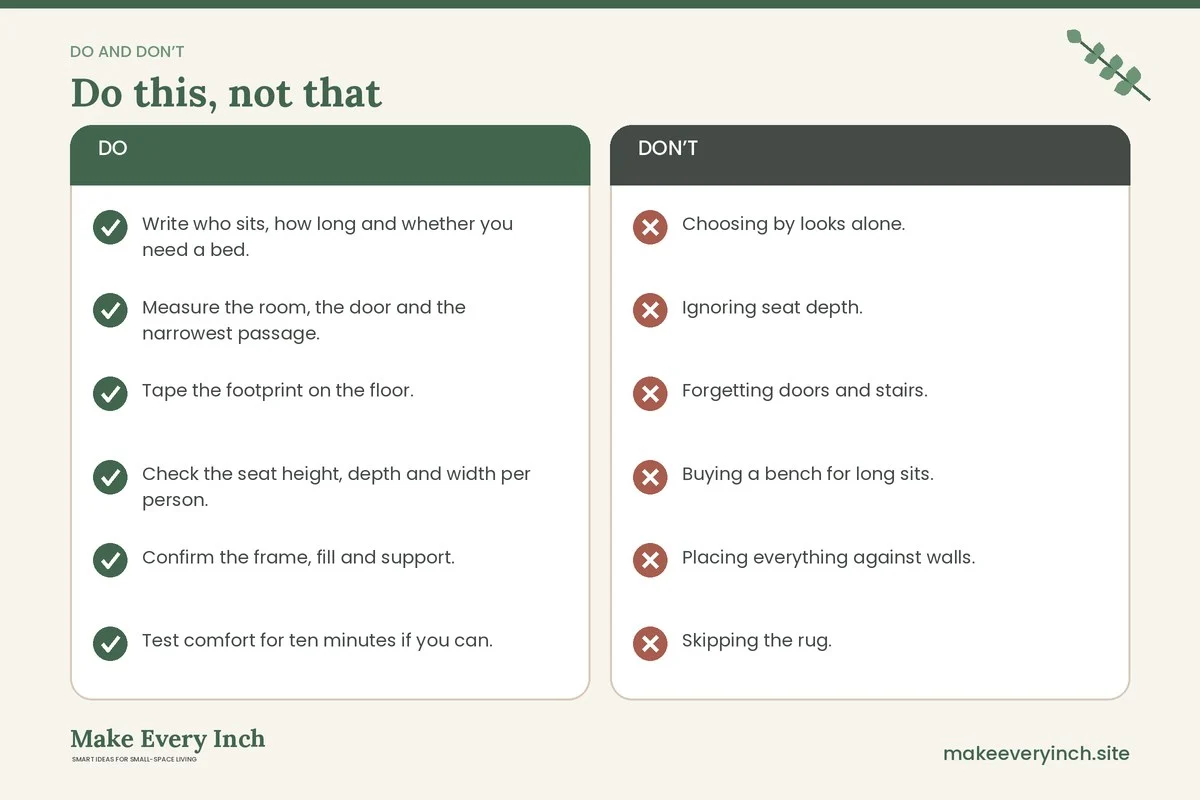
- Choosing by looks alone. Sit on it for at least ten minutes before you decide, or check the return policy.
- Ignoring seat depth. Too shallow and you slide, too deep and your feet dangle.
- Forgetting doors and stairs. A piece that is too wide for the entry is a costly mistake.
- Buying a bench for long sits. Benches suit short sessions.
- Placing everything against walls. A floated seat can be more flexible, as long as you keep the walkway.
- Skipping the rug. A rug ties a sofa-free arrangement together.
- Overlooking the guests. If friends stay, plan a bed or a mattress option.
Buying checklist
- Write who sits, how long and whether you need a bed.
- Measure the room, the door and the narrowest passage.
- Tape the footprint on the floor.
- Check the seat height, depth and width per person.
- Confirm the frame, fill and support.
- Test comfort for ten minutes if you can.
- Look at the covers and cleaning method.
- Check how the mechanism moves and where fingers go.
- Ask about weight limits.
- Plan a rug and lighting.
- Keep a walkway of about 30 to 36 inches.
- Get permission before any drilling.
FAQ
What are the best sofa alternatives for a small living room?
A loveseat, a pair of armchairs, a daybed and a bench with cushions are the most popular. The best choice depends on how many people sit, how long and whether guests sleep over.
Can I replace a sofa with two armchairs?
Yes, if you mostly sit upright and rarely lie down. Add an ottoman or a bench for extra seats.
Is a daybed comfortable enough to use as a sofa?
It is comfortable if you add back cushions and choose a firm mattress, but the seating is more upright than a standard sofa. Test it before you buy.
What is the smallest seat for two people?
A loveseat of about 52 to 60 inches is the usual minimum. A bench or a pair of chairs can be narrower in total, but each person has less support.
How do I make a room without a sofa feel cozy?
Use a rug, lamps at seat height, throws and cushions, and group the seats so they face each other. Warm bulbs help in the evening.
What should renters watch for?
Avoid built-ins and wall fixings unless the landlord agrees. Freestanding pieces such as daybeds, benches and modular seats move with you. See our post on small living room ideas for renters.
Keep going: Keep planning with our small living room furniture ideas, small living room ideas and best small dining tables.
Save this guide for later
Pin the ideas you like to Pinterest so you can come back to them when you plan your space.