15 Narrow Living Room Ideas for Families With Kids and Play Space
Quick answer: The best narrow living room ideas for families keep a 36-inch lane open for walking and crawling, put the play zone at the far end where it is out of the traffic path, use shallow storage 12 to 16 inches deep that kids can reach, and round or soften every edge. Anchor tall furniture to the wall, keep cords out of reach and choose pieces that fold, stack or slide away.
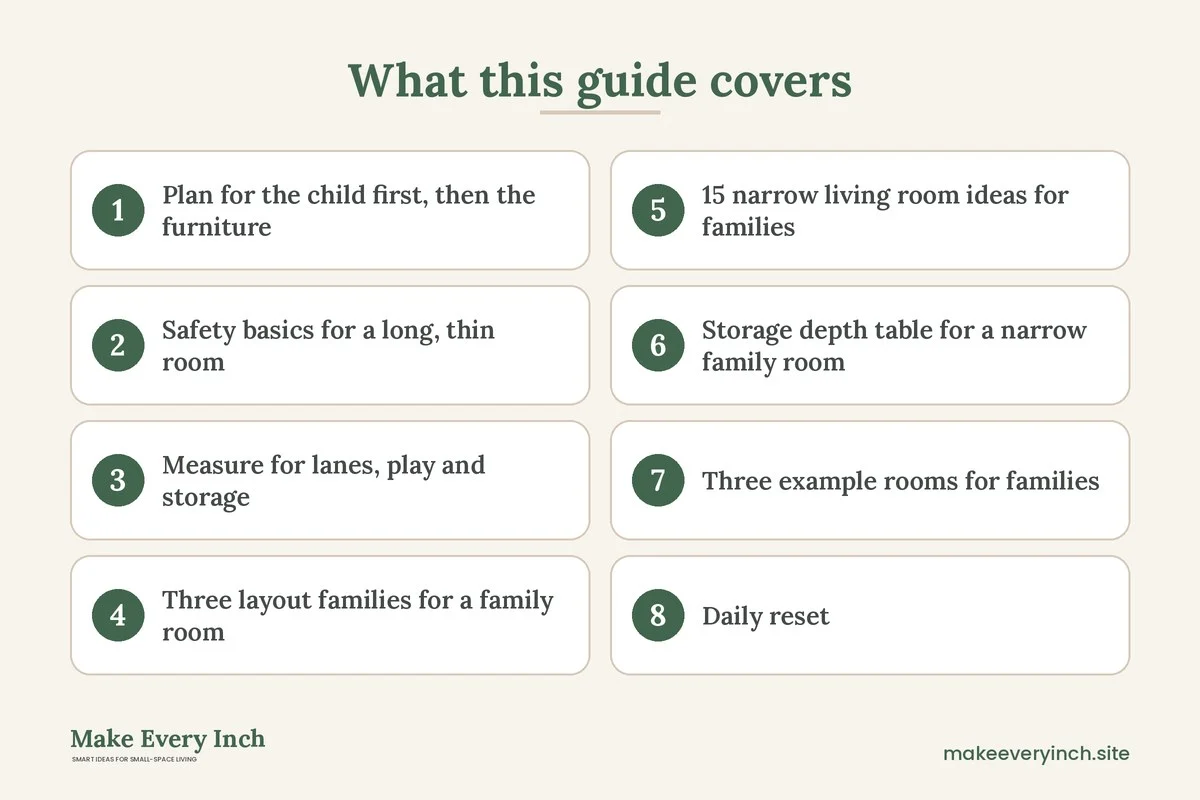
Narrow living room ideas for families have to do three jobs at once: keep the room safe, hold a surprising amount of stuff and still leave a patch of floor where a child can build, crawl or roll a toy car. In a room that is 8 to 10 feet wide, those jobs compete for the same few inches. The sofa wants the width, the toy box wants the wall and the child wants the middle. This guide shows how to plan a long, thin room around children. It covers the safety basics, how to measure for a play zone, three layout families, 15 specific ideas, a storage depth table, example rooms with numbers, a daily reset routine, common mistakes and a checklist. For the full overview, start with our main guide to narrow living room ideas, and for the broader topic read small living room ideas.
Plan for the child first, then the furniture
Most family living rooms get furnished for adults and then adapted for children. In a narrow room that order fails, because there is no spare space to adapt. Start instead with what the children do in the room. A baby needs a safe patch of floor about 3 by 4 feet to roll and crawl. A toddler needs a clear run of 6 to 8 feet to toddle without hitting a corner. A school-age child needs a flat surface for homework and a place to build that does not get trodden on. A teenager wants a seat that is theirs.
Write down what your family does in the room on a normal weekday and on a weekend. Then mark the busiest moment, which is often the hour before dinner. That moment decides where the lane and the play zone sit. If the kids play while you cook nearby, the play zone belongs at the end closest to the kitchen so you can see them. If they watch screens, it belongs in front of the sofa.
The second principle is that a narrow room has one long axis, and children love to use it. A 14-foot room is a racetrack. Leave the length as open as you can, and push the heavy furniture to one long wall.
Safety basics for a long, thin room
A narrow room puts children close to furniture edges, so safety is about edges, tipping and cords. Treat the following as a checklist, and consult the maker’s guidance for each product.
- Anchor tall furniture. Any bookcase, dresser or cabinet taller than about 30 inches should be fixed to the wall with the hardware supplied or a strap suited to the wall type. Narrow, tall units tip more easily than wide ones. If you rent, check the lease first and ask the landlord about wall fixings.
- Soften the edges. Choose round or oval tables, or add corner guards to square ones. In a thin room a child will pass by a table corner many times a day.
- Keep cords out of reach. Blind cords, charger cables and lamp cords can be hazards. Use cord shorteners, cord covers or cordless blinds, and place lamps behind furniture.
- Secure the TV. A wall-mounted screen is safer than one on a low stand, and a stand-mounted TV should be strapped. Our guide to small living room TV wall ideas shows layouts for narrow walls.
- Check the floor. A rug should have a non-slip layer, and its edges should lie flat. A rug pad also protects the floor and reduces noise.
- Mind the windows. Keep seating and shelves away from windows so that a child cannot climb onto a sill. Use window stops if the windows open wide.
- Plan the door swing. A door that opens onto a play area can hit a child. Keep the first 36 inches inside the door clear.
These are general points, not a substitute for the instructions that come with a product or for the advice of a safety professional.
Measure for lanes, play and storage
In a narrow room you plan three strips of floor. The lane is for walking, the play zone is for children and the furniture zone is for the sofa and storage. Take the narrowest width of your room, subtract the depth of the sofa and see what is left.
For example, a room 9 feet wide is 108 inches. A sofa 34 inches deep leaves 74 inches. A lane of 36 inches leaves 38 inches for play and tables, which is tight for a play mat. If the room is long, the better answer is to put play at the end and keep the lane clear along the sofa.
Here are typical ranges to use as a starting point. Always check actual product sizes and measure again before you buy.
- Lane: 36 inches for a family, since a parent carrying a toddler or a laundry basket needs more width than a single adult.
- Sofa depth: 30 to 36 inches, with a shallow model saving the most width.
- Play mat: 3 by 4 feet for a baby, 4 by 6 feet for a toddler, and a larger rug of 5 by 8 feet for older children.
- Storage units: 12 to 16 inches deep for toy storage, 8 to 12 inches for books.
- Child table: about 18 to 24 inches wide, with chairs tucked beneath.
- Sofa to TV: at least 7 feet, and more if the screen is large.
Three layout families for a family room
Sofa on one long wall, play at the end
This is the most common plan. The sofa sits on the long wall, and the lane runs along its front. The far end of the room, away from the door and the kitchen path, becomes the play zone with a rug and a low storage unit. It works in rooms at least 12 feet long, and it keeps toys away from traffic.
Sofa as a divider
In a longer room, 15 feet or more, a sofa floated away from the wall splits the room into a sitting area and a play area. The back of the sofa becomes a soft barrier that keeps a crawling child inside the play zone. Put a console of 10 to 12 inches deep behind the sofa, and make sure it is out of reach of small hands or cleared of fragile items. This layout needs a lane of 36 inches along the wall behind the sofa.
Everything on one side, a clear middle
In a room 8 feet wide there is no space for zones, so keep every large piece on one long wall and leave the other as an open strip of about 48 to 60 inches. The strip serves as lane and play space at once. Toys live in low storage along the wall and get put back each evening. It is the plan for tight rooms that must be flexible.
15 narrow living room ideas for families
Seating that suits a busy household
1. A shallow, sturdy sofa
Choose a sofa 30 to 34 inches deep with firm cushions, which are easier for children to climb on and for you to clean. Look for tight-back or high-back designs that do not trap crumbs, and washable covers where you can. Our guide to the best sofas for small apartments lists features worth checking.
2. Storage ottomans instead of a coffee table
A soft ottoman has no corners and can be moved aside for play. A lid opens to hide blankets or toys, and a tray on top turns it into a table for snacks. See the best storage ottomans for what to look for.
3. A bench along the wall
A bench 14 to 18 inches deep with baskets beneath seats three children and stores shoes or games. It uses a fraction of the depth a chair needs. Fasten it or place it so it cannot be pulled over.
4. Floor cushions and poufs
Poufs and floor cushions add seats for guests and for kids, and they pile in a corner when not needed. Keep them lightweight and washable.
Play space in a long, thin room
5. A play zone at the far end
Mark the end of the room with a rug of 4 by 6 or 5 by 8 feet. A rug defines the play space, softens falls and quiets noise. Keep the zone at least 6 feet away from the door so a swinging door never meets a toddler.
6. A low shelf for toys
A shelf 12 to 16 inches deep and 24 to 30 inches tall lets a child take out and put back their own toys. Anchor it to the wall anyway, since children climb. Open cubbies with fabric bins keep things sorted. For tall units, see the best narrow bookshelves.
7. A fold-away play table
A table that folds flat against the wall or slides under the sofa gives school-age children a drawing or building surface. When it is not in use, the floor reopens. Choose a version with rounded corners.
8. A mat that rolls or tiles
Interlocking foam tiles or a roll-up mat can come out during play and vanish at bedtime. This is useful in a room 8 feet wide where a permanent play rug would cramp the lane.
9. A toy rotation system
Keep only a third of the toys in the room at any time and rotate the rest from a closet or under a bed. Fewer toys mean smaller storage and less mess, which matters when every inch counts.
Storage that works at child height
10. Shallow wall shelves up high
Put books and breakable items on shelves above the reach of a child, with a depth of 8 to 10 inches. They free the floor, and they keep valuable things safe. Fix them to studs or use wall anchors rated for the load, and check the lease if you rent.
11. Baskets with handles
Large baskets with handles let children carry toys to the play zone and back. Fabric ones are softer if a child bumps into them. Label them with pictures for small children.
12. A sofa console behind the seating
When the sofa floats as a divider, a console of 10 to 12 inches deep behind it stores games, remote controls and chargers out of the play zone. Keep it clear of anything fragile or sharp.
13. Under-sofa and under-bench bins
Low bins on wheels slide under the sofa and hold blocks, cars or craft supplies. Choose bins with lids so that toys do not spill.
Making the room feel bigger and calmer
14. A mirror on the long wall
A mirror opposite the window brings in light and makes the width feel bigger. Hang it high enough that a child cannot reach it, with the center at about 57 inches, or use a safety-backed type. Do not lean a heavy mirror against a wall where kids play.
15. Soft, layered lighting
Use a floor lamp behind the sofa, a lamp on a high shelf and a dimmer for the main light. Avoid lamps on low tables where a child can pull them. Our guide to small living room lighting ideas gives more options.
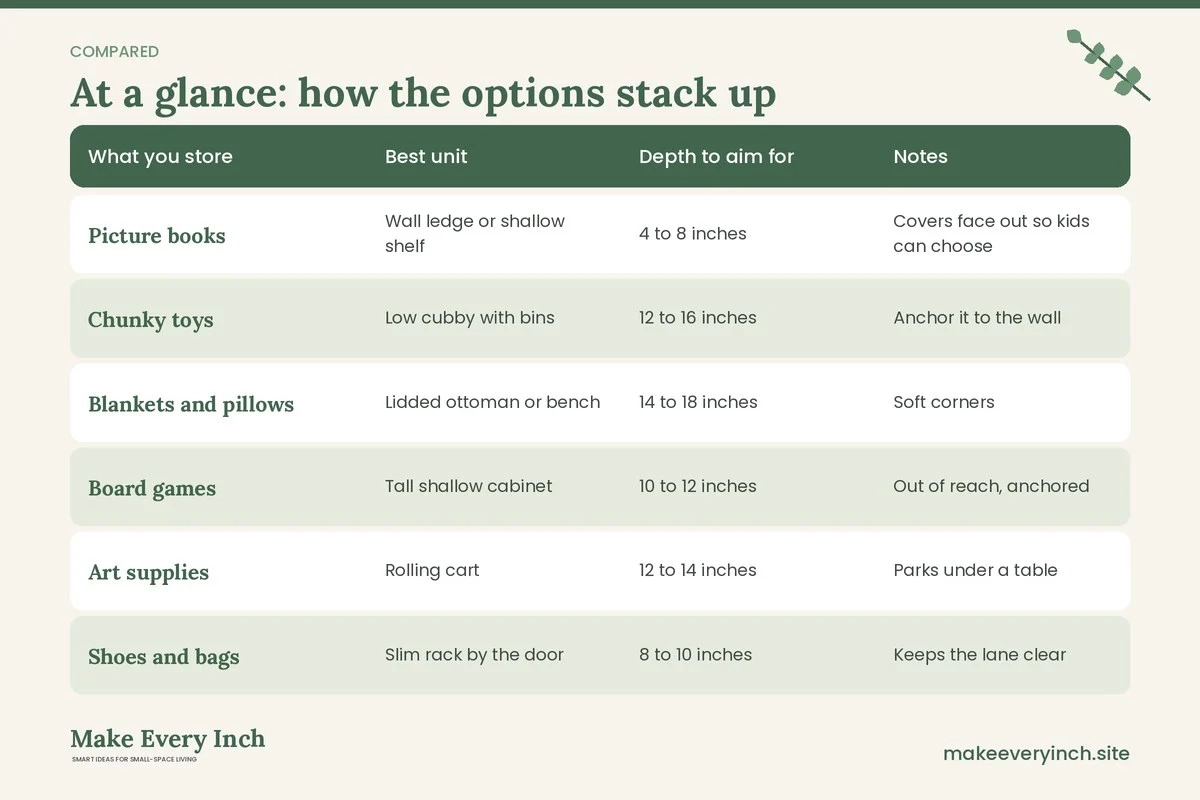
Storage depth table for a narrow family room
This table shows how deep storage should be for each type of family stuff. Aim for the shallowest depth that still holds the item, so you keep the lane wide.
| What you store | Best unit | Depth to aim for | Notes |
|---|---|---|---|
| Picture books | Wall ledge or shallow shelf | 4 to 8 inches | Covers face out so kids can choose |
| Chunky toys | Low cubby with bins | 12 to 16 inches | Anchor it to the wall |
| Blankets and pillows | Lidded ottoman or bench | 14 to 18 inches | Soft corners |
| Board games | Tall shallow cabinet | 10 to 12 inches | Out of reach, anchored |
| Art supplies | Rolling cart | 12 to 14 inches | Parks under a table |
| Shoes and bags | Slim rack by the door | 8 to 10 inches | Keeps the lane clear |
| Remotes and chargers | Console basket | 10 to 12 inches | High and out of reach |
Three example rooms for families
A room 8 feet wide and 14 feet long, with a toddler
At 96 inches wide, there is little room to spare. Put a 70-inch sofa of 32 inches deep on one long wall, which leaves 64 inches of floor. Keep a lane of 36 inches along the front, and use the remaining 28 inches for a low shelf of 14 inches on the opposite wall. Roll a 4 by 6 foot mat into the end of the room for play and roll it up at bedtime. A storage ottoman replaces the coffee table. This plan is tight, but it works for a young family that wants a safe floor.
A room 9 feet wide and 16 feet long, with two children
At 108 inches wide and 16 feet long, you can use zones. Put a 76-inch sofa on the long wall in the first 8 feet, with a console behind it if you float it. In the second half, put a rug of 5 by 8 feet and a low bench with baskets. A fold-away table sits against the wall for homework. Keep a lane of 36 inches on the open side. The children have a play end, and the adults have a sitting end.
A room 10 feet wide and 13 feet long, with a baby and a school-age child
At 120 inches wide, you have more freedom. Place the sofa on the short wall, aimed down the room at a wall-mounted TV. The lane runs along one long side. The baby plays on a 4 by 6 foot mat in the middle of the floor while the older child uses a small table by the window. Shelves along the opposite long wall hold toys and books at two heights. Mount the TV high so that it is out of reach.
Daily reset: keeping a thin room usable
A narrow family room has no hiding places, so a short daily routine matters more than a clever layout.
- The ten-minute tidy: before dinner, everyone puts toys back in their baskets. Turn it into a game or a song.
- The lane rule: nothing stays on the floor in the walkway overnight.
- Weekly rotation: swap the toys in the room for those stored away.
- Cord check: once a week, check for loose cords and for items that have drifted onto the lane.
- Seasonal edit: every few months, remove toys that no longer fit your children’s ages.
Making space for adults too
A family room should not be only a play space. Keep one corner for adults that is not toy-filled, such as a chair with a lamp and a small side table of 12 to 14 inches. If you share the room with a partner, read our companion guide on narrow living room ideas for couples for ideas about zones for two. For general layout principles, see small living room layout ideas and the furniture advice in small living room furniture ideas. A shelf for adult things, placed high and out of reach, keeps your own items safe.
Mistakes families make in narrow rooms
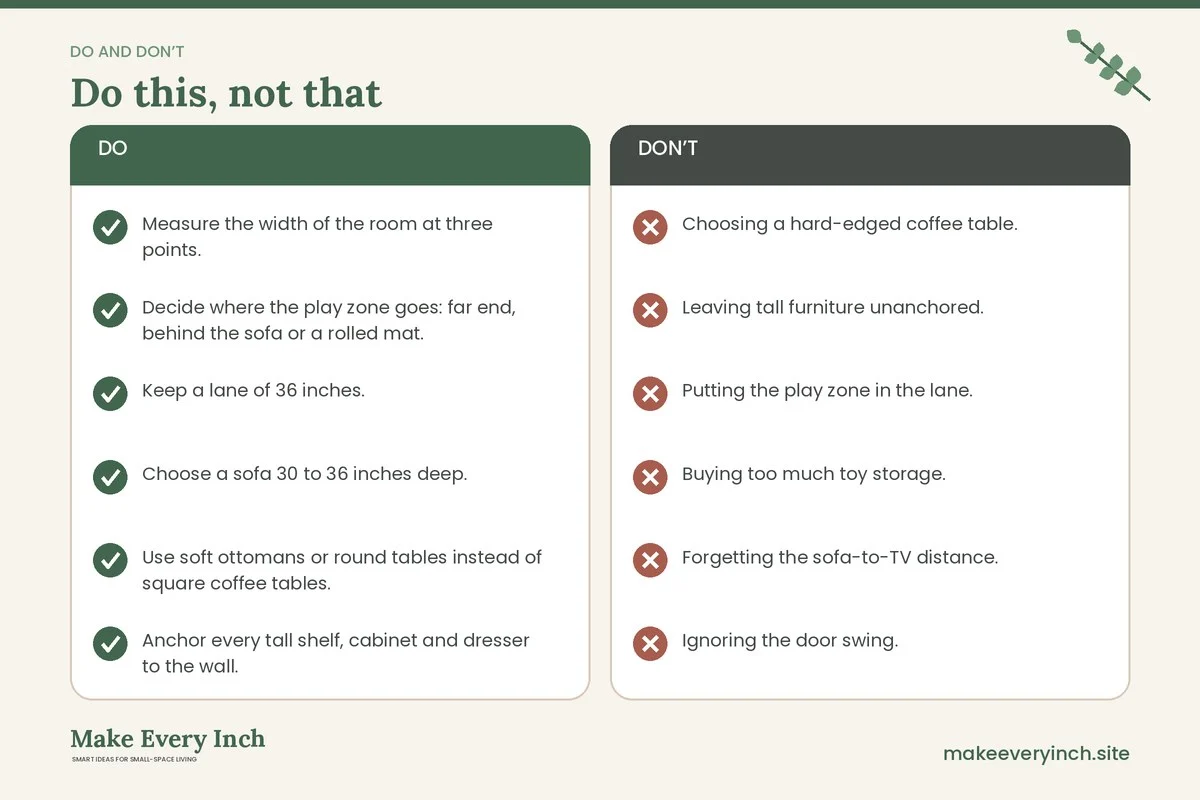
- Choosing a hard-edged coffee table. Corners at a child’s head height are a hazard. Use a soft ottoman or a round table.
- Leaving tall furniture unanchored. Children climb, and a narrow tall unit can tip. Fix it to the wall.
- Putting the play zone in the lane. Toys in the walkway cause trips. Move play to the end.
- Buying too much toy storage. Large boxes eat the width. Edit the toys instead.
- Forgetting the sofa-to-TV distance. A screen close to the sofa causes eye strain, so measure before you mount.
- Ignoring the door swing. A door that swings into the play zone is a risk.
- Using lamps on low tables. A child can pull a lamp over. Use floor lamps behind furniture or wall lights.
A shopping approach for a family on a tight floor plan
Begin with the pieces that set the width, which are the sofa and the storage, and measure each against your lane. Look for furniture that does two jobs, such as an ottoman with storage or a bench with baskets. Check that surfaces can be wiped, that fabrics can be washed and that corners are soft. Second-hand shops and online marketplaces often have shallow sofas and small shelves, but check each piece for stability and for the manufacturer’s anchoring points. Choose pieces light enough for one adult to move, since you will rearrange as the children grow. Before buying, tape the footprint on the floor and let the children walk through it, because they will find the pinch points before you do.
Family checklist
- Measure the width of the room at three points.
- Decide where the play zone goes: far end, behind the sofa or a rolled mat.
- Keep a lane of 36 inches.
- Choose a sofa 30 to 36 inches deep.
- Use soft ottomans or round tables instead of square coffee tables.
- Anchor every tall shelf, cabinet and dresser to the wall.
- Fix or strap the TV.
- Tidy cords and blind pulls out of reach.
- Add a non-slip rug pad.
- Store toys in baskets 12 to 16 inches deep.
- Put breakables on high shelves.
- Plan a ten-minute tidy before dinner.
- Keep the first 36 inches inside the door clear.
FAQ
How do I fit a play area in a narrow living room?
Use the far end of the room for a rug or a roll-up mat of 4 by 6 or 5 by 8 feet, and keep the lane clear along the sofa. In a room 8 feet wide, a mat that rolls up each night is more realistic than a permanent play zone.
How wide should the walkway be in a family living room?
Aim for 36 inches, which allows a parent carrying a child or a basket to pass. A lane of 30 inches is the minimum for adults without a load.
What is the safest coffee table for a narrow family room?
A soft ottoman, a round table or a table with rounded corners. You can also skip the table and use a tray on an ottoman.
Is it necessary to anchor furniture to the wall?
It is a sensible precaution for any piece taller than about 30 inches, especially bookcases, dressers and cabinets, since children climb. Use the hardware that comes with the piece, and ask your landlord before drilling if you rent.
How can I store toys without losing floor space?
Use low shelves of 12 to 16 inches deep, lidded benches, under-sofa bins and wall shelves for books. Rotate toys so that only a third are out at once.
Should the sofa face the length or the width of a narrow room?
Facing the length leaves the room feeling like a tunnel but keeps the sofa-to-TV distance comfortable, while facing the width keeps the sofa along the long wall and leaves a lane in front. In most family rooms the long wall is better, since it leaves play space at the end.
Keep going: Keep planning with our small living room storage ideas, small living room ideas for renters and narrow hallway ideas.
Save this guide for later
Pin the ideas you like to Pinterest so you can come back to them when you plan your space.