Small Living Room Makeover Ideas for Families: A Phased Plan for Safe, Durable Rooms
Quick answer: The best small living room makeover ideas for families work in phases. Start with safety and decluttering, then fix the layout so kids have a clear play zone, choose washable and durable finishes, anchor every tall piece, and add storage that children can reach themselves. Finish with lighting, textiles and styling. Spread the work over four weeks so the room stays usable the whole time.
Small living room makeover ideas for families have to do something that most makeover advice ignores: they must still work on a Tuesday evening when someone has spilled juice, someone else has dumped a box of blocks and a third person needs somewhere to sit. A family room is a stage, a playground, a homework corner and a movie theater all at once, and in a small space every one of those jobs competes for the same few square feet. This guide is a step-by-step makeover plan built around that reality. It covers the safety walk-through, the order of operations, measurements for play and walking space, a durability table, three example rooms, a four-week schedule, mistakes to avoid and a checklist. For the wider topic, read our main guide on small living room makeover ideas, the pillar on small living room ideas and the layout companion on small living room layout ideas.
Small living room makeover ideas for families work best in phases
A family cannot move out of the living room for a week, so the classic “rip everything out and start again” makeover rarely fits. Instead, plan the project in phases. Each phase is small enough to finish in a few evenings, leaves the room safe at the end and delivers a visible improvement. If life gets busy, you can pause between phases without living in a construction zone.
A good phased order for a family looks like this: safety and declutter first, layout second, surfaces and paint third, furniture fourth, lighting fifth, textiles sixth and styling last. The order matters. Declutter before you buy anything, because you cannot size storage until you know what must be stored. Settle the layout before you paint, because the layout decides which wall becomes the feature and where the lamps go. Choose furniture before textiles, because the sofa fabric will drive the colors of the rug and cushions. Style last, because it is the part that makes the room feel finished and the part that is easiest to redo.
Before and after thinking helps. Take photos of the room from the doorway and from the sofa, and write down three things that annoy you most. For most families the list reads something like “no place for toys,” “the sofa swallows the room” and “it is too dark in the evening.” Those three complaints become the brief for the makeover. If a purchase does not solve one of the three, it can wait.
Phase one: the safety walk-through
Safety comes first because it is cheaper and faster to prevent a problem than to fix it, and because several of the best safety steps are also design steps.
Get down to a child’s eye level and crawl the room, or at least look at it from the floor. You will notice cords that dangle within reach, sharp table corners at head height, loose rug edges, small objects under the sofa and shelves that look climbable. Make a note of each one.
- Anchor tall furniture. Bookcases, dressers, media units and tall shelving can tip if a child climbs them. Use the anchoring hardware that comes with the piece, or a generic wall anchor kit, and fix the unit to a stud or a suitable wall anchor. Anchoring also applies to a TV on a stand. If you rent, check the lease first and ask the landlord about small fixings, or choose lower pieces that are less of a tipping risk.
- Manage cords. Window blind cords, lamp cords and charger cables are risks for small children. Use cordless blinds where possible, tuck lamp cords behind furniture and use cord covers or clips along baseboards.
- Round or pad the corners. Replace sharp-cornered coffee tables with a round or oval table, a soft ottoman or a low storage bench. Corner guards are a short-term option while children are at the crawling and early walking stage.
- Check electrical outlets and power strips. Use outlet covers in rooms with toddlers, keep power strips out of reach and never run cords under rugs. Do not overload an outlet when you add lamps, a charging station and a TV. If an outlet feels warm or a plug is loose, stop using it and have an electrician look at it.
- Check windows and heating. Keep furniture away from windows that open, since a child could climb up. Keep cushions and curtains clear of radiators and heaters.
- Look at small objects. Coins, batteries, magnets and small toy parts belong on high shelves or in lidded boxes. Button batteries in remotes deserve a special check, so make sure the battery compartment is closed.
These are general home safety habits, and they are not a substitute for official guidance for your child’s age. If you are unsure about a product’s suitability, read the manufacturer’s instructions and consult trusted child safety guidance.
Phase two: declutter with a family system
Decluttering a family room is different from decluttering a single adult’s room because there are more people with more opinions. The goal is a system that the whole household can follow, not a one-time purge.
Start with the toy mountain. Empty every bin and group the toys into three piles: loved and used weekly, occasional, and outgrown or broken. Keep the first pile in the living room, store the second elsewhere in a closet or under a bed, and donate or recycle the third. A rotation system works well. Keep about half of the toys out of sight and swap them every few weeks, and children often greet the swap as if the toys were new.
Next, tackle the paper and the gadgets. Homework, school notices, mail and art projects pile up fast. Give each family member a flat file box or a tray, and set a weekly time to sort them. Chargers and devices get a single charging station, ideally on a shelf out of reach of small children.
Finally, check the furniture itself. Is every piece earning its place? A chair that nobody sits in, a side table that holds only clutter and a TV stand with three empty shelves can all go. Removing a single piece can give you more usable floor than any storage idea. For a deeper process, take a look at our guide to small apartment decluttering ideas.
Phase three: fix the layout and make a play zone
The layout is where a small family room is won or lost. The aim is to keep a clear central floor for play and to give adults a seat that does not block it.
Measurements to plan around
- Main walkway: 30 to 36 inches wide so adults can carry laundry or a toddler without turning sideways.
- Open play area: at least 4 by 5 feet of uninterrupted floor for babies and toddlers, or about 5 by 6 feet for older children who build and sprawl. In a very small room, a hedged range of 3 by 4 feet can still work if the rest of the floor stays clear.
- Sofa to TV: 7 to 9 feet is usual for a small room, but any distance that avoids neck strain is fine. A shorter distance works if the screen is modest.
- Coffee table gap: 14 to 18 inches between the sofa and the coffee table for adults. In a family room, consider 18 to 20 inches so little legs can pass.
- Storage reach: keep everyday kids’ items between about 12 and 36 inches off the floor, depending on age, so children can reach and return things alone.
- Rug size: an area rug of 5 by 8 feet is a common choice for a compact room, with at least the front legs of the sofa on it.
Layout moves that make space for kids
Push the main seating to the perimeter and let the floor be the play area. A sofa along the longest wall, an armchair or two floor cushions at an angle and a slim storage bench under the window leave the center open. Avoid placing furniture in the middle of the room, because that creates islands that children run around.
Replace the traditional coffee table with a soft ottoman or a low, rounded table that doubles as a play surface. If you prefer to skip the table, our guide to small living room ideas without a coffee table shows how. If your family likes to lounge together, a sectional can create a cozy pit, and our post on small living room ideas with a sectional covers the sizes that fit.
Phase four: paint and surfaces that survive family life
Paint is one of the cheapest changes, and in a family room it also has to take a beating. Choose a washable finish such as satin or eggshell, which wipes clean better than flat paint. Light and mid tones hide fingerprints better than very dark ones, and a lower wall in a slightly deeper shade can hide scuffs at child height. A painted wainscot or a wallpaper-free dado line can protect the area where chairs and toys bump the wall.
Paint safety matters, especially around children. Choose a low-VOC or zero-VOC paint, which has fewer fumes. Ventilate well: open windows, run a fan and keep the room aired during painting and while the paint cures. Keep children and pets out of the room while you paint, and let the walls dry fully before you move the family back in. If someone in the household has asthma or a sensitivity, extend the airing time. Read the label for drying and curing times. Test any finish on a hidden spot first, and if your home was built before modern lead paint rules, use caution when sanding old paint and seek professional advice before disturbing it.
For flooring, a low-pile or flat-weave rug is easier to vacuum and less likely to trap crumbs than a shaggy one. Add a non-slip rug pad to stop the rug from sliding. A rug that is machine-washable or made of a forgiving, patterned weave hides stains. A hard-wearing performance fabric on the sofa, or a washable slipcover, saves a lot of worry. In a rental, peel-and-stick or removable solutions need a lease check first, and our guide to renter friendly apartment decorating ideas lists options that leave no trace.
Phase five: furniture that fits a family
When you choose furniture, think about three questions: can a child hurt themselves on it, can it survive a spill, and does it store things?
- Sofa: pick a sofa with a firm seat, rounded arms and a fabric that can be wiped or washed. A slipcover that goes in the washing machine is the practical choice for most families. A sofa with a low back is easier to scale than a deep, tall one in a small room.
- Coffee table or ottoman: choose a storage ottoman or a rounded table. A table with lower shelves is useful for books and puzzles.
- Media unit: a low unit is safer and keeps the TV near eye level when seated. Anchor the unit and the TV to the wall.
- Storage: look for open cubes at kid height and closed cabinets higher up for adult items. Bins with handles are easier for small hands.
- Seating extras: a pair of poufs or floor cushions gives seats for visiting children and stores under a console when not in use.
For more on choosing pieces that fit, read our guide to small living room furniture ideas.
An anchoring note: any piece taller than about 30 inches, including bookcases, cabinets, shelves and display units, should be secured to the wall, particularly in a home with climbing children. Fill the top shelves with light items and the bottom shelves with heavier ones to keep the center of gravity low.
Phase six: storage children can use
A family living room lives or dies by its storage. The best systems are simple enough that a four-year-old can follow them.
- Open bins at floor level. A row of fabric or woven bins on a low shelf lets children toss toys in without sorting. Label them with pictures for non-readers.
- A storage bench by the door or window. Inside it go blankets, board games or seasonal toys. Choose a lid with a slow-close hinge or a lift-off top to protect fingers.
- Wall-mounted shelves above reach. Store breakables, craft supplies and adult items higher up. In a rental, check the lease before drilling, or use the ideas in our post on no-drill storage ideas for renters.
- A rotating toy basket. Keep one basket in the room and refill it from the closet every few weeks.
- A shoe and bag drop. If the front door opens into the living room, a small station for shoes and school bags prevents a pile in the middle of the floor. See our post on small entryway organization for ideas.
Our broader guide to small living room storage ideas has more options for every inch.
Phase seven: lighting that works for homework and bedtime
Family rooms need layers of light. Overhead light is for cleaning and active play, lamps are for evenings and reading, and a small task light is for homework. Choose warm bulbs of about 2700 kelvin for evenings and a brighter, slightly cooler bulb for the task spot.
Place lamps where children cannot pull them over. A wall-mounted or plug-in sconce keeps floor space clear, and a heavy-based lamp is more stable than a lightweight one. Run cords behind furniture and secure them. Do not use extension cords as a permanent solution, and check that bulbs do not exceed the lamp’s rated wattage. Dimmers and smart plugs make it easy to lower the light at bedtime. For more ideas, read our guide to small living room lighting ideas.
Phase eight: textiles and styling
Textiles are the final layer and the most forgiving one. Choose washable throws and cushion covers with zippers, and avoid delicate trims that small hands pull off. Curtains should be cordless or have a safe tie-back, and they should hang high and wide to make the window look bigger. Patterned fabrics hide stains better than plain light ones, and mid-tone colors are forgiving.
Styling is where the room feels like yours. Put a few of the family’s favorite things on display: framed kids’ art on a ledge, a plant that is safe if nibbled, a tray of books and a basket for blankets. Check that any plant is non-toxic for children and pets before bringing it in. Keep breakables out of reach and keep the surfaces that children can reach mostly empty. For a cozier feel, borrow ideas from our post on cozy small living room ideas.
A durability table for common choices
This table compares family-friendly options for the surfaces that take the most wear. It is a general guide, and the right choice depends on your household.
| Item | Family-friendly choice | Why it works | Watch out for |
|---|---|---|---|
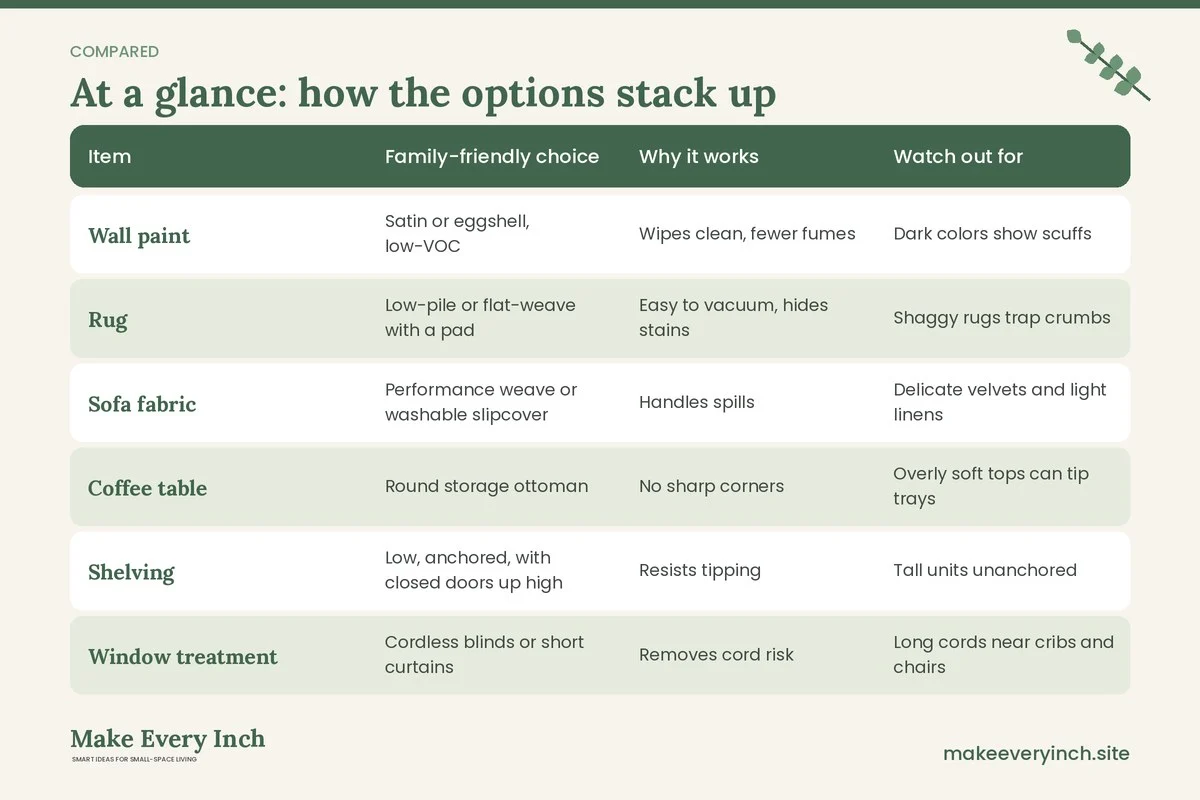
| Wall paint | Satin or eggshell, low-VOC | Wipes clean, fewer fumes | Dark colors show scuffs |
| Rug | Low-pile or flat-weave with a pad | Easy to vacuum, hides stains | Shaggy rugs trap crumbs |
| Sofa fabric | Performance weave or washable slipcover | Handles spills | Delicate velvets and light linens |
| Coffee table | Round storage ottoman | No sharp corners | Overly soft tops can tip trays |
| Shelving | Low, anchored, with closed doors up high | Resists tipping | Tall units unanchored |
| Window treatment | Cordless blinds or short curtains | Removes cord risk | Long cords near cribs and chairs |
| Lighting | Wall sconces or heavy-based lamps | Keeps cords and floors clear | Lightweight lamps that tip |
Three example family rooms
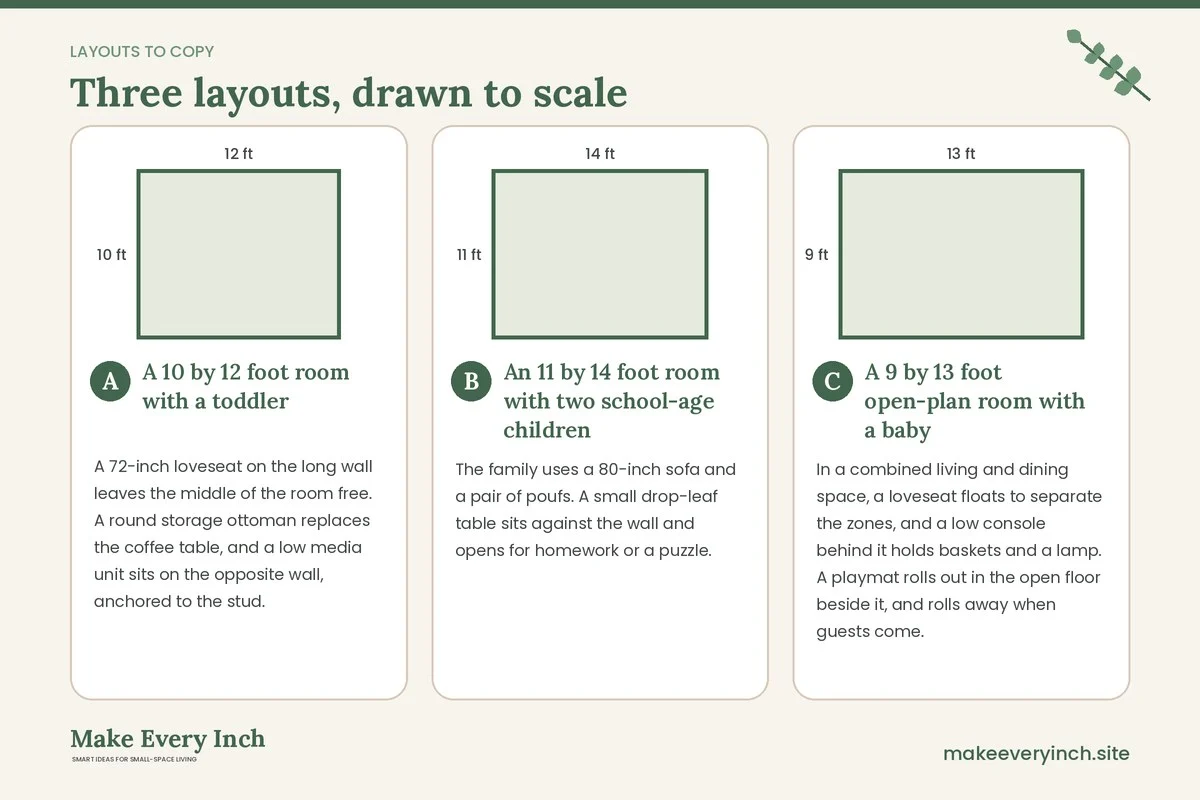
A 10 by 12 foot room with a toddler
A 72-inch loveseat on the long wall leaves the middle of the room free. A round storage ottoman replaces the coffee table, and a low media unit sits on the opposite wall, anchored to the stud. A 5 by 8 foot flat-weave rug with a pad gives soft ground for play. Toy bins live on a low shelf under the window, and a high shelf holds adult items. The cords are tucked behind the media unit, and the lamps are plug-in sconces. The walkway is 34 inches, and the open play area is about 4 by 5 feet.
An 11 by 14 foot room with two school-age children
The family uses a 80-inch sofa and a pair of poufs. A small drop-leaf table sits against the wall and opens for homework or a puzzle. A bookcase of 48 inches is anchored to the wall and holds books in the lower half and display items above. A 5 by 8 foot rug runs under the front legs of the sofa. An open play area of about 5 by 6 feet stays clear, and the children store their art supplies in a lidded bench. A wall-mounted light over the table doubles as the homework lamp.
A 9 by 13 foot open-plan room with a baby
In a combined living and dining space, a loveseat floats to separate the zones, and a low console behind it holds baskets and a lamp. A playmat rolls out in the open floor beside it, and rolls away when guests come. Cordless blinds and softly padded corners keep the room safe, and the storage ottoman holds blankets and soft toys. The walkway is 32 inches, and the playmat zone is about 4 by 4 feet. This room works because everything moves, and nothing is bolted into the middle.
A four-week makeover schedule
This schedule suits a family with limited time. Each week has a theme, a short task list and a clear end point.
Week one: safety and declutter
Do the crawl-through. Anchor tall furniture, tidy cords and fit corner guards or outlet covers as needed. Sort toys into three piles, clear the paper, and donate or recycle what you do not need. By Sunday the room should be safer and lighter, even before you buy anything.
Week two: layout and paint
Measure the room and tape out the new layout on the floor. Live with it for two days. Then paint, with the windows open and the children out of the room, and let it dry and air fully. Move the furniture back in the new layout.
Week three: furniture and storage
Bring in or swap the key pieces: sofa cover, ottoman, shelf and bins. Set up the toy rotation and the shoe drop. Label the bins with pictures. Check that everything tall is anchored.
Week four: lighting, textiles and styling
Add lamps and sconces, then hang curtains and place the rug with a pad. Finish with cushions, throws, a plant, framed art and a basket. Take an after photo from the same two spots as the before photos and compare. If you only have a weekend, do weeks one and two on Saturday and weeks three and four on Sunday, accepting a lighter touch.
Mistakes families make
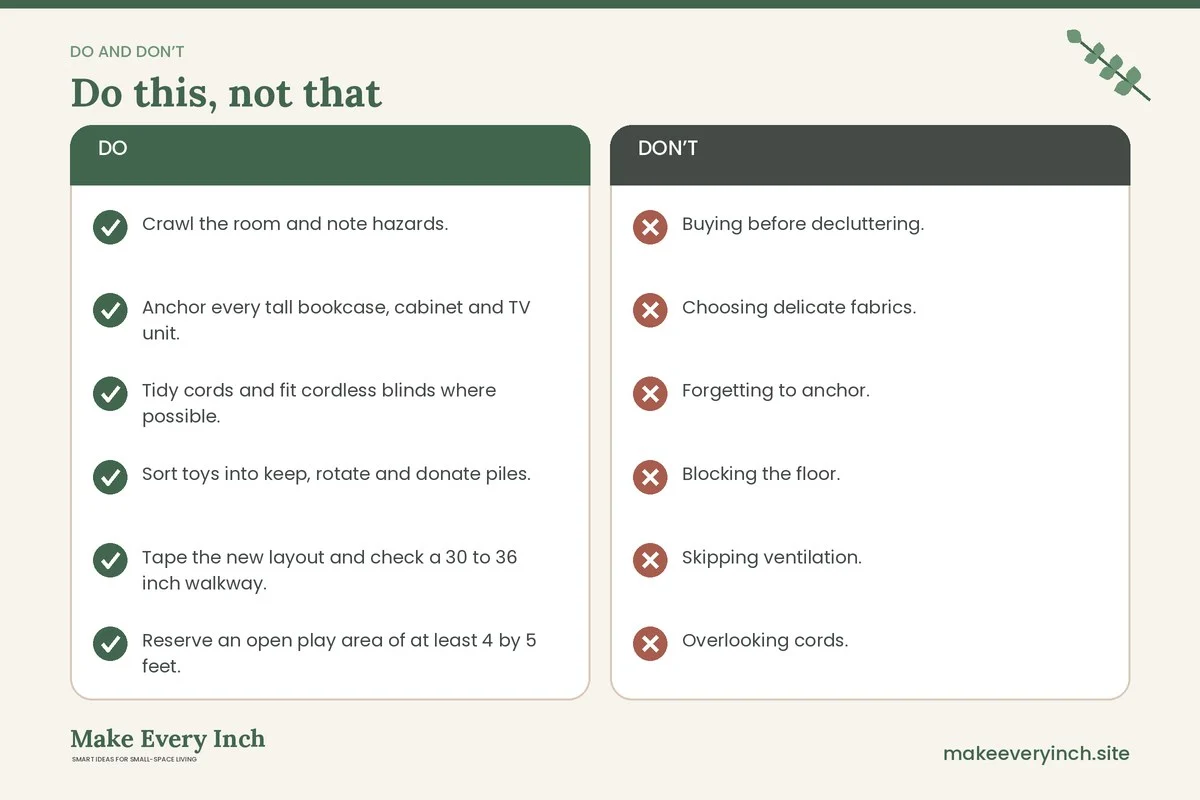
- Buying before decluttering. You end up with storage that does not fit the stuff.
- Choosing delicate fabrics. Pale linen and velvet are beautiful, but they may not survive a juice cup.
- Forgetting to anchor. A tall bookcase is a tipping risk, and anchoring takes about ten minutes.
- Blocking the floor. Pieces in the middle of the room leave no play space.
- Skipping ventilation. Fresh paint needs air, and children should stay out until the room has aired.
- Overlooking cords. Cords near cribs, chairs and play areas are an easy fix and an important one.
- Doing everything at once. A phased plan lets you adjust as you learn how your family uses the room.
Family makeover checklist
- Crawl the room and note hazards.
- Anchor every tall bookcase, cabinet and TV unit.
- Tidy cords and fit cordless blinds where possible.
- Sort toys into keep, rotate and donate piles.
- Tape the new layout and check a 30 to 36 inch walkway.
- Reserve an open play area of at least 4 by 5 feet.
- Choose a washable paint finish and ventilate well.
- Pick a low-pile rug with a non-slip pad.
- Choose a washable sofa fabric or slipcover.
- Replace sharp-cornered tables with round or soft ones.
- Add storage at child height and closed storage up high.
- Layer lamps, a task light and warm bulbs.
- Add washable textiles and non-toxic plants.
- Take before and after photos.
FAQ
How do I start a small living room makeover with kids at home?
Begin with a safety walk-through and a declutter. Then work in short phases so the room stays usable. Do the messy jobs, such as painting, while children are elsewhere.
What is the safest way to make a small living room kid-friendly?
Anchor tall furniture, hide or shorten cords, choose rounded corners and keep small objects out of reach. Follow manufacturer guidance and trusted child safety advice for your child’s age.
Which paint is best for a family living room?
A washable satin or eggshell finish in a low-VOC formula is a common choice. Ventilate well while painting and while the paint cures, and keep children and pets out of the room until it is dry.
How much play space does a small living room need?
Aim for an open area of about 4 by 5 feet for toddlers and a little more for older children, while keeping a 30 to 36 inch walkway. In very tight rooms, a playmat that rolls away can do the job.
What furniture works best for a family in a small living room?
Furniture that is rounded, washable, anchored and equipped with storage: a storage ottoman, a slipcovered sofa, a low media unit and bins at child height.
Can I do this in a rental?
Yes. Use freestanding storage, removable fixings agreed with your landlord and washable textiles. Check the lease before painting or drilling.
Keep going: Keep planning with our small living room storage ideas, small living room ideas for renters and small living room lighting ideas.
Save this guide for later
Pin the ideas you like to Pinterest so you can come back to them when you plan your space.