23 Small Apartment Makeover on a Budget Ideas That Work
Quick answer: A small apartment makeover on a budget works best in this order: declutter and rearrange for free, fix lighting, add textiles (curtains, rug, bedding), then paint or swap hardware if your lease allows, and only then buy furniture. Spend on what you touch and see every day, buy secondhand for anything solid, and photograph the apartment before you change anything.
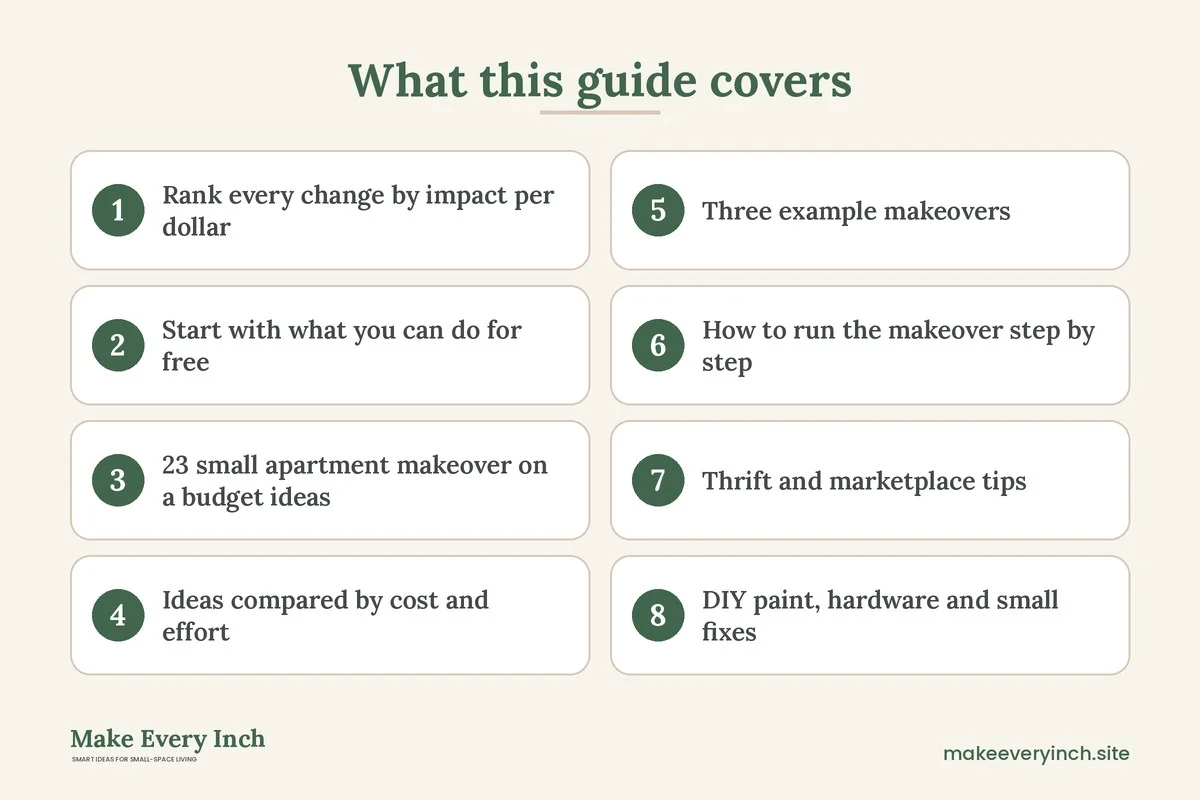
A small apartment makeover on a budget is mostly a question of order. Most people start by shopping for a sofa or a rug, and they run out of money before the room feels different. The cheaper path is to change what the eye notices first (light, color, clutter), then what the body notices (soft surfaces, seating), and leave big furniture for last. This guide ranks changes by impact per dollar, lays out three plans at about $250, $750 and $1,500, and gives itemized sample budgets with honest price ranges. It also covers free changes, thrift and marketplace buying, DIY paint and hardware, renter-safe options, room-by-room advice, a four-weekend timeline and the mistakes that waste the most money. If you are starting from the walls, our guide to renter friendly apartment decorating ideas pairs well with this one.
Rank every change by impact per dollar
Before you spend anything, sort the possible changes into four groups. The first group is free: moving furniture, removing clutter, cleaning windows and rehanging what you already own. The second is under $50 per item: bulbs, lamp shades, pillow covers, cabinet knobs, a plant, a mirror from a thrift store. The third is $50 to $200 per item: curtains, a rug, bedding, a secondhand chair, a bookcase, a gallon of paint. The fourth is anything above that, such as a sofa, a bed frame or a dining set, and those purchases are usually the ones to delay.
In a small apartment the first two groups do most of the work. A cluttered room looks smaller and cheaper than it is, and harsh overhead light flattens every surface. Fixing those two things often changes a room more than a $400 purchase would. Prices in this guide are typical ranges for the US and vary by city, season and store, so treat them as planning numbers and check current prices before you buy.
Start with what you can do for free
Take photos and make a measured sketch
Photograph every room from the doorway and from the opposite corner. These pictures serve two jobs: they show you what you actually see when you walk in, and they are your lease record if you later paint or hang anything. Then measure each room, the windows and the largest furniture, and sketch a simple plan on paper. A sketch costs nothing and prevents the most expensive mistake, which is buying something that does not fit.
Decide on a short palette
Choose three colors before you shop: one light base, one mid tone and one accent. Write them down, or take a photo of paint chips or fabric you like. Every purchase then has to match at least two of the three. A short palette makes thrifted pieces look like a set, and it keeps you from collecting random items that fight each other.
23 small apartment makeover on a budget ideas
Free changes
1. Rearrange before you buy anything
Pull furniture away from the walls an inch or two, float the sofa if the room allows it, and try the bed on a different wall. Move one piece at a time and live with it for a day. A new arrangement can open a walkway or reveal a window you had been blocking.
2. Declutter surfaces and floors
Clear everything off the top of the dresser, the counters and the table, then return only what you use daily. Box the rest and store it under the bed or in a closet for two weeks. Anything you did not reach for can be sold or donated, which often raises $50 to $200 toward your makeover.
3. Shop your own home
Move a lamp from the bedroom to the living room, swap pillows between rooms, and use a scarf or a quilt as a throw. Frames from a drawer can be spray cleaned and refilled with new prints. Treat your own belongings like a thrift store you can visit for free.
4. Clean the windows and the light fixtures
Dirty glass and dusty shades can cut the daylight in a small room noticeably. Wash the windows inside, wipe the sills, and take the covers off ceiling fixtures to remove dead insects and dust. It takes an hour and costs almost nothing.
Lighting
5. Replace bulbs with warm, matching ones
Choose LED bulbs labeled 2700K for living areas and bedrooms, and use the same color temperature everywhere so the rooms look consistent. Expect to pay about $2 to $5 per bulb in multipacks. Check that each bulb fits the fixture’s maximum wattage rating, which is printed on the socket.
6. Add lamps at three heights
Most rentals have one ceiling light, which makes a room feel flat in the evening. Add a table lamp, a floor lamp and a small accent light, and turn the overhead off at night. Secondhand lamps often cost $8 to $25, and a new shade can make an old base look current. See renter friendly lighting ideas for plug-in sconces and other no-wiring options.
Paint and hardware
7. Paint one wall or one piece of furniture
If your lease allows paint, a single accent wall or a repainted bookcase costs about $35 to $70 for a gallon plus supplies. Pick a color that sits in your palette, and use tape and a small roller for clean edges. If paint is banned, repaint a thrifted dresser instead, since it moves with you.
8. Swap cabinet and drawer hardware
New knobs or pulls change a kitchen, a bathroom vanity or a dresser for roughly $2 to $6 per piece. Keep the old hardware in a labeled bag, and put it back before you move out. Measure the hole spacing first, because pulls need to match it exactly.
9. Use peel-and-stick tile or wallpaper in one small area
A backsplash strip behind the sink or a panel behind a desk is manageable and visible. Test a corner and check the lease, because adhesive can lift paint from some walls. See removable wallpaper ideas and temporary backsplash ideas for how to apply and remove each safely.
Textiles
10. Hang curtains high and wide
Mount the rod 4 to 6 inches above the window frame, or near the ceiling, and let the panels extend a few inches past each side. This makes windows and ceilings look larger, and it hides awkward blinds. Panels in a light, simple fabric usually cost $20 to $50 each, and tension rods avoid drilling.
11. Buy a rug large enough to anchor furniture
A rug that is too small makes a room look chopped up. In a living room, the front legs of the sofa and chairs should sit on the rug, and a 5 by 8 foot size is a common minimum. Secondhand and clearance rugs often run $60 to $200, and a flat weave is easier to clean.
12. Refresh bedding and pillows
New bedding is the quickest way to change a bedroom. A duvet cover and pillowcases in your palette run about $40 to $90, and pillow covers for the sofa are $8 to $15 each. Covers are cheaper than new inserts, and they wash easily.
13. Throw a slipcover or a large cloth over tired seating
A fitted slipcover can hide a stained or mismatched sofa for about $50 to $120. A large throw in a solid color works for a smaller fix. Choose a fabric with some texture so the sofa looks intentional instead of covered.
Furniture and storage
14. Buy one good secondhand piece
Look for solid wood dressers, side tables and bookcases, which often cost $30 to $150 secondhand and last longer than flat-pack at the same price. Open drawers, check that they slide, look for a musty smell and test for wobble before paying. Heavy pieces can be sanded and repainted if the finish is worn.
15. Use a bookcase as storage and a room divider
A bookcase placed at an angle or against a wall adds storage without taking much floor. Anchor tall pieces to the wall if the lease allows, or choose a low unit that cannot tip easily. Our guide to vertical storage ideas shows more ways to use height.
16. Add storage that doubles as seating or a table
An ottoman with a lid, a bench with baskets or a trunk used as a coffee table hides clutter and seats guests. Expect $40 to $120 depending on size and material. See small space storage furniture for more pieces that work twice.
Walls and decor
17. Hang one oversized piece instead of many small ones
One large print or canvas looks calmer and more expensive than six small frames. Print a large poster at a copy shop for roughly $10 to $30, add a frame from a thrift store, and lean it or hang it with strips rated for its weight. See renter friendly wall decor ideas for hanging methods.
18. Use mirrors to bounce light
A large mirror opposite or beside a window brightens a room and makes it look deeper. Secondhand floor mirrors are often $25 to $90, and leaning one against a wall needs no hardware. Keep a leaning mirror stable on a non-slip pad, and secure it if there are children or pets.
19. Bring in plants, real or convincing
Two or three plants in matching pots add life for $10 to $40 total. Pothos, snake plant and ZZ plant tolerate low light and missed waterings. If you cannot keep plants alive, use good faux stems and group them in odd numbers.
Renter-safe upgrades
20. Replace or cover the dated shades and light covers
A plug-in or battery light and a paper shade can disguise a bare bulb or a dated fixture. Never replace a hardwired fixture without permission, and keep the original to reinstall at move-out. See security deposit safe apartment upgrades for reversible changes.
21. Cover the floor you dislike
Peel-and-stick floor tiles can hide worn vinyl in a small kitchen or bath, but they may bond to the floor, so test a hidden area and check the lease. A large rug is the reversible alternative. Keep rug pads under any rug to prevent slipping.
22. Create an entry with a hook and a tray
A row of hooks on an adhesive rail, a tray for keys and a small mat make the front door feel organized. Total cost is often $25 to $60. Our small entryway ideas guide covers rentals with no entry at all.
23. Add a focal point with a temporary headboard or a freestanding screen
A fabric headboard leaned on the wall, or a folding screen behind a sofa, gives the room a focal point without paint. Use a staple-free fabric wrap or clips to keep it removable. Prices are about $30 to $100 for materials.
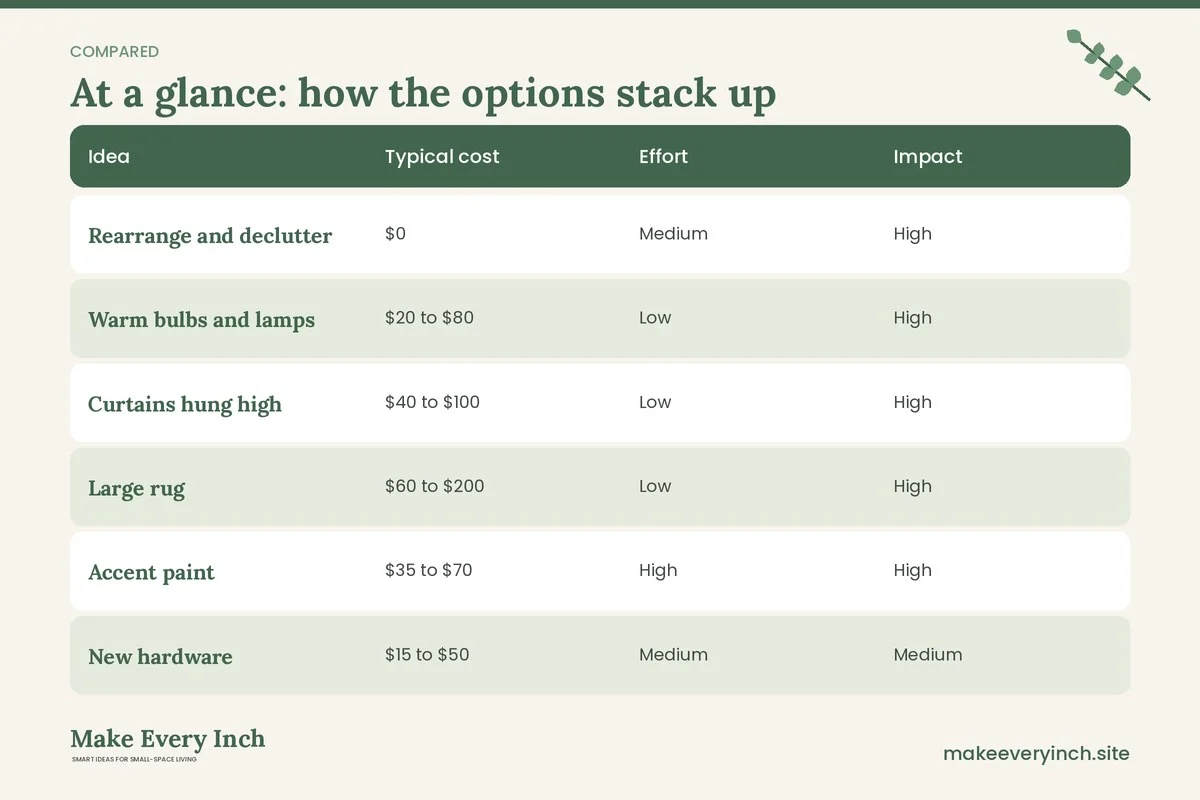
Ideas compared by cost and effort
| Idea | Typical cost | Effort | Impact | Renter safe |
|---|---|---|---|---|
| Rearrange and declutter | $0 | Medium | High | Yes |
| Warm bulbs and lamps | $20 to $80 | Low | High | Yes |
| Curtains hung high | $40 to $100 | Low | High | Yes |
| Large rug | $60 to $200 | Low | High | Yes |
| Accent paint | $35 to $70 | High | High | Needs permission |
| New hardware | $15 to $50 | Medium | Medium | Yes, keep originals |
| Secondhand dresser or chair | $30 to $150 | Medium | Medium | Yes |
| Peel-and-stick tile | $30 to $100 | High | Medium | Test first |
| Plants and pots | $10 to $40 | Low | Medium | Yes |
| New sofa | $500 and up | Low | Medium | Yes |
Three example makeovers
A studio with one big room, $250
A studio renter had a bed, a sofa and a table all in one space. She moved the bed to the quiet corner, set a bookcase beside it as a half wall, and cleared the counters. She spent about $20 on matching bulbs, $30 on two thrifted lamps, $45 on curtains hung close to the ceiling and $35 on pillow covers and a throw. The remaining money went to a framed poster and a plant. The space now reads as zones, and nothing she bought has to be left behind.
A one bedroom with tired rental finishes, $750
A couple had beige walls, builder-grade fixtures and a sofa that clashed with everything. They got permission to paint the living room wall behind the sofa, spent about $75 on paint and supplies, and put $120 into a 5 by 8 rug. A slipcover cost about $90, two lamps $60, curtains $70 and a large mirror $60. New knobs for the kitchen cabinets cost about $30. The rest bought a secondhand side table and prints.
A two bedroom with a family, $1,500
A family used a large budget to solve storage first. They bought a bench with baskets for the entry, a bookcase for the living room and under-bed bins for the kids’ rooms, and they decluttered before buying. Paint in two rooms, a new rug and bedding came next. They kept a small reserve for surprises, which turned out to be a lamp that did not fit its shade. The reserve covered it without stress.
How to run the makeover step by step
Step 1: Set the budget and the reserve
Decide the total, then hold back 10 percent as a reserve. Write each planned purchase with a low and high price. Track receipts in a note on your phone, and update your total after each purchase, so you know when to stop.
Step 2: Order the work
Do cleaning and decluttering first, then painting, then lighting, then big textiles, then furniture and finally small decor. Doing it in this order prevents you from buying decor for a room that is still changing. Painting always comes before hanging anything on the walls.
Step 3: Shop in a loop
Visit thrift stores and online marketplaces weekly, with your measurements and palette in your phone. Check the sold prices on similar items so you know what a fair price is. Offer 10 to 20 percent below the asking price on marketplace listings, and be ready to pick up the same day.
Step 4: Inspect and clean secondhand finds
Check upholstered pieces for smells, stains and bed bugs, which show up as small dark spots in seams. Wash fabrics on a hot cycle when the label permits. Wipe wood with a mild soap solution, and let it dry fully before painting or oiling.
Step 5: Photograph and record
Take after photos in the same spots as the before ones. Keep the originals of anything you replaced, such as hardware or shades, in a labeled box for move-out.
Thrift and marketplace tips
Go early in the week for thrift stores, since weekend stock is picked over. Look for furniture with solid wood and dovetail joints, brass or metal lamps, and glass or ceramic items that clean easily. Search online listings with several words, such as “dresser,” “chest” and “bureau,” because sellers use different terms. Meet in a public place for pickups, bring a friend for heavy items, and measure stairwells and doors before you buy. Skip upholstered pieces with strong odors, particleboard that has swollen from moisture and anything you cannot clean. Resale shops and end-of-season clearance sections at big retailers can also be good for rugs, lamps and bedding.
DIY paint, hardware and small fixes
Paint
Use a quality primer on glossy or dark surfaces, and cut in along edges with painter’s tape pressed down firmly. Two thin coats are better than one thick one. Ventilate the room, and keep paint away from heaters and pilot lights. For rentals, ask the landlord first, and keep the paint name and color in case you must restore the original.
Hardware and fixtures
Replace knobs with a screwdriver, and match the hole spacing in millimeters or inches. Switch plates cost about $1 to $5 each and can be changed without touching wiring, though you should switch off the breaker if you are unsure. Do not alter electrical fixtures or plumbing unless the lease and local rules allow it and you are qualified.
Small repairs
Fill small nail holes with spackle, sand lightly and touch up the paint. Caulk the tub or sink edge if it has gone gray, which costs around $6 to $10 for a tube. These tiny fixes make a rental look cared for, and they protect your deposit.
Room-by-room priorities
Living room
Start with light, a rug and curtains, then consider a slipcover or a secondhand chair. Our guide to small apartment living room ideas shows layouts that suit tight spaces.
Bedroom
Bedding, a bedside lamp and curtains deliver the most change. Move the bed if it blocks the window or the door. For a deeper look at a single room under a tight budget, see small bedroom makeover ideas and the weekend plan in small bedroom makeover under $200.
Kitchen
Clean thoroughly, replace hardware, add a cart or a rack and use warm lighting over the counter. See small kitchen makeover ideas.
Bathroom
New towels, a shower curtain, a bath mat and fresh caulk change the room in an afternoon. See small bathroom makeover ideas.
Entry
Add hooks, a mat and a mirror, so you stop dropping things on the nearest surface.
Pick a style so purchases match
Choosing a direction keeps secondhand finds from clashing. If you like warm, collected rooms, look at vintage apartment ideas or boho apartment ideas. If you prefer calm and clear surfaces, try minimalist apartment ideas or modern small apartment ideas. A dark, snug apartment can borrow from dark apartment ideas. Whatever you choose, repeat two or three colors and two or three materials across the home.
Four weekends, one apartment
Weekend 1: Clear and plan
Photograph, measure, declutter and clean. Sell or donate what you do not need, and rearrange furniture. Set your palette and budget. This weekend is almost free.
Weekend 2: Light and walls
Replace bulbs, add lamps and clean fixtures. If allowed, paint the accent wall or the furniture piece. Fill nail holes and caulk.
Weekend 3: Textiles and furniture
Hang curtains, lay the rug, change bedding and add pillows. Pick up the secondhand furniture you found during the week, and place it.
Weekend 4: Finish and style
Hang the art, add plants and set up the entry. Remove one item from each surface to finish, and take after photos. Review the receipts and note what you would do next.
Budget guide
About $250
Bulbs, two thrifted lamps, curtains with a rod, pillow covers and a throw, new knobs, a thrifted frame and print, cleaning and caulk supplies and a couple of plants. Itemized, that is roughly $12 to $20 for bulbs, $20 to $35 for lamps, $35 to $50 for curtains, $30 to $45 for textiles, $15 to $25 for hardware, $20 to $35 for art, $10 to $20 for supplies and $10 to $20 for plants, for a total near $152 to $250.
About $750
Everything above, plus paint, a secondhand chair or side table, a 5 by 8 rug, a bookcase, upgraded lamps, bedding, a leaning mirror and extras. Approximate ranges: paint and supplies $55 to $80, chair or table $50 to $90, rug $70 to $130, bookcase $40 to $80, lamps and bulbs $35 to $60, curtains and rod $40 to $70, bedding $45 to $80, mirror $35 to $70, art and frames $25 to $50, hardware and small items $25 to $40. These add up to about $420 to $750.
About $1,500
Paint in two walls or a small room, a slipcover or a used sofa, a larger rug, storage furniture, three lamps, two sets of curtains, bedding, mirrors, art and DIY extras. Ranges: paint $100 to $150, seating $100 to $150, rug $120 to $220, storage $120 to $200, lighting $80 to $130, curtains $70 to $120, bedding $90 to $150, mirrors $60 to $110, art $50 to $90, DIY extras $50 to $90, for roughly $840 to $1,460 in total. Many people finish below the cap, which leaves a cushion.
Mistakes that waste money
- Buying a sofa or bed first
- Skipping measurements
- Buying many small decor items instead of one large piece
- Choosing a rug that is too small
- Mixing white and warm bulbs in the same room
- Painting without checking the lease
- Buying secondhand upholstery without inspecting it for smells and pests
- Spending the whole budget without a reserve
- Throwing away original hardware
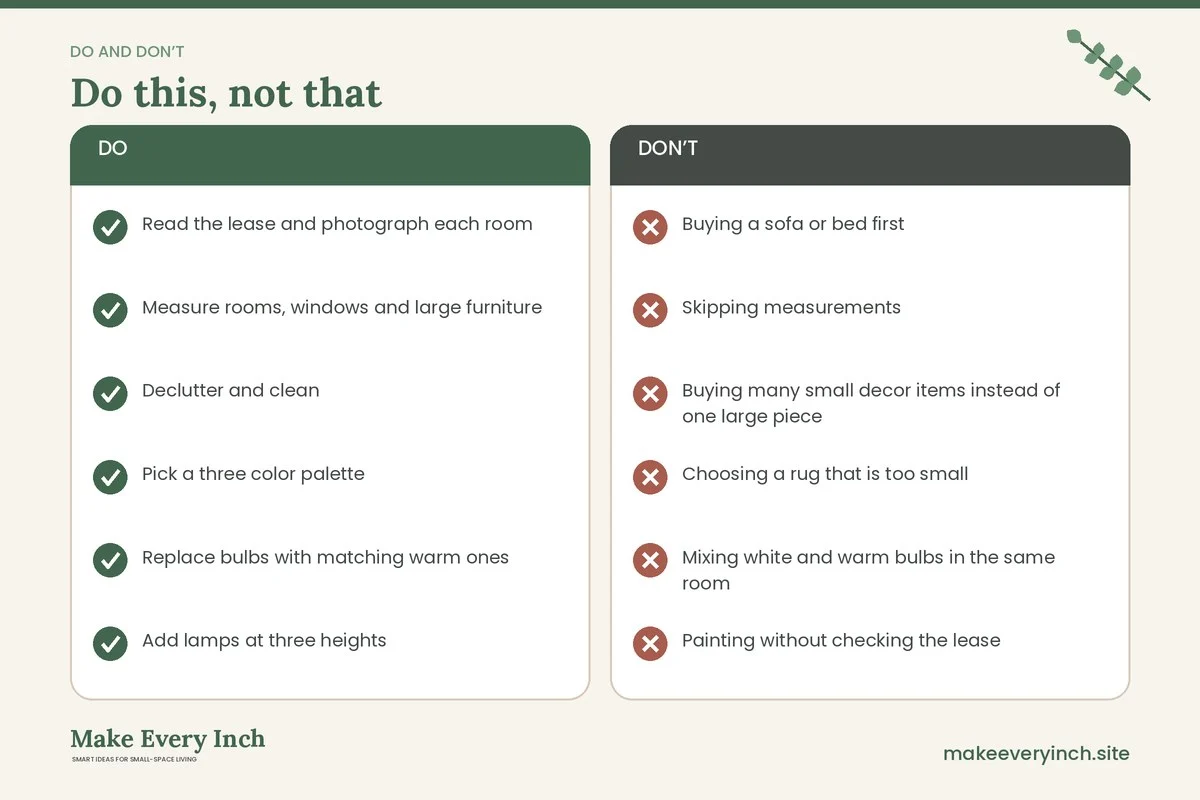
Small apartment makeover checklist
- Read the lease and photograph each room
- Measure rooms, windows and large furniture
- Declutter and clean
- Pick a three color palette
- Replace bulbs with matching warm ones
- Add lamps at three heights
- Hang curtains high and wide
- Lay a rug that anchors the seating
- Refresh bedding and pillows
- Swap hardware and keep the originals
- Add one oversized piece of art
- Buy secondhand furniture last
- Keep a 10 percent reserve
- Take after photos
FAQ
How much does a small apartment makeover cost?
It depends on how much you change. A meaningful refresh with lighting, textiles and small decor can be done for about $150 to $250, a fuller makeover with a rug, bookcase and paint typically runs $400 to $750, and a larger project reaches $1,000 to $1,500. Prices vary by city and by how much you buy secondhand.
What should I change first?
Change clutter, then lighting, then textiles. These are the cheapest changes with the largest visual effect, and they cost the least to reverse if your taste shifts.
How can I do a makeover if I rent?
Use lamps, curtains on tension rods, rugs, slipcovers, adhesive hooks and freestanding furniture. Ask in writing before painting, and keep original hardware. The guide to security deposit safe apartment upgrades lists more reversible options.
Is it worth buying secondhand furniture?
Yes for solid wood dressers, tables, bookcases and chairs, which tend to be sturdier than cheap new pieces. Be careful with mattresses and upholstered items, which can carry pests and odors.
How do I make a small apartment look bigger on a budget?
Clear the floor, hang curtains high, use mirrors and keep one color family across walls, textiles and large furniture. Lighter, matching tones help rooms feel continuous.
Should I paint a rental?
Only with permission. If the lease allows it, ask what color to restore at move-out, and photograph the walls before you start. If paint is not allowed, use a painted piece of furniture, large art or fabric instead.
What is the best order to do a makeover?
Clean and declutter, paint, light, textiles, furniture, then small decor. This order avoids redoing work, such as scuffing a new rug while you paint.
How do I stick to a budget?
Set a total and a 10 percent reserve, list each purchase with a price range and record every receipt. Wait a day before buying anything that is not on the list.
Keep going: Keep going with small bedroom makeover under $200, small space organization ideas and small apartment decluttering ideas.
Save this guide for later
Pin the ideas you like to Pinterest so you can come back to them when you plan your space.