14 Small Living Room Lighting Ideas Cozy Enough for Slow Evenings
Quick answer: The best small living room lighting ideas cozy rooms use keep most light low, warm and shaded. Put three or four lamps below 42 inches, choose bulbs around 2200 to 2700 kelvin, aim for roughly 600 to 1,200 total lumens in the evening, add a dimmer or a timer, and turn the overhead light off. Soft pools of light at seat height make a small room feel wrapped and calm.
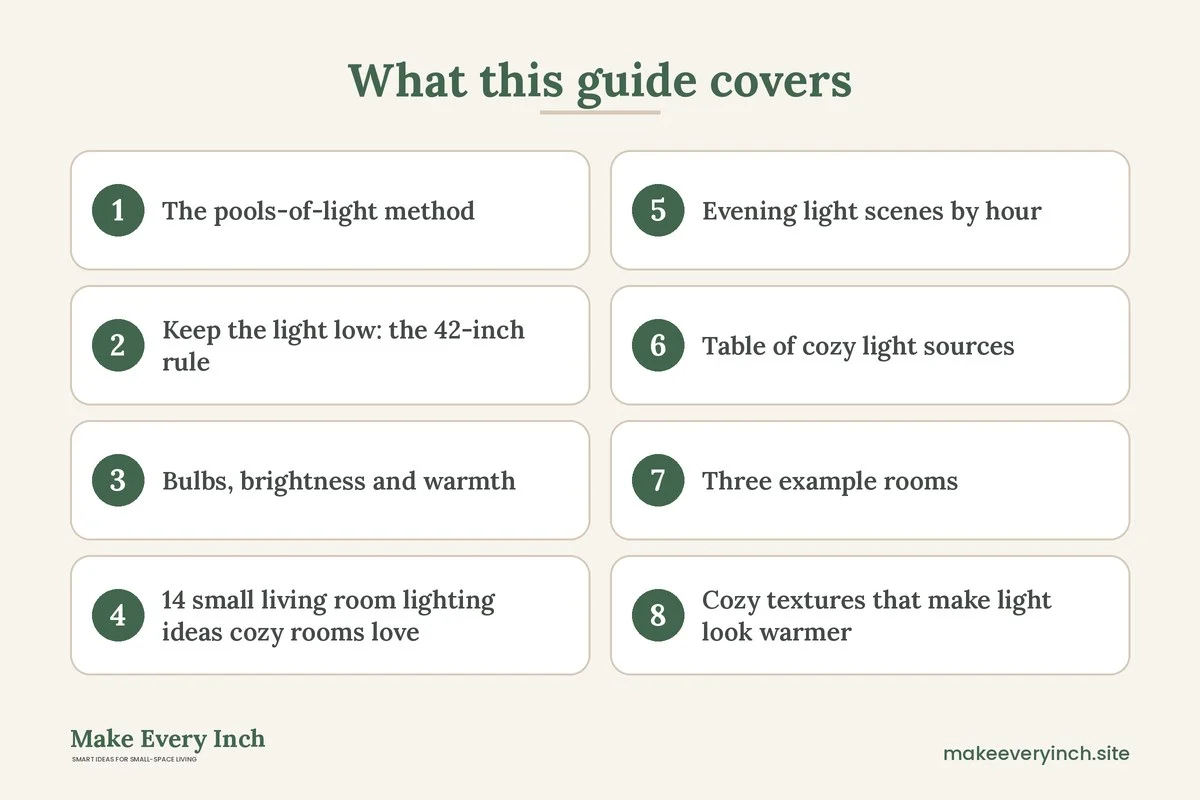
Small living room lighting ideas cozy enough for slow evenings are less about fixtures and more about where the light sits. A cozy room is lit from below eye level, from the sides and from behind, and it leaves the ceiling slightly dim. That is the opposite of the standard plan with a single bright overhead light, and it is the reason a small room can feel tight and clinical at night even when the furniture is soft. This guide shows how to build a warm lighting plan in a living room of roughly 9 by 12 feet to 12 by 15 feet. It covers the pools-of-light method, lamp height measurements, bulb choices, 14 ideas, evening light scenes by hour, a table, three example rooms, safety rules and a FAQ. For the overall topic, start with our main guide to small living room lighting ideas, the wider small living room ideas pillar and our room-by-room look at cozy small living room ideas. For a cleaner, more graphic approach, see the sister post on small living room lighting ideas modern.
The pools-of-light method
A cozy room is built from pools, not floods. A pool of light is a small, warm circle on a surface, a wall or a seat. The dark space between the pools is what creates the sense of shelter. To plan pools, walk through the room with a pencil and mark the places where a person actually sits, reads, eats or rests a drink. Each of those places gets its own light. Everything else can fall into shadow.
A good starting target for a small room is four pools:
- The reading pool beside the main seat, at about shoulder height.
- The conversation pool at the far end of the sofa or beside a second chair.
- The background pool on a wall, shelf or plant, so the edge of the room is not black.
- The floor or corner pool low in a corner, to soften the far end of the room.
Three pools often feel enough in a room under 120 square feet, and four fit a room up to about 180 square feet. The pools should overlap slightly so the room looks connected, but not so much that they merge into one bright cloud.
Keep the light low: the 42-inch rule
The easiest cozy rule to apply is this: most light sources should sit below about 42 inches from the floor. That is roughly the height of a seated person’s eyes plus a bit more, so the light falls on laps, books and faces rather than shining down from above. Sources above that height can be fine if they point up or are heavily shaded, but a bare bulb above eye level is the main reason a room feels harsh.
Practical measurements that help:
- Table lamp height: a lamp with a total height of 22 to 28 inches on a side table of 20 to 24 inches puts the bottom of the shade near 38 to 42 inches. That is about right for a seated person.
- Shade size: the shade’s bottom width should be about equal to the lamp’s body height, so a 12-inch body suits a shade 12 to 16 inches wide.
- Distance from the seat: place a reading lamp 12 to 24 inches behind and to the side of your shoulder, aimed at the page.
- Floor lamp reading height: the bottom of the shade at about 42 to 48 inches when you want a gentle wash, or 60 to 66 inches for an arc that clears heads.
- Wall lights: a sconce centered at 54 to 60 inches gives a soft wall glow without shining into eyes.
- Shelf and ledge lights: anything under 18 inches off the floor works as a floor glow.
Bulbs, brightness and warmth
Cozy light is warm. In kelvin terms, 2200 to 2700 is the range that feels like candlelight to soft evening. Anything above 3000 begins to feel crisp. Many people mix 2700 kelvin in lamps with a dim-to-warm bulb that shifts color as it dims, which behaves like an old filament bulb. Where it is listed on the box, a color rendering of 90 or above keeps wood, fabric and skin looking natural.
Brightness is easier to overshoot than undershoot. For a cozy evening in a small room, a total of about 600 to 1,200 lumens across all sources is usually enough. That is roughly 5 to 10 lumens per square foot of floor in a 120 square foot room, well below the numbers used for a bright daytime living room. A typical reading lamp might use 250 to 450 lumens, a background lamp 100 to 250, and a floor glow 50 to 150. Check the lumen figure on the package rather than the wattage, and remember that a shade takes a share of the output.
If you want the room to be usable for tasks as well, keep one lamp that can go brighter, for example a bulb of 450 to 800 lumens on a dimmer, and leave the rest of the sources gentle.
14 small living room lighting ideas cozy rooms love
Lamps that do the heavy lifting
1. A fabric shade table lamp on each side of the sofa
Two lamps with linen or cotton shades turn the light into a warm glow and cast a visible, glowing shape on the wall. Fabric shades scatter light, which softens shadows. Choose a medium to dark inside lining if you want a warmer color and a lighter lining for more brightness.
2. A lamp on a stack of books
When a side table is too low, a shorter lamp can be lifted by a stack of hardbacks to reach the 38 to 42 inch shade bottom. Keep the stack stable, flat and away from the bulb. It is also a free way to add height.
3. A floor lamp with a drum shade beside the armchair
A floor lamp with a drum shade gives a soft, even wash at lap level. Leave 6 to 12 inches between the shade and the wall so it does not scorch a curtain or paint. The base should be heavy enough not to tip. For more floor lamp options, read our guide to the best floor lamps for small rooms.
4. A lamp on the bookshelf
A small lamp on a shelf at about 40 to 50 inches adds a background pool and gives the shelf contents a glow. Keep it away from paper stacks and check that the shade is a safe distance from books.
Layers of low glow
5. A warm strip behind the sofa or under a console
A low-power strip placed behind the sofa back or under a console lights the wall in a halo. Choose a warm white of about 2200 to 2700 kelvin and a diffuser if the dots show. Keep the adapter ventilated and within its rated length.
6. A paper lantern or fabric globe on the floor
A soft globe on the floor in a corner offers a gentle, round pool at about 12 to 18 inches high. It fills the dark triangle where two walls meet, which makes the room feel more finished.
7. A rechargeable lamp for the coffee table
A small cordless lamp with a dimmable setting and a base about 6 to 10 inches high is a movable pool. It can sit on a tray, a window sill or a side table and goes away when you need the space. Charge it in a safe place and unplug it when full.
8. Flameless candles in groups of three
Flameless candles on a tray give a flicker without heat or open flame. Group them in odd numbers, with different heights between 3 and 8 inches. They are a good choice if you have pets or children. Real candles need constant supervision and a stable holder, and many renters prefer to skip them.
9. A string of small lights along a shelf or window
A string of warm lights draped along a shelf, a mantel or a window frame adds a sparkle. Pick a string with a warm color, a plug rated for the use and an in-line switch. Do not overload the outlet or connect more strings than the label allows.
Surfaces, shades and soft reflections
10. A plug-in sconce with a fabric shade
A plug-in sconce beside the sofa or the TV wall brings light up from the side table. Mount the center at 54 to 60 inches and use a cord cover to keep the line tidy. Our guide to renter-friendly lighting ideas covers adhesive and clamp options for tenants.
11. A mirror that catches a lamp
A mirror hung or leaned where it reflects a lamp doubles the pool. Keep the reflected scene pleasant, and avoid reflecting a bare bulb. A mirror with an aged or antiqued finish adds softness.
12. Warm shades on the overhead light
If you can’t remove the ceiling fixture, change what it does. Replace a clear bulb with a warm one on a dimmer, and keep it on the lowest setting for evenings. A paper or fabric shade that hangs over a bare bulb reduces glare.
13. Sheer curtains that glow
Sheer curtains in a pale, warm color catch a lamp placed near the window. At night they glow from within and fix the black-window problem. Hang the rod 4 to 6 inches above the window frame so the glow starts higher.
14. A dimmer, timer or smart plug
Lighting is cozy when it changes. A dimmer lowers the intensity, a timer turns the lamps on at dusk and a smart plug can run a schedule. Use bulbs that are compatible with the dimmer, and keep the total load within the rating on the label.
Evening light scenes by hour
A cozy room does not have one setting; it has a few. Think of them as scenes you switch between over the evening. The numbers below are planning ranges for a 120 square foot room.
Late afternoon: 4 to 6 p.m.
Daylight is fading. Turn on one lamp near the window and keep the overhead off. Aim for about 250 to 400 lumens of lamp light to soften the transition. This keeps the room from sliding into dimness while you still have natural light.
Dinner and conversation: 6 to 8 p.m.
Use two or three lamps at 300 to 450 lumens each, with a floor glow of about 100 lumens. If you eat in the room, add a candle-style light on a tray. Keep the lamps at or below shoulder height so nobody squints.
Reading or hobby: 8 to 9:30 p.m.
Raise the reading lamp to its brighter setting, around 450 to 700 lumens, and drop the others. Place the lamp so the light comes over your shoulder at about 15 to 20 inches above the page.
Screen time and wind-down: 9:30 to 11 p.m.
Lower everything. Aim for 100 to 300 lumens in the background and a low glow behind the TV. This level feels like candlelight and helps the eyes adjust. If you stream a film, bias lighting at about 10 to 15 percent of the screen brightness reduces eye strain.
Overnight and early morning
Use a night glow in the hallway or a tiny lamp on the floor for safe walking. Keep it under 50 lumens so it does not wake anyone.
Table of cozy light sources
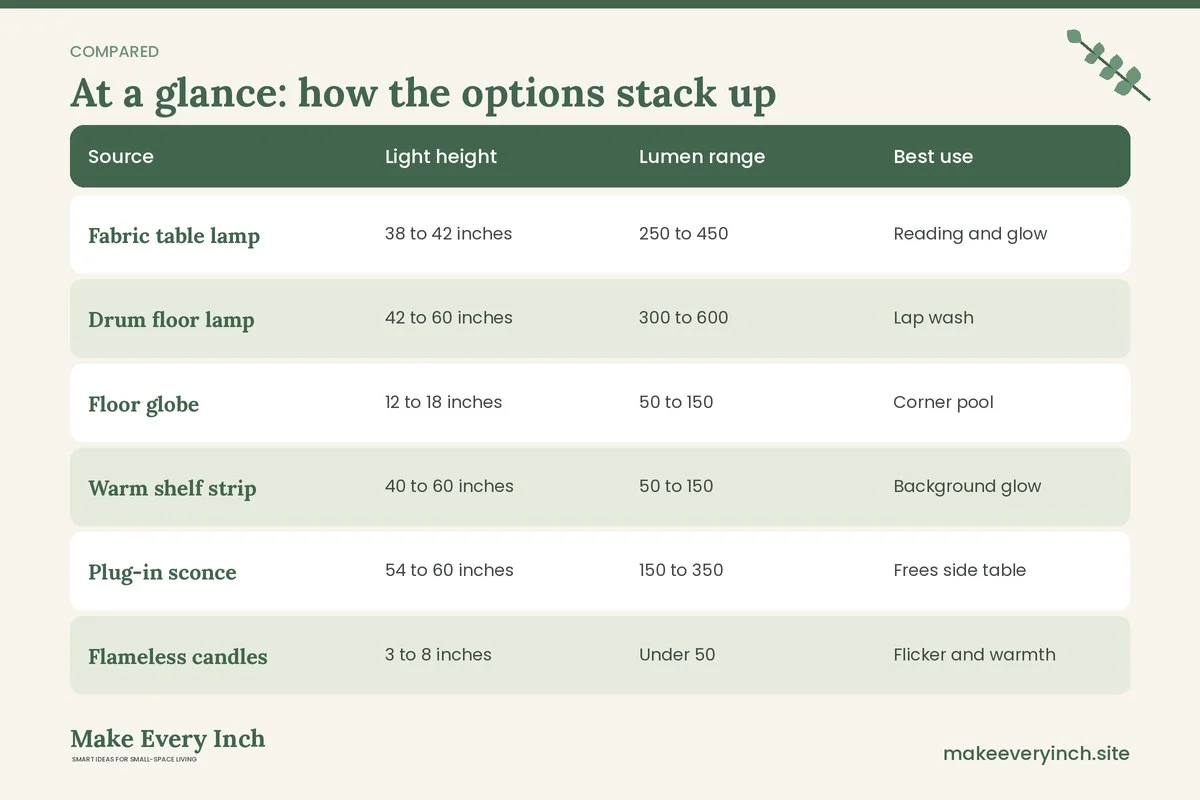
Use this table to match each source to its job. Heights refer to the position of the light, not the whole fixture.
| Source | Light height | Lumen range | Best use | Cozy tip |
|---|---|---|---|---|
| Fabric table lamp | 38 to 42 inches | 250 to 450 | Reading and glow | Choose a warm lining |
| Drum floor lamp | 42 to 60 inches | 300 to 600 | Lap wash | Keep 6 to 12 inches from walls |
| Floor globe | 12 to 18 inches | 50 to 150 | Corner pool | Place in the darkest corner |
| Warm shelf strip | 40 to 60 inches | 50 to 150 | Background glow | Use a diffuser |
| Plug-in sconce | 54 to 60 inches | 150 to 350 | Frees side table | Use a cloth shade |
| Flameless candles | 3 to 8 inches | Under 50 | Flicker and warmth | Group in threes |
| String lights | Varies | Under 100 | Sparkle | Do not overload outlets |
| Rechargeable lamp | 6 to 12 inches | 50 to 200 | Movable pool | Put it on a tray |
Three example rooms
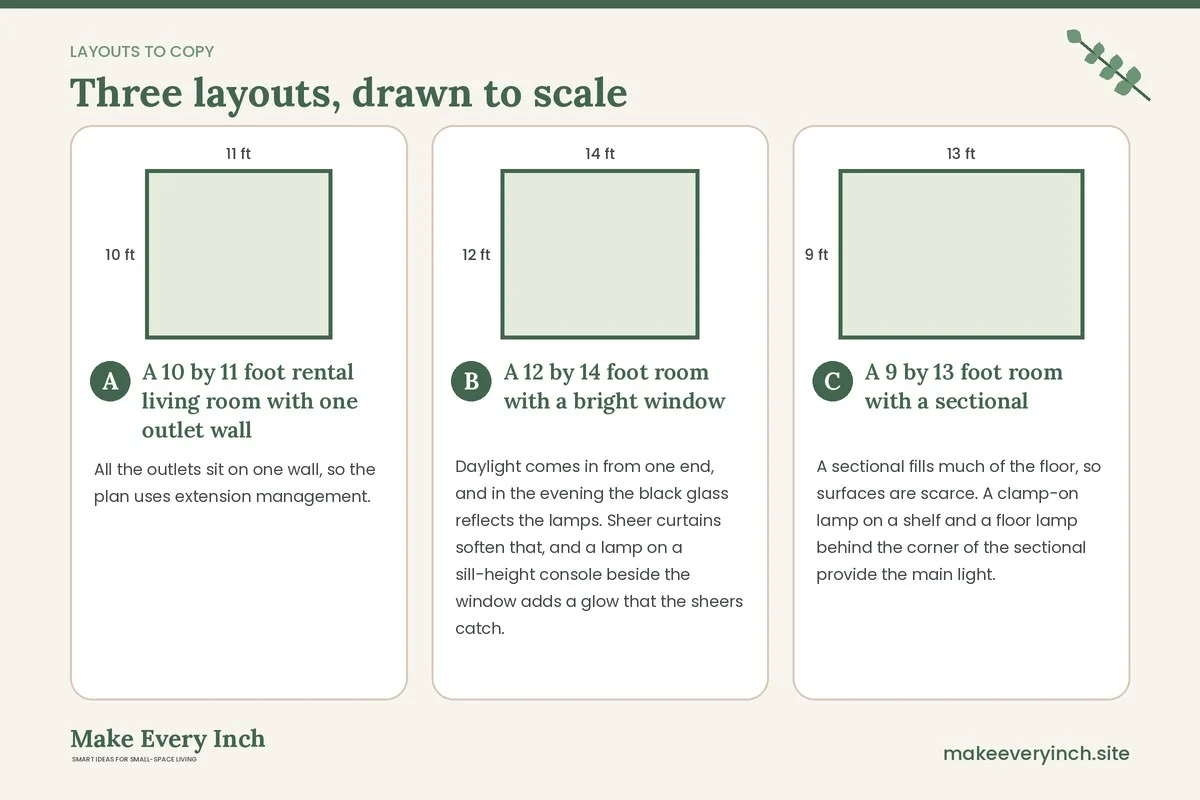
A 10 by 11 foot rental living room with one outlet wall
All the outlets sit on one wall, so the plan uses extension management. A table lamp on the side table near the outlet handles the sofa, a floor lamp with a long, tidy cord reaches the armchair, and a rechargeable lamp covers the far shelf. A cord cover runs along the baseboard. Total evening light: about 800 lumens. The overhead fixture stays off. No holes are drilled.
A 12 by 14 foot room with a bright window
Daylight comes in from one end, and in the evening the black glass reflects the lamps. Sheer curtains soften that, and a lamp on a sill-height console beside the window adds a glow that the sheers catch. A pair of table lamps flank the sofa at about 350 lumens each. A warm strip behind the TV console lights the wall. Total: roughly 1,100 lumens, with every source below 48 inches.
A 9 by 13 foot room with a sectional
A sectional fills much of the floor, so surfaces are scarce. A clamp-on lamp on a shelf and a floor lamp behind the corner of the sectional provide the main light. A string of lights along a shelf and a floor globe in the far corner finish the room. The overhead light is off. Total: about 700 lumens. For furniture that leaves space for lamps, see our guide to small living room furniture ideas.
Cozy textures that make light look warmer
Light reads warmer on soft surfaces. A matte wall in a warm white, a wool throw, a woven basket and a wooden table each absorb or scatter light in a gentle way. A glossy surface sends a bright reflection back to the eye, so a high-gloss coffee table directly under a lamp can add glare. Place a tray, a woven mat or a book on top of shiny surfaces to break up the reflection.
Color also matters. Warm whites, terracotta, cream and soft greens look richer under 2200 to 2700 kelvin bulbs, while blue-gray and cool white can look dull. If you plan to repaint, test a sample under your actual bulbs at night. Our post on small living room layout ideas cozy shows seating layouts that keep the lamps and the conversation close together.
Electrical safety for a cozy lighting plan
Warm, layered lighting means more lamps, more cords and more bulbs near fabric. That makes safety habits worth building.
- Check the wattage label. Every lamp has a maximum bulb wattage near the socket. Never exceed it, and never use a bulb that is too long for the shade.
- Keep bulbs away from fabric. Leave space between the bulb and the shade, and keep throws, curtains and paper at a safe distance from any warm bulb.
- Never overload an outlet. Count what is on the circuit. Do not plug heaters, space warmers or other high-draw appliances into the same strip as your lamps, and do not chain power strips.
- Manage cords. Keep cords out of walkways, do not run them under rugs and do not staple them. A cord cover or clip along the baseboard is safer and neater.
- Choose flameless over flame. If you use real candles, never leave them unattended, keep them away from fabric and use stable holders. Many households with pets or children skip them.
- Check string lights. Use sets with a safety listing for your region, do not join more sets than the label permits and unplug them when you leave.
- Use timers and smart plugs within their rating. A plug has a maximum load. Add up the lamps on it and stay below it.
- Hardwiring needs a licensed electrician. Installing a new wall sconce, changing a ceiling fixture or adding a dimmer switch should be done by a licensed electrician. Tenants should also check the lease and ask the landlord.
Common mistakes
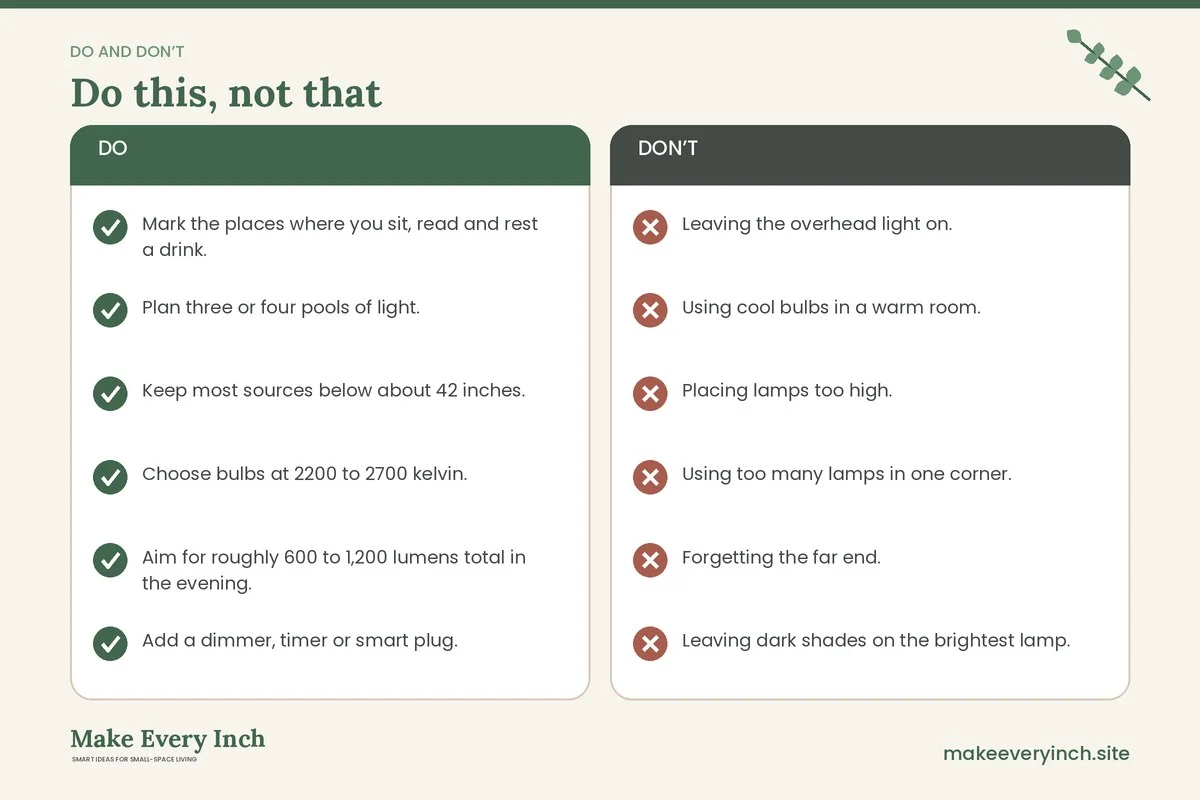
- Leaving the overhead light on. A bright ceiling fixture flattens the pools. Switch it off in the evening.
- Using cool bulbs in a warm room. One cool bulb stands out among warm ones. Match every bulb.
- Placing lamps too high. A shade that sits at standing eye level blinds the people sitting down.
- Using too many lamps in one corner. Spread the pools out so the room has a rhythm.
- Forgetting the far end. A dark far wall makes a small room look like a tunnel. Add a floor glow or a shelf lamp.
- Leaving dark shades on the brightest lamp. A very dark shade absorbs most of the light. Choose a shade that matches the job.
- Hiding cords poorly. A tangle at the base of a lamp ruins the calm. Bundle and tuck.
Cozy lighting checklist
- Mark the places where you sit, read and rest a drink.
- Plan three or four pools of light.
- Keep most sources below about 42 inches.
- Choose bulbs at 2200 to 2700 kelvin.
- Aim for roughly 600 to 1,200 lumens total in the evening.
- Add a dimmer, timer or smart plug.
- Use fabric or paper shades for diffusion.
- Light the far end of the room.
- Switch off the overhead light after dusk.
- Check the wattage label on every lamp.
- Keep bulbs away from curtains and throws.
- Never overload an outlet or chain power strips.
- Hire a licensed electrician for hardwired changes.
FAQ
What makes a living room lighting plan cozy?
Warm bulbs, low placement, fabric shades and several small pools of light instead of a single bright source. The ceiling light stays off or on a very low setting.
How bright should a cozy small living room be?
A total of roughly 600 to 1,200 lumens in the evening is a comfortable planning range for a room of about 120 square feet. Let your own comfort decide where in that range you land.
What color bulb is the coziest?
Bulbs around 2200 to 2700 kelvin give a candle-like glow. A dim-to-warm bulb shifts toward the warmer end as you lower the brightness.
How do I make a small room feel cozy without drilling?
Use table and floor lamps, plug-in sconces on adhesive hooks where the lease allows, clamp-on lights, rechargeable lamps and string lights. Our guide to renter-friendly lighting ideas lists no-drill ideas.
Should I use the same lamps in the bedroom and the living room?
The principles are the same, with lower light and warm bulbs. For a quiet space, read our guide to small bedroom lighting ideas for ways to carry the style through the home.
Are string lights safe to leave on?
Use sets with a safety listing, follow the connection limit on the label and turn them off when you go to bed or leave the house. A timer helps.
Keep going: Keep planning with our small living room lighting ideas, cozy small living room ideas and best floor lamps for small rooms.
Save this guide for later
Pin the ideas you like to Pinterest so you can come back to them when you plan your space.