15 Small Bedroom Ideas for Women That Work Around Real Daily Routines
Quick answer: The best small bedroom ideas for women are built around what you actually do in the room: sleep, get dressed, do a morning routine and sometimes work. Give the bed a clear side or two, put a mirror and a bright light where you get ready, tuck a fold-away or wall-hung desk into one corner, and use under-bed and over-door storage for the rest. Keep 24 to 30 inches of floor beside the bed and secure every tall piece to the wall.
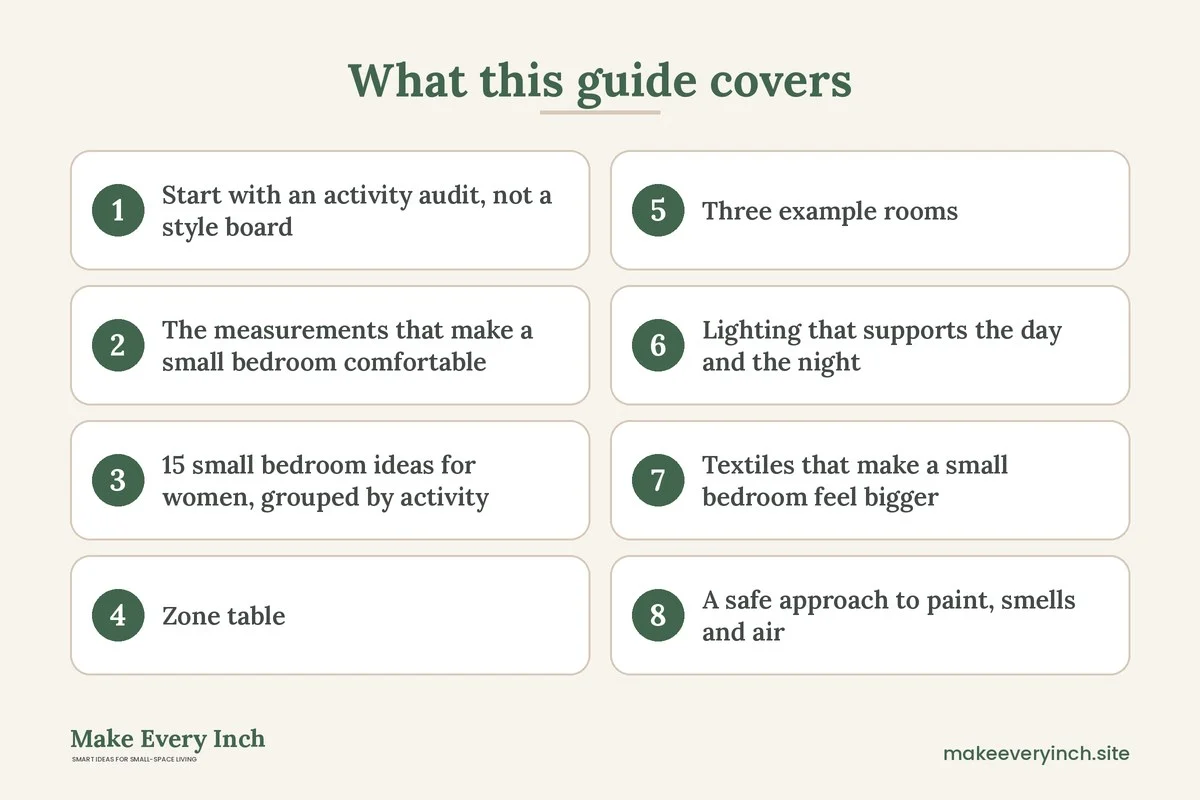
Small bedroom ideas for women are most useful when they start from routines instead of stereotypes. A bedroom does not need to look a certain way to suit you. It needs to let you fall asleep easily, get ready without bumping into furniture, find clothes in the dark at 6 a.m. and, for many people, open a laptop for a few hours without turning the bed into an office. This guide is for a bedroom, not a living room, so every idea is judged by how it helps you sleep, dress and unwind. It covers a quick activity audit, the measurements that matter, 15 ideas grouped by activity, a zone table, three example rooms, a four-week plan, a checklist and an FAQ. For the broader topic, start with our main guide to small bedroom ideas, and if you rent, read our companion post on small bedroom ideas for renters.
Start with an activity audit, not a style board
Before you buy anything, spend one week writing down what happens in your bedroom. Most people discover that the room does four or five jobs, and that the trouble comes from one job crowding out another. Use this short list and tick what applies.
- Sleep: bedtime reading, a phone charger, a glass of water, a light that does not wake you.
- Getting ready: a mirror, a good light for your face, a place for jewelry, skincare and hair tools, and a spot to choose an outfit.
- Clothes: daily clothes, seasonal clothes, shoes, bags and laundry.
- Working or studying: a laptop session, video calls, paperwork, a monitor.
- Winding down: stretching, a yoga mat, a chair for pulling on shoes, a small corner for a book.
- Extras: a sewing machine, a keyboard, craft supplies or exercise gear.
Circle the two jobs that happen most often and the one that annoys you most. The annoying one is your first project. If you lose ten minutes every morning hunting for earrings, a small tray and a wall hook solve more than a new bed frame. If your laptop lives on the duvet, a desk solution is the priority. This audit also stops impulse purchases, because every item has to earn its place by serving a job on your list.
Next, note when you use the room. A bedroom used mainly at night can lean on soft, low lighting and a cozy bed zone. A bedroom used all day, perhaps because it is also your office, needs a daytime light source and a clear visual line between work and rest.
The measurements that make a small bedroom comfortable
Small bedrooms feel cramped less because of the total area and more because of a few tight spots. These ranges are general guides, so adjust them to your own body and furniture.
- Beside the bed: 24 to 30 inches of clear floor on at least one long side. If the bed sits against a wall, the open side needs the full 30 inches if you can manage it. Two people sharing can aim for 24 inches on each side, or 18 inches at the very least.
- Foot of the bed: 24 to 36 inches if you walk across it, or 12 to 18 inches if it is a dead end that you rarely use.
- Dresser clearance: 36 inches in front of a dresser so the drawers can open fully and you can stand beside them. A dresser with a depth of 16 to 18 inches suits a tight room better than a 20 to 24 inch one.
- Wardrobe or closet doors: a hinged door needs a swing space equal to its width. If the swing blocks the bed, replace the door with a curtain or a sliding panel.
- Desk depth: 16 to 24 inches for a laptop, 24 to 30 inches if you use a monitor. A desk width of 30 to 40 inches is enough for most people.
- Mirror height: the center of a wall or door mirror at about 55 to 60 inches from the floor works for most heights. A full-length mirror usually needs a width of 14 to 20 inches and a height of 48 inches or more.
- Bedside table height: within 2 inches of the top of the mattress so that the surface is easy to reach, which usually means 22 to 28 inches.
- Bed height: the top of the mattress at 20 to 26 inches from the floor. Higher beds leave room underneath for storage boxes, but they need a step stool for shorter sleepers.
Mark the footprint of the bed, the dresser and the desk on the floor with painter’s tape. Walk the room as you would on a normal morning: out of bed, to the closet, to the mirror, to the door. Wherever your hip or knee brushes something is a spot to fix, and you can fix it for free by turning a piece or swapping it for a slimmer one.
15 small bedroom ideas for women, grouped by activity
For sleeping well
1. Put the bed where the room has most open floor
In a small room, the bed is the largest object, so its position decides everything else. A bed centered on the short wall leaves two equal walkways but wastes corner space. A bed pushed into a corner leaves one wide walkway and frees the opposite side for a desk or a dresser. Choose the layout that gives you the most usable clear floor in one piece. See our guide to small bedroom layout ideas for diagrams of the common options.
2. Move the bed away from the door line and window drafts
Look for a position where you can see the door without lying directly in its line, and where the headboard is not under a drafty window. A calm sightline and a steady temperature help many people relax. If the only wall is under a window, use a headboard that is taller than the sill and keep curtains closed at night.
3. Give the bedside a job list, not a table
Decide what must be within reach: a lamp, a phone, a glass of water, a book and a tissue box. A narrow table of 10 to 14 inches wide holds these items. A wall-mounted shelf or a clip-on tray saves floor space. A stool or a small stack of crates works if you use fewer items. Charge your phone with a cable long enough to reach the bed, but keep cords tidy and out of walking paths.
4. Use warm, dimmable light at the bed
A lamp with a warm bulb, around 2700 kelvin or lower, makes it easier to wind down. A dimmable bedside lamp lets you read and then lower the brightness without getting up. Keep the shade low so that the light does not shine into your eyes. If you share the room, a pair of small reading lights lets each person control their own side. Look at our post on small bedroom lighting ideas for a layered plan.
5. Add a layer for darkness and quiet
Lined curtains or a blackout liner behind your existing curtains help you sleep later on bright mornings. A thick rug beside the bed softens footsteps and warms the floor. If street noise bothers you, soft materials such as upholstered headboards and heavy curtains absorb a little sound. They do not block noise, but they help the room feel calmer.
For getting ready
6. Make a dressing spot out of a narrow console
A console of 10 to 14 inches deep and 30 to 40 inches wide can host a mirror, a tray for jewelry and a small stool. It does the job of a vanity in a quarter of the space. Choose a console with a drawer for makeup, skincare or hair tools. If the space beside a window is free, the natural light there is the kindest for getting ready.
7. Light your face evenly
A mirror lit from only one side or from directly overhead throws shadows. A light on each side of the mirror, or a lamp on the console, shows your face evenly. If you use clip-on or plug-in lights, plug them into a socket with a switch so you can turn them off at once. Do not run extension cords across the floor, and do not overload a socket with several heating tools. Unplug hair tools after use, and keep them on a heat-safe tray.
8. Hang a full-length mirror on the door or lean it against the wall
A tall mirror on the back of the door or leaning in a corner makes the room feel larger and removes the need for a second piece of furniture. A leaning mirror must be anchored to the wall with a safety strap or bracket, because it can tip. A door-mounted mirror should be fixed with hardware rated for its weight, or a hanging frame that fits over the top of the door.
9. Do a daily outfit rail
A slim rail on the wall or on the back of the closet door holds tomorrow’s outfit, a bag and a scarf. It makes mornings quicker and keeps clothes off the chair. A floor-standing garment rack of 30 to 36 inches wide can double as a capsule wardrobe, but pair it with a cover or a curtain so the room looks calm.
For clothes and storage
10. Take the closet up to the ceiling
Add a second rod beneath the first for shirts and trousers, and a high shelf above for out-of-season items in labeled boxes. A narrow hanging organizer fits shoes, scarves and belts. For more ideas, see our guide to small closet organization ideas and our post for rooms with no built-in closet at all, small bedroom ideas without a closet.
11. Make the bed work as a storage unit
A bed with drawers, a lift-up frame or enough clearance for rolling boxes can hold a full season of clothes and bedding. Measure the gap between the floor and the slats before you buy boxes. If the bed has low legs, use risers designed for furniture and check their weight rating. Read our under-bed storage ideas and the roundup of the best beds with storage for choices.
12. Pick a tall, narrow dresser instead of a wide, low one
A tall dresser of 18 to 24 inches wide uses wall height rather than floor area. Look for a model with five or six drawers, and place it where the drawers open without hitting the bed. Because tall furniture can tip, anchor every tall dresser, wardrobe or bookcase to a wall stud using the anti-tip hardware that came with it, especially if there are children or pets in the home. In a rental, ask your landlord, or choose freestanding furniture with a low center of gravity and a wide base. Our review of the best small dressers lists features to check.
For working and unwinding
13. Fit a fold-down or wall-hung desk into one corner
A fold-down desk with a 30 to 36 inch width disappears when you close it. A narrow wall-hung desk holds a laptop and a notebook. Keep the work surface away from the headboard, so your brain can tell the difference between the bed and the desk. A chair that tucks fully under the desk, or a stool that slides under the bed, stops the corner from looking like an office. Our guide to small bedroom desk ideas goes deeper on this.
14. Make a work nook that you can close
A folding screen, a curtain on a ceiling track or a tall bookcase can hide the desk when work is finished. A visual break matters: closing the nook at the end of the day tells you the workday is over. If you take video calls, choose a background that is plain and well lit, and place the light in front of you, not behind you.
15. Reserve a floor patch for stretching
A yoga mat needs about 24 by 72 inches of clear floor. If the room has no such space, stand the mat upright against a wall and unroll it beside the bed when you need it. A small basket for a resistance band and a foam roller keeps the kit together. A bedroom that supports your body as well as your mind often feels more spacious, because you notice the floor and not the clutter.
Zone table: match each activity to a solution
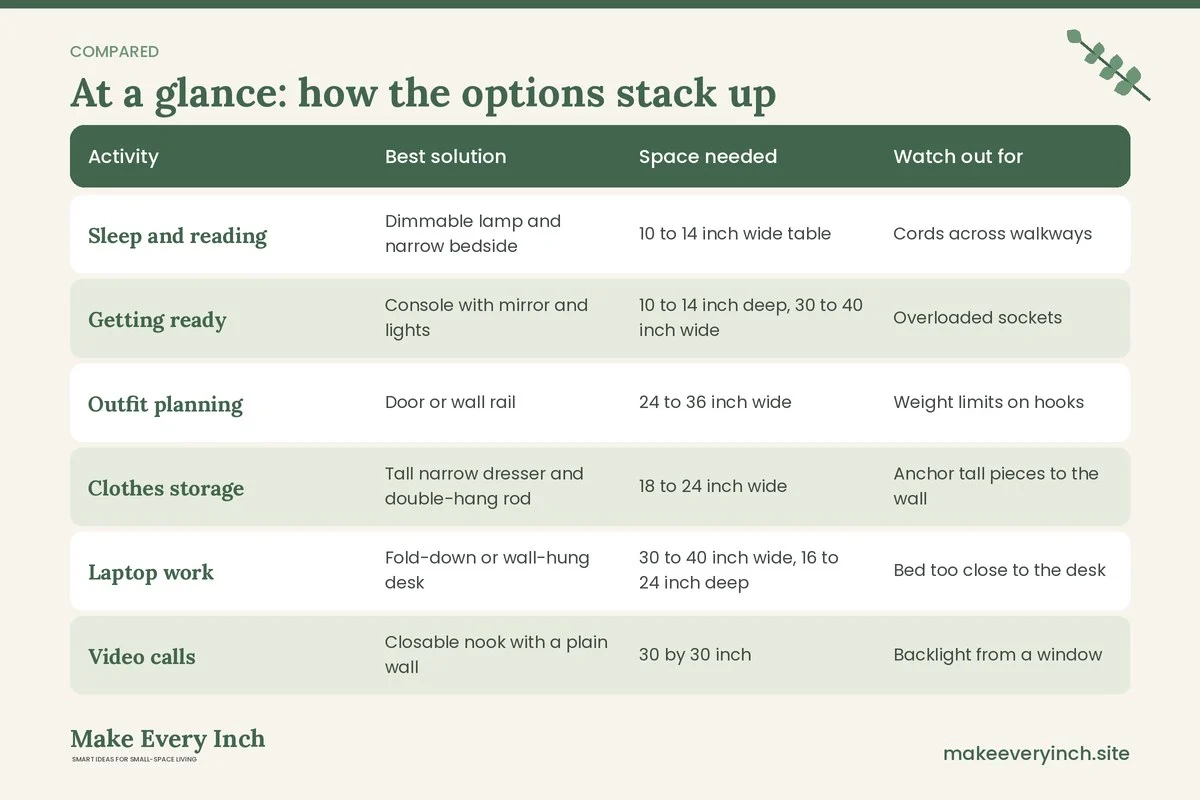
Use this table to decide what to buy first. Pick your top two activities and ignore the rest until later.
| Activity | Best solution | Space needed | Watch out for |
|---|---|---|---|
| Sleep and reading | Dimmable lamp and narrow bedside | 10 to 14 inch wide table | Cords across walkways |
| Getting ready | Console with mirror and lights | 10 to 14 inch deep, 30 to 40 inch wide | Overloaded sockets |
| Outfit planning | Door or wall rail | 24 to 36 inch wide | Weight limits on hooks |
| Clothes storage | Tall narrow dresser and double-hang rod | 18 to 24 inch wide | Anchor tall pieces to the wall |
| Laptop work | Fold-down or wall-hung desk | 30 to 40 inch wide, 16 to 24 inch deep | Bed too close to the desk |
| Video calls | Closable nook with a plain wall | 30 by 30 inch | Backlight from a window |
| Stretching | Upright mat and a basket | 24 by 72 inch when used | Slippery rugs |
| Seasonal storage | Under-bed boxes and a high shelf | Bed clearance of 8 to 14 inches | Heavy boxes on high shelves |
Three example rooms
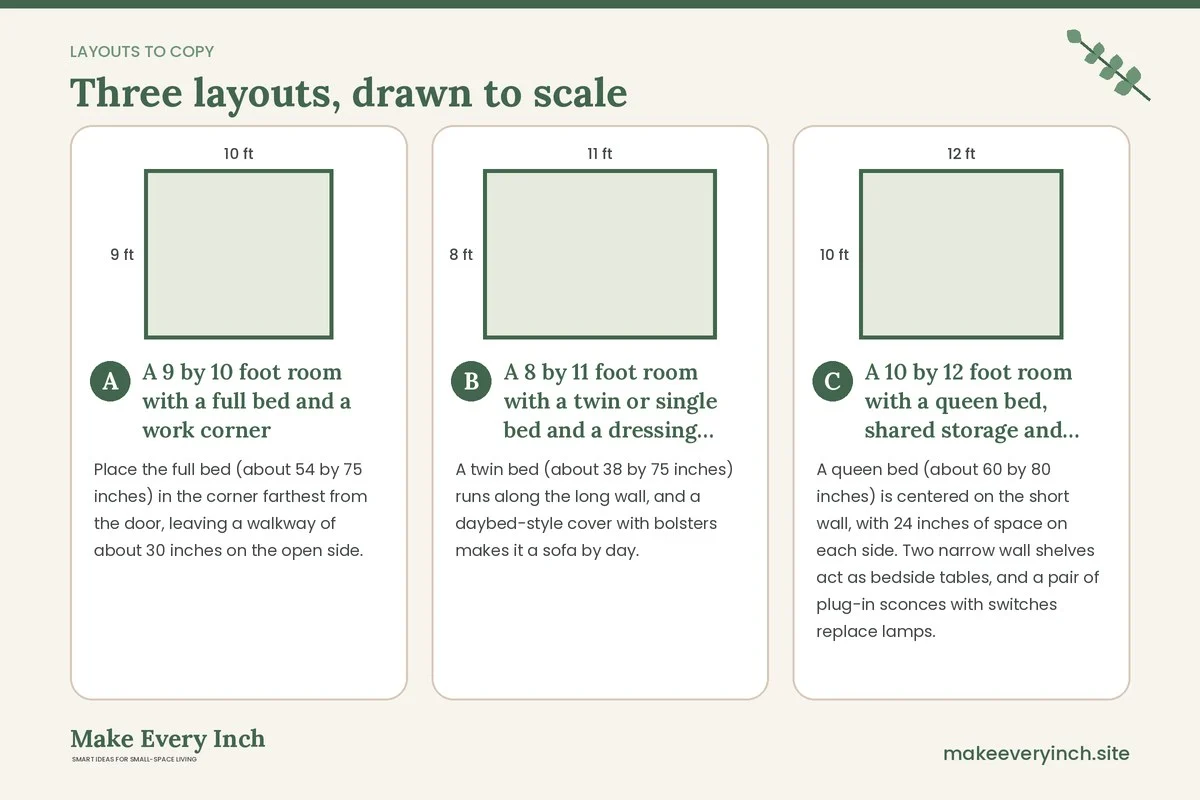
A 9 by 10 foot room with a full bed and a work corner
Place the full bed (about 54 by 75 inches) in the corner farthest from the door, leaving a walkway of about 30 inches on the open side. A fold-down desk of 32 inches wide fits under the window, and the stool slides beneath the bed when not used. A tall dresser of 20 inches wide stands against the wall nearest the door, with the anti-tip strap fixed to a stud. A mirror hangs on the back of the door, and an outfit rail sits beside it. This plan suits someone who works from home two or three days a week and wants the bedroom to stay restful on the others.
A 8 by 11 foot room with a twin or single bed and a dressing area
A twin bed (about 38 by 75 inches) runs along the long wall, and a daybed-style cover with bolsters makes it a sofa by day. At the far end, a console of 12 inches deep and 36 inches wide stands under the window, with a mirror and a pair of small lights. A bed with drawers holds clothes, which lets you skip a dresser entirely. A wall shelf above the bed holds books and a lamp. This plan suits someone who gets ready at length each morning and needs good light and a clear surface more than a desk.
A 10 by 12 foot room with a queen bed, shared storage and no closet
A queen bed (about 60 by 80 inches) is centered on the short wall, with 24 inches of space on each side. Two narrow wall shelves act as bedside tables, and a pair of plug-in sconces with switches replace lamps. A slim wardrobe of 24 inches wide stands at the foot of the bed against the opposite wall, anchored to the wall. A garment rail behind a curtain covers the rest of the clothes. For a room like this, see our post on small bedroom ideas with a queen bed. The look is calm because the pieces are symmetrical and the floor is clear.
Lighting that supports the day and the night
Bedrooms need three kinds of light. Ambient light, such as a ceiling fixture or a floor lamp bounced off the ceiling, lets you move around. Task light, such as a desk lamp or mirror lights, helps you see what you are doing. Mood light, such as a dim bedside lamp or a string of low-wattage lights, helps you relax at night. Use a different switch or plug for each layer so you can turn off the task lights when you close the day.
Choose warm bulbs for the evening and cooler, brighter ones for the desk and the mirror. If your ceiling light is harsh, switch to a bulb with a lower brightness or a shade that diffuses the light. Never cover a lamp or a bulb with fabric that can touch it, and do not put a lamp under a cloth that traps heat. Check that every plug-in light has a current rating suitable for the bulb.
Textiles that make a small bedroom feel bigger
Fabric changes how a small room feels. Pick a limited palette of two or three colors, and repeat them in the bedding, the curtains and the rug. A light, plain bedspread makes the bed appear less bulky. Hang curtains close to the ceiling and let them fall to the floor, which draws the eye up. A rug that extends 18 to 24 inches beyond the sides and foot of the bed keeps the floor warm without cutting the room in two. For a small room, a 5 by 8 foot rug under the lower two thirds of the bed is a common choice.
Layer with care. A duvet, a coverlet and two pillows often look neater than six cushions that need moving every night. If you wash bedding weekly, own two sets so that one is always ready. Store the second set inside a pillowcase of the same set to keep things tidy.
A safe approach to paint, smells and air
If you repaint, choose a low-VOC or zero-VOC product, keep windows open while you work, run a fan and leave the room to air out for as long as the label recommends before you sleep in it. Do not sleep in a freshly painted room if the smell is strong. In a rental, get written permission before painting. Be careful with candles and incense in a small bedroom: keep them away from curtains and bedding, never leave them burning while you sleep and open a window when you use them. If you use a plug-in diffuser or a humidifier, follow the cleaning directions so that mold does not build up.
A four-week plan
You do not need a full makeover. Try this schedule, one task per week.
Week 1: Audit and clear
Run the activity audit, tape out the floor and clear every surface. Remove anything that does not serve a job on your list. Wash or rotate bedding. Decide on the layout you want to try.
Week 2: Sleep and light
Move the bed if needed, fix the bedside setup and swap harsh bulbs for warm ones. Add blackout liners or a rug beside the bed. Tidy cords with clips along the baseboard.
Week 3: Getting ready and clothes
Set up the console or mirror, add the outfit rail and rework the closet with a second rod or a hanging organizer. Anchor any tall furniture to the wall.
Week 4: Work nook and finishing
Install the fold-down desk or the wall-hung table, add a screen or a curtain if you want the nook to close and dress the room with one plant or one piece of art. Walk through your morning routine and make small fixes.
Mistakes to avoid
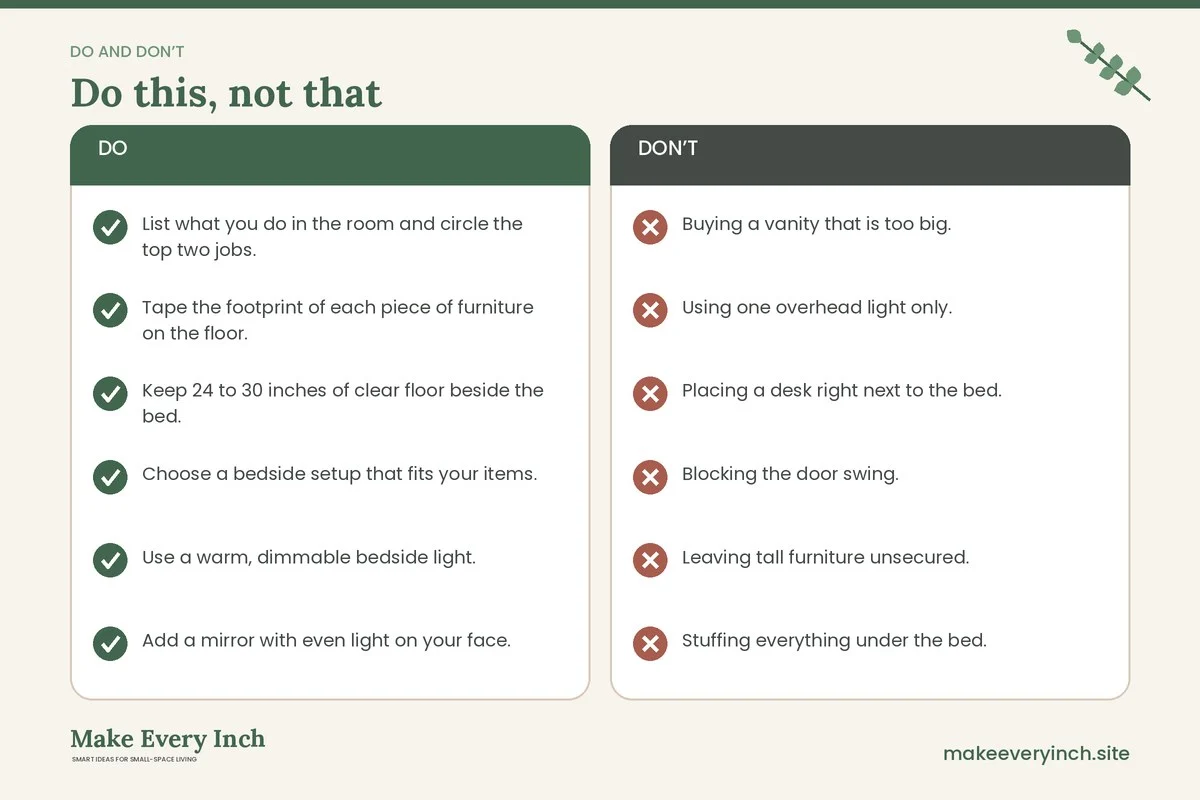
- Buying a vanity that is too big. A full vanity table often overwhelms a small room. A console with a mirror does the same job.
- Using one overhead light only. Overhead light alone flattens the room and makes it feel colder. Add at least one lamp.
- Placing a desk right next to the bed. The bed soon becomes the desk chair. Put some distance, or a screen, between them.
- Blocking the door swing. A door that cannot open fully makes the room tense. Check the swing before any furniture goes down.
- Leaving tall furniture unsecured. A loaded dresser can tip. Anchor it.
- Stuffing everything under the bed. Under-bed storage works for off-season items. Daily items belong in the drawers and on the rail.
- Following a style before a plan. A pretty room that makes you trip every morning is not a good room.
Checklist
- List what you do in the room and circle the top two jobs.
- Tape the footprint of each piece of furniture on the floor.
- Keep 24 to 30 inches of clear floor beside the bed.
- Choose a bedside setup that fits your items.
- Use a warm, dimmable bedside light.
- Add a mirror with even light on your face.
- Hang an outfit rail or hook near the door.
- Use the vertical space in the closet.
- Choose a tall, narrow dresser and anchor it to a wall stud.
- Fit a fold-down or wall-hung desk if you work in the room.
- Add a screen or curtain to close the work nook.
- Keep cords off the floor and sockets not overloaded.
- Use low-VOC paint and ventilate well if you repaint.
- Check your lease before drilling or painting.
FAQ
What is the best layout for a small bedroom?
It depends on the shape, but a bed pushed into a corner gives you one wide walkway and frees a long wall for storage or a desk. Compare it with a centered bed using painter’s tape, and choose the layout that leaves the biggest uninterrupted floor area.
How can I fit a desk in a small bedroom?
Use a fold-down or wall-hung desk of 30 to 40 inches wide and 16 to 24 inches deep. Place it away from the headboard if possible, and use a stool that slides under the bed. A screen or a curtain helps separate work from rest.
Where should I put a mirror in a small bedroom?
A full-length mirror on the back of the door or leaning in a corner saves space. Lean it only if you can anchor it to the wall. For a face mirror, place it beside a window or add lights on each side.
How do I store clothes without a big wardrobe?
Add a second rod to the closet, use a tall narrow dresser, put seasonal items in under-bed boxes and use an outfit rail for daily clothes. The post on small bedroom storage ideas has more options.
Can I make a small bedroom feel cozy without clutter?
Yes. Use warm light, one soft rug, a limited palette and a few well chosen textiles. Keep the surfaces clear and give everything a home. For help clearing the room first, read our guide to small bedroom organization ideas.
Is it safe to use plug-in lights and extension cords in a bedroom?
Use them with care. Plug lights into a wall socket or a power strip with a surge protector rated for the load, avoid daisy-chaining strips and keep cords out of walking paths and away from bedding. If a plug or a cord feels warm, stop using it. For anything that needs wiring, hire a licensed electrician.
How much should I plan for a bedroom refresh?
Work in stages, starting with the item that fixes your biggest annoyance. Many ideas here use things you already own, such as a stool, a tray or a rail, so you can spread costs over weeks or months.
Keep going: Keep planning with our small bedroom makeover ideas, small bedroom furniture ideas and small bedroom ideas for renters.
Save this guide for later
Pin the ideas you like to Pinterest so you can come back to them when you plan your space.