Renter Friendly Bedroom Storage Ideas
Quick answer: The best renter friendly bedroom storage ideas are reversible: use the space under the bed, the back of the door, freestanding wardrobes and dressers, tall shelves with permitted anchoring, and vertical hanging inside the closet. Check the lease, photograph the room first, keep every item removable, and anchor tall furniture only if the lease allows it, otherwise choose low, stable pieces.
Renter friendly bedroom storage ideas start from a simple fact about rentals: the bedroom is the room where you keep the most belongings, and you are the least free to change the room itself. Clothes, shoes, bedding, books, bags and a lifetime of small things all need homes, yet the closet is often one rod and one shelf, and the walls are painted in a finish you do not want to scar. This guide is about reversible bedroom storage. It covers the lease check, a measure-first method, ideas for under the bed, over the door, in the closet, on freestanding furniture and in the corners, followed by a comparison table, anchoring rules, three example bedrooms, a seasonal rotation, a checklist and a FAQ. For ideas that cover the whole home, read our hub on renter-friendly apartment decorating ideas, and for general bedroom solutions that are not tied to a lease, see our guide to small bedroom storage ideas.
Check the lease, then record the room
Read the lease for rules about wall fixtures, adhesives, alterations and anything attached to a wall or ceiling. Many leases forbid nails and screws, and some also restrict adhesive on painted walls. If anything is unclear, ask the landlord or property manager in writing, say exactly what you plan to use and keep the reply. Never drill without permission, even for one screw, because a hole in a wall or a stud is an alteration under most leases.
Next, take photos before you move anything. Photograph each wall, the closet interior, the door and its hinges, the baseboards, the windowsills and the floor. Include the corners where furniture will stand, since floors show dents and scratches from heavy pieces. Save the photos with dates, and take a second set at move-out. A record of the starting condition is the strongest protection for your deposit.
Last, identify the floor type. Carpet, hardwood, laminate and vinyl each need a different approach to furniture. Hard floors need felt or rubber pads under legs and feet, and carpet needs a flat base so the furniture does not sink or tip. Heavy pieces, such as a full dresser, can leave marks on soft flooring, so spread the weight with a wide base or a thin board.
Measure first, buy second
Bedroom storage fails most often because the piece does not fit. Spend ten minutes with a tape measure and write down the following.
- Bed clearance: the distance from the floor to the underside of the bed frame or box spring, to the nearest quarter inch. Many frames sit 7 to 12 inches high, and a few sit higher or lower.
- Door swing: the arc of every door, including the closet, so no piece blocks it. Leave at least 24 inches of clear path beside the bed where possible.
- Wall widths: the clear width between corners, windows and doors, and the height to the ceiling. Allow 1 to 2 inches of height clearance for a tall piece to tilt into place.
- Closet interior: the width, depth and rod height. A standard closet depth is around 24 inches, and a rod sits around 60 to 66 inches off the floor, but yours may differ.
- Outlets and vents: mark where outlets, switches and heating vents are, since furniture should not cover them.
- Door thickness: measure the top edge of the door if you plan to use an over-the-door rack, since hooks fit only a limited thickness.
Draw a rough floor plan on paper or use painter’s tape to mark each piece’s footprint on the floor. Walk around the tape for a day before you buy. If you bump a corner or must turn sideways to reach a drawer, the piece is too large for the room.
24 renter friendly bedroom storage ideas
Under the bed
1. Rolling drawers for off-season clothing
Shallow drawers on casters slide under most frames and hold folded sweaters, extra bedding and travel gear. Measure the clearance, and choose a drawer that is at least an inch lower than the frame so it slides without catching. On carpet, check that the wheels roll rather than drag.
2. Lidded fabric bins for soft items
Soft bins keep dust off linens and bend around legs and slats. Use them for items that you reach a few times a year, and label the ends so you can find them without pulling every bin.
3. Bed risers for more room
Risers lift the frame by a few inches and add a lot of storage depth. Choose a type with a recess or a lip that holds the bed leg, and check that the bed will not slide off. Use them only on a frame that the manufacturer says can be raised, and avoid stacking tall risers on a loose frame. For more on this zone, see our guide to under-bed storage ideas.
4. A flat shoe tray
A flat tray holds two or three rows of shoes without stacking them. Choose a shallow one for low frames, and keep the shoes dry before you store them.
5. A storage bed or ottoman bed, if you are buying
If you are replacing the frame, a bed with drawers or a lifting platform stores a great deal without any wall attachment. See our guide to the best beds with storage. Remember to move the heavy pieces carefully so the floor stays unmarked.
Over the door and on the back of the door
6. An over-the-door hook rail
A rail with several hooks holds robes, bags and tomorrow’s outfit. Check that the door can still close with the rail in place. Place heavier items on the bottom hooks, and do not exceed the stated weight, or the door can bend or the hooks can bite into the finish.
7. An over-the-door shoe pocket organizer
The pockets hold shoes, scarves, hair tools or socks. Pick a version with a rigid frame if the door is hollow, since a soft pocket sheet can swing and bang the door. Close pockets that hold heavy items so they do not stretch the hooks.
8. A mirror on the door
A full-length mirror on the back of a door gives you a dressing space without a stand. Use a mirror that hangs from over-the-door hooks, and never attach a heavy mirror to the door with adhesive. A heavy mirror that falls can injure someone and break.
9. Over-the-door baskets
Baskets hold smaller items, such as hats and gloves. They work best on a solid door, away from a hinge side where the door’s weight shifts.
Inside the closet
10. A double rod for short items
A hanging rod in the middle of a tall closet doubles the hanging space for shirts, skirts and folded trousers. Use an adjustable type that hangs from the existing rod and does not need screws. Check the existing rod can carry the extra weight, and keep heavy coats on the main rod.
11. Slim, matching hangers
Slim hangers save about an inch for every few garments. They also make a row look calm. Avoid bulky wooden types if space is tight.
12. Stacking shelves on the floor
A freestanding stack of cubes or shelves under the hanging clothes holds folded items and shoes. Choose one that fits the closet depth with the door closing. For a full plan, see our guide to DIY closet organization for small spaces and small closet organization ideas.
13. Hanging organizers for sweaters and accessories
A hanging shelf unit slides onto the rod and holds folded sweaters without creases. Keep the weight light, since a rod can bow under a full load.
14. A rolling rack instead of a closet
If there is no closet at all, a sturdy rolling rack gives you a hanging rail and shelves. See our guide to small bedroom ideas without a closet. Lock the wheels when it is in place, and choose one with a wide, stable base.
Freestanding furniture
15. A freestanding wardrobe
A wardrobe replaces the closet entirely, and it leaves with you. Measure the height against the ceiling and the doors against the room. Most wardrobes are tall and can tip, so read the anchoring section below before you load one.
16. A tall, narrow dresser
A dresser that is tall and slim uses height instead of floor area. Check the stability, and anchor it where the lease allows. Place the heaviest items in the bottom drawers, and open only one drawer at a time.
17. A low, wide dresser
A low dresser is less likely to tip and doubles as a nightstand or a desk. It also gives you a surface for a lamp or a mirror, and the wall above stays free.
18. A bookcase turned into a wardrobe
Open shelves hold folded clothes in baskets. Use baskets on the shelves for a tidy look, and keep the bookcase against a wall.
19. A bench with a lift-up seat
A storage bench at the foot of the bed holds blankets or shoes and doubles as a seat. See our guide to the best storage ottomans.
Corners, gaps and unusual spots
20. A corner shelf unit
A tall, narrow unit fits a corner and uses wasted space. Check whether the shelves are rated for the weight and whether you can anchor it.
21. A headboard with shelves
A freestanding headboard with shelves holds a book, a glass and a lamp. Keep the weight light, and avoid heavy items above your head.
22. A narrow rolling cart beside the bed
A cart with three tiers works as a nightstand and a charging station. Lock the wheels and keep cords tidy. Never run a cord under a rug or a heavy piece.
23. A clothes valet or a stand
A stand for tomorrow’s clothes keeps a chair free. It is a small piece, and it folds when you do not need it.
24. The top of the wardrobe or the closet shelf
Use the highest shelf for luggage or items you use once a year. Keep the load light, and never store heavy items where they can fall on you.
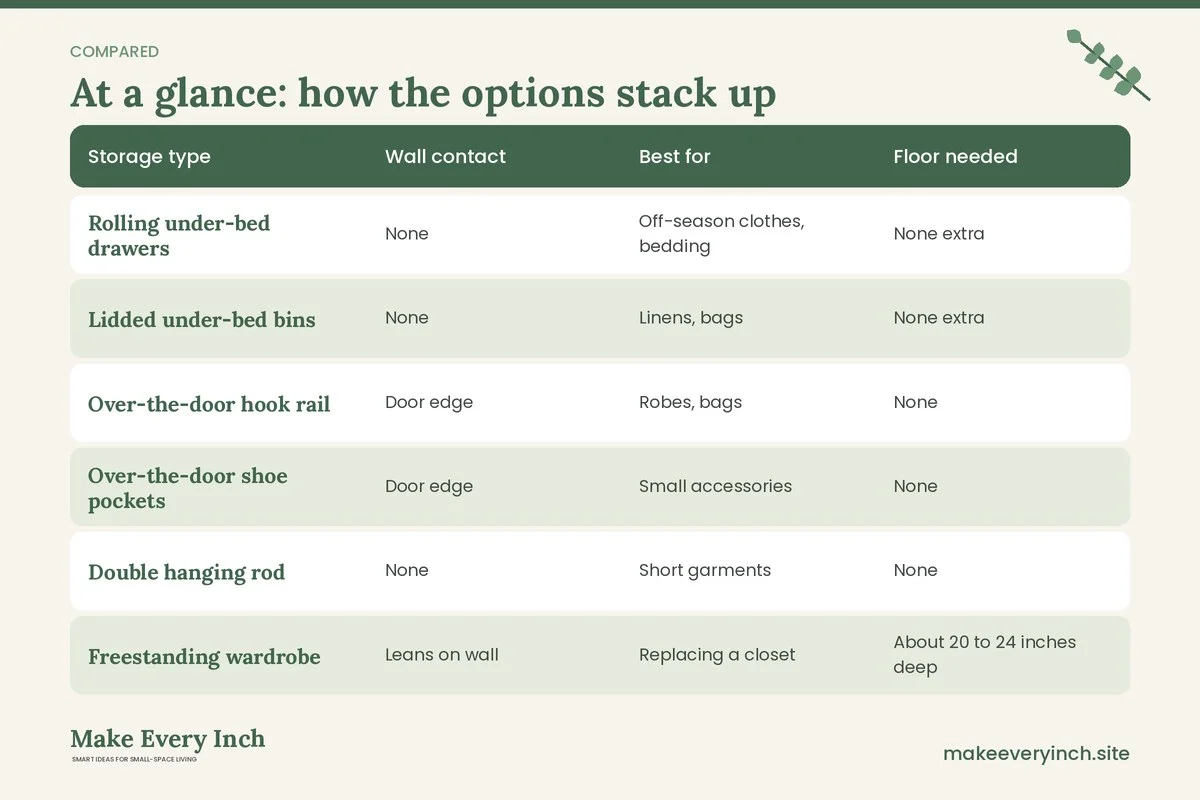
Comparison table: which storage type fits which problem
| Storage type | Wall contact | Best for | Floor needed | Main caution |
|---|---|---|---|---|
| Rolling under-bed drawers | None | Off-season clothes, bedding | None extra | Check bed clearance |
| Lidded under-bed bins | None | Linens, bags | None extra | Dust and moisture |
| Over-the-door hook rail | Door edge | Robes, bags | None | Door must close fully |
| Over-the-door shoe pockets | Door edge | Small accessories | None | Light loads only |
| Double hanging rod | None | Short garments | None | Rod strength |
| Freestanding wardrobe | Leans on wall | Replacing a closet | About 20 to 24 inches deep | Tip-over risk |
| Tall dresser | Leans on wall | Folded clothes | About 16 to 20 inches deep | Anchor if allowed |
| Low dresser | Minimal | Everyday clothes | About 16 to 20 inches deep | Heavy to move |
| Rolling rack | None | No-closet rooms | About 16 to 20 inches deep | Lock wheels |
| Storage bench | None | Bedding, shoes | About 14 to 18 inches deep | Lid weight |
Anchoring, stability and safety
Tall furniture is the one bedroom storage risk that needs special care. Dressers, wardrobes and bookcases can tip, especially when drawers are open or a child climbs on them. Tip-over injuries are a real hazard, and it is worth planning for stability before the piece goes in.
- Ask first. Anchors usually mean a screw in the wall. Many leases forbid it, so get written permission from the landlord, and ask whether a stud is acceptable.
- Choose the right fix. If you are allowed, use the anti-tip straps or brackets that come with the furniture. Attach them to a wall stud or with an anchor that is rated for the wall type, and follow the directions.
- If you cannot anchor, choose low and wide furniture instead of tall and narrow furniture. A piece whose height is less than its depth times three is much more stable. Keep heavy items low, and do not place a TV on a dresser that is not designed for it.
- Lean it back. A slight backward lean, from a thin shim under the front feet, helps a piece stay put. Make sure it cannot slide.
- Load it correctly. Put heavy items in the bottom drawers, open one drawer at a time and close them after use.
- Children and pets. If children live in or visit the home, treat anchoring as essential. If you cannot anchor, do not use a tall dresser.
- Over-the-door items. Stay within the weight rating, and avoid heavy loads that can pull a door off its hinges.
- Electrical safety. Do not run cords under a bed, a rug or a piece of furniture where heat can build up. Do not overload outlets and power strips, and keep chargers off soft bedding.
- Fire safety. Keep storage clear of heaters, radiators and vents. Leave clear room around the bedroom door, since it is your escape route.
- Ventilation. Do not seal damp clothing into a closed bin. Leave air space behind a wardrobe on an exterior wall to reduce mold.
If you want to paint a piece of furniture you are bringing, use low-VOC paint, work with a window open and let it cure before you load it. Never paint anything on the lease’s property without permission.
Three example bedrooms
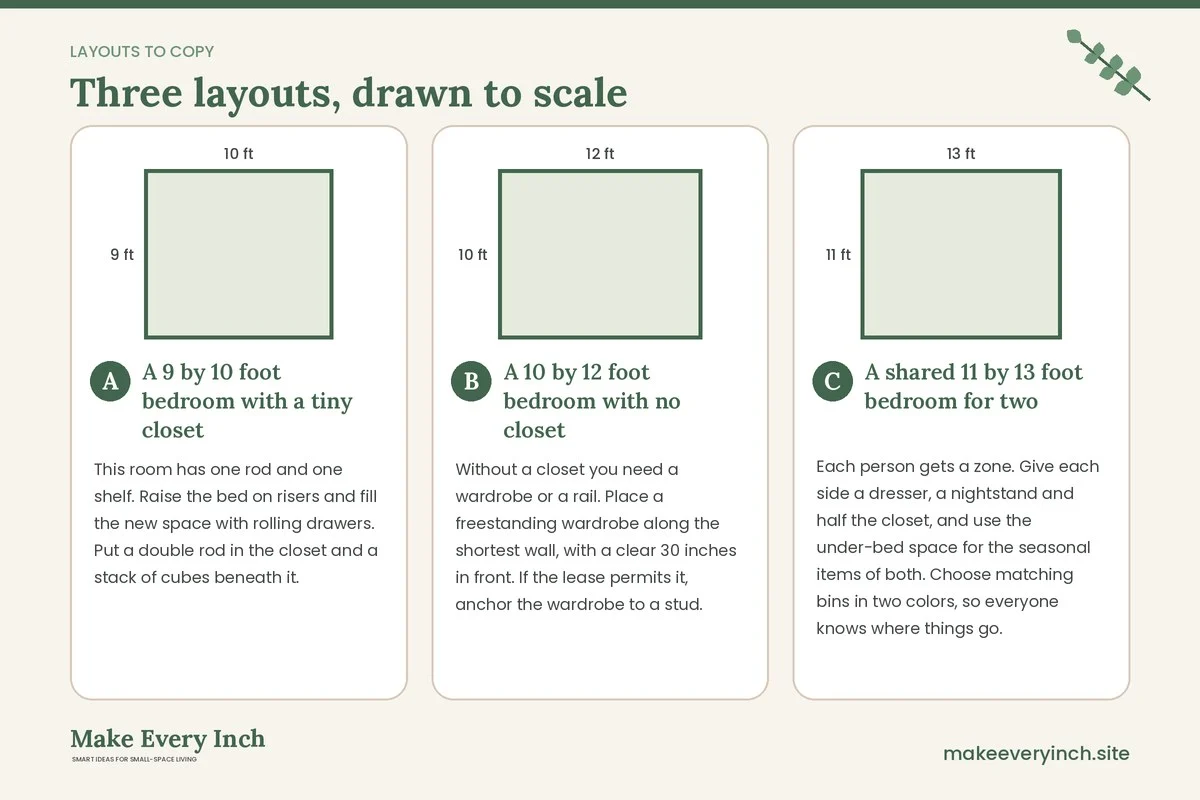
A 9 by 10 foot bedroom with a tiny closet
This room has one rod and one shelf. Raise the bed on risers and fill the new space with rolling drawers. Put a double rod in the closet and a stack of cubes beneath it. Use an over-the-door hook rail for tomorrow’s clothes. A low dresser at the foot of the bed holds the rest. This gives you four storage zones and no wall fixings.
A 10 by 12 foot bedroom with no closet
Without a closet you need a wardrobe or a rail. Place a freestanding wardrobe along the shortest wall, with a clear 30 inches in front. If the lease permits it, anchor the wardrobe to a stud. If not, use a rolling rack and two low dressers instead. Add a storage bench at the foot of the bed. For further ideas, see our guide to small bedroom ideas for renters.
A shared 11 by 13 foot bedroom for two
Each person gets a zone. Give each side a dresser, a nightstand and half the closet, and use the under-bed space for the seasonal items of both. Choose matching bins in two colors, so everyone knows where things go. A wide, low dresser under the window gives you a shared surface and a place for a lamp. For a plan built around two people, see our guide to small bedroom ideas for couples.
A seasonal rotation
You rarely need every garment at once. Rotating by season frees space.
- In spring and autumn, move off-season clothes into under-bed drawers or lidded bins.
- Wash and dry everything fully before you store it, and avoid plastic bags that trap moisture.
- Put a label with the contents and the date on each bin.
- Keep daily items at hand height, and put bulky items such as coats and blankets at the top or the bottom.
- Donate what you did not wear all year.
- Check each bin for moisture and pests as you swap.
Mistakes to avoid
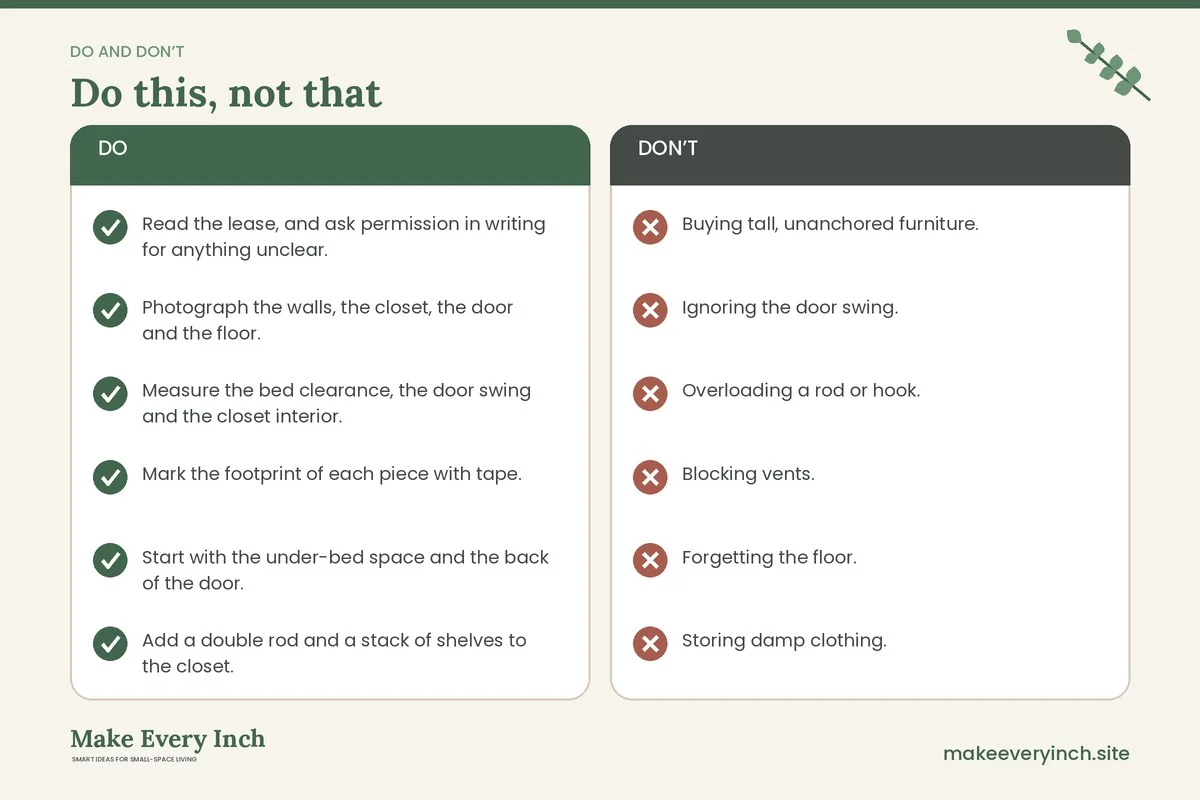
- Buying tall, unanchored furniture. If you cannot anchor it, do not buy it.
- Ignoring the door swing. A wardrobe that blocks the door is a hazard.
- Overloading a rod or hook. Respect the weight limits on everything.
- Blocking vents. Keep storage clear of heaters and radiators.
- Forgetting the floor. Heavy pieces can dent carpet and scratch hard floors, so use pads.
- Storing damp clothing. It leads to mold, especially in under-bed bins.
- Skipping the photos. Take them before and after.
- Assuming adhesive is harmless. Test on a hidden spot, and follow the lease.
Moving out
Empty the room completely, and look at the walls, the floor and the closet. Remove over-the-door items and check the door edge. Peel any adhesive slowly, warm any residue gently and wipe it off with a mild cleaner that suits the surface. Fill nothing and paint nothing without permission. Compare the room to your first set of photos and take a second set. Keep both until your deposit has been returned. For more help, see our guide to organization ideas for renters.
Bedroom storage checklist
- Read the lease, and ask permission in writing for anything unclear.
- Photograph the walls, the closet, the door and the floor.
- Measure the bed clearance, the door swing and the closet interior.
- Mark the footprint of each piece with tape.
- Start with the under-bed space and the back of the door.
- Add a double rod and a stack of shelves to the closet.
- Choose low, wide furniture if you cannot anchor.
- Anchor tall pieces only with written permission.
- Put heavy items in the lowest drawers.
- Keep cords, heaters and vents clear.
- Rotate clothes by season, and store them clean and dry.
- Take photos again before you move out.
FAQ
What is the best renter friendly bedroom storage idea?
Under-bed storage is usually the best place to start, because it adds a lot of space and attaches to nothing. Add rolling drawers or lidded bins that fit your bed clearance, and then move on to the back of the door and the closet.
Can I anchor a dresser in a rental?
Only with permission. Many leases ban screws in walls, so ask in writing. If the landlord says no, choose a low, wide dresser, keep heavy items low and avoid tall furniture, especially if children are in the home.
Do over-the-door organizers damage doors?
Used within their weight rating on a solid door, they usually do not. Check that the door closes fully, and look at the top edge for scuffs. A cushion or felt pad on the hook can protect the paint.
How can I add a closet to a bedroom that has none?
Use a freestanding wardrobe or a rolling rack, plus low dressers. Keep the walkway clear and choose pieces that fit the room. See our guide to small bedroom ideas without a closet, linked above.
Is it safe to use bed risers?
They can be safe on a sturdy frame that is designed to be raised. Use risers with a recess, check that the bed cannot slide and avoid very tall stacks. If the frame is old or loose, skip them.
How do I protect my floor from heavy furniture?
Use felt or rubber pads on hard floors, and a wide base or board on carpet. Lift furniture instead of dragging it, and photograph the floor before you start.
Keep going: Keep going with our guide to no-drill storage ideas for renters, the full list of small bedroom ideas for renters and the sibling guide to renter-friendly kitchen storage ideas.
Save this guide for later
Pin the ideas you like to Pinterest so you can come back to them when you plan your space.