Small Home Office Ideas That Fit Anywhere
Quick answer: The best small home office ideas that fit anywhere are portable and flexible: a laptop kit stored in a tray or bag, a rolling cart, a fold-away or wall-hinged desk, a console that doubles as a desk, and a corner nook with a narrow shelf. Pick the setup that matches how many hours you work, keep the footprint to roughly 2 by 4 feet or less, and plan a five-minute set-up and pack-down routine so the space returns to normal each evening.
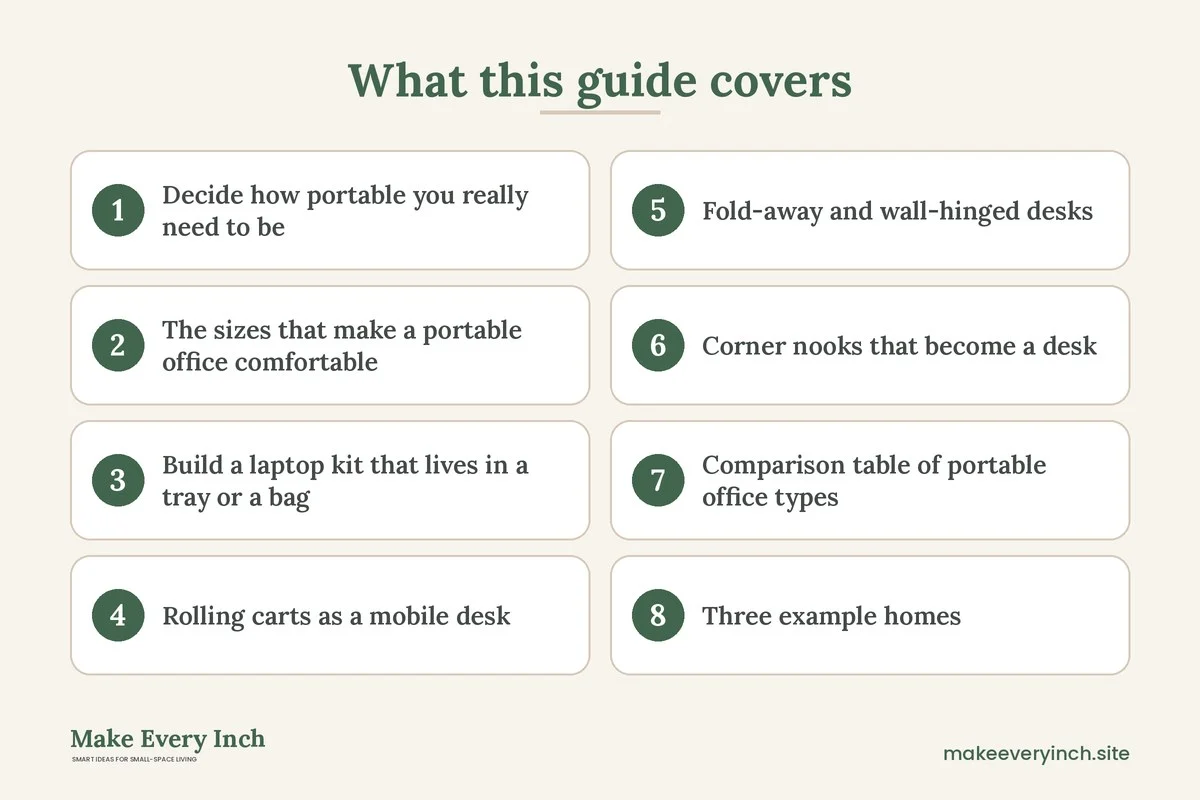
Small home office ideas that fit anywhere are for people who do not have a spare room, a permanent desk spot or a landlord who welcomes holes in the wall. Maybe you work from the sofa three days a week, from the dining table on busy days, or from a corner of the bedroom that also has to hold a bed. The common problem is that a fixed desk demands a fixed footprint, and many small homes cannot give one up. A portable setup solves this by turning an office into a kit, a cart or a fold-away surface that appears when work starts and disappears when it ends. This guide covers how to choose between setups, the sizes that matter, a laptop kit you can build from what you own, carts, fold-away desks, corner nooks, a comparison table, three example homes, safety notes, mistakes and a checklist. For the wider topic, start with our main guide to small home office ideas, and for the companion piece on arranging a workspace once you have chosen it, read small home office layout ideas.
Decide how portable you really need to be
Before you buy or build anything, answer three questions. They save more money and space than any product.
- How many hours a day do you work at the setup? Under three hours a day suits a pure kit that lives in a bag or on a tray. Three to six hours suits a cart or a fold-away desk with a proper chair. Over six hours generally calls for a fixed or semi-fixed desk, even a small one, because setting up and packing down twice a day becomes a burden you will stop doing.
- Do you need to hide it? If work items stay visible in your living space, you may find it hard to switch off in the evening. A setup that folds, closes or rolls behind a door gives you a mental boundary as well as a physical one.
- Do you take calls or video meetings? A call needs a plain background, decent light on your face and a quiet corner. A portable setup that can reach a wall, even a small stretch of wall, handles video better than one that floats in the middle of a room.
Write the answers in one sentence, such as “I work four hours a day, I need to hide it, and I take two calls a week.” That sentence points to the right section below.
The sizes that make a portable office comfortable
A flexible office still has to fit a body. These ranges are common starting points for an adult, and bodies and chairs vary, so treat them as hedged guidance and adjust to your comfort. This is not medical advice, and if you have pain when you work, a qualified professional can advise on your setup.
- Work surface height: often around 28 to 30 inches for a seated desk. Many people find a laptop on a lower surface, such as a 24 to 26 inch cart or a lap tray, tiring over long sessions, so keep those for short stints.
- Surface depth: 20 to 24 inches fits a laptop, a notebook and a mug. A depth of 16 to 18 inches works for a laptop alone.
- Surface width: 30 to 40 inches is enough for one laptop and a notebook. A second screen usually asks for 40 to 48 inches.
- Knee space: at least 18 to 24 inches of clear depth under the surface and about 24 to 26 inches of height, so your legs are not squeezed by a drawer or a cross bar.
- Chair clearance: roughly 30 to 36 inches behind the desk edge to pull out and sit down, or 24 inches in a tight spot where you slide the chair in from the side.
- Screen height: the top of the screen is often placed near eye level, so a laptop on a low surface benefits from a riser and a separate keyboard.
- Folded footprint: aim for 2 to 4 inches deep for a wall-hinged desk, and 12 to 18 inches deep for a folding table stored in a closet.
Measure your own elbow height when you sit in the chair you plan to use. If your forearms rest on the surface at about a right angle, you are close. If you must lift your shoulders or reach down, change the surface height or add a cushion.
Build a laptop kit that lives in a tray or a bag
The cheapest and most flexible portable office is a kit. It turns any surface, a dining table, a counter, a bed tray or a console, into a workstation in two minutes, and it fits in a cupboard when you finish.
What goes into the kit
- A laptop stand or riser so the screen sits closer to eye level.
- A compact keyboard and a mouse, either wireless or on a short cable.
- A charger with a cable that is long enough to reach a wall socket from where you work.
- A headset or earbuds for calls.
- A notebook, two pens and a small pad of sticky notes.
- A small clip light or a lamp if the room is dim.
- A cable pouch for chargers and adapters.
Everything lives in a tray, a shallow box, a bag or a drawer. The tray is the key idea. When you finish work, the whole kit goes onto the tray and the tray goes onto a shelf or into a cupboard. You carry a single object, not twelve.
Where the kit works best
- A dining table. The most common spot. Keep the kit on a shelf near the table so you do not carry it far.
- A kitchen counter. Stand-height work for short tasks. A counter is fine for a morning of emails but is not comfortable for a full day of seated work.
- A bed tray or a lap desk. For light work only. Sitting in bed for hours rarely suits a back, and it blurs the boundary between sleep and work.
- A console behind a sofa. A narrow console, 12 to 16 inches deep, can act as a standing or perching surface for short stints.
For storing the kit and the rest of your gear, see our guide to small space organization ideas.
Rolling carts as a mobile desk
A cart gives you a surface with storage that moves with you. It works best for people who want to shift their office between rooms or tuck it into a closet.
Choosing a cart for work
Look for a cart with a top of at least 18 by 24 inches, wheels with locks, and a lower shelf for a printer, files or a box. The top should be flat and stable, because a laptop on a wobbling top is irritating within the hour. A lip around the top keeps items from sliding when you roll it. Our guide to the best rolling kitchen carts covers the features to look for, many of which apply to office use as well.
Cart set-ups
- The slim cart. A 12 to 15 inch deep cart is enough for a laptop and a notebook if you stand or perch on a tall stool. It slides into a gap beside a refrigerator or a bookcase.
- The two-tier cart. The top holds the laptop, the middle holds a basket of papers and the bottom holds a box with a printer. Roll it out of a closet and plug it in.
- The cart plus lap desk. The cart parks beside the sofa and acts as a side table with storage. A lap desk sits on the knees for writing, and the cart holds the rest of the kit.
Cart safety
Lock the wheels before you work. Do not load the top shelf with heavy items because a top-heavy cart can tip, especially when a chair bumps it. Route a power cord so no one trips on it, and do not stretch a cable across a walkway. If the cart carries a power strip, plug the strip into the wall rather than into another strip, and keep the load within the limits printed on the strip and the socket.
Fold-away and wall-hinged desks
A fold-away desk is the answer when you want a real desk surface but cannot spare the floor space all day. These come in a few common forms.
Types of fold-away desks
- A wall-hinged drop-leaf desk. The surface folds up flat against the wall and drops down on a hinge and a support bracket. This option typically needs fixing to wall studs, so it belongs only in homes where drilling is permitted. Always get written permission from a landlord before you drill, and use fasteners suited to the wall type. If you are unsure of the structure, ask a qualified installer.
- A freestanding folding table. A table with folding legs stores flat in a closet, behind a door or under a bed. Check that it is stable, with no wobble and a locking mechanism for the legs.
- A secretary or cabinet desk. A cabinet with a drop-down front becomes a desk when open and a closed piece of furniture when shut. It hides cables and paperwork behind doors. Anchor a tall cabinet to the wall if you are permitted to, or choose a low one that is stable on its own.
- A fold-down shelf bracket. A narrow shelf on folding brackets provides a perch or standing surface about 12 to 16 inches deep. Fine for short work, and less suited to long sessions.
- A convertible console. A console table with a pull-out or flip-up leaf extends from 12 inches deep to 24 inches when you work.
Fold-away tips
Keep the heavy gear off the folding surface unless the product is rated for it. A monitor on a weak hinge is an accident waiting to happen. Make sure there is a socket nearby and plan where the cable runs when the desk is folded. When the desk is up, the area around the folded panel should be free of anything that stops it from closing. If the desk is against a wall that you cannot drill, a freestanding folding table or a cart is a safer choice. Our post on DIY desk ideas for small spaces shows more ways to build a compact surface.
Corner nooks that become a desk
A corner nook is not exactly portable, but it is flexible, since it uses a space that does little else. Corners are often dead zones, and a narrow desk plus a shelf can turn one into an office.
Ways to build a corner nook
- An L-shaped arrangement of two narrow surfaces. Two 12 to 16 inch deep shelves or tables meeting at the corner give you a workspace plus a place for a lamp.
- A triangular or corner desk. Designed to fit the angle of a wall junction. Check that the knee space is wide enough, because corner desks can feel cramped.
- A narrow desk with a pegboard or a rail above. Hang a few trays, a pen cup and a clip light from a freestanding or a tension-based system, if you cannot drill.
- A window nook. A narrow desk below a window uses a spot that is often free. Mind glare on the screen, and check the window for drafts and heat.
- A closet nook. Remove the doors or fold them back, and fit a shelf at desk height inside. Close the doors at the end of the day to hide the office entirely. Make sure there is ventilation if you use equipment that warms up, and do not close a door on a hot device.
A corner nook is a good partner for a small shelf of books and supplies. For more on how to do this in a bedroom, see our post on small bedroom ideas with a desk, and for desk choices, see the best desks for small apartments.
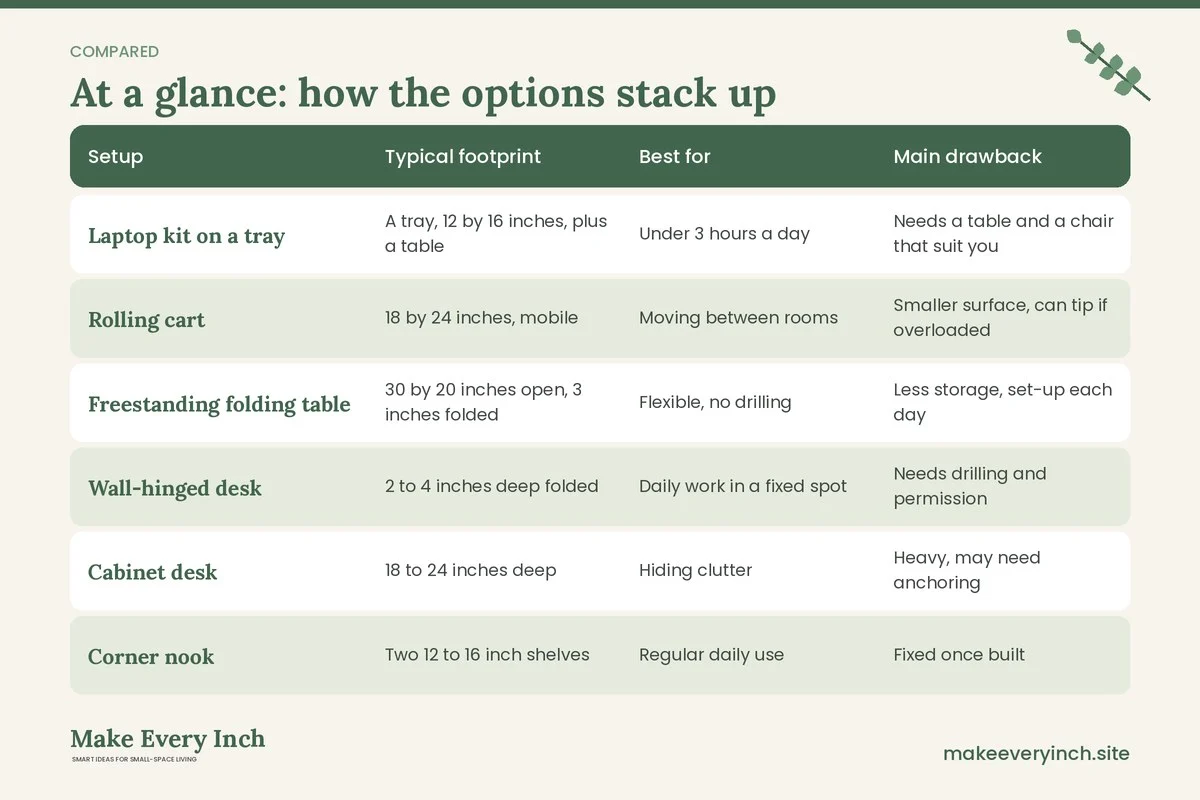
Comparison table of portable office types
| Setup | Typical footprint | Best for | Main drawback | |
|---|---|---|---|---|
| Laptop kit on a tray | A tray, 12 by 16 inches, plus a table | Under 3 hours a day | Needs a table and a chair that suit you | |
| Rolling cart | 18 by 24 inches, mobile | Moving between rooms | Smaller surface, can tip if overloaded | |
| Freestanding folding table | 30 by 20 inches open, 3 inches folded | Flexible, no drilling | Less storage, set-up each day | |
| Wall-hinged desk | 2 to 4 inches deep folded | Daily work in a fixed spot | Needs drilling and permission | |
| Cabinet desk | 18 to 24 inches deep | Hiding clutter | Heavy, may need anchoring | |
| Corner nook | Two 12 to 16 inch shelves | Regular daily use | Fixed once built | |
| Convertible console | 12 to 24 inches deep | Dual use with a hallway or living room | Narrow surface |
Use the table as a starting point, not a rulebook. Many people combine two, such as a corner shelf for the laptop and a cart for printing and files.
Three example homes
1. The studio apartment
A studio with one main room has no space for a permanent desk. The owner uses a console behind the sofa as a standing surface for short tasks, and a freestanding folding table stored behind the bed for long days. A kit in a tray holds the laptop, riser, keyboard and charger. The routine is simple: unfold the table by a window, place the riser, plug in the charger, and fold everything away at 5 pm. A tall folding screen or a bookcase nearby separates the work area from the bed visually. For more on this layout, see how to fit a desk into a studio apartment and studio apartment ideas for working from home.
2. The bedroom with a corner
A bedroom has a free corner beside the window, 36 by 30 inches. The owner fits a narrow desk, 36 inches wide and 18 inches deep, along one wall, and a floating shelf, if allowed, or a freestanding shelf above it. The bed is 4 feet away, so a lamp with a warm bulb is kept for the evening, and the laptop goes in a drawer at night. A curtain or a folding panel hides the desk from the bed, if desired. The room reads as a bedroom again when work ends. See also small bedroom desk ideas.
3. The shared living room
A family home with a combined living and dining room has a dining table that serves for meals. The remote worker uses a cart that lives in a coat closet. The cart holds a laptop, a keyboard, a headset and a printer. Each morning it rolls to the end of the dining table, plugs in beside a socket and anchors the work. At lunch, the cart rolls back into the closet and the table is ready for a meal. A small lamp and a headset keep calls clear when children are around.
Cords, power and lighting for portable offices
A flexible setup still needs power and light, and these two are where small spaces often go wrong.
Power
- Plug high-draw items, such as heaters, space heaters and kettles, directly into a wall socket, and not into a power strip with your laptop and a monitor.
- Do not chain power strips together. Check the rating printed on the strip and do not exceed it.
- Keep cords out of walkways. If a cord has to cross a path, use a cord cover that is rated for foot traffic and does not create a trip edge.
- Let chargers and adapters breathe. Do not bury them under cushions or blankets.
- Coil excess cord and use clips or ties, not tight bends that can damage the insulation. Our guide to renter-friendly ways to hide cords has non-damaging options.
Light and glare
- Place the screen so a window is to the side, not behind or in front of you. A window directly behind the screen creates glare and reflections.
- Use a lamp that lights the desk without shining directly on the screen. A clip light or a small desk lamp helps in the evening.
- A neutral or warm bulb is gentle for long work in the evening. Avoid a bare bulb in the line of sight.
- For more ideas, see renter-friendly lighting ideas.
Ventilation and comfort
If your nook is in a closet or a small room, keep air moving and do not block vents. If you plan to paint a nook or a closet, choose a low-VOC product and ventilate until the smell fades, following the instructions on the label.
Storing the office so the room resets
A portable office only works if the pack-down is easy. Build the storage first.
- Choose one box, tray or drawer that holds everything. If it does not fit, you own too much for a portable office.
- Use a shelf or a hook near the work spot for the bag or tray.
- Keep a small basket for papers that need action, and clear it weekly.
- Label the cable pouch so you do not hunt for an adapter.
- Keep the printer on a shelf in a closet or on the cart, and print only when needed.
For hidden options, our post on hidden storage ideas is a good source, and the no-drill storage ideas for renters shows how to add shelves without making holes. If you do add a shelf, anchor it to the wall where permitted, and never overload it.
A five-minute daily routine
A portable office succeeds on routine, not on gear.
1. Set up. Take the tray to the work spot, place the riser and plug in the charger. Two minutes.
2. Check the light. Adjust a blind or a lamp so there is no glare. Thirty seconds.
3. Work in blocks. Stand, stretch and look away from the screen at regular intervals. Hedged advice only: this is a general habit, and a professional can give tailored guidance.
4. Pack down. Clear the surface, put the laptop and charger on the tray and return the tray to its home. Two minutes.
5. Reset the room. Push the chair in, fold the table and wipe the surface.
A shut-down ritual, even a small one, tells your brain that work is over. Switch off a lamp, close a cabinet or fold a panel.
Common mistakes with portable offices
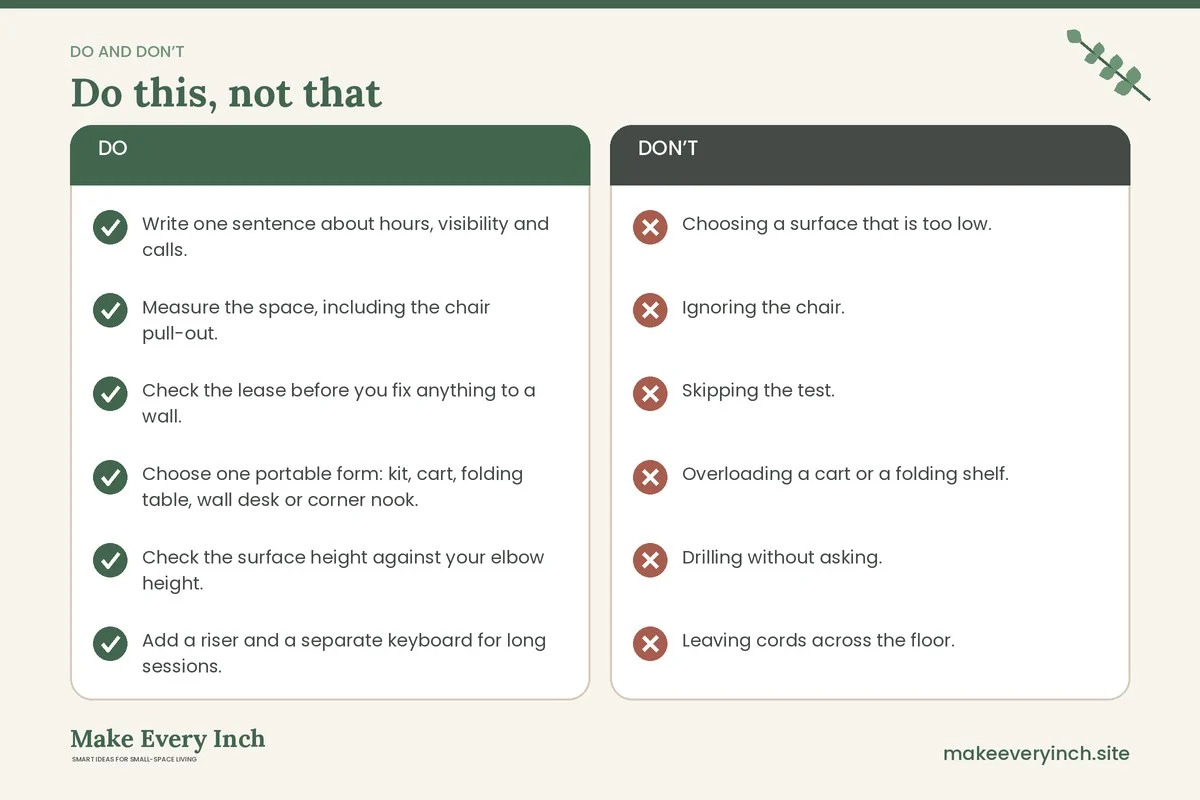
- Choosing a surface that is too low. A lap desk is fine for an hour and uncomfortable for a day.
- Ignoring the chair. The best desk fails with a poor chair. A dining chair with a cushion can work for short stints. Long days usually benefit from a supportive seat.
- Skipping the test. Set up the kit once and work for an hour before you commit to a design.
- Overloading a cart or a folding shelf. Respect the rated weight and keep heavy items low.
- Drilling without asking. A wall-hinged desk needs a conversation with the landlord first.
- Leaving cords across the floor. Plan the route before you plug in.
- Letting the kit sprawl. If the tray overflows, remove items until it does not.
Setup checklist
- Write one sentence about hours, visibility and calls.
- Measure the space, including the chair pull-out.
- Check the lease before you fix anything to a wall.
- Choose one portable form: kit, cart, folding table, wall desk or corner nook.
- Check the surface height against your elbow height.
- Add a riser and a separate keyboard for long sessions.
- Locate a wall socket and plan the cord route.
- Do not chain power strips, and keep to the printed ratings.
- Place the screen so windows sit to the side.
- Add a lamp for the evening.
- Anchor tall cabinets or shelves where permitted.
- Create a home for the kit and a five-minute pack-down routine.
- Test the setup for an hour before buying more.
FAQ
What is the best small home office idea if I have no spare room?
A laptop kit on a tray combined with a folding table or a cart is the most flexible. It uses no permanent floor space, and you can add a corner nook later if you want a regular spot.
How big does a portable desk need to be?
Roughly 30 to 40 inches wide and 20 to 24 inches deep fits a laptop and a notebook. A narrower surface works for a laptop alone, and a second screen asks for a wider one. Adjust to your body and your work.
Can I use a dining table as my office?
Yes, many people do. Keep a kit on a nearby shelf, clear the table at the end of the day and use a chair with a cushion that suits you. Check that the table height feels comfortable with your elbows.
How do I make a fold-away desk safe?
Choose one rated for your equipment, fix a wall-hinged model only with permission and suitable fasteners, and keep heavy gear off weak hinges. If you are unsure, ask a qualified installer.
How do I hide a work setup in a living room?
Use a cabinet desk, a cart in a closet, or a screen or curtain that hides the nook. A tray that stores everything also helps, since one object is easy to put away.
Is it bad to work from the sofa or bed?
Many people find it uncomfortable for long sessions, and it can blur the line between rest and work. This is general information, not medical advice, and a professional can advise on pain or posture.
How do I manage cords in a flexible office?
Keep one charger at the work spot, use a cable pouch, avoid chaining power strips, and route cords out of walkways. Non-damaging clips and covers help in a rental.
Keep going: Keep planning with our small home office ideas guide, the small home office layout ideas companion post and how to fit a desk into a studio apartment.
Save this guide for later
Pin the ideas you like to Pinterest so you can come back to them when you plan your space.