Furniture That Makes Small Rooms Feel Bigger
Quick answer: Furniture that makes small rooms feel bigger is light in visual weight, not just small in size. Choose pieces with exposed legs, open sides and low backs, keep tones close to the wall color, use a few larger pieces instead of many tiny ones, let one multipurpose item replace two, and keep sight lines to the floor and the window clear. Anchor tall pieces and never drill in a rental without permission.
Furniture that makes small rooms feel bigger is not always the smallest furniture you can find. A room full of tiny pieces looks busy and chaotic, and a single bulky sofa can swallow a whole wall. What matters is visual weight: how heavy, dark, solid and tall each object looks, and how much of the floor, the wall and the light it lets you see past. A leggy sofa and a glass-topped table can take up the same floor as a skirted sofa and a solid wooden block, and yet feel far lighter. This guide explains the principles, shows how to apply them piece by piece, and gives a comparison table, three example rooms, a layout checklist and an FAQ. It is a buying and planning guide with no brand names. For the full furniture overview, read our pillar on the best furniture for small apartments, and for the bedroom’s biggest piece see the companion post on how to choose a bed for a small bedroom.
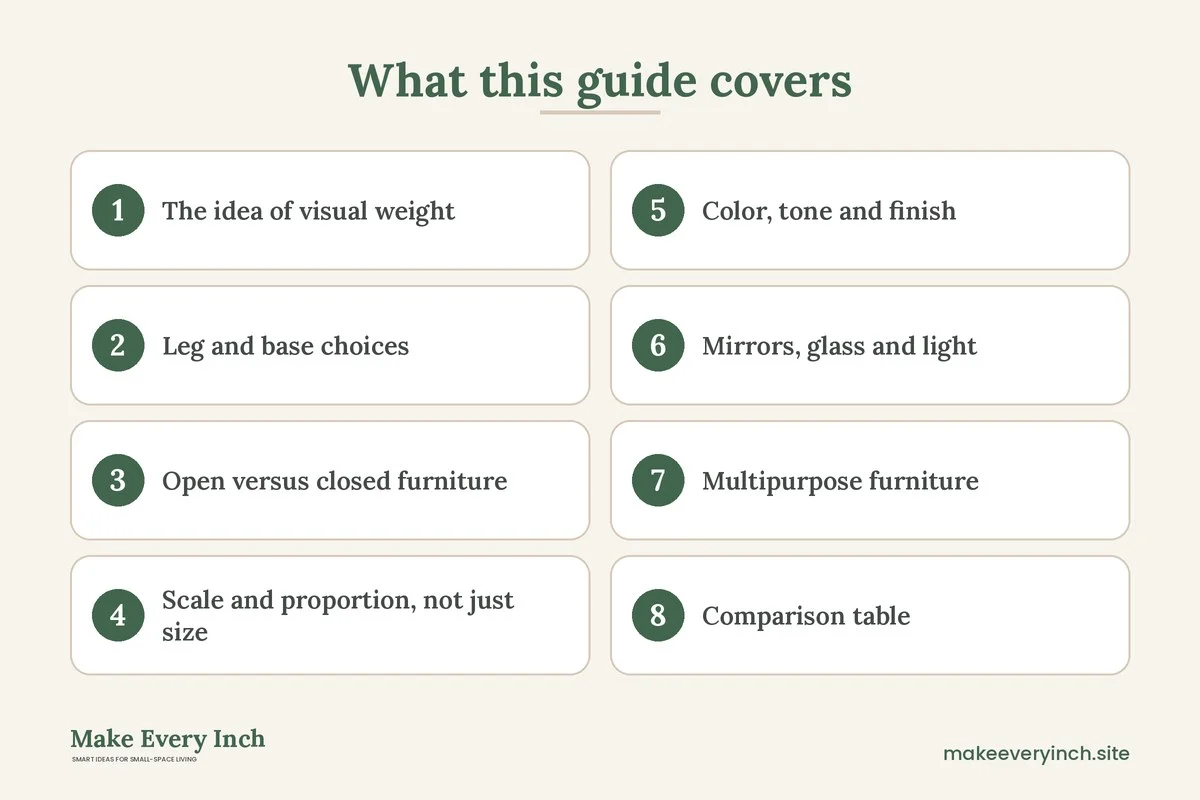
The idea of visual weight
Your eye reads a room in a second. It notices how much of the floor is visible, how far it can see along the walls and how many different colors and shapes compete for attention. Rooms feel bigger when the eye travels easily and rests on a few calm things. They feel smaller when the eye hits blocks, edges, clutter and dark masses.
You can lighten a piece of furniture in five ways. Raise it on legs so that floor shows beneath. Open it up with slats, glass, mesh or wire so that sight lines pass through. Lower it so that it does not cut the wall. Match it to the wall color so that it fades. Or give it a simple shape, because rounded and plain forms read as lighter than carved, skirted or heavily detailed ones. No single trick works alone, and the best rooms combine two or three.
Leg and base choices
The most reliable change is to choose furniture that shows floor. When the floor continues under a sofa, a bed, a console or a cabinet, the room reads as larger, because the eye measures space by how much floor it can see. Look for these details.
- Leg height: a sofa or a chair with legs roughly 6 inches tall or more shows a clear band of floor. Taller, slim legs on a console or a media unit work even better.
- Leg shape: thin, tapered or metal legs look lighter than thick blocks. Splayed legs add a mid-century feel, and they widen the footprint a little, so test with tape.
- Wall-hung or floating units: a wall-mounted cabinet or shelf frees the floor completely. Check the manufacturer’s load limit, find studs or use the right anchors for the wall type, and do not drill into a rental without written permission. Our guide to no-drill storage ideas for renters offers alternatives.
- Clearance for cleaning: about 4 to 6 inches under a piece lets a robot or a mop pass, which matters for tiny rooms where dust is visible.
Skirted sofas and cabinets with a solid plinth look heavy, since they hide the floor. They can still be right if you need hidden storage, but accept that they add visual mass.
Open versus closed furniture
Open furniture has gaps. It lets light and sight lines pass. Closed furniture is a block. Neither is better in all cases, because a room with only open pieces shows every item stored on them and looks cluttered.
- Open pieces: wire or metal shelving, ladder shelves, open-back bookcases, glass or acrylic tables, rattan and cane, slatted benches and chairs with open arms.
- Closed pieces: cabinets with doors, solid-front dressers, storage ottomans and trunks.
- A good mix: use open pieces in the front of the room and near windows, and closed pieces where you need to hide clutter. A low closed cabinet with an open shelf above gives both.
When you display items on open shelving, edit them. Group similar things, leave gaps and let a few shelves be empty. Our guide to small space organization ideas helps with deciding what stays visible.
Scale and proportion, not just size
It sounds odd, but a few larger pieces often feel bigger than many small ones. A room with ten small objects looks fussy, since the eye has ten things to process. A room with a sofa, a chair, a table and a shelf has four. Aim for a clear hierarchy. One anchor piece, usually the sofa or the bed, sets the scale. The next pieces follow it, and the smallest ones support.
Match the scale to the room’s height, too. In a room with a low ceiling, a low-profile sofa and a bed with a short headboard keep the wall visible above. In a room with a high ceiling, a tall bookcase draws the eye up and makes the room feel more generous. If you do add tall furniture, anchor it to the wall studs with the hardware recommended by the maker, because tipping is a serious hazard, particularly with children. Ask the landlord before you drill, and use freestanding low units if drilling is not allowed.
Proportion also applies to rugs and art. A rug that is too small chops the floor into a patch and makes it look smaller. A rug that reaches under the front legs of the sofa and chairs ties the group together. Hang art low and centered over furniture so that it relates to the pieces below.
Color, tone and finish
Color affects weight. Dark, saturated furniture against a pale wall pops out and looks heavy. Furniture that is close to the wall color blends in and recedes. This is why a white or pale bookcase in a white room almost disappears and gives you storage without bulk.
- Tone on tone: match the largest piece, usually the sofa, to the wall or the floor in a similar value. A pale sofa on a pale rug looks airier than a dark one.
- Wood tones: light woods read as lighter than very dark ones. Keep the wood tones consistent, to avoid a patchwork look.
- Finishes: matte surfaces absorb light, while a few glossy or mirrored surfaces bounce it around. Do not overdo gloss in a small room, since too many reflective surfaces create glare.
- Patterns: a small, tidy pattern on one large piece is fine. Many patterns on many pieces add visual noise.
- A dark accent can help: a single dark piece, such as a media unit or a bed, can anchor a room and give it depth. Keep it to one.
If you paint to make the walls match your furniture, choose low-VOC paint, ventilate while it dries and check the lease first.
Mirrors, glass and light
Mirrors do not count as furniture, though a large leaning floor mirror often acts as one. It doubles the light and the apparent depth of a wall. Place a mirror across from a window to bounce daylight, or at the end of a narrow room to extend it. Avoid placing it opposite clutter, since it will double the mess as well. Heavy mirrors must be hung securely and into studs or with anchors rated for the weight. A leaning mirror should be stabilized with an anti-tip strap or a wedge, because it can slide on a smooth floor.
Glass and acrylic tables take little visual space, though fingerprints show. A table with a glass top and slim metal legs is the classic example. For dining, our guide to the best small dining tables explains round, drop-leaf and extending options. Lighting counts as furniture too. A floor lamp that arcs over a chair takes no table space, and a wall-mounted plug-in sconce frees the surface of a night table. Light the corners, because dim corners shrink a room.
Multipurpose furniture: fewer pieces, more function
The most direct way to make a small room feel bigger is to need fewer objects. A piece that does two jobs removes one from the room. Be honest about whether you will use the second function, though. A multipurpose piece that is awkward to use becomes a dust collector.
- Storage ottoman: a seat, a footrest, a surface with a tray and a hidden box. See the best storage ottomans for what to compare.
- Nesting tables: two or three tables in one footprint. Pull them out when needed.
- Drop-leaf or wall-mounted fold-down table: a desk or a dining table that disappears. Folding mechanisms can pinch fingers, so keep hands clear when raising or lowering them, and keep children away from hinges. Check the load limit and mount into studs, and get permission before you drill a rental wall.
- Daybed or sofa bed: a seat by day and a bed at night. Check the open footprint before you buy.
- Bench with storage: an entry bench that stores shoes and doubles as a dining bench.
- Bed with drawers or a lift: moves the dresser out of the room.
- Console that extends into a table: a narrow shelf by day and a dining surface for six when needed.
The test for any multipurpose piece is simple. Imagine using each function on a normal Tuesday, and not only on the day you show it to a friend. If the second function takes more than a minute to set up, you will skip it.
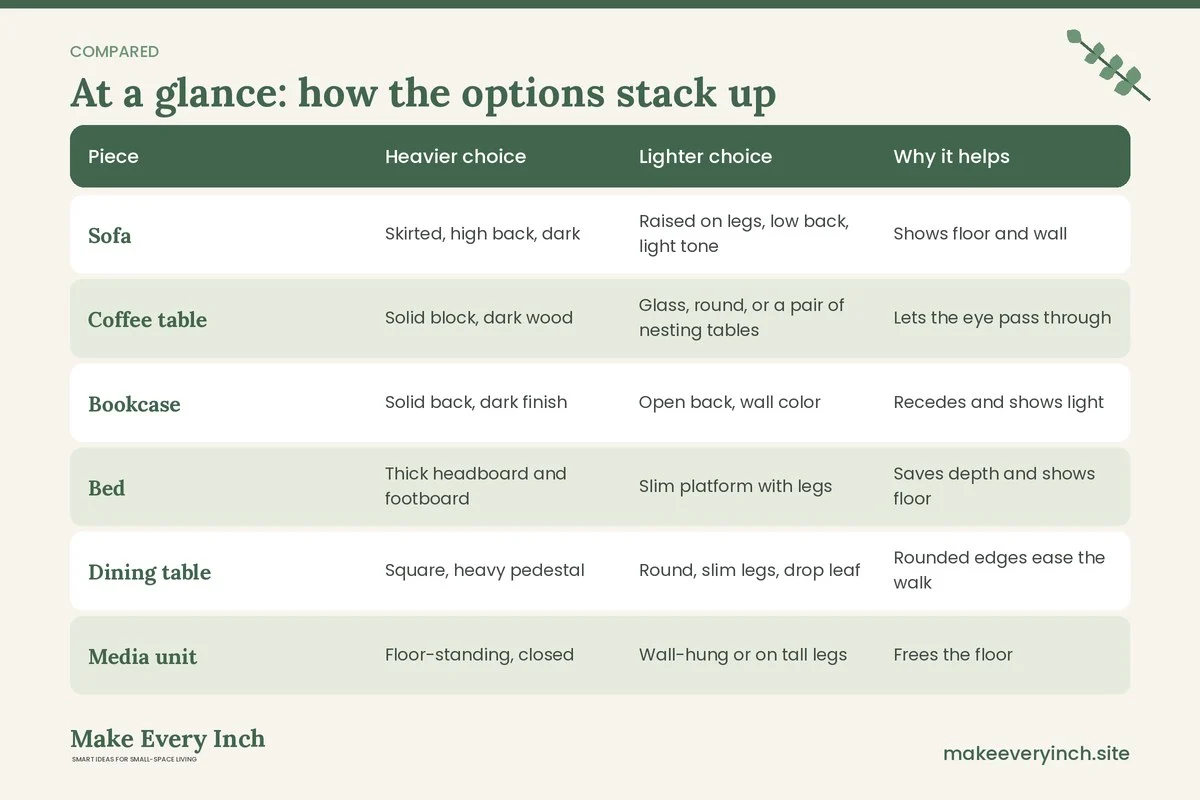
Comparison table: heavy versus light choices
| Piece | Heavier choice | Lighter choice | Why it helps |
|---|---|---|---|
| Sofa | Skirted, high back, dark | Raised on legs, low back, light tone | Shows floor and wall |
| Coffee table | Solid block, dark wood | Glass, round, or a pair of nesting tables | Lets the eye pass through |
| Bookcase | Solid back, dark finish | Open back, wall color | Recedes and shows light |
| Bed | Thick headboard and footboard | Slim platform with legs | Saves depth and shows floor |
| Dining table | Square, heavy pedestal | Round, slim legs, drop leaf | Rounded edges ease the walk |
| Media unit | Floor-standing, closed | Wall-hung or on tall legs | Frees the floor |
| Chair | Overstuffed, skirted | Open frame, slim arms | See-through shape |
| Storage | Large closed cabinets | One tall unit plus open shelves | Fewer blocks |
| Desk | Big, boxy, with drawers | Wall-mounted or narrow console | Tucks away |
Layout moves that make furniture look smaller
Even good furniture can look cramped if you place it wrongly. These moves help.
- Float less, anchor more: push the big pieces against the long walls to leave a continuous center. In some rooms a floating sofa does help to divide a zone, but only if the room is wide enough.
- Keep sight lines low: put low furniture in front of windows, and keep tall units on the walls without windows. A clear window view feels like extra space.
- Leave a clear path: a straight line from the door to the window, around 30 to 36 inches wide, makes a room feel open. Do not block it with a table.
- Angle with care: a corner chair set at an angle can soften a stiff room, but angled furniture wastes the corner, so tape first.
- Use the vertical space: tall shelves, hooks and wall-mounted cabinets pull the eye up.
- Repeat shapes: round table, round mirror and round rug create a pattern that feels calm and organized.
Our small living room layout ideas post expands on these layouts and gives arrangements for different shapes. If your space is a single room, our studio apartment ideas show how to use furniture to divide zones.
Three example rooms
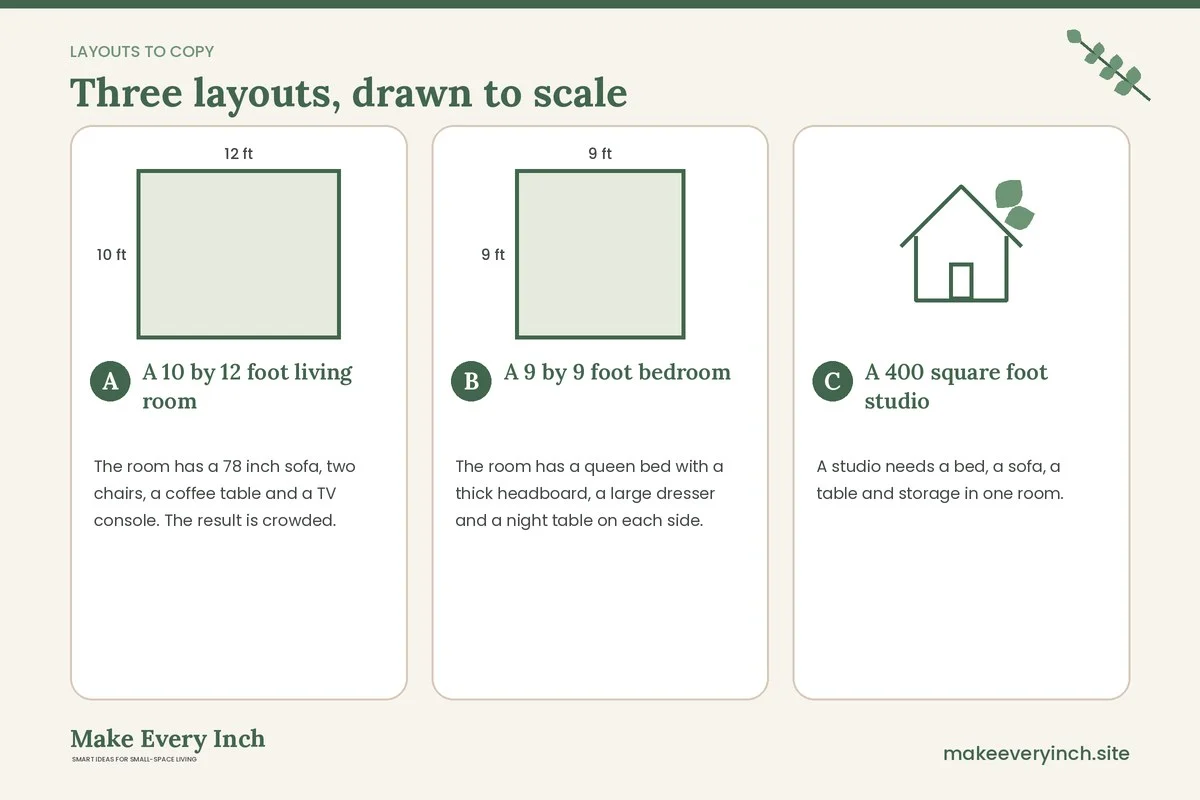
A 10 by 12 foot living room
The room has a 78 inch sofa, two chairs, a coffee table and a TV console. The result is crowded. The change is to replace the skirted sofa with a leggy one of the same width in a pale tone, swap the solid coffee table for a nesting pair, and trade the console for a wall-hung unit on the long wall (if the lease and the studs allow it). The floor now continues under the sofa and the console, and one chair goes. The room did not grow, but a clear band of floor along both walls makes it read bigger. For more ideas, see our small living room ideas pillar.
A 9 by 9 foot bedroom
The room has a queen bed with a thick headboard, a large dresser and a night table on each side. Swap the headboard for a thin panel, choose a platform bed with legs and replace the dresser with a tall, narrow chest in the wall color, anchored to the wall. Use two wall-mounted sconces instead of table lamps, so the night tables shrink to small shelves. The floor stays visible under the bed, and the dresser takes a quarter of its old footprint.
A 400 square foot studio
A studio needs a bed, a sofa, a table and storage in one room. Use a daybed or a sofa bed in place of a separate bed and sofa, a drop-leaf table on one wall that doubles as a desk, and a single tall open shelf in the color of the wall as a room divider. Keep the window wall low. This reads as one calm room instead of three small ones. Folding furniture needs clear floor when open, so tape its open footprint, and keep a 30 inch path.
Common mistakes
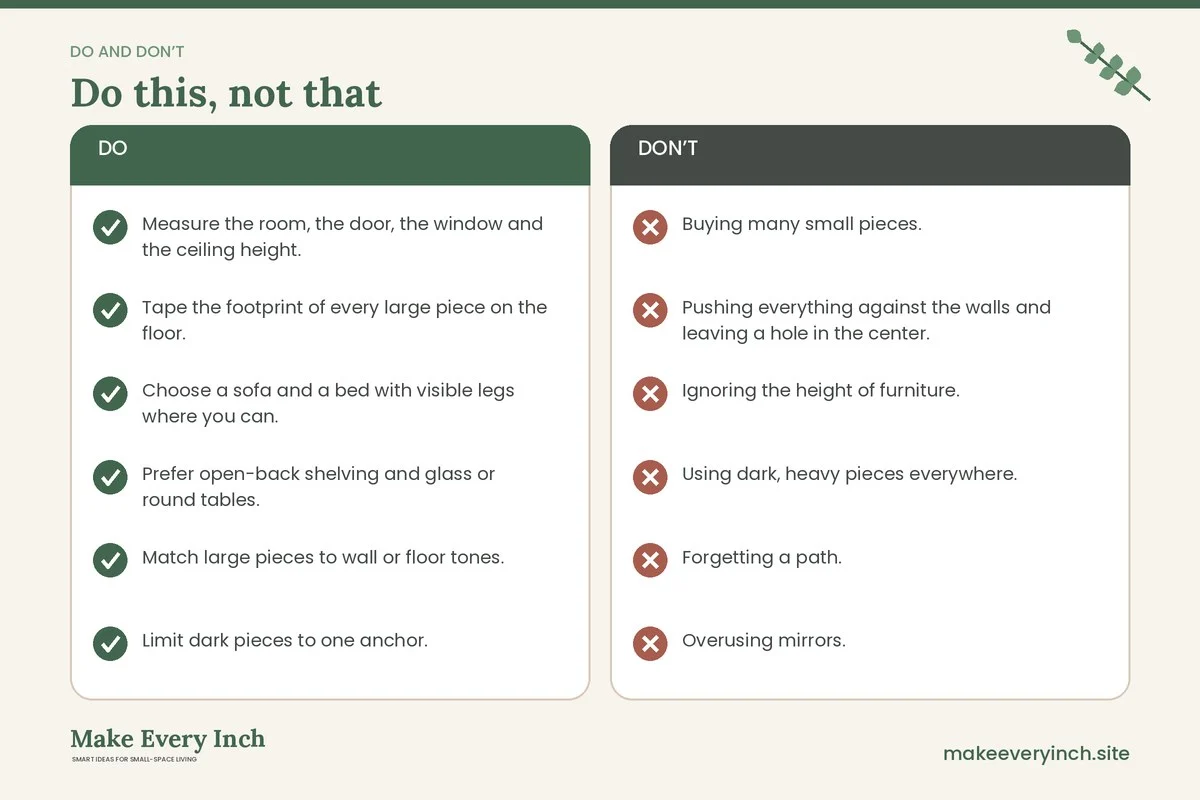
- Buying many small pieces. A cluster of tiny tables and stools looks cluttered. Choose fewer, slightly larger pieces.
- Pushing everything against the walls and leaving a hole in the center. Group seating so it relates, and add a rug.
- Ignoring the height of furniture. A tall bookcase in front of a window blocks the light that makes the room feel open.
- Using dark, heavy pieces everywhere. Keep one dark anchor, and make the rest lighter.
- Forgetting a path. If you must turn sideways to pass a table, the room is too full.
- Overusing mirrors. One or two well-placed mirrors help, and a wall of them can feel strange.
- Skipping the tape test. Mark the footprint on the floor before you buy.
Safety and lease notes
- Anchor tall pieces. Bookcases, wardrobes and chests should be secured to studs with the supplied or recommended hardware.
- Wall-mount within limits. Follow load limits, use the right anchors for your wall type and find studs for heavy loads.
- Ask first. In a rental, get written permission before drilling, and use freestanding or adhesive-free options if you cannot.
- Mind the pinch points. Folding tables, sofa beds and drop-leaf hinges can trap fingers, so move slowly and keep children away.
- Stabilize mirrors. A leaning floor mirror needs an anti-tip measure.
- Keep cords tidy. Do not run cords under rugs or across walkways, and do not overload sockets with lamps and chargers.
- Ventilate. New furniture and paint can release odors. Open windows until they fade.
Shopping and planning checklist
- Measure the room, the door, the window and the ceiling height.
- Tape the footprint of every large piece on the floor.
- Choose a sofa and a bed with visible legs where you can.
- Prefer open-back shelving and glass or round tables.
- Match large pieces to wall or floor tones.
- Limit dark pieces to one anchor.
- Choose at least one multipurpose item that you will actually use.
- Keep a 30 to 36 inch path from the door to the window.
- Leave the window wall low and clear.
- Add a rug that reaches under the front legs of the seating.
- Place a mirror across from a window, and secure it.
- Anchor all tall furniture, and check the lease before drilling.
FAQ
What furniture makes a small room look bigger?
Pieces with exposed legs, open sides, low backs and tones close to the wall color. Glass or round tables, wall-hung units and slim frames also help, as does having fewer, slightly larger items.
Is small furniture always best for a small room?
No. Too many tiny pieces look cluttered. A few well-proportioned pieces with light visual weight usually read as bigger.
Should I use light or dark furniture in a small room?
Light and mid tones usually recede, but one dark piece can add depth. Keep it to a single anchor.
Do mirrors really make a room feel bigger?
They bounce light and extend sight lines, which helps. Place them across from a window, and avoid reflecting clutter. Secure them well.
How many pieces of furniture are too many?
There is no fixed number. If you cannot keep a 30 inch main path or turn without bumping, remove something. A room should show plenty of floor.
What is the best multipurpose furniture for a small room?
Storage ottomans, nesting tables, drop-leaf tables and beds with storage are common choices. Pick the item that solves your biggest problem and that you will use daily.
Can I use wall-mounted furniture in a rental?
Only with written permission, since it needs drilling. Otherwise use freestanding units on legs or adhesive-free options.
Keep going: Keep exploring with our best furniture for small apartments, our best sofas for small apartments and the guide to how to choose a bed for a small bedroom.
Save this guide for later
Pin the ideas you like to Pinterest so you can come back to them when you plan your space.