15 No-Drill Small Laundry Room Ideas for Renters
Quick answer: A small laundry room renters can set up safely starts with the lease and a call to the landlord about any change to the machines, walls or vent. Then use freestanding racks, tension rods, over-the-door hooks, adhesive-free carts and washable baskets. Keep the dryer clear, never block vents or shutoff valves, store chemicals out of reach, and photograph the room before you begin.
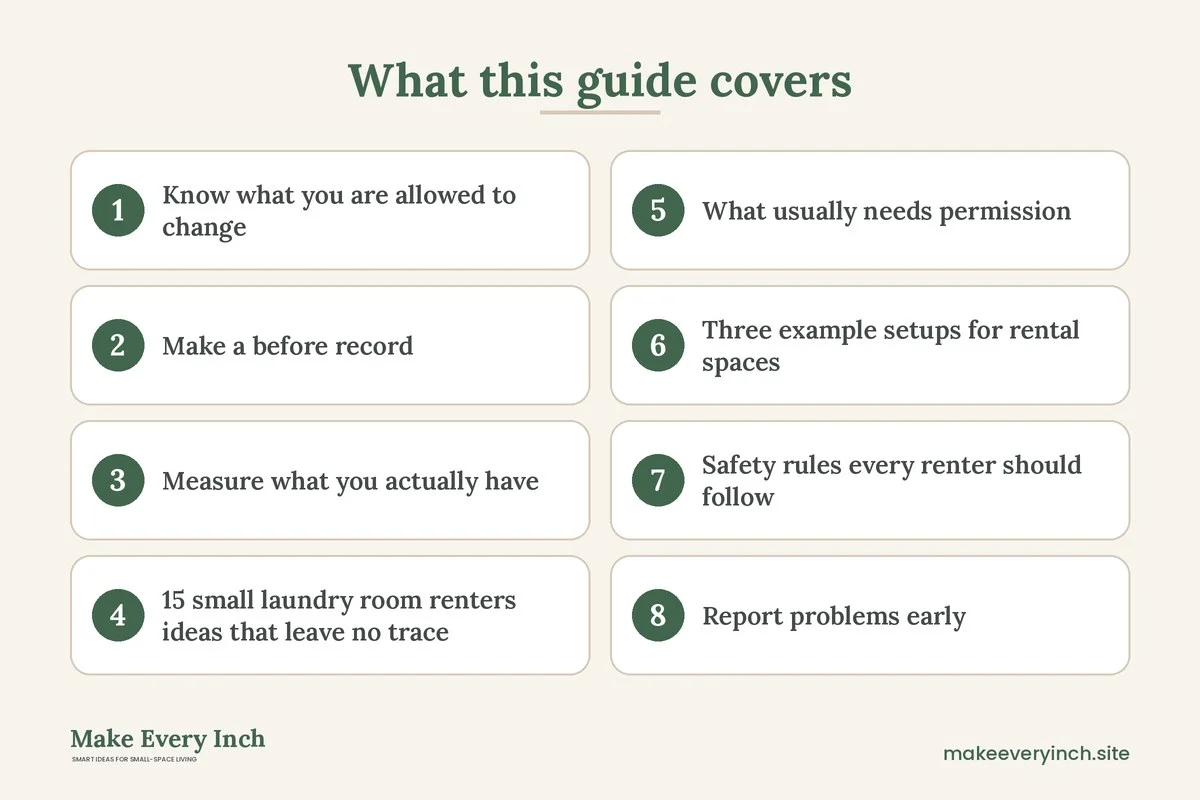
A small laundry room renters inherit is usually a puzzle. The machines are in a closet, a hallway, a kitchen corner or a shared basement. The walls may be unpainted, the shelves fixed in odd places and the lease silent on what you can change. You cannot knock out a wall, and you probably should not drill into one. The aim is to make the space work and to leave it exactly as you found it. This guide covers what to read in your lease, what to ask the landlord, how to take a before record, 15 ideas that use no permanent changes, a table of what usually needs permission, three example setups, safety rules for venting and water, a move-out routine and a checklist. For a wider view, read our hub on small laundry room ideas, and for the cost side of the same job see small laundry room ideas on a budget.
Know what you are allowed to change
Start with the lease and any house rules. Look for words about alterations, appliances, drilling, painting, adhesives and shared spaces. Many leases list the washer and dryer as the landlord’s property, which can mean you may not move them, replace them or connect anything new. Others treat them as the tenant’s responsibility for ordinary care, such as cleaning the lint trap.
Ask in writing before you do anything beyond placing a freestanding item. A short email works well. Tell the landlord what you plan to do, how it will be removed and when. Keep the reply. Typical questions include:
- May I place a freestanding rack or cart beside the machines?
- May I hang a tension rod inside the closet?
- May I use removable hooks on the door or the wall?
- Who is responsible for the dryer vent and for cleaning it?
- Where are the water shutoff valves, and may I access them?
- Are there rules about running the machines at certain hours or leaving the dryer unattended?
If you share a laundry room with other tenants, ask about posted rules and storage. Shared rooms often forbid leaving belongings behind.
Make a before record
Before moving anything, take clear photos of the whole space. Capture the walls, the floor, the machines, the hose connections, the vent and the shutoff valves. Note any existing stains, scuffs, leaks or damage and, if you can, send them to the landlord with a date. This record protects your deposit and protects you from being blamed for problems that were already there. Our post on security deposit safe apartment upgrades explains how to document a rental and which changes tend to be low risk.
Measure what you actually have
Measure the width, depth and height of each machine, the space between the machines and the walls, the clearance above them and the walkway in front. Check the appliance manuals for the clearances they require, because the numbers differ by model. Many manuals ask for a few inches of space at the back for the vent, and a bit of room at the sides. Keep your racks and carts out of that space.
Measure the door swing as well. A cart that blocks the washer door by an inch will be a daily annoyance. Test sizes by marking the floor with painter’s tape and opening the doors fully.
15 small laundry room renters ideas that leave no trace
Freestanding storage
1. A narrow rolling cart between the machines and the wall
A slim cart with three tiers fills a gap of 6 to 10 inches. It holds detergent, softener and stain removers, and it rolls out for cleaning. Lock the wheels when it is in place, and keep it clear of the dryer’s back vent and the shutoff valves. Check that the weight is spread evenly so it does not tip.
2. A freestanding shelf that stands over the machines
Some freestanding racks straddle a washer and dryer without touching the wall. Choose one with a wide, stable base, and make sure it does not rest on the machine tops, which vibrate. If the unit is tall, ask whether the landlord is comfortable with a small anti-tip strap, because anchoring a tall unit is a safety matter. Never pull a tall piece onto yourself, and keep heavy bottles on the lower shelves.
3. A wire rack in the corner
A corner rack uses wasted space and holds baskets and spray bottles. Put heavier things low and lighter things high. Keep the rack away from the dryer’s exhaust and any heat source.
4. A laundry hamper with a lid and handles
A hamper with a lid reduces visual noise and gives dirty clothes a home. Handles make carrying easier, and a washable liner means you can clean it in the machine. If your space is tight, choose a narrow style or a tall slim one.
Hanging without drilling
5. A tension rod inside the closet
A tension rod holds clothes on hangers, a drying rack or a curtain. Choose a rod rated for the load and check it regularly because the pressure can ease over time. Keep it away from heat, and do not use it directly over the dryer exhaust. See our full list of no drill storage ideas for renters.
6. Over-the-door hooks and racks
The back of the laundry door is free storage. Hang an ironing board, a lint brush or a shoe organizer filled with small bottles. Confirm the door still closes and that the hooks have padding so they do not scratch the paint.
7. Adhesive hooks for light items
Removable adhesive hooks suit light things such as a mesh bag or a small broom. Test one in a hidden spot for a few days first, because damp walls and textured paint hold adhesive poorly. Follow the weight limit on the pack, and remove them slowly according to the instructions.
8. A hanging bar that sits on the machine sides
Magnetic strips and hooks can attach to the metal side of some machines. Check that the surface is truly magnetic, and that the manual does not warn against it. Keep items clear of vents and controls. Use only light things.
9. A fold-down drying rack
A freestanding fold-down rack gives you a place for delicates without any wall fixings. Fold it flat and store it behind the door. Keep it away from the dryer’s exhaust and leave room to walk.
Work surfaces and sorting
10. A temporary folding board over the machines
A flat board that rests on the top of a pair of side-by-side machines can serve as a folding surface. Use it only when the machines are off and still, and check the manual for any weight limit on the tops. Remove it before you start a cycle, because vibration can move it. Never place a board over the dryer’s vents or the control panel.
11. A rolling laundry sorter
A frame with three bags or bins sorts clothes as you toss them in. It folds flat or tucks beside the machines. Make sure the wheels lock.
12. A basket system
Use stackable baskets for lights, darks and delicates, and a smaller one for items that need repair. A wire or plastic basket is easy to wipe clean and moves with you.
Looks and comfort
13. A washable curtain on a tension rod
If the machines sit in an open nook, a curtain on a tension rod hides them. Keep the fabric well away from the dryer’s vent and from heat, and push it aside whenever the dryer runs. Choose a fabric that you can wash and that suits the room.
14. A removable mat and a floor tray
A non-slip mat protects the floor, and a shallow tray under the washer’s edge can help you catch early leaks. Check the floor often. Do not use a mat that could shift under your feet or trap water.
15. Removable lighting
A plug-in or battery light under a freestanding shelf brightens a dim corner. Keep cords tidy and away from water, and do not use extension cords as permanent wiring. See our guide to renter-friendly lighting ideas for more options.
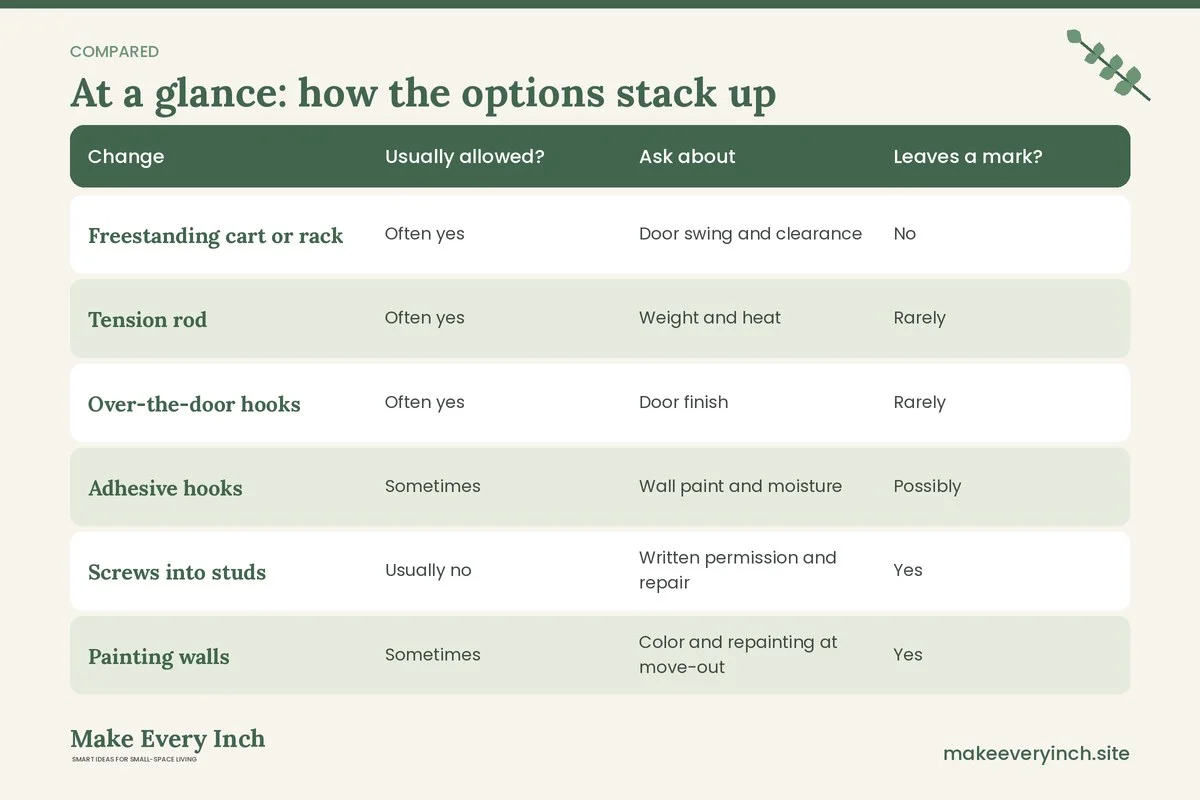
What usually needs permission
The table below gives general patterns. Your lease and landlord always decide.
| Change | Usually allowed? | Ask about | Leaves a mark? |
|---|---|---|---|
| Freestanding cart or rack | Often yes | Door swing and clearance | No |
| Tension rod | Often yes | Weight and heat | Rarely |
| Over-the-door hooks | Often yes | Door finish | Rarely |
| Adhesive hooks | Sometimes | Wall paint and moisture | Possibly |
| Screws into studs | Usually no | Written permission and repair | Yes |
| Painting walls | Sometimes | Color and repainting at move-out | Yes |
| Peel-and-stick floor | Rarely | Adhesive and subfloor | Possibly |
| Changing the vent or hoses | No | Licensed work only | Yes |
| Moving or replacing machines | No | Landlord’s equipment | Yes |
If a change is not on the “often yes” list, ask first. A reply in writing is worth the extra day.
Three example setups for rental spaces
A hallway closet with a stacked pair
The closet is about 27 to 30 inches wide, and the stacked machines fill most of it. Stacked units are heavy and can vibrate, so do not add anything that rests on them. Use an over-the-door rack for small bottles and a slim wire rack outside the closet for baskets. Keep the closet door open or use a louvered one while the dryer runs, because trapped heat and moisture are a safety issue. Check the manual and the building rules for the required opening. Our guide to small closet ideas covers other ways to use a closet.
A shared basement laundry corner
A tenant has a corner of a shared room with a machine pair and a bare wall. Shared rooms often have rules, so confirm what you can leave behind. Bring a rolling cart or a carry bag and take it with you after each load. Use a lidded tote for detergent so it stays tidy and so a spill does not reach the common floor. Avoid leaving chemicals where children or others can reach them. Keep valuables with you.
A kitchen alcove with a stacked pair behind bifold doors
The machines hide behind folding doors beside the refrigerator. Add a tension rod inside for hanging items, use hooks on the back of the doors, and set a narrow cart outside the doors for a hamper. Leave the doors open when the dryer runs. Do not hang fabric near the dryer’s vent or the kitchen heat sources. For more ideas in the same room, see renter-friendly kitchen storage ideas.
Safety rules every renter should follow
A rental does not change the physics of a laundry room. Heat, lint, water and chemicals are in the same place. These points apply broadly, so follow your appliance manuals, building rules and local codes.
- Clearance and ventilation around dryers. Do not stack baskets, towels or boxes against the dryer. Keep the front clear for airflow and the back clear for the duct. Check the manual for the minimum gaps. Enclosed closets may need a vented door, so ask the landlord what the building requires.
- Lint buildup and fire risk. Clean the lint trap after every load. If clothes take longer to dry, or the dryer feels unusually hot, stop using it and report it. A clogged vent is a common cause of laundry fires.
- Venting rules. A dryer should vent to the outside through a proper duct. Do not redirect the vent yourself, connect it to a closet or use flimsy plastic ducts. Vent work belongs to the landlord or a licensed professional.
- Water leaks and shutoff valves. Learn where the shutoff valves are, and keep them reachable. Look at the hoses for cracks, bulges or drips, and report any problem right away. A small leak can damage the floor and become your cost at move-out.
- GFCI near water. Outlets near sinks and washers are often required to have ground-fault protection. If an outlet is warm, scorched or loose, stop using it and tell the landlord. Do not run extension cords across wet floors.
- Weight and vibration. Stacked and side-by-side machines vibrate. Do not put heavy shelves or baskets on top of a running machine, and avoid anything that could slide off.
- Anchoring shelves. Tall shelves can tip. Do not drill into walls without written permission. If you cannot anchor a tall unit, choose a shorter, lower one with a wide base.
- Chemicals. Store detergents, bleach and stain removers high or in a locked box, away from children and pets. Keep them in their labeled containers. Never mix cleaners, especially bleach with ammonia or acidic products, because harmful gases can form.
- Paint and fumes. If the landlord allows painting, choose low-VOC paint and ventilate the room.
Report problems early
Renters often hesitate to report issues, but early reports protect you. Write a short message with a photo and a date. Say what you saw and where. Examples include a hose with a bulge, a vent that has come loose, a soft spot in the floor, a door that does not close or an outlet that sparks. Keep a copy.
Keep it tidy in a shared or tight space
- Take your supplies with you. In a shared room, carry a tote with detergent and a lint brush.
- Wipe the machine after use. Leave the machines clean for the next person and for the landlord’s inspection.
- Respect quiet hours. Machines are loud and vibrate through walls.
- Never leave a running dryer unattended for long. If you leave home, finish the cycle first.
Move-out routine for the laundry space
When the lease ends, restoring the laundry space is mostly about removing what you added and cleaning what you used.
- Remove everything you installed. Take down tension rods, racks, hooks and baskets.
- Peel adhesives slowly. Warm the adhesive gently and pull the strip parallel to the wall. If paint lifts, stop and ask for advice.
- Clean the machines. Wipe the drum, the gasket and the lint trap. Run a cleaning cycle if the manual suggests one.
- Vacuum behind and around. Look for lint and dust. Do not move a heavy machine alone.
- Wipe the walls and the floor. Use a mild cleaner, and never mix products.
- Compare to your photos. Take new photos from the same angles.
For other rental routines, our renter-friendly apartment decorating ideas guide and the post on organization ideas for renters have more tips.
Common mistakes renters make in laundry spaces
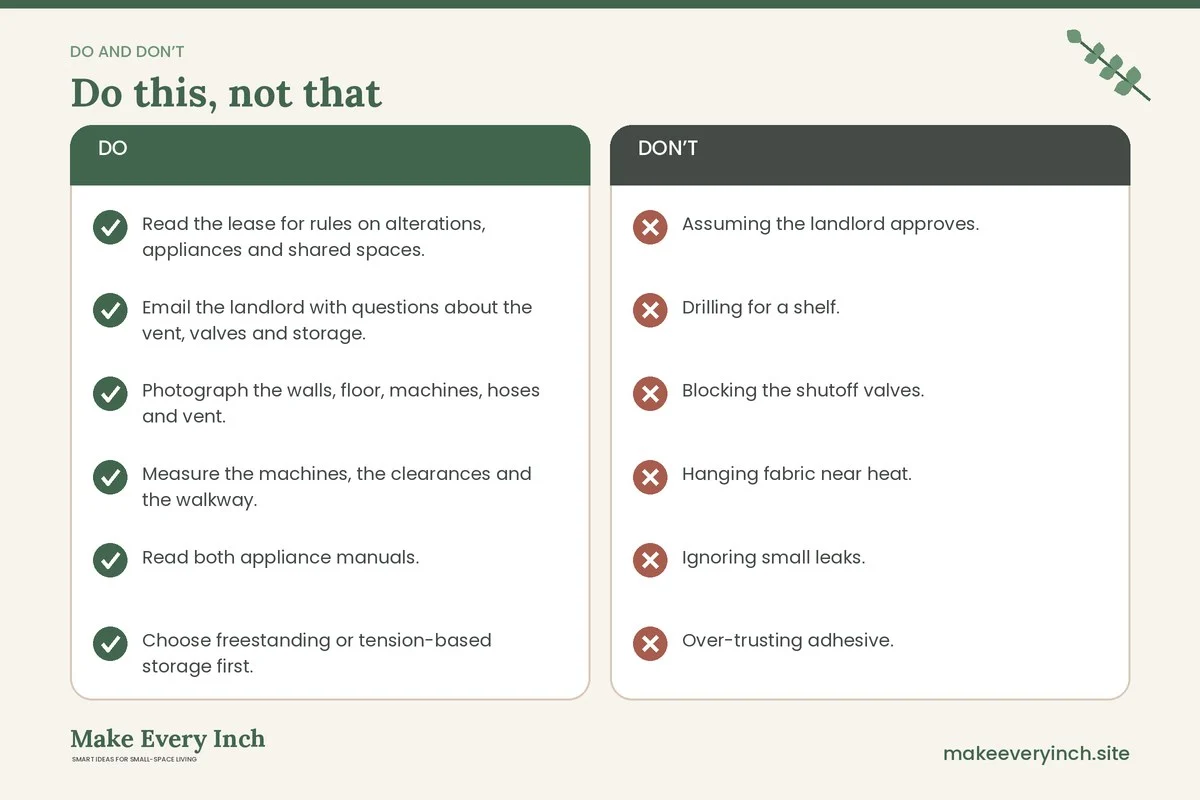
- Assuming the landlord approves. Silence is not permission. Ask in writing.
- Drilling for a shelf. A single screw can lead to a deposit deduction. Choose freestanding or tension-based options.
- Blocking the shutoff valves. A cart in front of a valve is a hazard in an emergency.
- Hanging fabric near heat. Curtains and towels near the dryer vent are a risk.
- Ignoring small leaks. A drip becomes a stain, then a repair bill.
- Over-trusting adhesive. Damp walls make strips fail. Test first.
- Keeping chemicals low. A child or a pet can reach a low shelf.
- Forgetting the manual. The clearances and the rules for your model matter more than a general rule of thumb.
Renter laundry checklist
- Read the lease for rules on alterations, appliances and shared spaces.
- Email the landlord with questions about the vent, valves and storage.
- Photograph the walls, floor, machines, hoses and vent.
- Measure the machines, the clearances and the walkway.
- Read both appliance manuals.
- Choose freestanding or tension-based storage first.
- Keep the dryer, its vent and the shutoff valves clear.
- Store chemicals high, labeled and away from children and pets.
- Never mix cleaners.
- Clean the lint trap after every load.
- Report leaks, loose vents and hot outlets early.
- Remove everything you added at move-out and compare to your photos.
FAQ
What can I do in a small laundry room renters can change without permission?
Freestanding items are usually the safest: a cart, a hamper, a basket system or a fold-down rack. Anything attached to a wall or to the machines should be cleared with the landlord first. Our renter-friendly storage ideas for small apartments post lists more options.
Can I add a shelf above the washer without drilling?
A freestanding shelf that straddles the machines is the usual answer, and it must be stable and out of the way of the dryer’s vent. Do not rest a shelf on the machines, and do not use a tall unit that could tip. Ask the landlord about anchoring if the unit is tall.
Who is responsible for cleaning the dryer vent?
It depends on the lease and the law where you live. Ask the landlord. Cleaning the lint trap is almost always the tenant’s job, while the duct often belongs to the landlord or a professional.
Can I use adhesive hooks on laundry room walls?
Sometimes. Damp, textured or freshly painted walls may fail the test. Try a hidden spot first, follow the weight limits and remove the hook slowly at move-out.
How do I hide the washer and dryer in a rental?
A washable curtain on a tension rod or a folding screen works for an open nook. Keep the fabric clear of the dryer vent and open it whenever the dryer is running.
What should I do if the washer hose leaks?
Turn off the water at the shutoff valve, unplug the machine if it is safe to do so, mop up the water and tell the landlord right away with photos. Do not use the machine until it is repaired.
Is it safe to run the dryer in a closet?
Only if the manual and the building allow it and the closet has the required ventilation. Keep the door open or use a louvered one, and ask the landlord if you are unsure.
Keep going: Keep going with our small laundry room ideas on a budget, the guide to small bathroom ideas and our tips for budget small space ideas.
Save this guide for later
Pin the ideas you like to Pinterest so you can come back to them when you plan your space.