16 Small Bedroom Closet Organization Ideas Built Around Zones and Measurements
Quick answer: Small bedroom closet organization works best when you divide the closet into zones by how often you reach for things: eye-level for daily clothes, the lower third for shoes and bins, the top shelf for rarely used items and the door for flat accessories. Measure your rod height and depth, hang by garment length, use matching slim hangers, add a second rod only where the clothes are short and keep a one-in, one-out habit.
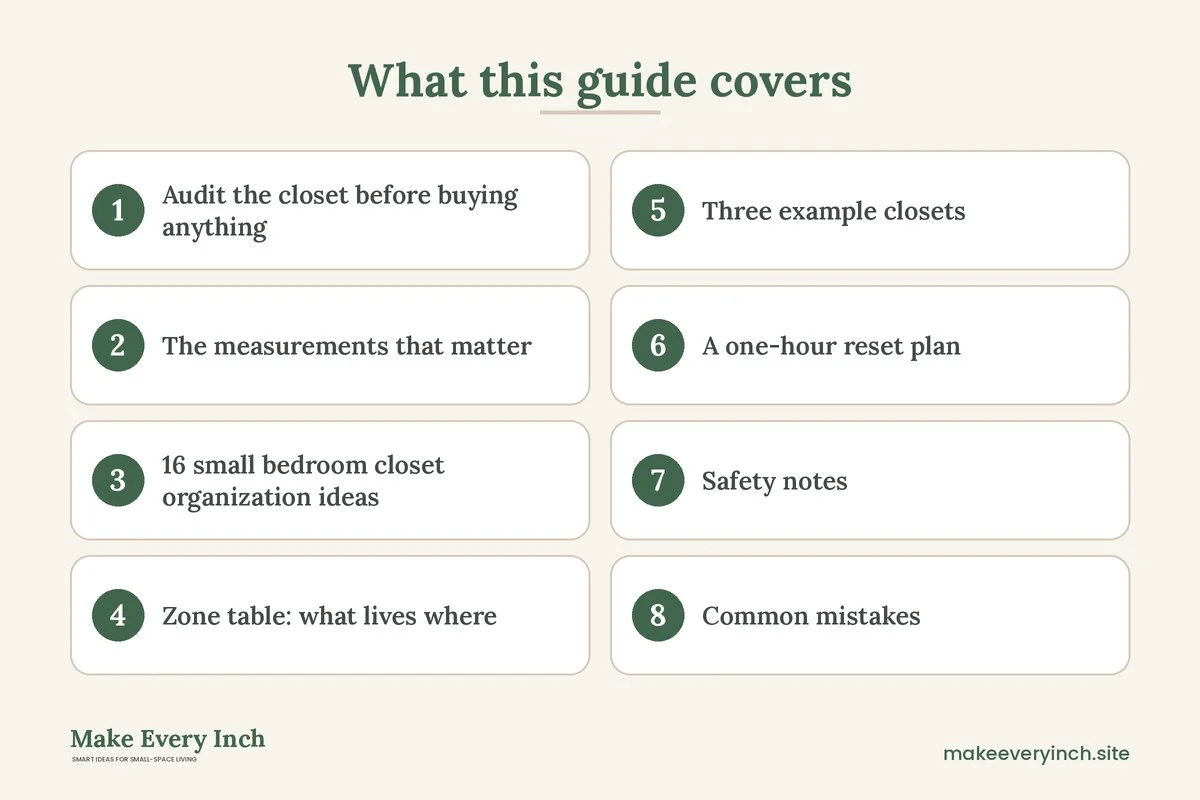
Small bedroom closet organization is really a measuring problem disguised as a tidying problem. Most bedroom closets are 24 inches deep and somewhere between 2 and 6 feet wide, with one rod, one shelf and a lot of wasted air above, below and behind the clothes. This guide shows how to read your closet as a set of zones, rather than a single box, and then fill each zone with the right tools. It covers the closet audit, the measurements that matter, 16 ideas, a zone table, three example closets, a one-hour reset plan, safety notes and a checklist. For the wider approach to the whole room, read our main guide on small bedroom ideas, and for the surface beside the bed see the companion post on nightstand alternatives for small bedrooms.
Audit the closet before buying anything
Take everything out. This sounds like a chore, yet it is the step that saves the most money, because you often discover that half of the closet is holding things you do not wear. Sort clothes into four piles: wear weekly, wear seasonally, wear rarely for a special reason and no longer wear. Be honest about the last pile and plan to donate, sell or recycle it. If a pile of clothes needs repair, put it in a labeled bag and set a date to fix it, or let it go.
Then count what is left by type. A rough count of shirts, trousers, dresses, coats, folded knits, shoes and accessories tells you how many inches of hanging rod and how many shelf inches you need. As a guide, a hanging garment on a slim hanger uses about 1 to 2 inches of rod, and a bulky coat can use 3 inches or more. A closet with a 48 inch rod can usually hold 24 to 40 items on slim hangers, depending on thickness. If your count is far over this, you need to edit as well as organize. For more on editing, see decluttering rules for small homes.
Finally, empty the closet completely and wipe it down. Check for damp, mold or pests, particularly on exterior walls. Keep the doors open to air it out. If you spot a persistent damp patch, tell your landlord or a professional, rather than painting over it. If you do repaint the closet, choose a low-VOC paint and ventilate the room until the smell is gone.
The measurements that matter
Good closet organization depends on a handful of numbers. Measure these before you shop.
- Width and depth: note the width of each section and the depth. A standard depth is about 24 inches. A rod should sit about 12 inches from the back wall so hangers turn freely, which leaves room for shelf units behind or beside the rod only if the closet is deeper.
- Rod height: a rod at about 66 to 72 inches suits long coats and dresses, and a rod at about 40 to 42 inches suits shirts and folded trousers. Standard closets often put a single rod near 66 inches, wasting the space beneath short garments.
- Space below hanging clothes: a shirt that is 28 to 32 inches long leaves roughly 30 inches of floor space beneath it.
- Shelf clearance: a top shelf is usually 12 to 14 inches deep. Leave about 2 inches above the tallest item so you can pull it out easily.
- Door clearance: a hinged door that swings into a room needs about the door width in clear floor, but the back of the door is free storage space. Check the gap between the door and the shelf to ensure that hooks do not collide with the clothes.
- Weight: a rod and shelf have load limits, often in the range of 30 to 50 pounds per rod section for a typical home closet, depending on the fixing. Heavy items such as winter coats, boots and stored books should sit on the floor or on a floor-standing unit.
Write the numbers in your phone. A tape measure and ten minutes will prevent the most common error, which is buying bins that fit nothing.
16 small bedroom closet organization ideas
1. Group by garment length
Hang shorts and shirts together, trousers together, and dresses and coats at the end. This frees the space under the short garments. If your closet has a single rod, group so the shortest clothes sit at one end, then place a low stack of bins or a short drawer unit beneath them.
2. Add a second rod only where the clothes are short
A hanging rod doubler adds a second level and can almost double capacity in a section of shirts and trousers. It works only for garments shorter than about 32 inches, and it must be installed on the existing rod without drilling if you rent. Check the weight limit and do not hang heavy coats on the lower level. Our guide to how to double hanging space in a closet goes through the options.
3. Switch to slim, matching hangers
Mixed hangers waste inches and make a closet look chaotic. Matching slim hangers, 0.2 to 0.3 inches thick, can add several garments per foot of rod. Avoid very slippery finishes for silky fabrics, and use a felt or flocked style for these. Keep a few wide-shoulder hangers for jackets so they hold their shape.
4. Use the top shelf for rarely used items
The top shelf is a deep zone for seasonal items. Use lidded boxes of equal size, 11 to 12 inches deep, and label the front. Never stack heavy boxes above head height where they could fall, and keep the most-used box at the front. See seasonal clothing storage in small homes for a full rotation plan.
5. Add a shelf divider or two
Vertical dividers keep stacks of folded knits from toppling and make each stack visible. Clip-on or freestanding styles suit renters since they need no drilling. A stack of 6 to 8 sweaters per section is a stable limit for most shelves.
6. Fold with the file method
Fold shirts and knits into small rectangles and store them upright like files in a drawer or box. You can see every item at once, and you can pull one without disturbing the rest. A 12 inch deep bin can hold 10 to 14 folded tees standing upright.
7. Hang a shoe organizer on the door
A hanging door organizer with pockets holds shoes, scarves, belts or small accessories. Make sure the door can still close and that the hooks fit over the top of the door without damaging the paint or the frame. Choose a lighter organizer if your door is hollow. For more shoe options, see shoe storage ideas for small closets.
8. Use the floor, but only in the lower third
Shoes, bins and a laundry basket can sit on the floor, as long as they do not trap moisture against the wall. Leave a 1 to 2 inch gap at the back for air. Raise the items a few inches on a low rack if your closet is prone to damp. A tall pile of loose shoes is both untidy and a trip hazard.
9. Add a slim drawer tower inside
A narrow three-drawer unit, about 12 to 16 inches wide, fits beneath short hanging clothes and replaces a dresser. This is particularly valuable in a bedroom that cannot take a chest of drawers. Tall units must be anchored to the wall when allowed, and every drawer unit should have a stop that prevents it from pulling out entirely. Read our post on small closet drawer alternatives for more options.
10. Hang a hook rail inside the door or on a side wall
A rail with four to six hooks holds the next day’s outfit, a bag, a robe or a belt. Mount it at about 60 inches for adults, lower for children, and avoid drilling unless permitted. Adhesive hooks suit light loads of a few pounds and need a clean, dry surface.
11. Use S-hooks or a cascading hanger for accessories
A cascading hanger lets you hang scarves, ties or belts in a vertical line. S-hooks on the rod hold bags and caps. These items take up so little space that they can be forgotten, so assign them a spot and keep to it. For bags, read handbag storage ideas for small closets.
12. Add under-shelf baskets
A basket that hooks beneath the top shelf adds 6 to 8 inches of storage for scarves, hats or underwear. Check that the shelf thickness matches the hook and that the weight is below the shelf’s limit. This is a good use of dead space between the shelf and the rod.
13. Install lighting
A dark closet makes any system fail. A battery-powered motion light or a stick-on LED strip needs no wiring and shows the back corners. Use secure battery compartments in homes with small children or pets, and keep any light away from fabric so it cannot overheat. Hardwiring is a job for a licensed electrician and needs a landlord’s permission.
14. Convert the closet door if it eats space
A swing door needs floor space in the room. If it blocks furniture, a curtain on a tension rod, a folding door or a sliding door can free that area. A curtain is the lowest-cost, renter-friendly option, though it gives less dust protection. Ask before replacing any door, since it is usually part of the property.
15. Create a landing spot for worn-once clothes
A hook or a small open basket inside the closet door holds items that are not dirty but not ready to put away. This habit reduces the pile on a chair. Keep the basket small so it does not become a catch-all.
16. Label sections and use a one-in, one-out rule
A small label on a shelf edge or bin tells everyone in the household where things go. A one-in, one-out rule keeps the system from overflowing. When you buy a new top, one old top leaves. Review twice a year when seasons change.
Zone table: what lives where
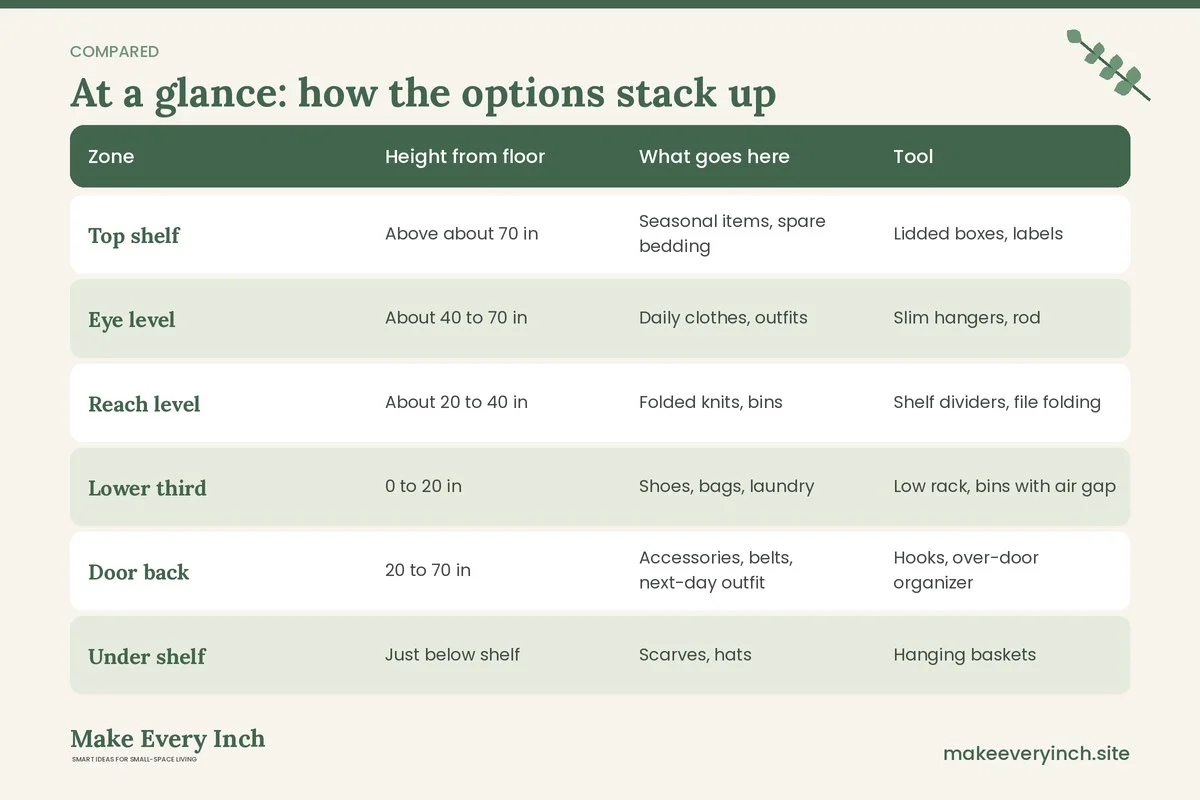
| Zone | Height from floor | What goes here | Tool |
|---|---|---|---|
| Top shelf | Above about 70 in | Seasonal items, spare bedding | Lidded boxes, labels |
| Eye level | About 40 to 70 in | Daily clothes, outfits | Slim hangers, rod |
| Reach level | About 20 to 40 in | Folded knits, bins | Shelf dividers, file folding |
| Lower third | 0 to 20 in | Shoes, bags, laundry | Low rack, bins with air gap |
| Door back | 20 to 70 in | Accessories, belts, next-day outfit | Hooks, over-door organizer |
| Under shelf | Just below shelf | Scarves, hats | Hanging baskets |
Three example closets
A 4 foot wide reach-in with a single rod
The closet has one rod at 66 inches and a shelf above. Most clothes are shirts and trousers. The owner installs a rod doubler across 30 inches of the rod for shirts and folds trousers into a pair of 12 inch bins on the floor. Long coats stay at one end on the original rod. The top shelf holds three lidded boxes of off-season items, and an over-door organizer holds shoes. The result adds roughly one third more hanging capacity without drilling or replacing the closet.
A 30 inch wide closet in a rental
The closet has no shelf and a rod that cannot move. The tenant adds a freestanding shelf tower, which is anchored if the lease allows or limited to a short, stable height if not. Slim hangers and file folding are used throughout. A tension rod across the top creates a shelf for off-season boxes only if the walls are rated for it and the load is light. The renter checks the lease first and keeps all hardware removable. See small closet ideas and how to organize a closet with no built-in shelves for more detail.
A shared closet for two people
A couple divides a 6 foot closet down the middle. Each person gets a half, a drawer tower and a section of the top shelf. Hanging clothes are arranged by length, with one person on the short-garment side. They use different hanger colors to show whose is whose, and a shared basket holds items to repair or donate. For more, see small closet ideas for couples.
A one-hour reset plan
- Minutes 0 to 10: empty the closet and wipe it down.
- Minutes 10 to 25: sort into four piles and bag the donations.
- Minutes 25 to 35: measure rod height, shelf depth and floor space.
- Minutes 35 to 50: return the items by zone, starting with the daily eye-level clothes.
- Minutes 50 to 60: label sections, hang the door organizer and set a date to review.
Do the reset at the start of each season. If an hour is too long, divide it across two evenings.
Safety notes
- Anchoring: tall drawer towers and shelf units should be anchored to the wall using the supplied hardware, where the lease allows it, because a loaded unit can tip and injure a child or pet. If you cannot anchor, choose a low unit.
- Never drill without permission: closet walls and ceilings belong to the property. Ask before installing rods, shelves or hooks.
- Weight limits: respect the rating of the rod, shelf and any over-door hardware. Heavy items belong on the floor.
- Electrical and heat: keep lights and cords away from fabric, do not overload outlets, and never store items against a hot pipe or heater.
- Ventilation and moisture: leave gaps for air, use moisture absorbers if needed, and fix the source of any damp. Choose low-VOC paint for any repaint and air out the room.
- Chemicals: store cedar, mothballs, cleaning products and medication out of reach of children and pets. Choose pet-safe pest deterrents.
- Sharp edges: check metal shelves and brackets for burrs, and keep a safe step stool for the top shelf.
Common mistakes
- Buying before measuring. Bins that are 1 inch too deep will not fit.
- Overfilling. A closet packed to the brim damages clothes and makes dressing a struggle. Leave about 10 percent free space.
- Ignoring the door. The back of the door is the most underused surface in the room.
- Mixing hangers. Uniform hangers save inches and calm the eye.
- Storing heavy items high. Put them low and in a box you can lift safely.
- Skipping the edit. No system works if there are twice as many clothes as space.
Checklist
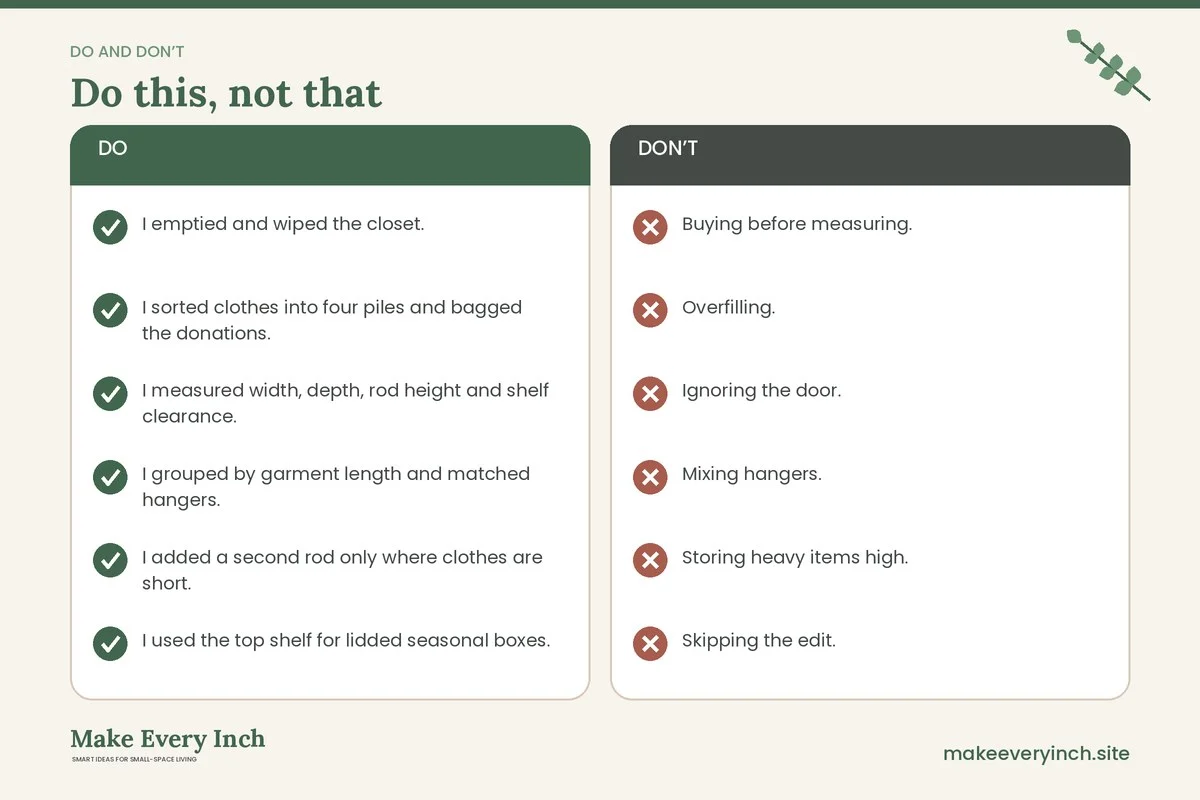
- I emptied and wiped the closet.
- I sorted clothes into four piles and bagged the donations.
- I measured width, depth, rod height and shelf clearance.
- I grouped by garment length and matched hangers.
- I added a second rod only where clothes are short.
- I used the top shelf for lidded seasonal boxes.
- I filled the door and under-shelf space.
- I checked weight limits and anchoring.
- I checked the lease before drilling or adhesives.
- I set a one-in, one-out rule and a review date.
Frequently asked questions
How do I organize a small bedroom closet with no shelves? Use a freestanding tower, stackable bins, a hanging shelf organizer and the door back. Always check weight limits. Our guide on small bedroom storage ideas covers more.
How much hanging space do I need? It depends on your wardrobe, but a rough guide is 1 to 2 inches per garment on slim hangers. Count your hanging items and multiply to see how many inches of rod you need.
Should I fold or hang? Hang items that wrinkle or stretch badly, such as blazers and dresses, and fold knits and tees. File folding saves space and shows everything.
Can I organize a closet without drilling? Yes. Use rod doublers, over-door hooks, tension rods, freestanding units and adhesive hooks for light loads. Check the lease and the wall finish.
What if my closet is too small for all my clothes? Edit, rotate seasons and move off-season items to under-bed boxes or a different room. See under-bed storage ideas.
How often should I reorganize? Do a light reset every season and a full audit once a year.
Keep going: Keep going with the full guide to small bedroom ideas, pair it with small closet organization ideas, and rework the surfaces beside the bed with nightstand alternatives for small bedrooms.
Save this guide for later
Pin the ideas you like to Pinterest so you can come back to them when you plan your space.