Small Bedroom Decor That Does Not Feel Cluttered: 12 Rules
Quick answer: Small bedroom decor does not cluttered when you edit by sightline instead of by object. Stand in the doorway and from the bed, count what your eyes land on, then cap each flat surface at three items, keep to three main colors, hang art in one connected group, and let one wall stay bare. Anchor tall pieces, keep cords tidy, and ask permission before making any holes.
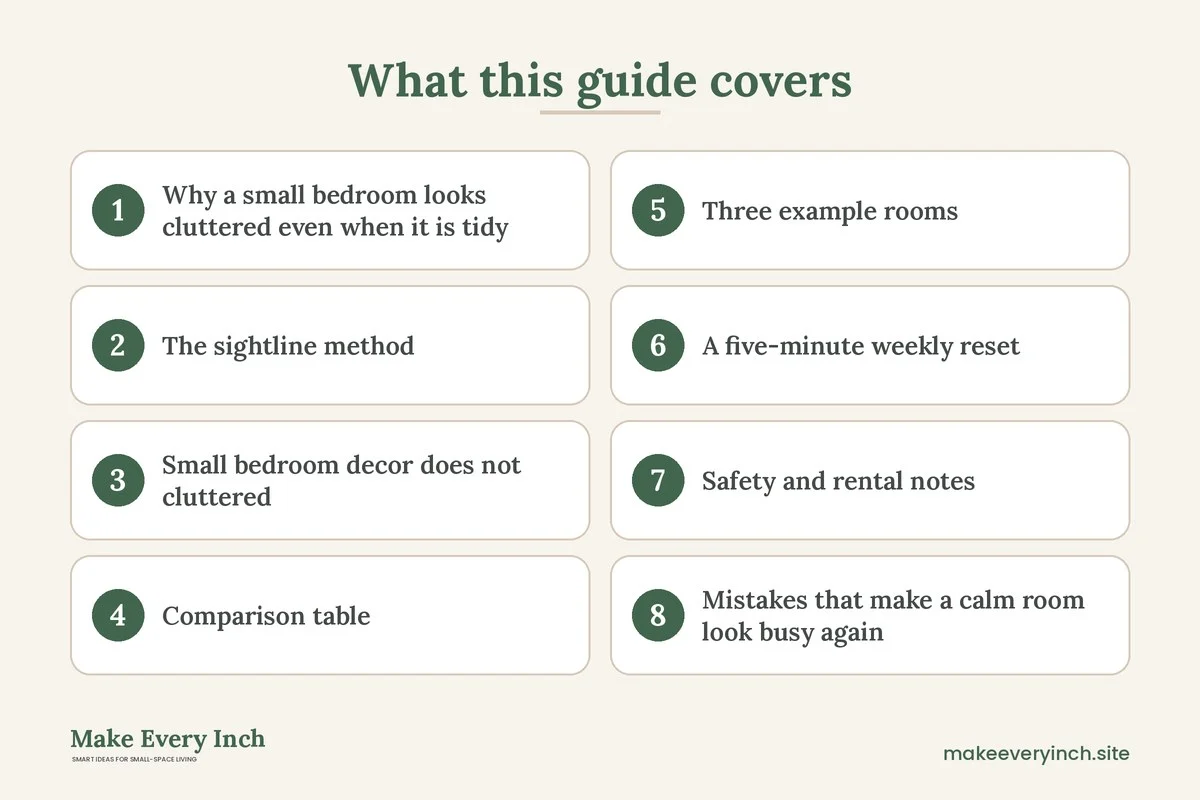
Small bedroom decor does not cluttered by accident. In a room that measures 9 by 10 feet, every object competes for the same few views, and the eye reads a dozen small things as noise even when each one is lovely on its own. This guide is about styling rather than storage. It explains the sightline method for editing a bedroom, then gives 12 rules for surfaces, color, walls, textiles, lighting and the bedside, followed by a comparison table, three example rooms, a weekly reset routine, safety notes, a checklist and a short FAQ. If you want the wider picture first, start with our main small bedroom ideas guide. For hidden containers and shelving, see small bedroom storage ideas. For the general version of this topic across every room, read our post on small room decor ideas that avoid clutter.
Why a small bedroom looks cluttered even when it is tidy
Clutter in a bedroom is two different problems wearing the same name. The first is physical: clothes on the chair, cups on the nightstand, a laundry pile. The second is visual: too many unrelated shapes, colors and heights in one view. A room can be physically tidy and still feel busy, because the shelf has fourteen small frames in six finishes, the bed carries seven pillows and the walls are covered edge to edge.
Decor is the thing most people add last and edit least. Storage solves the first problem. Styling solves the second. That is why a bedroom with perfect drawers can still feel crowded the moment you walk in. The goal of this post is to fix the second problem, so that the room reads as calm even if a few things are out of place.
Three facts about small rooms make visual editing more important than in a large one. First, there is less empty floor and wall to rest the eye, so every object is seen close up and from many angles. Second, a bedroom is a place you want to relax in, and busy views keep the brain slightly switched on. Third, the bed is the largest object, and it sits in the middle of almost every sightline, so whatever surrounds it is judged against it.
The sightline method: edit by what you see
Most decluttering advice starts with objects. The sightline method starts with views. You pick the two or three places where you most often look at the room and edit only what shows up there. It is quicker than a full purge and it protects the things you love, because items out of sight can stay.
Step 1: choose your three viewpoints
Stand in the doorway, sit on the edge of the bed and lie back against the pillows. These are the three views that matter. For each, take a photo with a phone, in daylight, without rearranging anything first. Photos are blunt. A cluttered view that felt normal in person often looks surprising on a screen.
Step 2: mark the busiest zone in each photo
Look for the spot where the eye stops. It is usually a dresser top, a nightstand, a shelf above the bed or the back of a door. Circle the zone on your phone or just list it. You will probably find three to five busy zones, and that is a manageable number.
Step 3: apply a count, not a feeling
Feelings drift. A count does not. For each busy zone, count the separate objects. A stack of three books counts as one object, a matching pair of candles counts as one, and a tray with three items on it counts as one. Counting by groups is the trick, because it rewards you for gathering things into a single shape.
Step 4: edit until each zone has a clear focal point
A calm zone has one thing you notice first, a few supporting pieces and some empty space. When you cannot say what the focal point of a shelf is, remove items until you can. Items you remove do not have to be thrown away. Put them in a labeled box and keep it for a month. Whatever you do not miss can be donated or moved on.
Small bedroom decor does not cluttered: the 12 rules
Surfaces
1. Three groups per flat surface
Cap every flat surface at three groups. A dresser top might hold a tray with a few small items, one lamp and one framed print leaning at the back. A nightstand might hold a lamp, a book and a glass. Grouping by tray or by stack turns many small things into one shape, and the cap forces a choice.
2. Leave a clear third
Keep roughly a third of each surface bare. Empty space is a design element, and in a small room it is the one that most clearly signals calm. If a dresser is 48 inches wide, aim for at least 16 inches of open top that you do not fill. Use the bare stretch as a landing spot for keys, a phone or a folded sweater so it does not become permanent storage.
3. Vary height inside each group
Items of the same height read as a row of fence posts. Mix a tall piece, a mid piece and a low piece. A slim vase, a stack of books and a small dish make a triangle that looks arranged on purpose. Keep the tallest piece below eye level when you are sitting on the bed so it does not block the view of the wall behind it.
4. Use trays and boxes as visual borders
A tray defines where the group begins and ends, so small things look like one object. A lidded box does the same for items that you need but do not want to see, such as hair ties, chargers, lip balm and spare keys. Choose trays with a low, stable rim, and keep them clear of the edge of the surface to avoid a spill.
Color and pattern
5. A three-color cap
Choose three main colors for the room, usually a light base, a mid tone and one accent. Every textile, frame, lamp base and vase should fit one of those three, with small exceptions for natural wood and metals. Photograph the room again and you will see how much calmer the view becomes. If you need help picking the palette, our guide to colors that make small rooms look bigger covers light-reflective choices that suit a bedroom.
6. One pattern per layer
Allow a single pattern each at the bed, the window and the floor. Anything beyond that fights with the bed, which is already the largest shape. A striped duvet pairs well with a plain rug and solid curtains. If you love patterned curtains, keep the bedding plain. When you do paint or wallpaper, check that the product is rated low in volatile organic compounds, open the window while it dries, and ask your landlord first. For temporary options in a rental, see removable wallpaper ideas.
Walls
7. Hang art as one connected group
Scattered frames on a wall look like clutter. A connected group looks like a single piece of art. Plan the group as a rectangle, keep 2 to 3 inches between frames, and make the outer edge line up with the width of the bed or the dresser below. Lay the frames on the floor first and take a photo before you hang anything. If the wall belongs to a landlord, never drill without written permission. Adhesive strips rated for the weight of the frame, or a leaning arrangement on a shelf, are safer choices. Our post on renter friendly wall decor ideas goes through the options, and small space wall art ideas has layouts for narrow walls.
8. Leave one wall quiet
Pick one wall, ideally the one you see most while lying down, and keep it nearly bare. A headboard, a mirror or one large print is enough. The quiet wall gives the eye a place to rest and makes the busier wall seem intentional. A mirror opposite a window will bounce light across the room, but avoid pointing one directly at the bed if you find reflections at night unsettling. For placement ideas, read our guide to small room mirror placement ideas.
Textiles and lighting
9. Edit pillows to a working number
Seven pillows on a double bed look like a pile. Try two sleeping pillows, two matching decorative pillows and one accent. If you want a layered look, fold a throw across the foot of the bed in a single band rather than scattering it. Keep the bedding in two or three tones from your palette. A bedroom that looks made in thirty seconds stays tidy more easily than one that needs a full pillow ritual.
10. One warm light at each level
Layer light at three heights: a ceiling or overhead light, a bedside lamp and a low accent such as a small table lamp or a plug-in sconce. Warm bulbs make textiles look cozy, and shades hide the bulb from the eye. A cord that dangles down the wall is a clutter signal, so route it behind furniture or use cord covers. Use only the bulb wattage printed on the lamp, keep shades clear of the bulb, and do not run cords under rugs. See our posts on small bedroom lighting ideas and renter friendly ways to hide cords.
The bedside and the floor
11. A bedside with a defined job
A nightstand has three jobs: light, a place for tonight’s items and a spot to charge a phone. If a nightstand holds more than that, move the extras into a drawer or a basket. In a very small room, a wall-mounted shelf or a stool can stand in for a table. Keep any shelf over the bed light and shallow, with items that cannot fall onto a sleeper, and mount into studs or anchors rated for the load. In a rental, ask first.
12. Let the floor read as one surface
Floors are the largest area after the walls. A rug that is too small chops the floor into pieces, while a larger one pulls it together. Choose a rug that extends at least 18 to 24 inches beyond the sides and foot of the bed, or at least the front two legs on it. Keep the area under the bed visible or fully hidden with a bed skirt so there is no half-seen jumble. If you use under bed storage, see our list of under bed storage ideas for boxes that match the bed.
Comparison table: busy versus calm versions of the same spot
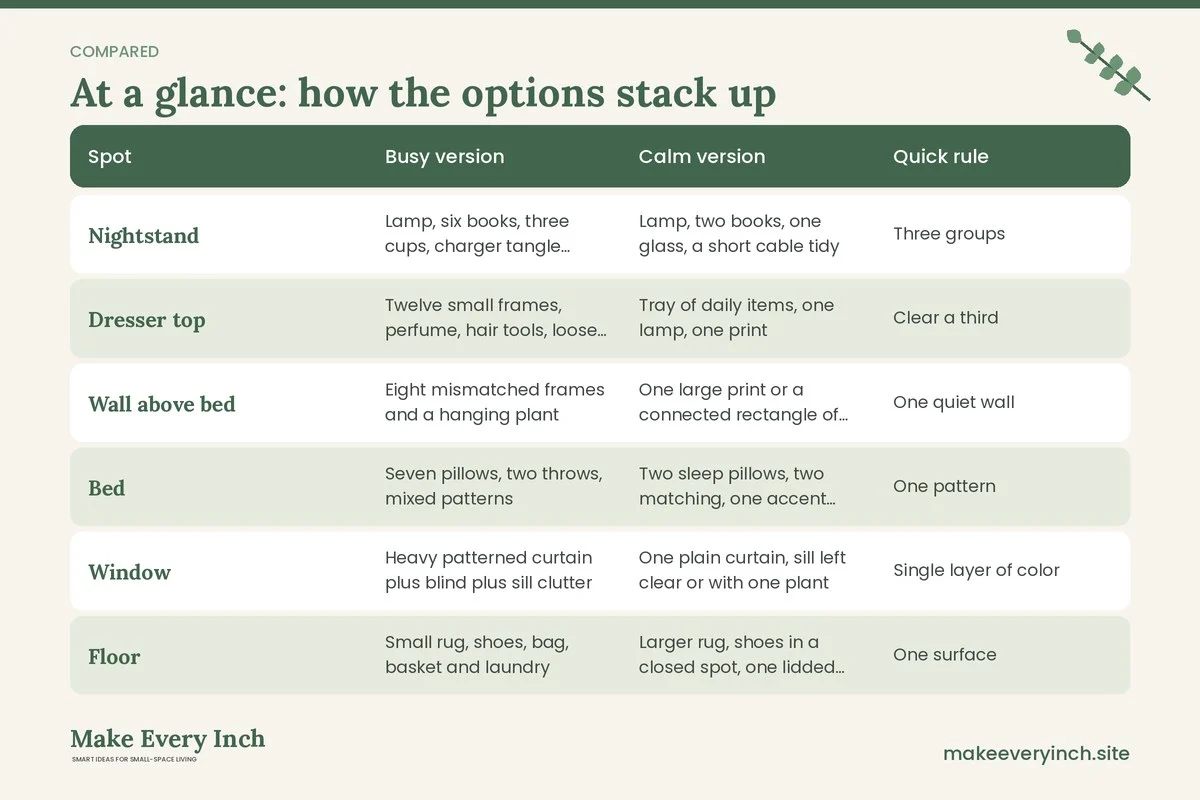
The table shows how a small change in the same spot turns a busy view into a calm one.
| Spot | Busy version | Calm version | Quick rule | |
|---|---|---|---|---|
| Nightstand | Lamp, six books, three cups, charger tangle, jewelry | Lamp, two books, one glass, a short cable tidy | Three groups | |
| Dresser top | Twelve small frames, perfume, hair tools, loose coins | Tray of daily items, one lamp, one print | Clear a third | |
| Wall above bed | Eight mismatched frames and a hanging plant | One large print or a connected rectangle of four | One quiet wall | |
| Bed | Seven pillows, two throws, mixed patterns | Two sleep pillows, two matching, one accent, one throw | One pattern | |
| Window | Heavy patterned curtain plus blind plus sill clutter | One plain curtain, sill left clear or with one plant | Single layer of color | |
| Floor | Small rug, shoes, bag, basket and laundry | Larger rug, shoes in a closed spot, one lidded hamper | One surface | |
| Door | Hooks stacked with bags and coats | One hook for tomorrow’s outfit, the rest inside the closet | One item per hook |
Three example rooms
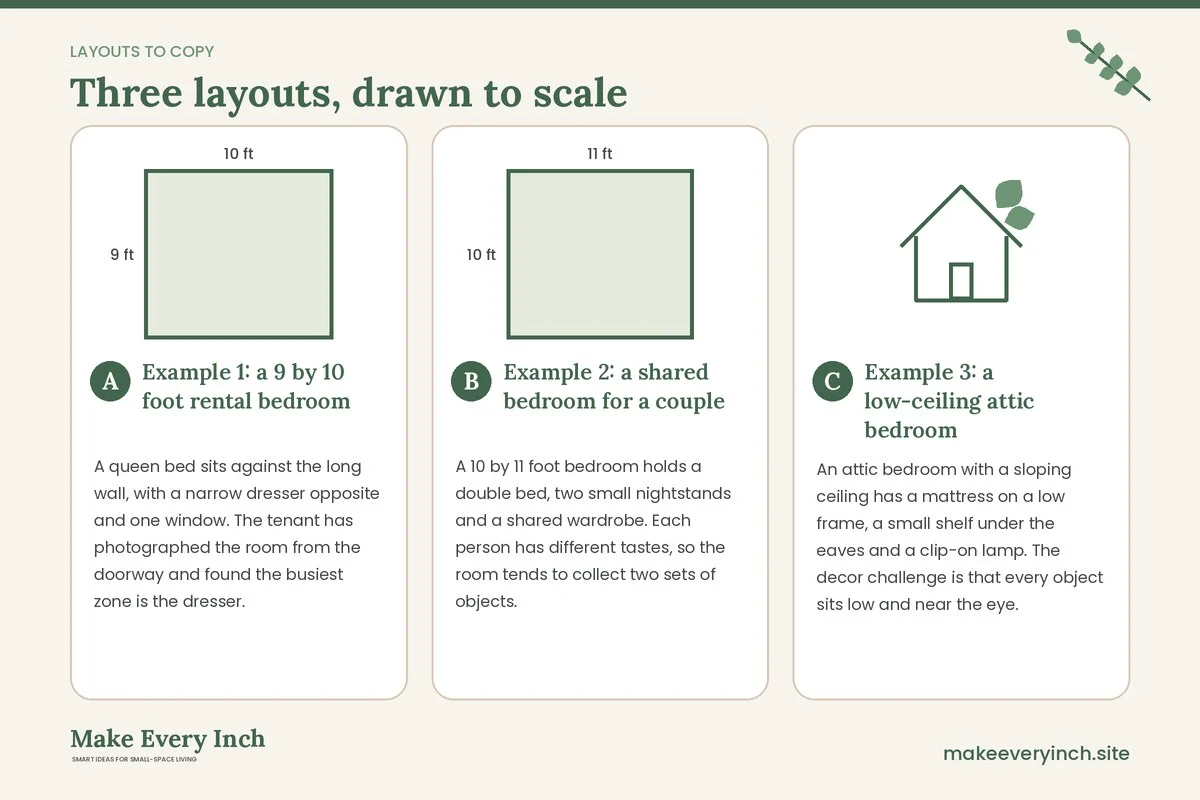
Example 1: a 9 by 10 foot rental bedroom
A queen bed sits against the long wall, with a narrow dresser opposite and one window. The tenant has photographed the room from the doorway and found the busiest zone is the dresser. It holds a mirror leaning against the wall, two candles, six small frames, a jewelry stand, a stack of mail and a plant. Using the three-group rule, the tenant makes a tray for daily items, leans one framed print behind it and keeps the plant at one end. The other frames move into a single connected group on the wall above, hung with removable strips that are rated for the weight of the frames, after a check of the lease. The result has the same sentimental pieces, but the eye now sees three things instead of fifteen.
Example 2: a shared bedroom for a couple
A 10 by 11 foot bedroom holds a double bed, two small nightstands and a shared wardrobe. Each person has different tastes, so the room tends to collect two sets of objects. The couple agrees on a three-color palette and gives each side of the bed an identical lamp and a single tray. A basket under each nightstand takes the personal extras. A closed hamper near the door keeps clothes off the chair. They keep the wall above the bed bare apart from a single large piece, and the dresser carries only a mirror and a tray. Because the room has two people’s habits in it, they run a five-minute reset every Sunday evening.
Example 3: a low-ceiling attic bedroom
An attic bedroom with a sloping ceiling has a mattress on a low frame, a small shelf under the eaves and a clip-on lamp. The decor challenge is that every object sits low and near the eye. The occupant avoids hanging anything on the sloped section, uses one long shelf along the straight wall with grouped books and one plant, and keeps the slope clear apart from a plain light fabric to soften the edge. A rug defines the bed zone. For more on low rooms, see our posts on small bedroom ideas for attic rooms and small bedroom ideas with low ceilings.
A five-minute weekly reset
Even a well-styled room drifts. A short routine stops the drift.
- Clear every flat surface of anything that is not part of its three groups.
- Return cups, glasses and plates to the kitchen.
- Fold or hang worn clothes, or drop them in the hamper.
- Straighten the bed and arrange pillows in the same order.
- Wipe the nightstand and dresser while they are bare, since dust shows up on dark wood.
- Check the floor for cords, shoes or bags and put them away.
- Photograph the doorway view and compare it with last week.
Safety and rental notes
Decor looks best when it is also safe. Anchor tall dressers, bookcases and shelving units to the wall with the hardware recommended for your wall type, particularly where children or pets share the home, because tall furniture can tip. Never hang anything heavy above a bed or crib unless it is fixed to a stud or a suitable anchor and is rated for the load. Keep candles on stable, heat-safe trays, away from textiles, and extinguish them before you sleep. Plug lamps and chargers into outlets that are not overloaded, and avoid daisy-chaining extension cords. Leave air gaps around radiators, heaters and vents, and do not block ventilation. If you paint, choose a low-VOC product, ventilate and keep children and pets away while it dries. In a rental, read the lease and ask in writing before drilling, painting or using strong adhesives, and take a photo of each wall before you start. Our guide to small bedroom ideas for renters covers more removable options.
Mistakes that make a calm room look busy again
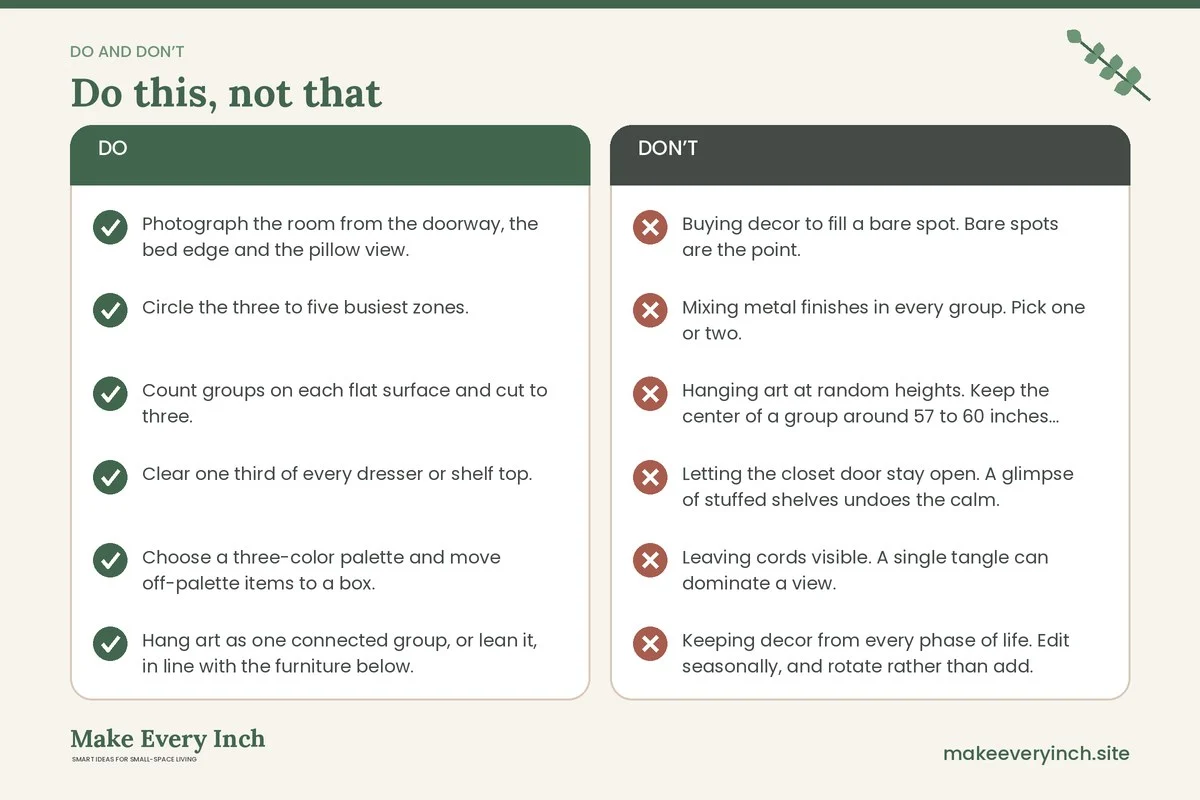
- Buying decor to fill a bare spot. Bare spots are the point.
- Mixing metal finishes in every group. Pick one or two.
- Hanging art at random heights. Keep the center of a group around 57 to 60 inches from the floor, or lower above furniture.
- Letting the closet door stay open. A glimpse of stuffed shelves undoes the calm.
- Leaving cords visible. A single tangle can dominate a view.
- Keeping decor from every phase of life. Edit seasonally, and rotate rather than add.
For a longer list of layout and furniture errors that go beyond decor, read our companion post on small bedroom mistakes to avoid.
Checklist: a calm small bedroom
- Photograph the room from the doorway, the bed edge and the pillow view.
- Circle the three to five busiest zones.
- Count groups on each flat surface and cut to three.
- Clear one third of every dresser or shelf top.
- Choose a three-color palette and move off-palette items to a box.
- Hang art as one connected group, or lean it, in line with the furniture below.
- Keep one wall quiet.
- Reduce pillows to a working set.
- Add warm light at two or three heights and tidy cords.
- Give the nightstand a clear job.
- Confirm that tall furniture is anchored and nothing heavy hangs above the bed.
- Set a reminder for the weekly five-minute reset.
FAQ
How many decorative items are too many in a small bedroom?
There is no fixed number, but a useful guide is three groups per flat surface and one connected group per wall. If you cannot say what a surface’s focal point is, there is probably too much.
Can a minimalist look still feel cozy?
Yes. Warmth comes from texture, soft light and a limited color range, not from the number of objects. Layered bedding, a wool or cotton throw and a warm lamp add comfort without adding clutter. Our post on small bedroom ideas minimalist shows how.
What if I have a lot of sentimental items?
Rotate them. Display a small selection for a season, store the rest in a labeled box and swap them later. Keeping a few things on show makes each one matter more.
How do I decorate without damaging walls?
Use leaning art, adhesive hooks within their stated weight limits, removable wallpaper and plug-in lighting. Check your lease before you use any adhesive on painted surfaces.
Does a mirror make a bedroom look more cluttered?
It can, because it doubles whatever is in front of it. Place a mirror where it reflects a window or a calm wall, not a messy corner.
Where do I start if the whole room feels overwhelming?
Start with the nightstand and dresser top. They are small, they sit in the main sightline, and a quick win there builds momentum for the rest of the room.
Keep going: Keep going with small bedroom ideas, a plan for small bedroom organization ideas and a softer approach in cozy apartment bedroom ideas.
Save this guide for later
Pin the ideas you like to Pinterest so you can come back to them when you plan your space.