Small Home Entryway Organization Ideas Built Around Your Daily Departures and Arrivals
Quick answer: Small home entryway organization works best when you plan around two moments, leaving and arriving, instead of around furniture. List what each person grabs on the way out and drops on the way in, give each item one landing spot within arm’s reach of the door, keep the walkway at least 30 inches clear, and finish with a five-minute weekly reset. Anchor tall pieces, never block the exit and never drill without permission.
Small home entryway organization is easiest to solve when you stop thinking about furniture and start thinking about motion. Every day your household does two things at the door: it leaves, in a hurry, and it arrives, tired and carrying things. A tidy entryway is simply a system that makes both of those moments easy. If the keys have a spot, the bag has a hook, the wet umbrella has a drip zone and the mail has a tray, the rest of the home stays calmer. This guide takes a distinct approach compared with our other entry posts. Instead of listing products, it walks you through an audit of your own departures and arrivals, gives you depths and clearances to plan a layout, shows how to set up hooks, trays and benches by task, and finishes with three example homes, a weekly reset and a checklist. For the wider topic, start with our small space organization ideas pillar. If you want a ready list of options, see small entryway storage, and for a rental there is a separate guide to renter friendly entryway organization ideas. It also pairs with our companion post on small home seasonal storage ideas, which covers what to do with the coats and boots you rotate out.
Start with a departure and arrival audit
Spend three days watching what actually happens at your door. Do not tidy first. Stand where you normally stand and write down every object that touches the entry in the morning and the evening. Use two columns, one for leaving and one for arriving, and one row per person.
Typical leaving items include keys, a wallet, a phone, a bag, a lunch, a water bottle, a coat, a hat, shoes, a mask or sunscreen, a dog leash and a pass or badge. Typical arriving items include the same bag and coat, wet shoes, an umbrella, packages, mail, shopping bags and sometimes a child’s backpack and sports kit. Add pets if you have them, because a leash, a towel for muddy paws and a waste bag holder all belong near the door.
Now mark each item with one of three labels. Mark it A if it is used every day, B if it is used a few times a week, and C if it is seasonal or rare. Only the A items deserve prime space at hand height next to the door. B items belong one step away, in a drawer or basket, and C items belong elsewhere in the home. Many entries become cluttered because C items occupy A positions. A heavy winter parka in July, or a pile of party shoes, is the classic example.
Finally, note the choke points. Where do people stop and drop things? Where does somebody have to step over a bag to reach the door? Where does water pool? Those places are where your solutions must go.
Measure the space you have
Small entries come in a few shapes, and the shape decides the solution. Measure before you plan.
- Wall width beside the door: if you have 12 to 18 inches, a slim rail with hooks and a narrow shelf will work. Beyond 24 inches you can add a console or a bench.
- Depth of the available floor: under 10 inches suits only a shoe rack or a wall rail. 10 to 14 inches suits a slim shoe cabinet or a console. 16 to 20 inches suits a bench with storage.
- Clear walking width: keep at least 30 to 36 inches between the door swing and any furniture for a comfortable path. In a very tight hallway, 24 inches may be the absolute minimum, and nothing should protrude into it.
- Door swing: check which way the door opens. A door that opens against a piece of furniture will damage both, and a door that cannot open fully is an exit hazard.
- Hook height: adults 60 to 66 inches, children 36 to 48 inches. A second lower row of hooks lets small children hang their own bag and gives them a daily win.
- Bench seat height: 16 to 18 inches suits most adults putting on shoes.
- Light switch and outlet: note their positions. Do not cover a switch, a smoke alarm, a thermostat or an electrical panel.
Mark your clear path on the floor with painter’s tape. Everything else you add must stay outside that line.
Choose a layout by wall type
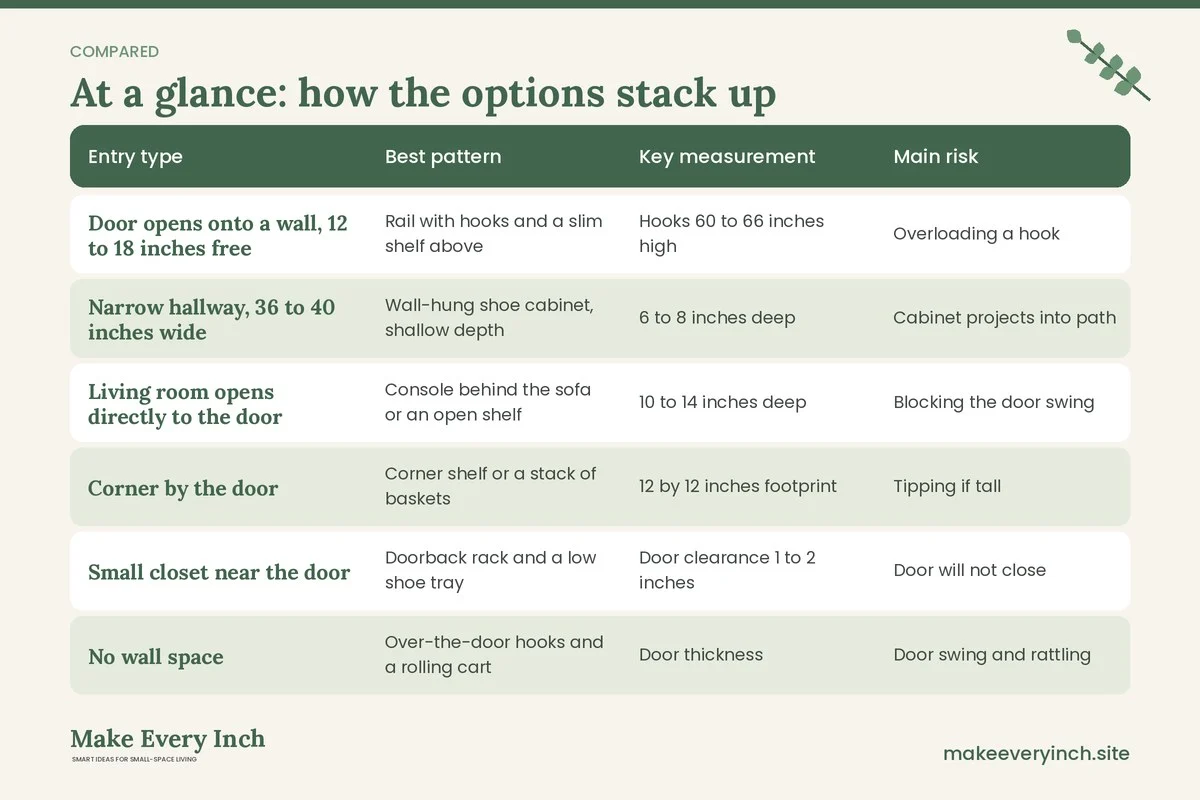
Instead of choosing a product first, choose among these six patterns based on what the audit and measurements tell you.
| Entry type | Best pattern | Key measurement | Main risk | |
|---|---|---|---|---|
| Door opens onto a wall, 12 to 18 inches free | Rail with hooks and a slim shelf above | Hooks 60 to 66 inches high | Overloading a hook | |
| Narrow hallway, 36 to 40 inches wide | Wall-hung shoe cabinet, shallow depth | 6 to 8 inches deep | Cabinet projects into path | |
| Living room opens directly to the door | Console behind the sofa or an open shelf | 10 to 14 inches deep | Blocking the door swing | |
| Corner by the door | Corner shelf or a stack of baskets | 12 by 12 inches footprint | Tipping if tall | |
| Small closet near the door | Doorback rack and a low shoe tray | Door clearance 1 to 2 inches | Door will not close | |
| No wall space | Over-the-door hooks and a rolling cart | Door thickness | Door swing and rattling |
For a deeper look at options without a hall or foyer, read small home entryway ideas when there is no foyer. If you have no closet at all, small entryway ideas with no closet lists additional layouts.
Build the five landing spots
A good entry has five small jobs. You do not need five pieces of furniture. In many cases one wall and one floor strip is enough.
1. The key and pocket landing
Keys are the first and last thing you touch. Choose one spot at hand height, within arm’s reach as you step in. A small tray on a shelf, a hook just inside the door or a wall-mounted holder can work. Put a second hook for a spare set above the first, if you share keys. Keep the landing spot clear of mail, because mail piles bury keys. Add a small bowl or a pocket tray for wallets, earbuds and sunglasses.
2. The bag and coat landing
Hooks do more than shelves in a small entry. Place them at consistent heights. One hook per person is a good starting point, with a few spares for guests. Heavy bags do better on a wall hook that is rated for the load and fixed into a stud or with the correct anchor. In a rental, ask permission first. If you cannot drill, use a freestanding coat stand with a heavy, wide base, or a tension pole between floor and ceiling rated for the weight. Check the weight limit on any adhesive hook, and do not use adhesive hooks for heavy bags. A rail with four hooks across 24 inches of wall carries a day’s coats and bags for a small family.
3. The shoe landing
Shoes cause more clutter than anything. Decide how many pairs live in the entry. Many small households can manage one pair per person for daily use plus a few extra, which means 4 to 6 pairs for two people. Everything else goes in a bedroom closet. A tray on the floor catches wet or muddy shoes. A slim, tilted cabinet can hold pairs in a thin footprint. A bench with a lower shelf stores pairs where you put them on. See our dedicated guide to small shoe storage ideas for additional types, and check that anything with a flat top cannot be knocked by a swinging door.
4. The mail and package landing
Mail multiplies. Install one small tray, basket or wall file by the door and sort items as soon as you come in. Recycling goes straight into the bin. Bills and forms go into a single tray that gets emptied weekly. Packages need a temporary spot, such as a low shelf or a labeled basket, until you open and break down the box. Keep a small pair of scissors or a letter opener nearby, stored out of reach of children.
5. The weather and pet landing
Umbrellas, wet coats and muddy paws need a drip zone. Place a waterproof tray or boot mat inside the door, and keep a small hook for an umbrella. A small towel for paws can hang on a hook at pet height. Wet shoes should dry flat, not in a closed cabinet, to avoid odors and mildew. If the entry is damp, keep electrical items and chargers away from the wet area. A tray should also keep water off timber floors, which can swell and stain.
Hook, basket and bench plans by household
The same wall can be set up in different ways. Use this as a starting point, then adapt it.
Single adult
One rail with three hooks, one shelf above at about 60 inches for a tray and a plant, and a two-pair shoe tray on the floor. Everything else lives in the closet. The wall stays visually light, which helps a small space feel larger.
Couple
One rail with five hooks, a shallow tray shelf with a bowl for each person, a bench or stool for putting on shoes and a four-pair shoe rack. Each person claims half of the hooks, which keeps it fair. A mirror above the shelf helps with last-minute checks.
Family with children
Two rows of hooks at two heights, with names or colors on the lower row. A low basket for each child holds their daily items, such as hats and gloves. A bench with a lower shelf holds shoes. A wall pocket for mail and school notes keeps papers off the counter. Small children should not use items such as heavy mirrors or wall-hung shelves unless they are firmly fixed, so keep the lower zone light and the upper zone secure. For more, see small entryway organization for families.
Household with pets
Add a hook for a leash at hand height, a small lidded container for treats and waste bags, and a washable mat. Keep all cleaning products and pet medicine out of reach in a closed cupboard. A baby gate may help keep a dog away from the door when you carry heavy items.
Make a small entry feel bigger
A cluttered entry makes a home feel small before the door has even closed. A few tricks help.
- Use a mirror on the wall opposite the light source. It bounces light and helps with a last check. Mount it securely, and in a rental, use an approved method or lean a floor mirror and secure it with an anti-tip strap.
- Keep the lowest area open. A visible floor strip of 12 to 18 inches makes the area look wider. Wall-hung pieces help.
- Choose a single color for hooks and baskets so that the area reads as calm.
- Light the space. A lamp or a battery light in a dark corner makes the entry welcoming. If you use a plug-in light, route the cable along the wall and never run it across the walkway. Check that outlets are not overloaded.
- Use closed storage for visual noise. Lidded baskets hide small clutter.
If wall art would help, small entryway wall decor ideas shows ways to decorate without crowding the wall.
Safety and lease notes
An entry is an exit, so safety comes first.
- Never block the door. Keep the door swing and the path clear at all times, including in the dark.
- Anchor tall pieces. A shoe cabinet or a narrow bookcase taller than about 30 inches should be anchored to the wall, with permission in a rental. A child or pet can pull a loaded unit over.
- Respect weight limits. Hooks, rails and shelves all have load ratings. A full backpack can weigh more than you think.
- Do not drill without permission. Check your lease. If drilling is not allowed, choose a freestanding or over-the-door option.
- Watch the water. Wet areas can be slippery. Use a mat with a non-slip backing and clean it regularly. Keep chargers and power strips off the floor and away from puddles, and if an outlet is near a wet area, have it checked by a qualified electrician for a ground-fault protection device.
- Ventilate. Shoes and wet coats can cause damp smells. Leave a gap for air, and open a window when possible. If you paint the area, use low-VOC paint and ventilate until the smell has gone.
- Child safety. Keep small items, scissors, batteries and cleaning products out of reach. Use rounded edges where children play.
- Pet safety. Keep leashes and cords out of chewing reach when not in use.
Three example entries
The 30-inch hallway
A rental flat has a hallway 30 inches wide and 5 feet long with a door at the end. The owner has no room for furniture. They put an over-the-door hook set on the front door for bags, a tilted wall-hung shoe cabinet only 6 inches deep, fixed with the landlord’s permission, and a small tray on top for keys. A thin runner with a non-slip pad catches water. The path stays at 24 inches clear and nothing sticks out.
The studio with the door onto the living area
A studio has no hall, and the front door opens into the main room. The solution is a console table 12 inches deep, set to the side of the door, with a basket underneath for shoes and a tray on top for keys. A wall mirror hangs above, with hooks on a rail beside it. A screen or a bookcase would hide the area from the sofa but could block light, so the owner chooses an open shelf. For more studio ideas, see studio apartment entryway ideas.
The family hall with two kids
A family has a hall 42 inches wide and 8 feet long. One wall carries a rail with two heights of hooks, a bench 14 inches deep with a shelf for shoes and a wall pocket for notes. The bench is rounded at the corners. A storage cubby above the hooks holds hats and gloves in labeled baskets. A mat catches water. They anchor the tall cubby to the wall studs. A spare coat rack lives in a closet for guests. To rotate seasonal gear, the family follows the swap plan in small home seasonal storage ideas.
The five-minute weekly reset
The best organization is one that survives a busy week. A five-minute reset keeps the entry from drifting.
1. Empty the mail tray. Sort into recycle, action and file.
2. Return strays. Put away anything that does not belong in the entry, such as cups, toys and tools.
3. Check shoes. Return extras to closets. Leave only the daily pairs.
4. Wipe the tray and mat. Shake or wash as needed.
5. Check hooks. Remove anything that has not been used this week, and make sure no hook is overloaded.
6. Look at the path. Walk from the door to the room. Anything in the way gets moved.
Many households do this on Sunday evening. Pair it with a seasonal swap at the start of each season to keep the load right, as described in our post on seasonal clothing storage in small homes.
Common mistakes to avoid
- Starting with furniture. Audit first, then choose.
- Too many pairs of shoes. Limit the daily set.
- Hooks at the wrong height. Children cannot reach high hooks, and adults’ bags drag on the floor if hooks are too low.
- Heavy bags on weak hooks. Check load ratings.
- Blocking the door swing. Open and close the door fully before you commit.
- No place for wet things. Water ruins floors and furniture.
- Mail without a home. Sort daily or weekly.
- Ignoring safety. Anchor tall pieces and keep the path clear.
- Too much decor. A few items look calm, and a crowded wall looks busy.
Entryway checklist
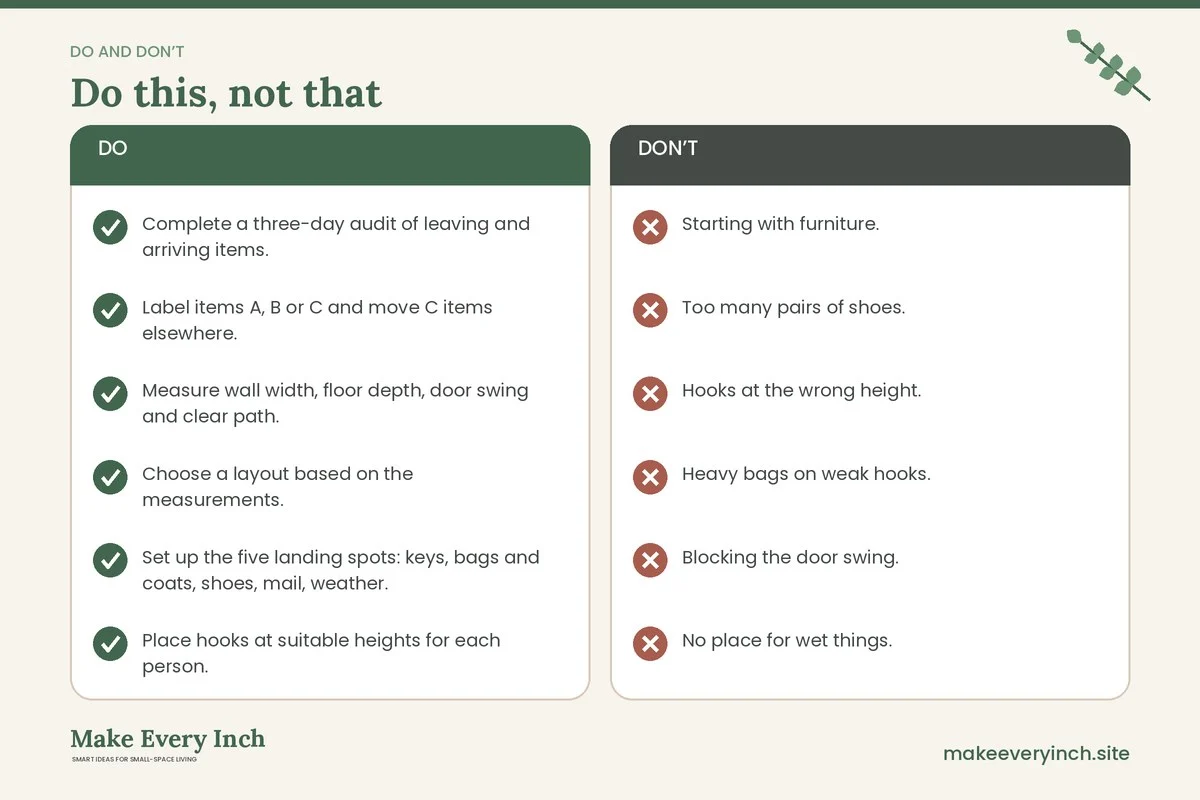
- Complete a three-day audit of leaving and arriving items.
- Label items A, B or C and move C items elsewhere.
- Measure wall width, floor depth, door swing and clear path.
- Choose a layout based on the measurements.
- Set up the five landing spots: keys, bags and coats, shoes, mail, weather.
- Place hooks at suitable heights for each person.
- Anchor tall furniture and confirm permission for any fixings.
- Keep the walkway at least 30 inches clear where possible.
- Use a mat with non-slip backing for wet areas.
- Keep chargers, cords and power strips away from water.
- Schedule a five-minute weekly reset.
FAQ
How small can an entryway be and still work? Even a wall 12 inches wide can hold a rail with hooks and a small shelf. The goal is to give each daily item a spot, not to fit furniture.
What if I rent and cannot drill? Use freestanding racks, over-the-door hooks, tension poles and weighted bases. Check the lease, and read our guide on no-drill storage ideas for renters for more.
How many shoes should I keep at the door? Many households find that one or two pairs per person for daily use is enough, with the rest stored in a closet or under a bed.
Where should I put keys so I do not lose them? Choose one spot at hand height, inside the door, and use it every time. A tray, a hook or a bowl all work. The key is consistency.
How do I keep the entry clean when the weather is bad? Use a tray or mat for wet shoes, hang wet coats where they can drip onto the tray and leave a gap for air. Wipe the tray weekly.
Should I choose a bench? A bench is useful if you have 16 to 20 inches of depth and 36 inches of wall width. If not, a stool that tucks away or a wall-hung fold-down seat may suit better, with the right fixings and permission.
Keep going: Keep going with small space organization ideas, small entryway storage and small coat storage ideas.
Save this guide for later
Pin the ideas you like to Pinterest so you can come back to them when you plan your space.