Studio Apartment Storage Ideas: A Whole-Studio Inventory Plan
Quick answer: The best studio apartment storage ideas work from an inventory, not a shopping list. Count what you own, sort it by how often you use it, then give every category a home in one of six zones: vertical walls, under the bed, furniture with storage, the closet, the kitchen and the bath. Use the top of the room for rarely used items, keep daily items between knee and shoulder height, anchor tall pieces and check the lease before drilling.
Studio apartment storage ideas are different from storage ideas for a one-bedroom, because in a studio every box you store is also part of the room you sleep, cook and relax in. There is no hallway closet to hide the overflow and no spare room for the vacuum. A single open space has to hold a whole household, and whatever you cannot store ends up on the floor, the bed or the counter, where it makes the entire home feel messy. This guide takes a whole-studio approach. It starts with a short inventory, then walks through six storage zones one by one, adds a comparison table, three example studios, a weekly routine, safety notes, mistakes and a checklist. For the larger picture, read our main guide to studio apartment ideas, and for the matching look at seating and beds, see the companion post on studio apartment furniture ideas.
Start with an inventory, not a shopping cart
Most people buy storage first and discover afterwards that the bins do not match what they own. Reverse the order. Set aside one weekend morning and walk through the studio with a notebook, a tape measure and a few sticky notes. Write down every category of belongings, not every item. A category is something like winter clothing, towels, pantry food, paperwork, cleaning supplies, hobby gear or luggage.
Next, rate each category on two scales. The first is frequency: daily, weekly, monthly or seasonal. The second is size: fits in a hand, fits in a shoebox, fits in a suitcase or larger. Daily and weekly items need easy access between about 24 and 60 inches off the floor, which is the zone your arms reach without bending or stretching. Monthly items can live a little higher or lower. Seasonal items and bulky items belong in the hard-to-reach spots: the top shelf, the space under the bed or the top of a wardrobe.
Finally, mark what you could remove. A studio cannot hold duplicates, broken things and “someday” items. Be honest about the second pan, the fourth set of sheets and the box of cables with no matching device. Whatever you remove is storage you do not have to buy. Many people find that a ten to twenty percent reduction changes the room more than any new shelf. Our guide to small space organization ideas has a longer decluttering method if you want one.
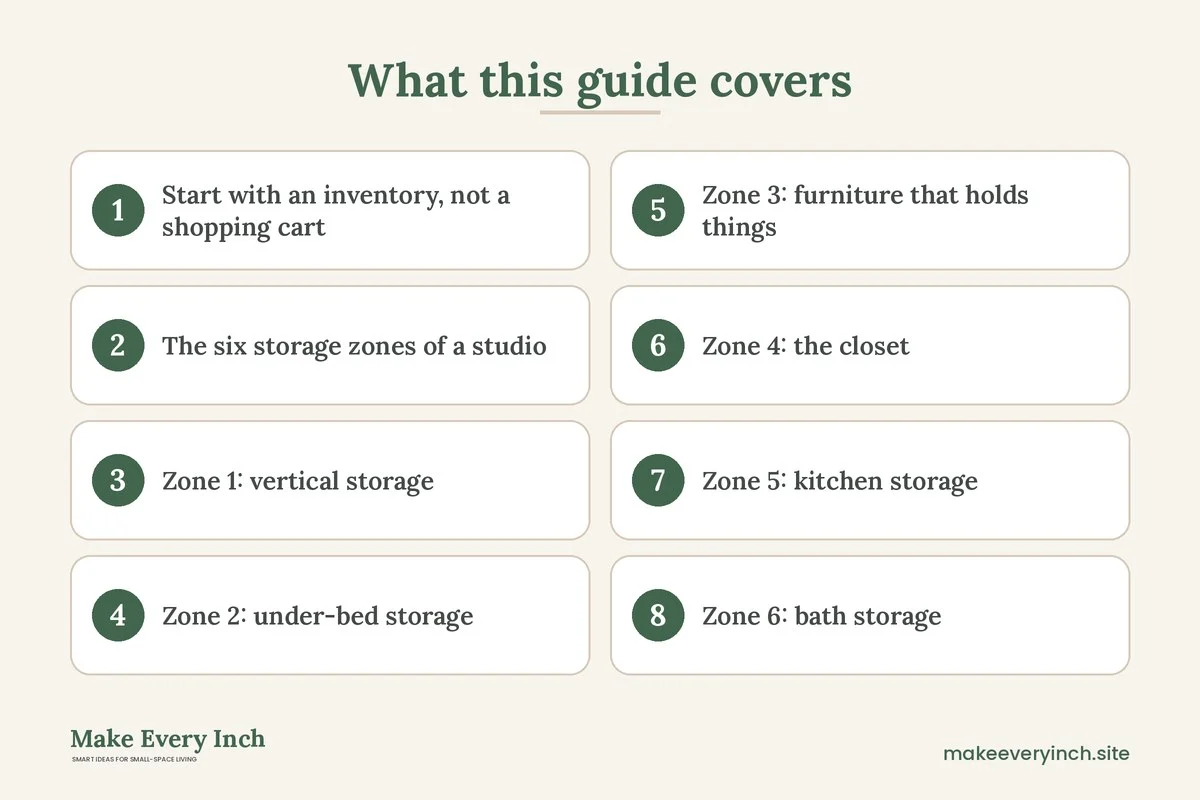
The six storage zones of a studio
A studio is easier to organize when you stop thinking of it as one room and think of it as six zones. Each zone has its own typical storage, its own limits and its own risks. Use the list below as a map for the rest of this guide.
- Vertical zone: the walls above 60 inches and the area above doors and windows.
- Under-bed zone: the 8 to 18 inches between the mattress frame and the floor, or the whole volume under a raised bed.
- Furniture zone: pieces that double as storage, such as ottomans, benches and bed frames.
- Closet zone: the one closet most studios have, plus the back of its door.
- Kitchen zone: cabinets, counters, walls and the sides of the refrigerator.
- Bath zone: the smallest room, with the highest humidity.
Zone 1: vertical storage
Walls are the largest unused surface in a studio. A typical wall is 8 feet tall, yet most furniture stops at about 3 feet. The 5 feet above it is free space that can hold shelves, hooks and rails. Our detailed post on vertical storage ideas goes deeper, and the highlights for a studio are below.
Tall shelving that reaches 6 to 7 feet
A narrow bookcase, 10 to 12 inches deep and 60 to 78 inches tall, holds a surprising amount in a footprint of about 2 square feet. Place it where it also divides space, such as at the foot of the bed, and it does two jobs. Use closed baskets on the lower shelves for visual calm, and keep books and plants at eye level. Because a tall shelf can tip, anchor it to a wall stud with the supplied bracket. If the lease bans drilling, ask in writing, or choose a leaning ladder shelf with a wide base and heavy items on the bottom shelves. Never load the top of a freestanding unit with heavy things.
Shelves above the door and window
The strip above a door, usually 12 to 20 inches tall, can hold a shallow shelf for rarely used items such as luggage or spare bedding. Choose a shelf that is secured to the wall through the frame, not one that rests on the trim. Keep heavier items low and lighter items high, and avoid putting anything above the bed that could fall on a sleeping person.
Rails, hooks and pegboards
A rail with hooks holds bags, hats, scarves and kitchen tools. A pegboard turns a blank wall into a flexible storage panel, and you can move hooks as your needs change. If you cannot drill, adhesive hooks rated for the weight work for light items. Read the weight rating, clean the surface with the recommended wipe and respect the cure time. For ways to avoid holes, see our guide to no-drill storage ideas for renters and the list of DIY wall storage ideas for small spaces.
The back of every door
Over-the-door racks hold shoes, cleaning supplies, pantry items or accessories. They use no wall space and no drilling. Check that the door still closes properly, that the hooks fit the thickness of the door, and that the weight does not strain the hinges.
Zone 2: under-bed storage
The bed is the biggest single object in a studio, and the space beneath it is the biggest hidden volume. A standard bed frame leaves 8 to 18 inches of clearance. That is enough for flat bins, rolling drawers or vacuum bags for out-of-season clothes. Our dedicated post on under-bed storage ideas has more options, and a few studio-specific rules follow.
Measure the clearance first
Measure from the floor to the lowest part of the frame, including slats and legs. Then measure the width and length you can use, remembering that the head of the bed is usually against a wall and the sides may be blocked by a nightstand. Choose bins that are about 1 inch lower than the clearance so they slide without scraping.
What belongs under the bed
Good candidates are seasonal clothing, spare bedding, shoes you wear rarely, wrapping supplies and travel gear. Poor candidates are food, anything damp and anything fragile. Because dust gathers under a bed, use lidded bins or zipped cases. Label each bin on the end that faces out, so you do not pull out three bins to find one scarf.
Raising the bed
If the clearance is small, bed risers can add 4 to 8 inches. Use risers rated for the weight of the bed and the people on it, and check the stability of the bed afterwards. Also consider whether a raised bed will look and feel too high for a small room. Do not raise a bed next to a window you could fall out of, and keep a clear path to the exit. If you are shopping, our post on the best beds with storage compares drawer, lift-up and platform designs.
A loft or a platform
Some studios have a high enough ceiling to support a loft bed or a platform that raises the bed 3 to 5 feet. This creates a full room underneath for a desk, a wardrobe or a seating nook. Lofts need at least 8 feet of ceiling height, a safe ladder and enough space above the mattress to sit up. Check the lease and the fire safety rules before building anything, and never block a window or door that serves as an exit.
Zone 3: furniture that holds things
A studio cannot afford furniture that only does one job. Each piece should offer a seat or a surface and a hidden compartment. Our wider guide to small space storage furniture lists the main types.
- Storage ottoman: a footrest, a seat, a coffee table with a tray and a bin for blankets. See the best storage ottomans.
- Bench at the foot of the bed: holds extra linens, shoes or a laundry bag, and gives you a place to sit while you dress.
- Coffee table with a lift top or shelf: hides remotes, chargers and books.
- Sofa with storage under the seat or in a chaise: common in small studios and holds pillows and throws.
- Console behind the sofa: a shallow cabinet 10 to 14 inches deep holds keys, mail and a lamp, and also divides the living and sleeping areas.
- Dresser as a nightstand: a three-drawer unit by the bed replaces a nightstand and holds a week of clothes.
Check that the weight of the contents is distributed and that lids close slowly. Choose lids with soft-close hinges or supports, especially if children or pets are present. For a sense of how these pieces fit a studio living area, see our post on small apartment living room ideas for studios.
Zone 4: the closet
Most studio closets are narrow, shallow or both, and they carry the burden of the whole home. A typical reach-in closet is 24 inches deep and 3 to 6 feet wide, with a single rod and a shelf. You can raise its capacity with a few changes. Our guides to small closet organization ideas and DIY closet organization for small spaces explain each in more detail.
Double the hanging space
Add a second rod below the first, about 40 to 42 inches from the floor, for shirts, skirts and folded trousers. Hanging space doubles for short items. Long dresses and coats stay on the original rod. Use an adjustable rod that sits on supports, such as a tension fit, if you cannot drill into the walls.
Use slim, matching hangers
Thin hangers can save up to a third of the rod space, and a uniform shape keeps the row tidy. Cascading hangers hold several garments in a vertical stack.
Stack the shelf
Use shelf dividers to keep stacks upright and add a hanging shelf organizer for sweaters. Baskets on the upper shelf hold hats, gloves and scarves. Keep heavy items low.
The floor of the closet
Add a low shoe rack or stackable shoe shelf. Keep boots in a bin if they take too much room. For more ideas, see our guide to small shoe storage ideas.
The inside of the door
Slim hooks, an over-the-door organizer or a mirror free up the wall space outside the closet. A full-length mirror on the door also makes the studio look larger.
No closet at all?
Some studios have a wardrobe alcove or no closet at all. In that case, use a freestanding wardrobe, a clothing rack with a cover or a tall dresser. Our post on small bedroom ideas without a closet covers this situation. Place a freestanding wardrobe against a wall, anchor it, and keep it from blocking a window or an exit.
Zone 5: kitchen storage
The kitchen is the most crowded zone of the studio because a single wall handles cooking, food, dishes and often laundry. Our post on small kitchen storage ideas and the version for small kitchen storage ideas without remodeling offer extra detail. Studio-specific moves follow.
Use the walls
A rail along the backsplash holds utensils, mugs and small pots. A magnetic strip holds knives and metal tools. Shelves above the counter hold jars and plates. For more, see our guide to small kitchen wall storage ideas. If you rent, try rails that hang from adhesive hooks rated for the load or a freestanding rack.
Use the cabinets better
Add a shelf riser inside each cabinet so plates and bowls stack in two levels. Use hooks under the shelf for mugs, and a turntable for corner cabinets. Keep the items you use daily at counter height or below, and the seldom-used ones high.
Add a cart or a rolling island
A narrow cart gives extra counter and shelf space and parks next to the sofa when you need it. See our list of best rolling kitchen carts and the post on small kitchen cart ideas. In a studio, keep the cart away from the stove, because fabric and paper burn.
The side of the refrigerator and the top of the cabinets
The side of the refrigerator can hold magnetic racks for spices and foil. The top of the cabinets can hold baskets for lesser-used items, but leave the space above the stove clear and keep anything flammable away from heat. Keep at least 18 inches between a cooking surface and a shelf above it, or follow the manufacturer’s instructions.
Mind the ventilation
A studio with the kitchen in the main room carries cooking smells and moisture into the sleeping area. Store oil, spices and snacks in sealed containers. Run the vent hood or open a window when cooking, and avoid hanging fabric near it.
Zone 6: bath storage
A studio bathroom is often a single small room with a toilet, sink and tub or shower. Storage must work with moisture, so choose materials that resist damp. Our posts on small bathroom storage ideas for tight spaces, tiny bathroom storage ideas and the best over-the-toilet storage go into detail.
- Over-the-toilet shelves: hold towels and spare rolls. Choose a freestanding unit that straddles the tank, and anchor it if it is tall.
- Over-the-door hooks: hold towels and robes and need no drilling.
- Shower caddy: a hanging or tension-pole version keeps bottles off the tub edge.
- Wall-mounted shelves or a medicine cabinet: use adhesive that is rated for bathrooms, or ask permission to drill.
- Baskets or bins on a shelf: hold toiletries by person, so one basket belongs to each resident.
- A slim rolling cart: fits between the toilet and the wall and holds toiletries and spare towels.
Keep electrical items, such as hair dryers and razors, away from water, and never run a cord across wet surfaces. Make sure vents are clear, and wipe surfaces regularly to prevent mold.
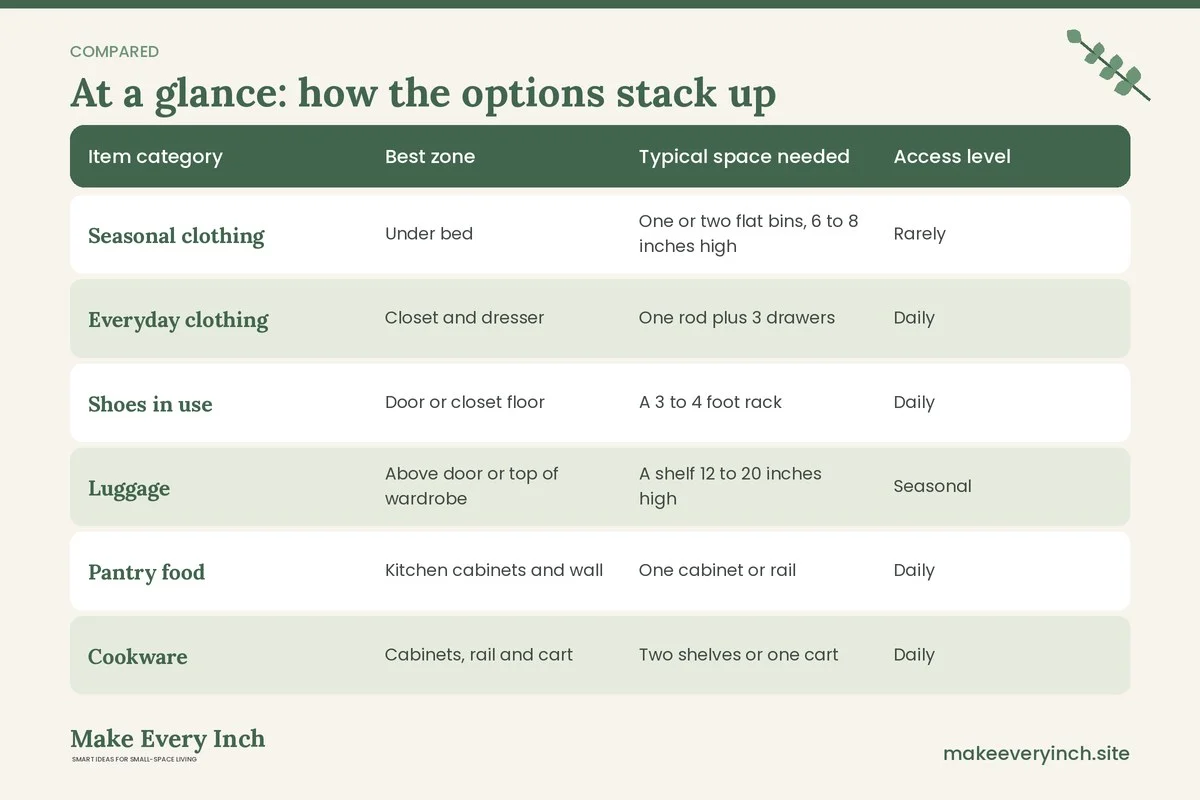
Comparison table: which zone for which item
Use this table to match each category to the storage zone that suits it best. The size column is a rough guide.
| Item category | Best zone | Typical space needed | Access level |
|---|---|---|---|
| Seasonal clothing | Under bed | One or two flat bins, 6 to 8 inches high | Rarely |
| Everyday clothing | Closet and dresser | One rod plus 3 drawers | Daily |
| Shoes in use | Door or closet floor | A 3 to 4 foot rack | Daily |
| Luggage | Above door or top of wardrobe | A shelf 12 to 20 inches high | Seasonal |
| Pantry food | Kitchen cabinets and wall | One cabinet or rail | Daily |
| Cookware | Cabinets, rail and cart | Two shelves or one cart | Daily |
| Towels and linens | Bath shelf, bench and bed | One basket per person | Weekly |
| Paperwork | Shelf box or small file | One 12 inch box | Monthly |
| Hobby gear | Tall shelf or ottoman | One bin | Weekly |
| Cleaning supplies | Behind a door or under the sink | One caddy | Weekly |
Three example studios
A 400 square foot studio with one closet
The room is 16 by 25 feet and has a single reach-in closet, a galley kitchen and a full bath. The resident installs a second closet rod, adds an over-the-door shoe organizer, and places a bed with 14 inches of clearance. Two flat bins hold winter sweaters and spare bedding. A 72-inch bookcase, anchored to the wall, stands at the foot of the bed as a half wall and holds books, baskets and plants. A storage ottoman serves as a coffee table and holds throws. The kitchen uses a rail, a magnetic knife strip and a narrow cart. The plan keeps the main path at 36 inches and does not cover any window.
A 300 square foot studio with no closet
A freestanding wardrobe, 24 inches deep, anchored to the wall, sits next to the entry. A rolling rack with a cover holds off-season coats. A bed on risers has 16 inches of clearance and holds six bins. A console behind the sofa works as a drop zone and divider, and a tall dresser serves as a nightstand. For ideas on how to divide the room without blocking exits, read our guides to renter-friendly ways to divide a studio apartment and DIY room divider ideas for studio apartments.
A 500 square foot studio with high ceilings
With 10-foot ceilings, the resident adds a tall shelf wall along one side, 84 inches high, with upper shelves for luggage and boxes and lower shelves for daily items. A platform bed with drawers replaces the old frame. A rail and shelf system covers the kitchen wall. The extra height is used only when the shelving is stable, anchored and reachable with a sturdy step stool. Heavy items stay under 60 inches.
Safety notes for studio storage
Storage that fails can cause more harm than clutter. Keep these rules in mind.
- Anchor tall furniture. Bookcases, wardrobes and dressers can tip, especially with children, pets or an earthquake. Use the wall anchors that come with the piece.
- Ask permission before drilling. Read the lease and ask the landlord in writing. Never drill into walls without permission, and avoid drilling near wiring or pipes.
- Keep exits clear. Do not place shelves, racks or bins in front of the door or in the path to a window. Keep the route to the entry at least 30 to 36 inches wide.
- Respect electrical limits. Do not run extension cords under rugs, do not daisy-chain power strips, and keep shelving away from outlets and radiators.
- Watch heat and flammables. Keep paper, fabric and aerosol cans away from the stove, heaters and candles.
- Ventilate. Do not pack closets so tightly that air cannot move, and keep stored items off the floor in damp rooms to prevent mold. When you paint shelves or bins, use low-VOC paint and open a window.
- Mind the weight. Check the rating on every shelf, hook and bin.
Mistakes to avoid
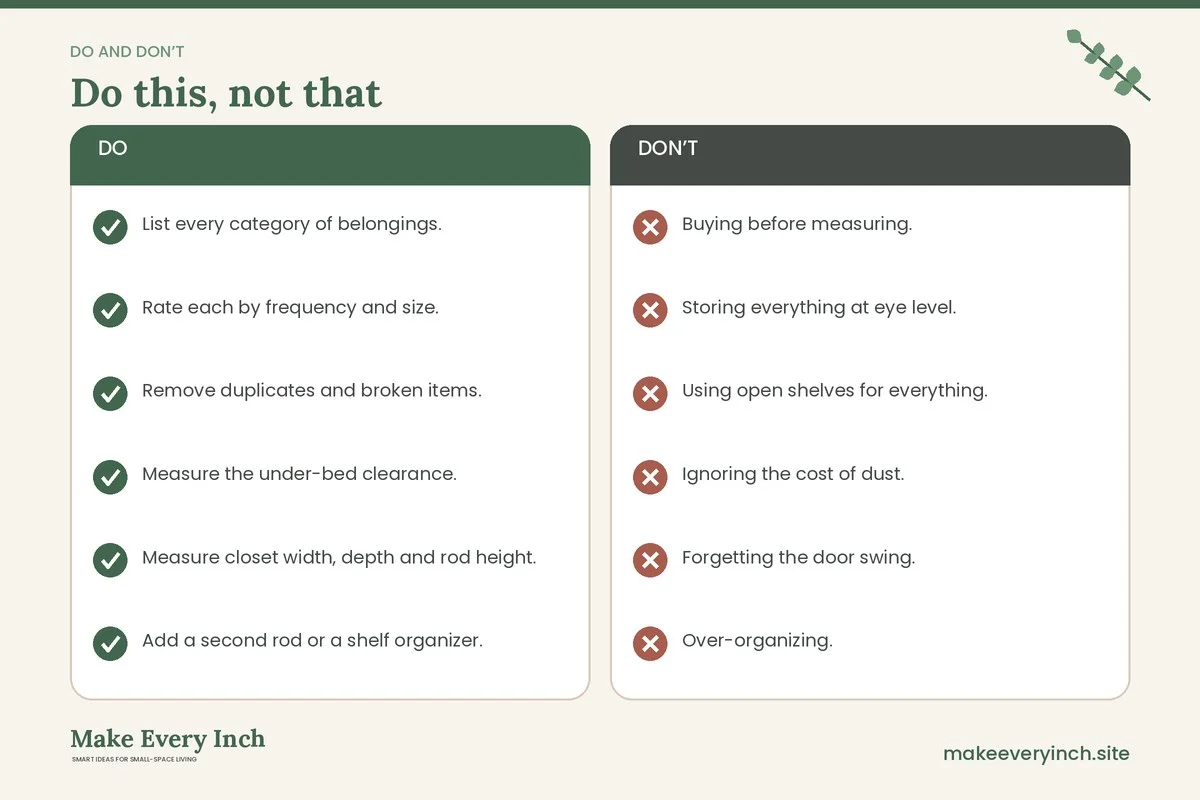
- Buying before measuring. A bin that is 1 inch too tall will not fit under the bed.
- Storing everything at eye level. Eye level is for daily use. Move seasonal items higher or lower.
- Using open shelves for everything. Too many open shelves look noisy in a studio, because you see the whole room at once. Use baskets and doors for the rest.
- Ignoring the cost of dust. Items stored under a bed need lids.
- Forgetting the door swing. A rack can block a door or hit a wall.
- Over-organizing. A system with too many bins takes more effort to maintain than to ignore. Aim for a few large categories.
- Skipping labels. Without labels, you will forget what is where within a month.
A weekly routine for keeping it all in order
Systems fail without upkeep. Spend about 15 minutes a week on a short reset.
- Monday: return the items that have migrated to the bed or sofa to their homes.
- Wednesday: clear the kitchen counter and wipe the shelves.
- Friday: empty the bathroom basket, check the towels and restock.
- Sunday: put away laundry, check the under-bed bins and decide whether anything should leave the studio.
Once a season, swap out clothes, review the pantry and clear paperwork. Treat the ten items you use most as the heart of the system, and keep them within arm’s reach.
Studio storage checklist
- List every category of belongings.
- Rate each by frequency and size.
- Remove duplicates and broken items.
- Measure the under-bed clearance.
- Measure closet width, depth and rod height.
- Add a second rod or a shelf organizer.
- Use the back of every door.
- Add one tall, anchored shelf.
- Choose one storage ottoman or bench.
- Install rails or hooks in the kitchen.
- Add baskets in the bath.
- Label every bin.
- Confirm the lease allows what you plan.
- Keep exits and walkways clear.
- Schedule a weekly 15 minute reset.
FAQ
What is the best storage idea for a studio apartment?
There is no single best idea. The most effective approach is to use vertical space, the area under the bed and furniture with built-in storage together, and to remove what you do not need first.
How do I store things in a studio with no closet?
Use a freestanding wardrobe, a clothing rack with a cover, a tall dresser and under-bed bins. Anchor tall pieces, and keep them away from windows and exits.
How much can I store under a bed?
It depends on the clearance. With 8 to 18 inches of height, you can usually fit several flat bins of seasonal clothing, bedding and shoes. Measure before you buy.
Can I add storage without drilling?
Yes. Use tension rods, over-the-door organizers, adhesive hooks rated for the weight, freestanding shelves and furniture with built-in storage. For heavy or tall pieces, ask your landlord about anchoring.
How do I keep a studio from looking cluttered?
Hide most things in closed storage, keep surfaces mostly clear, and choose a limited color range for bins and baskets. A routine of 15 minutes a week keeps the system working.
Where should I put items I rarely use?
Place them in the hard-to-reach zones: above the door, on the top shelf of the closet, on top of a wardrobe or under the bed.
Keep going: Keep going with our guides to studio apartment ideas, studio apartment furniture ideas and small home storage ideas for every room.
Save this guide for later
Pin the ideas you like to Pinterest so you can come back to them when you plan your space.