Studio Apartment Ideas for Making Space Feel Bigger
Quick answer: The best studio apartment ideas for making space feel bigger work on perception, not square footage. Draw the eye up with vertical lines, bounce light with mirrors and pale surfaces, keep as much floor visible as you can, limit your palette to two or three related colors and choose furniture with legs and a scale that fits the room. Keep exits clear, anchor tall pieces and ask before drilling.
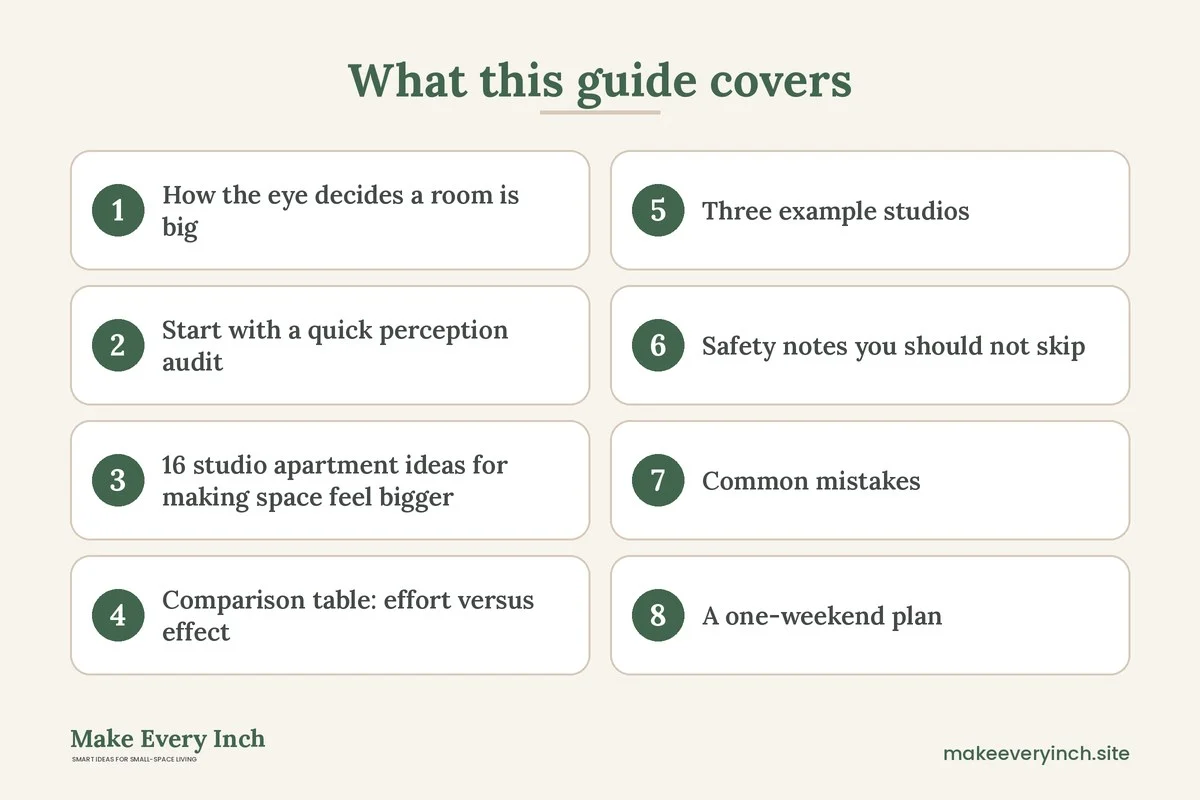
Studio apartment ideas for making space feel bigger start with a surprising fact: a room feels large or small based on what your eyes can read, not only on its measurements. A 400 square foot studio with a clear floor, bright walls and an unbroken sight line can feel more generous than a 500 square foot one stuffed with dark furniture. This guide treats the problem as a design of perception. It covers how the eye judges space, 16 ideas organized by vertical lines, light, mirrors, floor, color and scale, a comparison table, three example studios, safety notes and a checklist. For the wider topic, read our main guide to studio apartment ideas, and pair it with the companion post on studio apartment layout ideas that create zones.
How the eye decides a room is big
You do not measure a room with a tape when you walk in. Your brain makes a fast guess using a few cues, and each cue can be nudged by design.
- Visible floor: the more continuous floor you see, the larger the room seems. Furniture that hides the floor, or a floor covered in objects, shrinks the room.
- Height: a high ceiling makes a room feel airy. You cannot raise the ceiling, but you can pull the eye up and make the walls look taller.
- Light and brightness: bright, evenly lit surfaces recede. Dark corners advance and close the room in.
- Sight lines: long, uninterrupted views suggest depth. A window or a doorway you can see from the far side of the room extends the space.
- Visual noise: many colors, patterns and small objects compete for attention and make the room look crowded.
- Scale: furniture that is too large for the room, or too small for its function, throws off the sense of proportion.
Keep these cues in mind as you work through the ideas. Each one lifts one or more cues, and several together create a noticeable change.
Start with a quick perception audit
Before you buy anything, stand in the doorway and take a photo of the room, then stand at the far end and take another. Look at the photos rather than the room. Photos are honest in a way that familiar rooms are not. Ask yourself:
- Where does my eye stop first?
- Which pieces look heavy or dark?
- Where is the floor hidden?
- What is on top of surfaces that does not need to be?
- Where does the light fall, and where is it dim?
Write down three things that bother you, and let the list guide which of the ideas below to try first. In many studios the top three are clutter on surfaces, one heavy piece in the center and poor lighting in a corner. Those are quick and often free to fix.
16 studio apartment ideas for making space feel bigger
Vertical lines that lift the eye
1. Hang curtains high and wide
Mount the curtain rod close to the ceiling, or at least several inches above the window frame, and extend it past the frame on each side by 8 to 12 inches. The curtains then cover the wall instead of the glass, which makes the window look taller and wider and lets in more light when open. Choose a length that just kisses the floor. Use tension rods or a rod with permission-friendly fixings if your lease bans drilling, and see our guide to renter-friendly window treatment ideas.
2. Use tall, narrow furniture
A tall, slim bookcase draws the eye up and uses vertical wall space, leaving the floor clear. Keep it to a depth of 10 to 12 inches in walkways. Always anchor tall furniture with the hardware the maker supplies, or choose a lower, stable piece if you cannot anchor. Our list of best narrow bookshelves is a good starting point.
3. Stripe it vertically
Vertical stripes on a rug runner, a throw or removable wallpaper emphasize height. Keep the stripes thin and low contrast so the pattern does not overwhelm the room. For the wall, peel-and-stick options can be an option when the lease allows them, and our guide to removable wallpaper ideas covers the risks.
4. Hang art vertically and a little high
A long, narrow frame, or a column of two or three frames, creates a vertical line. Hang art so its center sits at about 57 inches from the floor in most places. In a studio, going a few inches higher can make the wall look taller, as long as the art still relates to the furniture below it. Use adhesive hangers within their weight rating, and test them in a hidden spot.
Light that opens the room
5. Let the window do its job
Clear the sill and the area in front of the window. Move tall furniture away from the light, and use sheer or light-filtering curtains in the daytime. Even a small window feels larger when light spreads across the walls and the floor.
6. Layer your lighting
A single ceiling fixture flattens a room and leaves shadows in the corners. Add a floor lamp, a table lamp and a plug-in wall light at different heights. Aim some light at the walls or the ceiling so the surfaces glow, which makes the room look wider. Bulbs in the same warm or neutral tone avoid a patchy look. Read our guides on renter-friendly lighting ideas and best floor lamps for small rooms.
7. Light the dark corner
A corner without light looks like the room ends sooner than it does. Place a small lamp, an uplight or a strip of battery or plug-in light there. Keep cords tidy and out of the walkway, do not overload an outlet, and respect each fixture’s maximum bulb wattage.
8. Choose glossy and light-reflecting surfaces with care
A semi-gloss finish, a pale tabletop or a glass surface reflects some light. Use these on small items, such as a tray or a side table, rather than making everything shiny. Too many reflective surfaces can create glare, especially near a bright window.
Mirrors that double depth
9. Place a large mirror opposite the window
A mirror across from a window reflects daylight and the view, which increases brightness and creates the sense of a second window. Lean a floor mirror against the wall so it needs no hardware, and make sure it cannot slide or tip: use a secure stand or a wall strap with permission. Do not position it so that it reflects a cluttered corner or a harsh direct light into your eyes.
10. Use a mirror to extend a sight line
A mirror at the end of a short hall or beside the entry makes the path look longer. Place it where it reflects the best part of the room, such as a plant, a light or a view of the window, rather than the door of the bathroom or a pile of bags.
11. Pick mirrors with care and secure them
Hang or lean heavy mirrors only with fixings rated for their weight, and with the landlord’s permission if drilling is needed. Large glass is heavy and can hurt someone if it falls. Do not place a mirror where it could focus sunlight onto a flammable surface, such as a curtain or a sofa, during the day.
Clear floor and legs
12. Choose furniture on legs
When you can see the floor beneath a sofa, a bed or a console, the room looks lighter. Legs 6 inches or higher also make cleaning easier. If you use the space beneath for storage, keep the items in matching boxes so it reads as one calm band. Our guide to under-bed storage ideas shows how to keep it tidy.
13. Use one rug, and make it big enough
A tiny rug looks like a postage stamp and cuts the room into pieces. A larger rug, with the front legs of the main furniture on it, makes the floor look continuous. Keep it a low-contrast color close to the floor tone, and use a rug pad so it does not slip.
14. Clear the surfaces
Flat surfaces collect objects, and each object adds visual noise. Leave each surface with a maximum of three items, such as a lamp, a plant and a tray. Store the rest in closed boxes or shelves. Our posts on decluttering rules for small homes and hidden storage ideas help you edit.
Color and scale
15. Limit the palette and repeat it
Use two or three related colors across walls, textiles and furniture. A light base, a mid-tone and one accent is a simple formula. Matching the wall and the largest furniture, such as a white shelf on a white wall, makes the furniture visually recede. If you paint, check your lease first, and use low-VOC paint with the windows open until the smell fades.
16. Match furniture scale to the room
An oversized sofa swallows a studio, and a toy-sized one wastes the seating area. As a guide, a sofa in a small studio is often 60 to 76 inches wide, with arms that are slim, and a bed has a low headboard that does not block the window. Use pieces that do two jobs, such as a storage bed or an ottoman with a lid. See our guides to best sofas for small apartments and best furniture for small apartments.
Comparison table: effort versus effect
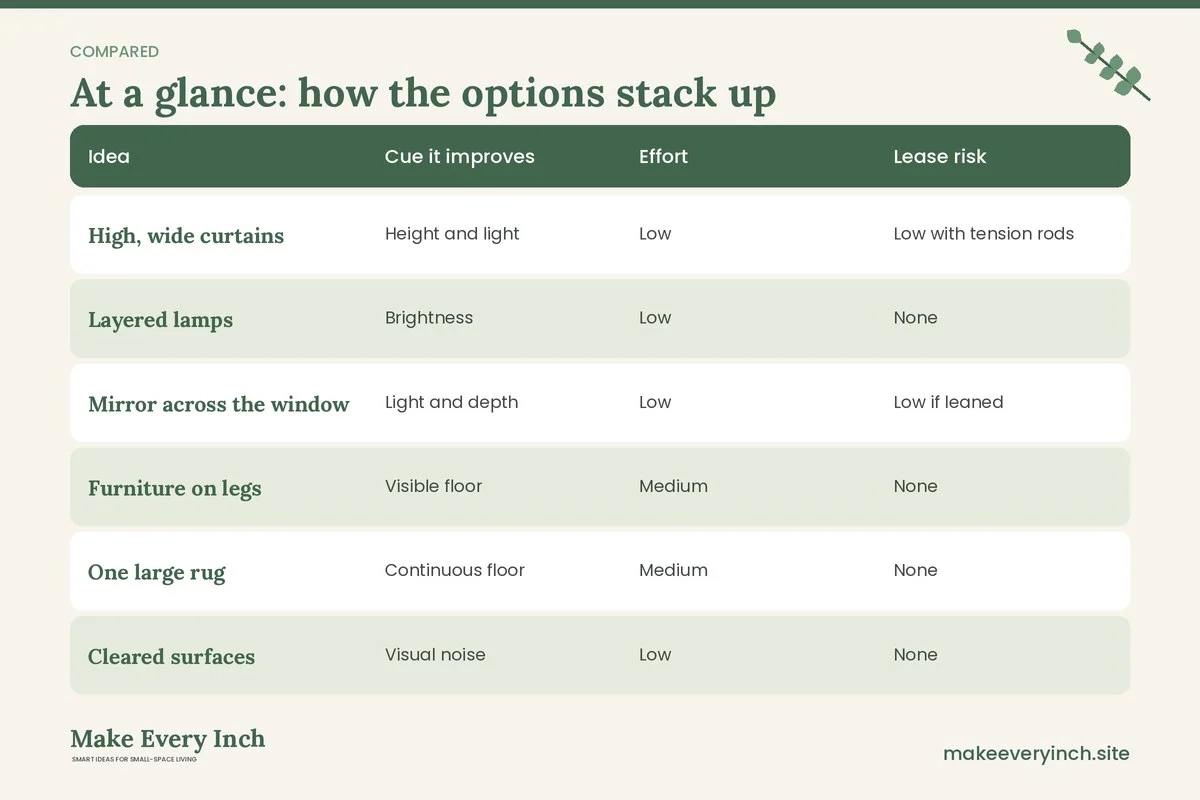
| Idea | Cue it improves | Effort | Lease risk | Best for |
|---|---|---|---|---|
| High, wide curtains | Height and light | Low | Low with tension rods | Rooms with a short window |
| Layered lamps | Brightness | Low | None | Dim corners |
| Mirror across the window | Light and depth | Low | Low if leaned | Rooms with one window |
| Furniture on legs | Visible floor | Medium | None | Beds and sofas that sit low |
| One large rug | Continuous floor | Medium | None | Rooms with a patchy floor |
| Cleared surfaces | Visual noise | Low | None | Any studio |
| Tone-on-tone palette | Color and calm | Medium | Medium if painting | Rooms with mixed furniture |
| Tall narrow shelf | Height | Medium | Medium if anchoring | Rooms with a bare wall |
| Vertical stripes | Height | Medium | Medium with wallpaper | Low-ceiling rooms |
Three example studios
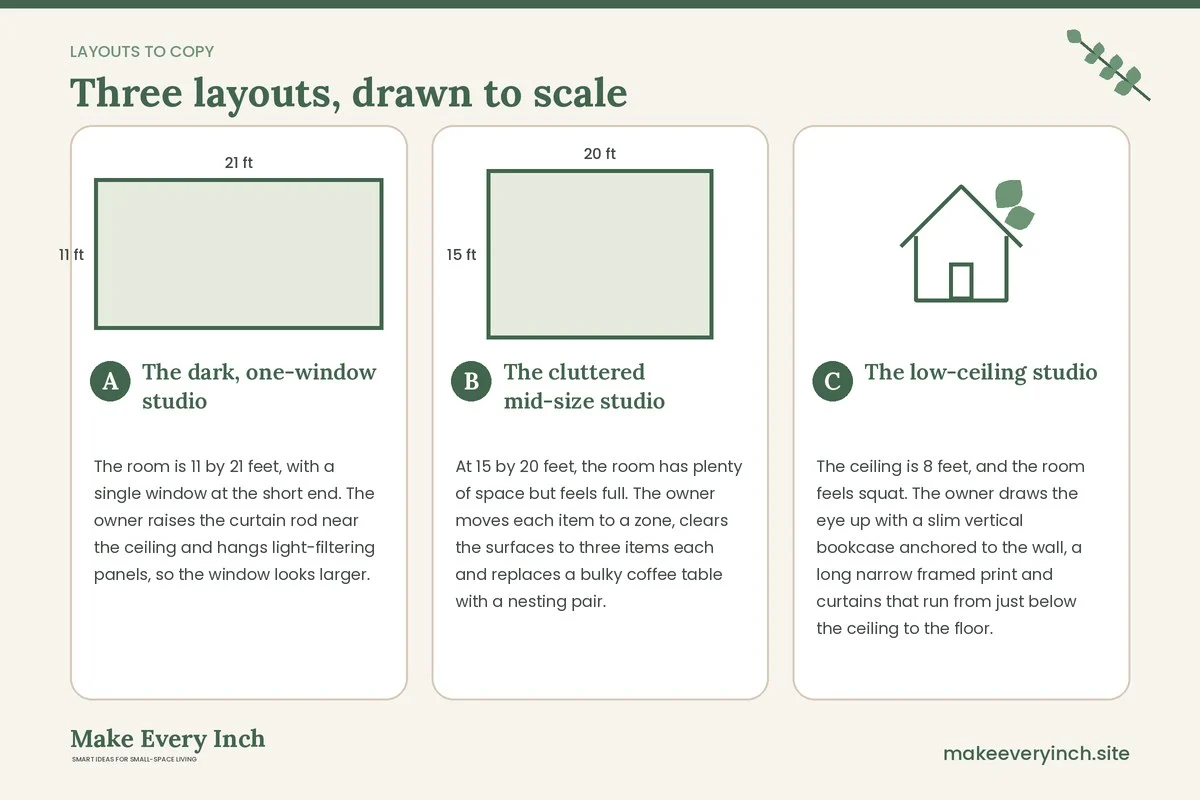
The dark, one-window studio
The room is 11 by 21 feet, with a single window at the short end. The owner raises the curtain rod near the ceiling and hangs light-filtering panels, so the window looks larger. A tall mirror leans on the opposite wall to bounce daylight back. Three lamps replace the one overhead light: a plug-in wall lamp by the bed, a floor lamp at the sofa and a small lamp in the dark corner. The result is a room that feels brighter and longer without any change in layout. The owner clears the sill and swaps a heavy dark throw for a pale one.
The cluttered mid-size studio
At 15 by 20 feet, the room has plenty of space but feels full. The owner moves each item to a zone, clears the surfaces to three items each and replaces a bulky coffee table with a nesting pair. The bed, which sat directly on the floor, is raised on legs to show the floor beneath. A single large rug in a neutral tone replaces three small ones. The color palette shrinks to white, warm gray and one green accent in plants. The room now reads as one calm space instead of ten small stories.
The low-ceiling studio
The ceiling is 8 feet, and the room feels squat. The owner draws the eye up with a slim vertical bookcase anchored to the wall, a long narrow framed print and curtains that run from just below the ceiling to the floor. A runner with thin stripes lines the hall. The furniture is low and slim, and the walls are the same pale shade as the ceiling, which removes the hard line between them. The lighting points upward from a floor lamp, washing the ceiling with light.
Safety notes you should not skip
- Keep exits clear: do not add furniture or mirrors that block a door, a window or a route to the exit. The bed should never sit in front of the only window if it is the exit.
- Anchor tall furniture: bookcases and tall shelves can tip. Use the maker’s anchoring hardware with your landlord’s permission, and never drill without permission.
- Mirror and glass safety: secure mirrors, and keep them away from beds if they could fall onto a sleeper. Use the right fixing for the weight.
- Electrical: do not overload outlets or power strips, avoid cords under rugs and use bulbs that match the fixture’s rating.
- Ventilation and paint: use low-VOC paint, open windows while painting and let the room air out before you sleep there.
- Window coverings: keep cords for blinds out of reach of children and pets.
- Check the lease: removable solutions are safer when you are not sure what is allowed.
Common mistakes
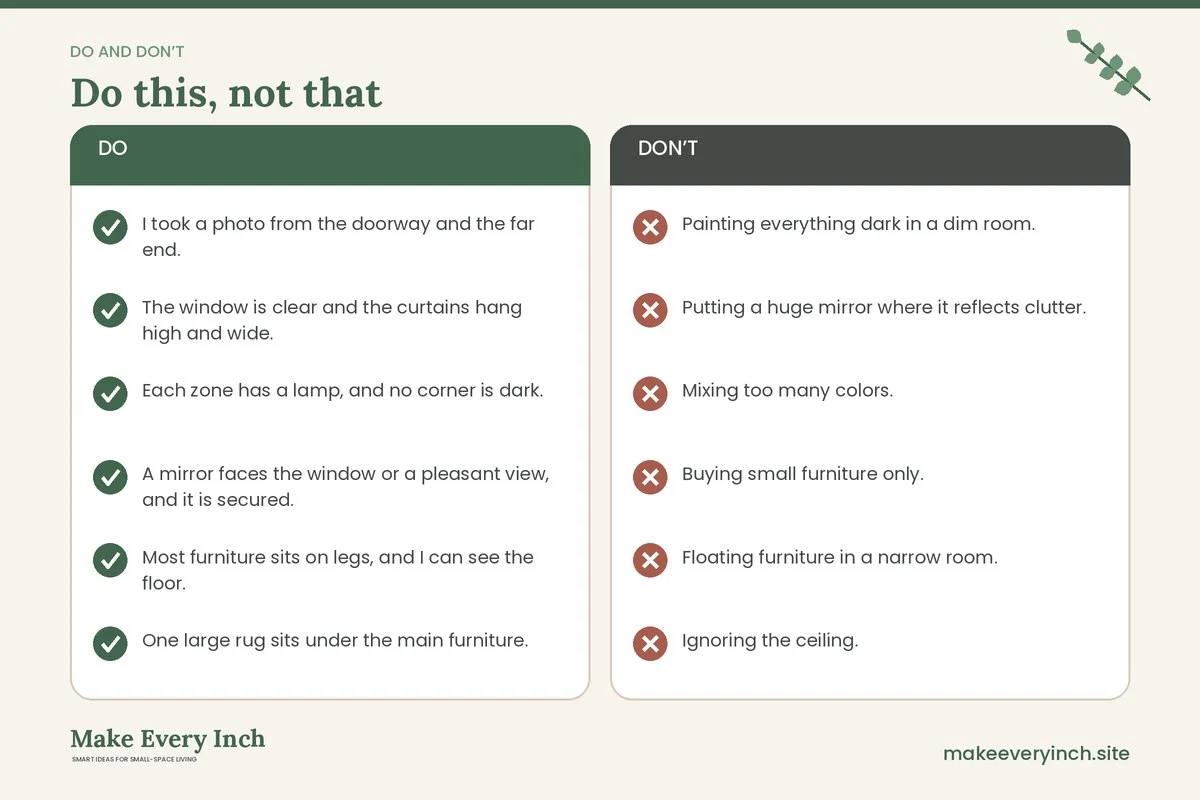
- Painting everything dark in a dim room. It can work with strong lighting, but it often makes a small room feel closed in.
- Putting a huge mirror where it reflects clutter. A mirror doubles what it faces, including the mess.
- Mixing too many colors. A busy palette increases visual noise.
- Buying small furniture only. Too many tiny pieces make a room look cluttered. A few larger pieces that fit well often look better.
- Floating furniture in a narrow room. It cuts the path. Keep the main route 30 to 36 inches wide.
- Ignoring the ceiling. A white or pale ceiling is a free source of reflected light.
- Hiding everything in the open. Visible storage should be tidy, and the rest should be behind doors or in boxes.
A one-weekend plan
Saturday morning: clear and clean
Take everything off the surfaces and the floor. Wash the windows and wipe the sill, because dirty glass reduces light. Sort the items into keep, store and donate. For help, see our guide to small apartment decluttering ideas.
Saturday afternoon: light and mirrors
Reset the lamps, add bulbs of one warm tone and place the mirror. Check the reflection from the door and from the bed. Move it if it reflects something you do not want to double.
Sunday: floor, color and scale
Lay a rug, lift any furniture that sits low and unify the textiles. Remove the one item that feels too big, and see how the room changes. Walk in as if you were a guest and take another photo to compare.
Perception checklist
- I took a photo from the doorway and the far end.
- The window is clear and the curtains hang high and wide.
- Each zone has a lamp, and no corner is dark.
- A mirror faces the window or a pleasant view, and it is secured.
- Most furniture sits on legs, and I can see the floor.
- One large rug sits under the main furniture.
- Surfaces hold three items or fewer.
- The palette has two or three related colors.
- Furniture scale fits the room and the main path is 30 to 36 inches.
- Tall pieces are anchored, and cords are tidy.
- I checked my lease before drilling or painting.
FAQ
What makes a studio feel bigger fastest?
Clear the surfaces, open the curtains, add light to dark corners and show more floor. These changes cost little and affect perception right away.
Do mirrors really make a room look bigger?
They add brightness and depth when placed to reflect light or a pleasant view. They do not add actual space, and they can double clutter if they face a messy area.
Should I paint a small studio white?
Light colors reflect more light and usually feel more open, but a warm off-white, a pale gray or a soft green can work as well. Choose by the light in your room, and check your lease first.
Is it better to have small furniture?
Not always. Right-scaled furniture that suits the room works better than many tiny items. Pick slim arms, exposed legs and multi-use pieces.
How do I keep the room feeling big and still have zones?
Use low, open dividers, rugs and lighting rather than solid walls. Our post on studio apartment layout ideas that create zones shows how.
Can I do this as a renter?
Yes. Most of these ideas, such as lamps, leaned mirrors, rugs and tension rods, need no installation. See our guide to renter-friendly apartment decorating ideas.
Keep going: Keep going with our studio apartment ideas guide, small bedroom ideas that make the room feel bigger and dark apartment ideas.
Save this guide for later
Pin the ideas you like to Pinterest so you can come back to them when you plan your space.