Small Living Room Ideas for Renters Budget Guide: 14 Low-Cost, Lease-Safe Moves
Quick answer: The best small living room ideas for renters budget plans spend in a fixed order: first on things you can take with you (a rug, a lamp, a pair of side tables), then on things that fix a real problem (storage, a seat that fits), and last on décor. Keep every purchase removable, keep a 30 to 36 inch walkway, check the lease before any adhesive, and expect costs to vary widely by region and by whether you buy new or second-hand.
Small living room ideas for renters budget plans have two rules at once: spend little, and leave nothing behind that costs you part of your deposit. Those rules pull in the same direction more often than you might expect, because the cheapest upgrades are usually the loose ones, such as lamps, rugs, baskets and furniture that stands on its own legs. This guide is written for the renter who has a small sum to spend, a lease with unclear wording and a room that is perhaps 9 to 12 feet wide. It covers how to read the lease for the money angle, how to set a ceiling, which purchases pay back first, 14 low-cost ideas with hedged price ranges, a spend-order table, three sample budgets, second-hand rules, a moving-day check and a checklist. For the wider picture, read our main guide to small living room ideas for renters, the pillar on small living room ideas and our broader list of budget renter upgrades.
Start with the lease, because it protects your money
A budget disappears quickly if a deposit deduction follows you out of the door. Before you buy anything, read the clauses on nails, adhesive, paint, flooring and fixtures. Then ask yourself three questions about every idea in this guide. Can I take it with me? Can I remove it in under ten minutes? Will it leave a mark on the wall, the floor or the ceiling? If the answer to the last question is yes or maybe, either skip the idea or ask the landlord in writing.
Photographs are the cheapest insurance you can buy. On move-in day, photograph each wall, the floor under any rug area, the window frames and the light fixtures, with a date on the file. Keep the images with your lease. If a deduction is ever proposed for wear that was there when you arrived, you have evidence.
Many leases allow small nail holes, some allow them with a written request, and some forbid them outright. Policies on adhesive strips vary too, since strips can lift paint on older or recently painted walls. If you are not sure, test one small strip in a hidden spot, such as behind a door, for several days before you commit a whole gallery wall to it. That small precaution costs almost nothing.
Set a ceiling and split it into three buckets
Most renters spend better when they decide on a total before they browse. The number depends on your income and on how long you plan to stay, so treat any figure in this guide as a rough guide only. A simple way to divide it is the 60, 25, 15 split.
- About 60 percent for portable essentials: a rug, a lamp or two, seating that fits and one surface at the right height.
- About 25 percent for problem-solvers: storage that gets floor clutter off the floor, a curtain rod and curtains, or a mirror to bounce light.
- About 15 percent for décor: pillows, a throw, a plant and a few prints in frames.
If your budget is very small, put nearly all of it in the first bucket and live with bare walls for a month. A room with one good lamp and a rug that anchors the sofa looks more finished than a room with ten small objects and no light.
Next, decide how long you will stay. If you expect to move in under a year, favor items that fold, stack or disassemble. If you will stay three years or more, spending a little more on a durable sofa or rug can pay back through lower cost per year, as long as the item will fit the next place. A piece that is 30 inches deep and 72 inches wide fits through most doors and into most small rooms, and that portability is worth more than a dramatic piece that works in only one room.
The measurements that save you from returns
Returns cost time, and sometimes a restocking fee, so measure first. Use painter’s tape to mark the footprint of every large item on the floor before you order. These are the numbers that matter most in a room 9 to 12 feet wide.
- Sofa depth: 30 to 36 inches for a small room. Over 38 inches and the sofa starts to take over the floor.
- Sofa length: 68 to 80 inches for a loveseat or small sofa. In a room 9 feet wide, a sofa over 84 inches rarely leaves a comfortable path.
- Walkway: 30 to 36 inches for the main route, and 24 inches for a side path used occasionally.
- Rug size: 5 by 8 feet works for most small rooms, with the front legs of the sofa resting on it. A 4 by 6 foot rug often looks like a doormat if the sofa sits entirely off it.
- Side table distance: 16 to 24 inches from the seat edge to the near edge of a table, so a mug is within reach.
- Sofa to TV: at least 6 to 7 feet in most small rooms, which keeps a wall-mounted screen from feeling too large.
- Curtain rod: 4 to 6 inches above the window frame and 3 to 6 inches wider on each side, so the window looks bigger.
A note on tall furniture. Bookcases, shelving units and tall storage cabinets can tip, particularly where children or pets are present. Whenever you buy a tall piece, anchor it to the wall with the hardware the maker supplies, and check your lease first, since that means drilling a small hole. If the lease forbids it, ask the landlord for written permission, choose a shorter or heavier piece, put heavy items low and light ones high, or pick a freestanding unit with a wide base and a low center of gravity. Avoid placing a tall, unanchored piece near a doorway or where anyone sits or sleeps beneath it.
14 small living room ideas for renters on a budget
All price ranges below are rough and hedged. Costs vary by region, season, retailer and condition, and second-hand prices vary more than new ones. Use them to rank ideas, not to forecast a bill.
Portable essentials: spend here first
1. A rug that reaches under the sofa
A rug of about 5 by 8 feet is usually the single biggest visual upgrade in a rental, because it covers a floor you cannot change and gathers the furniture into one group. Prices commonly run from tens of dollars for a simple flatweave to a few hundred for a larger wool one, depending on material and size. Pair it with a non-slip pad cut slightly smaller than the rug so the edges lie flat, and check that the pad is safe for your floor type before you lay it. Some rubber-backed products can stain vinyl or finished wood, so ask the maker or test a corner.
2. Two lamps instead of the overhead light
Many rentals have one harsh ceiling fixture. Two plug-in lamps at different heights, one on a side table and one on the floor, make the room look larger and warmer in the evening. A basic table lamp can cost anywhere from a modest amount to more, and warm bulbs of around 2700 kelvin soften the room. Lamps are fully portable, which is why they rank near the top of any renter’s list. See our guide to best floor lamps for small rooms for features to look for.
3. A pair of side tables rather than one coffee table
A 14 to 16 inch table at each end of the sofa often serves better than a central table in a room under 12 feet wide, and a pair can cost less than one large piece. Look for tables with a lip so a glass cannot slide off. If you eat in the room, add a stool or a tray that doubles as a surface. For more ideas, read our post on small living room ideas without a coffee table.
4. A sofa that fits the room, second-hand if possible
Sofas are the biggest expense in the room, and the second-hand market is large. Measure your door, hallway and stairwell, then look for a seat depth of 30 to 36 inches and arms that are slim. A used sofa from a local listing can cost a fraction of the new price, but check the frame by lifting one corner, and look for smells, stains and wobbly legs before you pay. If you must buy new, choose removable covers, which can be washed or replaced. Our list of best sofas for small apartments covers features worth checking.
Problem-solvers: spend here second
5. Baskets and bins to hide the clutter
Open surfaces make a small room feel crowded. A few lidded baskets on a low shelf or under a console absorb remotes, chargers, throws and magazines. A set of three baskets often costs less than a single decorative object, and they move with you. Match the material, such as seagrass or felt, so the group reads as one thing. Our post on small living room storage ideas has more.
6. A storage ottoman in place of a bulky coffee table
An ottoman with a lid and a tray gives you a footrest, extra seat, table and a hidden place for blankets in one footprint of roughly 30 by 18 inches. Prices vary widely by size and material. Read our guide to the best storage ottomans before you buy, and test the lid so it holds a mug without wobbling.
7. Curtains hung high on a tension rod
Hung close to the ceiling, curtains make the window look taller and cover the cheap blinds that rentals often have. A tension rod suits a window recess that is the right width and needs no holes, though it holds only light fabric, so check the weight rating. Where the lease allows small screws, a standard rod is more secure. Choose a light color and a lined panel if privacy matters. Curtain panels are among the least expensive ways to change the feel of a room.
8. A leaning floor mirror
A tall mirror leaned against a wall opposite a window can double the light in the room and costs far less than a large wall mirror with hanging hardware. Lean it at a slight angle on a non-slip surface, and do not place it where it can be bumped. Treat it as a tall item: if it can fall, use a wall anchor, a restraint kit meant for mirrors, or a heavier frame, and ask your landlord if drilling is needed. For wall ideas, see our guide to renter-friendly wall decor ideas.
9. A slim bookcase, anchored or short
Vertical storage frees the floor, and a slim bookcase of 10 to 12 inches deep fits most rooms. Choose one that is under 48 inches tall if you cannot anchor it, and keep heavier books on the lower shelves. Our list of best narrow bookshelves shows what to look for, and our guide to vertical storage ideas has more options.
Décor: spend here last
10. Peel-and-stick wallpaper on one small area
A small panel of removable wallpaper behind a console or inside a bookcase adds pattern for a modest cost. Test a small piece first, because removal can lift paint on some walls. Our post on removable wallpaper ideas covers prep and removal. If the lease bans it, use a large piece of fabric on a tension rod or a leaning canvas instead.
11. Adhesive strips for light frames
Strips rated for the weight of the frame hold small and medium prints. Use the number of strips the maker advises, press firmly for the time stated and remove them by pulling the tab slowly parallel to the wall. A set of strips is inexpensive and a few frames can transform a bare wall. Use them only where your lease allows and where the test patch passed.
12. Plants that do the work of art
A few plants add color for a small outlay. Pothos, snake plants and ZZ plants tolerate low light and irregular watering, and a trailing plant on a shelf softens hard edges. Use saucers so water never touches the floor. See our notes on small living room lighting ideas if the room is dim.
13. Throws and pillows in a limited palette
Choose two or three colors and repeat them across pillow covers, a throw and a rug. Pillow covers are cheaper than full pillows, and you can swap them with the seasons. A limited palette makes inexpensive items look intentional.
14. Swap hardware, and keep the originals
Where the lease allows, replacing cabinet knobs, a light shade or a switch plate cover changes the look for little money. Keep every original in a labeled bag, and put them back at move-out. If you cannot swap anything, cover the existing shade with a clip-on or plug-in alternative instead of altering the fitting.
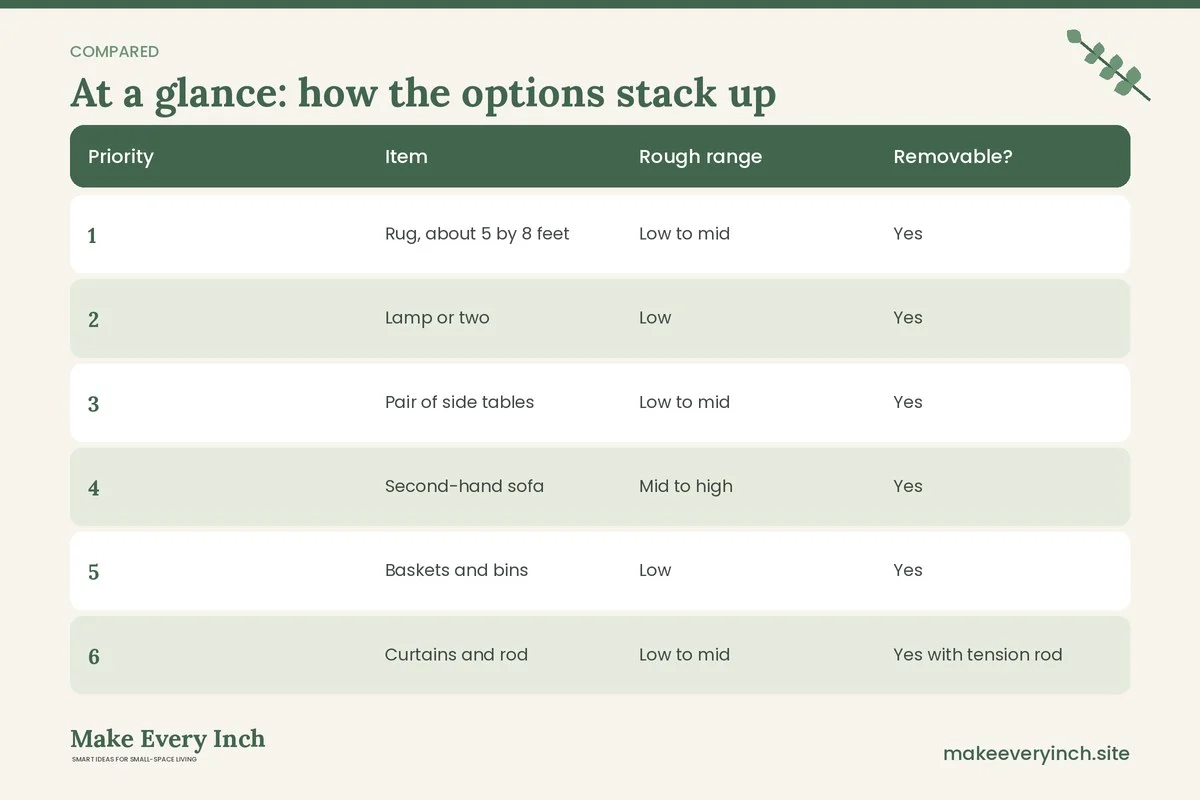
Spend-order table
Use this table as a quick filter before checkout. The ranges are broad, hedged guesses for budgeting only and will not match every market.
| Priority | Item | Rough range | Removable? | Why it ranks here |
|---|---|---|---|---|
| 1 | Rug, about 5 by 8 feet | Low to mid | Yes | Anchors the whole room |
| 2 | Lamp or two | Low | Yes | Fixes harsh ceiling light |
| 3 | Pair of side tables | Low to mid | Yes | Replaces a bulky coffee table |
| 4 | Second-hand sofa | Mid to high | Yes | Largest comfort gain |
| 5 | Baskets and bins | Low | Yes | Hides clutter fast |
| 6 | Curtains and rod | Low to mid | Yes with tension rod | Frames the window |
| 7 | Leaning mirror | Low to mid | Yes | Doubles daylight |
| 8 | Slim bookcase | Low to mid | Yes, anchor if allowed | Adds vertical storage |
| 9 | Plants and pots | Low | Yes | Adds life |
| 10 | Frames and strips | Low | Mostly | Fills bare walls |
| 11 | Peel-and-stick panel | Low to mid | Test first | Adds pattern |
Three sample budgets
A very small budget
Spend on the rug and a lamp only. Borrow or reuse a side table, such as a stool, a stack of crates with a board or a dining chair. Cover the sofa with a washable throw. Use baskets you already own. This plan takes a bare, echoing room and gives it light, a defined floor and a tidy surface.
A modest budget
Add the pair of side tables, curtains on a tension rod and a leaning mirror. Pick up a second lamp. Add a few plants. For a room 10 feet wide, this group makes a plain rental feel like a finished room without touching the walls.
A larger budget
Start with a second-hand sofa that fits, then add a storage ottoman, a slim anchored bookcase and framed prints on adhesive strips. If the lease allows, replace the shade on the ceiling fixture. For a deeper room of 12 feet or more, the extra spend goes to the seat, since seating shapes comfort most.
Where to find low-cost furniture
Second-hand is the main source of savings. Local listings, thrift stores, estate sales, building lobbies at move-out time and neighborhood groups often have solid wood tables and sofas for less than flat-pack equivalents. Search with specific words such as “loveseat” or “console table” and measure before you go. Bring a tape measure, a flashlight and a cloth to wipe a surface.
When buying used, apply a short inspection. Sit on the sofa and bounce, which tells you about the frame. Look under cushions and along seams. Pull out drawers and check the runners. Avoid anything with a persistent smell, because it rarely goes away. For fabric furniture, check the label for care instructions before you buy cleaning products.
Flat-pack furniture is cheap but can be heavy to move and awkward to reassemble after a few moves. If you choose it, keep the fixings in a labeled bag and store the manual. Pieces made of solid frames are easier to take apart and rebuild, and they hold up across moves.
The hidden costs of renting
A budget plan should include costs that are not on the receipt. Delivery fees, assembly time, floor protectors, a pad for the rug, a bulb change and a replacement cord cover can each add a little. Move-out costs belong in the plan too: a cleaning cloth for scuffs, a small tub of spackle if the lease allows nail holes to be filled, and a day or two to put the hardware back. Setting aside a small sum for these makes the rest of the plan more honest.
Also think about the cost per use. A lamp used every evening for three years costs a little each night. A trend item used twice costs a lot per use. When two options are close in price, pick the one that works in the next place.
Moving-day removability check
On the day before you leave, walk the room with your move-in photographs. Check each wall for marks, remove adhesive strips slowly and wipe any residue with a damp cloth. Fill allowed nail holes with a small amount of spackle if the lease says so, and sand lightly once dry. Lift the rug and look for dents under furniture legs. Replace swapped hardware and return shades and bulbs to their original positions. Then take new photographs from the same angles. If you leave the place in the condition you found it, the deposit conversation is short.
Mistakes that waste a small budget
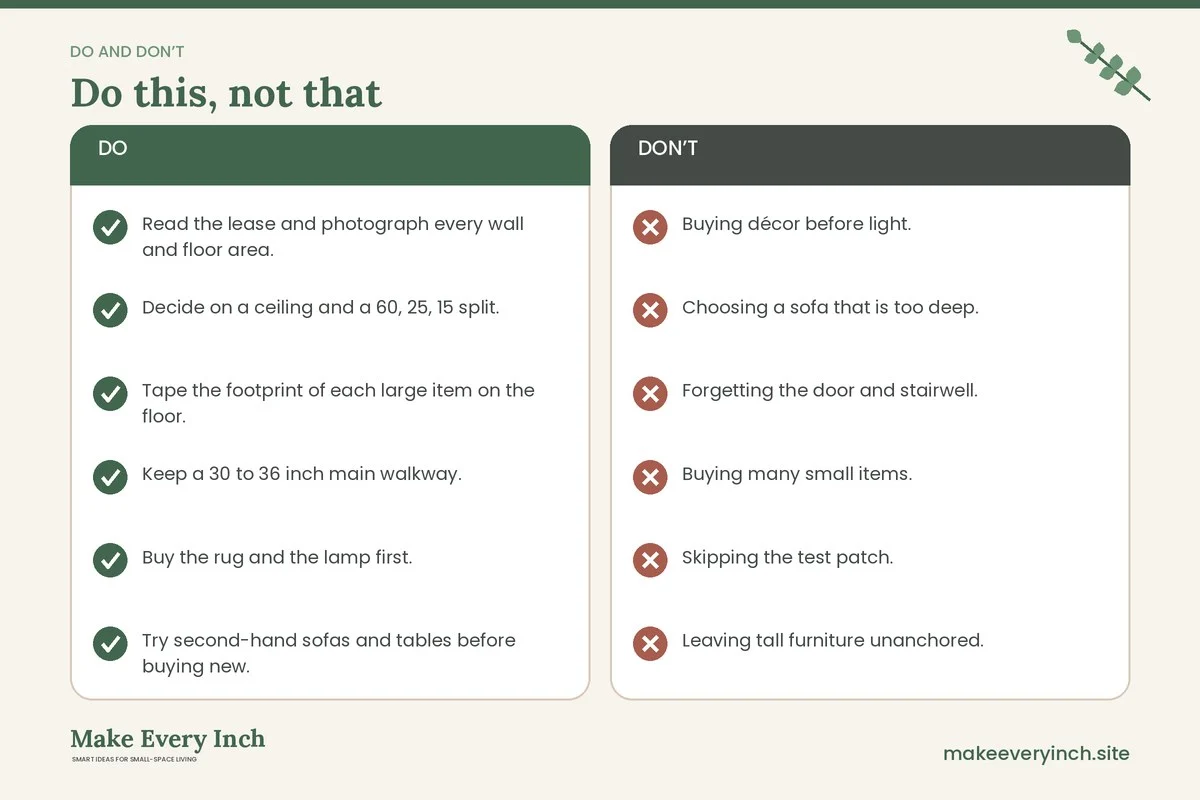
- Buying décor before light. A room with no lamp looks smaller, whatever hangs on the wall.
- Choosing a sofa that is too deep. An extra 6 inches of depth cuts into the walkway.
- Forgetting the door and stairwell. A sofa that cannot reach the room is a return.
- Buying many small items. Ten small objects read as clutter, while three larger ones read as a plan.
- Skipping the test patch. A strip or a sheet of peel-and-stick that lifts the paint costs more than it saves.
- Leaving tall furniture unanchored. If a piece can fall, anchor it, or choose one that cannot.
- Ignoring the next move. Pieces that suit only this room lose value fast.
Budget renter checklist
- Read the lease and photograph every wall and floor area.
- Decide on a ceiling and a 60, 25, 15 split.
- Tape the footprint of each large item on the floor.
- Keep a 30 to 36 inch main walkway.
- Buy the rug and the lamp first.
- Try second-hand sofas and tables before buying new.
- Use lidded baskets to hide small items.
- Test every adhesive in a hidden spot.
- Anchor tall furniture, or choose short, heavy pieces.
- Keep receipts, manuals and the original hardware.
- Photograph the room again before you hand back the keys.
FAQ
How much should I spend on a small living room as a renter?
There is no single number. A useful approach is to set a ceiling you are comfortable with, spend about three fifths of it on portable essentials such as a rug, lamps and tables, and leave the rest for storage and décor. Prices vary a lot by region and condition.
What is the first thing to buy for a rental living room?
Lighting and a rug usually make the biggest difference for the least outlay. A lamp fixes harsh overhead light, and a rug of about 5 by 8 feet pulls the furniture together.
Are adhesive strips safe for rental walls?
They are often fine on smooth, well-cured paint, though results vary by wall and by how long they stay up. Test in a hidden spot, follow the weight rating and remove them slowly. Check your lease first.
Is second-hand furniture worth it for a small living room?
Often yes, because it can cost much less than new and holds its value. Measure carefully, inspect the frame and avoid anything with a strong smell.
How do I make a rental living room look bigger cheaply?
Use two lamps, a mirror opposite a window, curtains hung high and a rug that reaches under the sofa. Clear surfaces with baskets. These moves cost little and need no holes. Our guide to small living room layout ideas shows how to arrange the furniture.
Should I anchor a bookcase in a rental?
Yes, where you can. Tall furniture can tip, and anchoring prevents it. If the lease forbids holes, ask in writing, or choose a shorter, heavier unit and keep it away from seating and sleeping areas.
Keep going: Keep planning with our small living room ideas for renters, budget renter upgrades and small living room furniture ideas.
Save this guide for later
Pin the ideas you like to Pinterest so you can come back to them when you plan your space.