14 Small Room Rug Ideas to Define Zones and Work Areas
Quick answer: A small room rug define zones best when each rug marks one job: a seating area, a bed, a desk or a dining spot. Pick rugs whose edges line up with furniture legs, leave about 12 to 18 inches of bare floor between neighboring rugs, keep the colors related, and secure every rug so it cannot slide or curl and trip anyone.
A small room rug define zones question usually starts with a room that has to do too much. One space holds a sofa, a desk and a place to eat, and without any visual cues it reads as a single crowded block. A rug is the cheapest and most flexible tool for fixing that, because it draws a boundary on the floor without a wall, a divider or a single nail. This guide explains how the zoning effect works, how to size and place a rug for each job, 14 specific ideas, a comparison table, three example rooms, color and pattern rules, safety notes and a checklist. For the wider picture, read our pillar guide on small room decor ideas, and keep the companion post on small space curtain ideas to add height nearby, since rugs pull the eye down while curtains pull it up.
Why a rug marks a zone
A zone feels real when the eye can find its edge. In an open room, the floor is usually the largest unbroken surface, so changing its color or texture in one rectangle tells people where one activity ends and the next begins. Furniture that sits on the rug belongs to the zone, and furniture off the rug belongs somewhere else. That single rule is the basis of everything below.
A rug also changes how a space sounds and feels underfoot. Soft surfaces tend to reduce echo a little, and a room with several textiles often feels calmer than a bare one. That is a general tendency rather than a promise, and the effect depends on the rug, the room and the floor beneath it.
The trade-off is that every rug you add cuts the floor into smaller pieces. In a small room, too many rugs make the floor look busy and the room look smaller. The goal is not to cover the floor but to use as few rugs as you need, placed with clear intent. Two or three rugs are usually the limit for a single open room, and one well-chosen rug can often do the work of two.
Measure the room and list the jobs
Before you pick any rug, write down the jobs the room performs. A typical list reads sleeping, sitting, working and eating, though only two or three of those may actually happen in the space. Then measure the floor, the furniture and the walkways.
- Room size: measure wall to wall, and note the door swing and any radiator, vent or built-in that sits on the floor.
- Furniture footprint: measure the sofa, bed, desk or table, and write down how far each piece extends in every direction when it is in use. A chair that is pulled out from a desk needs about 24 to 36 inches behind it.
- Walkways: main paths often need 30 to 36 inches, while a side path can be tighter. Rugs should not block a door or sit where people cut a corner.
- Floor type: hard floors and carpet need different rug backings, and a rug on top of carpet needs extra grip.
Mark each planned rug with painter’s tape for a day or two. Walk around the tape, sit in each chair and open each door. If you stub a toe on the tape, you will stub it on the rug.
Sizing rules that hold up in small rooms
Rug size matters more than rug style. A rug that is too small makes the furniture look like it is floating, and a rug that is too big eats the walkway. These ranges are starting points rather than fixed rules, so adjust them to your room.
- Living area: aim for a rug large enough that at least the front legs of the sofa and any chairs rest on it. In many small rooms that means a size around 5 by 8 feet, though a 4 by 6 foot rug can work if the group is compact.
- Bed: the rug should extend roughly 18 to 24 inches beyond the sides and foot of the bed, or sit across the lower two thirds of the bed so your feet land on it in the morning. For a smaller room, two narrow runners at the sides can work better than one wide rug.
- Desk: the rug should be large enough that the chair stays on it when it rolls back. A chair that catches on a rug edge is annoying, and some rugs are poor choices under a rolling chair, so consider a low, flat weave or skip the rug.
- Dining spot: the rug should extend about 24 to 30 inches past the table edge on every side so chairs remain on the rug when pulled out. In a tight room this is the hardest rule to meet, and a smaller table may be easier than a larger rug.
- Entry: a runner or mat of about 2 by 3 feet to 2.5 by 5 feet marks the arrival spot, depending on the width of the space.
- Gap between rugs: keep roughly 12 to 18 inches of bare floor between neighboring rugs so each reads as its own island.
Hedge your final numbers by checking your own measurements. A room that is only 9 feet wide cannot take a rug that is 8 feet wide and still show any floor, and in that case a smaller rug that sits entirely inside the furniture group is a good fallback.
14 small room rug ideas to define zones
Ideas for the seating area
1. The anchor rug under the front legs
Place a rug so the front legs of the sofa and the chairs rest on it, with the back legs off. This is the classic arrangement because it ties the pieces together without needing a huge rug. It works well in a living room where the sofa sits against a wall, and it keeps the walkway clear behind the group.
2. A rug that fits entirely inside the seating group
If the room is tight, choose a rug small enough to sit completely within the furniture, with all legs on or all legs off. This looks neat in a very small space, but it can look like a doormat if it is too small, so keep it at least a few inches wider than the sofa’s seat area on each side.
3. A round rug under a chair corner
A round rug in a reading corner marks a small spot without adding another rectangle to the floor. Round shapes soften the right angles of a boxy room and are often easier to fit around a door swing. Place an armchair so that at least half of the chair sits on the rug.
4. A runner beside the sofa
A narrow runner along one side of the sofa marks the walkway and the seating at once. It guides the eye toward a window or a door, and it can stretch a short room. Choose a flat weave so the runner does not catch on feet.
Ideas for sleeping and dressing areas
5. A rug across the lower two thirds of the bed
Slide a rug under the bed so it extends past the foot and out to both sides. Your first steps land on something soft, and the bed zone looks clearly defined. This works particularly well in a studio, where the bed needs to look distinct from the living area. See our guide to studio apartment layout ideas that create zones for the wider plan.
6. Two runners, one on each side of the bed
Where a single rug would be too large, two matching runners flank the bed. Each one gives a soft landing, and the gap at the foot keeps the floor visible. Check that the runners extend a little past the bed’s edge and that neither one blocks a drawer or a door.
7. A small mat at the dressing spot
A small rug or mat in front of a dresser or wardrobe marks the dressing zone. It keeps your feet off a cold floor and it breaks up a long run of bare boards. For more bedroom ideas, see our small bedroom ideas guide.
Ideas for working and dining areas
8. A low, flat rug under the desk
Use a thin, flat weave under a desk so a rolling chair moves smoothly. Make sure the rug is large enough that the chair stays on it, and avoid thick pile that traps the wheels. If the chair still catches, a chair mat designed for the purpose may suit your floor better than a decorative rug.
9. A rug that links the desk and the shelf
Extend a rug a little past a desk and the shelf beside it, and the pair reads as an office corner. This is a useful trick when a desk shares a room with a sofa, and it pairs well with the ideas in our post on how to create a work zone in a small apartment.
10. A rug under a small dining table
A round or square rug under a small table makes the dining spot look intentional. Choose a flat, wipeable or easy-to-shake material, because crumbs and spills are likely, and keep the edges clear of the chair legs where possible. If chairs will catch on the edge, a smaller table or no rug is safer than a rug that trips people.
11. A bench-and-rug nook for the window
A rug in front of a window seat or a bench marks a reading nook. A small round rug works best, and a pair of floor cushions can sit on top of it for extra seating.
Ideas for entries, hallways and open plans
12. An entry mat or runner
A mat inside the door marks the arrival spot and catches grit. Pair it with a hook rail or a shelf, and the entry becomes a mini drop zone. Our guide to small home drop zone ideas shows how.
13. A long runner that links two zones
In a narrow open-plan room, a long runner can lead the eye from the sitting area to the kitchen or the window. It works as a visual path, and it keeps the walkway clear because it follows the route people already take.
14. A layered rug for a rental floor
Place a smaller rug on top of a larger neutral one to add a pattern in a rental without committing to a bold base. The base rug protects the floor, and the top rug defines the zone. Layering is easy to undo, though it increases the risk of tripping, so use a thin base and grip pads under both rugs.
Rug placement table
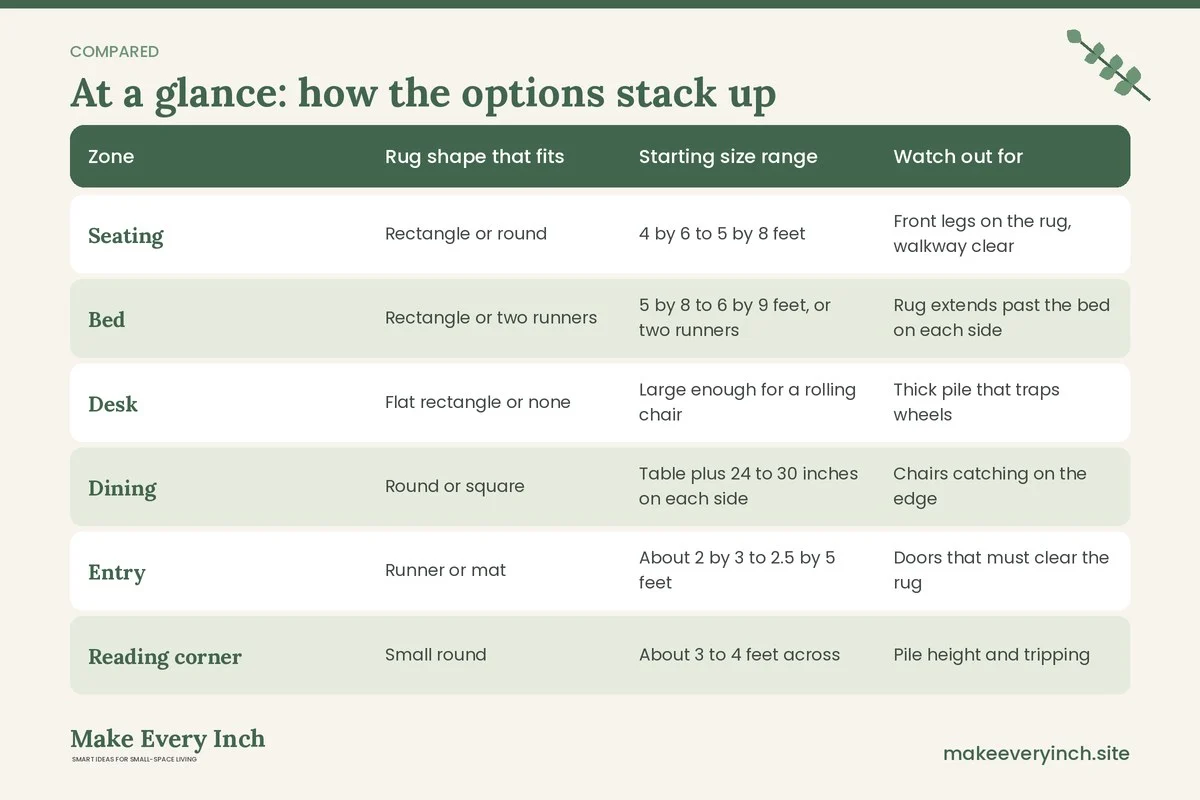
The table below summarizes the zones, the shape that tends to fit, a size range to start from and the main thing to watch. Treat the sizes as starting points and verify them against your own room.
| Zone | Rug shape that fits | Starting size range | Watch out for |
|---|---|---|---|
| Seating | Rectangle or round | 4 by 6 to 5 by 8 feet | Front legs on the rug, walkway clear |
| Bed | Rectangle or two runners | 5 by 8 to 6 by 9 feet, or two runners | Rug extends past the bed on each side |
| Desk | Flat rectangle or none | Large enough for a rolling chair | Thick pile that traps wheels |
| Dining | Round or square | Table plus 24 to 30 inches on each side | Chairs catching on the edge |
| Entry | Runner or mat | About 2 by 3 to 2.5 by 5 feet | Doors that must clear the rug |
| Reading corner | Small round | About 3 to 4 feet across | Pile height and tripping |
| Rental floor layer | Small rug on a base | Base fits the room, top fits the zone | Slipping layers and trip risk |
Color and pattern rules
Zones read best when the rugs look related. A room with three rugs in three unrelated colors looks scattered, while a room with three rugs that share a hue looks planned. These approaches help.
- Repeat one color. Pick one color that appears in every rug, even if it is only a thin line or a small accent. The repetition ties the zones into one room.
- Vary scale, not style. A large pattern in the living area, a small pattern at the desk and a plain rug at the bed give each zone a different feel while the palette stays calm.
- Use darker rugs where you want weight. A deep color grounds the seating area. A lighter rug at the bed keeps the sleeping zone airy. Keep the transition between them gentle.
- Keep one rug plain. If two rugs are patterned, keep the third plain. The eye needs a resting place.
- Match the undertone. Warm woods look better with warm-toned rugs, and cool floors suit cooler tones. If you are not sure, hold a sample against the floor in daylight and again in the evening.
- Think about the walls. A rug can carry the color you do not want to commit to on the walls. If you are working on the walls too, see our guide to small dining room color schemes for palette ideas that carry through the home.
Texture counts as much as color. A flat weave, a low pile and a looped surface all reflect light differently, and mixing two textures, such as a flat weave in the living room and a soft pile by the bed, creates contrast without extra pattern.
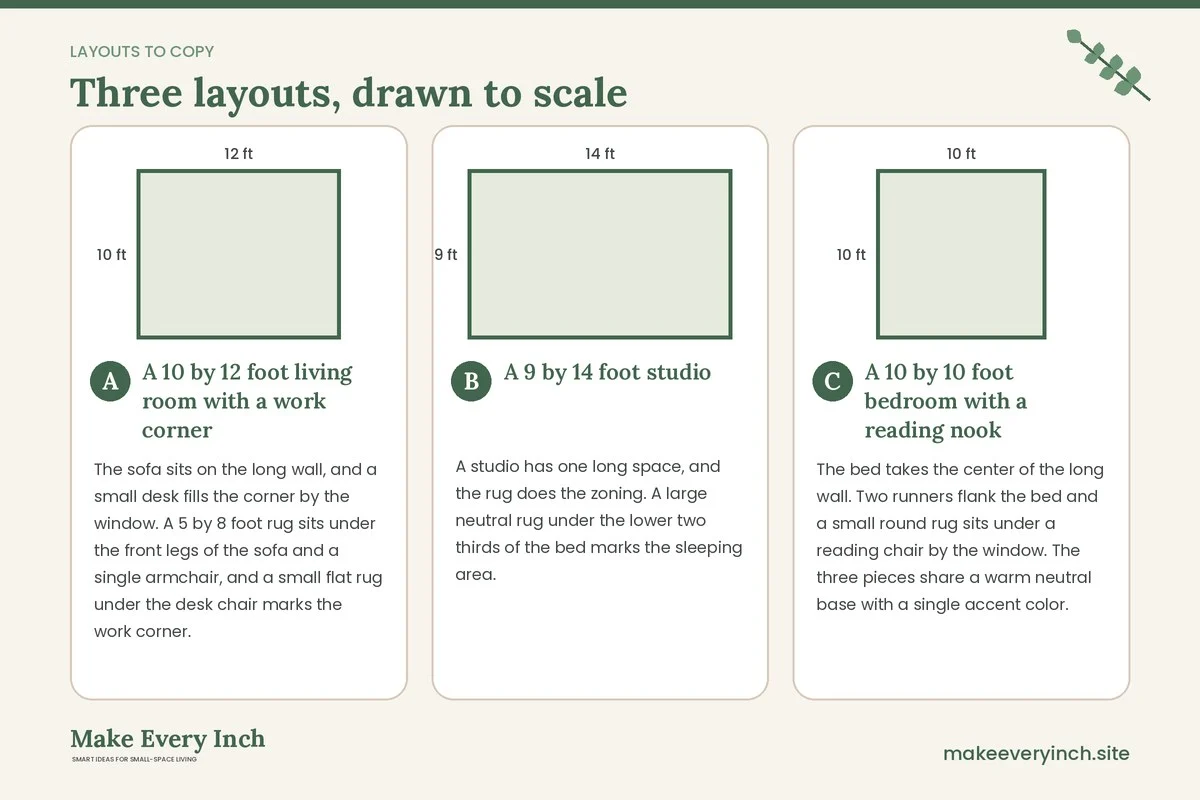
Three example rooms
A 10 by 12 foot living room with a work corner
The sofa sits on the long wall, and a small desk fills the corner by the window. A 5 by 8 foot rug sits under the front legs of the sofa and a single armchair, and a small flat rug under the desk chair marks the work corner. About 12 to 18 inches of bare floor between the two rugs signals that the work corner is separate. The two rugs share a muted blue, and one is plain while the other has a small pattern. Walkways remain at roughly 30 inches, and the plan costs little to change if the layout shifts later.
A 9 by 14 foot studio
A studio has one long space, and the rug does the zoning. A large neutral rug under the lower two thirds of the bed marks the sleeping area. A round rug under a small table marks the eating spot, and a runner from the entry to the kitchen defines the path. Each rug sits at least 12 inches from the next, and a tall bookcase stands between the bed and the living area. For more ways to separate a studio, see our post on DIY room divider ideas for studio apartments.
A 10 by 10 foot bedroom with a reading nook
The bed takes the center of the long wall. Two runners flank the bed and a small round rug sits under a reading chair by the window. The three pieces share a warm neutral base with a single accent color. The chair is positioned so that half of it sits on the round rug, and a floor lamp stands behind it. See our guide to renter friendly lighting ideas for ways to light the nook without hardwiring anything.
Keeping rugs flat and safe
A rug that slides or curls is a tripping hazard, and falls are one of the most common household accidents. These steps reduce the risk.
- Use a grip pad. A non-slip pad under every rug on a hard floor stops sliding. Choose a pad that is rated for your floor type, and check the label, because some rubber-backed products can react with certain floor finishes. Read the instructions before you lay one over a finished or delicate floor.
- Check the edges. Corners that curl up are a trip risk. Flatten them with a thin pad, a rug tape rated for your floor or by rolling the rug against the curl overnight. Do not stick strong adhesive tape to a rental floor without permission.
- Keep the pile low near doors. A thick rug can catch a door. Test every door and drawer before you commit.
- Mind the cords. Do not run a cord under a rug. A covered cord can overheat and may be damaged by foot traffic without anyone noticing. Route cords along the wall or use a cord cover designed for the floor.
- Think about pets and children. A rug that bunches can trap small paws and little feet. Choose a low pile and a firm backing in homes with toddlers, older adults or pets.
- Watch the heat. Keep rugs away from heaters, radiators and fireplaces. Maintain the clearance recommended in the heater’s manual.
- Ask about the floor. In a rental, check the lease for rules on floor coverings and adhesives. Rugs themselves are normally allowed, but gluing or taping them down may not be.
- Clean on a schedule. Dust and grit wear a rug and a floor. Vacuum regularly, shake out small rugs and follow the care label.
Rugs, storage and the rest of the room
A rug works hardest when the floor above it is calm. Clutter on a rug makes the zone look messy even if the rug is pretty. Keep the floor within each zone mostly clear, and put the things you use there into storage that is not on the rug. Our guide to small space organization ideas shows how to keep each zone tidy.
Furniture legs matter too. Heavy furniture can press permanent dents into some rugs and floors. Use furniture pads under legs, and move pieces a little from time to time. Tall furniture must be anchored if you place it near a rug, so a shelf cannot tip onto anyone who trips. Use the anchoring hardware that comes with the piece, and in a rental ask before you drill.
If your budget is tight, a single good rug often does more than three cheap ones. Our post on budget small space ideas covers other ways to stretch a small allowance, and our guide on apartment decorating styles can help you choose a look before you buy.
Mistakes to avoid
- Buying a rug that is too small. A rug that only fits under the coffee table makes the sofa look adrift. Measure again.
- Using too many rugs. More than three in one room makes the floor look chopped up. Combine zones if you can.
- Ignoring the door swing. A rug that blocks a door is a daily annoyance.
- Skipping the pad. A sliding rug is a hazard, and a pad extends the life of the rug.
- Choosing the wrong pile for the job. Thick pile suits a bedside, and flat weaves suit a desk and a dining spot.
- Putting a rug where the sun hits all day. Strong sun can fade fibers over time, so consider a lighter weave or rotate the rug.
- Forgetting the lighting. A zone without light looks unfinished. Our post on small living room lighting ideas shows how to light a seating area.

Rug zoning checklist
- List the jobs the room performs.
- Measure the room, the furniture and the walkways.
- Tape every planned rug on the floor for a day.
- Check the size rules for each zone.
- Leave 12 to 18 inches of bare floor between rugs.
- Repeat one color across the rugs.
- Use a grip pad under each rug on a hard floor.
- Test every door, drawer and chair against the rug.
- Keep cords off the floor under rugs.
- Anchor tall furniture and ask before drilling.
FAQ
How many rugs can a small room have?
Two or three is the usual limit for a single room. Beyond that the floor looks fragmented. If you need more zones, use furniture, lighting or a shelf to mark some of them.
What size rug should go under a bed in a small bedroom?
A rug that extends roughly 18 to 24 inches past the sides and foot of the bed is a common starting point. If the room is tight, two runners or a rug under only the lower two thirds of the bed work too.
Can I layer rugs in a small room?
Yes, if the base rug is thin and both rugs are secured. Layering adds pattern, but it also raises the risk of tripping, so use grip pads and check the edges.
Will a rug make my small room look smaller?
A rug that is too small or too busy can. A rug that is large enough to hold the main furniture usually makes the room feel organized, and a light, low-contrast color can help the floor feel open. Our guide to furniture that makes small rooms feel bigger has more tips.
What is the best rug for a rolling desk chair?
A low, flat weave is usually easier than a thick pile. If the chair still catches, a dedicated chair mat may be a better choice than a decorative rug.
Do rugs help with noise?
Soft surfaces can reduce echo and footfall noise to some extent, which may help in an apartment. The effect depends on the thickness of the rug and the pad.
Are rugs allowed in rentals?
Loose rugs are normally fine, but check the lease for rules about floor coverings, adhesives and protective pads. Ask in writing before you fix anything to the floor.
Keep going: Keep planning with our small living room ideas, renter friendly wall decor ideas and small space curtain ideas to add height.
Save this guide for later
Pin the ideas you like to Pinterest so you can come back to them when you plan your space.