How to Make a Small Living Room Look Bigger in 10 Steps
Quick answer: To make a small living room look bigger, lighten and unify the walls, bring in layered light, hang mirrors across from windows, raise curtains to the ceiling, use a rug large enough to hold the seating, choose furniture on legs, clear the floor and sight lines, and draw the eye up. Do the cheap steps first, check the lease before painting or drilling, and test each change for a week.
Anyone who wants a small living room look bigger is really asking about perception. The walls do not move, but how the eye reads the room can change a lot. Color, light, lines, height and clutter all tell the brain how much space there is. This guide gives a ten-step order of operations, with numbers and quick tests, so that you can see progress after each step. It also includes a before and after table, three example rooms, a weekend plan, safety notes and a checklist. For the wider topic, see the main small living room ideas pillar. If you need a buying list for pieces, read our small living room furniture ideas, and if you want a layout, read small living room layout ideas. This post is about illusion and editing, not about buying a whole new set.
How a room reads as large or small
A room feels large when the eye travels far, finds few interruptions and sees light on the surfaces. It feels small when the eye stops at a dark block, a busy cluster or a hard line cut across the wall. Five visual factors do most of the work.
- Brightness: light surfaces and light bouncing from windows make edges soften.
- Continuity: when the walls, trim and ceiling are close in tone, the corners blur and the box feels larger.
- Height: a high line, such as a tall curtain or a tall shelf, pulls the eye up and makes the ceiling feel higher.
- Visible floor: the more floor you see, the bigger the room reads. Furniture on legs and a clear center help.
- Order: fewer objects in view means fewer stops for the eye.
You can make a small living room look bigger by working on each of these in turn. Start with the free steps, then move to the ones that need purchases.
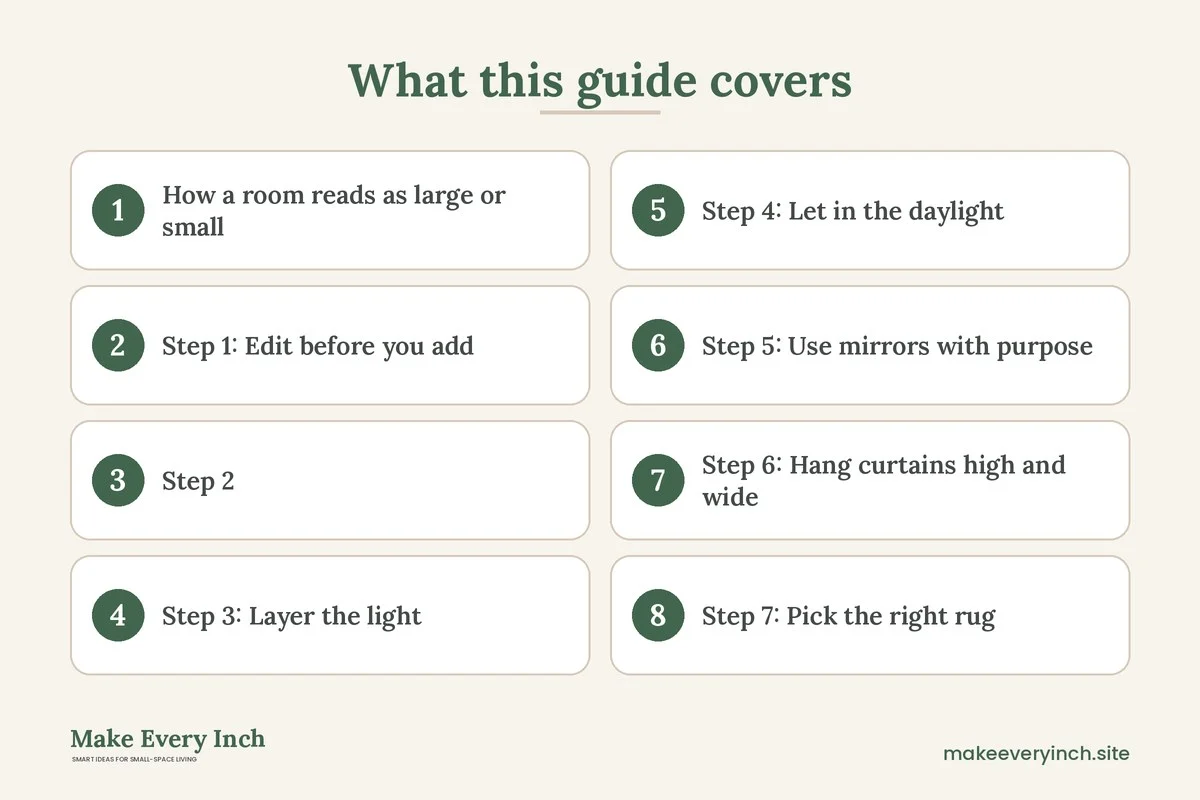
Step 1: Edit before you add
The cheapest way to gain visual space is to remove things. Walk around the room with a box and a bag. Take out anything that has no job, that you have not used in a month or that lives on the floor. Look especially at three zones.
- The floor: move shoes, bags, boxes and spare chairs out of sight. A clear floor is the single biggest gain.
- The sight line from the door: whatever you see first from the entrance sets the impression. Clear that surface and the wall behind it.
- The top of every flat surface: keep a third of each surface empty. A table with three items looks calmer than one with ten.
Our decluttering rules for small homes post offers a method for sorting. For storage that hides what remains, see small living room storage ideas. Do this step before you buy anything, because you may find you need less than you thought.
Step 2: Choose a calm, light color story
Paint is the most powerful change, but it is also the one a renter must clear with the landlord. Ask in writing, and if painting is not allowed, use the removable options at the end of this step.
- Pick one main wall color in a light, soft shade with a slightly warm or cool undertone that matches your light. Rooms with weak daylight look better in warmer whites and pale neutrals, while sunny rooms handle cooler tones.
- Keep the ceiling a touch lighter than the walls, or the same tone, so it seems to lift.
- Paint the trim in the wall color or very close to it. Strong contrast outlines the box and makes it feel tighter.
- Choose a finish with a low sheen, such as matte or eggshell, so light spreads without glare. A little more sheen on the ceiling can bounce light.
- Use a low-VOC paint and ventilate the room during and after painting. Open windows, run a fan and keep children and pets out until the paint dries and the smell fades. Follow the label.
For a deeper look at tone, see colors that make small rooms look bigger and small room color schemes that feel cohesive. For a room with little daylight, read small room paint ideas for low light.
If you cannot paint, use these instead: a large piece of light fabric on a tension rod, a big light-toned print leaned on a shelf, or removable wallpaper in a pale pattern on one wall, only if the lease allows it.
Step 3: Layer the light
A small room with one overhead light looks like a box with a shadow in every corner. Layered light spreads brightness and hides edges.
1. Ambient light: one soft overhead or a floor lamp that washes the ceiling.
2. Task light: a reading lamp at the sofa or the chair.
3. Accent light: a small lamp on a shelf, or a strip behind a TV, to light the far wall.
Aim for at least three light sources at different heights. Use warm white bulbs around 2700 to 3000 kelvin for evening comfort, and keep the same bulb color across the room so the tones match. Check that bulbs do not exceed the lamp’s wattage rating, and do not run cords under rugs or across walkways. Use only one plug-in strip with a surge guard if outlets are short, and never daisy-chain strips. Our guide to small living room lighting ideas and the post on layered lighting ideas for small apartments give more plans, and renter friendly lighting ideas covers plug-in options.
Step 4: Let in the daylight
Natural light is free and the best tool you have. Clear the window area and keep it clean.
- Remove heavy valances and layers that block the glass.
- Keep the sill clear so light enters low.
- Do not put a tall bookcase or a sofa back right in front of a window.
- Clean the glass, since dirt dims the light more than you expect.
- Use sheer or light-filtering curtains in a pale tone for daytime, with a second layer only if you need privacy at night.
For more, read small home design ideas with natural light. If you need privacy without blocking light, see renter friendly ways to add privacy.
Step 5: Use mirrors with purpose
A mirror doubles whatever it faces. That helps only when it faces something worth doubling, like a window, a plant or a lamp.
- Place a large mirror across from or beside a window, not directly opposite a messy shelf or a bare corner.
- Choose a tall mirror of 48 to 72 inches, leaned against a wall, to add height. A floor-standing version needs no drilling.
- Hang a mirror on a short wall to stretch the room’s depth, if the lease allows holes. Use the right fixing for the weight and find a stud or use an anchor rated for it.
- Avoid a mirror where it reflects the TV or a glaring light.
- Check the safety: a leaned mirror should stand on a non-slip base and lean at a safe angle, away from a child’s play area and from doors that swing. Secure large mirrors with the anti-tip fittings supplied.
For more, read our small room mirror placement ideas.
Step 6: Hang curtains high and wide
The curtain line tells the eye where the wall ends. Hang the rod 4 to 6 inches below the ceiling, or as close to it as the wall allows, and extend it 8 to 12 inches past each side of the window so the glass is not covered when the curtains are open. Let the panels fall to just above the floor, about half an inch, or kiss it. This simple change can add a feeling of height without any extra furniture. If drilling is a problem, use a tension rod in an alcove or a rod that clamps in place, and check its weight rating. See small space curtain ideas to add height and renter friendly window treatment ideas. Keep blind and curtain cords out of reach of children and pets, using cord wraps or cordless styles.
Step 7: Pick the right rug
A rug that is too small makes furniture float and the room feel chopped. A rug that is large enough ties the pieces together. In most small living rooms, a 5 by 8 foot rug, or a 6 by 9 foot one in a larger space, works well. Place the rug so that at least the front legs of the sofa and any chair rest on it. Choose a low pile and a light or tonal pattern, since a rug with a strong high-contrast pattern can cut the floor into pieces. A pale rug in a tone close to the floor makes the floor look wider. Add a thin non-slip pad and keep the edges flat. Our guides on choosing rug size for a small living room and small room rug ideas to define zones give the details.
Step 8: Choose furniture that shows the floor
You do not need to replace everything, but you can adjust what you have.
- Look for legs: furniture raised 6 to 10 inches on visible legs shows the floor beneath. If a piece sits on the ground, consider swapping it for a leggier one when the time comes.
- Match the scale: a sofa 60 to 78 inches long and 32 to 36 inches deep suits most small rooms.
- Keep heights low on the window wall and use tall pieces on a wall that does not block light.
- Choose a light top: glass, open frames or pale wood read lighter than a thick dark slab.
- Use a round table: it removes corners from the path.
- Float the sofa only when you can: pulling it a few inches off the wall can help only if the room is wide enough for a 30 to 36 inch path.
Our post on furniture that makes small rooms feel bigger and the best furniture for a small living room guide cover pieces in depth. Anchor any tall piece to the wall, with permission, and never drill without it.
Step 9: Draw the eye upward
Height is the hidden dimension. Lead the eye up and the room feels taller.
- Hang art or a tall shelf so that the top reaches two thirds to three quarters of the way up the wall.
- Use vertical stripes or tall narrow frames rather than a wide low row.
- Keep a clear gap between the top of the furniture and the ceiling on at least one wall.
- Place a tall plant or a floor lamp that arcs up, in a corner.
- Hang a light fixture that does not drop too low, or choose a flush fitting for low ceilings.
When the ceiling is low, see small room ceiling ideas that draw the eye up and small home ideas for low ceilings. For art, check small room gallery wall layout ideas, and for hanging without damage, see renter friendly wall decor ideas. Watch weight limits on any hook or strip, and test adhesive on a hidden spot.
Step 10: Style with restraint
The final step is to style the room so it looks edited, not empty.
- Limit the palette to three main colors and one accent.
- Repeat materials such as wood, linen or metal two or three times so the eye reads rhythm.
- Group small items on trays so they read as one object.
- Use fewer, larger pieces of decor instead of many small ones.
- Keep cords out of sight with clips or a cable cover. See renter friendly ways to hide cords.
- Add plants that are tall and slim rather than wide. Check that plants are safe for pets and children. See small space plants and planters ideas.
Before and after table
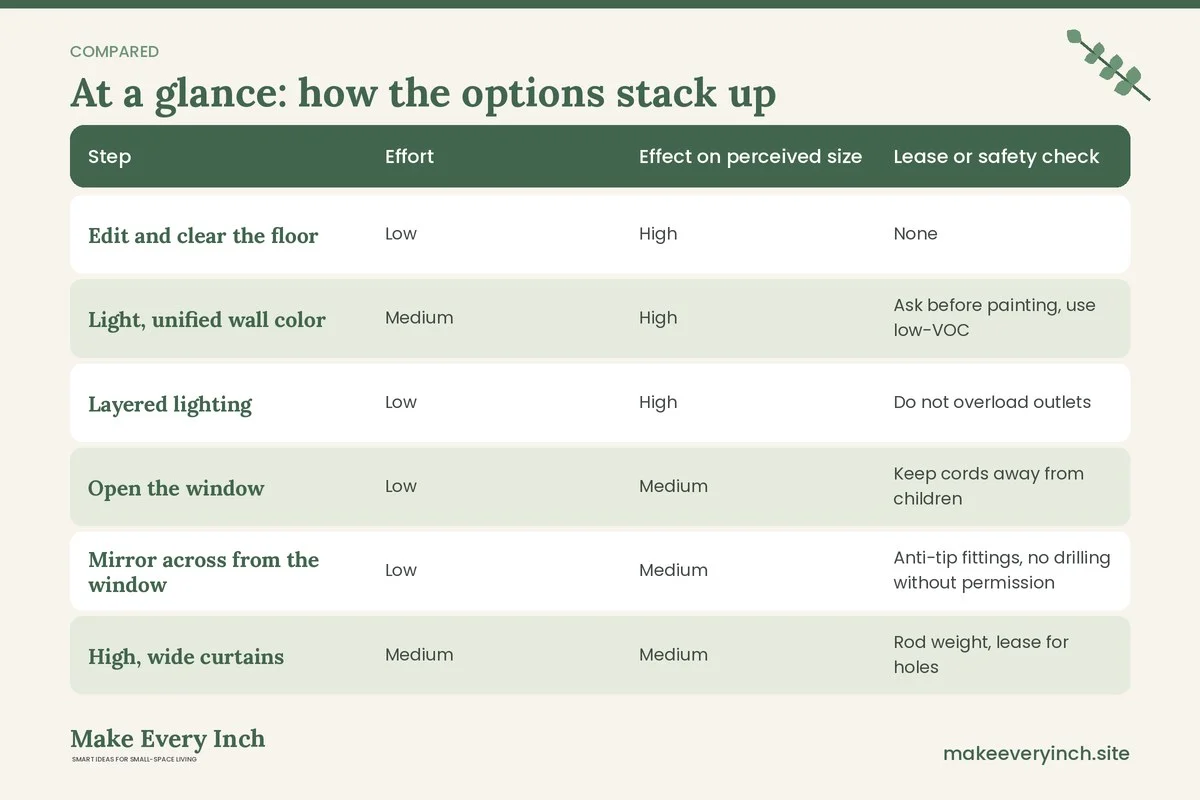
Use the table to estimate which steps change the room most for the effort. The effect ratings are a rough guide, not measurements.
| Step | Effort | Effect on perceived size | Lease or safety check |
|---|---|---|---|
| Edit and clear the floor | Low | High | None |
| Light, unified wall color | Medium | High | Ask before painting, use low-VOC |
| Layered lighting | Low | High | Do not overload outlets |
| Open the window | Low | Medium | Keep cords away from children |
| Mirror across from the window | Low | Medium | Anti-tip fittings, no drilling without permission |
| High, wide curtains | Medium | Medium | Rod weight, lease for holes |
| Larger rug | Medium | Medium | Flat edges, non-slip pad |
| Furniture on legs | High | Medium | Anchor tall pieces |
| Draw the eye up | Low | Medium | Weight limits |
| Restrained styling | Low | Medium | Pet and child safety |
Three example rooms
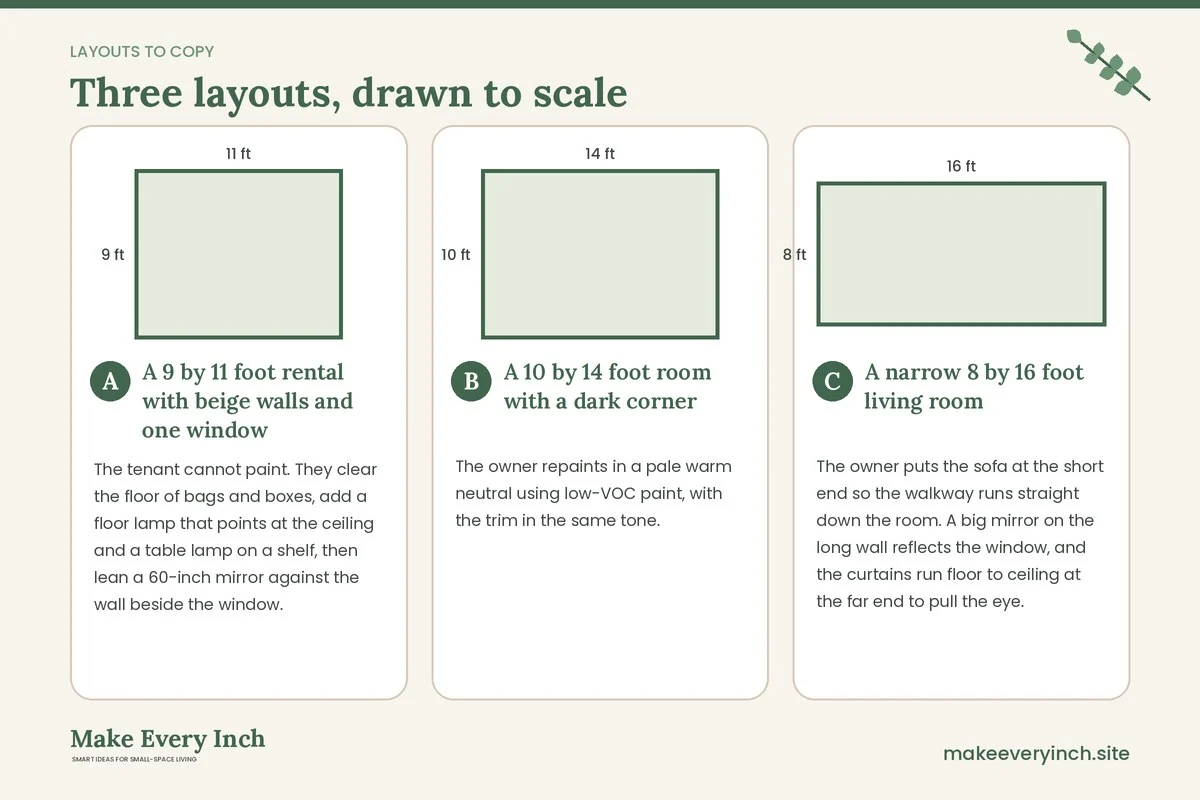
A 9 by 11 foot rental with beige walls and one window
The tenant cannot paint. They clear the floor of bags and boxes, add a floor lamp that points at the ceiling and a table lamp on a shelf, then lean a 60-inch mirror against the wall beside the window. They swap the heavy curtains for light panels on a tension rod near the ceiling, add a 5 by 8 foot rug in a pale tone and move the sofa back from the radiator to keep a 30-inch path. They hang a lightweight print with adhesive strips rated for its weight. The room looks brighter with no paint and no holes. See renter friendly small space upgrades that make a difference for more.
A 10 by 14 foot room with a dark corner
The owner repaints in a pale warm neutral using low-VOC paint, with the trim in the same tone. They add three light sources, including a lamp in the dark corner, and replace a dark coffee table with a glass-topped round one on slim legs. A tall plant stands in the corner, the TV sits on a low unit with a cable cover, and the bookcase is anchored to a stud. The perceived depth increases because the corners no longer stop the eye.
A narrow 8 by 16 foot living room
The owner puts the sofa at the short end so the walkway runs straight down the room. A big mirror on the long wall reflects the window, and the curtains run floor to ceiling at the far end to pull the eye. A runner-style rug runs lengthwise to emphasize depth, but it is wide enough, around 5 feet, to hold the sofa legs. Furniture sits on one side and the other side stays clear. For this shape, see narrow living room ideas.
A two weekend plan
If you want a structured way to start, try this simple plan.
Weekend one: free and cheap changes.
- Clear the floor and the sight line from the door.
- Remove extra furniture and take photos before and after.
- Clean the windows and remove heavy window layers.
- Move lamps to create three light sources.
- Rearrange the furniture to open a 30 to 36 inch path.
Weekend two: targeted additions.
- Add a mirror across from the window.
- Hang curtains high and wide.
- Lay the larger rug.
- Add one tall plant or a floor lamp.
- Style with trays and fewer objects.
Photograph the room at the same time of day before and after each weekend. Photos reveal clutter and balance that you stop seeing in daily life.
Safety and lease notes
- Lease first. Ask in writing before painting, drilling or using strong adhesives. Never drill without permission.
- Paint and ventilation. Choose low-VOC paint, ventilate during and after painting, and keep children and pets away until dry.
- Electrical. Do not overload sockets, do not run cords under rugs, keep lamps away from fabric and use bulbs at or below the rated wattage.
- Anchoring. Anchor tall furniture and large mirrors, and check the fixings for your wall type.
- Weight limits. Respect the limits on hooks, rods, shelves and adhesive strips.
- Child and pet safety. Keep cords from blinds and lamps out of reach, check plants for toxicity and avoid small decor items that can be swallowed.
- Clear exits. Keep the path to the door and windows free.
Common mistakes
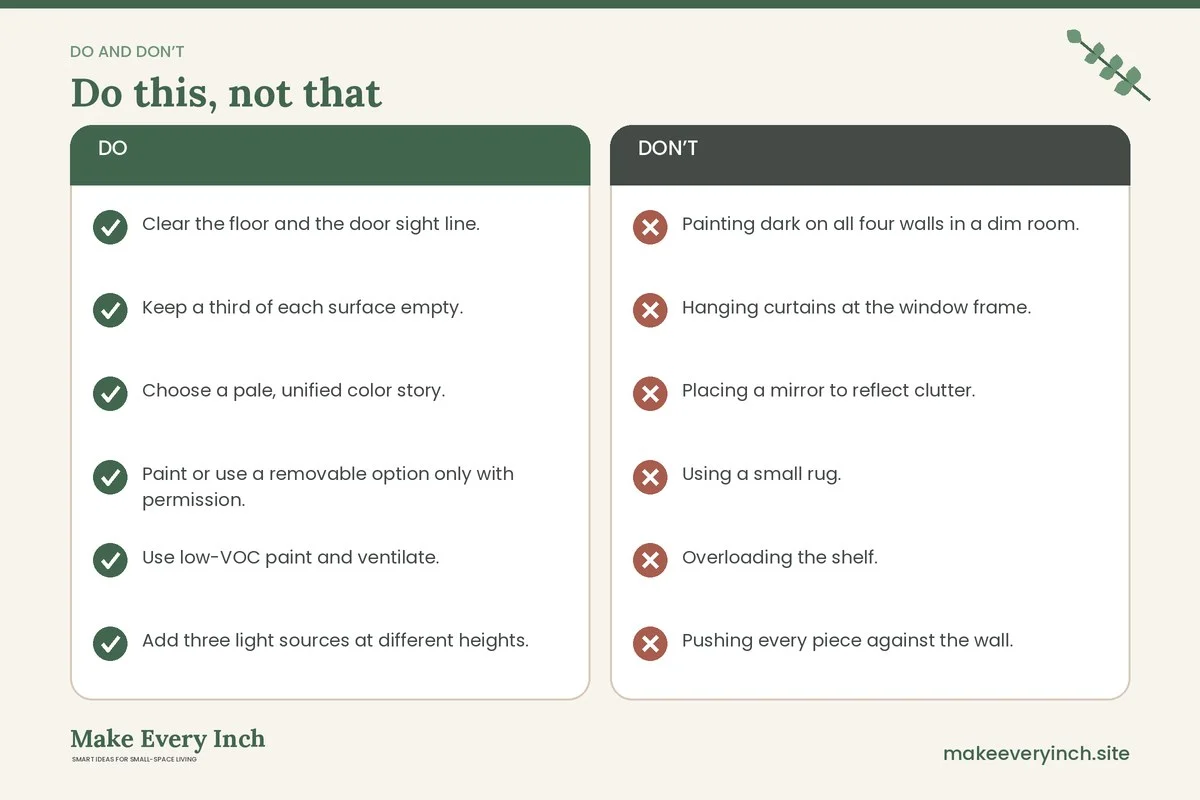
- Painting dark on all four walls in a dim room. It can feel cozy, but it rarely makes a room look larger.
- Hanging curtains at the window frame. It cuts the wall and shortens the room.
- Placing a mirror to reflect clutter. It doubles the mess.
- Using a small rug. It makes the furniture look scattered.
- Overloading the shelf. Visual noise shrinks the room.
- Pushing every piece against the wall. It can make the center feel empty, so test a small float.
- Ignoring the ceiling. A bare, dark ceiling lowers the room.
Checklist
- Clear the floor and the door sight line.
- Keep a third of each surface empty.
- Choose a pale, unified color story.
- Paint or use a removable option only with permission.
- Use low-VOC paint and ventilate.
- Add three light sources at different heights.
- Clean and unblock the window.
- Place a mirror across from the window.
- Hang curtains high and wide.
- Use a 5 by 8 foot rug at least.
- Choose furniture on legs.
- Anchor tall pieces and mirrors.
- Style with restraint and tidy the cords.
FAQ
What makes a small living room look bigger fastest?
Clearing the floor and layering the light usually give the quickest change, and both are free or cheap. Add a mirror across from the window next.
Should I paint a small living room white?
Light, soft shades help, but pure white can feel stark in a dim room. A warm pale neutral often looks better. Always check the lease first.
Do dark colors make a small room look smaller?
Not always, but dark walls can make edges feel closer in a room with little light. A dark wall can also add depth if used on one wall with plenty of light elsewhere.
Where should I put a mirror?
Across from or next to a window, at a height where it shows the view or the lamp, not the clutter.
Can I do this as a renter?
Yes. Most steps, such as clearing, lighting, mirrors that lean, tension rods, rugs and plants, need no drilling. Ask permission for paint and wall fixings. Our guide to renter friendly apartment decorating ideas gives more.
Does furniture size matter more than color?
Both matter. Furniture that is too large will undo the effect of light paint, so check scale before you buy.
Keep going: Keep going with best furniture for a small living room, small living room lighting ideas and small living room makeover ideas.
Save this guide for later
Pin the ideas you like to Pinterest so you can come back to them when you plan your space.