23 Small Entryway Ideas That Make a Great First Impression
Quick answer: The best small entryway ideas are a light or deep single color on the walls, a large mirror, a plug-in or ceiling light with warm bulbs, a slim rug, a narrow console or wall-hung bench and one or two personal touches such as art or a plant. Measure the space first, keep the path clear at about 36 inches wide, and style vertically so the floor stays open.
Small entryway ideas matter more than the square footage suggests. The entry is the first thing you see when you come home and the first thing a guest notices, yet it is usually the tightest, darkest and most overlooked part of the house. A few feet of floor can still feel welcoming if you plan the layout, choose the right light and pick pieces that fit the scale of the room. This pillar guide focuses on style and layout: color, mirrors, lighting, rugs, benches, console tables, galleries, plants, scent and door details. It also includes a comparison table, three example entries, a step-by-step method, a budget guide, common mistakes and a checklist. When you are ready to tackle the practical side, jump to the list of all our entryway guides near the end.
Measure first, then choose a layout
Before you buy anything, measure the entry in three ways. Measure the width and depth of the floor, measure the clear wall space between the door swing and the nearest corner or opening, and measure the distance from the floor to any switch or thermostat you need to keep clear. Write the numbers on your phone. A path of about 36 inches is a comfortable minimum for walking through with a bag, and 30 inches is the tightest most people will accept without turning sideways.
Next, note which way the door opens. An inward-swinging door sweeps an arc that nothing can occupy, so furniture belongs on the hinge-side wall only if it is shallow enough to stay clear of the door when fully open. Tape the outline of any piece you are considering on the floor with painter’s tape and walk through it a few times with a coat on. This takes ten minutes and prevents most return trips to the store.
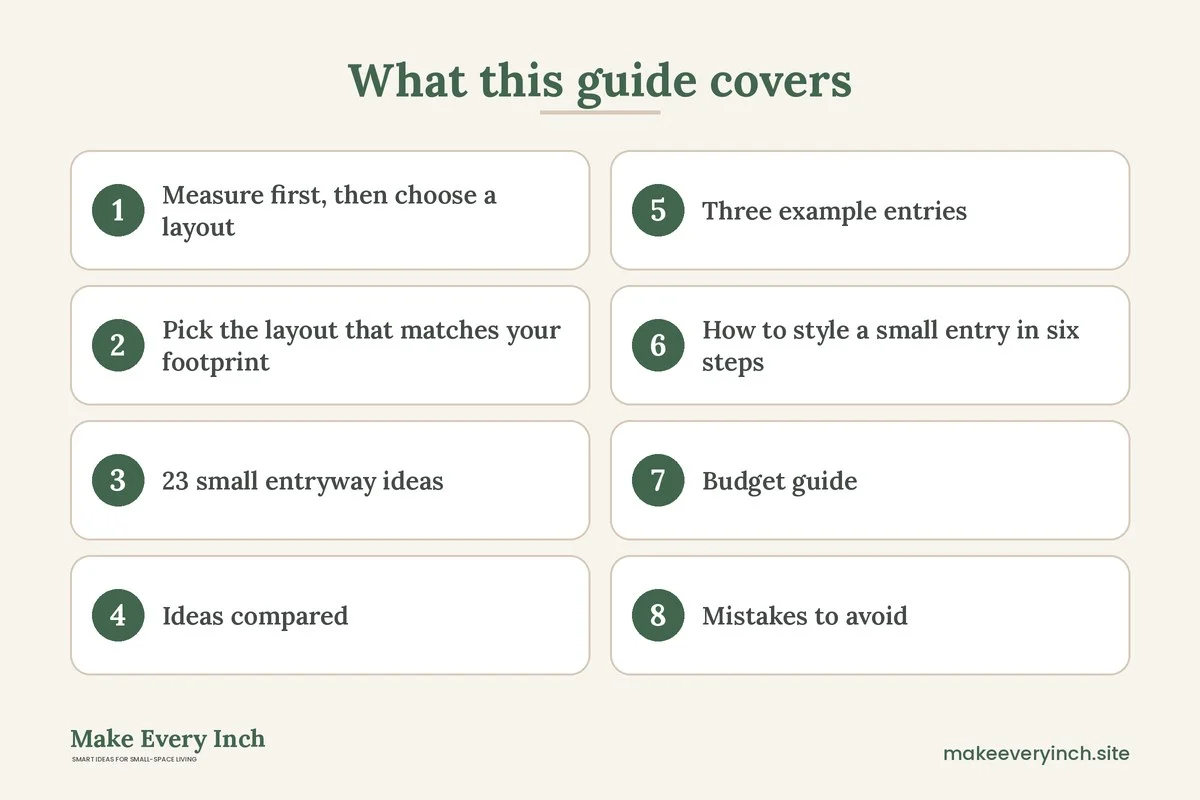
Pick the layout that matches your footprint
Small entries tend to fall into three shapes. A square landing of about 4 by 4 feet can hold a console on one wall and a mirror above it. A narrow strip of about 3 feet wide can hold a wall-mounted shelf, hooks and a runner, but little floor furniture. A door that opens straight into a room has no real entry, and the job is to suggest one with a rug, a light and a vertical statement. If that last one sounds like your home, our guide to no entryway apartment ideas covers it in depth.
23 small entryway ideas
Color and surfaces
1. Paint the walls one confident color
A single color on the walls, trim and door makes the space read as one calm box instead of several chopped-up planes. Pale warm white, soft greige and pale sage keep it airy, while a deep green or navy can feel intentional and cozy if there is a light source. Use a washable satin or eggshell finish, since entries get scuffed.
2. Try a two-tone wall
Paint the lower third of the wall a darker shade and the upper two thirds a lighter one, with a thin line of trim or a painter’s-tape edge between them. The dark base hides bag marks and shoe scuffs, and the light top keeps the room open. Renters can get the same effect with a peel-and-stick panel kit on the lower half, though you should read our guide to removable wallpaper ideas and your lease first.
3. Add a removable wallpaper accent
One wall in a small geometric or a soft botanical print gives the entry personality without a single shelf. Choose a pattern with a small to medium scale, since huge motifs look cropped in a tight space. Test a hidden corner first, and photograph the wall before you start.
4. Paint the ceiling
A ceiling in a pale tint of the wall color, or a soft sky blue or pale grey, draws the eye up and makes a low entry feel intentional. It is also the one surface that rarely gets scuffed. If you rent, ask permission, since repainting a ceiling back is more work than touching up a wall.
5. Choose a floor that handles wet shoes
If you can choose, durable tile, luxury vinyl plank or sealed wood stands up to rain and salt better than carpet. If you cannot change the floor, add a boot tray and a washable rug. Wipe up water quickly, because standing moisture can lift finishes and stain wood.
Mirrors and light
6. Hang or lean one big mirror
A large mirror is the single most effective trick for a small entry, because it doubles the light and the apparent depth. Aim for a piece at least two thirds as wide as the console or wall space below it. A full-length leaning mirror, often 60 to 70 inches tall, also lets you check your outfit on the way out, and it needs no hanging hardware.
7. Place the mirror opposite a light source
A mirror reflects what it faces. Put it opposite a window, a glass door or a lamp, and the light bounces around the room. Avoid facing it at a cluttered corner, which only doubles the clutter.
8. Use a round or arched mirror to soften corners
Entries are full of hard edges: door frames, console corners, shoe racks. A round or arched mirror breaks up that geometry, and it reads as art even when the wall is otherwise bare. Pick a thin frame in black, brass or natural wood to match your hardware.
9. Upgrade the ceiling light
A flush-mount or semi-flush fixture in a warm white bulb, around 2700 K, makes an entry feel welcoming. Choose a fixture with a shade that diffuses the light so it does not glare in your eyes as you walk in. Renters can swap a fixture if they keep the original and reinstall it at move-out; check the lease first and turn off the breaker before any electrical work.
10. Add a plug-in wall sconce or small lamp
If there is no ceiling light, a plug-in sconce with a cord cover or a small lamp on a console gives a warm glow without any wiring. Use a smart plug or a plug-in timer so the entry light comes on at dusk before you arrive. For more options, see renter friendly lighting ideas.
Rugs, benches and consoles
11. Lay a slim runner or a small low-pile rug
A rug marks the entry as a distinct place, and it catches dirt before it spreads. Choose a low pile, under about half an inch, so the door swings freely, and a flat weave that you can shake out or vacuum. In a narrow space, a runner about 24 to 30 inches wide leaves a few inches of floor visible on each side.
12. Use a rug grip so it stays put
A rug that slides is a trip hazard. Use a rug pad rated for your floor type, since some rubber pads can stain vinyl or finished wood, and check the product’s description. Trim the pad about an inch smaller than the rug on every side.
13. Pick a shallow bench or a wall-hung seat
A bench gives you a place to sit while you put on shoes, but it eats floor. Look for pieces about 12 to 16 inches deep and 36 to 48 inches long. A wall-hung bench, with the legs removed, keeps the floor clear for boots and for sweeping.
14. Use a slim console table
A console between 9 and 14 inches deep fits most entries and leaves a walkway. Put a tray for keys and a lamp on top, and keep the surface at about two thirds empty. Choose legs that show the floor underneath, since visible floor makes a space feel bigger.
15. Float a narrow shelf instead of a console
When a console is too deep, a wall shelf about 6 to 8 inches deep at around 36 to 40 inches high does the same job, and the floor stays open. See our notes on renter friendly shelving for installation options that do not damage walls.
Walls, art and greenery
16. Hang a small gallery above the console
Three to five frames in a consistent finish, with the center of the group at about 57 inches from the floor, make the entry feel finished. Keep the spaces between frames at 2 to 3 inches. For nail-free methods, see renter friendly wall decor ideas.
17. Use one oversized piece instead of many small ones
In a tight space, one large print or canvas looks calmer than a crowd of small frames. It also gives the eye one place to land. Lean it on the console if you cannot hang it.
18. Add a plant that handles low light
Many entries get little sun, so choose a plant that tolerates it, such as a snake plant, a ZZ plant or a pothos. Check the plant’s care tag, and keep it away from cold drafts at the door. A trailing pothos on a shelf adds softness at the top of the room.
19. Hang a few hooks with a clear purpose
Three hooks in a row at 60 to 66 inches high keep coats and bags off the floor, and a second row at about 44 inches suits children and tote bags. Use quality hooks with a rounded profile, and match the finish to your mirror frame. Our guide to small entryway organization covers hook layouts in more depth.
Sensory and door details
20. Add a scent that says welcome
A small diffuser, a reed set or a candle in a jar on the console gives the entry a signature smell. Choose something light, such as cedar, citrus or clean cotton, since a heavy fragrance feels overpowering in a small space. Never leave a flame unattended, and keep candles away from curtains and coats.
21. Dress the door and the hardware
A freshly painted door, a new knob or a matching set of hooks and handles changes the whole feel. Swapping a door handle is usually a screwdriver job, but keep the original parts in a labeled bag for move-out. A door in a strong color, such as deep blue or forest green, makes a plain entry feel designed.
22. Mark the threshold
A small stone dish for keys, a doormat inside and a threshold strip in a clean finish signal the line between outside and in. This helps a no-entry apartment feel more like a real entrance, and it keeps grit from traveling across the floor.
23. Add one personal touch
A framed family photo, a bowl you love, a hand-made ceramic or a postcard collection tells guests who lives here. Pick one thing and give it room, rather than many small objects. A calm entry with one personal detail looks better than a busy one with twenty.
Ideas compared
| Idea | Typical cost | Floor space used | Renter-friendly | Impact |
|---|---|---|---|---|
| Large mirror | $40 to $200 | None if leaned or hung | Yes | Very high |
| Wall paint | $30 to $80 | None | Ask first | High |
| Plug-in sconce | $25 to $70 | None | Yes | High |
| Runner rug | $30 to $120 | Floor only | Yes | High |
| Wall shelf | $25 to $90 | None | Depends on method | Medium |
| Slim console | $80 to $300 | 9 to 14 inches | Yes | High |
| Wall-hung bench | $60 to $200 | 12 to 16 inches | Ask first | Medium |
| Plant | $10 to $50 | Small | Yes | Medium |
| Door color | $20 to $50 | None | Ask first | Medium |

Three example entries
The 3 by 4 foot landing
A small landing beside the front door has one free wall of about 40 inches. Hang a round mirror about 28 inches wide, and add a wall shelf about 7 inches deep beneath it for keys and a lamp. Put a low-pile rug of about 2 by 3 feet on the floor, and hang three hooks to one side of the mirror. Total cost can land near $250, and everything is removable.
The narrow 3 foot strip
A strip entry gives you a wall about 8 feet long and a walkway only 3 feet wide. Line the wall with a 6 to 8 inch deep shelf and a row of hooks above, then add a runner and a long mirror that leans at the end of the run. Avoid any floor furniture over 12 inches deep. You will need to walk past the shelf without brushing it, so measure again after the first piece goes up.
The door that opens into the living room
There is no entry wall, only a few feet before the sofa. Use a runner to mark the zone, place a slim console with a lamp against the nearest wall, and add a mirror above it. A tall plant beside the door and a small tray for keys complete the idea. For layouts like this, see small apartment living room ideas.
How to style a small entry in six steps
Step 1: Clear everything
Remove every item from the entry, and look at the bare space. Note what bothers you most, such as darkness, a blank wall or a pile of shoes. This is the problem to solve first.
Step 2: Fix the light
Light is the cheapest, fastest improvement. Swap a cold white bulb for a warm one, or add a lamp or a sconce. Stand at the door at night and check the room reads as warm, not harsh.
Step 3: Choose the anchor
Pick one anchor, either a console, a bench or a large mirror, and place it first. Everything else relates to it. If you cannot decide, start with the mirror.
Step 4: Add the rug
Place the rug so that the door clears it, and the front edge sits just inside the threshold. Use a pad, and check the rug does not crease where the door swings.
Step 5: Layer the wall
Hang the mirror, art or shelf at the heights given above, using templates cut from paper. Add hooks last, since they depend on the other pieces.
Step 6: Edit
Remove one item from the entry. Then add one plant or personal object. Stand back at the door and view it as a guest would.
Budget guide
Under $75
A can of paint or a rug, a bulb swap, a few hooks and a plant from the garden center, or thrifted frames.
About $250
A leaning mirror, a plug-in sconce, a runner and a wall shelf with a tray, which together change the entry completely.
$600 and up
A custom-fit console, a good mirror, a hardwired light fixture installed by a licensed electrician, and a wall-hung bench.
Mistakes to avoid
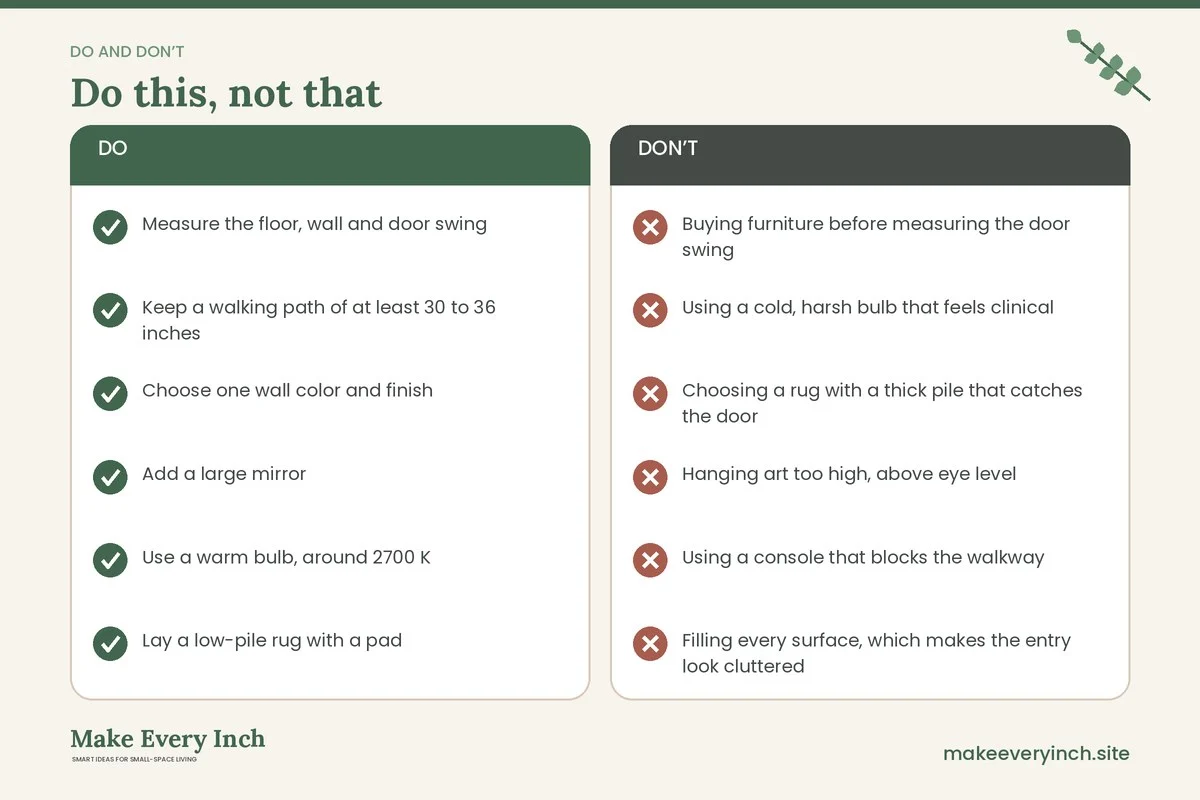
- Buying furniture before measuring the door swing
- Using a cold, harsh bulb that feels clinical
- Choosing a rug with a thick pile that catches the door
- Hanging art too high, above eye level
- Using a console that blocks the walkway
- Filling every surface, which makes the entry look cluttered
- Using a tiny mirror that does little for the space
- Ignoring the lease before painting or changing fixtures
Small entryway style checklist
- Measure the floor, wall and door swing
- Keep a walking path of at least 30 to 36 inches
- Choose one wall color and finish
- Add a large mirror
- Use a warm bulb, around 2700 K
- Lay a low-pile rug with a pad
- Pick a console or shelf no deeper than 14 inches
- Hang art with the center at about 57 inches
- Add a plant that tolerates low light
- Photograph the space before and after changes
All our entryway guides
This guide covers style and layout. These companion guides go deeper into the practical side, from storage to special layouts.
- Small entryway organization: drop zones, baskets and daily systems
- Narrow hallway ideas: make a long, skinny passage feel wider
- Small entryway storage: cabinets, benches and wall storage
- Apartment entryway decorating: decorating an apartment entrance
- Small shoe storage ideas: racks, cabinets and slim solutions
- Small coat storage ideas: hooks, rails and closets for outerwear
- Tiny foyer ideas: style a very small foyer
- No entryway apartment ideas: create an entry when the door opens into the room
FAQ
How do I make a small entryway look bigger?
Use a large mirror, a light wall color, warm lighting and furniture with visible legs. Keep the floor open and avoid heavy furniture. Vertical elements such as a tall mirror or a narrow shelf draw the eye up.
What colors work best in a small entryway?
Pale warm white, soft greige and light sage keep the space airy. Deep colors such as navy or green can work if you have a good light source and keep the trim crisp. Use one main color to avoid a chopped-up look.
What furniture fits a small entryway?
A console 9 to 14 inches deep, a wall-hung bench 12 to 16 inches deep or a narrow shelf are the most common choices. Leave at least 30 to 36 inches of walking space, and check the door swing before you buy.
How can I decorate an entryway as a renter?
Use a leaning mirror, a plug-in sconce, a rug, a freestanding console and adhesive hooks rated for the weight. Read the lease, test adhesives in a hidden spot and photograph the space before you start. See security deposit safe apartment upgrades for more.
How high should I hang a mirror in an entryway?
Center the mirror at about 57 inches from the floor, or hang it so the bottom edge is 6 to 8 inches above a console. If it is a full-length mirror, lean it securely and consider an anti-tip strap.
What is the best lighting for a small entry?
A warm white bulb of about 2700 K in a diffused fixture, plus a lamp or a sconce for layered light. Use a timer or a smart plug so the light is on when you arrive.
Do I need a rug in my entryway?
You do not need one, but a low-pile, washable rug catches dirt and defines the space. Use a pad so it does not slip, and shake or vacuum it often.
How do I style an entry that has no wall space?
Use the back of the door, a tall narrow mirror and a few wall hooks, or a floor lamp and a tray on the nearest table. Our guide to no entryway apartment ideas covers this case.
Keep going: Keep going with small entryway organization, renter friendly wall decor ideas and vertical storage ideas.
Save this guide for later
Pin the ideas you like to Pinterest so you can come back to them when you plan your space.