17 Small Living Room Ideas Without a Coffee Table Renter Friendly Swaps
Quick answer: The best small living room ideas without a coffee table renter friendly setups use freestanding pieces only: a pouf or storage ottoman with a tray, a nesting pair of side tables, a C-shaped sofa table, a clip-on or arm tray, a plant stand, or a bench at the sofa end. Nothing is screwed into the wall or floor, felt pads protect the surface, and everything leaves with you at move-out, so the deposit stays safe.
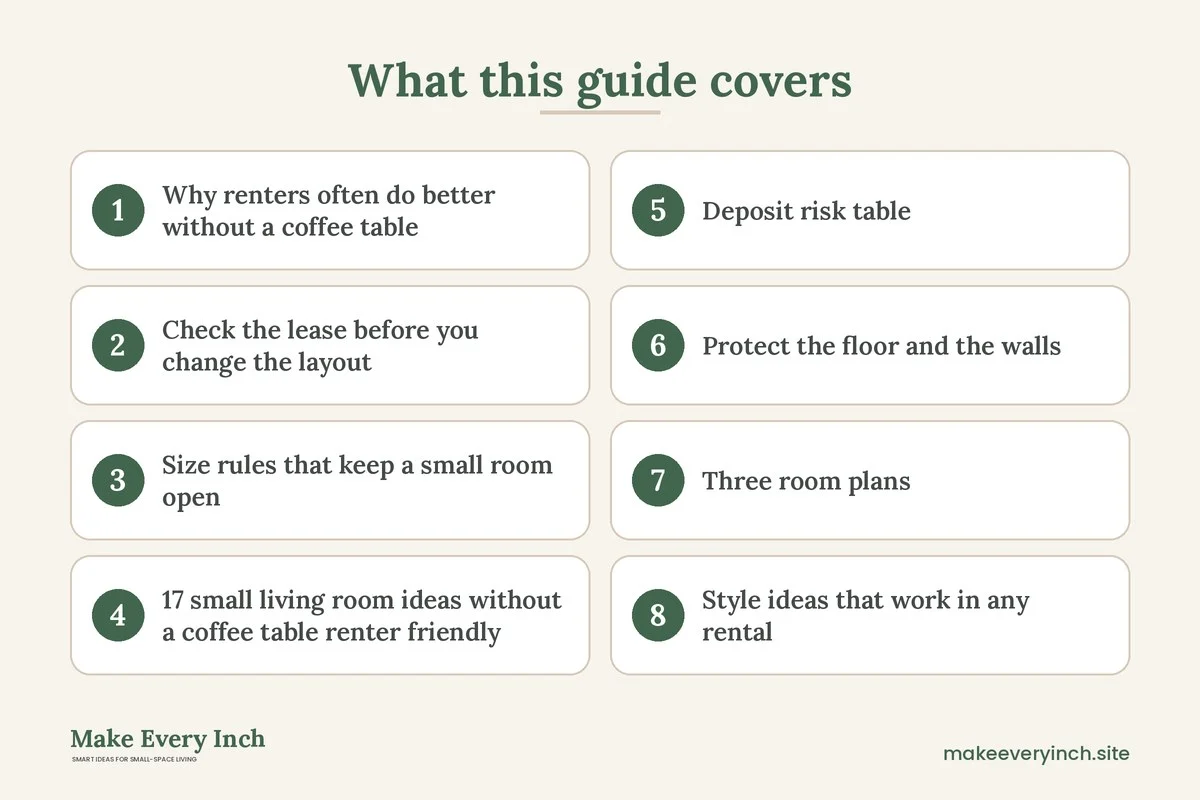
Small living room ideas without a coffee table renter friendly enough to protect your deposit come down to one rule: every replacement must stand, sit or clip on its own. A rental has a lease, thin floors, shared walls and often no permission to drill, so the usual advice to mount a fold-down shelf or bolt a ledge to the wall does not apply. This guide shows 17 swaps that work with no tools, a lease check you can finish in ten minutes, a table that ranks each swap by deposit risk, size rules in inches, three room plans, a floor and wall protection plan, a move-out routine and a checklist. For the overall approach to dropping the table, start with our main guide on small living room ideas without a coffee table and the wider hub on small living room ideas.
Why renters often do better without a coffee table
A coffee table is the heaviest, widest and least flexible piece in most small living rooms. It takes up about 8 to 10 square feet of floor, it forces a 14 to 18 inch gap on the sofa side, and it creates sharp corners at shin height. For a renter, it also tends to be the first thing that does not fit the next apartment. Moving from a 10 by 12 foot room to a 12 by 15 foot room changes which size of table works, and a table that was perfect becomes either lost or crowded.
Freestanding, lightweight replacements solve that. A pouf weighs a few pounds, a nesting pair splits into two pieces for two different rooms, and a tray on a storage ottoman turns a seat into a table in about five seconds. They also move aside when you need floor space for a yoga mat, a visiting relative’s air mattress or a play area. The result is a small room that reads as open on a normal evening and flexes when you need it to.
None of this requires owning anything fancy. The ideas below use basic shapes that you can buy, borrow or find secondhand, and every one of them avoids the three things that cost renters money at move-out: holes in walls, scratched floors and adhesive that pulls off paint.
Check the lease before you change the layout
Read the clauses about walls, floors, fixtures and alterations. Most leases ban nails and anchors, many ban adhesive, and some require rugs over hard floors in upstairs units to cut noise. A rug requirement matters here, because the rug is the anchor for your coffee table replacement. If your lease says nothing, ask in writing, and keep the reply.
Then photograph the room. Take a wide shot of the floor, a close shot of any existing scratches and a shot of each wall near the sofa. Date the pictures by sending them to yourself. This takes ten minutes and gives you proof that a scuff was there before you arrived.
Finally, test the floor. Slide a felt-padded furniture foot across a hidden corner. Wood, laminate and vinyl all scratch in different ways, and vinyl can also stain from rubber feet. Choose pads that match your floor, and replace them when they flatten or collect grit.
Size rules that keep a small room open
Measurements decide whether a swap works. Use these as starting points and adjust to your room.
- Keep 14 to 18 inches between the sofa edge and the nearest table or ottoman, so you can reach it without leaning.
- Keep 30 to 36 inches for the main walkway, and never go below 24 inches on a side path.
- Choose a surface that is 16 to 22 inches high, within about 2 inches of the sofa seat height, so mugs and plates are reachable.
- Choose a footprint of 18 to 30 inches across. Anything larger starts to feel like a coffee table again.
- Keep a rug that reaches under at least the front legs of the sofa and chairs, so the group reads as one zone.
- Leave about 3 feet in front of any door, closet or cabinet that swings out.
If you measure a swap and it fails two of these, pick a smaller one. A room that is 10 feet wide has no space for a 30 inch table plus two walkways.
17 small living room ideas without a coffee table renter friendly options
Pieces that sit on the floor
1. A pouf with a tray
A firm pouf about 16 to 18 inches high works as a footrest, a seat for guests and, with a rimmed tray on top, a table. Pick a pouf with a flat top and a solid core, since a soft one tips the tray. Store the tray on a shelf when you need the pouf as a seat.
2. A storage ottoman
A lidded ottoman about 30 inches wide holds throw blankets, remote controls or board games inside. Add a tray and you have a table with a hidden closet. The weight keeps it stable, so check the feet and add felt pads. Our guide to the best storage ottoman options covers shapes and sizes.
3. A nesting pair of side tables
Two round or square tables, one slightly smaller than the other, tuck together when idle. Pull them apart for a snack evening, and put them back when the room needs to be open. They are the most flexible swap for a renter, since each piece can also live next to a bed or a desk in the next place.
4. Large floor cushions
A pair of 24 to 28 inch floor cushions around a low tray makes a casual dining and game spot. This option suits a room with a rug and a relaxed layout, and it removes all hard edges from the floor.
5. A bench at the sofa end
A narrow bench about 14 to 16 inches deep placed along one side of the sofa gives a perch, a surface and a place for a plant. It also works as extra seating for a visitor, which a coffee table never does.
6. A low trunk or crate
A trunk or a wooden crate on its side with a flat top holds a drink and fits a small apartment style. Lay a piece of cloth or a cork mat on top if the surface is rough, and fit felt pads underneath.
Pieces that tuck beside the sofa
7. A C-shaped sofa table
A C-shaped table slides under the sofa seat edge, so the top sits right over your lap. It stands on its own base, needs no wall anchor and can be moved to the other side of the sofa in a second. Look for a base narrow enough to clear the sofa legs.
8. A narrow side table
A side table 10 to 12 inches wide and 24 inches tall by the arm of the sofa is enough for a lamp and a mug. Choose a model with a lower shelf for a basket of remotes.
9. A sofa arm tray
A wide flat tray, often made of wood or bamboo, rests across the arm of a sofa and holds a drink or a laptop. It needs no clamps or screws, but check that the arm is wide and flat enough, since a rounded arm lets the tray slide.
10. A clip-on side table
A table with a slim L-shaped frame slides under a sofa cushion or clips to a flat armrest. It holds a book and a mug and folds away when you need the space. Test the sofa for stability before you load it.
11. A plant stand as a drink perch
A small round plant stand at about 20 inches high holds a plant and, on the other side of the sofa, a mug. Use two matching stands in the corners to frame the sofa, and the room reads as designed, not improvised.
12. A stool with a tray
A stool or a short bar stool at the end of the sofa is a seat when you need one and a table when you add a tray. Choose a flat round top so the tray sits level.
Pieces that add height without drilling
13. A narrow console behind the sofa
A console 8 to 12 inches deep behind a sofa that floats in the room holds lamps, books and drinks. It needs only floor space and a wall to stand near, and it hides the sofa back. Add felt pads, and push it flush to avoid a gap. For layout ideas, see our guide to small living room layout ideas.
14. A floor lamp with a built-in shelf
A lamp with one or two small shelves in the stem gives you a table and a light without needing a plug-in shelf. Check the base is heavy enough to stop it from tipping. For more lamp options, see the guide to the best floor lamps for small rooms.
15. A freestanding ladder shelf
A ladder-style shelf leans on the wall with no hardware, and the lowest shelf can hold a lamp or a tray at table height. Rest it on a rubber foot or a non-marking pad, and fix a safety strap only if the lease allows it.
16. A bookcase that doubles as a tray surface
A low bookcase about 28 to 32 inches high next to the sofa has a top that holds a drink and shelves for books. For narrow options, see the best narrow bookshelves. Choose a model that has a back panel and a wide base, for stability.
17. A folding tray table
A folding tray table, the kind with a flat top and X legs, opens in two seconds for dinner or a laptop evening and folds flat behind a door or a sofa. It is the most space-friendly choice in a room under 120 square feet.
Deposit risk table
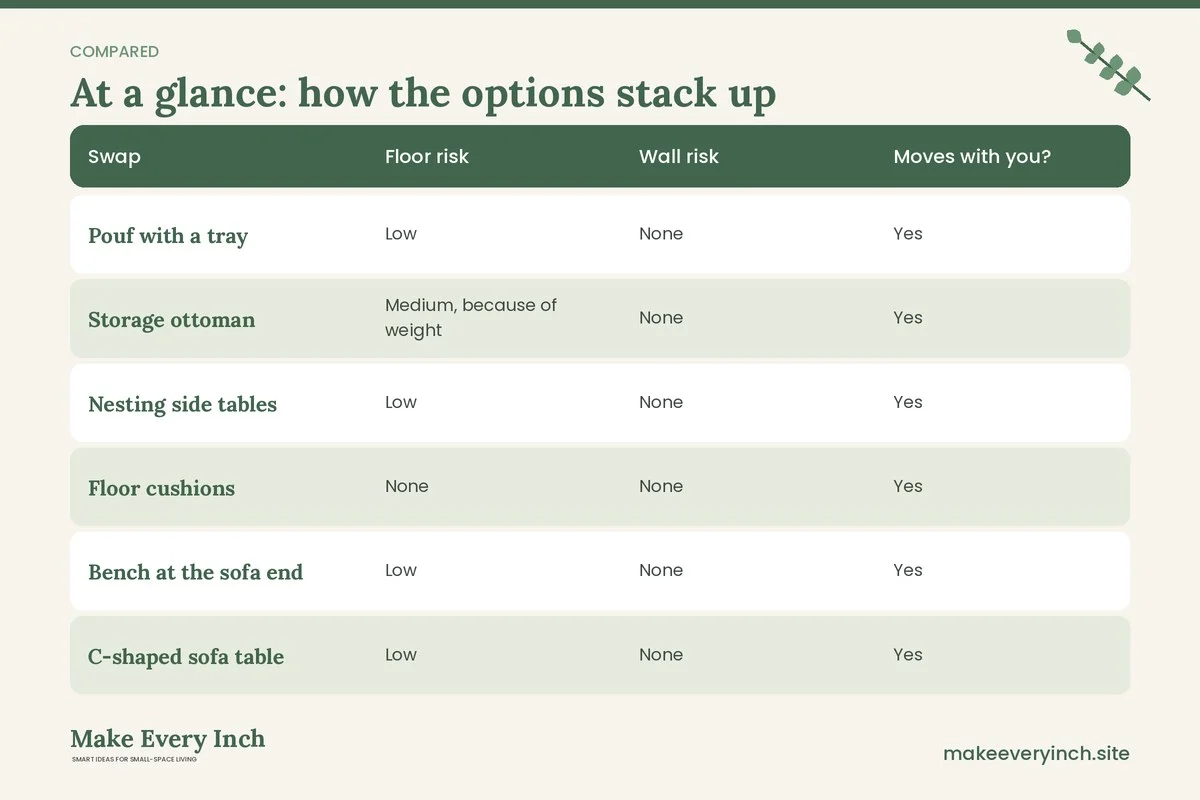
Use this table to choose swaps. Risk means the chance of a mark on a floor, a wall or a fabric, assuming you use felt pads and follow the lease.
| Swap | Floor risk | Wall risk | Moves with you? | |
|---|---|---|---|---|
| Pouf with a tray | Low | None | Yes | |
| Storage ottoman | Medium, because of weight | None | Yes | |
| Nesting side tables | Low | None | Yes | |
| Floor cushions | None | None | Yes | |
| Bench at the sofa end | Low | None | Yes | |
| C-shaped sofa table | Low | None | Yes | |
| Sofa arm tray | None | None | Yes | |
| Clip-on side table | None | None | Yes | |
| Plant stand | Low | None | Yes | |
| Console behind the sofa | Low | Low, if it touches paint | Yes | |
| Ladder shelf | Low | Medium, a lean can mark paint | Yes, but check | |
| Folding tray table | Low | None | Yes |
Most of the risk sits in the heavier pieces, which scratch floors, and in anything leaned on a wall, which can mark paint over time. Use pads and a thin cloth at the contact point, and move the piece slightly every few weeks.
Protect the floor and the walls
Floors
Fit every leg with a felt pad that fits the leg’s shape, and replace pads every six months, since a flat pad full of grit scratches. On vinyl, avoid dark rubber feet, which can leave a stain, and use clear or light pads. On hard floors, put a rug under the group and add a rug pad that does not stick to the floor. A rug about 5 by 8 feet is the common size for a small room, and the front legs of the sofa should rest on it.
Lift furniture instead of dragging it. When you move a pouf, an ottoman or a nesting table, carry it. A dragged piece is the quickest route to a long scratch.
Walls
For the wall behind the sofa, lean freestanding pieces carefully and leave a half-inch gap if the baseboard is thick. For lighting, choose a plug-in floor lamp instead of a hardwired fixture, and choose rope or clip lights if you need accent light. Our guide to renter friendly lighting ideas covers options that need no electrician. For art, lean frames on the console or use light strips rated for the frame weight. For more, see renter friendly wall decor ideas.
Rugs
If the lease needs a rug for noise, choose a rug with a thick pad. The pad reduces sound, lifts the rug off the floor so tray tables sit steadily and prevents slipping. Check that a rug does not curl at the edge, since that is a trip hazard and a place a tray table can catch.
Three room plans
A 10 by 12 foot room with a loveseat
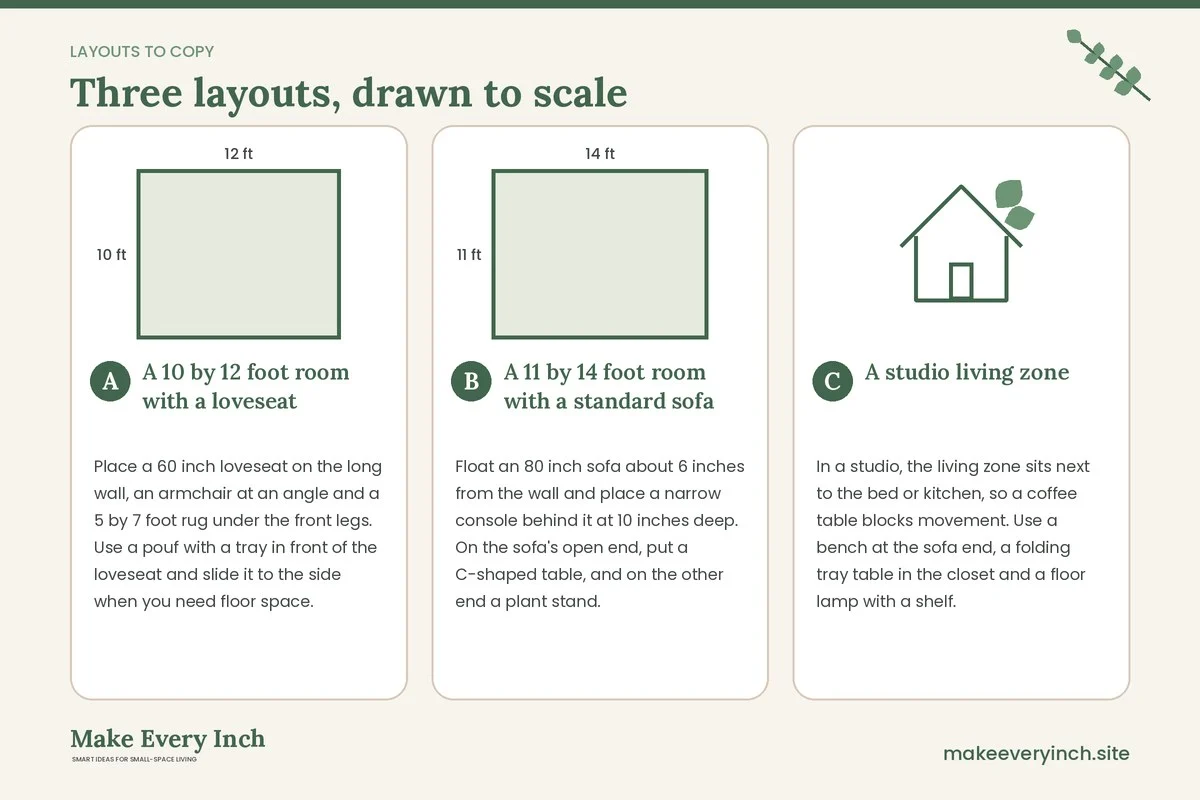
Place a 60 inch loveseat on the long wall, an armchair at an angle and a 5 by 7 foot rug under the front legs. Use a pouf with a tray in front of the loveseat and slide it to the side when you need floor space. Keep a 34 inch path from the door to the window. Add one nesting table by the chair. Total footprint of tables: about 4 square feet.
A 11 by 14 foot room with a standard sofa
Float an 80 inch sofa about 6 inches from the wall and place a narrow console behind it at 10 inches deep. On the sofa’s open end, put a C-shaped table, and on the other end a plant stand. Use a 6 by 9 foot rug that stretches under the front legs of the sofa and the chair. This plan gives you three table surfaces without a single piece in the center.
A studio living zone
In a studio, the living zone sits next to the bed or kitchen, so a coffee table blocks movement. Use a bench at the sofa end, a folding tray table in the closet and a floor lamp with a shelf. Keep a 30 inch path to the bed and the door. For more ideas, read our guide to small apartment living room ideas for studios.
Style ideas that work in any rental
Rental living rooms often start from a plain white box, so the replacement for a coffee table is a chance to add warmth. A woven basket on a stool, a wooden tray on an ottoman and a ceramic bowl on a nesting table add texture without cost. Keep to two or three materials, such as wood, linen and metal, so the room feels calm. Our cozy small living room ideas guide has more on layers, and the cozy layout guide shows how to arrange seats around a rug.
If you like a clean look, choose pieces in one color family, such as natural wood and cream, and limit the number of items on the top surface to three. Odd numbers look intentional. A tray, a candle and a small plant make a tidy group, and you can clear it in five seconds.
Storage that replaces the table’s job
A coffee table often hides storage in drawers. Without it, move that function to pieces that do not need drilling. A lidded ottoman holds throws, a basket by the sofa holds remote controls and magazines, and a bench with a shelf holds shoes or books. See our list of no-drill storage ideas for renters and the hidden storage ideas guide for more.
Keep items you reach for daily within arm’s length of the sofa and move the rest to a closed container. A small room feels crowded when ten small things sit on every surface, so give each thing a home. For a bigger plan, see small living room storage ideas.
Move-out routine
Plan the move-out when you move in. Keep the felt pads you do not use, and keep the box for any piece that comes apart. Two weeks before leaving, check each piece for marks, clean the floor under each leg and look at the walls behind the console and the ladder shelf. Compare to the photographs you took on day one.
Wipe each wall with a barely damp cloth, since dust marks near a leaned shelf come off easily. Fix any small scratch on a floor with a wax pen that matches the color, if the lease allows it. Roll the rug, wrap it in a sheet and stand it upright. Then take a final set of photographs, and keep them with the first set until the deposit is back.
Common mistakes
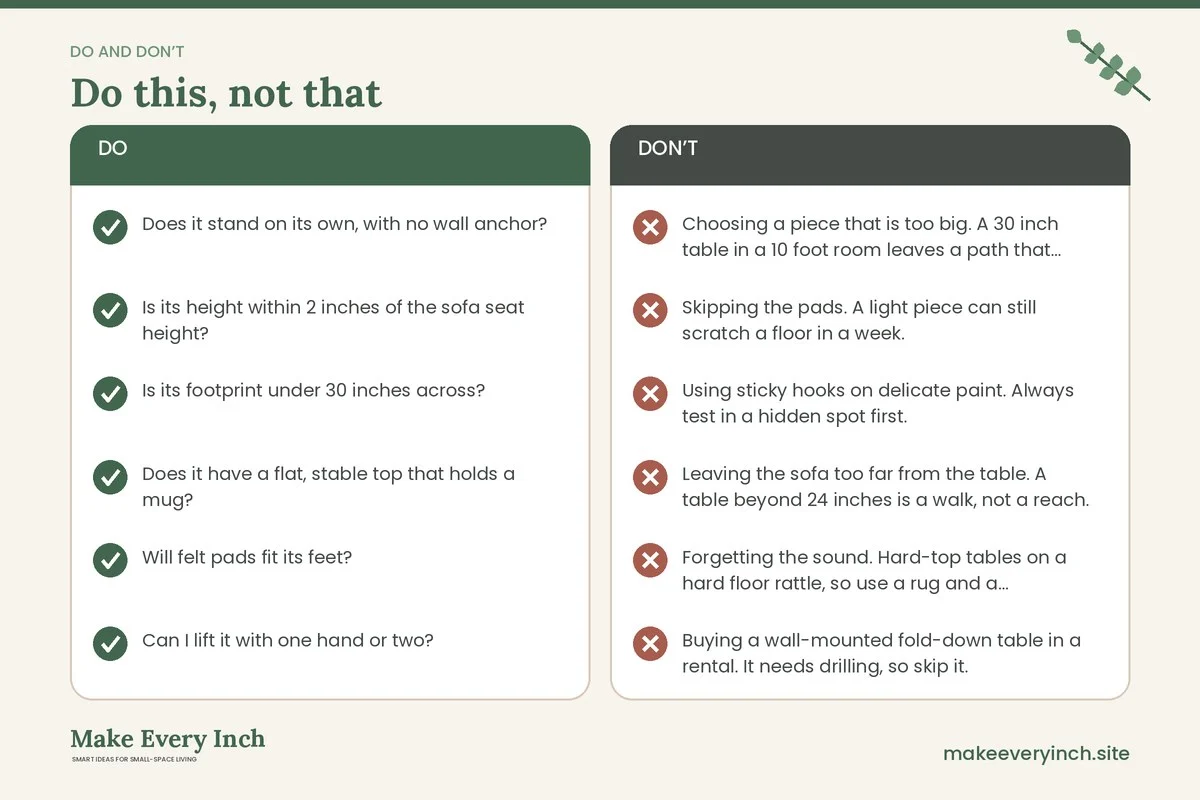
- Choosing a piece that is too big. A 30 inch table in a 10 foot room leaves a path that feels tight.
- Skipping the pads. A light piece can still scratch a floor in a week.
- Using sticky hooks on delicate paint. Always test in a hidden spot first.
- Leaving the sofa too far from the table. A table beyond 24 inches is a walk, not a reach.
- Forgetting the sound. Hard-top tables on a hard floor rattle, so use a rug and a felt-lined tray.
- Buying a wall-mounted fold-down table in a rental. It needs drilling, so skip it.
A renter friendly buying checklist
- Does it stand on its own, with no wall anchor?
- Is its height within 2 inches of the sofa seat height?
- Is its footprint under 30 inches across?
- Does it have a flat, stable top that holds a mug?
- Will felt pads fit its feet?
- Can I lift it with one hand or two?
- Will it fit the next place, in a larger or a smaller room?
- Does it have a second use, such as a seat or storage?
If a piece answers yes to at least six of these, it is a good buy.
Questions renters ask
Can I use adhesive strips to anchor a table?
Avoid it. Adhesive near the floor can lift paint on a baseboard and leave a mark. Freestanding pieces with felt pads are safer and cost less.
What if my landlord bans rugs?
Rare, but possible on certain floors. In that case, use felt pads and a thin runner under the group, or ask for written permission. Without a rug, choose lighter pieces and carry them.
Will a pouf stay stable with a tray?
A firm pouf with a flat top holds a light tray. If the pouf is soft, use a stool or a storage ottoman instead.
How do I make a no-table room feel finished?
Add a rug, a lamp and one surface on each side of the sofa. A room with a rug and two surfaces feels planned, even without a center table.
What is the cheapest swap?
A pouf with a tray, a crate or a folding tray table. You can also use a secondhand stool. Prices vary, so compare options in your area.
Can I use a coffee table later?
Yes. If your next place is larger, you can add a table again. Keeping the nesting tables means the pieces still earn their keep, in a bedroom or an office.
How to choose your first swap
Start with the question of what you use the table for. If you mostly put down a mug, choose a C-shaped table, a tray or a nesting pair. If you put your feet up, choose a pouf or a storage ottoman. If you eat in the living room, choose a folding tray table or a bench with a tray. If you want storage, choose an ottoman or a bench. Once you know the job, the swap is easy.
Next, set a trial period. Live with the new setup for two weeks and note what annoys you. If your knees hit a corner, move the piece 3 inches. If you reach too far, swap in a smaller piece closer to the sofa. A small room rewards small adjustments, and renting means you can adjust without commitment.
Keep going: Ready for the next step? Read our main guide to small living room ideas without a coffee table, see more removable fixes in small living room ideas for renters, and plan the walls with security deposit safe apartment upgrades.
Save this guide for later
Pin the ideas you like to Pinterest so you can come back to them when you plan your space.