16 Small Living Room Furniture Ideas Renter Friendly Enough to Move With You
Quick answer: The best small living room furniture ideas renter friendly households can use are pieces that move, fold, stack or stand without drilling: a sofa with removable legs or a compact frame, nesting tables, a leaning shelf, a bench with storage and a floor lamp. Measure doors and stairwells first, keep 30 to 36 inches of walkway, and anchor tall pieces in a way your lease allows.
Small living room furniture ideas renter friendly enough to survive a move are different from the ideas in a typical decorating feature. A homeowner can build a wall of cabinets, bolt a desk to a stud and pick a sofa that only just fits through the front door. A renter cannot do any of that without paying for it later. Every piece you buy has to pass three tests: it fits the room you have now, it leaves no mark on the walls or floor, and it will fit the next room, which may be larger, smaller or oddly shaped. This guide is about furniture, not decor. It covers the lease and floor check, how to measure for a piece you will move more than once, 16 ideas, a move-out table, example rooms, an anchoring section for tall furniture, a checklist and an FAQ. For the full overview, read our main guide to small living room furniture ideas and the wider small living room ideas pillar. If you also want to decorate around the furniture, our guide to renter-friendly apartment decorating ideas picks up from here.
Read the lease and protect the floor first
Furniture does more damage to rentals than most people expect, and most of it happens on the floor. Before you move anything, read the lease for the clauses on floor coverings, wall fixtures and alterations. Some leases ban rugs on hardwood without a pad, and others ask you to keep furniture off the walls by a set distance. Take dated photos of each wall and floor so you can show the original condition at move-out.
Then plan for floor protection as part of every furniture purchase. Felt pads on legs prevent scratches on wood and laminate, but they flatten and collect grit, so check them every few months. Wide rubber-free glides suit vinyl, since some rubbers can leave stains on soft flooring. A rug pad under a rug stops sliding and spreads the weight of a heavy sofa, which helps on soft floors where narrow legs can leave dents. If the floor is carpet, a furniture cup or a thin board under a heavy foot spreads the load. Treat the floor protection as a standing cost of renting, not an extra.
Measure for more than one home
The most expensive mistake a renter can make is buying a piece that fits the current living room and nothing else. Think of each purchase as a piece that must work in at least two plausible rooms. A good rule is to assume your next living room is between 10 by 12 feet and 12 by 15 feet. A sofa that is 72 to 84 inches long suits both of those sizes, and one over 90 inches tends to crowd the smaller one.
Measure the route as well as the room. Write down the width of the entry door, the width of any hallway corners, the stair width and the turning space at any landing. Many doorways give a clear opening of 28 to 32 inches, which means a sofa over 36 inches deep may need to tilt or have its legs removed. Choose pieces with detachable legs, split frames or modular parts so they can be carried in sections. Cardboard cutouts of the footprint on the floor, held in place with painter’s tape, help you see the real space the piece will take.
Check ceiling height as well. A tall bookcase that is 76 inches high needs a clear ceiling and room to tilt it upright, so confirm there is a gap of at least 2 to 3 inches above it. In rentals with low ceilings or sloped walls, a shorter piece is almost always safer.
16 small living room furniture ideas renter friendly
Seating you can take with you
1. A compact sofa with removable legs
Look for a sofa between 68 and 80 inches long with a seat depth of 20 to 22 inches. A frame with legs that unscrew and arms that are narrow gives the most freedom, since you can lower it through a tight door. Choose a fabric that wipes clean, because a rental sofa will see a few more moves than a purchased home’s.
2. A modular sofa you can reconfigure
Modular seating built from two or three blocks can be arranged as a straight sofa in one home and an L-shape in the next. Each block is easier to carry, so stairs are less of a problem. Keep the combined length near 80 to 90 inches in a small room. For larger layouts see our guide to the best sectionals for small living rooms.
3. A pair of lightweight armchairs
Two small chairs with an open frame and a seat width of 22 to 26 inches can replace a sofa in a very narrow room. They carry through any door, they can sit at an angle to form a conversation corner, and they stay useful as dining or desk chairs in the next home.
4. A sleeper chair or a folding guest seat
A chair that opens into a short bed, or a folding chair that stores behind a door, covers the occasional guest without a sofa bed. Look for a closed width of 28 to 32 inches. A folding option should be flat when stored, with a depth of 2 to 4 inches.
Tables that travel
5. A nesting set instead of a coffee table
A nesting set has a large table of about 18 to 22 inches across and a smaller one that tucks inside. It stores into a corner during the week and pulls out on weekends. Because it has no fixed footprint, you can use it in any room. If you are curious about going without a table at all, read our guide to small living room ideas without a coffee table.
6. A lift-top or folding table
A table that folds to a thin profile of 3 to 5 inches slides behind the sofa and doubles as a laptop desk or a dining spot. Check the hinge for sturdiness, and keep it shut in transit so it is not bent.
7. A tray ottoman
An upholstered cube with a tray on top works as a footrest, extra seat and table. Pick one around 16 to 20 inches high so it matches the sofa seat. For ideas on ones that also hide clutter, see our list of the best storage ottomans.
Storage that does not need a wall
8. A freestanding bookcase with a narrow depth
A bookcase between 9 and 12 inches deep gives you shelves without stealing floor space, and a height of 48 to 60 inches keeps it low enough to move upright. Choose open-back versions for lighter weight, or add a back panel for stability. Our post on the best narrow bookshelves lists features to look for.
9. A leaning ladder shelf
A leaning shelf rests against the wall at an angle and needs no hardware. It takes up a base of 14 to 18 inches, which is deeper than a flat bookcase, but it is light to move and easy to assemble. Fill the lower shelves with heavy items so the weight sits low, and read the anchoring section below.
10. A bench with a storage box
A bench under a window or at the foot of the sofa gives seating and a place for throws and board games. Choose a lid with a soft-close hinge or no hinge at all, so little fingers stay safe, and a height of 17 to 19 inches.
11. A rolling cart as a side table
A cart with locking wheels works as a bar, a tea station and a charging point. It rolls out of the way for a yoga session, and it is easy to load into a car. See our article on rolling kitchen carts for specifications that translate to the living room.
12. Freestanding shelving in place of built-ins
Where a landlord does not allow drilling, a freestanding cube unit holds the same things as a built-in. Its modular nature lets you rebuild it as a low unit in a small room or a tall one in a larger home. For more options see our no-drill storage ideas for renters and the guide to renter-friendly shelving.
Small pieces that change the room
13. A floor lamp instead of a ceiling fixture
Rental overhead lights are often harsh. An arc or tripod floor lamp with a footprint around 10 to 12 inches brings in a warm pool of light, and it leaves the ceiling untouched. See our guide to the best floor lamps for small rooms.
14. A tension-pole or plug-in lighting solution
A tension pole fits between floor and ceiling and holds lights, plants or shelves without screws. Check the ceiling type before you use one, since textured or soft ceilings can mark. Plug-in sconces use an outlet and a cord cover, so no wiring is touched. These ideas are covered in our guide to renter-friendly lighting ideas.
15. A folding desk or a drop-leaf console
A drop-leaf console is about 8 to 10 inches deep when closed and opens to 24 to 30 inches. It works as a desk in the day and a console in the evening, and it fits a hallway or the back of a sofa. For desk ideas, check the best desks for small apartments.
16. A room divider screen
A folding screen divides a studio living area from a sleeping area, hides a work corner and blocks a draught. It needs no hardware and folds to a few inches thick. Pick a height of 60 to 72 inches and a panel width of 16 to 20 inches. Check that the hinges are strong.
The move-out table
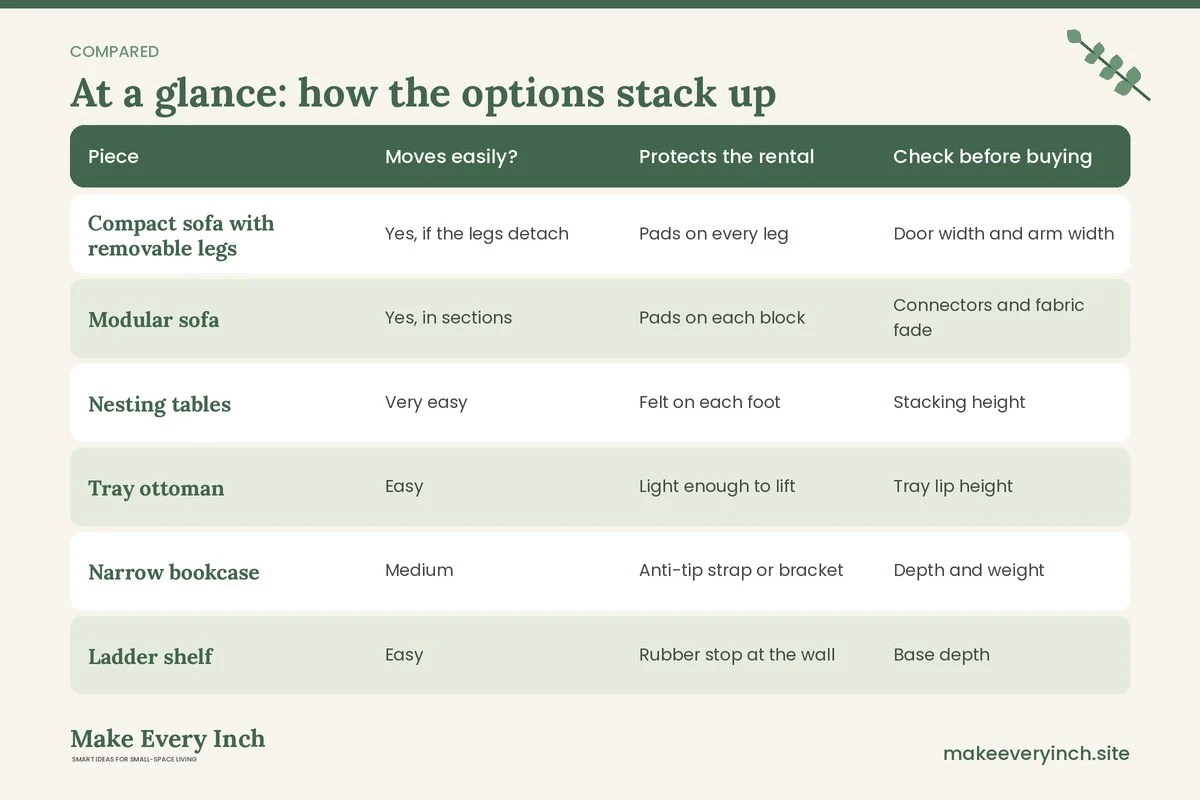
The table below rates each type of furniture by how easily it moves, how it protects a rental and what to check before buying. Use it to compare options before you commit.
| Piece | Moves easily? | Protects the rental | Check before buying |
|---|---|---|---|
| Compact sofa with removable legs | Yes, if the legs detach | Pads on every leg | Door width and arm width |
| Modular sofa | Yes, in sections | Pads on each block | Connectors and fabric fade |
| Nesting tables | Very easy | Felt on each foot | Stacking height |
| Tray ottoman | Easy | Light enough to lift | Tray lip height |
| Narrow bookcase | Medium | Anti-tip strap or bracket | Depth and weight |
| Ladder shelf | Easy | Rubber stop at the wall | Base depth |
| Rolling cart | Very easy | Wheels that do not mark | Wheel type and brakes |
| Floor lamp | Very easy | Base pad | Cord length |
| Folding screen | Very easy | No contact with walls | Hinge strength |
Tall furniture needs an anchoring plan
Any bookcase, tall shelf or narrow cabinet that is taller than about 30 inches can tip, and it is a real risk for children and pets. Tall furniture should be anchored to the wall wherever the rules allow. In a rental, that means asking first. Many landlords agree to a pair of small screws into a stud, which can be filled with spackle at move-out, and it is worth requesting this in writing.
If you cannot drill, there are options, but they have limits. Use a low, wide, heavy-bottomed unit rather than a tall, narrow one. Fill the bottom shelves with the heaviest items and keep the top light. Place the unit in a corner or between two walls, which reduces the chance of tipping forward. Some adhesive-based anti-tip straps exist, but they depend on the wall surface, and they should be treated as a partial measure rather than a replacement for a proper anchor. Never put a TV on a tall, unanchored unit. If the room is used by small children, choose short furniture and follow the maker’s anchoring advice. When in doubt, ask the landlord before you buy.
Three example rooms
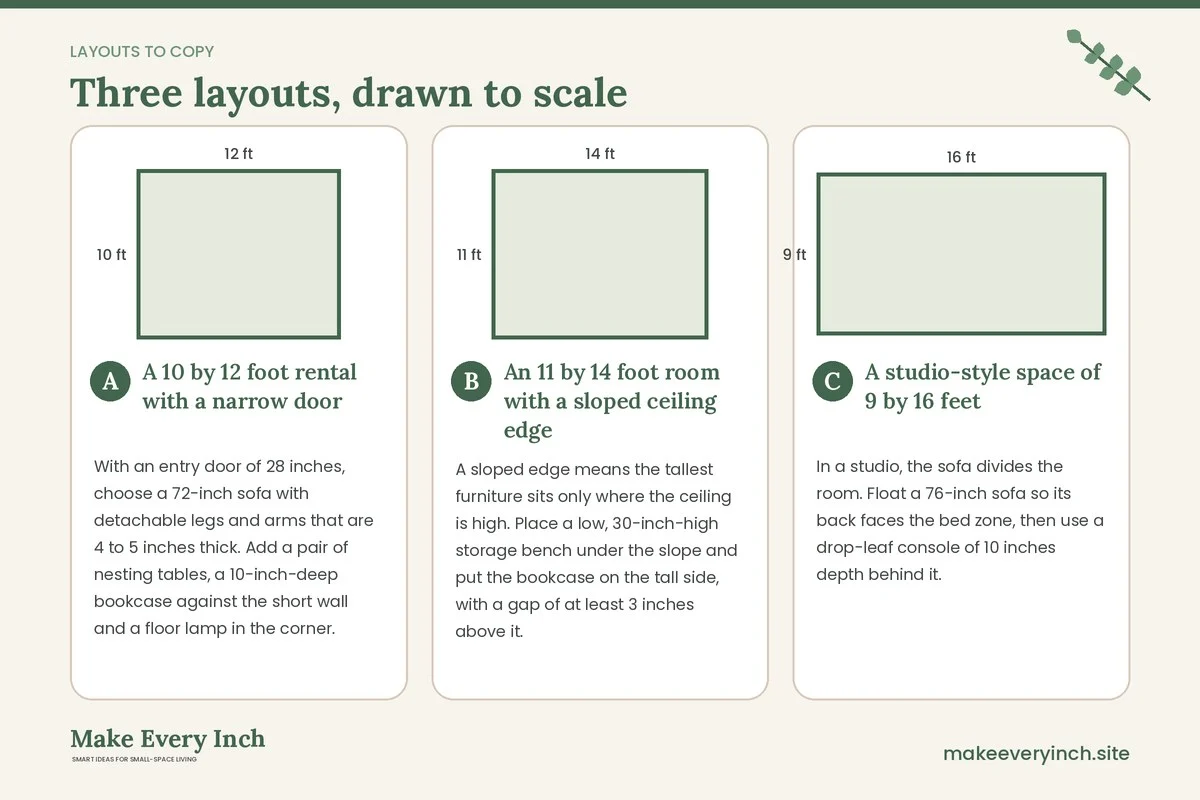
A 10 by 12 foot rental with a narrow door
With an entry door of 28 inches, choose a 72-inch sofa with detachable legs and arms that are 4 to 5 inches thick. Add a pair of nesting tables, a 10-inch-deep bookcase against the short wall and a floor lamp in the corner. The sofa sits along the longer wall, leaving a walkway of 36 inches. A 5 by 8 foot rug with a pad keeps the floor from being scratched, and a tray ottoman provides seating for a guest.
An 11 by 14 foot room with a sloped ceiling edge
A sloped edge means the tallest furniture sits only where the ceiling is high. Place a low, 30-inch-high storage bench under the slope and put the bookcase on the tall side, with a gap of at least 3 inches above it. A pair of armchairs forms a conversation corner, and a leaning shelf holds the books. The low bench keeps the sloped zone useful without banging heads.
A studio-style space of 9 by 16 feet
In a studio, the sofa divides the room. Float a 76-inch sofa so its back faces the bed zone, then use a drop-leaf console of 10 inches depth behind it. A folding screen at the end of the sofa makes a visual wall, and a cart serves as the bedside table on the other side. All of these pieces can be rearranged in the next home, and none needs a nail.
A move-out routine that protects the deposit
Treat the end of a lease as a series of small steps. Start two weeks before leaving by listing every piece you will take and its dimensions. Remove the felt pads, wipe the floor under each piece and look for marks. Photograph the floor and walls again once the room is empty. Reattach or replace any item you removed from the original furniture, such as curtain rods or light shades. Keep the packaging for fragile items, and keep the screws, keys and brackets for each piece in a labelled bag taped to it, so reassembly takes minutes.
If a mark appears on the floor, clean it with the method suggested for that flooring before the inspection. Do not use harsh chemicals on a finish you cannot identify. Our guide to security-deposit-safe apartment upgrades has more advice on keeping a deposit safe.
Common mistakes with renter furniture
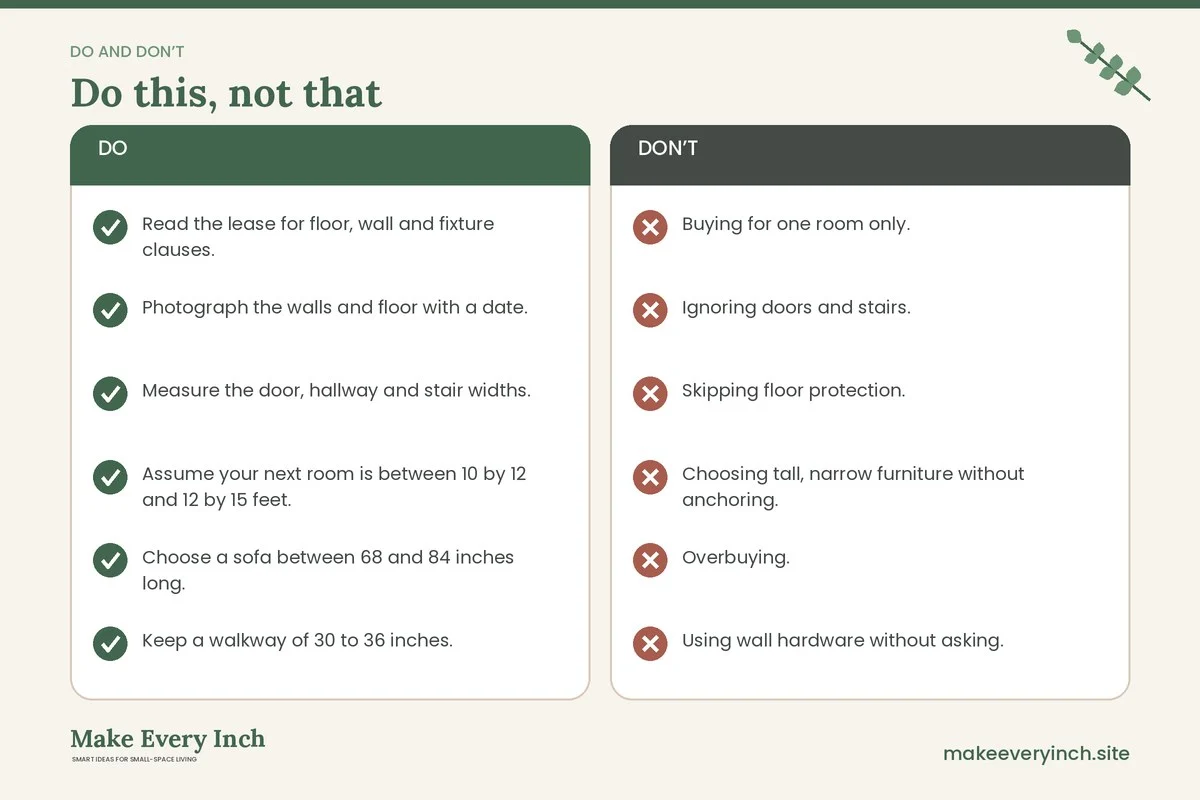
- Buying for one room only. A piece that fits perfectly today may not fit the next home. Aim for flexible sizes.
- Ignoring doors and stairs. A sofa that cannot come in is a very expensive mistake.
- Skipping floor protection. Scratches and dents are among the most common reasons for deductions.
- Choosing tall, narrow furniture without anchoring. If you cannot anchor, choose a lower unit.
- Overbuying. Every extra piece is something to carry, store or sell later.
- Using wall hardware without asking. Even a single screw can lead to a charge if the lease forbids it.
- Forgetting cords. A floor lamp or a charging station needs a cord path that does not cross the walkway.
Renter furniture checklist
- Read the lease for floor, wall and fixture clauses.
- Photograph the walls and floor with a date.
- Measure the door, hallway and stair widths.
- Assume your next room is between 10 by 12 and 12 by 15 feet.
- Choose a sofa between 68 and 84 inches long.
- Keep a walkway of 30 to 36 inches.
- Pick pieces with removable legs or modular parts.
- Fit pads on every leg and a pad under any rug.
- Choose a low, heavy-bottomed bookcase if you cannot anchor.
- Ask in writing before you attach anything to a wall.
- Keep screws and brackets in a labelled bag.
- Photograph the room again before you hand back the keys.
FAQ
What furniture is best for a small rental living room?
Compact, movable pieces work best: a sofa under 80 inches, nesting tables, a narrow bookcase, a floor lamp and a storage bench. They fit most rooms and leave no marks.
How do I protect a rental floor from furniture?
Use felt pads on wood and laminate, a rug pad under rugs and wide glides on vinyl. Check the pads every few months, and lift heavy furniture rather than dragging it.
Can I anchor a bookcase without damaging the wall?
Ask the landlord about a small screw into a stud, which can be patched later. If they refuse, choose a lower, heavier unit, use the corner of the room and consider an adhesive strap as a partial measure only.
How big a sofa can I fit through a normal door?
Many doors give a clear opening of 28 to 32 inches, so a sofa with removable legs and slim arms is easiest. Measure your own door, hallway and stairs first.
Is modular furniture worth it for renters?
Yes, because each block is easier to carry and can be rearranged for a new room. Check that the connectors are sturdy and that you can buy extra pieces later.
How do I make a rental living room feel less temporary?
Layer a rug, lamps and plants around the movable furniture. Our guide to small apartment living room ideas for renters shows how.
Keep going: Keep planning with our small living room ideas for renters, small living room storage ideas for renters and small living room layout ideas.
Save this guide for later
Pin the ideas you like to Pinterest so you can come back to them when you plan your space.