16 Small Living Room Ideas for Renters for Families
Quick answer: The best small living room ideas for renters for families combine freestanding storage, low and stable furniture, rounded edges and removable finishes. Keep a 36 inch main walkway, choose bookcases and TV stands that can be anchored, ask the landlord about small patchable holes, and use heavy low furniture, wall-friendly straps and shorter pieces where drilling is banned.
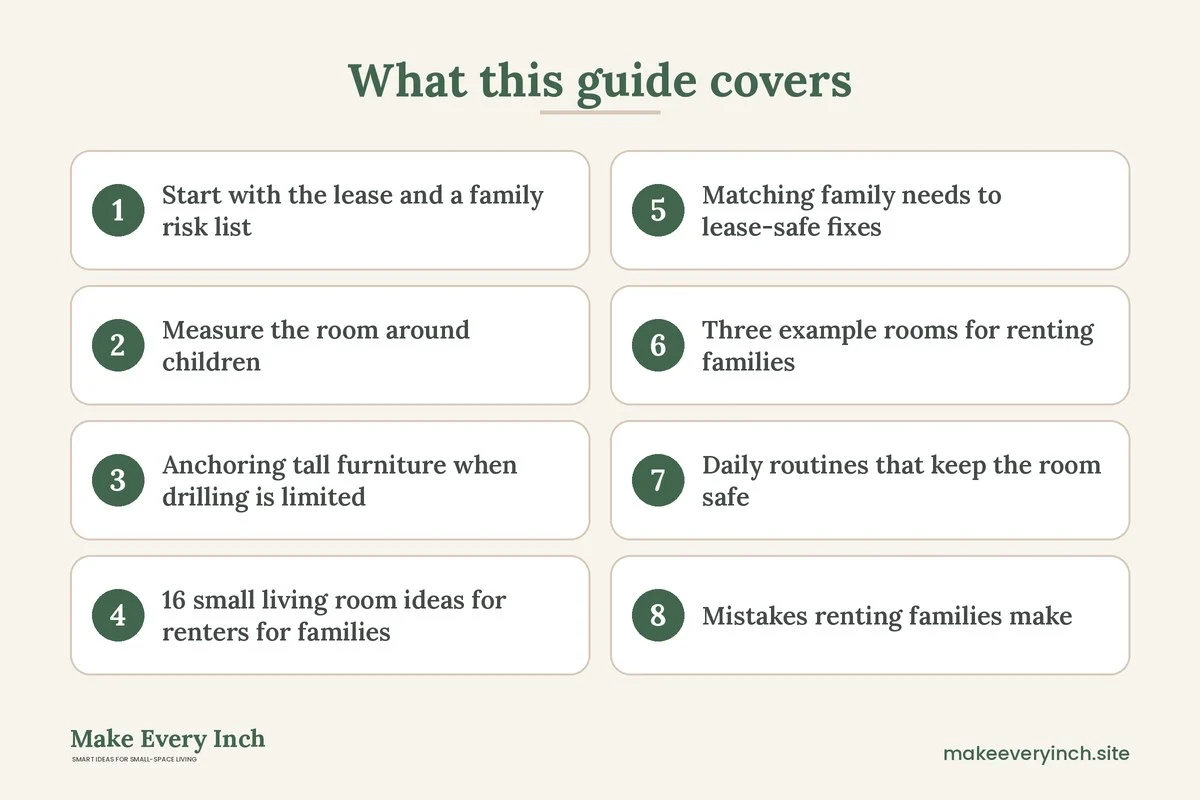
Small living room ideas for renters for families have to solve two problems at once. The room must hold toys, homework, a sofa and a TV in a space that may be only 10 by 12 feet, and every choice must be undone cleanly when the lease ends. Add small children and a third rule appears, which is that nothing can tip, pinch or trap. Most advice for renters assumes adults who can drill, hang and rearrange freely, and most advice for families assumes owners who can bolt a bookcase to a stud. This guide sits between the two. It covers the lease conversation, a safety-first measuring plan, 16 ideas, anchoring alternatives for tall furniture, a table that matches each family need to a lease-safe fix, example rooms, routines and a checklist. For the overall approach to rentals, start with our main guide to small living room ideas for renters, and keep the broader small living room ideas pillar nearby.
Start with the lease and a family risk list
Read three parts of the lease before you buy anything: the clause on wall alterations, the clause on damage and normal wear, and any rule about flooring coverage in apartments with neighbors below. Many leases that ban nails still allow small picture hooks, and many landlords will agree to a few anchor holes if you ask in writing and promise to patch them at move-out. A short email works well. Say that you have children, that you want to secure tall furniture to the wall for safety, that you will use a few small screws into studs, and that you will fill the holes before you leave. Keep the reply with your lease. Most landlords prefer a patched anchor hole to a tipped bookcase and an injury claim.
Then walk the room on your knees. Look at it at the height of a crawling baby and at the height of a four-year-old who climbs. List every hazard you can see: cords you can reach, heavy items on high shelves, sharp table corners, tall furniture with a narrow base, window cords, loose rugs and anything a child could pull down. Take photos of the walls and floors at the same time, since you will want proof of the original condition. This list drives the plan more than any style choice does, because a family room only works when it is safe first and pretty second.
Measure the room around children
Small rooms get tight fast when a play area is added. These numbers keep the room usable for adults and safe for kids, and they assume a typical rental living room of 10 to 12 feet wide and 12 to 15 feet long.
- Main walkway: 36 inches wide between the sofa and the opposite wall or media unit. This leaves room for an adult to carry a child, a laundry basket or a stroller.
- Secondary path: 24 to 30 inches to the window, balcony or bedroom hallway.
- Sofa depth: 32 to 36 inches for a family sofa. Deeper sofas steal floor space that a child needs for play.
- Play zone: about 4 by 5 feet of open floor, usually in front of the sofa. A rug of 5 by 8 feet defines it.
- Toy storage depth: 12 to 16 inches for open bins and low shelves, so they do not narrow the walkway.
- Low shelf height: no taller than 30 to 36 inches for anything a toddler might climb. Taller pieces need anchoring.
- TV stand height: 18 to 24 inches for a low media console, with the screen mounted or placed so that it cannot be pulled forward.
- Table clearance: at least 18 inches between a coffee table edge and the sofa seat for adult knees, and 12 inches of free floor beside it for a crawling child.
Mark these distances with painter’s tape on the floor and live with the tape for two evenings. If a parent bumps a corner, move the item. If a child has no space to sit and play, shrink the table or remove it. You can read more about floor planning in our guide to small living room layout ideas.
Anchoring tall furniture when drilling is limited
Safety experts and many consumer agencies recommend securing bookcases, dressers, TV stands and other tall or top-heavy furniture to a wall, because children climb and pull. In a rental, you have a ladder of options, and you should climb it in order.
Step one: ask for permission to anchor
Send the written request described above. Use small screws or the hardware that comes with the furniture, locate a stud with a stud finder, and keep the number of holes to two per piece. At move-out, fill each hole with spackle, sand it smooth and touch up the paint if the lease requires it. For many landlords this is a trivial repair. If the answer is yes, anchor every bookcase over about 30 inches tall, and every dresser and TV stand that could tip.
Step two: choose furniture that needs less anchoring
If drilling is refused, change the furniture instead of the wall. Choose pieces that are short, wide and heavy at the base. A low bookcase of 30 inches is far less likely to tip than a tall one of 72 inches. A bookcase with a solid back, a deep footprint and a base that is at least half as deep as the piece is tall is more stable than a narrow ladder shelf. Put the heaviest items on the bottom shelf and keep the top shelves for light things, such as baskets of soft toys. Our renter-friendly shelving guide covers more freestanding options.
Step three: use non-drilling stabilizers as a backup, not a substitute
Some products stick to the wall with adhesive or wedge between furniture and ceiling. Treat them as a partial measure. Adhesive straps depend on the wall surface, the paint and the weight, and a determined child can generate a strong pull. Check the weight rating on the packaging, follow the surface instructions, and never use them on the tallest, heaviest piece in the room. A tension-style post that presses between floor and ceiling is another option for a narrow tall shelf, as long as the ceiling is solid and the lease allows it. Ask yourself whether the piece needs to be tall at all.
Step four: remove the climbing incentive
Leave the top of any tall furniture empty, because toys and a TV on top invite climbing. Keep the lowest drawer or shelf as the heaviest. Never let drawers stay open, as children use them as steps. Put the TV on a low console, or mount it at a height your landlord approves rather than balancing it on a tall unit.
In short, the safest rental family room has few tall pieces, and the ones it has are anchored with the landlord’s agreement. If an item cannot be anchored and cannot be shortened, move it out of the room.
16 small living room ideas for renters for families
Storage that stands on its own
1. A low toy shelf under the window
A shelf of 24 to 30 inches under a window uses dead space and stays below climbing height. Choose one with a wide base and a solid back, and fill it with fabric bins that a child can pull out without tipping the unit.
2. A bench with bins at the entry side
A bench of about 16 inches deep with baskets below handles shoes, bags and toy overflow. It seats an adult putting on shoes and a child waiting for a turn. It also keeps clutter near the door, where it enters the room. See our post on small living room storage ideas for families for more.
3. A storage ottoman as table, seat and toy chest
A large ottoman replaces a hard-edged coffee table. Look for one with a soft top and a lid that closes slowly, and keep the hinge away from small fingers. Our list of storage ottomans explains what to check.
4. A rolling cart for crafts
A narrow rolling cart holds paper, crayons and glue. Park it by the sofa during homework time, then roll it into a closet or behind a door. Choose a cart with a lip and a locking wheel, so it does not roll on its own.
5. Baskets with a labeled system
Label bins with pictures for non-readers. A child who can find the blocks and put them back keeps the floor clear. Limit the number of bins to the shelf space you have.
Furniture that survives children
6. A sofa with washable covers
A sofa with removable, washable covers handles spills. Rented rooms often have light carpets or floors, so the sofa should be easy to clean. Check our guide to the best sofas for small apartments for size and depth to look for.
7. Rounded or soft-edged tables
Choose a round or oval coffee table, or a soft ottoman, so that a child running past meets a curve instead of a corner. In a tight room, a round table with a 30 to 32 inch diameter allows more movement than a square one.
8. Nesting tables instead of one big table
Nesting tables slide away to open play space and come out for snacks or homework. They stay stable because the heavy base holds the nested stack together.
9. A fold-away kids’ table
A small folding table with two stools can live behind the sofa or in a closet. It gives a child a spot for drawing and puzzles, and it disappears at bedtime.
Walls and floors without damage
10. A rug that grips
A rug of 5 by 8 feet defines the play zone, softens falls and protects floors. Use a non-slip pad, and choose a low-pile rug that strollers and toy cars can cross. Check the lease for flooring rules and avoid pads that can discolor certain floors.
11. Removable wallpaper in a small area
A peel-and-stick accent behind the sofa adds personality. Test a hidden spot first, and read our removable wallpaper ideas for tips. Avoid low areas where crayons and scuffs will reach it, or use a wipeable finish.
12. A kids’ gallery at child height
Frame drawings in lightweight frames and lean them on a shelf or hang them with adhesive strips rated for the weight. Hang them at about 36 to 42 inches from the floor so children can see their own art. This keeps the walls full without nails.
13. A cord-safe TV setup
Cords are a hazard and a clutter source. Use cord covers that stick on without damaging paint, bundle excess length, and keep power strips in a box or behind a heavy piece. The TV stand should be low, wide and heavy, with the TV set back from the edge.
Light, safety and comfort
14. Plug-in sconces and cord-managed lamps
A plug-in sconce frees the table surface and needs no wiring. Hide the cord with a channel, and keep it above child reach. See our guide to renter-friendly lighting ideas. Choose lamps with stable bases and shades that do not dangle.
15. Cordless window treatments
Cords on blinds are a known hazard for small children. Choose cordless blinds, or tension-rod curtains with the rod fixed high enough to stay out of reach. If the landlord supplies corded blinds, ask whether they can be swapped or the cords can be secured with a cleat set high on the frame.
16. A baby gate that fits without drilling
A pressure-mounted gate can protect a stairwell or a kitchen opening without drilling, as long as the instructions allow it for that location. Never use a pressure-mounted gate at the top of stairs. Where a gate would crowd a small room, consider a freestanding play yard that folds away.
Matching family needs to lease-safe fixes
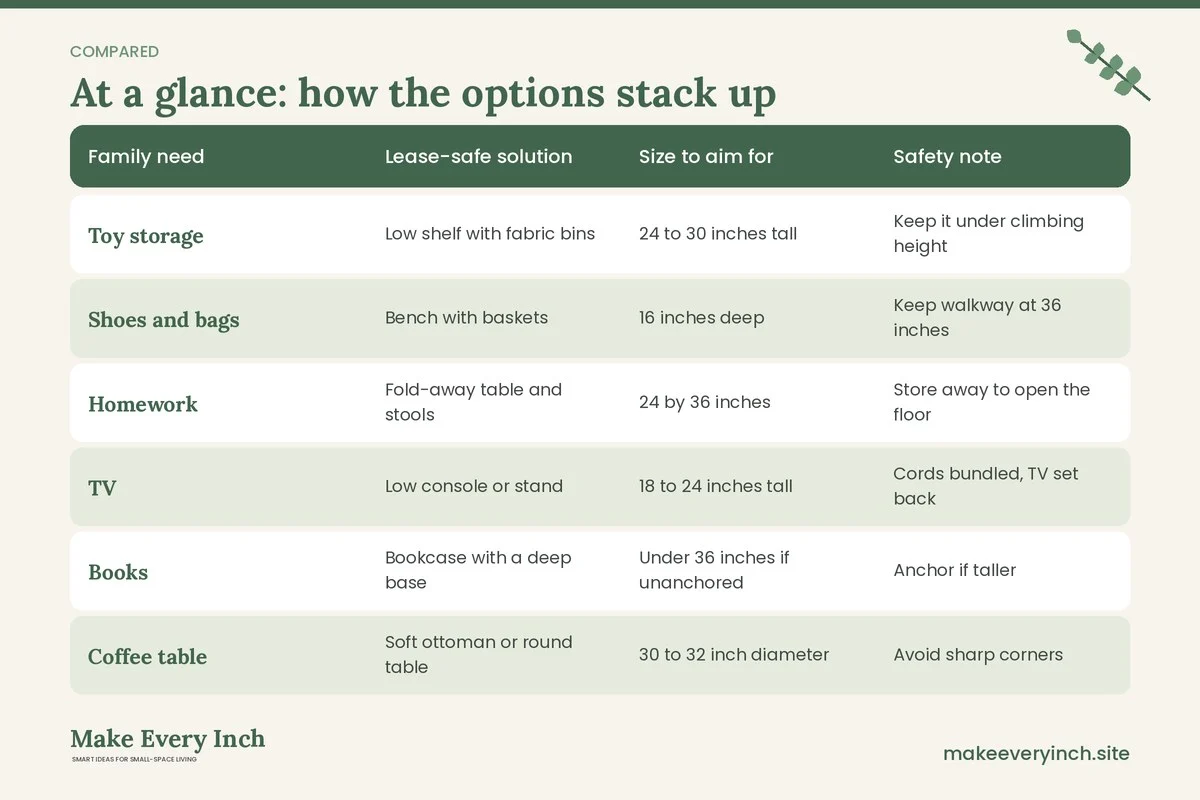
Use this table as a quick filter when you shop or rearrange.
| Family need | Lease-safe solution | Size to aim for | Safety note |
|---|---|---|---|
| Toy storage | Low shelf with fabric bins | 24 to 30 inches tall | Keep it under climbing height |
| Shoes and bags | Bench with baskets | 16 inches deep | Keep walkway at 36 inches |
| Homework | Fold-away table and stools | 24 by 36 inches | Store away to open the floor |
| TV | Low console or stand | 18 to 24 inches tall | Cords bundled, TV set back |
| Books | Bookcase with a deep base | Under 36 inches if unanchored | Anchor if taller |
| Coffee table | Soft ottoman or round table | 30 to 32 inch diameter | Avoid sharp corners |
| Walls | Adhesive strips and leaned art | Hang at child height | Test strips first |
| Windows | Cordless blinds or high rod | Full window width | No cords within reach |
| Floor | Non-slip rug pad | 5 by 8 feet | Check lease for floor rules |
Three example rooms for renting families
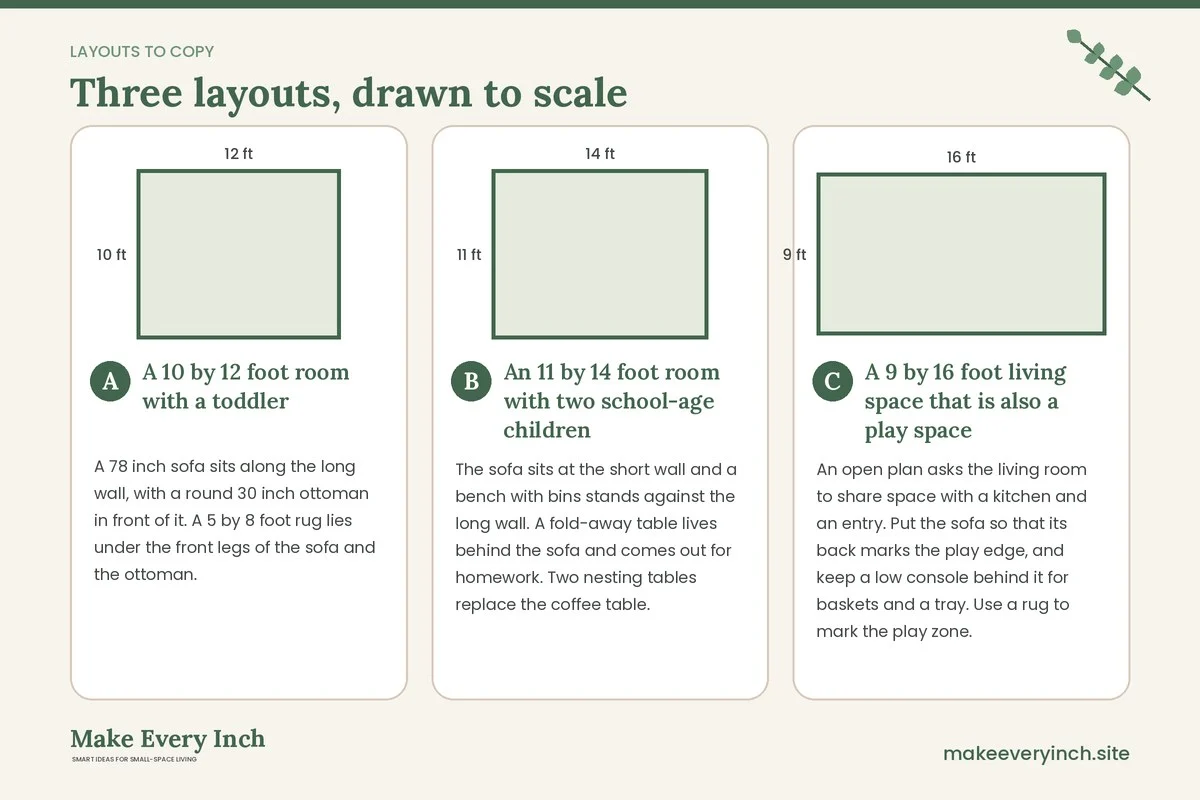
A 10 by 12 foot room with a toddler
A 78 inch sofa sits along the long wall, with a round 30 inch ottoman in front of it. A 5 by 8 foot rug lies under the front legs of the sofa and the ottoman. A low toy shelf of 28 inches sits under the window, and a wall-mounted TV or a low console with a TV stands opposite, leaving about 36 inches of walkway. A single plug-in sconce lights the sofa end. No furniture over 36 inches is in the room except a coat stand near the door, which is bolted in only if the landlord agrees.
An 11 by 14 foot room with two school-age children
The sofa sits at the short wall and a bench with bins stands against the long wall. A fold-away table lives behind the sofa and comes out for homework. Two nesting tables replace the coffee table. A bookcase of 48 inches stands in the corner and is anchored to a stud with the landlord’s permission, with the heavy books on the bottom shelf. A cart on wheels holds crafts and slides into a closet at night. The rug covers 5 by 8 feet and keeps the play area clear.
A 9 by 16 foot living space that is also a play space
An open plan asks the living room to share space with a kitchen and an entry. Put the sofa so that its back marks the play edge, and keep a low console behind it for baskets and a tray. Use a rug to mark the play zone. Anchor nothing, because nothing in the room is taller than 36 inches. Hang art at child height with adhesive strips and keep a 30 inch route to the kitchen.
Daily routines that keep the room safe
A safe family room depends on habits as much as furniture. These routines take minutes and stop the room from drifting back into clutter.
- The ten-minute reset: before dinner or bed, everyone puts toys back in labeled bins. Toys on the floor are tripping hazards for tired adults.
- The weekly safety sweep: once a week, check that drawers are closed, cords are tucked, anchors are tight and nothing heavy sits on a high shelf.
- A toy rotation: keep only a third of the toys in the living room and store the rest in a closet or under a bed. Rotate them every few weeks so they feel new, and the room stays calmer.
- A guest reset: before friends visit, move the play items to one corner and bring out the extra seating.
- A move-out folder: keep the lease, the written approvals and the photos in one place, so that patching and cleaning at the end are simple.
Mistakes renting families make
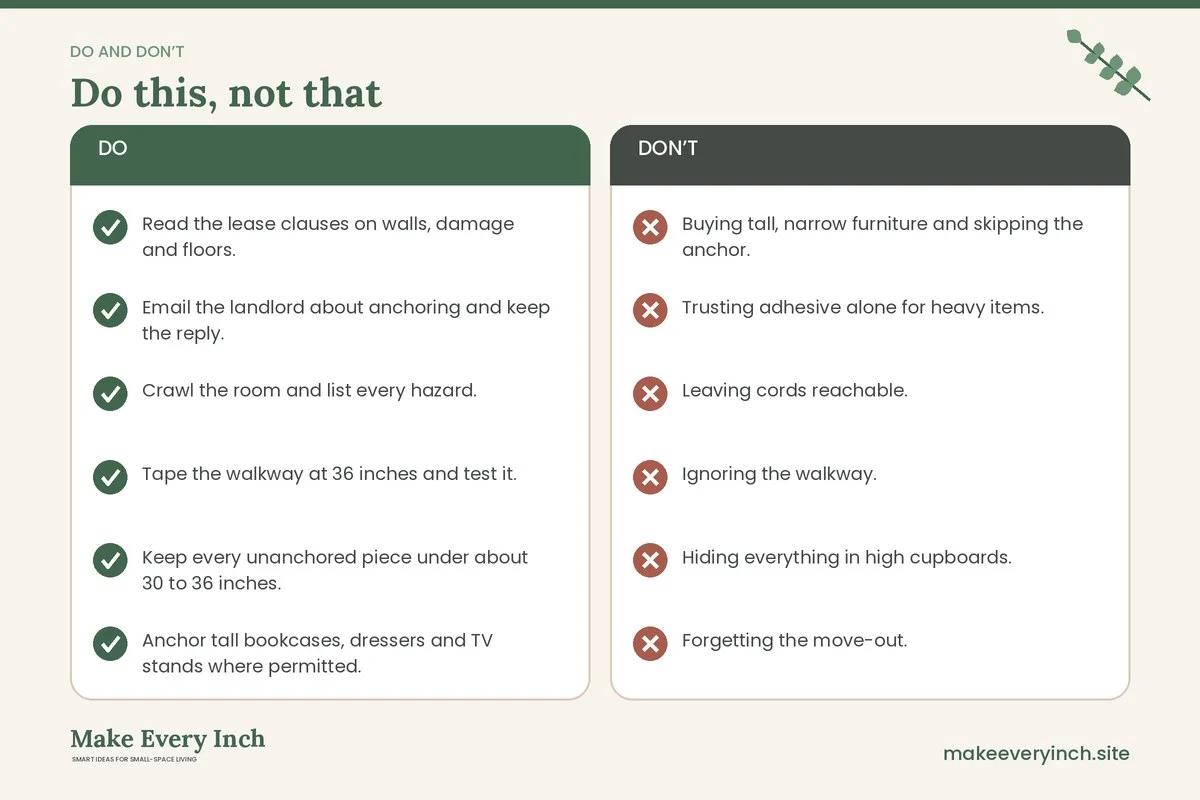
- Buying tall, narrow furniture and skipping the anchor. The risk is a tipped unit. Choose shorter pieces or ask for permission to anchor.
- Trusting adhesive alone for heavy items. Strips suit light frames, not bookcases.
- Leaving cords reachable. Window cords and power cords are hazards, so tidy them before anything else.
- Ignoring the walkway. A room that is full of toys fails the moment a child runs, so keep the 36 inch path.
- Hiding everything in high cupboards. If a child needs a stool to reach it, the stool becomes a climbing hazard.
- Forgetting the move-out. Keep receipts, hardware and photos, since a clean exit protects the deposit. Our guide to security-deposit-safe apartment upgrades is a useful companion.
Budget and shopping approach
You do not need to buy a whole room at once. Spend first on safety items, such as anchors, cordless blinds and a stable low shelf, then on comfort, such as a rug and a washable sofa cover, and last on decoration. Second-hand shops and online marketplaces are good sources of solid wood furniture that has already survived children, but check each piece for stability, sharp edges and missing hardware. Avoid anything with wobbly legs or damaged joints. Measure before you buy, and consider whether a piece can be moved by one person, since a rental family moves often.
Family renter checklist
- Read the lease clauses on walls, damage and floors.
- Email the landlord about anchoring and keep the reply.
- Crawl the room and list every hazard.
- Tape the walkway at 36 inches and test it.
- Keep every unanchored piece under about 30 to 36 inches.
- Anchor tall bookcases, dressers and TV stands where permitted.
- Put the heaviest items on the lowest shelf.
- Bundle and cover cords, and use cordless window treatments.
- Choose rounded or soft table edges.
- Lay a non-slip rug pad under a 5 by 8 foot rug.
- Label toy bins with pictures.
- Plan a ten-minute reset each evening.
- Keep photos, approvals and hardware for move-out.
FAQ
How can I anchor a bookcase if my landlord says no drilling?
First ask in writing, since many landlords agree to two small screws that you fill at move-out. If the answer is no, choose a shorter, heavier bookcase of about 30 inches, keep heavy items low, and leave the top empty. Adhesive straps can be a partial extra, but they are not a full substitute for a screw into a stud.
Is it safe to use adhesive strips for family photos and art?
Yes for light frames, as long as you follow the weight rating and the surface instructions. Do not use them for shelves, mirrors above a child’s play area or anything heavy enough to hurt if it fell.
What is the best coffee table for a small rental living room with a toddler?
A soft ottoman or a round table with a diameter of 30 to 32 inches. Both avoid sharp corners and can be moved aside for play.
How much floor space does a child need to play in the living room?
About 4 by 5 feet of clear floor is a good starting point for a young child, plus a 36 inch walkway for adults. A 5 by 8 foot rug marks the zone.
How do I childproof a rental without damaging the walls?
Use freestanding storage, cord covers, cordless blinds, pressure-mounted gates where the instructions allow, and furniture that is stable by design. For anything that needs a screw, ask the landlord. Our guide to no-drill storage ideas for renters gives more options.
Can I use a rug in an apartment with neighbors below?
Often yes, and a rug helps with noise. Check the lease for flooring coverage rules, since some buildings require a certain percentage of hard floor to be covered.
Keep going: Keep planning with our small living room ideas, small apartment living room ideas for families and small living room furniture ideas for families.
Save this guide for later
Pin the ideas you like to Pinterest so you can come back to them when you plan your space.