Small Home Organization for Busy People
Quick answer: Small home organization for busy people works when it asks for almost no effort. Build decision-free zones where every item has one obvious home, use 5-minute resets at fixed moments of the day, choose open or lidless containers so tidying takes one motion, and keep a single weekly 20-minute routine to catch what slipped. Fewer rules, fewer steps and fewer categories beat a perfect system you cannot maintain.
Small home organization for busy people is a different problem from small home organization for people with free weekends. If you work long days, care for others or simply have a full calendar, you do not need a color-coded system with forty labeled bins. You need a home where the mess cannot grow very large, and where putting something away takes less time than leaving it out. In a small space this matters even more, because a few stray items change how the whole room looks and feels. This guide shows how to build that kind of home. It covers the busy-person mindset, the 5-minute reset, decision-free zones, low-maintenance storage rules, a weekly 20-minute routine, a comparison table, three example homes, common mistakes, a checklist and a FAQ. For the wider topic, read our pillar guide on small space organization ideas, and for a no-spend approach see the companion post on small home organization without buying bins.
Why busy homes fall apart (and why it is not your fault)
Most organizing advice assumes you have time to sort, buy, label and maintain. A busy person has about ten spare minutes at a time, and often fewer. When a system needs more than that to maintain, it quietly fails. The failure is rarely about discipline. It is about friction.
Friction is the number of steps between you and a tidy result. Hanging a coat on a hook is one step. Opening a closet, finding a hanger, sliding the coat on it and closing the door is four. At the end of a long day, four steps loses to zero steps, and the coat goes on the chair. Once the chair is full, the pile attracts more. A small home shows the effect quickly, because there are fewer flat surfaces to absorb the overflow.
So the goal is not to be more disciplined. The goal is to remove steps from the actions you repeat every day, and to cut the decisions that slow you down. Two ideas do most of the work: the 5-minute reset, which catches the daily drift, and the decision-free zone, which removes the question of where things go.
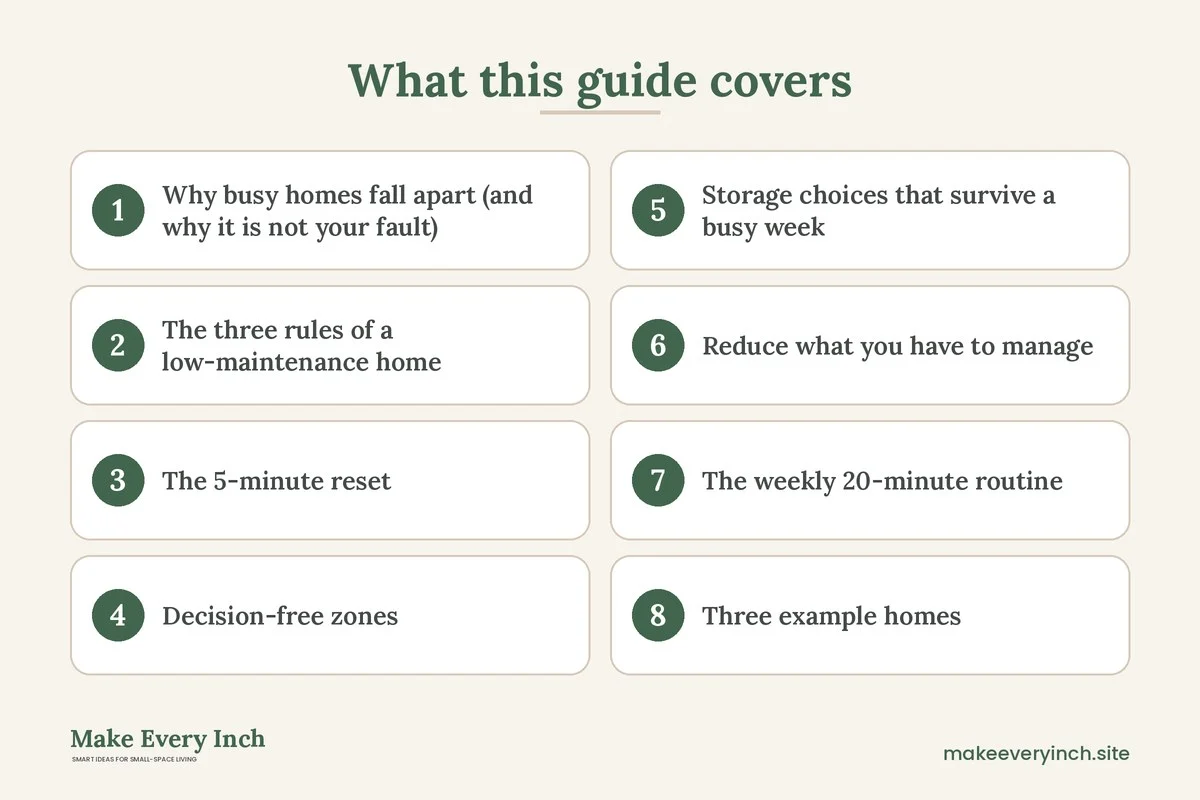
The three rules of a low-maintenance home
Rule 1: One home per item
Every item you use weekly needs exactly one place. Not two, not “somewhere in the hall.” When an item has two homes, you waste a second deciding, and the item ends up in neither. Walk through your home and pick the one place for keys, wallet, charger, mail, glasses, bag, umbrella, scissors, tape and the remote. Write the list on a note if it helps.
Rule 2: Store near where you use it
Put things at the point of use, not where they would look neat. Cleaning spray belongs under the sink where you clean, and the bin for recycling belongs next to where the packaging appears. A good test is to ask where you would drop the item if you had your hands full. Build the home there.
Rule 3: Fewer steps beat better looks
Choose open baskets over lidded boxes for things you use daily, hooks over hangers for the coat you wear every day, and a shelf over a drawer for the pan you cook with every night. Save the lids, the drawers and the labels for items you reach for less than once a week. A beautiful system that takes four steps will fail. A plain system that takes one step will survive.
The 5-minute reset
The 5-minute reset is a short, fixed routine that returns a room to its baseline. It works because it is small, repeatable and tied to something you already do. You do not need to finish a project. You need to put the room back where it started.
How to run a reset
Set a timer for five minutes, or use a song as the clock. Start at the door and move in one direction around the room. Do three things only: carry stray items to their home, throw away obvious trash and clear flat surfaces. Do not sort, do not reorganize and do not start a second task. When the timer ends, stop, even if you are not finished. Stopping on time is what makes the habit easy to start tomorrow.
When to reset
Tie each reset to an existing trigger, so you never have to remember it.
- Morning reset (5 minutes): after the coffee or while the kettle heats. Make the bed, clear the counter and put the dishes away.
- Arrival reset (2 minutes): when you get home. Hang the coat, set the bag in its spot and put the keys in the bowl.
- Evening reset (5 minutes): after dinner. Wipe the table, load the dishwasher or rack, return the remote and fold the throw.
- Bedtime reset (3 minutes): before sleep. Put the clothes in the hamper, set out tomorrow’s outfit and charge the phone.
You do not need all four on day one. Start with the one that bothers you most, such as the evening reset if you wake up to a messy kitchen. After two weeks, add another.
The reset checklist
Keep it short and visible. Many people keep it as a note on the inside of a cabinet door.
- Surfaces: clear the table, the counter and the nightstand.
- Floor: pick up shoes, bags and laundry.
- Dishes: put them in the dishwasher or the rack.
- Trash: empty the small bin if it is full.
- Reset one soft item: fold a throw or straighten a cushion.
Decision-free zones
A decision-free zone is a small area where every item has an obvious home, so tidying needs no thought. You build it once and then use it automatically. In a small home, five or six zones cover most of daily life.
The landing zone
This is the first place your things land when you enter. Use a hook for each person, a tray or bowl for keys and wallet, a small basket for mail and a spot for shoes. If you have no entryway, a wall beside the door or the back of the door will do. Keep the zone to what you handle every day. See our guide to small entryway organization and the post on small coat storage ideas for layouts.
The charging zone
Pick one outlet or power strip and one surface. Keep chargers plugged in there, with a tray or shelf for phones and devices. Never run cords under rugs, and do not overload a power strip. Use a strip with a built-in surge protector, check its rating and leave space around it for air. A single charging zone stops cables from spreading to every room.
The paper zone
Mail is a common source of clutter. Create one tray or a vertical file for incoming mail, and one folder for items that need action. Open mail at the same time every week, recycle the junk on the spot and scan or file the rest. If an item needs action in under two minutes, do it right away.
The cleaning zone
Keep the five items you use most in one caddy or on one shelf: an all-purpose spray, a few cloths, a small brush, a dish soap and a roll of paper towels. Store the caddy where you clean most often. When supplies are in one place, a quick wipe becomes possible. Read the labels, store products away from heat and never mix cleaners. Keep them out of reach of children and pets, and ventilate when you use them.
The laundry zone
A hamper in the room where you undress saves a trip. If you have a small laundry area, see our post on small laundry room organization. Two compartments, one for darks and one for lights, remove the sorting step later.
The kitchen zone
Group items by task, not by type. Keep coffee supplies together, baking supplies together and lunch-packing supplies together. For ideas on drawers and cabinets, read small kitchen organization ideas and small kitchen drawer organization ideas.
Storage choices that survive a busy week
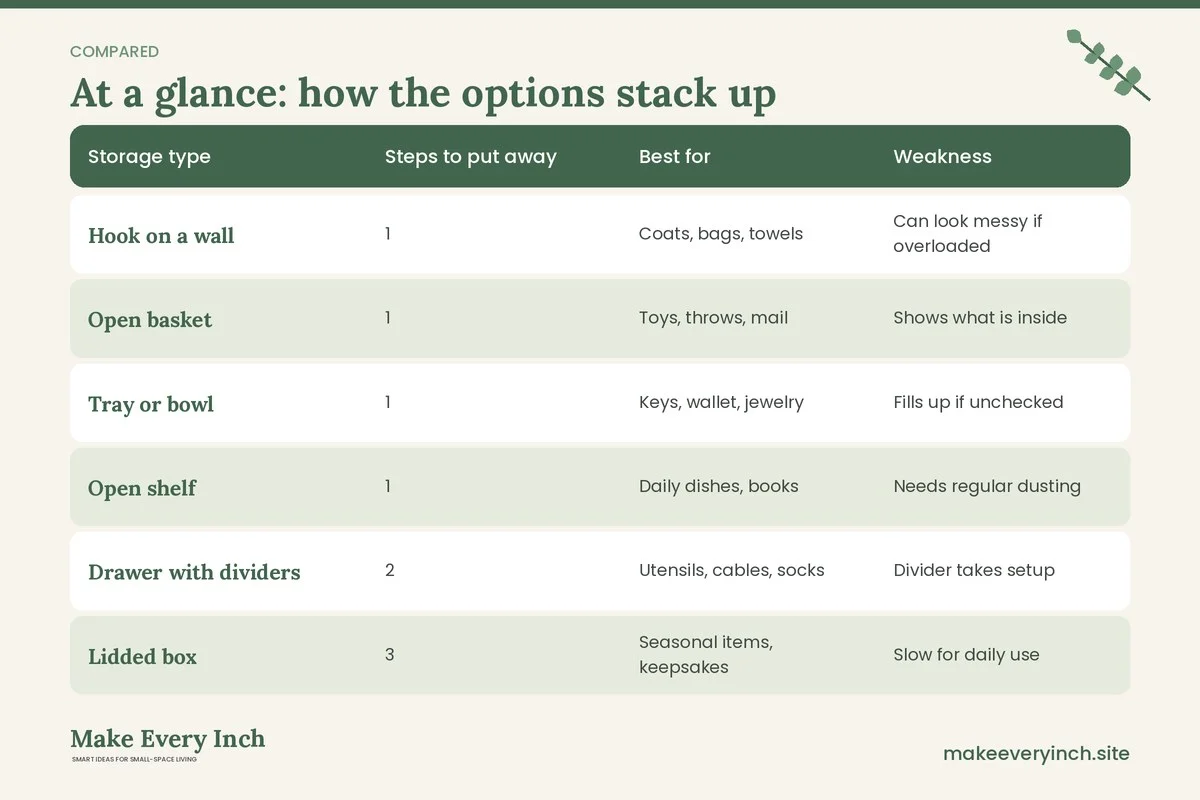
The best storage for a busy home is fast to use and forgiving about mistakes. This table compares common options by effort, not by looks.
| Storage type | Steps to put away | Best for | Weakness |
|---|---|---|---|
| Hook on a wall | 1 | Coats, bags, towels | Can look messy if overloaded |
| Open basket | 1 | Toys, throws, mail | Shows what is inside |
| Tray or bowl | 1 | Keys, wallet, jewelry | Fills up if unchecked |
| Open shelf | 1 | Daily dishes, books | Needs regular dusting |
| Drawer with dividers | 2 | Utensils, cables, socks | Divider takes setup |
| Lidded box | 3 | Seasonal items, keepsakes | Slow for daily use |
| Closet with hangers | 3 to 4 | Occasional clothes | Slow, so clothes pile up |
The pattern is clear: the more steps, the more likely the item ends up on a chair. Use one-step storage for daily items and multi-step storage for rare ones.
Sizes that make tidying easy
A few measurements help. Hooks mounted at 60 to 66 inches from the floor suit most adults, and a second row at 40 to 48 inches suits children. A basket under a console should be at least 2 inches narrower than the shelf opening so it slides in and out. A drawer divider should leave about a quarter inch of free space on each side so items do not jam. Keep the daily shelf between knee and shoulder height, which is the easiest range to reach without bending or stretching.
Reduce what you have to manage
A busy person cannot maintain a large collection. The easiest way to organize faster is to own less of the items that take up the most time. This does not mean a strict purge. It means a few small cuts.
- Duplicates: keep one or two of everyday tools. Five spatulas rarely help.
- Almost-empty products: use them up or toss them. They fill drawers.
- Clothes that need ironing or special care: if you never wear them, let them go.
- Free items: promotional bags, extra mugs and tote bags multiply quickly. Keep a fixed number.
- Paper: go digital for bills, manuals and receipts when you can.
Use the one-in, one-out rule for categories that tend to grow, such as mugs, tote bags and shoes. When something comes in, something leaves. For a deeper approach to clearing, see our small apartment decluttering ideas.
The weekly 20-minute routine
The reset handles daily drift. The weekly routine handles the slow build-up that daily resets miss. Pick a regular time, such as Sunday afternoon or Thursday evening, and set a 20-minute timer. Split the time into four blocks of five minutes.
1. Surfaces and floor (5 minutes): clear the dining table, the desk and the hall, then run a vacuum or a broom over the main walkway.
2. Fridge and pantry (5 minutes): toss expired food, wipe one shelf and note what you need to buy.
3. Laundry and bedding (5 minutes): start a load, change the sheets if it is their week and return clean clothes to their homes.
4. Paper and plans (5 minutes): open the mail, check the calendar, set out what you need for the week and take out the recycling.
If you have more than one person at home, assign blocks: one person takes blocks one and two, and the other takes three and four. Do it together with music, and the routine feels shorter. Do not extend the timer. If a block uncovers a bigger job, such as a closet that needs sorting, write it on a list for a later day.
The monthly extra (optional)
Once a month, add 15 minutes for one small zone: a drawer, a shelf or a cabinet. Empty it, wipe it, put back only what you use and donate the rest. Rotate through the zones over the year. Small, regular passes stop the need for a big weekend overhaul.
Three example homes
Example 1: A studio apartment, one person
The studio has one main room and a small kitchen. The owner works long hours and eats out often. The setup has a landing zone with two hooks, a tray and a shoe mat at the door. A charging shelf sits next to the bed, with a lamp. Open shelves in the kitchen hold daily plates, and a lidded bin under the sink holds cleaning supplies. The 5-minute morning reset covers the bed and the counter, and a weekly 20-minute reset covers the fridge and laundry. Because the room is small, a single basket by the sofa holds the throw and the remote. The result is a home that is rarely more than five minutes from tidy.
Example 2: A one-bedroom apartment, a couple with unpredictable schedules
The couple shares the space but rarely shares the same hours. The landing zone has a hook and a tray for each person, so nothing mixes. A shared paper tray sits on the console, and mail is opened on Sunday. The kitchen has task zones for coffee and lunch-packing. The evening reset takes five minutes and is done by whoever is home first. The weekly routine is split: one takes the fridge and surfaces, the other takes laundry and paper. The key is that each person has their own one-step spots, so they never need to ask where something goes.
Example 3: A two-bedroom apartment, a parent with a young child
Daily life includes toys, bags, school papers and snacks. The child has a low hook at 40 inches and an open bin at floor level for toys, so cleanup is a toss, not a sort. A rotating basket holds school papers until Friday, when they are filed or recycled. The 5-minute reset happens right before bath time, and the child helps by carrying toys to the bin. The weekly 20-minute routine includes a quick check of the child’s clothes bin and the pantry for lunches. Anchor any tall shelves or dressers to the wall using the hardware the manufacturer provides, and ask your landlord before drilling in a rental. See no-drill storage ideas for renters for options.
Common mistakes busy people make
- Buying containers before sorting. Containers hold clutter in a prettier way. Remove the excess first.
- Creating too many categories. More categories mean more decisions. Use broad groups.
- Choosing hard-to-reach storage. If you must move three things to reach a box, you will not use it.
- Skipping the reset because the room is a mess. A five-minute pass always helps, even if it does not finish the job.
- Organizing everything at once. A weekend overhaul burns energy. Do one zone at a time.
- Ignoring other people. Systems fail when housemates do not know the homes. Walk everyone through the zones once.
- Overfilling shelves. Leave about 20 percent empty space so putting things away is easy.

Smart upgrades that save time
You do not need to buy anything, but a few low-cost changes remove steps. Add a second row of hooks near the door. Place a small basket at the bottom of the stairs or the end of the hall for items that need to travel to another room. Use a lazy-susan style turntable in a cabinet so you can see everything at once. Add an over-the-door organizer for shoes, cleaning supplies or accessories. Put adhesive hooks inside cabinet doors for lids and cloths, and check their weight rating first. For more vertical options, see our guide to vertical storage ideas and the ideas for cheap storage in apartments.
Safety notes
Anchor tall furniture such as bookcases and dressers to the wall, particularly if children or pets live with you. Do not overload outlets or power strips, and keep cords out of walkways. Never drill into walls without permission from your landlord or building owner. When you clean or paint, ventilate the room and choose low-VOC products where you can. Keep heavy items on lower shelves and out of reach of small children.
Bedroom, kitchen and bathroom in five minutes
Bedroom
Make the bed, put clothes in the hamper and clear the nightstand. Keep a basket for the day’s strays. For more ideas, see small bedroom organization ideas and under-bed storage ideas.
Kitchen
Clear the counter, wipe the stove and the sink and put dishes away. Keep a small bin for the compost or trash within reach of the prep area. For counter ideas, read small kitchen counter organization.
Bathroom
Keep the daily products in a single caddy or on one tray, wipe the sink and hang the towel. Our post on small bathroom organization ideas shows how to use the walls and the back of the door.
Habit stacking: link tidying to what you already do
Habit stacking means attaching a new task to an existing one. It removes the need for reminders. Some examples: while the coffee brews, empty the dishwasher. While the shower warms, hang the towel and wipe the sink. While dinner cooks, wipe the counter. While you wait for a video call to start, put away three items. After you brush your teeth, put the clothes in the hamper. The task takes a minute or two and rides on a trigger that already happens every day.
If you live with others, agree on the stacks. For example, whoever cooks does not clean, and whoever finishes eating clears their plate. Clear, simple rules prevent arguments and keep the load even.
Your first week plan
Day 1: pick the landing zone and put up hooks. Day 2: set up the charging zone. Day 3: sort the mail and create a paper tray. Day 4: set the cleaning caddy. Day 5: try the evening reset for five minutes. Day 6: try the weekly 20-minute routine. Day 7: adjust. Whatever did not work, change it. Whatever worked, keep. The point is not to finish, but to build a rhythm.
Busy-home checklist
- Name one home for keys, wallet, phone and bag.
- Install hooks at the door at the right heights.
- Set up a charging zone with one power strip.
- Create a paper tray and open mail weekly.
- Keep a cleaning caddy where you clean.
- Choose one-step storage for daily items.
- Leave 20 percent of each shelf empty.
- Pick a morning, arrival or evening reset.
- Set a weekly 20-minute timer.
- Apply one-in, one-out to mugs, bags and shoes.
- Anchor tall furniture to the wall.
- Review the system after one month.
FAQ
How do I organize a small home when I have almost no time?
Start with one zone, the landing zone near the door, and one 5-minute reset in the evening. These two changes remove most daily clutter. Add the weekly 20-minute routine once the reset feels automatic.
What is the fastest way to tidy a small home?
Move in one direction around the room, put items in their homes, throw away trash and clear flat surfaces. Do not sort or reorganize during a quick reset. A timer helps you stop on time.
Should I use labels?
Use labels for items that are shared or rarely used, such as seasonal boxes and pantry bins. For daily items, the shape of the zone should make the home obvious. If everyone knows where things go, labels are optional.
How do I get my family or housemates to follow the system?
Walk through the zones together once, keep the rules simple and give each person a one-step spot. Make the routine a shared event with music. Children respond well to low hooks and open bins.
Is open storage messy in a small home?
It can be, if it is overloaded. Open storage works well for daily items if you limit what goes in and keep the contents consistent. Use lidded boxes for the things you do not want to see.
How often should I declutter?
A short monthly pass on one zone is enough for most people. Add a larger pass when seasons change or when you move. See organization ideas for renters for options that move with you.
What if I fall off the routine?
Restart with the smallest version: one 5-minute reset in the evening. Do not try to catch up. A missed week does not undo the system, because the zones still make things easy to put back.
Keep going: Keep going with our small space organization ideas, small home organization without buying bins and small apartment decluttering ideas.
Save this guide for later
Pin the ideas you like to Pinterest so you can come back to them when you plan your space.