Small Entryway Organization for Families
Quick answer: Small entryway organization for families works best when each person gets a personal station (a hook at their own height, a cubby or bin and a shoe spot), backpacks follow a one-way flow from door to hook, and a short routine keeps it running. Mount kid hooks at 36 to 48 inches depending on age, keep 30 to 36 inches of clear floor, and anchor every tall piece to the wall.
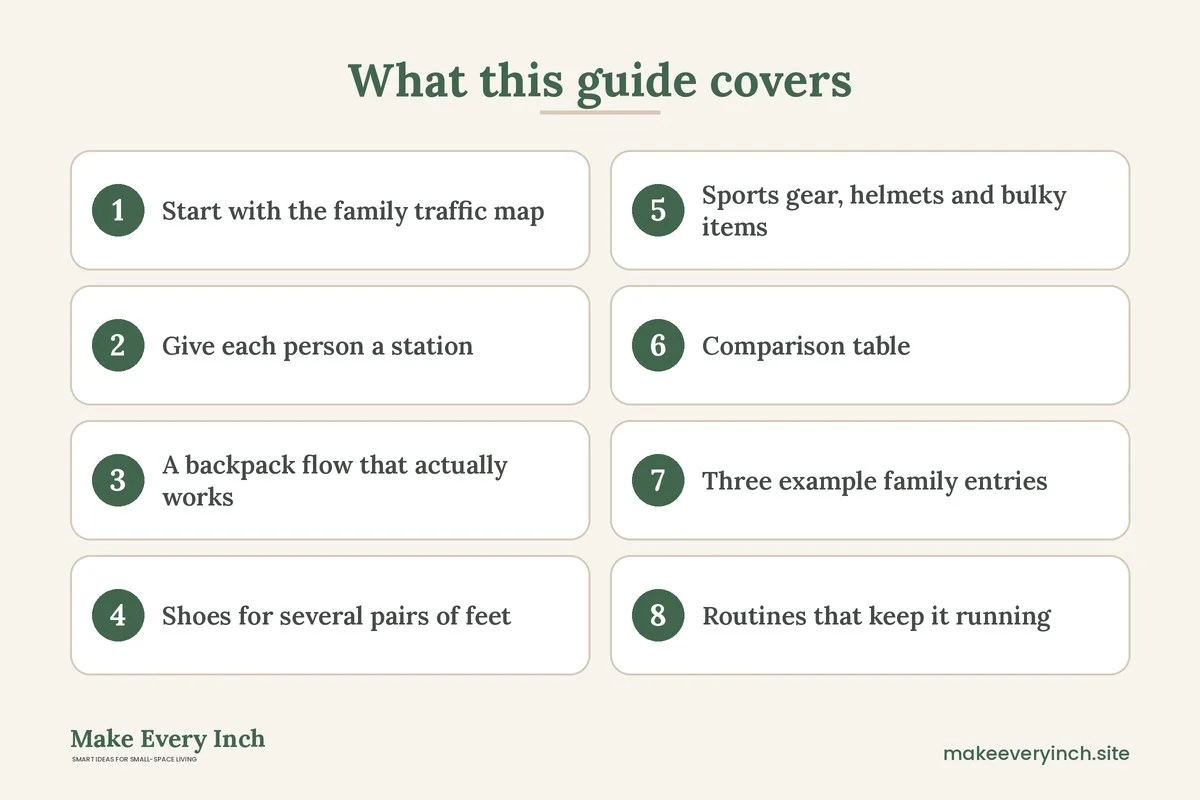
Small entryway organization for families is a different puzzle from organizing an entry for one or two adults. A family multiplies everything: coats, shoes, bags, helmets, lunch boxes, permission slips and the number of people trying to leave through one door at 7:45 in the morning. The goal is not a showpiece. It is a system that children can use without help, that adults can reset in two minutes and that survives a week of rain. This guide covers how to give each person a station, how to size hooks and cubbies for different ages, how to design a backpack flow, how to store shoes and sports gear, and which routines keep it going. It also includes safety rules for anchoring furniture and keeping little hands away from hazards. For a general look at the topic, see our main guides on small entryway organization and small entryway ideas, and the wider post on small home organization for families.
Start with the family traffic map
Before buying bins, spend three days watching what actually happens at the door. Note who comes in and out, in what order, with what, and where each thing lands. Most families discover that the mess has a pattern. The backpacks drop where the kids first stop. Shoes pile where the door opens. Keys, mail and sports gear land on the nearest flat surface.
Draw a rough sketch of your entry and mark three spots: where people take shoes off, where they put down bags, and where they hang coats. In a good layout these happen in a line, in the order people move: shoes, then coats, then bags, then into the house. If your sketch shows a loop or a crossing, change the layout so each person moves one way.
Also list the household’s gear by person. A child might have a coat, a rain jacket, school shoes, sports shoes, a backpack, a lunch bag, a water bottle and a helmet. An adult might have a work bag, a gym bag and keys. Count the items that must be in the entry at once. That count sets your storage size, and it often turns out smaller than you feared, because many items can live elsewhere.
Give each person a station
The core idea in family entries is the station: a small, labeled zone that belongs to one person. A station usually has a hook, a bin or cubby and a shoe spot. Stations work because they answer the question “where does this go?” before it is asked, and because each person can be held responsible for a defined space.
Plan a station width of 10 to 14 inches per child and 14 to 18 inches per adult when using a bench or cubby unit. A hook rail needs 6 to 8 inches per person for coats and bags. For a family of four, a total width of 48 to 72 inches handles it comfortably. If you have less, make the stations vertical: a hook above, a bin below.
Hook heights by age
Hook height decides whether a child can do it alone. These are rough ranges, and you should adjust for your own children by having them stand against the wall and reach naturally.
- Toddlers (about 2 to 3 years): 28 to 36 inches. Use a rounded, soft-edged hook so a fall is not dangerous.
- Preschoolers (about 3 to 5 years): 34 to 42 inches.
- Early school age (about 6 to 8 years): 40 to 48 inches.
- Older children (about 9 to 12 years): 48 to 56 inches.
- Adults: 60 to 66 inches.
Mount one row for adults and a lower row for children, or stagger the heights on a single board. Kids grow quickly, so choose a system where you can move hooks. A rail with slots or a pegboard strip lets you shift them. Round the ends of hook tips so they sit below eye level or have a rounded cap, because a pointed hook at a toddler’s face height is a real hazard.
Cubbies and bins
A cubby holds the things that do not hang: a lunch bag, a hat, gloves, a water bottle or a library book. A cube of 12 by 12 inches fits a small child’s essentials, and a cube of 13 by 15 inches suits a school-age child. If you do not have a cubby unit, use open baskets on a shelf or a bin on the floor under each hook.
Label every cubby with the name or a picture for young children. Use a different color for each person if you wish. Choose bins with soft sides and handles, because children will pull them out and drop them. A low bin, no more than 10 inches deep, is easy for a small child to reach into.
A backpack flow that actually works
Backpacks are the biggest challenge for family entries because they are bulky, heavy and carried in at the end of a long day. The flow below keeps them from spreading through the home.
1. Arrive: the child enters and takes off shoes at the shoe spot.
2. Unload: before the backpack goes on its hook, the child takes out the lunch box, homework folder and permission slips.
3. Sort: the lunch box goes to the kitchen counter or a labeled bin, and papers go into the family inbox, a tray or a vertical file on the wall.
4. Hang: the backpack goes on the child’s hook, at a height the child can reach.
5. Prepare tomorrow: after dinner, the child repacks the backpack and hangs it ready for the morning.
A backpack hook should carry about 10 to 15 pounds without pulling out. Mount it into a stud or use a rail with at least two fasteners. Heavy bags on a single small hook will pull loose, and children tend to hang them with a swing. A deep shelf above the hooks can hold a helmet or a spare hat, but keep heavy items low.
An “inbox” for paper is a small but valuable piece. A wall file, a tray or a cork strip near the hooks catches the notes, forms and artwork that would otherwise cover the kitchen counter. Empty it once a week.
Shoes for several pairs of feet
Shoes are where most family entries fail. Four people with two pairs each means eight pairs competing for a small space. The best fix is to limit what lives in the entry and to give each person a defined spot.
- One pair at the door per person. The shoes in current use sit in the entry, and the rest live in bedrooms or a closet.
- A boot tray 30 to 36 inches long catches rain and mud. Place it where the door opens so wet shoes stay on the tray.
- A slim shoe cabinet, 7 to 10 inches deep, holds six to ten pairs in a shallow footprint. Our guide to best narrow shoe cabinets has more on these.
- A bench with a shelf below gives a place to sit while putting shoes on, which toddlers and older family members both appreciate. Allow 15 to 18 inches of depth and about 17 inches of seat height.
- Open cubbies for children, one per child, at a height they can reach. Put shoes in nose first so they are easy to grab.
For more ideas on handling shoes in a tiny space, read our post on small shoe storage ideas.
A seasonal change is also useful. In summer, keep sandals at the door and send boots elsewhere. In winter, reverse it. Rotate on the first cold weekend and the first warm one.
Sports gear, helmets and bulky items
Families accumulate gear: soccer balls, cleats, helmets, scooters, umbrellas, swim bags and instruments. Without a plan, these become obstacles in a narrow entry. Choose a home for each category before the season begins.
- Balls and rackets: a mesh bag on a hook, or a bin with a lid, keeps them contained. Mount the bag at child height so children put the ball away themselves.
- Helmets: a hook, or a shelf, 5 to 10 inches deep, above the kid hooks. Helmets are bulky but light.
- Scooters and skateboards: a wall-mounted rack holds them off the floor. Alternatively, park them in a garage, a hall closet or a balcony if you have one.
- Umbrellas: a tall basket, a stand or a hook for each umbrella. Dry the umbrella before storing it.
- Instruments and large bags: a dedicated hook or shelf, stored in the entry only on days they are needed.
- Strollers and wagons: if you must store them in the entry, fold them and keep them in the corner beside the door. A stroller needs about 20 by 30 inches when folded.
If the entry is too small to hold all this, make a “gear station” in the garage, a closet or a corner of another room and move gear to the entry only on the day it is needed. A small whiteboard or a printed weekly schedule shows who needs what on which day. For more detailed ideas, see our DIY guide to entryway storage for tiny homes.
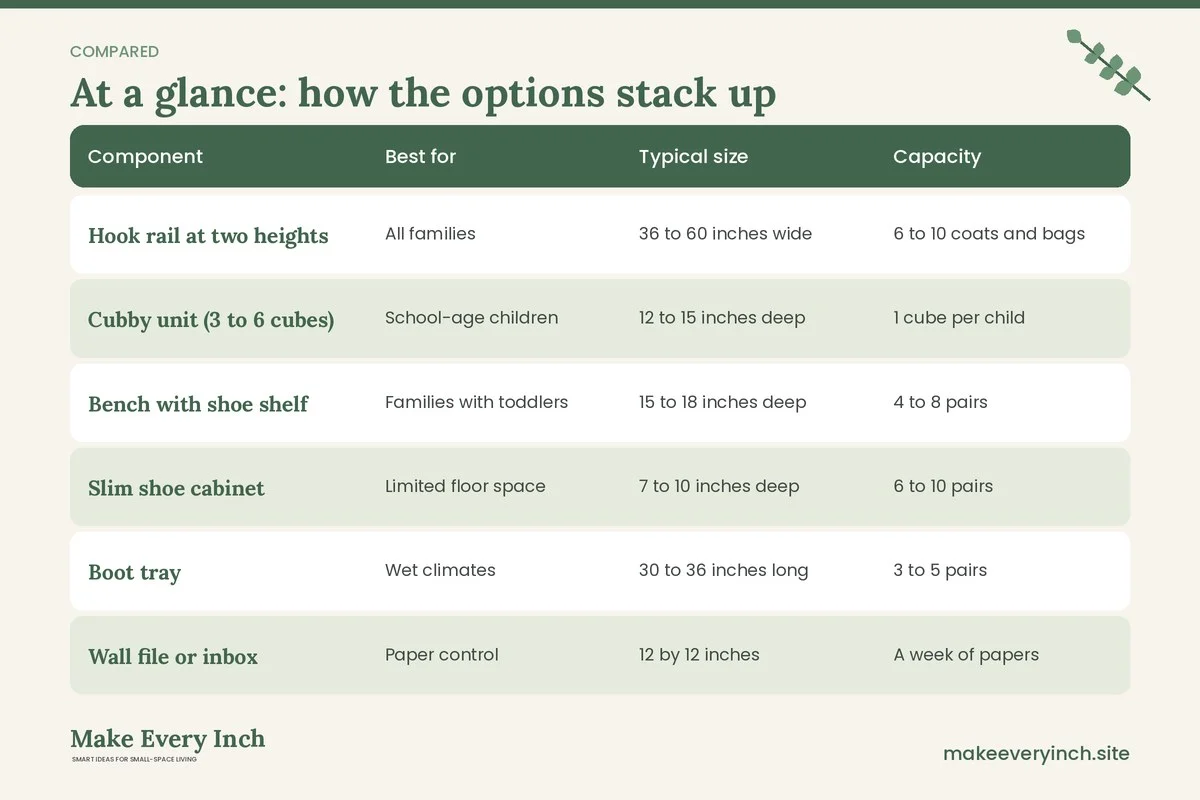
Comparison table: family entry components
Use this table to choose pieces by how many children you have, how much space you have and how much effort you want to put in.
| Component | Best for | Typical size | Capacity | Notes |
|---|---|---|---|---|
| Hook rail at two heights | All families | 36 to 60 inches wide | 6 to 10 coats and bags | Mount into studs; round the hook tips |
| Cubby unit (3 to 6 cubes) | School-age children | 12 to 15 inches deep | 1 cube per child | Anchor to the wall |
| Bench with shoe shelf | Families with toddlers | 15 to 18 inches deep | 4 to 8 pairs | Gives a sitting spot |
| Slim shoe cabinet | Limited floor space | 7 to 10 inches deep | 6 to 10 pairs | Flip-down doors save space |
| Boot tray | Wet climates | 30 to 36 inches long | 3 to 5 pairs | Easy to wipe clean |
| Wall file or inbox | Paper control | 12 by 12 inches | A week of papers | Empty weekly |
| Wall-mounted sports rack | Active families | 24 to 36 inches wide | 3 to 5 items | Mount into studs |
| Shelf above hooks | Hats, helmets, gloves | 5 to 10 inches deep | 3 to 6 items | Keep heavy things low |
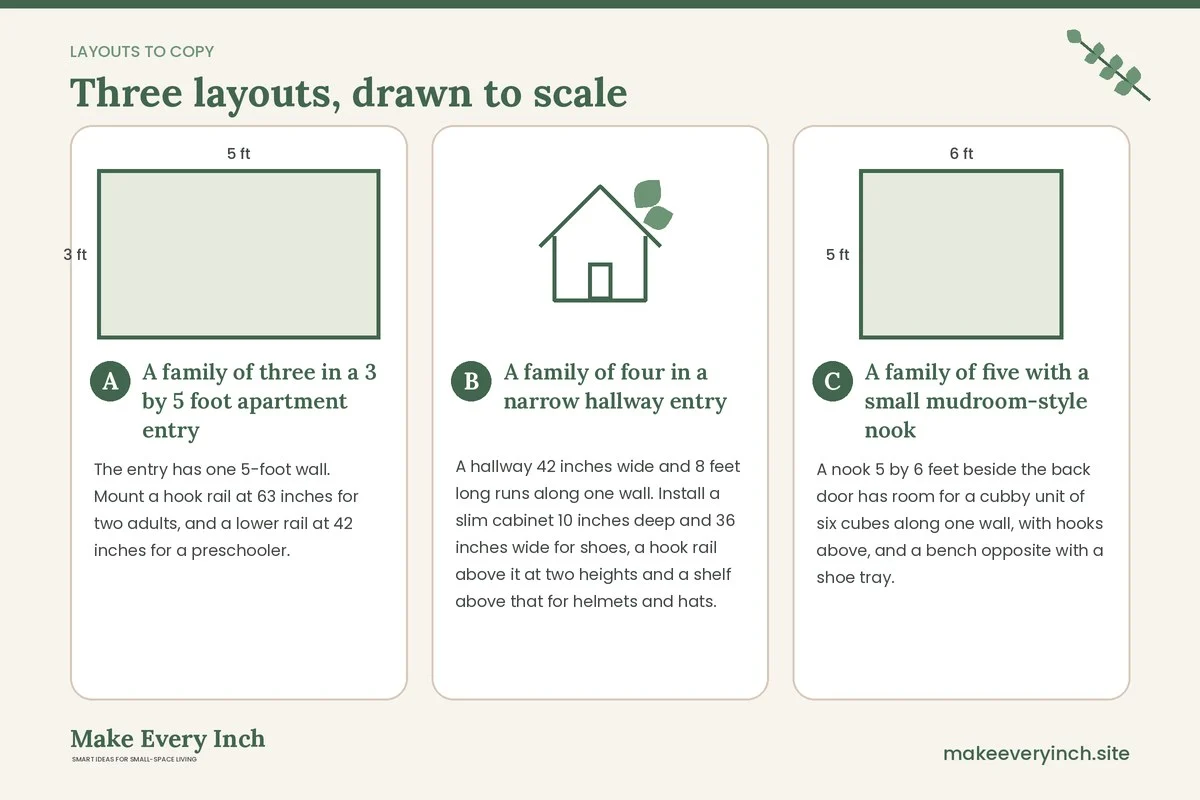
Three example family entries
A family of three in a 3 by 5 foot apartment entry
The entry has one 5-foot wall. Mount a hook rail at 63 inches for two adults, and a lower rail at 42 inches for a preschooler. Below the low rail, set a 30-inch boot tray and a narrow bench 14 inches deep, with a basket beneath it for the child’s shoes and hats. A wall file at 48 inches catches daycare papers. The walkway stays at 32 inches. The family keeps the second pair of shoes in the bedroom. For more compact approaches, see our post on no entryway apartment ideas.
A family of four in a narrow hallway entry
A hallway 42 inches wide and 8 feet long runs along one wall. Install a slim cabinet 10 inches deep and 36 inches wide for shoes, a hook rail above it at two heights and a shelf above that for helmets and hats. Each child has a hook with a name label, and each adult has a hook. A bench is too deep for the width, so a pair of low stools tucks under the rail. The remaining clear width is 30 inches. Our guide to narrow hallway ideas shows more ways to use a thin corridor.
A family of five with a small mudroom-style nook
A nook 5 by 6 feet beside the back door has room for a cubby unit of six cubes along one wall, with hooks above, and a bench opposite with a shoe tray. Each child gets a cube and a hook, and the parents share the sixth cube for gloves and hats. The cubbies are anchored to the wall, and the bench stores sports balls in a lidded bin. A rubber mat covers the floor and drains into a tray. A small shelf above the bench holds the bike helmets. The family adopts a rule of one pair of shoes per person on the floor, and everything else goes upstairs.
Routines that keep it running
Organization lasts only if the routine is easy. The best family routines are short, visible and shared.
- The arrival routine: shoes off, bag unpacked, bag on hook. Practice it with young children until it becomes automatic. Singing a song or counting can help.
- The evening reset: after dinner, each child checks their station and repacks tomorrow’s backpack. Parents do a one-minute sweep of the floor.
- The Sunday check: empty the paper inbox, wipe the tray, return stray items to the right rooms and check the week’s schedule for sports gear.
- The seasonal swap: twice a year, rotate shoes and coats, and pass outgrown clothes to the next child or to donation. Kids outgrow coats fast, so this is a good moment to check sizes.
- The visitor plan: keep two empty hooks and a small bench or bin for guests.
Use visual cues. A picture chart on the wall showing the steps (shoes, bag, hook) helps pre-readers. A small basket labeled “found items” catches stray things. A set of photos with each child’s name can mark their station.
Safety for a family entry
Children and furniture are a high-risk combination, so treat safety as part of the design, not an afterthought.
- Anchor tall and top-heavy furniture. Cubby units, shoe cabinets and hall trees can tip if a child climbs or pulls open drawers. Use the anti-tip hardware that comes with the piece and fix it into a wall stud, or use an anchor rated for your wall type. This matters especially for children under about five, who climb.
- Do not drill without permission. If you rent, read the lease and ask your landlord first. No-drill alternatives include freestanding cubby units, over-the-door hooks and tension rods. Our guide to no-drill storage ideas for renters lists several.
- Check behind the wall. Use a stud finder with live-wire detection and avoid drilling near outlets, switches or pipes.
- Round or cap hook tips. Pointed hooks at child eye level can cause injuries. Choose hooks with rounded ends or caps.
- Keep heavy items low. Place helmets, boots and heavy bags on lower shelves, and light items higher.
- Store hazards out of reach. Keep sunscreen, medicines, batteries, small magnets and cleaning products on a high shelf or in a locked cabinet, not in an open cubby.
- Mind cords. Avoid hanging cords, long scarves on hooks at toddler height and window cords near the entry.
- Keep the exit clear. Do not let bins or scooters block the path to the door.
- Ventilate when painting. If you paint a cubby or a bench, use low-VOC paint, open a window and allow it to cure fully before use.
Making it kid-friendly and still good looking
A family entry does not need to look like a daycare. A few choices help the space feel adult and calm while still working for children.
- Use a limited color palette. Pick two or three colors for bins and hooks so the space looks coordinated.
- Choose durable finishes. Wipeable paint, a washable rug and a metal or wooden hook rail handle daily use.
- Add a mirror. A mirror at adult height helps people check themselves on the way out, and a small one lower down delights children.
- Add a chalkboard or a magnetic strip. A small board for the week’s schedule and reminders keeps the list in one place.
- Include a drop zone for keys. A tray or hook near the door, out of reach of toddlers, stops the key hunt.
Keep the decorative items minimal. A plant or a framed photo above the hook rail makes the zone feel finished. See our guide to apartment entryway decorating for design ideas.
Mistakes families make
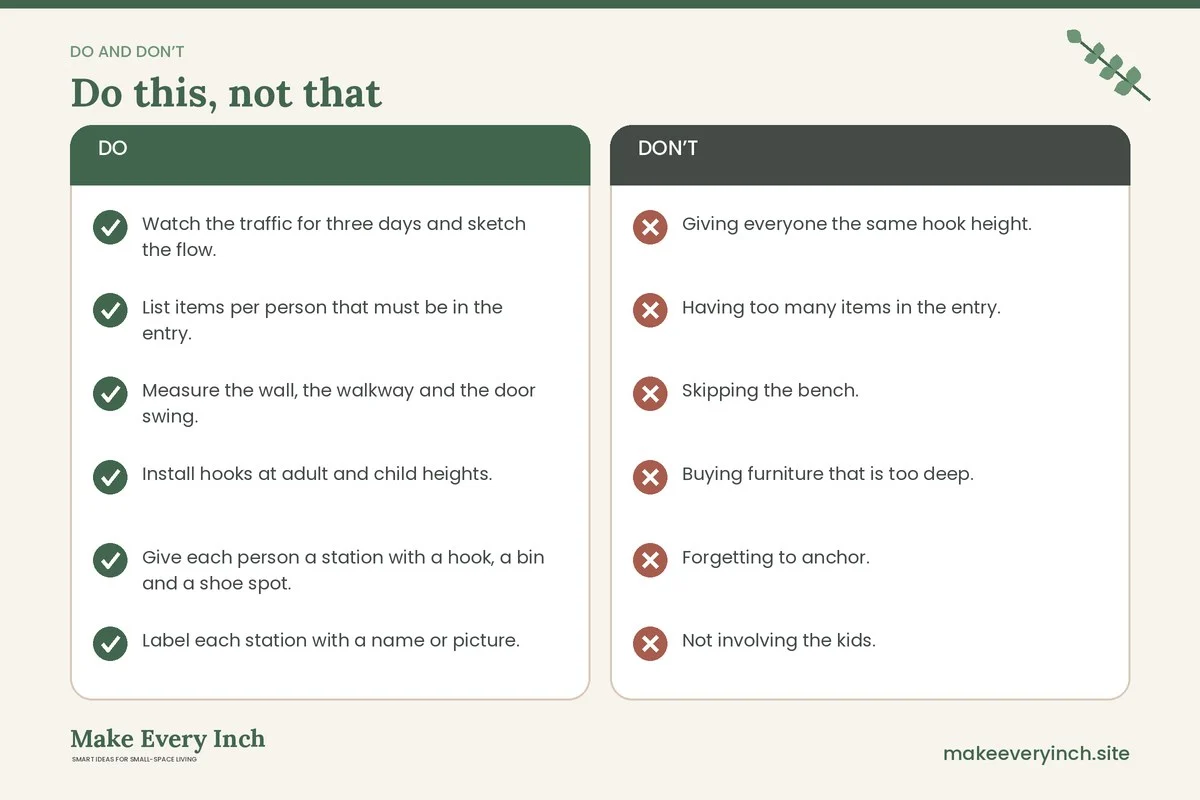
- Giving everyone the same hook height. Children cannot reach adult hooks, and adults hit their heads on low hooks.
- Having too many items in the entry. If the system relies on perfect behavior, it will fail. Fewer items make it forgiving.
- Skipping the bench. A toddler putting on shoes standing up is a recipe for tantrums and falls.
- Buying furniture that is too deep. A 24-inch deep cabinet in a 40-inch hall leaves little room.
- Forgetting to anchor. Tip-overs are preventable.
- Not involving the kids. Children who help choose colors and labels use the system more.
- Ignoring rain. Without a tray and a place to hang wet coats, water spreads into the home.
Checklist: family entry
- Watch the traffic for three days and sketch the flow.
- List items per person that must be in the entry.
- Measure the wall, the walkway and the door swing.
- Install hooks at adult and child heights.
- Give each person a station with a hook, a bin and a shoe spot.
- Label each station with a name or picture.
- Add a boot tray and a bench or shoe cabinet.
- Set up a paper inbox near the hooks.
- Choose a home for sports gear and helmets.
- Anchor tall furniture to the wall.
- Round or cap hook tips.
- Store hazards out of reach.
- Set up an arrival routine and an evening reset.
- Rotate seasonal items twice a year.
FAQ
How high should hooks be for kids?
It depends on age. Toddlers need about 28 to 36 inches, preschoolers 34 to 42, early school-age children 40 to 48 and older children 48 to 56. Adults use 60 to 66 inches. Test by having the child reach.
How do I stop backpacks from piling up?
Give each child a hook at their height, set a rule that the bag is unpacked first and hung second, and have the child repack it after dinner. A paper inbox beside the hooks keeps forms from spreading.
How many pairs of shoes should stay in the entry?
One pair per person in daily use is a good rule, with a few spare for guests. Store others in bedrooms or a closet, and rotate seasonally.
What is the best storage for a family with no mudroom?
A hook rail at two heights, a bench with a shoe shelf, a boot tray and a wall file fit most small entries. Use vertical space and keep the floor clear.
Do I need to anchor a cubby unit?
Yes. Any tall or top-heavy unit can tip, especially if children climb. Use the supplied hardware and fix it into a stud or use a wall-appropriate anchor. Renters should ask the landlord before drilling or choose a low, stable unit.
How do I get kids to use the system?
Make it easy, make it visible and make it a habit. Lower the hooks, label the cubbies, practice the routine for a few weeks and keep the number of steps small.
Keep going: Keep planning with our guides to small coat storage ideas, small entryway storage and organization ideas for renters.
Save this guide for later
Pin the ideas you like to Pinterest so you can come back to them when you plan your space.