Studio Apartment Furniture Ideas: Multi-Function Pieces That Fit
Quick answer: The best studio apartment furniture ideas favor pieces that do two jobs, stay low and light in scale, and leave a clear 30 to 36 inch path. Consider a sofa bed or daybed for sleeping and sitting, nesting tables for flexible surfaces, a drop-leaf or wall-hung table for dining and work, and legged pieces that show the floor. Avoid bulky sectionals, deep recliners, oversized headboards and anything that blocks a window or an exit.
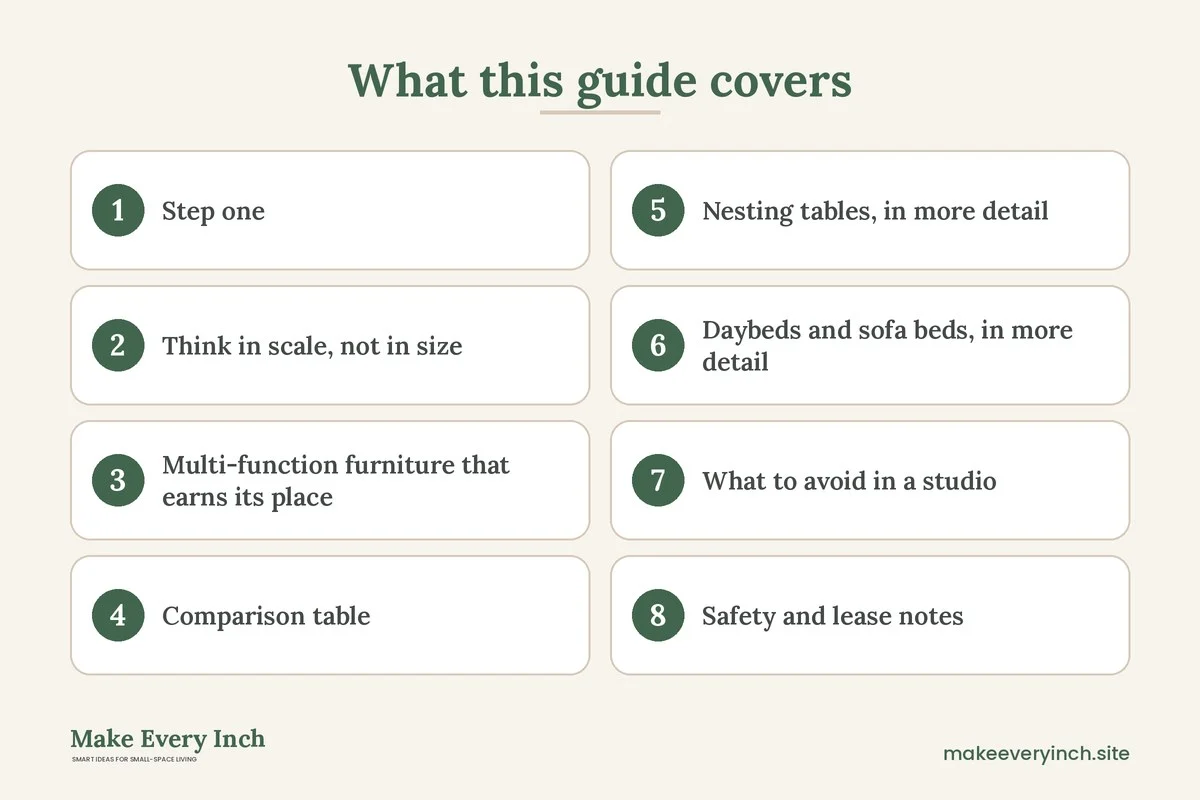
Studio apartment furniture ideas start with a hard truth: you are not furnishing a living room, a bedroom and a dining room, you are furnishing one room that must behave like all three. A pair of oversized pieces can swallow the space, and a handful of tiny ones can leave it feeling like a showroom. The answer lies in scale, in multi-function design and in careful placement. This guide covers how to measure a studio, which furniture categories earn their place, how sofa beds, daybeds and nesting tables compare, what to avoid, three example layouts, a placement checklist and a FAQ. For the whole-room picture, see our main guide to studio apartment ideas, and for the matching approach to keeping things off the floor, read our companion post on studio apartment storage ideas.
Step one: measure the studio like a floor plan
Before you shop, draw the studio on graph paper or in a free floor planner. Measure each wall, then mark the doors, windows, radiators, vents, outlets and the swing of every door. Note the ceiling height, because it affects what tall pieces you can use. Mark the path from the entry to the bed, kitchen and bathroom, and keep it free.
Then work out the zones. Most studios need five: sleep, sit, eat, work and entry. You will not give each a separate room, but each needs a place, even if it is just a corner. A common method is to dedicate the deepest part of the room to the bed, put the seating near the windows and the dining spot near the kitchen. The entry zone can be a single bench or a console with hooks.
Cut paper templates for each piece at actual size and place them on the floor. Walk the route between them. A good studio keeps the following clearances:
- Main walkway: 30 to 36 inches wide.
- Beside the bed: 24 to 30 inches on at least one side.
- Sofa to opposite furniture: 14 to 18 inches to a coffee table, or 30 inches if it is a walkway.
- Dining chair pull-out: 24 to 30 inches behind the chair.
- Door swing: keep the arc free, or choose a door that opens the other way.
- Windows and exits: do not block them, especially a window that serves as a fire escape.
Think in scale, not in size
Scale is the relation between a piece and the room. A sofa that is 84 inches wide suits a 20-foot-wide room and overwhelms a 12-foot one. For a studio, aim for furniture that is lower, lighter and narrower than the standard version.
Choose low profiles
Pieces under 32 inches tall let the eye see across the room and make the ceiling feel higher. A low bed, a low sofa and a low media unit open up the walls for art or shelves.
Show the floor
Furniture on slim legs reveals the floor beneath, and visible floor reads as more space. Look for legs at least 6 inches tall on sofas and dressers, and use open frames for tables and chairs.
Mind the visual weight
Dark, heavy fabrics and chunky arms read as large. Lighter colors, thin arms and open backs read as smaller. A glass or acrylic table seems to disappear. A rug in a pale tone can pull a zone together.
Keep the room to three or four big pieces
More than four large items in a studio feels crowded. A typical set is a bed, a sofa or daybed, a table and one storage piece. Everything else should be small, movable or wall-mounted.
Multi-function furniture that earns its place
Multi-function furniture is the heart of a studio. The idea is to buy one piece that replaces two. The list below groups the best types. For a broader look at the category, see our post on the best furniture for small apartments.
Sleeping that doubles as sitting
1. A sofa bed
A sofa bed gives you a sofa by day and a bed at night. It frees the studio of a permanent bed, which is the largest object in the room. Check the folded size, the open size and the clearance needed to open it. Also check the mattress type, because some thin mattresses feel hard for nightly use. A sofa bed suits people who host and sleep on a regular schedule, and it works best with a separate storage place for bedding.
2. A daybed
A daybed is a twin-size frame with a back and arms that works as a sofa. It stays made, so it never needs converting, and many versions have a trundle or drawers. It is a good choice if you want a bed that looks like a sofa without the fuss of a pull-out.
3. A futon with a frame
A futon turns from a sofa into a bed with a simple fold. It is light and often cheaper than a sofa bed, though comfort varies. Test it by sitting and lying down.
4. A Murphy or wall bed
A wall bed folds into a cabinet, and the studio becomes a living room in the daytime. It needs a solid, anchored installation, so it is best for owners or for renters with written permission. Never install one without confirming that the wall can carry the load, and use a professional if you are unsure.
5. A platform bed with drawers
A bed with built-in drawers replaces a dresser. It sleeps well, and it keeps the look of a bed. See our guide to the best beds with storage.
Seating that stores
6. A storage ottoman
An ottoman is a footrest, extra seat, table and bin. See the best storage ottomans.
7. A bench with a lid
A bench at the foot of the bed or by the door gives a seat for putting on shoes and holds items inside.
8. A small sofa or loveseat
A sofa between 60 and 72 inches wide suits most studios. Our post on the best sofas for small apartments lists features to check, such as depth, arm width and leg height.
9. Stackable or folding chairs
Chairs that stack or fold can hang on a wall hook or stand in a closet when not in use. They give you seats for guests without a permanent set of dining chairs.
Tables that change shape
10. Nesting tables
Nesting tables come in sets of two or three. Keep them together as one side table, or pull them apart to serve as a laptop table, a drinks table and a bedside table. They are ideal for a studio because they adapt to the moment.
11. A drop-leaf table
A drop-leaf table has hinged sides that fold down to leave a thin console. Open it for dinner for two, and fold it to leave room for a yoga mat. Make sure the leaves are supported securely.
12. A wall-mounted fold-down table
A wall-hung table folds flat against the wall. It needs anchoring, so check the lease first. A freestanding alternative is a narrow console that extends.
13. A rolling cart as a table
A rolling cart serves as a bar, a nightstand and a laptop spot. See the list of best rolling kitchen carts or the post on small kitchen cart ideas.
14. A lift-top coffee table
A table that lifts to desk height gives a work surface and hides items inside. It suits people who work from the sofa.
Storage that does a second job
15. A console behind the sofa
A console 10 to 14 inches deep stands behind a floating sofa as a divider, a drop zone and a lamp base.
16. A shelving unit as a room divider
An open bookcase, with a back panel or baskets, can divide the sleeping area from the living area while keeping light flowing. Anchor it, keep it under the ceiling and do not block an exit. For more on dividing a studio, see our guides to renter-friendly ways to divide a studio apartment and DIY room divider ideas for studio apartments.
17. A dresser as a TV stand or nightstand
A low dresser can hold a TV and clothes at once. A tall one can stand beside the bed instead of a nightstand.
18. A desk that hides
A secretary desk or a desk in a cabinet closes to look like a cupboard. It is helpful if you work from home and want to hide your work at night.
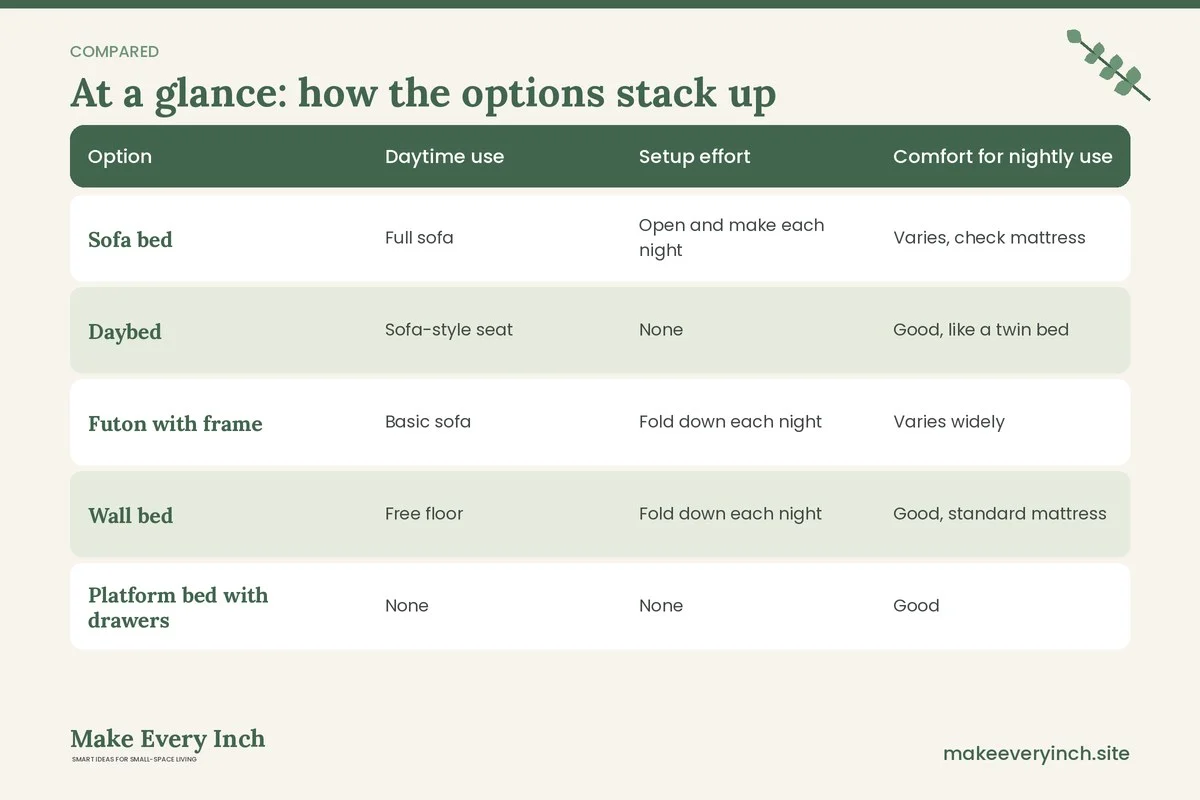
Comparison table: sofa bed, daybed, futon and wall bed
The sleeping solution is the largest decision, so compare it directly. All values are general ranges, and your product may differ.
| Option | Daytime use | Setup effort | Comfort for nightly use | Best for | Watch out for |
|---|---|---|---|---|---|
| Sofa bed | Full sofa | Open and make each night | Varies, check mattress | Hosts and frequent guests | Clearance to open, thin mattress |
| Daybed | Sofa-style seat | None | Good, like a twin bed | Solo sleepers | Fixed size, limited seating depth |
| Futon with frame | Basic sofa | Fold down each night | Varies widely | Tight budgets and short stays | Wear of the mattress |
| Wall bed | Free floor | Fold down each night | Good, standard mattress | Maximum floor space | Installation, wall strength, lease |
| Platform bed with drawers | None | None | Good | Anyone with a fixed sleeping zone | Takes floor space all day |
If you sleep in the studio every night, comfort and ease matter more than space, and a daybed or a platform bed often wins. If you host often or work from home, a wall bed or a sofa bed gives back more floor in the daytime.
Nesting tables, in more detail
Nesting tables are among the most useful pieces in a studio. A nest of two takes the same space as one table, and a nest of three can serve as a coffee table, a side table and a plant stand. Use the largest table as the main surface and slide the smaller ones out for guests. Choose heights that differ by about 2 to 3 inches, so the smallest tucks under the larger. Round or oval tops avoid sharp corners in tight paths, which matters in a space where you pass the same corner many times a day.
A few placement tips help:
- Keep the nest at the end of the sofa, where it is within 16 to 24 inches of a seated person.
- Park it under a console or beside the bed when it is not in use.
- Pair it with a tray so drinks stay stable on a small top.
- If you eat on the sofa, make sure the top is at least 12 inches wide.
Daybeds and sofa beds, in more detail
A daybed is a good option if you want a bed that never moves. Look for a frame with a solid back, which means you can sit without cushions that slide. Check the depth: a twin is about 38 inches wide and 75 inches long, which is shorter than a sofa but longer than most loveseats. Add large bolsters or pillows against the back so it feels like a sofa, and use a throw that is easy to wash.
A sofa bed gives more seating, but you must check the opening mechanism. Measure the folded length, the open length and the depth of the open frame, and compare it with the free floor in front of the sofa. Many designs need 70 to 85 inches of clearance when open, so a coffee table must move out of the way. A sofa that fits the room closed but not open will not work. Check that the mattress is comfortable by lying on it for ten minutes if you can. Keep the bedding in a nearby ottoman or bench so that setup takes two minutes.
What to avoid in a studio
Some furniture simply does not suit a one-room home. Skip or reconsider these.
- Sectional sofas. They dominate the room and are hard to move. If you love the shape, choose a small modular set that you can rearrange.
- Deep recliners. A recliner needs clearance behind it, and it often blocks a walkway.
- Oversized headboards. A tall headboard adds visual bulk. A slim or wall-hung one saves floor and sight lines.
- Four-poster beds. They block light and make a small room feel closed.
- Heavy dining sets. A set of four chairs and a large table takes more than half the floor in many studios. Use a drop-leaf, a bar-height shelf or a small round table.
- Wide coffee tables. A big coffee table cuts the walkway. Use nesting tables or an ottoman instead.
- Furniture in the path of a door or window. Keep a clear route to the entry and to any window that serves as an exit.
- Matching suites. A bedroom set of bed, dresser and two nightstands makes the studio look like a furniture store.
- Dark, heavy pieces everywhere. Mix a few light pieces to balance.
- Furniture that cannot be moved. In a rental, choose pieces that you can take with you.
Safety and lease notes
Studio furniture choices come with practical safety concerns. Keep these in mind.
- Anchor tall pieces. Bookcases, wardrobes, dressers and shelving units used as dividers can tip. Anchor them to a stud with the supplied hardware, and put heavy items on low shelves.
- Never drill without permission. Wall beds, wall tables and shelves need fixings. Read the lease and ask the landlord in writing. Where you cannot drill, choose freestanding pieces.
- Keep exits clear. Do not block the door or any window that could serve as an emergency exit. Keep a 30 to 36 inch path from the bed to the door.
- Check electrical load. Do not overload outlets with lamps, chargers and heaters. Avoid extension cords across walkways, and never run cords under rugs. Keep furniture away from baseboard heaters and radiators.
- Ventilation. Do not seal vents or radiators behind furniture. If you paint or refinish a piece, use low-VOC paint and open a window.
- Test mechanisms. Sofa beds and wall beds have springs and hinges. Follow the maker’s instructions, keep fingers clear and do not exceed the weight limit.
- Plan lofts carefully. A loft bed needs proper ceiling height, a sturdy ladder and, in many rentals, written approval.
Three example studios
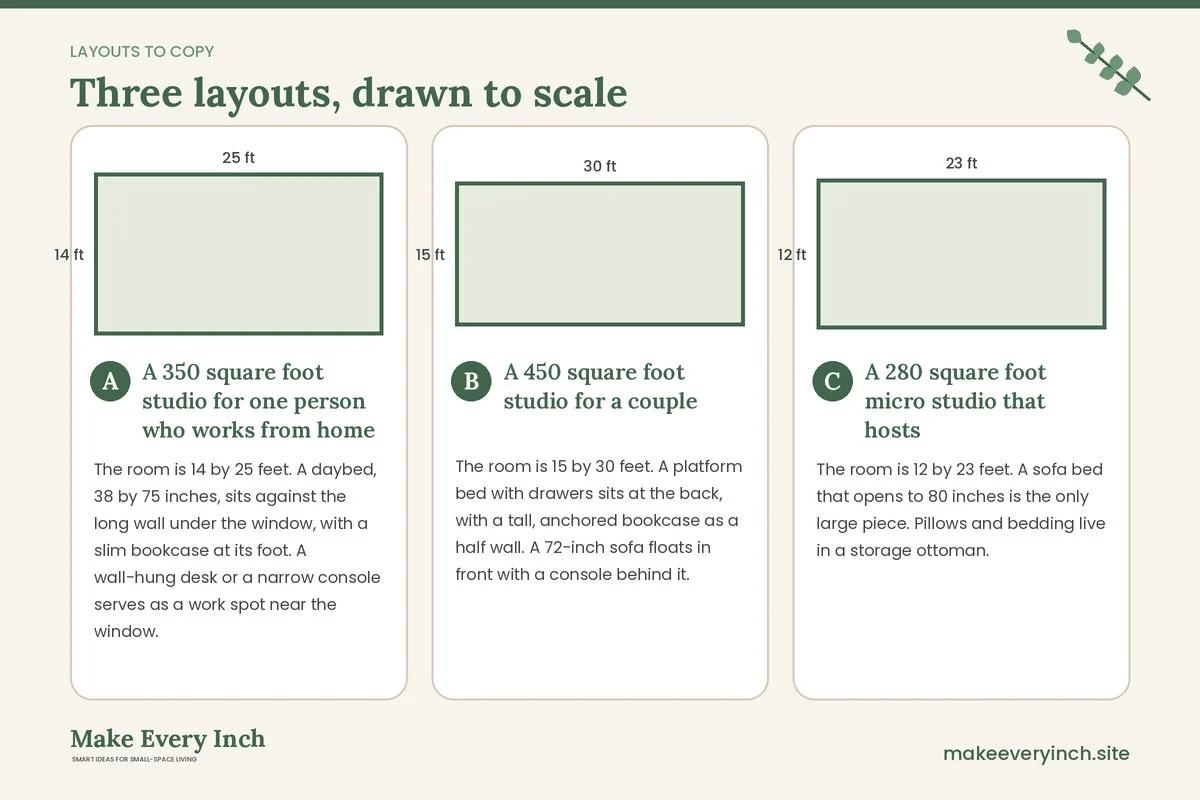
A 350 square foot studio for one person who works from home
The room is 14 by 25 feet. A daybed, 38 by 75 inches, sits against the long wall under the window, with a slim bookcase at its foot. A wall-hung desk or a narrow console serves as a work spot near the window. A set of two nesting tables sits by the daybed. A small rug anchors the seating zone. A bench by the entry holds shoes. The walkway stays at 36 inches.
A 450 square foot studio for a couple
The room is 15 by 30 feet. A platform bed with drawers sits at the back, with a tall, anchored bookcase as a half wall. A 72-inch sofa floats in front with a console behind it. A drop-leaf table by the kitchen seats two for dinner, and folded, it becomes a console. Two stackable chairs live in the closet. Two nesting tables serve as side tables. The couple keeps a 30-inch path along the window wall.
A 280 square foot micro studio that hosts
The room is 12 by 23 feet. A sofa bed that opens to 80 inches is the only large piece. Pillows and bedding live in a storage ottoman. A wall-mounted fold-down table, installed with the landlord’s written permission, serves as a desk and a dining spot. A rolling cart acts as a nightstand and bar. A mirror leans against the wall to bounce light. Everything either folds, stacks or rolls.
Placement tips that make furniture work harder
Even the right furniture looks wrong in the wrong place. A few placement habits help.
- Float the sofa. A sofa with its back to the sleeping area marks a boundary without a wall.
- Put the bed in the deepest corner. It is the least trafficked place and gives a sense of retreat.
- Use the window wall for the desk or table. Natural light helps, though avoid glare on a screen.
- Align furniture with the room’s lines. Furniture parallel to the walls looks calm, while angled pieces can waste corners.
- Leave one wall quiet. If one wall has a door, a window and a bed, keep another wall mostly clear.
- Use rugs to define zones. A 5 by 8 foot rug under the seating group and a smaller one by the bed separate the areas without walls.
- Layer the lighting. A lamp at the bed, a lamp at the sofa and a light over the table make each zone feel separate. See our post on small apartment living room ideas for studios for more layouts.
Buying approach
Furniture for a studio is an investment in comfort, so shop in this order. First the bed or sleeping solution, because it is the largest. Then the main seat. Then a table. Then storage. Measure each piece, check the clearance to open, and check that it fits through the door, the stairwell and the elevator. Look for flat-pack pieces that you can assemble in the room, or pieces that come apart for a move. Secondhand furniture is a good way to try a size before you commit, and our post on thrifted furniture ideas for small homes shows how. For tighter budgets, see our guide to budget-friendly furniture ideas for small apartments.
Studio furniture checklist
- Measure the room, doors, windows and outlets.
- Draw the five zones: sleep, sit, eat, work and entry.
- Tape each piece to the floor at actual size.
- Keep a 30 to 36 inch main path.
- Choose one multi-function sleeping solution.
- Pick a sofa between 60 and 72 inches wide.
- Add nesting tables or a drop-leaf table.
- Choose legs at least 6 inches high where you can.
- Keep to three or four large pieces.
- Anchor every tall piece.
- Confirm the lease before any fixing.
- Keep windows and exits clear.
- Check that the sofa bed opens with space to spare.
- Check delivery routes for each piece.
- Add a rug for each zone.
FAQ
What is the best furniture for a studio apartment?
Furniture that does two jobs and stays small in scale: a sofa bed or daybed, nesting tables, a storage ottoman, a drop-leaf table and a shallow console. Pick a limited number of large pieces and keep the paths clear.
Should I get a sofa bed or a daybed?
If you sleep in the studio nightly, a daybed or a platform bed is easier. If you host or want maximum floor in the daytime, a sofa bed or wall bed is better. Check the opened size before you buy.
How big should a sofa be in a studio?
A sofa of 60 to 72 inches suits most studios. Larger rooms can handle 80 inches. Check depth too, because 32 to 36 inches is common and shallower versions save floor.
How do I separate the bed from the living area?
Use a floating sofa, a shelving unit, a curtain on a ceiling track, or a rug. Keep exits clear and anchor anything tall. Our guide to renter-friendly ways to divide a studio apartment offers more.
Is a Murphy bed a good idea in a rental?
It can be, but it needs secure fixing to the wall or floor and often needs written permission. If you cannot install one, a sofa bed or a daybed gives a similar result without drilling.
Can I mix furniture styles in a studio?
Yes. Repeat a color or material across pieces so the mix looks planned. Keep large pieces simple and add character with small items.
How many pieces of furniture are too many?
More than four large pieces usually feels crowded. If the path narrows below 30 inches, remove or replace something.
Keep going: Keep going with our guides to studio apartment ideas, studio apartment storage ideas and small living room furniture ideas.
Save this guide for later
Pin the ideas you like to Pinterest so you can come back to them when you plan your space.