Studio Apartment Ideas for Working from Home
Quick answer: The best studio apartment ideas for working from home put the desk where you can see the room’s door but not the bed, use a rug, shelf or lamp to mark the work zone, set ergonomic heights (elbows near 90 degrees, screen top at eye level), choose a tidy call background, soften noise with rugs and curtains, and finish each day with a ten-minute reset that hides the work.
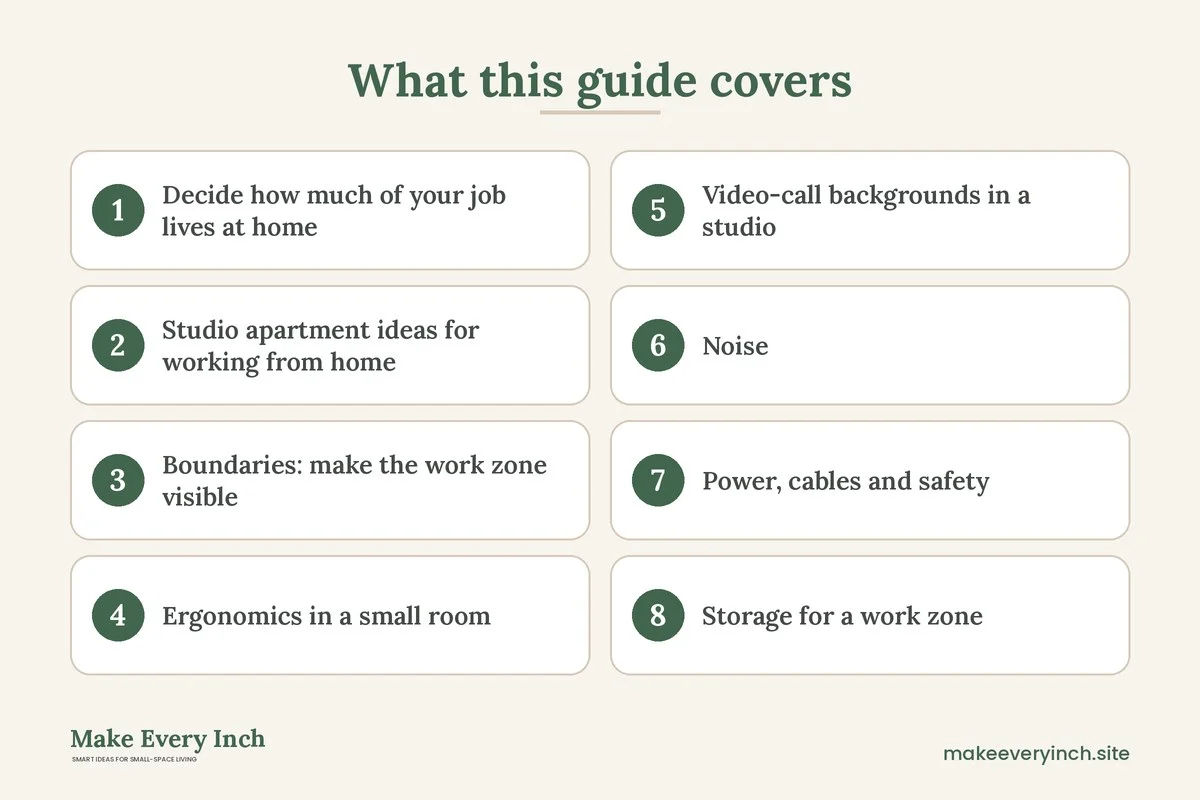
Studio apartment ideas for working from home have to answer an odd question: how do you leave work when work lives six feet from your bed? In a studio there is no spare room, no door to close and no commute to mark the end of the day. The desk shares air, light and sound with the place where you sleep, eat and relax. That can be perfectly comfortable, and many people do it well, but only when the desk is placed with care, the boundaries are visible and the day has a clear end. This guide covers desk placement, boundaries, ergonomics, video-call backgrounds, noise, lighting, an end-of-day reset, a comparison table of setups, three example studios, a checklist and a FAQ. For the overall picture of living in one room, read our pillar guide on studio apartment ideas, and if you share the room with a partner, the companion post on studio apartment ideas for couples covers two work zones and sleep schedules.
Decide how much of your job lives at home
Before choosing furniture, be honest about how you work. A full-time remote worker with eight hours of video calls needs a different setup from someone who answers email for two hours a day. Ask yourself these questions.
- How many hours per day will you sit at the desk? Over four hours, ergonomics become a priority, and a dedicated desk is worth the floor space.
- How many hours of calls? Calls mean sound, background and lighting all matter.
- Do you use paper, a second monitor or equipment? These decide the desk width and the storage.
- Do you need to leave the desk set up overnight? If not, a fold-away setup keeps the studio calmer.
- Do you share the room? A partner changes the plan for sound and screens.
Your answers place you on a scale from “laptop on a table” to “permanent workstation.” The rest of this guide gives options at each point on that scale.
Studio apartment ideas for working from home: desk placement
Desk placement is the single decision that affects everything else. A good spot gives you light, quiet and a visual break from the bed. A bad spot makes work and rest blur together.
Rules of thumb for placement
- Keep the desk out of the line of sight from the bed. If you can see your monitor when you lie down, the work follows you into sleep. Turn the desk so the bed is behind you, or block the view with a shelf, a screen or a curtain.
- Use natural light from the side. A window to your left or right is better than a window behind the monitor, which causes glare, or one behind you, which reflects on the screen. If the window must be in front, use a sheer curtain to soften it.
- Leave 36 inches behind the chair. You need room to push back and stand without hitting a bed, a wall or a door. 30 inches is the minimum.
- Keep the exit clear. The desk and chair should never block the door, the route to a window or the path from the bed to the entry. Leave a walkway of 30 to 36 inches.
- Avoid the kitchen side. Cooking noise and smell, plus the temptation to snack, make it a poor spot for focus.
- Think about the wall behind you for video calls. The area that shows in the camera matters, and we cover it below.
The best spots, ranked by how often they work
- By the window, perpendicular to it. This gives side light, a view for resting your eyes and a natural separation from the bed.
- In an alcove or corner. A corner reduces sound travel and feels like a small office. A corner desk of around 48 to 60 inches wide can fit a laptop, a monitor and a notebook.
- Behind the sofa. A narrow console of 12 to 16 inches deep used as a standing desk or a stool-height perch can sit behind the sofa and define the work zone. See our guide to small apartment living room ideas for studios for sofa-back layouts.
- At the foot of the bed. A last resort. Use a screen or a curtain to hide it.
- At the dining table. Fine for light work, but you need to clear it for meals.
For furniture options by size, see best desks for small apartments, DIY desk ideas for small spaces and small bedroom desk ideas, which covers desk placement when the desk sits near the bed.
Boundaries: make the work zone visible
In a studio, boundaries have to be seen, because no wall does the job. The aim is to give your brain a cue that says “this is the office” when you sit down and “this is home” when you leave. Visual cues are cheap and effective.
- A rug under the desk and chair. Even a small rug of about 4 by 6 feet marks a floor territory. Choose a flat weave that the chair can roll on, or use a chair mat.
- A different light. Give the desk its own lamp and turn it on when work starts and off when it ends. A cooler, brighter bulb for work and warm light for the rest of the room is a strong signal.
- A shelf or bookcase as a back. A low shelf behind the desk, or a tall one at the side, creates a partial wall. Anchor any tall unit to the wall with the landlord’s permission, and keep it at a height that does not block light.
- A curtain or screen. A folding screen or a ceiling track curtain hides the desk at the end of the day. See renter-friendly ways to divide a studio apartment and DIY room divider ideas for studio apartments for options that need no drilling or are easy to build.
- Different seating. Use a desk chair for work and a different seat for rest. Avoid working from the sofa or the bed, so those places stay associated with rest.
- A dedicated bag or box. Keep laptop, charger and notebook in one container that moves from the desk to a shelf at the end of the day.
Boundaries with other people
If you live with a partner, a flatmate or a pet, agree on working hours and signals. A closed laptop, a pair of headphones, a lamp turned on or a card on the chair can mean “do not disturb.” If the people you live with work too, plan call times to avoid overlap. Rules like these cost nothing and prevent a lot of friction.
Boundaries with yourself
The harder boundary is the one with yourself. Set start and end times, and stick to them where you can. Take a short walk before you begin, as a stand-in for a commute, and another when you finish. Use an alarm at the end of the day that tells you to shut down, and treat it like an appointment.
Ergonomics in a small room
A studio often means a compromise chair and a table that was not designed for work. Fixing this does not need much space, but it does need measurements. General ergonomic guidance is widely published, and it varies by body, so treat the numbers below as starting points and adjust to what feels right. If you have pain, talk to a health professional.
The basic setup
- Desk height: typically 28 to 30 inches for a standard desk. If you are shorter or taller, an adjustable chair and a footrest help.
- Chair height: feet flat on the floor, knees near 90 degrees, thighs roughly parallel to the floor.
- Elbows: near 90 degrees, with shoulders relaxed and forearms supported.
- Screen: the top of the screen at or slightly below eye level, about an arm’s length away. A laptop on a stand with a separate keyboard and mouse is a big improvement.
- Keyboard and mouse: close to the body, wrists neutral.
- Back support: use a chair with lumbar support or add a small cushion or rolled towel.
- Lighting: light on the task from the side, not directly in your eyes or on the screen.
Space-saving ergonomic tricks
- A laptop stand and a compact keyboard turn a dining table into a workable desk.
- A fold-flat footrest or a sturdy box under the desk helps if the table is high.
- A wall-mounted drop-leaf desk gives a proper surface that folds away. Ask for permission before mounting anything, and attach it to studs rather than relying on small anchors.
- A standing option. A sturdy shelf, a counter or an adjustable stand lets you alternate between sitting and standing. Take breaks and move often, whichever you use.
- A timer for breaks. Short movement breaks every 30 to 60 minutes are commonly recommended, and a studio is small enough that even a lap of the room counts.
Video-call backgrounds in a studio
In a studio the wall behind your desk may be the same wall as your bed, your wardrobe or your kitchen. A cluttered or personal backdrop can feel awkward, and a sloppy one distracts. You have several options, and all can be done without drilling.
- Face the camera toward a plain wall. Turn the desk so the camera sees a clean section of wall, a bookcase or a plant, and the bed is out of frame.
- Use a bookcase as a backdrop. Style two or three shelves with books, a plant and one object. Keep it neat and not too busy.
- Hang a fabric panel or a tapestry on a tension rod. This hides a messy wall and softens sound. Use adhesive hooks with weight limits, or a tension rod across an alcove.
- Use a folding screen behind you. It hides the bed or the kitchen and can be folded away at night.
- Position the camera at eye level. Raise the laptop on a stand or a stack of books. A low camera shows the ceiling and your chin.
- Light your face. Put the main light in front of you, a window or a lamp slightly to one side. A light behind you leaves you in silhouette. Soft, diffused light is the most flattering.
- Keep the frame calm. Remove anything you would not want to explain, and keep the background tidy. A blurred virtual background is an option, but a real, tidy backdrop often looks better.
Check what the camera sees before each important call, and move anything that looks distracting. See our guide to renter-friendly lighting ideas for plug-in lamps and lighting that needs no wiring.
Noise: protecting your focus and your neighbours
Noise in a studio runs in both directions. The kitchen, the neighbours and the street disturb you, and your calls disturb anyone sharing the room.
Soften the room
Hard surfaces bounce sound. Soft surfaces absorb it. The cheapest improvements are:
- Rugs on bare floors, with a rug pad.
- Curtains that are thick or lined, hung wider than the window.
- Bookshelves filled with books, especially on a wall shared with a neighbour.
- Upholstered furniture and cushions.
- Fabric wall hangings or acoustic-style panels hung with tension rods or adhesive hooks.
- Door and window seals to reduce draughts and outside noise. Ask the landlord before fitting anything permanent.
Manage the sources
- Headphones. A comfortable pair with a good microphone is the most effective tool. Noise-cancelling headphones help against steady noise, such as traffic or a fan.
- A white noise source. A fan or a sound machine masks speech.
- Schedule loud tasks. Do the vacuuming, blending and washing machine cycles outside your call times.
- Use the right room. If a partner is on a call, you can move to the opposite end of the studio, step out or use headphones.
Do not block vents or radiators with soundproofing material. Leave airflow, and avoid stuffing foam or heavy fabric near heaters, which is a fire risk.
Power, cables and safety
A home office adds a monitor, a laptop, a lamp, a router and chargers to a room that may have few outlets. A tidy and safe setup matters.
- Use a surge protector with a built-in breaker and a single plug, and do not daisy-chain strips.
- Keep the load reasonable. Avoid adding heaters, kettles and other high-power appliances to the same strip as your computer.
- Route cables along walls or desk edges, not across walkways. See renter-friendly ways to hide cords for options that do not damage walls.
- Keep the router ventilated and off the floor.
- Anchor tall shelves and monitors on risers. A bookcase behind the desk must be fixed to the wall with the landlord’s permission, or replaced by a lower unit.
- Keep paper and boxes away from heaters and the path to the door.
- Ask before drilling. Never drill into walls, ceilings or window frames without written permission from the landlord.
- Check alarms. Smoke and carbon monoxide alarms must stay uncovered and working. Do not hang screens or curtains over them.
- Ventilate. A desk in a closed corner for long hours needs fresh air. Open a window when you can, and if you paint or refinish a desk, use low-VOC products and ventilate before using the room.
Storage for a work zone
A studio desk needs storage that holds work and hides it. The aim is to keep the minimal set of items within reach and put the rest away.
- A wall shelf or a pegboard above the desk, if the lease allows mounting. If not, use a freestanding shelf.
- A drawer unit or rolling cart under or beside the desk for paper, cables and supplies.
- A lidded box or a basket for the end-of-day cleanup.
- A file box with a handle, if you need paper records, that slides into a closet.
- A tray to gather pens, notebook and phone.
For broader ideas, see small space organization ideas and vertical storage ideas. If you need extra floor in the sleeping area, see our guide to under-bed storage ideas.
The end-of-day reset
The reset is the most underrated part of working from home in one room. It turns the office back into a home, tells your brain that work is over and protects your sleep. It takes about ten minutes, and it is easier than it sounds if you set up the room to support it.
A ten-minute reset routine
- Save and close. Write tomorrow’s top three tasks on a card, then shut down the laptop.
- Put the work in a container. Laptop, charger, notebook and papers go into a bag, box or drawer.
- Hide the desk. Close the drop-leaf, pull the curtain, fold the screen or drape a cloth over the desk.
- Switch the lights. Turn off the task lamp, turn on a warm lamp in the relax area.
- Change something physical. Change your clothes, wash your face, step outside or take a short walk. This acts as your “commute home.”
- Reset the chair. Push it in, or swap it for a stool so it does not invite you back.
- Do a two-minute tidy. Clear cups and plates, wipe the desk and return items.
- Say a closing phrase. Some people say “done for today” aloud. It sounds silly and it works.
Make the reset easy
- Use a fold-away desk or a cabinet desk that closes like a cupboard.
- Keep only one bag of work items.
- Choose a desk lamp with its own switch so the cue is easy.
- Put a plant, a candle or a book on the desk area at night, so the desk reads as a table again.
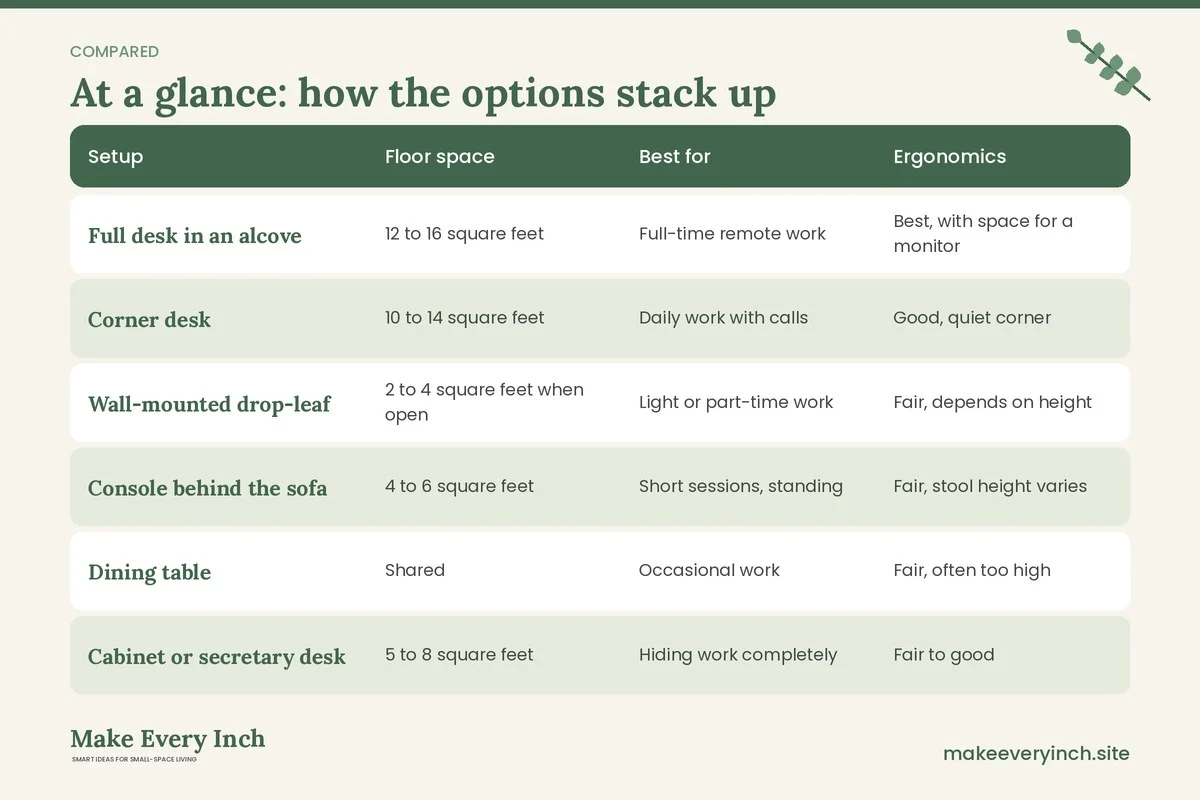
Comparison table: work setups for a studio
| Setup | Floor space | Best for | Ergonomics | End-of-day reset | |
|---|---|---|---|---|---|
| Full desk in an alcove | 12 to 16 square feet | Full-time remote work | Best, with space for a monitor | Needs a screen or curtain | |
| Corner desk | 10 to 14 square feet | Daily work with calls | Good, quiet corner | Easy to cover | |
| Wall-mounted drop-leaf | 2 to 4 square feet when open | Light or part-time work | Fair, depends on height | Excellent, folds flat | |
| Console behind the sofa | 4 to 6 square feet | Short sessions, standing | Fair, stool height varies | Easy to tidy, still visible | |
| Dining table | Shared | Occasional work | Fair, often too high | Must clear for meals | |
| Cabinet or secretary desk | 5 to 8 square feet | Hiding work completely | Fair to good | Excellent, doors close | |
| Rolling cart and laptop stand | 3 to 5 square feet | Very small studios | Fair, needs a stand | Roll to a closet |
No setup is perfect. A larger desk gives better ergonomics but a stronger reminder of work, and a smaller one hides easily but is less comfortable for long hours. Pick the one that matches the amount of work you do and whether you can leave it out overnight.
Three example studios for remote workers
Studio 1: The narrow 350 square foot studio, 10 feet wide
A long, thin room with a window at the far end. The resident works eight hours a day with several video calls.
- Desk: a 48 inch desk at the window, perpendicular to the glass, so light comes from the side. The bed is on the opposite long wall and out of the line of sight.
- Boundary: a flat-weave rug under the desk and chair, a task lamp with a cool bulb, and a low bookcase between the desk and the sofa.
- Background: the camera faces a bookcase with plants and a few books.
- Noise: a thick rug, lined curtains and noise-cancelling headphones.
- Reset: a bin for the laptop, a folding screen across the desk end, and a warm lamp in the sofa area.
Studio 2: The 280 square foot compact studio
A small room with little spare floor. The resident works from home three days a week.
- Desk: a wall-mounted drop-leaf, about 40 inches wide and 18 to 20 inches deep, mounted with the landlord’s permission, or a console table if mounting is not allowed. It folds away at night.
- Seat: a folding chair or a stool that tucks under the table.
- Boundary: the desk is on the wall farthest from the bed. A tapestry on a tension rod hides the wall at night.
- Background: a blank wall with a plant, and a plug-in lamp for face light.
- Ergonomics: a laptop stand, a separate keyboard and a footrest.
- Reset: the leaf folds, the chair goes in the closet and the tapestry is pulled across.
Studio 3: The studio with a sleeping alcove
A room with a recess for the bed, and a main area. The resident has frequent calls.
- Desk: a full desk in the main area, 60 inches wide, near the window and out of sight from the alcove.
- Boundary: the alcove is curtained off for sleep, with a gap for airflow, and the desk has its own lamp and rug. The sleeping zone stays free of work items.
- Background: a bookcase behind the desk, anchored with permission, and a neutral wall.
- Noise: books on the shared wall, a rug, and a headset.
- Reset: the laptop goes into a drawer, the lamp is switched off and a runner or tray turns the desk into a console for the evening.
For living area ideas that work with a desk nearby, see small apartment living room ideas, and for a couple’s view of the same challenge, see our guide on small bedroom ideas with a desk.
Mistakes people make when working from a studio
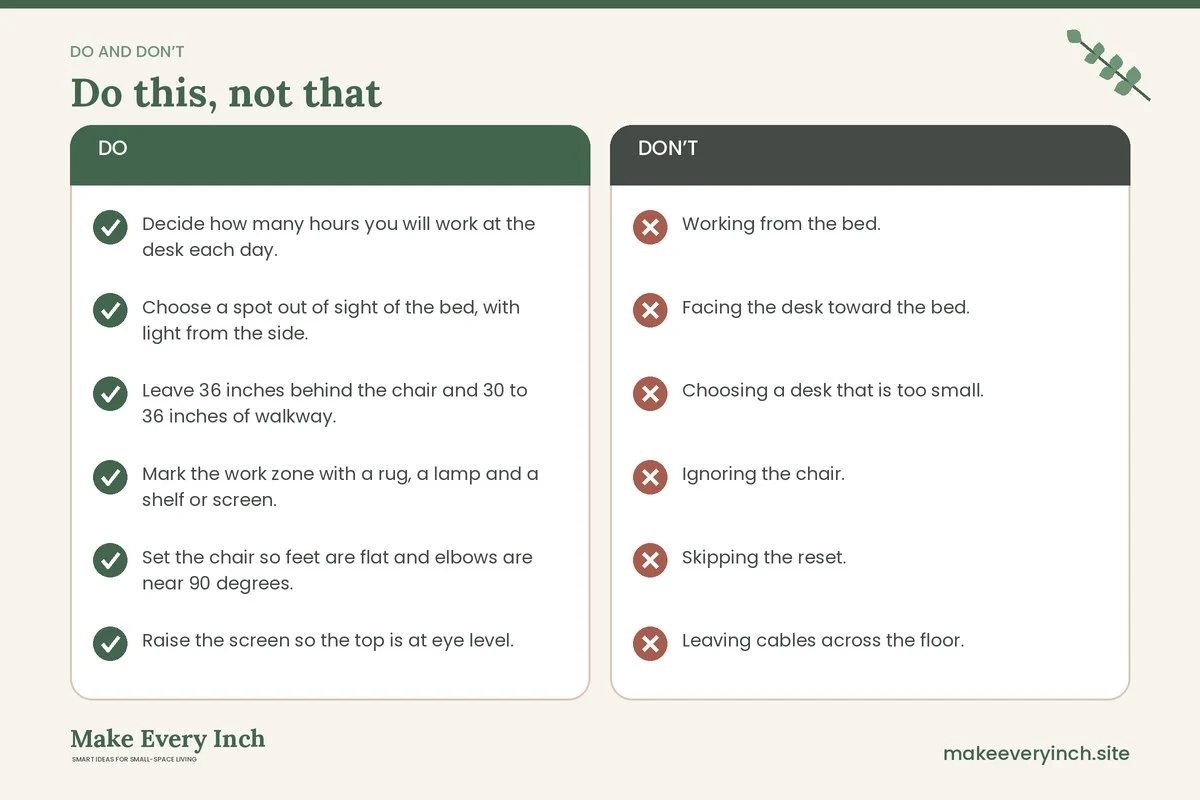
- Working from the bed. It teaches your brain to associate the bed with work, and it hurts your back.
- Facing the desk toward the bed. You see the bed all day, and the monitor lights you at night.
- Choosing a desk that is too small. A cramped desk is hard to use for long hours.
- Ignoring the chair. A good chair matters more than a large desk.
- Skipping the reset. Work then leaks into the evening.
- Leaving cables across the floor. They are a trip hazard and look messy.
- Overloading one power strip. It is a fire risk.
- Blocking the exit. A desk, a divider or a pile of boxes must never block the way out.
- Forgetting the background. Look at your camera view before the call, not during.
Remote worker’s studio checklist
- Decide how many hours you will work at the desk each day.
- Choose a spot out of sight of the bed, with light from the side.
- Leave 36 inches behind the chair and 30 to 36 inches of walkway.
- Mark the work zone with a rug, a lamp and a shelf or screen.
- Set the chair so feet are flat and elbows are near 90 degrees.
- Raise the screen so the top is at eye level.
- Check what the camera sees, and tidy the background.
- Add rugs, curtains and books to soften noise.
- Use headphones for calls.
- Use one surge protector, no daisy chains, and route cables safely.
- Anchor tall shelves, with permission.
- Keep alarms, vents and exits clear.
- Set start and end times.
- Run the ten-minute reset every evening.
FAQ
How do I separate work and living space in a studio?
Use visual cues: a rug, a dedicated lamp, a shelf or a screen. Use a different seat for work, keep work items in one container and run an end-of-day reset. Time boundaries, such as fixed start and end times, matter as much as physical ones.
Where is the best place for a desk in a studio apartment?
Usually by a window with the light coming from the side, out of sight from the bed and with the exit clear. A corner or an alcove works well, since it reduces noise and gives a sense of a small office.
Can I work from the sofa or the bed?
For short tasks, yes. For long days, a proper desk and chair are better for posture and for keeping rest and work apart.
What is the smallest desk that works for full-time work?
Many people manage with a surface around 40 to 48 inches wide and 20 to 24 inches deep, plus a laptop stand and a separate keyboard. Your equipment and comfort decide the limit, so test it with a few days of normal work.
How can I improve my video-call background without drilling?
Face a clean wall or a bookcase, use a folding screen, hang fabric on a tension rod or use adhesive hooks within their weight limits. Raise the camera to eye level and light your face from the front.
How do I reduce noise in a studio?
Add rugs, lined curtains, bookshelves and upholstered furniture. Use headphones and white noise, and plan loud tasks outside call times. Do not block vents or heaters.
Do I need my landlord’s permission for a desk setup?
Not for freestanding furniture, but yes for anything that involves drilling, mounting a shelf or a drop-leaf, hanging ceiling hardware or painting. Ask in writing, and never drill without permission.
Keep going: Keep planning with our studio apartment ideas pillar guide, the companion post on studio apartment ideas for couples and our DIY room divider ideas for studio apartments.
Save this guide for later
Pin the ideas you like to Pinterest so you can come back to them when you plan your space.