Capsule Wardrobe Storage for Small Closets
Quick answer: Capsule wardrobe storage for small closets starts with a number, not a purchase. Pick hedged category counts (for example 8 to 12 tops, 3 to 5 bottoms, 2 to 4 layers), measure your rod and shelf space, hang only what you wear weekly, fold knits, keep off-season pieces in a breathable box under the bed or on the top shelf, and set a one-in, one-out edit rule so the capsule stays small.
Capsule wardrobe storage for small closets is less about owning very few clothes and more about matching what you own to the space you have. A small closet fits a limited amount, and when the clothes exceed it, the closet turns into a pile that hides your best pieces. A capsule gives you a plan: a defined set of items that mix and match, a home for each category and a rule for what happens when something new arrives. This guide shows how to plan the capsule, set category counts, measure and divide your closet, store folded and hanging pieces, handle off-season clothes, write edit rules and avoid common mistakes. For the full picture of making a compact closet work, start with our pillar guide on small closet ideas, then pair it with small closet organization ideas for layout tricks. If you share a closet, the companion post on small closet ideas for couples covers fair zones.
What a capsule wardrobe actually is
A capsule wardrobe is a small collection of versatile clothes that work together. Most capsules are built around a limited color palette, a handful of fits you feel good in and pieces that suit your real life rather than an imagined one. The idea is not a fixed number. Some people are happy with 25 items, others need 60 because their job, climate or hobbies demand it. A person who commutes in a suit and exercises outdoors needs more categories than someone who works from home.
For storage purposes, think of a capsule as a budget of space. Your closet is the budget and every garment is a purchase against it. When you plan the capsule first and the storage second, you avoid buying organizers for clothes you never wear. When you plan the storage first, you often find that half the problem solves itself, because the closet shows you how much it can hold comfortably.
Step 1: Audit what you really wear
Before you set a number, find out what you wear. Empty the closet onto the bed, or if that is too much, work one category at a time. Sort every item into four piles: wear weekly, wear a few times a year, wear for a special occasion and do not wear. Be honest about the last pile. Clothes that do not fit, need repairs you will never do or belong to a lifestyle you no longer have are taking up room.
A useful trick is the reverse hanger test. Turn all hangers backward. When you wear something, hang it back the right way. After a month or a season, the backward hangers show what you ignored. This works well for a capsule because it uses your own behavior rather than guesswork.
- Wear weekly: these form the core of the capsule and get the best, most reachable space.
- Wear a few times a year: keep the ones you love, and store them higher or lower in the closet.
- Special occasion: keep one or two outfits, and store them in a garment bag or box away from daily space.
- Do not wear: donate, sell, repair or recycle. Check the guidance in our post on decluttering rules for small homes for a method.
Step 2: Set category counts (with hedged ranges)
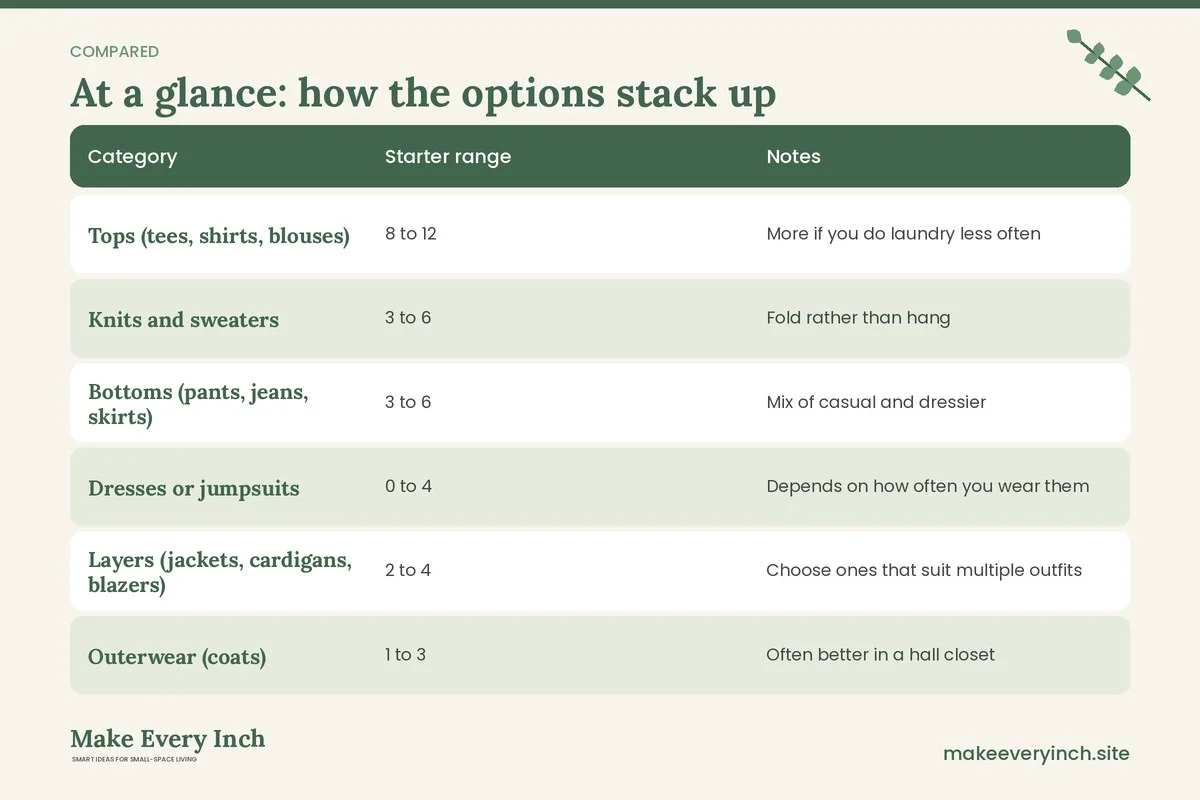
Category counts turn a vague wish into a plan. The ranges below are starting points only. Adjust them for your climate, your laundry habits and your job. If you do laundry weekly, you may need more tops than someone who washes twice a week. If you live where winters are long, your outerwear and knit counts will be higher.
| Category | Starter range | Notes |
|---|---|---|
| Tops (tees, shirts, blouses) | 8 to 12 | More if you do laundry less often |
| Knits and sweaters | 3 to 6 | Fold rather than hang |
| Bottoms (pants, jeans, skirts) | 3 to 6 | Mix of casual and dressier |
| Dresses or jumpsuits | 0 to 4 | Depends on how often you wear them |
| Layers (jackets, cardigans, blazers) | 2 to 4 | Choose ones that suit multiple outfits |
| Outerwear (coats) | 1 to 3 | Often better in a hall closet |
| Workout clothes | 3 to 6 sets | Use a drawer or bin |
| Sleepwear and loungewear | 2 to 4 sets | Drawer or under-bed box |
| Shoes | 4 to 8 pairs | Depends on activities |
| Bags and accessories | 2 to 4 bags | Hooks or a shelf |
These are not rules. They are a way to start. If you need 14 tops, that is fine, as long as they fit the closet without crowding. The point of the number is to expose the gap between what you own and what the space allows. If your closet holds 20 hanging items comfortably and you own 45, the capsule gives you a reason to choose.
The 70 percent rule
Aim to fill roughly 70 to 80 percent of your rod and shelf space. Full closets are hard to use because hangers jam and shelves topple. Leaving a margin makes it easy to put clothes away, lets garments breathe and gives you room for a new piece without a purge. If you hit 100 percent, you are back to the original problem.
Step 3: Measure the closet before you organize it
Measure the inside width, depth, height and the rod height. Write them on your phone. A typical reach-in closet is around 24 inches deep, and widths vary a lot, from 24 inches to 6 feet or more. Standard hanging clothes need about 22 to 24 inches of depth with the hanger turned to face the door, and many small closets are shallower. Shallow closets can still work if you use slim hangers and turn the hanger rod sideways, but check that doors can close.
- Hanging length: shirts and jackets need about 30 to 36 inches of drop. Pants folded over a hanger need 18 to 24 inches. Dresses and coats can need 48 inches or more.
- Rod spacing: hanging space per item is roughly 1 to 2 inches with slim hangers and 2 to 3 inches with bulky ones. A 36-inch rod holds around 15 to 25 slim-hanger items, depending on thickness.
- Shelf height: folded sweaters stack comfortably 10 to 12 inches high. Taller stacks lean and slide.
- Floor space: shoes need about 4 to 5 inches in width per pair, and boots take more.
A rough sketch of the closet on paper makes the plan easier. Mark the rod, the shelves, the door and any awkward corners. Then draw in your capsule categories and see what fits. If the rod is too short for dresses, put them at the end where the drop is longest or on the back of the door.
Step 4: Choose the right storage for each category
The best storage depends on how the clothes behave. Hanging suits items that wrinkle or that you wear weekly. Folding suits heavy knits and soft tees. Rolling suits workout clothes and sleepwear in drawers. Mixed storage lets you use every part of the closet.
Hang these
Blazers, button-up shirts, dresses, trousers you dislike creasing and anything you wear weekly. Hanging gives visual access: you see the outfit at a glance. Use slim, uniform hangers, since a single hanger type makes the rod tidy and saves a surprising amount of width. Avoid wire hangers for heavy coats. They can bend and leave marks on shoulders.
Fold these
Sweaters, knits and thick tees stretch on hangers, so fold them on a shelf or in a drawer. Stack folded knits no higher than 10 to 12 inches, and use a shelf divider to keep stacks from falling into each other. For a cleaner look, fold in thirds and file items upright when drawer depth allows. Our guide to best small dressers explains drawer sizes if you need extra folding space.
Roll or file these
Workout clothes, pajamas and socks fit in drawers or bins. Rolling saves space for soft fabrics, and filing them upright lets you see every item. If the closet has no drawers, use fabric bins on a shelf. Label them if two people share the shelf.
Hook these
Bags, belts, scarves and hats go on hooks. Over-the-door hooks and slim rails use space that is otherwise wasted. If you rent, a hook that hangs over the door needs no drilling. For more options, read our guide to no-drill storage ideas for renters.
Step 5: Use every layer of the closet
Vertical space is the most underused resource in a small closet. Most closets have a single rod and a high shelf, with the area between the rod and the floor empty. A capsule wardrobe usually has fewer long garments, which frees room for a second layer.
- Double hang: if most of your clothes are shirts, tops and folded pants, add a second rod about 36 to 40 inches below the first. Make sure the lower rod is not blocked by long items.
- Shelf above the rod: keep it for off-season boxes and bags. Keep heavy items low and light items high.
- Floor shelves or a small stack of drawers: these hold shoes, bags or folded items. Keep drawer units stable and do not overload them.
- Door space: a pocket organizer or hooks use the back of the door, but check clearance so the door still shuts.
For more ideas that use vertical space, see our post on vertical storage ideas and the guide to DIY closet organization for small spaces.
Safety notes for hanging and stacking
- Weight limits: a rod or shelf has a rated load. Closet rods can bow or pull from their brackets if overloaded, especially with a double row of heavy coats. Check manufacturer limits, avoid loading a rod past the point where it visibly sags and spread heavy items across supports.
- Anchoring tall units: any freestanding tower, shelving unit or tall dresser that can tip should be anchored to the wall with the correct hardware, especially if children or pets are in the home. Fill drawers from the bottom up, and open only one drawer at a time.
- Drilling and hanging hardware: never drill into walls, doors or ceilings without permission if you rent. Check your lease and ask in writing. Tension rods and over-the-door hooks are lower-risk alternatives, though they also have weight limits.
- Over-the-door items: check that the door still closes, and keep sharp hooks away from where a child can reach.
Step 6: Plan for off-season storage
A capsule wardrobe works best when it is seasonal. You keep the current season in the closet and store the rest out of the way. This keeps the daily closet small and makes each change of season feel like a refresh.
What counts as off-season
Heavy coats, thick knits, swimwear, sandals, shorts or holiday outfits depending on climate. People who live in mild climates may only need to swap a few items, and some may not need to swap at all. Do not force a rotation if you wear year-round clothes.
Where to put them
- Under the bed: shallow, lidded boxes or rolling bins hold knits, accessories and folded clothes. See our guide to under-bed storage ideas for dimensions and styles.
- Top shelf of the closet: use fabric boxes with handles, so you can pull them down without a pile sliding. Keep each box under a weight you can lift comfortably overhead.
- A trunk or an ottoman: a storage trunk at the foot of the bed doubles as seating and holds blankets and swaps.
- Vacuum bags: they save space but are not for everything. Compression can flatten down, feathers and some wools, and long-term compression may damage fibers. Use them for sturdy synthetic items and check the label.
How to store clothes safely
Wash or dry-clean everything before storing it. Stains and body oils attract pests and set over time. Make sure items are fully dry to avoid mildew, and keep boxes away from damp walls and floors. Breathable fabric boxes or cardboard are better than sealed plastic for natural fibers, because trapped moisture can cause mustiness.
Be careful with moth deterrents. Traditional mothballs contain chemicals that can be harmful if breathed in or swallowed, and they are especially risky around children and pets. If you use any chemical product, follow the label exactly, store it where nobody can reach it and consider ventilation. Cedar blocks or sachets are a common alternative, though they work best as a mild deterrent and their scent fades over time, so refresh them according to the product’s instructions. Clean storage and sealed containers for wool are often more effective than any scent. If you see signs of an infestation, wash or freeze the affected items according to care labels and clean the area.
If you paint or refinish a shelf or box, choose a low-VOC finish, ventilate the room and let it cure fully before putting clothes inside.
Step 7: Write your edit rules
Edit rules are what keep a capsule from drifting back into clutter. They should be simple enough to remember and flexible enough to follow.
- One in, one out: when you bring in a new piece, one leaves in the same category.
- The category cap: each category has a limit. If it is full, you cannot add without removing.
- The 30-day pause: wait 30 days before buying a non-essential item. If you still want it, check that it fits your palette and that you have something to pair it with.
- The three-outfit test: a new piece should work with at least three things you own.
- The seasonal review: at each season change, look at what you wore and what you did not. Move unworn items to a donate bag.
- The hanger flip: keep the reverse hanger test running year-round.
- A donate bag by the door: any item that does not feel right goes into the bag the day you notice it, so you do not reconsider.
Edit rules work best when written down. Put them on a sticky note inside the closet door or in your phone. Share them with a partner if you share the closet.
Three example closets
A 3-foot reach-in with one rod and one shelf
This closet has about 36 inches of rod. Hang 12 to 18 items on slim hangers: shirts, a couple of dresses, two jackets and trousers. Use the shelf for four or five folded sweaters and a box of accessories. A small shoe rack on the floor holds four to six pairs. Off-season pieces go in a lidded box under the bed. Use a hook on the back of the door for a bag and a robe. This closet has no space for a second rod unless you reduce the length of hanging items, so the capsule has to be lean.
A 5-foot reach-in with sliding doors
With a wider closet, you can split the rod into two parts: long items on one side and a double rod of shorter items on the other. Remember that sliding doors only let you reach half the closet at a time, so put the most worn pieces in the part you open first. The top shelf holds off-season boxes. The floor holds a shoe rack and a basket for laundry. This layout supports a capsule of roughly 40 to 60 pieces, depending on thickness.
A wardrobe with no closet
Many small bedrooms lack a closet. A freestanding wardrobe or a clothing rail with a small dresser can take its place. Place the wardrobe against a wall and anchor it. Use the rail for hanging items and the dresser for folded ones. Add a bench with storage at the foot of the bed for off-season items. For more ideas, see our post on small bedroom storage ideas. A rail looks open and airy, so keep it tidy, using one color family and consistent hangers.
Mistakes to avoid
- Buying organizers first. Measure and edit before you buy any bins. Otherwise you organize clutter.
- Setting a number that does not fit your life. If you need work clothes and gym clothes, count both.
- Overpacking the rod. Crowded clothes crease and make dressing harder.
- Forgetting laundry. A capsule needs enough pieces to last between washes, or you will end up running out.
- Storing damp or unwashed items. This invites mildew and pests.
- Ignoring shoes and bags. They take more space than you think, so include them in the plan.
- Treating the capsule as permanent. Bodies, jobs and seasons change. Review every few months.
Capsule storage checklist
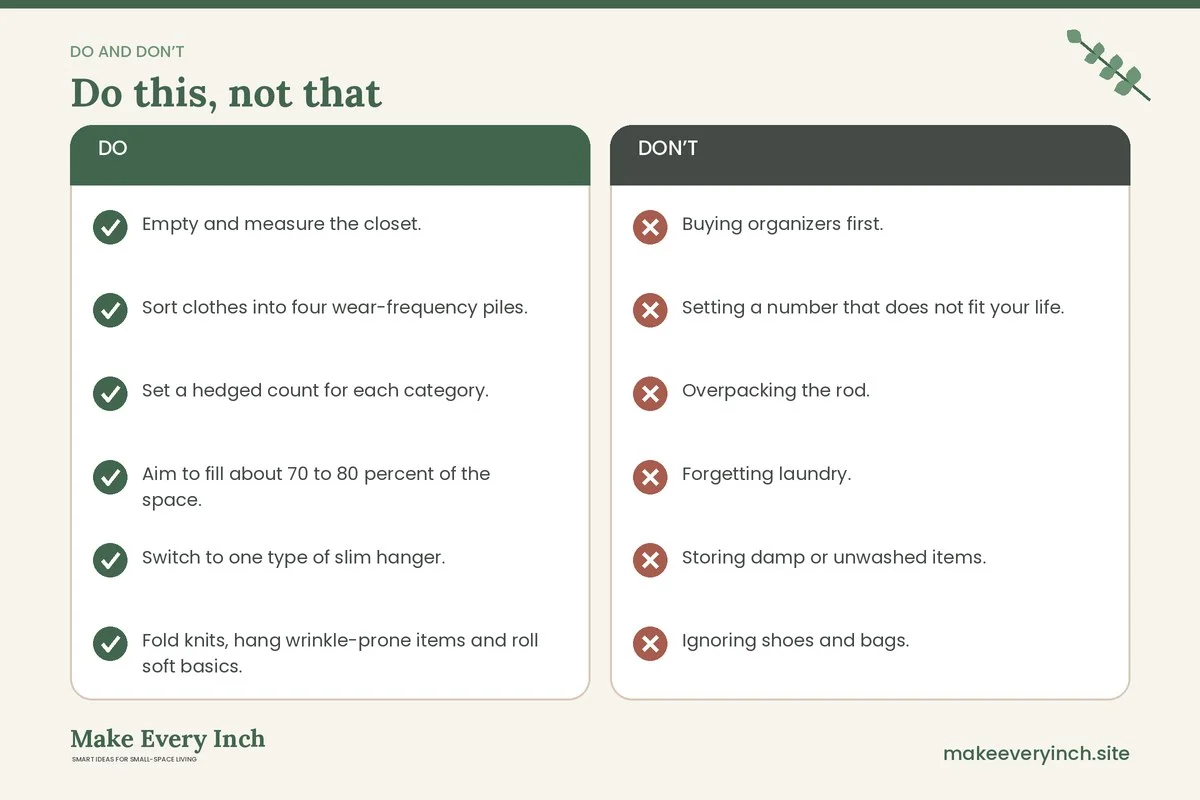
- Empty and measure the closet.
- Sort clothes into four wear-frequency piles.
- Set a hedged count for each category.
- Aim to fill about 70 to 80 percent of the space.
- Switch to one type of slim hanger.
- Fold knits, hang wrinkle-prone items and roll soft basics.
- Add a second rod or shelf if there is room.
- Check rod and shelf weight limits.
- Anchor tall furniture.
- Choose breathable boxes for off-season clothes.
- Wash everything before storing.
- Write your one-in, one-out rule where you can see it.
- Review at every season change.
FAQ
How many clothes should be in a capsule wardrobe?
There is no single number. Many people use a range of about 25 to 50 pieces for everyday clothing, but your climate, job and laundry routine matter more than any figure. Start with category ranges and adjust.
Do shoes and accessories count?
It helps to count them separately, because they take different storage. Give shoes and bags their own ranges so they do not crowd out clothing.
How do I store a capsule wardrobe with no closet?
Use a freestanding wardrobe or a clothing rail with a dresser or storage bench. Anchor tall pieces to the wall, and keep the rail tidy with matching hangers. Our guide to small space organization ideas can help you find room.
What is the best way to store off-season clothes?
Wash them, dry them fully and store them in breathable boxes under the bed or on a high shelf. Avoid damp areas, and check the care label before using compression bags.
Are mothballs safe to use?
Mothballs contain chemicals that can be harmful, so use them only as directed on the label, keep them out of reach of children and pets and ventilate the area. Many people prefer clean storage and cedar as gentler options.
How do I stop my capsule wardrobe from growing again?
Keep an edit rule such as one in, one out, set category caps and review each season. Writing the rules down makes them easier to follow.
Can a capsule work in a rental?
Yes. Use tension rods, over-the-door hooks, freestanding racks and under-bed boxes, and ask before you drill anything into walls or doors.
Keep going: Keep going with our pillar on small closet ideas, the guide to small closet organization ideas and the roundup of minimalist apartment ideas.
Save this guide for later
Pin the ideas you like to Pinterest so you can come back to them when you plan your space.