Small Dining Room Lighting Ideas
Quick answer: The best small dining room lighting ideas layer one main light over the table with a dimmer, a warm glow at the edges and, for renters, plug-in options that need no wiring. Hang a pendant roughly 28 to 36 inches above the tabletop, choose warm bulbs around 2700 kelvin, shield the bulb to cut glare and let the lamp stay well clear of fabric. Ask an electrician about any hardwired change.
Small dining room lighting ideas matter more than most people expect, because a small dining space is usually one room doing several jobs. The same table hosts breakfast, homework, a laptop session and a Saturday dinner for four. One harsh ceiling light turns all of those into the same flat, bright scene, while a layered plan lets the room change with the hour. This guide covers how to plan the light over a small table, how high to hang a pendant, how to use dimmers and warm bulbs, what plug-in options exist for renters, how to avoid glare and heat, and which electrical safety rules deserve respect. It ends with a comparison table, three example rooms, a checklist and a FAQ. For the full approach to the space, start with our pillar on small dining room ideas, and read the companion post on small dining room wall decor ideas once the light is settled.
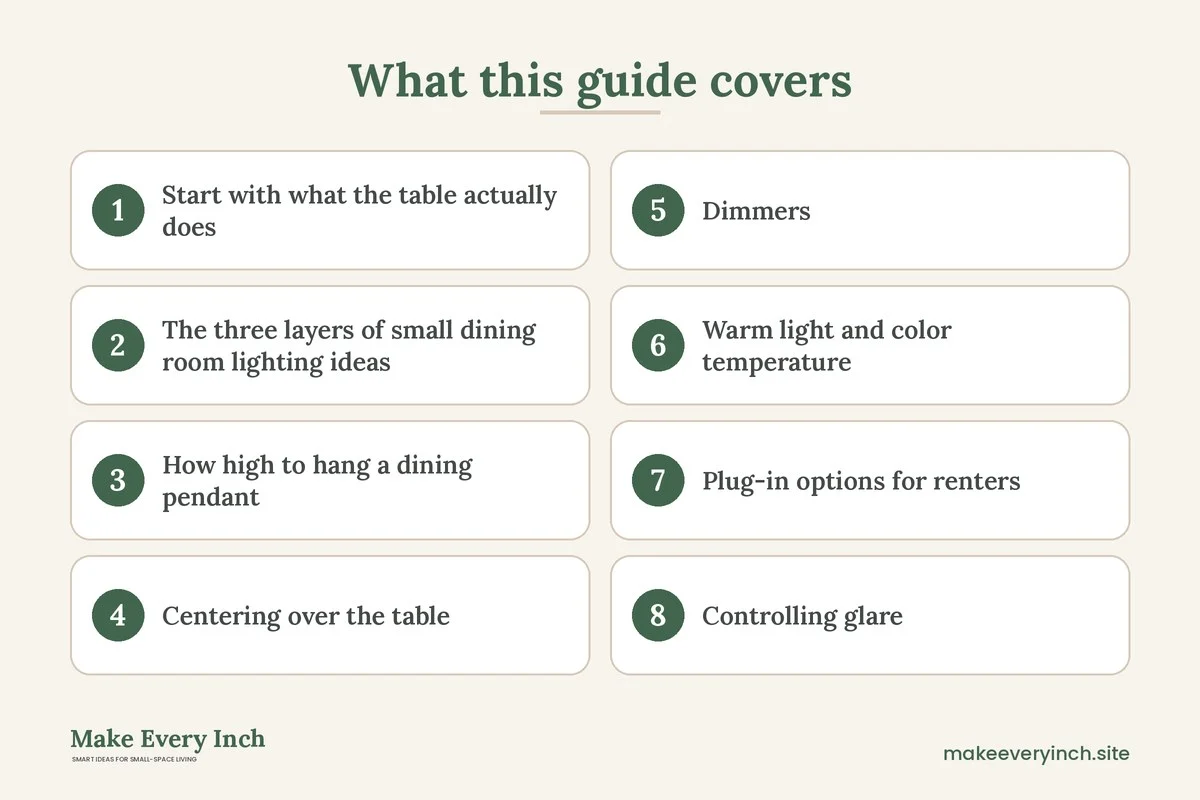
Start with what the table actually does
Before choosing a fixture, write down the jobs your table performs. A table used only for dinner needs soft, low light. A table used for work needs brighter, more even light that does not cast a shadow on the keyboard. A table in a studio may sit beside a kitchen or a sofa, so it also acts as a visual divider. Most small dining rooms need both modes, which is why one switch and one bulb are rarely enough.
Next, look at the room itself. Note where the ceiling box sits. In many rentals the ceiling fixture is not centered over the table, because the table was added later. Note the color of the walls and the ceiling, since pale surfaces bounce light and dark ones absorb it. Note the window position, because a table near a window gets daylight but may also get glare on a screen in the afternoon. These small facts decide whether you need a swag pendant, a rail, a wall light, a lamp on a sideboard, or all of them.
The three layers of small dining room lighting ideas
A small room benefits from three layers, even if each layer is modest.
- Main light: a pendant, a flush fixture or a small chandelier that lights the table. This does the heavy lifting.
- Accent light: a lamp on a sideboard, a wall sconce or a picture light that lights the edges of the room and makes the walls glow.
- Task or mood light: a candle-like lamp on the table, a clip light on a shelf or a small portable light for a card game.
You rarely need all three at full strength. Often a dimmable main light plus one lamp on a side surface is enough, and the lamp is what makes the room feel warm at night.
How high to hang a dining pendant
Pendant height is the question most people ask first, and it has a reasonable range rather than a single exact answer. A common guideline is to hang the bottom of the fixture roughly 28 to 36 inches above the tabletop. Within that range, think about three things.
First, ceiling height. In a room with a standard 8 foot ceiling, many people land near the lower half of the range, around 30 to 34 inches. In a room with a taller ceiling, they raise the fixture a few inches so it still looks proportioned to the room. If your ceiling is lower, aim for the upper part of the range to keep heads clear, but check that the fixture does not look as if it is touching the ceiling.
Second, the size of the shade. A wide, shallow shade can hang a little higher without blocking sight lines across the table. A tall, narrow fixture needs to sit higher so diners can see each other across it. A good test is to sit down at the table and look at the person opposite. If the fixture cuts across their face, raise it.
Third, the visible bulb. A bare or clear bulb at eye level is uncomfortable, so aim for a diffused shade or a fixture where the bulb sits inside a shell. The glow should feel soft, not sharp.
For width, a common guideline is a fixture about one half to two thirds the width of the table, so a 30 inch round table suits a fixture around 15 to 20 inches wide. For a rectangular table, a linear fixture or a pair of small pendants about one third of the way in from each end often works well. These are rules of thumb, not laws. Hold a paper template at the intended height before you commit to the change.
Centering over the table
Hang the pendant over the center of the table, not over the center of the room. In a small room where the table sits against a wall or in a corner, the fixture may need to move several feet from the existing ceiling box. A swag kit with a plug and a ceiling hook allows this without moving wiring, but the cord must be routed safely, as covered in the safety section below. If the table is on a banquette, the light should favor the table, not the walkway.
Dimmers: the cheapest way to change the room
A dimmer lets one fixture act as a work light at noon and a candle-like glow at dinner. In a small dining room, this is often the single most useful upgrade. Several types exist.
- Wall dimmer replacing the switch: this is a wiring change, so it is a job for a licensed electrician or for a landlord, and it needs a lease check.
- Plug-in dimmer: a small device that sits between a lamp and the outlet. It needs no wiring, though you must check that it suits the lamp and the bulb.
- Smart bulb or smart plug with a dimming feature: an app or remote controls the brightness. It needs no wiring, but the bulb must be labeled as dimmable.
- Lamp with a built-in touch dimmer: many table and floor lamps have steps built in.
The key rule is compatibility. A dimmer must suit the load and the bulb type. LED bulbs need to be labeled as dimmable, and the dimmer may need to be a type designed for LEDs. A mismatch can cause flicker, buzzing or a bulb that never dims smoothly. Read the packaging on both items and follow it. If you are not sure, ask a store assistant or an electrician.
Warm light and color temperature
Light color is measured in kelvin. Lower numbers look warmer, higher numbers look cooler. For dining, a warm white around 2700 kelvin is a common choice because it flatters food and skin and feels relaxed. Around 3000 kelvin feels a little crisper. Higher numbers, such as 4000 or above, can feel clinical at a dinner table, though they can suit a work-from-home table in daytime.
Keep every bulb in the room at a similar color temperature, so the pendant and the lamp do not fight. Also look at the color rendering index, which describes how accurately a bulb shows colors. A higher number generally makes food and wood look more natural. Packaging often lists it.
Brightness is measured in lumens. A small dining room often feels comfortable with a modest total, and a dimmer lets you adjust. As a rough guide, many people aim for a total across the dining area in the range of a few hundred to around a thousand lumens, then fine-tune by eye. Treat that as a starting range rather than a rule, and remember that a fixture’s rating limits matter more than the number you are chasing.
Plug-in options for renters
Many small dining rooms are in rentals with a single builder-grade ceiling light, no sconce wiring and a lease that bans drilling. The good news is that you can build a layered scheme without touching the wiring.
Plug-in swag pendants
A swag pendant has a long cord and a plug. You hang it from a ceiling hook and run the cord along the ceiling and down a wall to an outlet. Check the lease before installing any hook, because a screw in the ceiling is a permanent hole. Where a hook is not allowed, a floor lamp with an overhead arc can place a shade above the table, and it needs no hole at all.
Plug-in wall sconces
A sconce with a plug and a cord can mount with a screw into a stud or with a removable adhesive if it is light enough. If you cannot drill, choose a lightweight one and check the weight rating on the adhesive. Cord covers that match the wall color hide the line, and a paintable cover blends in.
Table and sideboard lamps
A lamp on a sideboard or shelf adds warm accent light with no fixing at all. A pair of small lamps on a console reads as a deliberate scheme. Choose a lamp whose shade is wide enough to hide the bulb from seated eye level.
Rechargeable lamps
A cordless lamp has a built-in battery and sits on the table or a shelf. It is good for a candle-like glow at dinner and for renters with no outlet near the table. Read the manual to learn how long a charge lasts, and check that the lamp is stable and cannot be knocked over easily.
Clip lights and picture lights
A battery or plug-in picture light above an art piece gives a soft glow along a wall. Choose a battery type if there is no outlet, and replace batteries on schedule. Do not leave a battery light on in a closed cabinet without checking that it is rated for that use.
Strip lights
LED strips under a shelf or behind a sideboard add a glow on the wall. Use the adhesive carefully, test it on an out-of-sight spot and keep in mind that adhesive may mark paint. Use a strip with a proper power supply, not a homemade connection.
Controlling glare
Glare is the sharp, tiring brightness that comes from a bare bulb or a shiny surface. In a small room it is easy to create, because the table is close to every light source. Several fixes help.
- Use diffusers and shades: frosted glass, linen or paper shades soften the light and hide the bulb.
- Choose a lower-output bulb: a bulb that is too bright for a small shade is the most common cause of glare. Many bulbs are available in lower lumen outputs.
- Raise or lower the fixture: if the bulb sits at eye level when you are seated, glare is almost certain.
- Reduce shiny surfaces: a glossy table or glass top reflects the bulb back at you. A tablecloth, runner or placemat breaks the reflection.
- Add side light: light that comes from two directions softens shadows and makes each single source feel less harsh.
- Mind the window: a table near a window may gather glare on a screen. Sheer curtains diffuse daylight, and angling a laptop away from the window helps.
Another point is shadows. A single overhead light can cast shadows under the eyes of people at the table, which looks unflattering. A little side light fills that in.
Bulb heat and fixture ratings
Every fixture and lamp has a maximum wattage or a bulb type listed on a label, usually near the socket. Follow it. Heat builds up in enclosed shades and glass globes, and a bulb that is too strong for the fixture can scorch the shade or damage the wiring over time. LED bulbs usually produce less heat than older types, which makes them a common choice for small rooms, but they still warm up, especially in enclosed fixtures. Look for a bulb labeled as suitable for enclosed fixtures if the shade is closed.
Keep paper shades, fabric and decorations away from the bulb. A paper lantern should have a safe distance between the bulb and the paper, and tea candles should never be used as a substitute for a lamp near hangings. Never cover a lamp with cloth to dim it. Dimmable bulbs and a proper dimmer do that job safely.
If a fixture is warm to the touch after several hours, that is normal to a degree, but if it smells hot, flickers, hums or discolors, switch it off, unplug it and replace or inspect it before using it again.
Electrical safety for a small dining room
Dining rooms combine food, drinks and electricity, so a few rules are worth following.
- Never overload an outlet or a power strip. Check the ratings of both and avoid chaining strips together. Use one strip with a built-in protection feature if you need extra sockets, and keep it off the floor where a spill could reach it.
- Route cords where nobody trips. A cord that crosses a walkway or hangs beside a chair is a hazard. Use cord covers along walls and keep cords from running under rugs.
- Keep cords away from heat and from children and pets. A dangling swag cord near a high chair or a toddler’s reach is an invitation to pull. Secure it high and tight.
- Do not hang heavy fixtures from adhesive hooks. A pendant needs a proper ceiling hook or box rated for its weight. If you do not know what the ceiling can hold, ask a professional.
- Respect hardwired work. Replacing a ceiling fixture, adding a dimmer or installing a sconce on a wall circuit is electrical work. In many places it must be done by a licensed electrician, and a rental needs the landlord’s permission. Turn off the circuit at the breaker, not only at the switch, before anyone touches the wiring.
- Keep liquids away from outlets and plugs. A candle-lamp or a plug-in light on a sideboard should sit where a tipped glass cannot reach.
- Check the lamp’s certification mark. Look for a recognized safety mark on the plug or label, and avoid damaged cords or loose plugs.
- Check smoke alarm clearance. Do not hang a fixture so close to a detector that it interferes with it.
- Never drill or screw into a ceiling or wall without permission. Leases often bar it. If you must make a hole, ask first in writing.
None of this is a substitute for local code or for a qualified electrician’s advice. If you are unsure, ask.
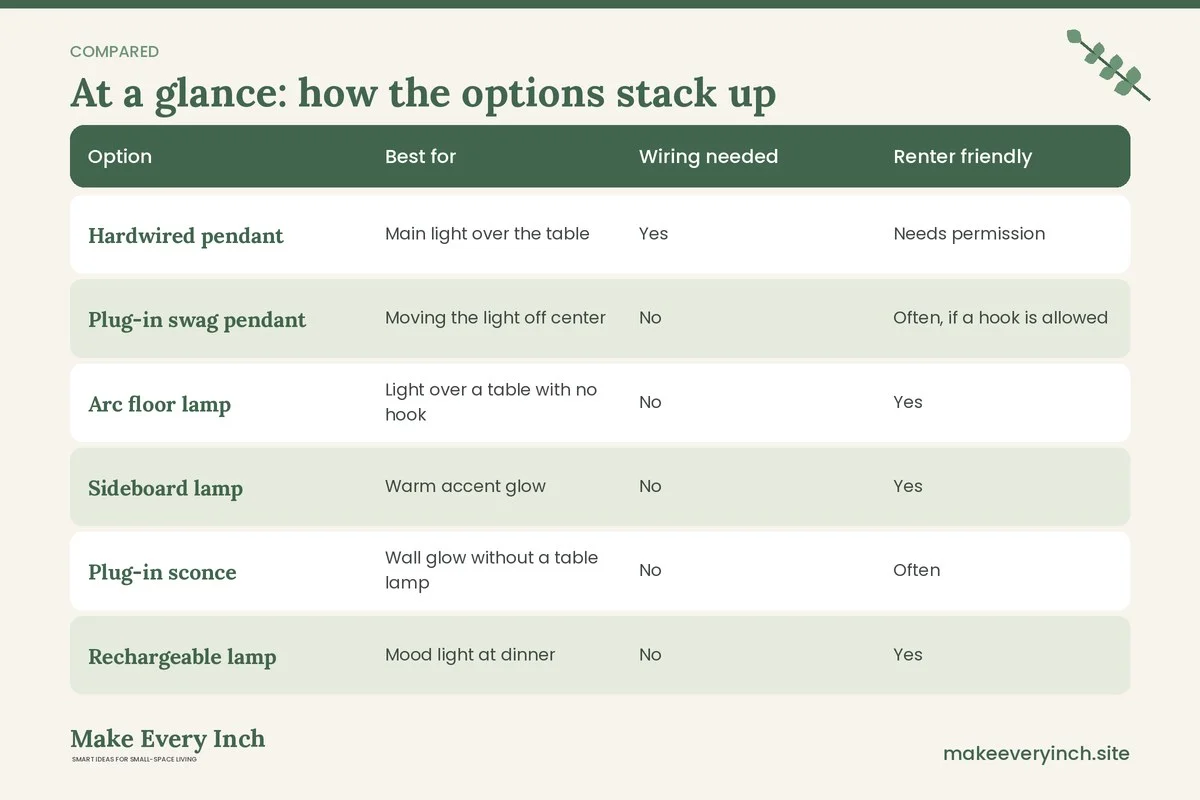
Comparison table: dining light options for small rooms
| Option | Best for | Wiring needed | Renter friendly | Watch out for |
|---|---|---|---|---|
| Hardwired pendant | Main light over the table | Yes | Needs permission | Height and ceiling box |
| Plug-in swag pendant | Moving the light off center | No | Often, if a hook is allowed | Cord routing |
| Arc floor lamp | Light over a table with no hook | No | Yes | Base stability |
| Sideboard lamp | Warm accent glow | No | Yes | Shade hides the bulb |
| Plug-in sconce | Wall glow without a table lamp | No | Often | Cord cover and mounting |
| Rechargeable lamp | Mood light at dinner | No | Yes | Battery life and stability |
| LED strip | Shelf or sideboard glow | No | Depends on adhesive | Heat and adhesive marks |
| Picture light | Lighting wall art | Sometimes | Often | Battery or cord |
Three example rooms
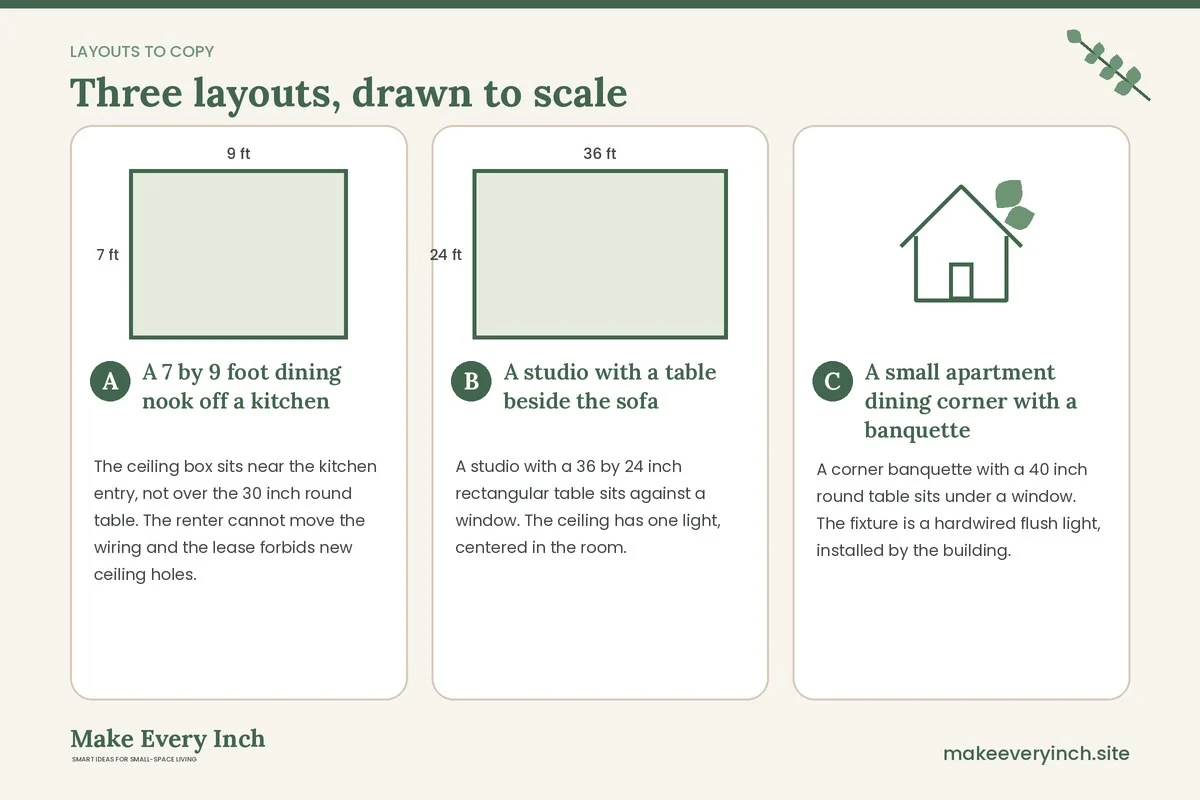
A 7 by 9 foot dining nook off a kitchen
The ceiling box sits near the kitchen entry, not over the 30 inch round table. The renter cannot move the wiring and the lease forbids new ceiling holes. The plan is a plug-in arc floor lamp placed beside the table with its shade over the center, plus a small lamp on a shelf and a plug-in dimmer on the floor lamp if the lamp type allows it. The existing ceiling light stays off at dinner and on for cleaning. Cords run along the wall behind the table with a cord cover. The result is a warm table light with no new holes.
A studio with a table beside the sofa
A studio with a 36 by 24 inch rectangular table sits against a window. The ceiling has one light, centered in the room. The tenant adds a warm lamp on a console behind the sofa, a small pendant on a swag cord over the table where the lease allows a hook and a smart bulb that dims in the evening. The sofa side gets its own lamp so the dining table does not light the entire room. The dimmer is the key tool because the same table is a desk by day and a dinner table by night.
A small apartment dining corner with a banquette
A corner banquette with a 40 inch round table sits under a window. The fixture is a hardwired flush light, installed by the building. The tenant asks the landlord for permission to swap it for a small drum pendant at a modest height, and gets approval in writing. An electrician handles the work and installs a dimmer. A pair of sconce-style plug-in lights flanks the window, and cords are covered along the wall. A pale shade keeps glare low, and the banquette cushions absorb sound. The whole scheme stays within the lease.
Matching light to the table shape
Shape changes the best fixture. A round table loves a single round pendant centered over it. A rectangular table suits a linear fixture or two small pendants. A square table works with one fixture centered. An oval table may favor a pair of smaller pendants spaced along its length. A drop-leaf table that changes size benefits from a light that sits over the center when closed and does not clash with the leaves when open. If you plan to move the table, a floor lamp with an arc, or a plug-in swag you can shift, is more flexible than a fixed fixture.
See our guide to the best small dining tables for size and shape ideas, and our post on studio apartment dining area ideas for ways to zone a table within an open room.
Lighting the rest of the dining area
A small dining room often connects to a kitchen or a living room, so lighting should flow. Match the color temperature of the kitchen under-cabinet lights and the dining pendant, so the two spaces do not look like different rooms. Our post on small kitchen lighting ideas covers task light for counters, and small living room lighting ideas shows how to extend the same warm scheme into the next room. If the dining area is part of a kitchen plan, our guides to small apartment kitchen ideas and small kitchen ideas cover the surrounding layout.
Mistakes to avoid
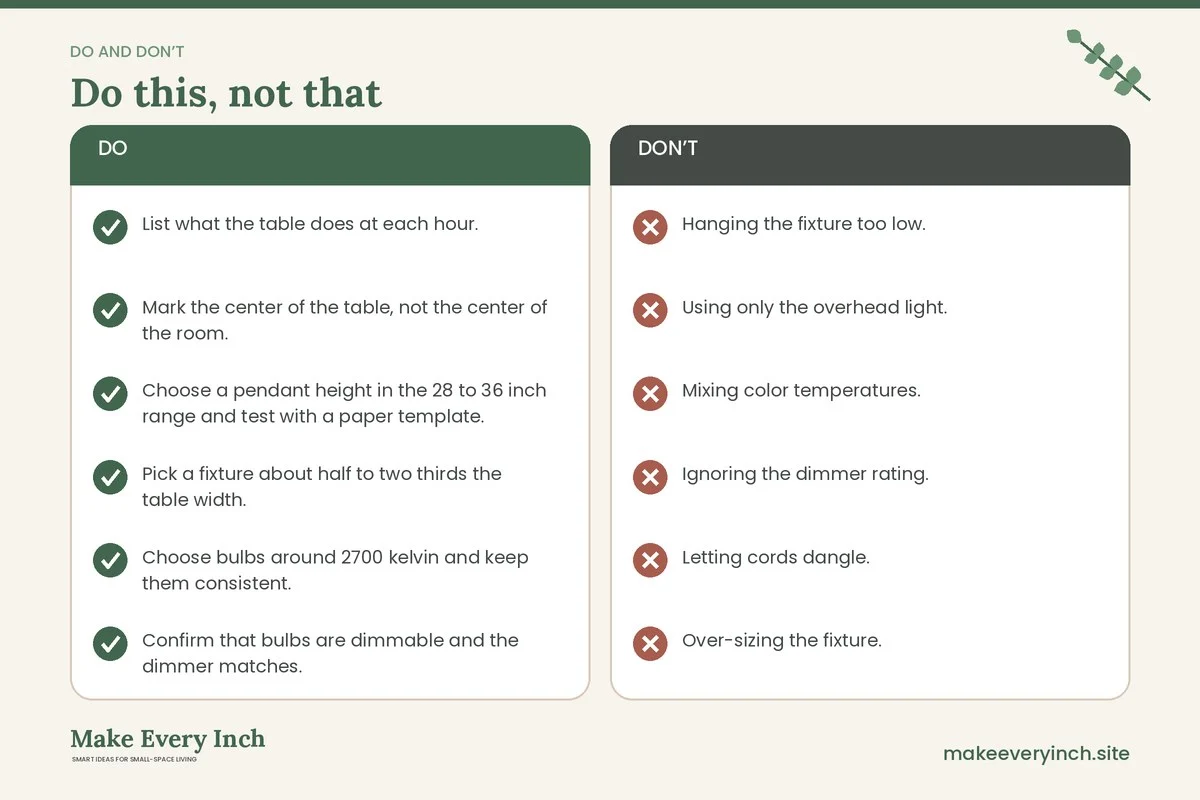
- Hanging the fixture too low. A pendant that blocks the view across the table feels heavy in a small room.
- Using only the overhead light. One source flattens the room and creates shadows.
- Mixing color temperatures. A cool bulb beside a warm one looks accidental.
- Ignoring the dimmer rating. A mismatch causes flicker.
- Letting cords dangle. They are a trip, tug and tidy hazard.
- Over-sizing the fixture. A large chandelier crowds a small ceiling and can feel dominating.
- Forgetting the lease. Hooks, screws and wiring changes need permission.
- Skipping the shade. An exposed bulb at eye level is the main cause of glare.
Seasonal and daily tweaks
Light needs change through the day and across the year. In winter, evenings are long and a warm lamp matters more. In summer, daylight reaches the table later, and you may only need accent light. Create a simple routine: main light dimmed at dinner, side lamp on after eating, everything off at bedtime except a small night light if needed. A timer plug on a lamp, rated for the load, can switch it on at dusk. Check that any timer suits the lamp, and keep it clear of liquids.
Checklist
- List what the table does at each hour.
- Mark the center of the table, not the center of the room.
- Choose a pendant height in the 28 to 36 inch range and test with a paper template.
- Pick a fixture about half to two thirds the table width.
- Choose bulbs around 2700 kelvin and keep them consistent.
- Confirm that bulbs are dimmable and the dimmer matches.
- Add at least one lamp on a side surface.
- Use shades or diffusers to hide the bulb.
- Check the label for the maximum bulb rating and obey it.
- Keep cords off the floor and away from chairs and children.
- Do not overload outlets or chain power strips.
- Ask the landlord and an electrician before any hardwired change.
- Do not drill or screw into the ceiling or walls without permission.
FAQ
How high should a pendant hang over a small dining table?
A common guideline is roughly 28 to 36 inches above the tabletop. Adjust for ceiling height, shade size and sight lines, and test before you finalize.
What kind of bulb is best for a dining room?
Many people prefer a warm white around 2700 kelvin, with a dimmable LED labeled as suitable for the fixture. Match the color temperature across all lights.
Can I add a dimmer in a rental?
A plug-in dimmer or a smart bulb needs no wiring. Replacing a wall switch is electrical work that needs permission and often a licensed electrician.
What are the best plug-in options?
Arc floor lamps, sideboard lamps, plug-in swag pendants, plug-in sconces and rechargeable lamps. Each avoids hardwiring, though a swag hook still needs permission.
How do I stop glare on the table?
Use a shade or diffuser, a lower-output bulb, a tablecloth or runner and a second light source. Make sure the bulb is not at eye level.
Is it safe to use a paper shade near a bulb?
Only if the bulb type and wattage suit the shade and there is clear space between them. Follow the fixture label and avoid hot bulbs near paper.
Do I need an electrician?
For any hardwired change, such as replacing a fixture or switch, yes in most places. Ask the landlord first if you rent.
Keep going: Keep planning with our small dining room ideas pillar, the companion guide to small dining room wall decor ideas and our small space organization ideas.
Save this guide for later
Pin the ideas you like to Pinterest so you can come back to them when you plan your space.