Best Storage Beds for Small Bedrooms
Quick answer: The best storage beds for small bedrooms are the ones whose storage can actually be opened in your room. Measure the clearance first: a drawer bed needs roughly the drawer’s depth plus 24 to 30 inches of floor in front of it, while a lift-up bed needs about 36 inches at the foot or side for the frame to swing. Choose drawers for a tight room with a daily-use wardrobe, a lift-up frame for bulky seasonal items, and a platform with open cubbies when you want light weight and easy cleaning.
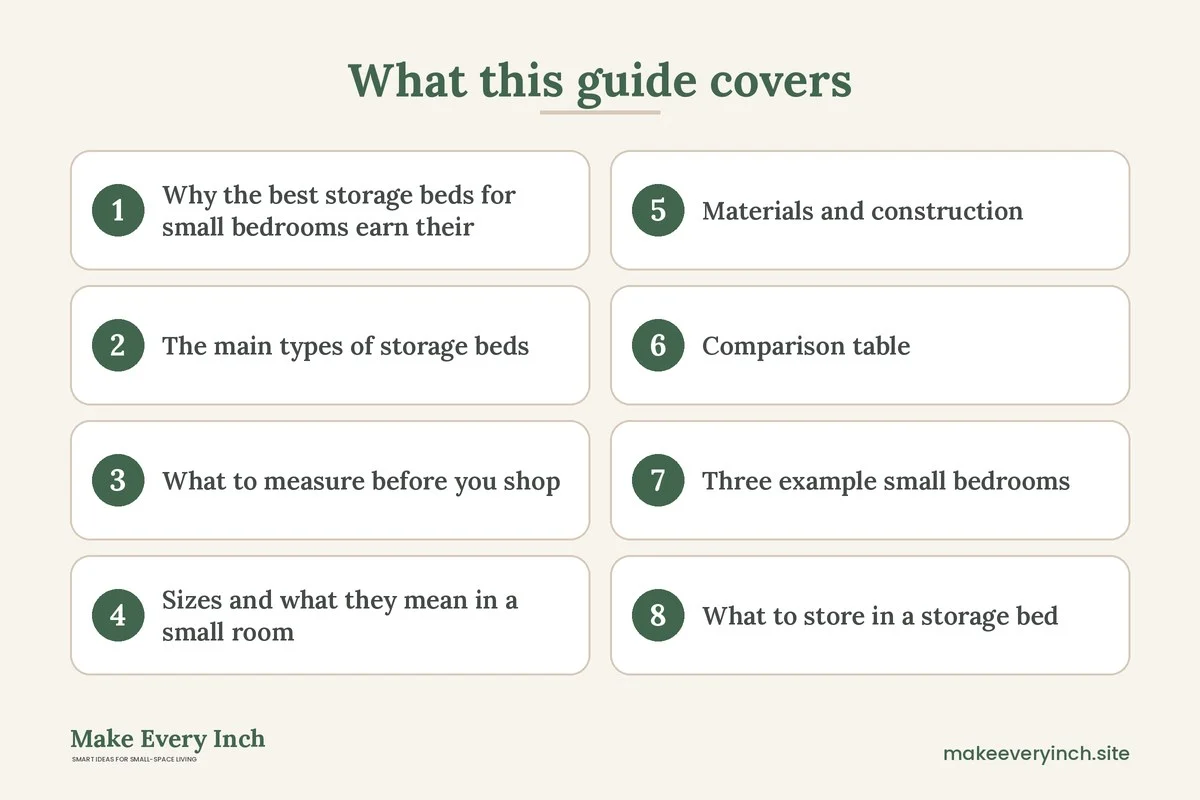
The best storage beds for small bedrooms can turn a single piece of furniture into a dresser, a closet extension and a luggage room, but only if the design matches the space. A storage bed that cannot open fully is just a heavy, expensive platform. This is a buying guide, not a list of products. It explains what to look for, the sizes and clearances that matter, the materials and mechanisms, the trade-offs between the main types, and how to match a frame to your room. It also includes a comparison table, three example bedrooms, a safety section, a pre-purchase checklist and an FAQ. For the wider picture of choosing furniture for compact homes, start with our pillar guide to the best furniture for small apartments. If you want a shorter list of options, our companion post on the best beds with storage covers the basic choices, while this guide goes deeper into fit, clearance and room planning.
Why the best storage beds for small bedrooms earn their footprint
A bed is the largest object in most bedrooms. A queen mattress is about 60 by 80 inches, which is roughly 33 square feet before you add a frame, and a full is about 54 by 75 inches. In a bedroom of 10 by 10 feet, the bed can take up a third of the floor. The area under the mattress is usually the only large volume left unused, and the space between a standard frame and the floor is often 8 to 14 inches high. A storage bed puts that volume to work, and it can free space elsewhere. Moving seasonal clothes, spare bedding and shoes under the mattress can let you drop a dresser, and in some rooms that gains 12 to 20 square feet of floor.
The trade-off is that storage beds are heavier, deeper and more rigid than basic frames. They can also raise the mattress height, restrict air flow under the mattress, and make the room feel more crowded if the frame is bulky. The best choice is a frame that earns its footprint, with storage you will actually use each week. The rest of this guide helps you decide what that looks like.
The main types of storage beds
Drawer beds
A drawer bed has one to six drawers built into the base, usually on one or both long sides or at the foot. Drawers are easy to reach, they hold clothes, shoes and linens in a way that is easy to sort, and they suit daily use. The main limit is clearance. Each drawer needs to roll out its full depth, and drawer depth runs from about 18 to 24 inches for typical sets. You need that depth plus space to stand and bend, so plan on 24 to 30 inches of floor in front of each drawer front. A bed with drawers on both sides needs that clearance on both sides, which is hard to find in a room under 11 feet wide.
Foot-end drawer beds are a good option for a bed pushed against a wall on both sides, since the drawers open toward the room’s entry. They need a clear 30 inches or more at the foot, and that can conflict with a door swing or a dresser.
Lift-up or gas-lift beds
A lift-up bed uses a hinged base to raise the mattress and the slats together, exposing a single open cavity that runs the full length of the bed. Gas struts or springs hold the platform open. This gives the most storage volume, often much more than drawers, because there are no dividers and no drawer boxes. It suits bulky and seasonal items such as duvets, suitcases, winter coats and spare pillows. The trade-offs are access and effort. You must lift the whole mattress, and you must remove the bedding to do it. It is a poor choice for everyday items, and it also needs clearance to swing, about 36 inches at the foot or at the side that lifts, plus some headroom if the room has a sloped ceiling.
The lifting action also raises safety concerns, covered below, since a gas strut can fail or release suddenly if it is old or overloaded.
Platform beds with cubbies or open shelves
A platform bed with open cubbies or a low shelf along the side holds baskets, books and shoes without drawers or lids. It is lighter than a drawer bed, it has no moving parts, and it is simple to clean. Open storage is also easier to put into a rental, since the frame often ships flat and assembles with a few bolts. The cost is visual clutter. Open cubbies look neat only if you use matching baskets or bins.
Headboard storage
Many storage beds add shelves, cabinets or a ledge to the headboard. A headboard with a built-in shelf can replace one or two nightstands. That gains floor space in a narrow room, since each nightstand takes 14 to 20 inches along the wall. Look for a shelf depth of at least 6 inches for a phone and a small lamp, and a depth of 8 to 10 inches if you want to hold a book and a glass of water. Check where the headboard sits relative to the wall and the outlets.
Ottoman and storage-footed frames
An ottoman bed is a variation of the lift-up type, with an upholstered base that lifts from the side or foot. A bench at the foot of a bed can also hold blankets or shoes. A bench is a lighter, cheaper way to get a little storage with a standard frame, and it can be moved when needed. For other multiuse seating, see our guide to the best storage ottomans.
Divan and box-base frames
A divan or box-base bed has a solid base with drawers built in, and the mattress rests directly on top. It usually has no headboard unless you add one. The solid base gives firm support and can be very strong. The mattress can run hot on a solid base, since air has limited paths around it, so many people prefer a frame with a slatted or vented top.
What to measure before you shop
Measuring is the step that most shoppers skip, and it is the step that decides whether a storage bed works. Use a tape measure and a pad of paper, and record the following.
- Room width and length: write down the interior dimensions, and mark the door, closet door, windows and radiators.
- Door swings and drawer fronts: a door that swings into the room can block a drawer or a lift-up frame. Note how far the door opens, and whether the closet door clears the foot of the bed.
- Walkway: aim for at least 24 inches on the side you use most, and 30 to 36 inches if you can spare it. A 24-inch path is a minimum for one person, and it is tight when the drawer is open.
- Ceiling and slope: a lift-up frame, or a bed with a tall headboard, needs headroom. Under a sloped ceiling, check the point where the headboard sits.
- Mattress thickness: the combined height of the frame and the mattress should let you sit with your feet on the floor. A frame height of 12 to 18 inches plus a 10-inch mattress puts the top at 22 to 28 inches, which is typical.
- Delivery path: measure doors, hallways, stair turns and elevators. Many storage frames ship as heavy boxes, and a lift-up frame can weigh more than a standard bed.
- Outlets and vents: make sure the bed does not block a heating register, a radiator or a wall outlet that you need.
Mark the footprint of the bed on the floor with painter’s tape. Add the clearance zones for drawers or lift space with a second color. Then try walking around the bed, opening the door and pretending to open the drawers. If the tape shows a conflict, you have found it before the delivery.
Sizes and what they mean in a small room
Choosing the size of the bed matters as much as choosing the type. A twin mattress is about 38 by 75 inches, a full is 54 by 75, a queen is 60 by 80 and a king is about 76 by 80. Each step up gives you more sleeping space but fewer inches of floor for drawers, walkways and a dresser.
For a room under 10 by 10 feet, a full or a twin is often easier to live with than a queen. A queen leaves about 30 inches on each side in a 10-foot-wide room only if it is centered, and a drawer bed needs more than that. In a room of 10 by 12 feet or more, a queen with drawers on one side and the other side against a wall can work. A king bed in a small bedroom rarely leaves room for a drawer bed on both sides, so a lift-up frame or foot-end storage is the more realistic option.
If you share the room with a partner, consider where the access side will be. The person who needs the most storage should take the side with drawers, and the other side can be against the wall or have a narrow shelf. For more on layouts with large beds, see our posts on small bedroom ideas with a queen bed and small bedroom layout ideas.
Materials and construction
Storage beds carry the weight of a mattress, one or two sleepers and the items stored inside, so the material and the build matter. Here is what to know about the common choices.
- Solid wood: strong and long-lived, and it can be refinished. It is heavy and can cost more. Look for tight joints and a thick rail.
- Engineered wood, such as plywood or medium-density fiberboard: common in storage beds and usually lighter and more affordable. The quality varies widely. Good plywood is strong, while low-density board can sag, chip at the edges or swell if damp. Check for a rail thickness suited to your weight and for metal hardware in load-bearing joints.
- Metal frames: often paired with fabric or wood drawers. They can be sturdy and slim. Check that the weld points and bolts are well finished.
- Upholstered frames: soft to the touch and quiet, with a cozy look, though fabric can stain and collect dust. Look for removable or wipeable covers if you have pets or children.
- Drawer construction: look for full-extension metal glides, a drawer box with a solid bottom and a stop to prevent the drawer from pulling out. Wooden runners are quieter but wear faster, and cheap plastic wheels can bind under weight.
- Slats: the slats under the mattress should be spaced about 2 to 3 inches apart, or follow the mattress maker’s requirement, and a center support helps on queen and larger sizes.
Finish also matters in a small bedroom. A low-VOC finish and a solid base with good ventilation are healthier choices for sleeping spaces. If the bed arrives with a strong odor, air it in a well-ventilated room before use and follow the maker’s instructions.
Comparison table: which storage bed fits which room
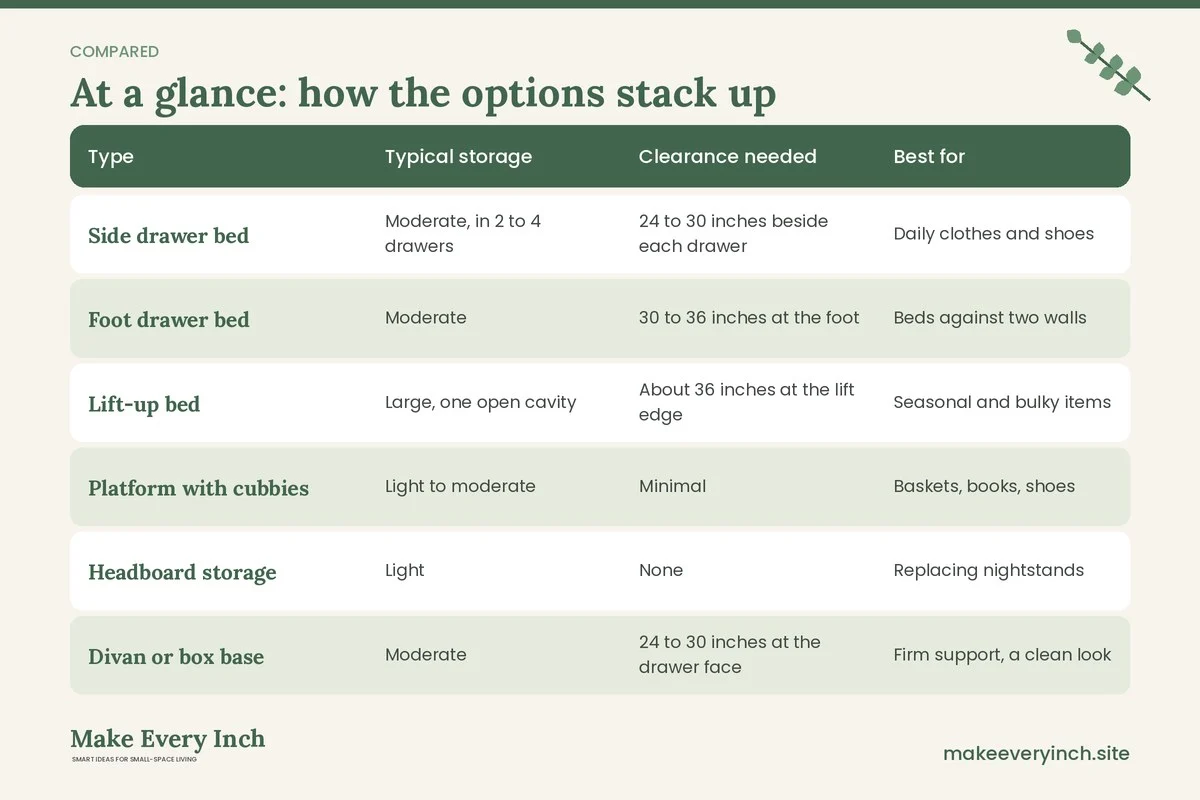
The numbers below are approximate ranges for planning, and they vary by design. Always check the maker’s published dimensions and your own room.
| Type | Typical storage | Clearance needed | Best for | Main trade-off |
|---|---|---|---|---|
| Side drawer bed | Moderate, in 2 to 4 drawers | 24 to 30 inches beside each drawer | Daily clothes and shoes | Needs floor on drawer sides |
| Foot drawer bed | Moderate | 30 to 36 inches at the foot | Beds against two walls | Conflicts with doors and dressers |
| Lift-up bed | Large, one open cavity | About 36 inches at the lift edge | Seasonal and bulky items | Hard to reach daily items |
| Platform with cubbies | Light to moderate | Minimal | Baskets, books, shoes | Open storage can look busy |
| Headboard storage | Light | None | Replacing nightstands | Small capacity |
| Divan or box base | Moderate | 24 to 30 inches at the drawer face | Firm support, a clean look | Can trap heat under the mattress |
Three example small bedrooms
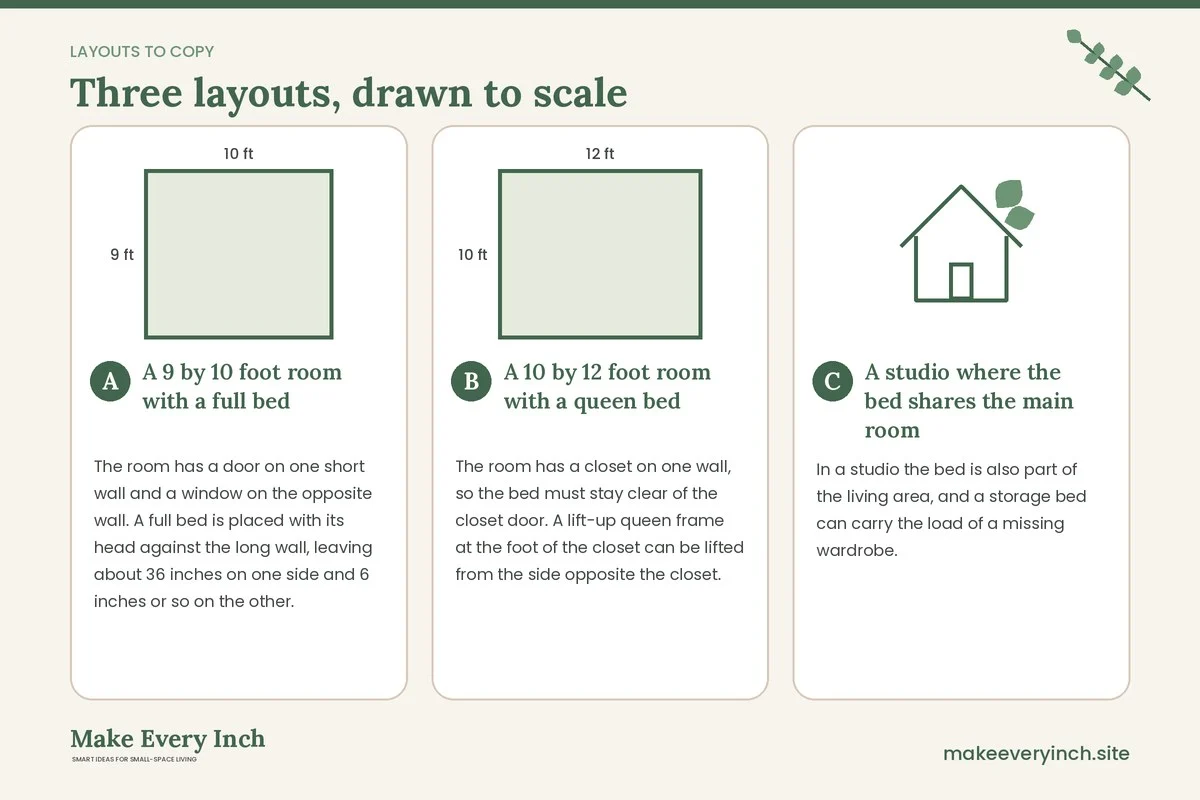
A 9 by 10 foot room with a full bed
The room has a door on one short wall and a window on the opposite wall. A full bed is placed with its head against the long wall, leaving about 36 inches on one side and 6 inches or so on the other. A side-drawer bed with drawers on the 36-inch side works, since the drawers have about 30 inches of working room once the bed is pushed to the wall. A headboard shelf replaces the nightstand on the tight side. A tall narrow dresser can come out of the plan, which opens up the corner for a chair or a desk. For ideas that go with this room, see small bedroom storage ideas.
A 10 by 12 foot room with a queen bed
The room has a closet on one wall, so the bed must stay clear of the closet door. A lift-up queen frame at the foot of the closet can be lifted from the side opposite the closet. A queen with a lift-up base at the center of the long wall leaves about 30 inches on each side, enough to stand and lift if the nightstands are slim. Store bulky bedding and luggage in the base, and use the closet for hanging clothes. A pair of wall-mounted shelves or sconces avoids using floor space for nightstands. This pairing suits the layouts in our guide to small bedroom ideas.
A studio where the bed shares the main room
In a studio the bed is also part of the living area, and a storage bed can carry the load of a missing wardrobe. A platform with cubbies on the side facing the room and closed drawers on the side facing the wall keeps the look tidy. A low upholstered frame can double as a daybed with bolsters during the day. A foot-end bench with storage gives guests a place to sit. For more studio planning, see studio apartment ideas and our guide to a Murphy bed studio, and for a comparison with a wall bed, read our companion post on the best Murphy beds for small homes.
What to store in a storage bed
The right items make the bed work, and the wrong ones make it a nuisance. Match the item to the type of storage.
- Drawers: everyday clothes such as T-shirts, underwear, pajamas and workout gear, and shoes if the drawer is deep enough. Use dividers so items do not slide.
- Lift-up cavity: duvets, extra pillows, spare linens, luggage, off-season coats and boxed items. Use zipped fabric bags or bins so items stay clean and are easy to pull out.
- Cubbies: books, baskets of socks, a laundry bin, yoga mats. Choose baskets with handles.
- Headboard shelf: a phone, a lamp, a book and a small plant.
Avoid heavy tools, liquids, chemicals, candles and loose paper. Keep a few packets of moisture absorbers in a lift-up cavity if the room is damp, and let the cavity air out occasionally. Do not store anything near a heating register or a radiator. For more ideas on what fits under a bed, our guide to under-bed storage ideas has container and organizing options.
Safety and fit notes
Storage beds add weight and moving parts, so a few safety habits are worth following.
- Lift mechanisms: gas struts and springs can wear over time. Raise and lower the platform slowly, keep your hands and fingers clear of the hinge and the frame edge, and keep children and pets away while it is open. Check that the strut holds the frame in the open position before you reach in. If it drifts down, stop using it and ask the maker about a replacement.
- Pinch points: hinges, drawer glides and the gap between the lifted base and the frame can pinch fingers. Teach everyone in the home to keep a hand on the lift handle.
- Weight limits: check the maker’s limit for the bed, the drawers and the slats. Do not overload drawers, since an overloaded glide can jam or fail.
- Tall headboards and cabinets: if the bed has a tall headboard unit, bookcase or cabinet, anchor it to a wall stud with the supplied hardware where the lease permits. Anchoring tall furniture helps prevent it from tipping, which is especially important if children live in the home. Ask the landlord before you drill, and never drill without permission. If you cannot anchor to the wall, pick a low frame with no tall parts.
- Wall-mounted shelves and sconces: if you use wall shelves in place of nightstands, find the studs, follow the load rating of the hardware and mount only what the shelf is rated to hold. Use no-drill options if the lease forbids holes.
- Electrical: do not run a cord under the mattress or through a drawer, and keep chargers and power strips away from fabric and bedding. Check that any built-in lights or outlets are certified for use.
- Fire and ventilation: do not block a heating vent or a radiator with the bed or its storage. Air out any new frame and mattress in a ventilated room.
- Delivery and assembly: two people should lift and assemble heavy parts. Follow the instructions in order, and tighten bolts again after a few weeks of use.
Renter notes
If you rent, a storage bed is a good investment, since it moves with you and requires no drilling. A frame with drawers or cubbies can stand on its own without wall fixings. Check the lease for any rules on floor protection, and place felt pads under the frame to avoid scratching wood or vinyl floors. Choose a frame that breaks down into parts that fit through a standard door, since you will need to move it again. For more ways to gain storage without touching the walls, read no-drill storage ideas for renters and our guide to renter-friendly bedroom storage ideas.
Common mistakes to avoid
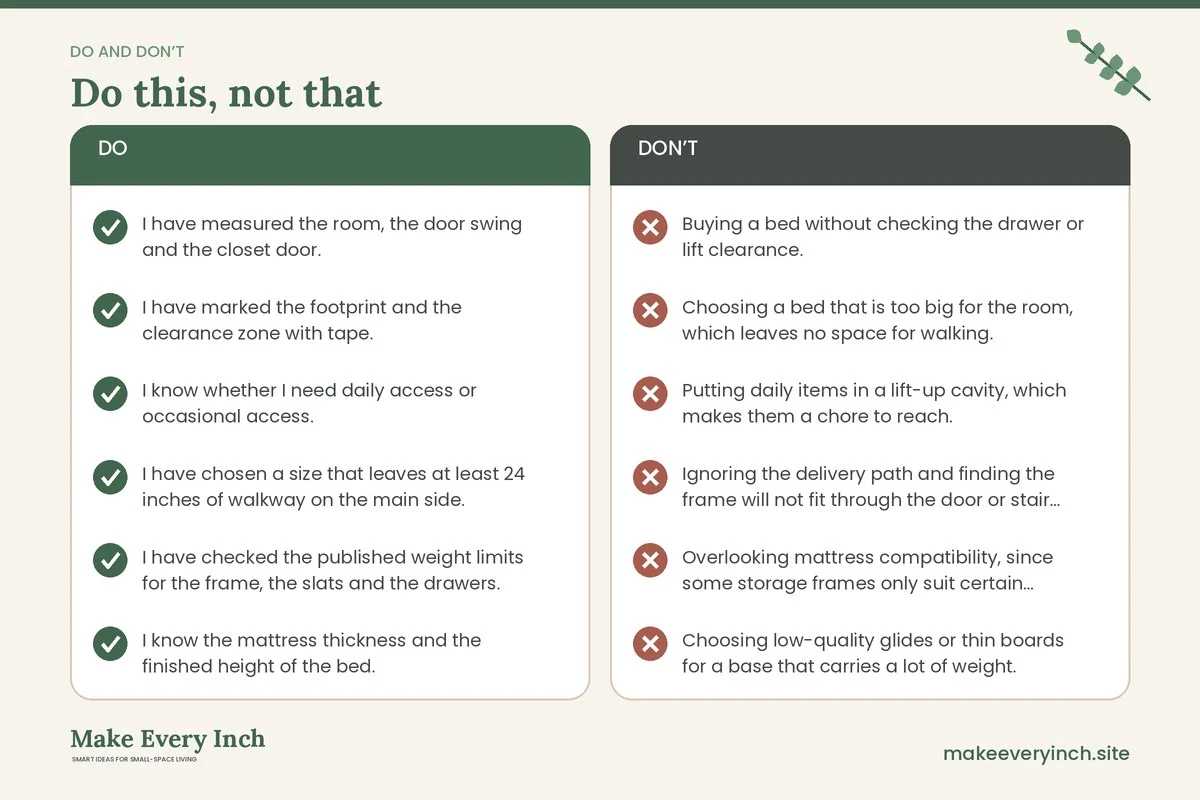
- Buying a bed without checking the drawer or lift clearance.
- Choosing a bed that is too big for the room, which leaves no space for walking.
- Putting daily items in a lift-up cavity, which makes them a chore to reach.
- Ignoring the delivery path and finding the frame will not fit through the door or stair turn.
- Overlooking mattress compatibility, since some storage frames only suit certain mattress heights or thicknesses.
- Choosing low-quality glides or thin boards for a base that carries a lot of weight.
- Skipping ventilation under the mattress in a damp climate.
- Leaving a tall headboard cabinet unanchored.
A pre-purchase checklist
- I have measured the room, the door swing and the closet door.
- I have marked the footprint and the clearance zone with tape.
- I know whether I need daily access or occasional access.
- I have chosen a size that leaves at least 24 inches of walkway on the main side.
- I have checked the published weight limits for the frame, the slats and the drawers.
- I know the mattress thickness and the finished height of the bed.
- I have checked the delivery path and the number of parts.
- I have read the lease and know what I can attach to the wall.
- I have planned how to organize the storage with bins or dividers.
- I have a plan for anchoring any tall parts, or I have chosen a low frame.
FAQ
Are storage beds good for small bedrooms?
They can be, if you have enough floor space to open them. A storage bed replaces a dresser or a chest in many rooms, which can free more floor than the bed takes. If your room is too tight for drawers or a lift, choose a platform with cubbies or a headboard shelf instead.
How much clearance does a drawer bed need?
Plan for the drawer depth plus 24 to 30 inches of standing room. A typical drawer is 18 to 24 inches deep, so the drawer front needs about 42 to 54 inches from the drawer face to the nearest obstacle, if you want to open it fully and stand beside it. Measure your own frame, because depths vary.
Is a lift-up bed or a drawer bed better?
A drawer bed suits daily items, and a lift-up bed suits bulky, seasonal items. If you have only one kind of item to store, choose the type that fits it. If you want both, some frames combine a lift-up base with one or two drawers at the foot.
Do storage beds need a special mattress?
Most take a standard mattress, but the thickness matters. A thick mattress raises the sleeping surface and can interfere with a lift-up mechanism or a headboard height. Check the maker’s guidance on mattress depth and weight. Solid or sealed bases may need a mattress that breathes well.
Can I use a storage bed on a hardwood floor?
Yes. Put felt pads under the legs or glides to avoid scratches, and lift rather than drag the frame when moving it. Check that the weight is spread across enough feet or a broad base.
Are storage beds heavy to move?
Many are, since they carry drawers, hinges and extra panels. Look for a frame that comes apart into smaller sections, and plan on two people to move it. If you move often, choose a simple platform or a frame with removable drawers.
Can I install a storage bed in a rental?
Usually yes, since most are freestanding. Avoid drilling into walls or the floor unless the lease allows it. If the bed has a tall headboard that needs wall anchoring, ask for permission first.
What size storage bed is best for a tiny bedroom?
A twin or a full frame is often the most practical in a room under 10 by 10 feet, because it leaves space for drawers and a walkway. A queen can work in a room of 10 by 12 feet or larger if you keep the rest of the furniture light.
Keep going: Pair your bed with a smart layout and the right companions. Start with the best furniture for small apartments, plan the room with small bedroom storage ideas, and compare a wall bed in our guide to the best Murphy beds for small homes.
Save this guide for later
Pin the ideas you like to Pinterest so you can come back to them when you plan your space.