Small Deck Ideas for Limited Space: 12 Safe, Smart Layouts
Quick answer: A small deck limited space works best with one clear job, a 30 to 36 inch walkway, furniture sized to the footprint and everything secured against wind. Choose folding, stacking or bench seating, keep furniture off the rail, put heavy planters near the posts and check the lease, the building rules and the deck’s weight limit before you add anything.
A small deck limited space is a puzzle with a few fixed pieces: a door, a railing, a handful of boards and usually a view you want to keep. Unlike a balcony, a deck often sits close to the ground or on the back of a house, so it can feel like a real room. Even so, a deck of 6 by 8 feet leaves very little room for a table, a few chairs, a grill and plants all at once. This guide shows how to decide what the deck is for, how to measure it, 12 layouts that fit, a furniture table, three example decks, a full safety section, a seasonal plan and a checklist. For the wider topic, start with our pillar on small balcony ideas, then read the companion post on small balcony ideas for pet owners if an animal shares the space.
Decide what the deck is for
Most small decks fail because they try to be a dining room, a lounge, a garden and a storage shed together. Pick one main job and one small backup job. The main job decides the biggest piece of furniture. The backup job gets a folding or movable piece.
Think about how you actually use the space in a normal week. If you have breakfast outside three times a week, a small bistro table earns its place. If you mostly sit with a book at the end of the day, one comfortable chair and a side table will serve you better than a set of four. If you cook outdoors often, you need clear space around the heat source, and that changes everything else. Write the main job and the backup job on one line, for example “morning coffee for two, plus herbs.” That line is your filter for every purchase and every layout choice.
Be honest about guests too. Many people plan for a crowd that arrives twice a year and then live with a cramped deck the other 363 days. A better approach is to plan for the daily use and add a few folding stools that live indoors or on a wall hook for the busy days. For more on seating that works in this way, see our guide to small space seating ideas for guests.
Measure the deck like a room
Measure the deck length and width, then the door swing, the rail height and the distance from the door to the nearest step. Draw it to scale on graph paper, with one square equal to 6 inches. Cut paper shapes for each piece of furniture you are considering and slide them around. This takes ten minutes and prevents most returns.
Use these working numbers as a starting point and adjust to your own body and habits.
- Main walkway: 30 to 36 inches from the door to the step or the rest of the deck. A narrower path is fine only for short runs.
- Chair pull-out space: 24 to 30 inches behind a seated person at a table, so the chair can move without bumping the rail.
- Door swing: keep the full arc of the door clear. A door that opens outward needs the arc clear of furniture and plants.
- Table size: a round table of 24 to 30 inches serves two people for coffee. A table of 30 to 36 inches suits a small meal for two.
- Distance from the rail: leave at least 12 to 18 inches between seating and the rail, and see the safety section for why.
- Clear zone near any heat source: follow the manufacturer’s instructions and local rules, and see the fire notes below.
A deck of 6 by 8 feet has 48 square feet. After a 3 foot walkway across one long side, you have roughly 3 by 8 feet of usable depth along the other side. That is enough for a bench with a narrow table or two chairs and a plant shelf, but not much more. Count the numbers before you fall in love with any piece.
12 small deck limited space ideas
Layouts that keep the walkway open
1. The bench against the house wall
A bench along the wall of the house uses the dead strip beside the door. A seat depth of 14 to 18 inches leaves the walkway open. Choose a bench with hollow storage for cushions, but check the lid is stable and the hinge cannot trap fingers.
2. The corner L
Two seats at right angles fill the corner and leave the center open. Add a small table in the angle between them. This is the most efficient seating layout for a square deck.
3. The bistro pair
Two chairs and a round table of 24 to 30 inches suit a small deck. Pick chairs that fold so you can open the full width on a day you want to stretch out.
4. The drop-leaf table on the wall
A drop-leaf or fold-down table fixed to the house wall or a freestanding rail table gives a dining surface that disappears when you finish. Fix any wall-mounted piece only if the lease and the building rules allow it, and use fixings suited to the wall material.
5. The stool trio
Three light stools that stack or tuck under a ledge work as seats, side tables and plant stands. They are the most flexible solution if the deck is under 40 square feet.
Vertical and edge ideas
6. A narrow rail shelf
A narrow shelf that sits on top of a flat deck rail holds a drink and a book. Use only a product made to clamp securely, never exceed its stated load, and never place anything that can fall onto a path or a neighbor below. See our safety section.
7. Wall-hung planters on the house side
Hang lightweight planters on the house wall rather than the outer rail, so a fall cannot drop onto people below. Only drill if you own the property or have written permission, and fix into solid material with proper anchors.
8. A trellis panel in a heavy pot
A freestanding trellis in a stable planter lets a climber add privacy without taking floor space. Anchor it so wind cannot tip it, and choose a pot with a wide, heavy base.
9. Tiered plant stands
A stepped stand holds many pots on a tiny footprint. Pick a stable, low design and keep the heaviest pots on the bottom shelf. For plant choices, see our guide to small space plants and planters ideas.
Surfaces, light and comfort
10. Interlocking deck tiles
Click-together tiles can cover worn boards and make the space feel finished. Check with the owner first, make sure water can drain through or under them and lift them each season to check the wood below.
11. An outdoor rug
A small outdoor-rated rug defines the seating zone and softens the boards. Choose a flat weave that dries quickly, and trim or tape the edges so they do not become a trip hazard.
12. Warm, safe lighting
Solar lanterns, battery lights and outdoor-rated plug-in strings add evening atmosphere without the problems of an open flame. For electrical rules, see the safety section. For more lighting ideas that suit rentals, read our guide to renter friendly lighting ideas.
Furniture types compared for a small deck
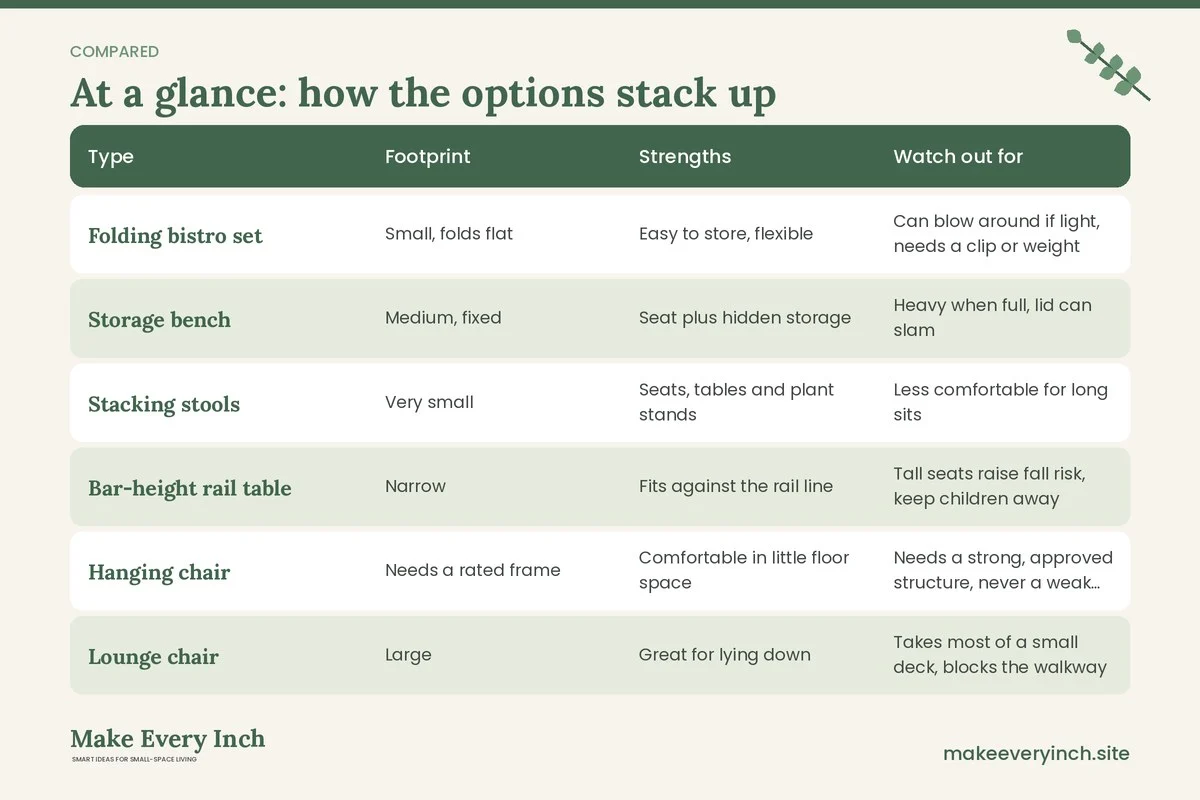
Picking the right type of furniture matters more than picking a style. This table compares the common choices for a small deck. The notes are general, and your own deck, climate and household will change the answer.
| Type | Footprint | Strengths | Watch out for |
|---|---|---|---|
| Folding bistro set | Small, folds flat | Easy to store, flexible | Can blow around if light, needs a clip or weight |
| Storage bench | Medium, fixed | Seat plus hidden storage | Heavy when full, lid can slam |
| Stacking stools | Very small | Seats, tables and plant stands | Less comfortable for long sits |
| Bar-height rail table | Narrow | Fits against the rail line | Tall seats raise fall risk, keep children away |
| Hanging chair | Needs a rated frame | Comfortable in little floor space | Needs a strong, approved structure, never a weak rail |
| Lounge chair | Large | Great for lying down | Takes most of a small deck, blocks the walkway |
| Nesting tables | Small, stack apart | Surface where needed | Light tops can blow off in wind |
For a broader look at furniture that does more than one job, see our guide to small space furniture ideas that do double duty and the buyer-style overview on best furniture for small apartments. If you want a small table that nests, our list of best nesting tables for small apartments explains the idea in indoor terms, and the same logic applies outdoors.
Safety on a small deck
A small deck is a lived-in structure, and it carries loads that people rarely think about. Read this section before you buy anything heavy.
Weight limits and structure
Decks and balconies are built for a stated load, and many are rated lower than people assume. A group of people, a filled planter and a full bench can add up quickly. Water-filled planters, wet soil, stone tiles, hot tubs and large grills are all heavy. Check the building rules, the lease or the owner before you add anything substantial, and when in doubt ask a qualified professional. Spread the weight, put the heaviest items near the posts or over the supports and avoid piling everything in one spot. Do not overload the deck, and never assume that a deck that looks solid is rated for a crowd.
Also look at the condition of the boards, the posts and the fixings each season. Soft, cracked or rotten wood, loose railings and rusted fasteners are signs to stop using the area until a qualified person has checked it.
Railing height and climbing risk
Railings are there to stop falls, and furniture can quietly defeat them. A chair, a bench or a planter shelf next to the rail gives a child or a pet a step to climb. Keep furniture at least 12 to 18 inches away from the rail, and keep anything climbable out of reach of the rail entirely. Check the gaps between balusters, because small children and some pets can squeeze through or put a head through a gap that looks small. If the gaps or the height concern you, ask the owner or a professional about options such as removable safety panels or mesh that are allowed under the lease.
Wind and tip-over
Light chairs, umbrellas and tall planters can blow over in strong wind. Use a heavy base on any umbrella, strap or weigh down tall pieces, and fold or bring in light furniture when gusts are forecast. Never hang heavy items from a rail unless the rail is clearly built for it.
Falling objects
Anything on a rail, a shelf or a high ledge can fall onto a person or a neighbor below. Secure pots with clips or bases made for the purpose, keep the heaviest items low and set things back from the edge. Do not store tools, bottles or loose items on rails.
Fire, grills and flames
Many leases, insurers and local codes limit or ban grills, fire bowls and open flames on decks, especially on upper floors or close to buildings. Read the lease and the local rules before you buy a grill, and follow the manufacturer’s instructions on clearances. Keep any permitted heat source away from railings, plants, umbrellas, cushions and the house wall, and never leave it unattended. Candles are safer in enclosed lanterns, or replaced by battery versions. Keep a way to put out a fire close at hand and know where the exits are.
Electrical safety and string lights
Use only lights and cords marked for outdoor use. Plug outdoor equipment into a socket protected by a ground-fault circuit interrupter (GFCI), and do not run extension cords through doors that need to close or across a walkway. Do not overload sockets with multiple adapters. Solar and battery lights avoid most of these concerns. If a cord feels warm, shows damage or has been rained on and is not rated for it, unplug it and replace it.
Drainage and water damage
Watering plants on a deck can send water through the boards and onto a neighbor or into the structure. Use saucers, empty them after rain and do not let water pool against the house wall. Never block drains or gutters. If the deck is above another home, be especially careful, because water damage to the unit below is a common reason for disputes.
Toxic plants and sun heat
Some popular plants are toxic to children and pets if chewed or swallowed. Check each plant before you buy it, and keep questionable ones out of reach or choose safer options. Dark surfaces, metal furniture and tiles can get very hot in direct sun, so test them with the back of your hand before children or pets sit or walk on them, and cover them with shade or a light rug.
Lease, HOA and permission
Before you change fixed features, check the lease, the HOA rules and the owner’s wishes. Do not drill into railings, posts, walls or boards without written permission, because fixings can damage the structure and may void a warranty or break a rule. Use freestanding and clamp-on solutions that are approved for your type of rail, and keep your changes reversible. For more on renting-friendly choices, our guide to renter friendly apartment decorating ideas explains how to approach permission and reversibility.
Three example small decks
These are scenarios, not tested layouts. Use them as thinking tools and adjust them to your own deck and rules.
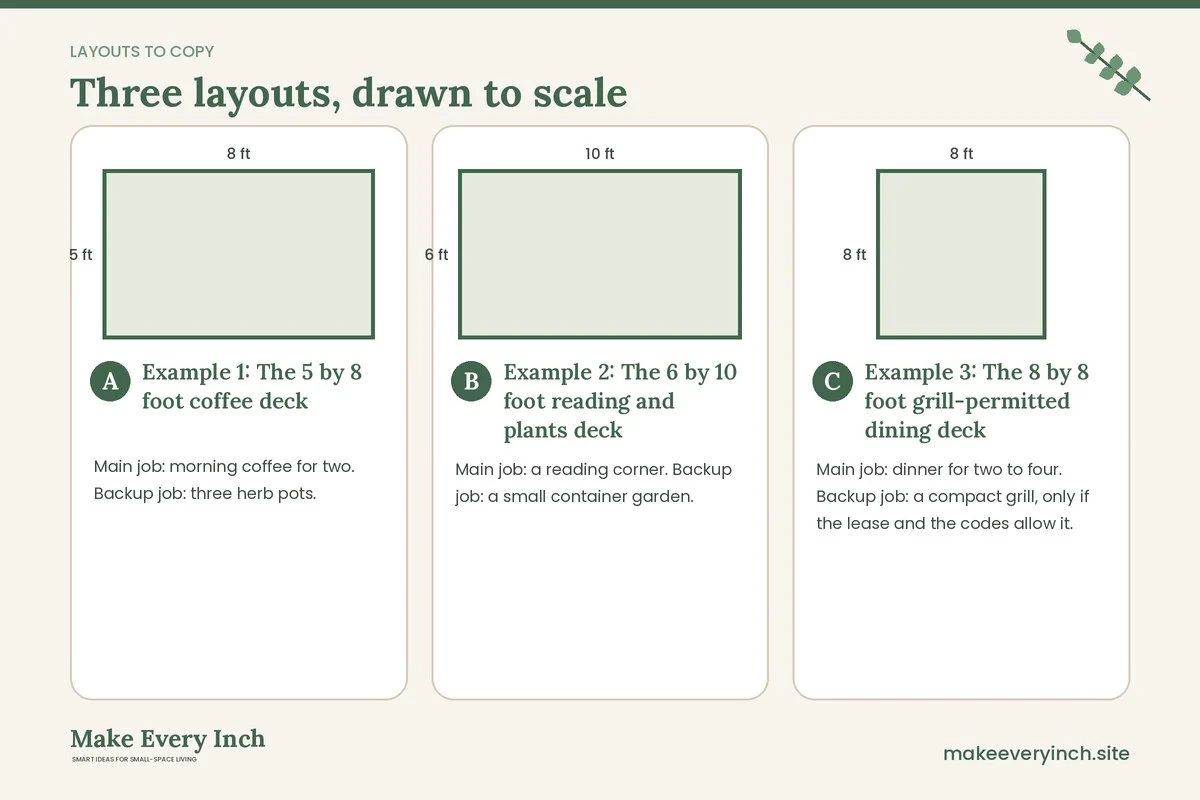
Example 1: The 5 by 8 foot coffee deck
Main job: morning coffee for two. Backup job: three herb pots.
The door sits at one short end, so the walkway runs the length of the deck along one long side. Place a round table of about 24 inches and two folding chairs at the far end, away from the door swing. Put a narrow plant shelf on the house wall, lightly loaded with small pots. Keep the walkway at 30 inches. A battery lantern on the table gives evening light. Everything folds or hangs, so a quick sweep takes five minutes.
Example 2: The 6 by 10 foot reading and plants deck
Main job: a reading corner. Backup job: a small container garden.
Put a storage bench along the house wall for cushions, a small side table at one end and a wide-based trellis planter in the far corner for privacy. Place the heaviest planter near a post. Add a flat-weave outdoor rug under the bench and table. Keep the rail clear for 18 inches. Use solar lanterns in place of candles. The walkway runs along the open side at 36 inches.
Example 3: The 8 by 8 foot grill-permitted dining deck
Main job: dinner for two to four. Backup job: a compact grill, only if the lease and the codes allow it.
If a grill is permitted, place it at the far corner with the clearances the manual states, well away from the house wall, umbrellas and cushions. Put a drop-leaf table on the other side, and use stacking stools for extra guests. Keep a clear path between the door and the grill. If a grill is not allowed, swap it for a second seating zone and move dinner to a small table. The point is to plan the safe use first and the style second.
Plan for the seasons
A small deck changes with the weather, and a plan keeps it from turning into a storage mess.
- Spring: inspect the boards, posts and rail. Wash the surface, check the drainage and put out the rug and cushions.
- Summer: add shade, check surfaces for heat and water plants at a time that avoids runoff.
- Autumn: bring in cushions and light furniture, clear leaves from gaps and drains and reduce the plant load.
- Winter: store or cover furniture, clear snow gently so the weight does not build up and keep paths free of ice.
If storage space is tight, label a single bin for deck items and keep it indoors. For more ideas on keeping a small home tidy, see our guide to small space organization ideas.
Common mistakes on a small deck
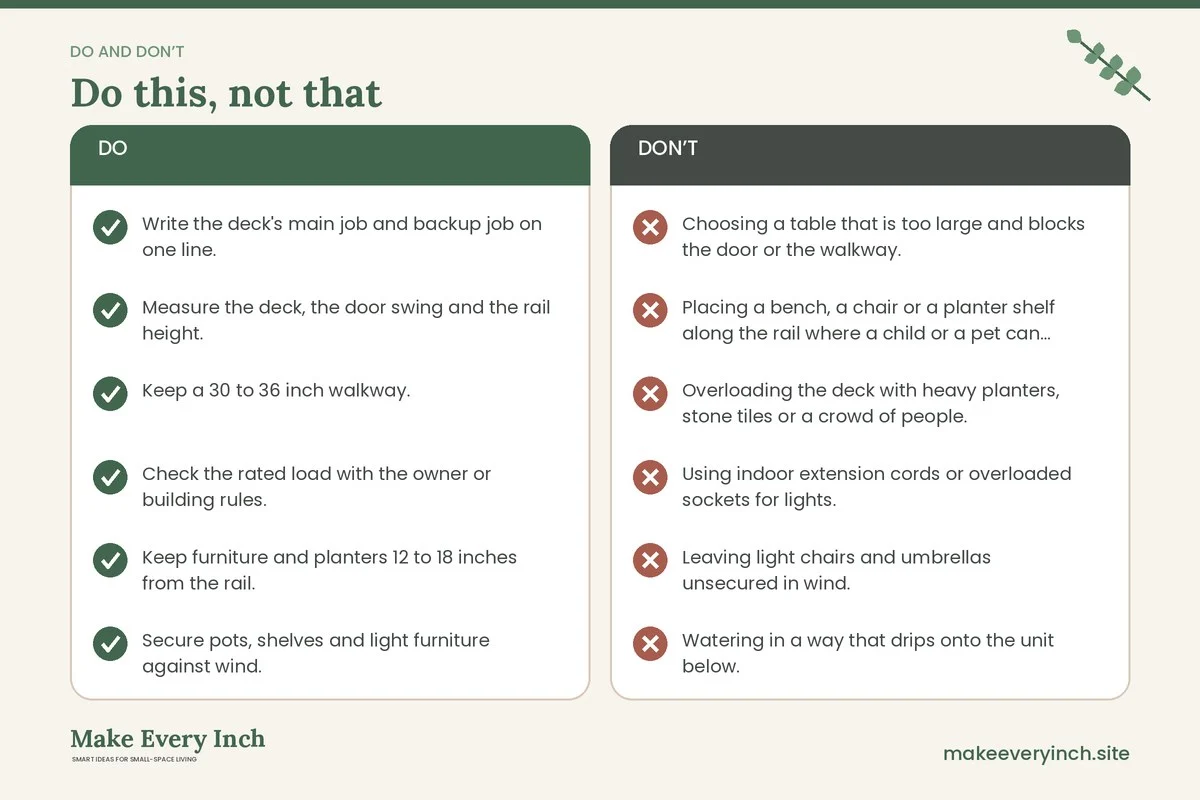
- Choosing a table that is too large and blocks the door or the walkway.
- Placing a bench, a chair or a planter shelf along the rail where a child or a pet can climb.
- Overloading the deck with heavy planters, stone tiles or a crowd of people.
- Using indoor extension cords or overloaded sockets for lights.
- Leaving light chairs and umbrellas unsecured in wind.
- Watering in a way that drips onto the unit below.
- Drilling into a rail, a post or a wall without permission.
- Buying a grill before reading the lease and the local codes.
Make it look good on a small budget
A small deck does not need many purchases. A coat of paint or stain on old furniture, if the owner allows it and the product is rated for outdoor use, can refresh the look. A second-hand bistro set often costs far less than new. Use a few textiles in one color family, pair them with green plants and keep the palette to three tones. If you want more ways to stretch a budget, our list of budget small space ideas shows how to prioritize, and our guide to small room decor ideas explains how to keep a space calm and uncluttered.
Frequently asked questions
How much furniture can a small deck hold?
It depends on the size and the rated load. As a rule of thumb, aim for a 30 to 36 inch walkway and keep furniture off the rail. For a deck of about 48 square feet, a two-person bistro set and a few plants is often enough. Check the rated load with the owner or a professional.
Can I put a grill on a small deck?
Only if the lease, the building rules, the insurer and the local codes allow it. Many places ban grills and open flames on decks, especially above ground level. Follow the manufacturer’s clearances, and keep it away from walls, plants and railings.
What is the best seating for a small deck?
Folding bistro chairs, a storage bench or stacking stools are the usual choices. A bench along the house wall saves the most space, and stools add flexibility. Choose based on the main job you gave the deck.
How do I keep my children and pets safe on a deck?
Keep furniture and planters away from the rail so nothing can be climbed, check the gaps between balusters, use safe plants and supervise. Our guide to small balcony ideas for pet owners covers pet-specific steps in more detail.
Can I add lights without wiring?
Yes. Solar lanterns and battery lights avoid wiring. If you use mains lights, choose outdoor-rated products, use a GFCI-protected socket and do not overload outlets.
Do I need permission to change my deck?
Often, yes. Check the lease and any HOA rules before you fix, drill or paint anything. Use freestanding and removable options when you are unsure.
Small deck checklist
- Write the deck’s main job and backup job on one line.
- Measure the deck, the door swing and the rail height.
- Keep a 30 to 36 inch walkway.
- Check the rated load with the owner or building rules.
- Keep furniture and planters 12 to 18 inches from the rail.
- Secure pots, shelves and light furniture against wind.
- Use outdoor-rated, GFCI-protected lights, or battery and solar ones.
- Confirm grill and flame rules before you buy anything.
- Control drainage so water does not reach the unit below.
- Check every plant for toxicity to children and pets.
- Get written permission before drilling or fixing anything.
- Inspect boards, posts and rails each season.
A small deck rewards restraint. Give it one job, measure it honestly, keep it safe and let a few well-chosen pieces do the work.
Keep going: Keep going with our pillar on small balcony ideas, the renting guide to renter friendly small balcony ideas and the room-by-room look at studio apartment ideas.
Save this guide for later
Pin the ideas you like to Pinterest so you can come back to them when you plan your space.