Studio Apartment Decorating Ideas
Quick answer: The best studio apartment decorating ideas make one room read as one home. Pick a tight palette of two or three main colors plus one accent, repeat materials across the room, define zones with rugs, lamps and art instead of walls, layer textiles for softness, and keep surfaces mostly clear. Choose fewer, larger pieces over many small ones, and give every object a home so decor never turns into clutter.
Studio apartment decorating ideas have a different problem from decorating a normal home. In a bedroom or a living room, you decorate one purpose. In a studio, a single room holds the sleeping, eating, working, lounging and cooking, and everything is visible from every spot. A mismatched lamp or a stack of mail shows from the bed, the sofa and the door. That is why decor in a studio is less about adding things and more about editing, repeating and connecting. This guide covers how to build a cohesive palette, layer textiles, mark zones with decor rather than furniture, hang wall art in a small footprint, use plants well, light the room in layers and keep it all from tipping into clutter. It includes a comparison table, three example studios, a seasonal refresh plan and a checklist. For the layout side, start with our pillar on studio apartment ideas. To choose and place a partition, read our companion on studio apartment ideas with a room divider.
Think of the studio as one composition
When every corner is in view, the eye reads the room as a single picture. That helps you. If the picture is calm, the whole studio feels bigger and more intentional than a collection of areas. If the picture is busy, a 400 square foot room feels like 250.
Start with three questions.
- What do you see first from the door? This is your first impression and the place to put your best piece, such as a mirror, a plant or a piece of art.
- What do you see from the bed? Lying down is when the studio looks messiest. Aim for a calm view, ideally of a plain wall, a window or a single piece of art.
- What do you see from the sofa? This is the daytime view. Make it the most layered, with art, lamp light and a plant.
Stand in each of these three spots and take a photograph. Photos flatten the room and reveal clutter that your eyes skip. Then decide what stays, what goes and what repeats.
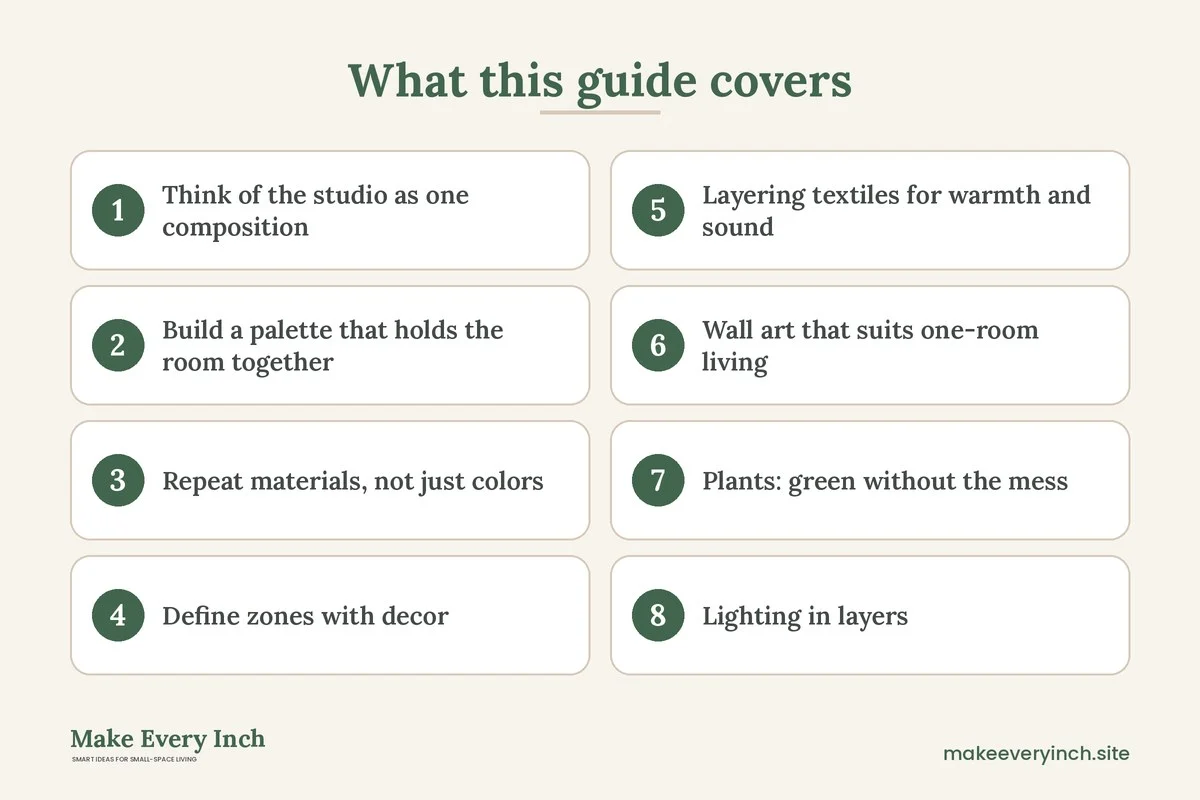
Build a palette that holds the room together
A palette is the strongest tool for cohesion. In a studio, aim for a tight set so that zones feel related even when they serve different uses.
The 60, 30, 10 approach
A classic proportion works well in one-room living.
- About 60 percent: the main color. This is usually a light neutral on walls, large furniture and the largest rug. Think warm white, soft grey, oatmeal, pale sage.
- About 30 percent: the secondary color. This appears in bedding, curtains, an armchair and larger textiles. It can be deeper, such as navy, clay, forest green or charcoal.
- About 10 percent: the accent. This is the small, bold repeat, such as brass, a rust cushion, a black frame or a bright piece of art.
The point is repetition. If rust appears on a cushion by the sofa, again in the bedding and a third time in a vase on the shelf, the eye connects the zones.
Choosing a base
Light bases reflect light, which helps a small studio, particularly one with a single window. Warm neutrals feel cozy, cool neutrals feel crisp, and either works if you do not mix undertones randomly. Hold a white towel against a wall, then your bedding, then the sofa, to see whether the whites clash. If one looks yellow and another looks blue, choose one family.
Using dark colors
Dark colors can work in a studio, but in small amounts. A deep green or navy wall behind the bed, or a charcoal sofa, adds depth. Use it on one surface, not all four walls, and repeat the same tone in a few small items. Never use a dark color on every wall in a studio with little light, because it removes the sense of space.
A palette for renters
If you cannot paint, build the palette from the movable pieces: rugs, bedding, curtains, art, lampshades and throw pillows. Let the walls be the neutral background. If the lease allows painting, choose low-VOC paint, ventilate the room well while it dries, and sleep with the window open if the instructions allow. Ask in writing before you paint.
Repeat materials, not just colors
Color is one thread. Materials are another. A studio feels coherent when two or three materials repeat in different zones.
- A wood tone: repeat it in the bed frame legs, the dining table, a shelf and a picture frame.
- A metal: choose one, such as black, brass or brushed nickel, and repeat it in the lamp base, curtain rod and cabinet pulls where you can swap them.
- A texture: linen, wool or cane. If you have a woven basket by the bed, put another beside the sofa.
- A shape: if the rug is round, add a round mirror and a round side table. Curves soften a studio full of rectangles.
You do not have to match exactly. Repetition with variation looks collected. Exact matching looks like a showroom.
Define zones with decor
A studio has zones, even when they are not walled off. Decor can mark them softly. The ideas below work with the layout described in our guide to small apartment living room ideas and the version written for studios.
Rugs
A rug is the strongest zone marker. Use one under the sofa and chairs and a different one, or none, under or beside the bed. Choose rugs that share a color or pattern scale so they do not fight. A common approach is a larger neutral rug in the living zone and a smaller textured rug beside the bed. Make sure the rug edges are secured with a non-slip pad or tape, because a curled corner is a trip hazard and can catch a door. Keep rugs from covering vents.
Lamps
Each zone should have its own light source. A floor lamp by the sofa, a bedside lamp, a task lamp at the desk and a small light near the kitchen turn one flat room into several cozy ones. Use the same bulb color, around 2700 kelvin, for all of them so the zones stay in harmony. See our guides on renter-friendly lighting ideas and the best floor lamps for small rooms.
Art and mirrors
Hang or lean a piece of art over the bed, another near the sofa and another by the entry. They mark where each zone begins. A mirror placed at the entry zone doubles the light and makes the arrival feel more generous.
Textiles
A throw and a few cushions on the sofa, and a different throw plus a quilt on the bed, are quiet signals of use. The textiles do not have to match, but they should share a color from your palette.
Furniture backs and shelving
A sofa with its back to the bed, a low shelf or a console behind it, creates a zone border with furniture you already own. If you want a dedicated partition, see our companion on choosing a room divider.
Floor treatments
Where the floor changes (a rug, a mat at the door, a runner in the kitchen strip), the zone changes. Even a mat at the entry says “this is where outside ends”.
Layering textiles for warmth and sound
Studios are often hard rooms: bare floors, big windows, flat walls. They echo, and they feel cold in both senses. Textiles solve both problems.
Windows
Curtains do more for a studio than almost any other decor item. Hang the rod 4 to 6 inches above the window frame, or near the ceiling, and let the curtain extend past the frame by 6 to 10 inches on each side so that the window looks bigger and the glass stays uncovered in the day. Lined curtains reduce echo and drafts. Our guide to renter-friendly window treatment ideas covers no-drill options.
Bed
Treat the bed as a piece of furniture the whole room sees. Choose bedding in a palette color, add a quilt or a folded throw at the foot, and limit the pillows to two or three. A headboard in fabric or a large piece of art above it makes the bed look like a deliberate zone. A bed that is neatly made is the biggest single decor upgrade in a studio, because it is the largest object in the room.
Sofa
A sofa takes two to four cushions and one throw. Vary the sizes, with one larger square, one lumbar and one smaller piece. Keep the colors within the palette. Fold the throw over the arm so the sofa looks styled but still usable.
Rugs and layers
Layering a smaller rug over a larger one adds depth, but only if the lower one is flat and the upper one has a non-slip backing. In a studio, layering is usually best limited to the living zone.
Sound
Soft surfaces absorb echo. A rug under the sofa, curtains at the windows and a fabric panel or wall hanging reduce the bounce. They also make the room feel calmer, which supports the cohesive look.
Wall art that suits one-room living
Walls are your largest free surface in a studio, and often the only place where you can add personality without using floor area. They also carry the greatest risk of clutter if you scatter small pieces.
Go larger and fewer
A few large pieces look calmer than many small ones. Choose one large piece for each zone, perhaps a 24 by 36 inch print over the sofa and a smaller one by the bed. If you love small prints, group them tightly into a single grid or block so they read as one unit.
Hang at the right height
The center of a piece should sit at about 57 inches from the floor. Over a sofa or a bed, hang the bottom edge 6 to 8 inches above the furniture, and make the art about two thirds of the width of the furniture beneath it. In a studio with low furniture, lower the hanging height slightly so the art relates to the sofa and does not float.
Lean, do not drill
If your lease forbids nails, lean art on shelves, a dresser or the floor against the wall. Use adhesive strips rated for the weight, test them in a hidden spot, and follow the instructions. Our guide to renter-friendly wall decor ideas lists many ways to fill walls without damage. Never drill without permission.
Frames and finishes
Use a limited set of frame finishes, such as black and natural wood, so that the walls stay coherent. A mix of frame colors works better when one repeats from zone to zone.
Use a wall as a divider
A tall piece of art or a tapestry on the wall behind the bed marks the sleeping zone clearly. A row of three frames above a console marks the entry. Zones need not use furniture at all.
Plants: green without the mess
Plants soften the hard lines of a studio and add life. They also add watering, soil and fallen leaves, which can become clutter.
- Choose a few, grouped. Three plants in one corner look intentional. Eight plants scattered across every ledge look messy.
- Vary the height. One tall floor plant, one medium plant on a table and one trailing plant on a shelf creates a pleasing rhythm.
- Use similar pots. Pots in two or three matching tones keep the greens in focus.
- Watch the light. Place plants where the light suits them. A plant in a dark corner struggles and looks sad. Consider a high-quality artificial plant only if the light is very poor, and keep it dusted.
- Protect the floor. Use saucers or trays, and check that water cannot drip onto electronics or wood floors.
- Know your pets. Many common houseplants are harmful to cats and dogs. Check before you buy if you share the studio with an animal.
- Keep them clear of the exit. A large plant at the door can trip someone or block a path in an emergency.
A plant on a divider shelf, a trailing plant on a high shelf and a tall plant beside the sofa can mark zones as well as decorate them.
Lighting in layers
Light shapes how decor looks. Harsh overhead light flattens a studio. Layers make it warm.
- Ambient: the general light, such as a ceiling fixture on a dimmer, or lamps that bounce light off a wall.
- Task: a reading light by the bed, a desk lamp, a light under a cabinet in the kitchen.
- Accent: a small lamp on a shelf, a string of lights, a picture light, a plug-in sconce.
Aim for three to five light sources in a studio. Use bulbs of one color temperature, and use dimmable bulbs where possible. In the evening, turn off the overhead light and use lamps. The room will look softer, and the clutter will recede.
Cords can turn into visual clutter, so tuck them along baseboards or behind furniture with the ideas in our post on renter-friendly ways to hide cords. Do not run cords under rugs, and do not overload a power strip. Use bulbs with a wattage that fits the lamp’s rating.
Keep decor from becoming clutter
The line between decor and clutter in a studio is thin. Use these rules.
The one-in, one-out rule
For every decorative item you bring in, take one out. This keeps the total fixed, which matters when you cannot add a closet.
Edit surfaces
Leave at least a third of each flat surface empty. A shelf with a plant, a stack of books and a lamp looks styled. A shelf with twenty objects looks messy. Group items in threes, vary the heights, and leave space around them.
Give everything a home
Decor and storage go together. Baskets, boxes and lidded containers hide the things you need but do not want to see. Our guides on small space organization ideas and no-drill storage ideas for renters show how to store more without drilling.
Prefer pieces that work twice
A storage bench at the foot of the bed, a lidded ottoman, a bookcase that doubles as a partition or a console with drawers are decor with a job. The more your decor stores, the less your studio collects.
Keep floors clear
The floor is the biggest part of a studio’s visual calm. Avoid piles of shoes, bags and boxes. Use hooks inside the closet door, an under-bed box, or a shoe shelf to keep the floor open.
The ten-minute reset
Make a habit of a ten-minute reset each evening. Fold the throw, put cups in the sink, return the cushion, clear the surface. A studio depends on small daily resets.
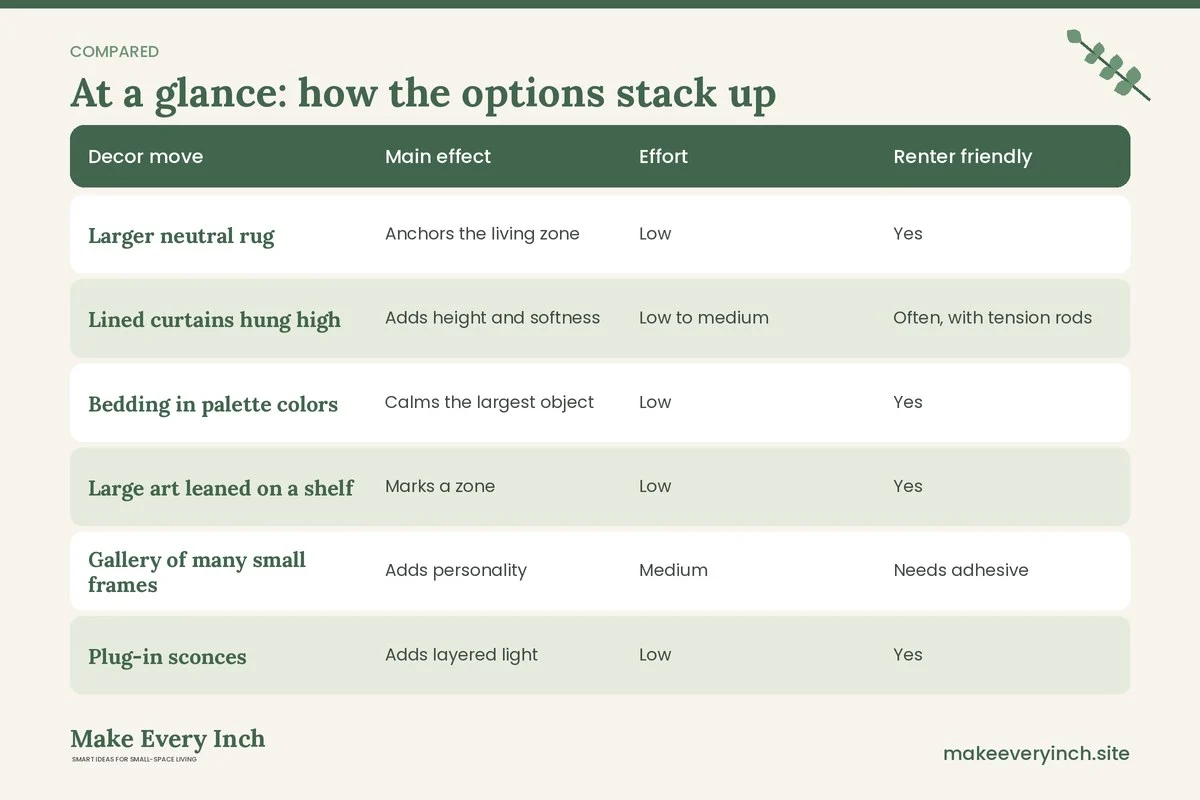
Comparison table: decor moves by effect and effort
The table below ranks common decorating moves by what they achieve and how much effort they take. The descriptions are general.
| Decor move | Main effect | Effort | Renter friendly | Clutter risk |
|---|---|---|---|---|
| Larger neutral rug | Anchors the living zone | Low | Yes | Low |
| Lined curtains hung high | Adds height and softness | Low to medium | Often, with tension rods | Low |
| Bedding in palette colors | Calms the largest object | Low | Yes | Low |
| Large art leaned on a shelf | Marks a zone | Low | Yes | Low |
| Gallery of many small frames | Adds personality | Medium | Needs adhesive | Medium to high |
| Plug-in sconces | Adds layered light | Low | Yes | Low |
| Row of plants on every ledge | Adds life | Medium | Yes | High |
| Mirror at the entry | Doubles light | Low | Yes | Low |
| Repainting walls | Sets the base color | High | Needs permission | Low |
| Open shelving styled with decor | Shows personality | Medium | Freestanding, yes | High |
Start with the low-effort, low-clutter moves, and add the others only when the base is calm.
Three example studios
A warm, neutral studio of about 350 square feet
The palette is warm white, oatmeal and a deep clay accent. A large neutral rug sits under the sofa, and a smaller textured rug lies beside the bed. The bedding is oatmeal with a clay throw, the cushions on the sofa repeat the clay, and a ceramic vase on the shelf carries the same tone. Light wood appears in the table, the shelf and the frames, with black metal on the lamp and the curtain rod. Lined linen-look curtains hang high. A single large print leans on the dresser, and a mirror leans by the entry. The room has four light sources, all warm, and a plant in each of two corners. The result looks like one calm home, even though it holds a bed, a sofa, a table and a kitchen.
A cool, modern studio of about 300 square feet
The base is light grey with a deep navy accent and white. A navy accent wall sits behind the bed, with a large white frame above it. The sofa is grey with two navy cushions, and the bedding is white with a navy throw. The metal is brushed nickel, and the wood is pale oak. A low bookcase behind the sofa marks the sleeping zone without a screen. Curves appear in a round mirror, a round side table and a round rug. The plants are in white pots. Because everything repeats in a limited range, the room looks tidy even when a few things are out.
A small, colorful studio of about 250 square feet for a renter
The walls are white and cannot be painted, so color enters through movable pieces. The base is white and natural wood, the secondary color is a deep green in the curtains and a velvet cushion, and the accent is mustard in the bedding stripe and a lampshade. Art hangs on adhesive strips and leans on a narrow shelf. A tension rod across the alcove holds a curtain for the bed. A plug-in sconce serves as a reading light. Because the palette has just three colors, the room feels lively but not noisy. The owner keeps a rule of one-in, one-out for decor.
A seasonal refresh without buying much
A cohesive studio can change with the seasons by swapping a few items.
- Spring and summer: replace heavy throws with light cotton or linen, swap dark cushion covers for lighter ones, open the curtains, add fresh flowers or a bowl of fruit.
- Autumn and winter: add a wool throw, a thicker rug on top of the base rug, warmer lamp shades and a candle-like LED light. Never leave real candles unattended, and keep them far from fabric and curtains.
- Rotate art: keep two or three pieces in storage under the bed and swap them each season.
- Store the swaps: keep off-season textiles in a lidded box under the bed or on a high shelf, never on the floor.
A refresh helps you feel as if the home evolves, without growing the pile of objects.
Common mistakes
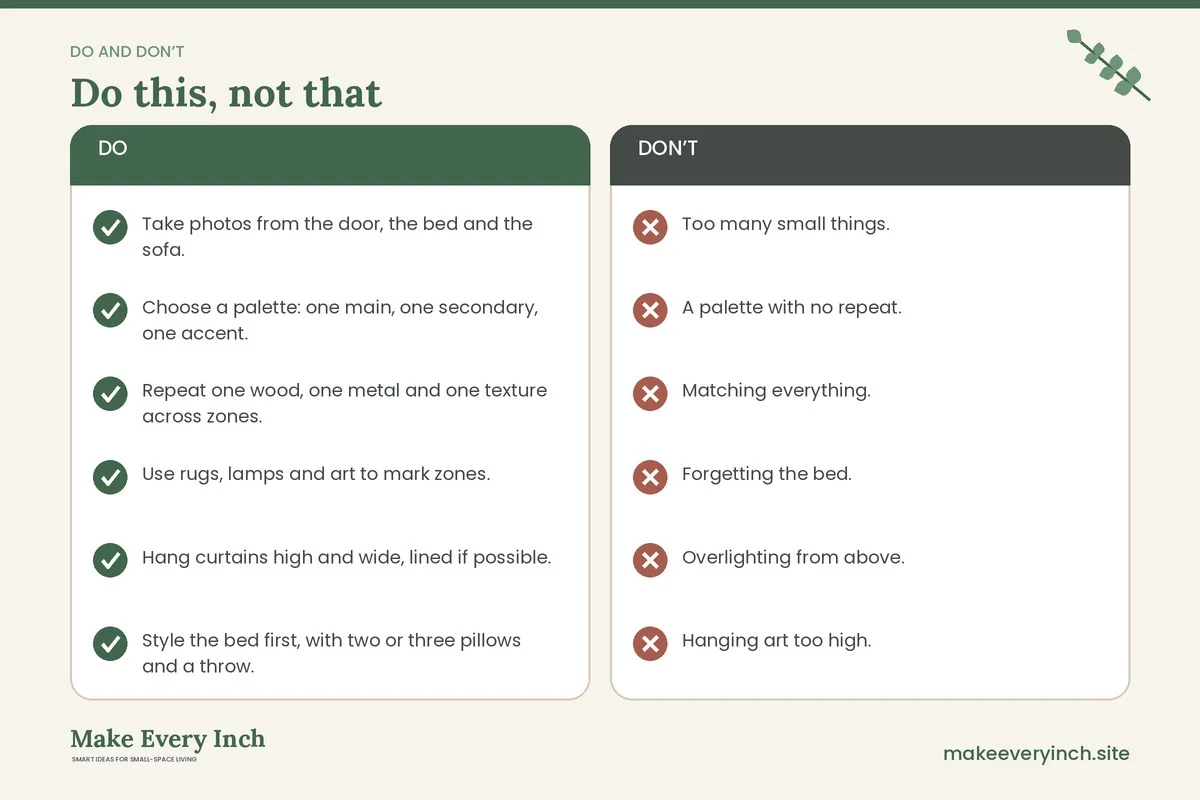
- Too many small things. Many little objects read as clutter. Choose fewer, larger pieces.
- A palette with no repeat. If every zone has a different color scheme, the studio feels like several rooms jammed together.
- Matching everything. A fully matched room looks flat. Mix textures within the palette.
- Forgetting the bed. The bed is the largest object in the room. Style it first.
- Overlighting from above. One bright ceiling light makes the room look flat. Use lamps.
- Hanging art too high. Art that floats near the ceiling feels disconnected from the furniture.
- Too many plants. A dozen plants add chores and clutter.
- Ignoring safety. Do not block exits, run cords under rugs, or leave candles unattended.
Safety and lease notes
- Anchor tall furniture. Bookcases, wardrobes and tall shelves used as decor should be anchored or weighted. Ask permission before drilling.
- Do not drill without permission. Use adhesive hooks, tension rods, leaning art and freestanding pieces, and photograph the walls before you start.
- Check the electrical load. Do not overload outlets or power strips with lamps, chargers and string lights. Replace damaged cords.
- Ventilate. If you paint, varnish or refinish anything, use low-VOC products and open the windows. Let new textiles and rugs air out if they have a strong smell.
- Keep paths and exits clear. Plants, baskets and rugs should not block the door, a window exit or the route from the bed to the door.
- Keep fabrics away from heat. Hang curtains and throws well away from the stove, heaters and candles.
Decorating checklist
- Take photos from the door, the bed and the sofa.
- Choose a palette: one main, one secondary, one accent.
- Repeat one wood, one metal and one texture across zones.
- Use rugs, lamps and art to mark zones.
- Hang curtains high and wide, lined if possible.
- Style the bed first, with two or three pillows and a throw.
- Choose a few large pieces of art, and hang them at about 57 inches to the center.
- Group plants in threes, with matching pots.
- Layer three to five warm lights, and use one bulb color.
- Hide cords and avoid overloading outlets.
- Keep a third of each surface empty.
- Apply one-in, one-out.
- Keep paths, exits and vents clear.
- Check the lease before painting, drilling or hanging.
FAQ
How do I decorate a studio apartment so it feels like separate rooms?
Use rugs, lamps, art and furniture backs to mark each zone, and repeat one palette across them. For a physical partition, see our guide to studio apartment ideas with a room divider.
What colors work best in a studio apartment?
Light, warm or cool neutrals as the base, a deeper secondary color for textiles, and one accent repeated three times. Dark colors work as accents rather than on every wall.
How many pieces of wall art should a studio have?
A few large pieces usually look calmer than many small ones. Aim for one per zone, and group small prints tightly into a single unit.
How can I decorate a studio on a budget?
Start with what you own, edit it, then add textiles and lamps, which have the greatest effect. Our post on small space decorating ideas on a tight budget has more approaches.
Can I decorate a studio if I rent?
Yes. Use movable pieces such as rugs, curtains on tension rods, leaning art and plug-in lights. Read our guide to renter-friendly apartment decorating ideas for more.
How do I stop decor from looking like clutter?
Keep a third of each surface empty, group items in threes, store the rest in baskets and boxes, and follow a one-in, one-out rule.
Should the bed be hidden in a studio?
Not necessarily. A neatly styled bed can be a feature. If you want it hidden, a divider, a curtain or the back of a sofa can help, as long as the route to the door stays clear.
Keep going: Keep going with our pillar on studio apartment ideas, the companion guide on studio apartment ideas with a room divider and our overview of apartment decorating styles.
Save this guide for later
Pin the ideas you like to Pinterest so you can come back to them when you plan your space.