Small Space Decorating Ideas on a Tight Budget
Quick answer: The best small space decorating ideas on a tight budget follow a spend order: first free swaps and editing, then light, then paint, then textiles, then a few thrifted or secondhand pieces, and decor last. Choose items that do a job, such as a mirror, a lamp or a throw, and skip anything that only collects dust.
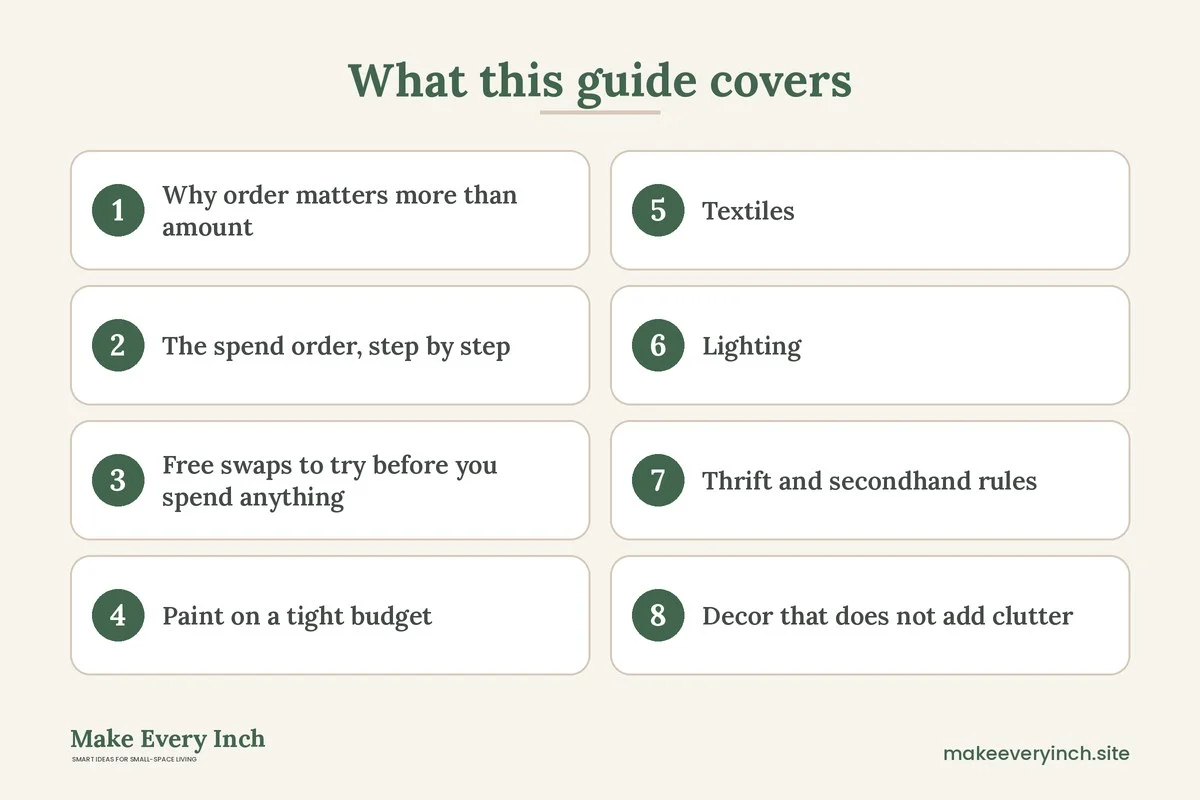
Small space decorating ideas on a tight budget work best when you stop thinking about shopping lists and start thinking about order. A small room punishes random purchases, because every object takes up a visible share of the space. A cheap item bought in the wrong order can cost more in the end than a good item bought at the right moment. This guide gives you a spend order, a list of free swaps to try before you buy anything, and focused advice on paint, textiles and lighting, the three upgrades that change a room most for the least outlay. It also covers thrifting rules, decor that does not add clutter, three example rooms, a comparison table, a checklist and a short FAQ. For the wider picture, start with our pillar guide to budget small space ideas and the companion pillar on small space organization ideas.
Why order matters more than amount
Most people with a small budget buy the fun things first. A cushion, a print, a candle and a plant arrive in the first week, and the room still feels flat because the basics were never touched. The harsh overhead bulb is still there, the walls still look tired and the furniture is still pushed against the wall in the same way. Decor sits on top of a room like icing on a cake, and it works only when the cake underneath is baked.
Think of the budget as a funnel. At the top are things that cost nothing, such as moving furniture, editing surfaces and shifting things between rooms. Below them sit things that cost little compared with their effect, such as a better bulb or a coat of paint. Further down are the things that cost more, such as a rug or a good lamp, and at the very bottom is the decor that adds personality. If you run out of money halfway, you want to stop at a point where the room already feels better, not with a shelf of trinkets in a room that still has bad light.
A second reason to follow an order is that early steps change what you need later. Editing a room may show you that you do not need the extra shelf you had planned. New light may make the wall color look different, so you might skip the paint. A rug may bring in enough pattern that you no longer want wall art. Each step informs the next, and a sequence protects your budget from impulse spending.
The spend order, step by step
Step 1: Free swaps and editing
Start with what you own. Walk through the room and take out everything that does not earn its place by being used, loved or needed. Put the removed items in a box by the door and look at the room for three days. Often the room looks larger and brighter without anything new. Our guide to decluttering rules for small homes gives a method for deciding what goes.
Then rearrange. Try the sofa on a different wall, swing the bed so that the head sits under the window or move a desk to face the light. Shift one piece at a time, and live with it for a day before judging. A layout change is the cheapest renovation there is, and it costs only effort.
Step 2: Light
Light is next because it changes every color and every surface in the room. Replace harsh bulbs with warm ones, add one or two lamps at different heights and remove any shade that blocks the light. A room lit from three points feels bigger than a room lit from one. Budget lamps and bulbs usually sit in the low cost bracket, and the effect is out of proportion to the spending. See renter-friendly lighting ideas and small living room lighting ideas on a budget for more.
Step 3: Paint
Paint is the strongest single change for a small cost per square foot. It may be an accent wall, a painted door or a painted piece of furniture, and it lets you set the mood of the room. If you rent, check the lease first, and consider removable options for small areas. Paint comes before textiles because a textile is chosen to match a wall, and it is easier than the other way around.
Step 4: Textiles
Curtains, a rug, a throw and cushion covers bring softness, sound absorption and color. Textiles are usually where a tight budget does the most work, because secondhand and basic fabrics can look rich when chosen with a plan. Buy covers instead of whole cushions, and buy fabric by the length instead of ready-made items when sewing is an option.
Step 5: A few secondhand pieces
Now that the room has a base, add one or two pieces that give it character. A small table, a mirror, a chair or a lamp base from a thrift shop or a neighborhood swap does the job. Limit this stage to the pieces that have a function.
Step 6: Decor last
Only once the first five steps are done should you buy decor. By this point you know what the room lacks, and you can buy with a clear picture. If the room already feels finished, you may buy nothing at all.
Free swaps to try before you spend anything
A swap costs nothing and shows you what the room needs. Try several of these on a free afternoon.
- Shop your own home. Move a lamp, a mirror, a stool or a framed print from another room. An object that looked ordinary in a bedroom may be perfect in a living room.
- Swap with a friend. Exchange a few pieces with a neighbor or friend for a month. You each get something new for free.
- Turn the furniture. Rotate a bookcase to use its back, or turn a dresser sideways to create a shorter, deeper surface.
- Reuse containers. Jars, trays and baskets that you already own can corral small items on a shelf. Remove labels and group by color.
- Rehang art. Raise pictures to eye level, which for most people is about 57 inches from the floor to the center. Group small frames in a block instead of scattering them.
- Clear the windows. Remove anything that blocks the glass, and clean the panes. Natural light is the cheapest decor there is.
- Style the surfaces by threes. On a shelf or a table, group three objects of different heights. Remove the rest.
- Borrow from nature. A bowl of branches, leaves or stones from a walk adds shape and texture at no cost. Check local rules before collecting anything from a protected area.
- Edit the color. Gather the objects in the room by color, and move the ones that fight the main palette to a different room.
Paint on a tight budget
Paint is one of the most effective small space decorating ideas on a tight budget because a single color can set the whole mood. A can of paint covers a lot of area compared with its cost, and the tools are inexpensive.
Choose where to paint
You do not need to paint every wall. The strongest options for a small space are listed here.
- One accent wall behind the bed, the sofa or the desk. It adds depth without making the room feel smaller.
- The ceiling, in a pale tint of the wall color, which makes the ceiling look higher in a tidy room.
- A door or the trim, which gives a crisp frame for the room.
- A piece of furniture, such as a dresser, a side table or a chair. A coat of paint can rescue a piece that is sturdy but dated.
- The inside of a bookcase or a cabinet, which creates a backdrop for objects and adds color in a small dose.
Pick colors for a small room
Pale and warm colors reflect light and make a room feel open. Mid-tone muted colors, such as sage, clay or dusty blue, add warmth without feeling heavy. Dark colors can work in a small room when used on purpose, since they blur the corners and give a cozy, enclosed look. Test any color on a large sheet of card and tape it to the wall for a few days. Look at it in morning light, in the evening and under lamps. Light changes paint color a great deal, and a sample is cheaper than a mistake.
Paint safely
Paint work involves fumes, dust and sometimes older paint, so take a few precautions.
- Ask permission first. If you rent, get the landlord’s approval in writing before you paint, and ask whether you need to return the walls to the original color.
- Choose low-VOC or zero-VOC paint. These products release fewer fumes, which helps in a small, closed space. Check the label.
- Ventilate. Open windows and run a fan that pulls air out of the room. Keep ventilating during the drying period, and follow the instructions on the can.
- Take care in older homes. Paint in homes built before the late 1970s may contain lead. Do not sand or scrape old paint until you have checked, and follow local guidance on testing and safe handling.
- Protect yourself. Wear a suitable mask when sanding, gloves for cleanup and eye protection when working overhead. Keep children and pets out of the room.
- Store and dispose of paint properly. Seal the can, keep it away from heat and take leftovers to a local collection point.
Prep matters more than the paint
Clean the wall, fill small holes, sand lightly where needed, wipe off dust and tape the edges. A cheaper paint on a well-prepared wall often looks better than an expensive paint on a dirty wall. If you are working on a piece of furniture, clean it, scuff the surface and apply a primer made for the material. For more renter-safe color, see our guide to removable wallpaper ideas.
Textiles: the cheapest way to add warmth
Textiles are soft, they are easy to swap and they have a big effect on both look and sound. In a small room that echoes, a rug and curtains cut the noise and make the space feel calm.
Curtains
Hang the rod higher and wider than the window frame, ideally a few inches above the frame and extending 8 to 12 inches on each side. This trick makes the window look larger and lets in more light, since the curtains rest on the wall when open. Choose light fabric in a color close to the wall for a seamless look. Curtains that skim the floor look tidy, and curtains that puddle are harder to keep clean. Plain panels in a basic fabric often look better than fussy ones. If sewing is an option, a length of fabric hemmed with a strip of fusible tape is usually cheaper than ready-made panels.
Rugs
A rug anchors the furniture and sets the zone. In a small living room, aim for a rug large enough that the front legs of the sofa and any chairs sit on it, which is often around 5 by 8 feet. A rug that is too small looks like a doormat and makes the room feel smaller. Flat-weave and low-pile rugs are usually more affordable and easier to clean. A rug pad prevents slipping and extends the life of the rug. In a rental, check that the rug does not trap moisture against the floor.
Throws, cushions and bedding
- Buy cushion covers instead of full cushions, and reuse the inserts you have.
- Limit the palette to two or three colors, with one pattern and two textures.
- Use a throw on the sofa or at the foot of the bed, and fold it neatly so that it looks intentional.
- Use a plain duvet cover in a calm color, which makes a bedroom feel larger and costs little.
- Layer, instead of buying many: a plain base, a patterned accent and a textured throw.
Fabric as a wall or furniture cover
A length of fabric can cover a wall panel, drape over a shelf to hide clutter, or become a headboard. A sheet on a tension rod over a messy open shelf hides it in seconds. Fabric can also revive an old chair when stapled over the seat pad, though that job needs a staple gun, so wear eye protection, keep fingers clear of the line and unplug electric tools when you are changing parts. Our guide to renter-friendly wall decor ideas shows more ways to use fabric without nails.
Lighting: the upgrade that changes everything
A small room lit by a single ceiling fixture looks flat and cramped. Layered light makes it look deeper and warmer.
The three layers
- Ambient light fills the room. A ceiling fixture, a floor lamp pointing upward or a lamp near a pale wall does this job.
- Task light helps with a particular job, such as a reading lamp, a desk lamp or an under-cabinet strip.
- Accent light adds mood. A small lamp on a shelf, a string of lights or a candle-style lamp gives a glow.
Aim for at least three light sources in a living room or bedroom, placed at different heights, with the lowest at about table level. Warm white bulbs, usually described as around 2700 kelvin, create a cozy feel. Use cooler bulbs in a work corner.
Low-cost lighting upgrades
- Replace old bulbs with energy-efficient ones in a warm tone.
- Add a plug-in wall sconce with a cord cover, which avoids hardwiring.
- Use a clip-on lamp on a shelf or a headboard.
- Choose a paper or fabric shade for a soft glow.
- Place a lamp near a mirror so it doubles the light.
- Add a stick-on light strip under a shelf or the TV unit.
Electrical safety
Lighting is where cheap upgrades can become unsafe, so treat the electrical side with care.
- Check ratings. Buy lamps, strips and cords that carry a recognized safety mark for your country, and avoid unmarked products.
- Match the bulb to the fixture. Do not exceed the maximum wattage printed on the lamp or the socket. Low-heat LED bulbs reduce the risk.
- Do not overload outlets. Avoid chaining power strips, and keep cords out of high traffic areas so no one trips on them.
- Keep cords away from heat and water, and never run them under rugs.
- Do not do hardwiring yourself unless you are qualified and permitted. In a rental, a landlord or an electrician should do any fixed wiring.
- Turn off the power at the switch and the breaker before changing a fixture, and never touch a socket with wet hands.
Thrift and secondhand rules
Secondhand is a pillar of small space decorating ideas on a tight budget because it brings character and quality that new cheap products rarely match. A short set of rules keeps you from filling the room with bargains that do not fit.
- Go with a tape measure and a list. Write down the space you have and the item you need, with sizes. A bargain that does not fit is not a bargain.
- Look for solid materials. Wood, metal and glass last longer than lightweight particle board that has been damaged by water. Pull a drawer, press a corner and test for wobble.
- Check for smells and pests. Mold, smoke and pest signs are hard to remove. Walk away from anything damp, musty or infested. Avoid used mattresses and upholstered items with stains.
- Be careful with old finishes. Painted pieces from earlier decades may have lead paint, so do not sand them without checking. Cribs, high chairs and children’s items have safety rules that change over time, so buy new for these.
- Buy lamp bases but replace the cord and fittings if they look worn. Frayed wires are a fire risk.
- Look at the frame, not the fabric, for chairs and sofas. Fabric can be replaced, but a broken frame is a permanent problem.
- Haggle gently, and buy things at the end of a sale or at the end of a month, when sellers are more willing to lower the price.
- Give each find a job. If you cannot say where it will sit and what it will do, leave it.
Good places to look include charity shops, neighborhood swap groups, community marketplaces, garage sales, estate sales and the curb on bulk trash days. See our guide to thrifted apartment decor ideas for more tips on finding pieces that suit a small home.
Decor that does not add clutter
In a small space, every object has a visual cost. The aim is decor that adds character without crowding the surfaces. Try these approaches.
- Choose a few large pieces over many small ones. One big print looks calmer than ten small frames, and it is simpler to dust.
- Pick objects that work. A beautiful bowl holds keys, a candle holder lights the room and a mirror brightens it. Decor with a job earns its place.
- Use the walls and the vertical space. Hanging items free up the floor and surfaces. See our guide to vertical storage ideas.
- Rotate instead of adding. Keep a small box of decor and swap a few items each season. The room feels fresh without growing.
- Follow the one in, one out rule. When a new item arrives, an old one leaves.
- Leave empty space. A bare section of shelf or wall lets the eye rest and makes the room feel larger. A rule of thumb is to leave about a third of a shelf empty.
- Use living decor wisely. A plant or two softens a corner, though many plants become clutter. Choose the types that suit your light, and follow a watering plan.
- Display and store at the same time. A lidded basket, a tray or a pretty box turns necessary items into part of the look.
Comparison table: where each dollar goes furthest
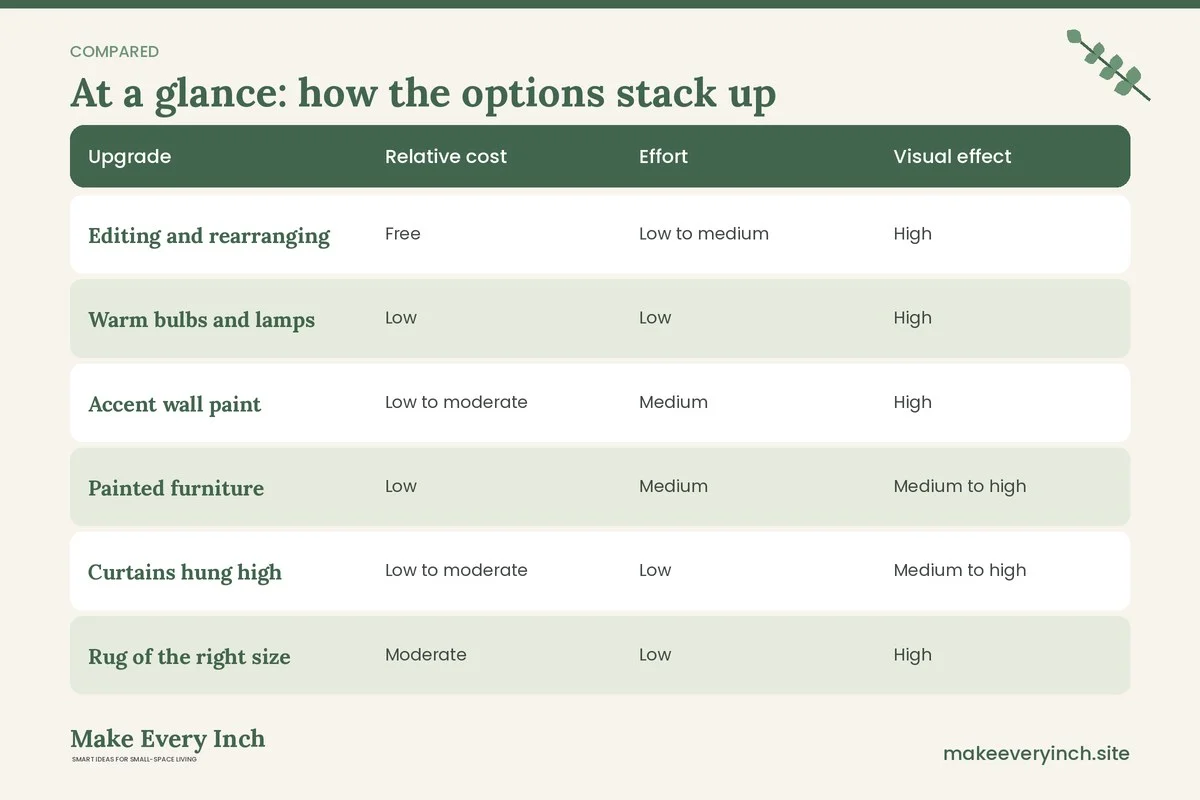
The table below compares the main upgrades by relative cost, effort and effect. Cost bands are relative and vary by region and by whether you buy new or secondhand.
| Upgrade | Relative cost | Effort | Visual effect | Notes |
|---|---|---|---|---|
| Editing and rearranging | Free | Low to medium | High | Always the first step |
| Warm bulbs and lamps | Low | Low | High | Layer at three heights |
| Accent wall paint | Low to moderate | Medium | High | Needs permission in a rental |
| Painted furniture | Low | Medium | Medium to high | Prep and low-VOC paint matter |
| Curtains hung high | Low to moderate | Low | Medium to high | Hang above the window frame |
| Rug of the right size | Moderate | Low | High | Often the largest textile cost |
| Cushion covers and throw | Low | Low | Medium | Limit the palette |
| Thrifted mirror | Low to moderate | Low | High | Place opposite a light source |
| Wall art | Low to moderate | Low | Medium | Choose fewer, larger pieces |
| Small plants | Low | Low | Medium | Match to the light you have |
Three example rooms
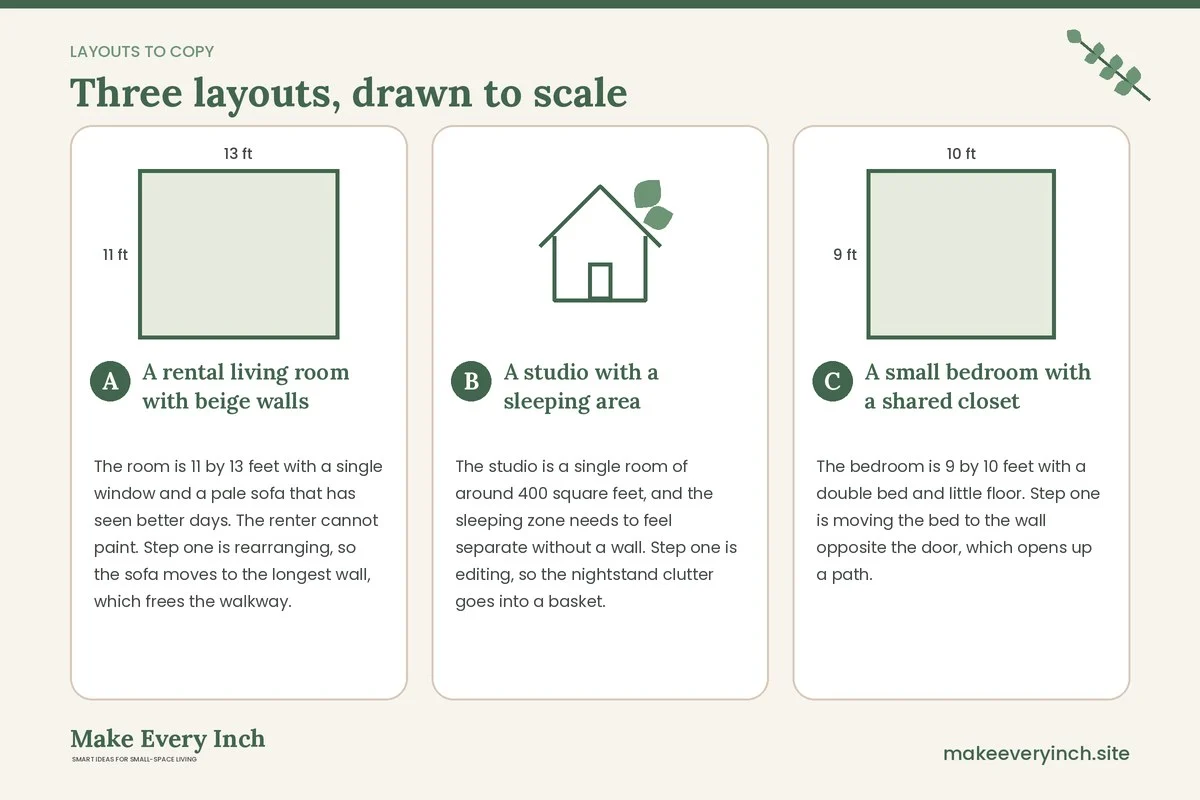
A rental living room with beige walls
The room is 11 by 13 feet with a single window and a pale sofa that has seen better days. The renter cannot paint. Step one is rearranging, so the sofa moves to the longest wall, which frees the walkway. Step two is light, with a warm bulb in the ceiling fixture, a floor lamp in the corner and a table lamp on a side table. Step three skips paint and uses removable options, such as a peel-and-stick panel behind a shelf in a small area, after checking the lease. Step four is textiles, with floor-length curtains hung high, a rug of around 5 by 8 feet and two cushion covers in a rust and cream palette. Step five is one secondhand mirror leaning near the window to bounce light. Decor is a single large print and a bowl of branches. The room feels deeper and calmer, and the total outlay stays modest because the largest changes were free or low cost.
A studio with a sleeping area
The studio is a single room of around 400 square feet, and the sleeping zone needs to feel separate without a wall. Step one is editing, so the nightstand clutter goes into a basket. Step two is light, with a clip-on lamp on the headboard and a separate lamp in the living zone so that the two areas have different moods. Step three is a painted accent on the wall behind the bed if permitted, or a large piece of fabric on a rod if not. Step four is a bedspread in a plain color, a rug under the bed’s lower third and curtains that hang to the floor. Step five is a thrifted bookcase placed at the foot of the bed as a divider, with the back facing the bed and covered with a length of fabric. Decor is limited to a single tray on top. The result is a studio that feels like two rooms.
A small bedroom with a shared closet
The bedroom is 9 by 10 feet with a double bed and little floor. Step one is moving the bed to the wall opposite the door, which opens up a path. Step two is light, with wall-mounted plug-in sconces instead of bedside lamps, which frees the nightstand surface. Step three is paint on the ceiling, in a pale tint, and a deeper tone on the door. Step four is a throw, a duvet cover in a single calm color and blackout-style curtains for sleep. Step five is a secondhand mirror hung on the back of the door, and step six is only two pieces of art. The extra storage comes from under the bed, so no new furniture is needed. For more ideas, see our post on small apartment makeovers on a budget.
Budget planning: a simple way to allocate
You do not need a spreadsheet, but a rough split helps you avoid overspending on the last step. A common approach, which you can adjust, is to divide the money into portions. Give the largest share to the items that affect the whole room, such as light and a rug, a moderate share to paint and curtains, a smaller share to secondhand furniture and the smallest to decor. Keep a small reserve, which is often around a tenth of the budget, for the surprise item you realize you need at the end. If you are starting from nothing, consider our guide to small apartment decor on a small budget and the budget renter upgrades list for ways to stretch the funds. Reliable ranges vary with your region, so check local prices before you plan, and treat any figure you see online as a rough guide only.
If you want to save for a larger item, such as a rug or a good lamp, put it on a wish list for at least two weeks. Many items that seemed essential on day one fade from the list by day fourteen, and the ones that remain are the ones you truly need.
Common mistakes on a tight budget
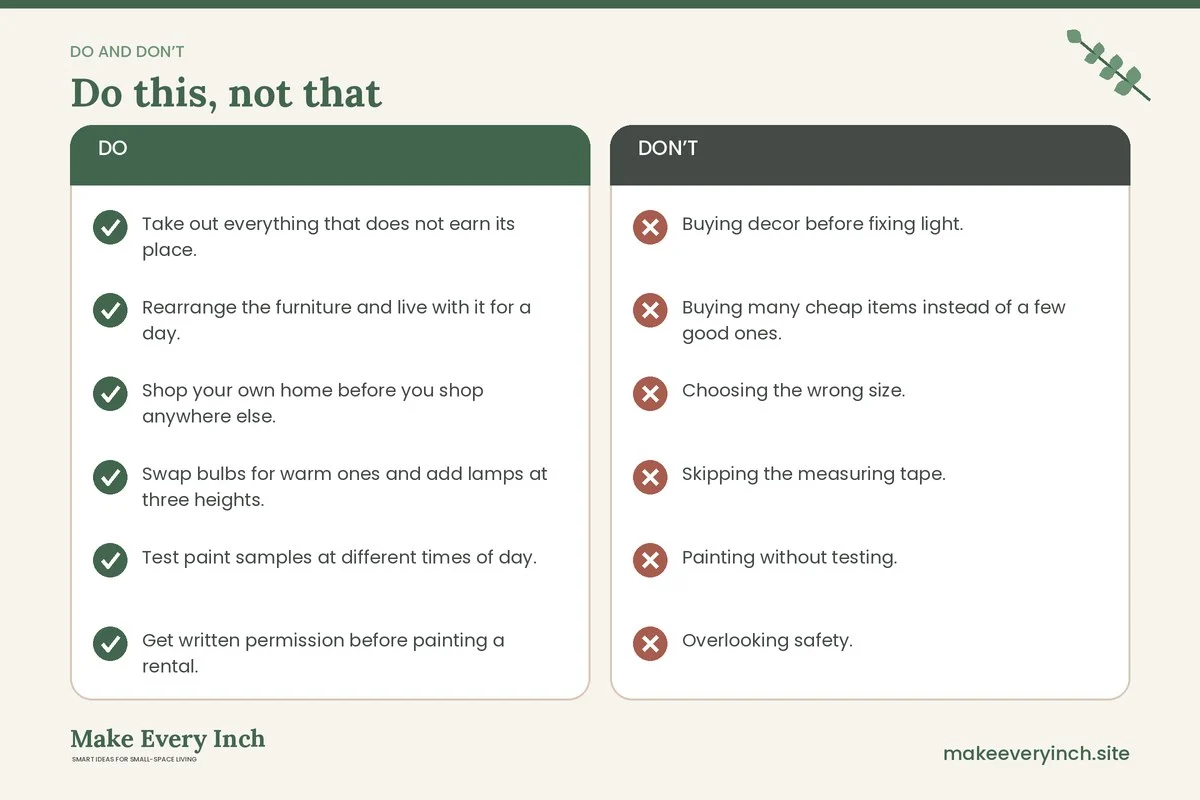
- Buying decor before fixing light. A beautiful object in a dim room still looks dim.
- Buying many cheap items instead of a few good ones. Cheap pieces wear out and often need replacing, which costs more over time.
- Choosing the wrong size. A rug, a mirror or a piece of art that is too small makes a room look cluttered.
- Skipping the measuring tape. Measure the room and the item before you buy, including the door and the stairs.
- Painting without testing. Always test a sample, and always check the lease.
- Overlooking safety. Overloaded outlets, old paint and poor ventilation can cause real harm. Take the time to do these steps correctly.
- Following trends that do not last. Pick colors and shapes that you still like in a year.
- Filling every surface. Empty space is part of the design.
Checklist
- Take out everything that does not earn its place.
- Rearrange the furniture and live with it for a day.
- Shop your own home before you shop anywhere else.
- Swap bulbs for warm ones and add lamps at three heights.
- Test paint samples at different times of day.
- Get written permission before painting a rental.
- Use low-VOC paint and ventilate well.
- Hang curtains high and wide.
- Choose a rug large enough for the front legs of the furniture.
- Limit cushions and throws to a small palette.
- Measure before you thrift, and inspect frames and cords.
- Give every new item a job.
- Leave about a third of each shelf empty.
- Keep a one in, one out rule.
- Wait two weeks before buying anything not on the plan.
FAQ
What should I buy first when decorating a small space on a tight budget?
Nothing at first. Edit the room, rearrange the furniture and use what you have. The first purchase is usually better light, such as a warm bulb and a lamp, since light changes how everything else looks.
Is paint worth it on a tight budget?
Often yes, since paint has a large effect for a modest cost, especially on one wall, a door or a piece of furniture. If you rent, ask permission first and consider removable options.
How can I make a small room look bigger without spending much?
Use pale, warm colors, hang curtains high, add a mirror opposite a window, keep the floor clear and layer your light. Editing the room often helps more than any purchase.
Where can I find good secondhand pieces?
Charity shops, neighborhood swap groups, community marketplaces, garage sales and estate sales all offer small tables, mirrors and lamps. Go with a tape measure and a short list.
How do I decorate without adding clutter?
Choose fewer, larger items with a purpose, keep surfaces about one third empty, rotate decor instead of adding to it and follow a one in, one out rule.
Is it safe to paint a small room myself?
It can be, with care. Use low-VOC paint, ventilate well, protect your skin and eyes and check for lead in older homes before sanding. Ask permission in a rental.
How can I make my lighting safer on a budget?
Buy items with a recognized safety mark, match bulbs to fixtures, avoid chaining power strips and leave any fixed wiring to a qualified person.
Keep going: Keep going with our guide to DIY storage ideas for small homes, the list of small bedroom ideas on a budget and our tips on cozy small living room ideas on a budget.
Save this guide for later
Pin the ideas you like to Pinterest so you can come back to them when you plan your space.