Budget Friendly Furniture Ideas for Small Apartments
Quick answer: The best budget friendly furniture ideas for small apartments start with a buying order, not a shopping list. Buy the bed and the main seat first, measure the room and the doorways before anything else, pick pieces that do two jobs, and inspect secondhand items for wobble, damp and pests. Spend more on what you use every day and less on what only holds objects.
Budget friendly furniture ideas for small apartments work best when you treat money and space as the same problem. Every piece you buy costs you twice, once at the checkout and again in floor area that you cannot use for anything else. A cheap chair that is too big for the room is more expensive than a good chair that fits, because it makes you live around it. This guide is about the order of purchases, the scale of each piece, the pieces that earn their keep by doing two jobs, and the checks that keep a secondhand find from turning into a regret. It does not repeat a buying guide for specific products. For that angle, read our pillar on the best furniture for small apartments, which compares categories and features. This post is about stretching a limited budget across a whole home. For the wider budget picture, see budget small space ideas, and for the organizing side, the guide to small space organization ideas. Once the furniture is settled, the companion post on small kitchen upgrades that cost very little covers the cheap fixes for the room that usually needs the most help.
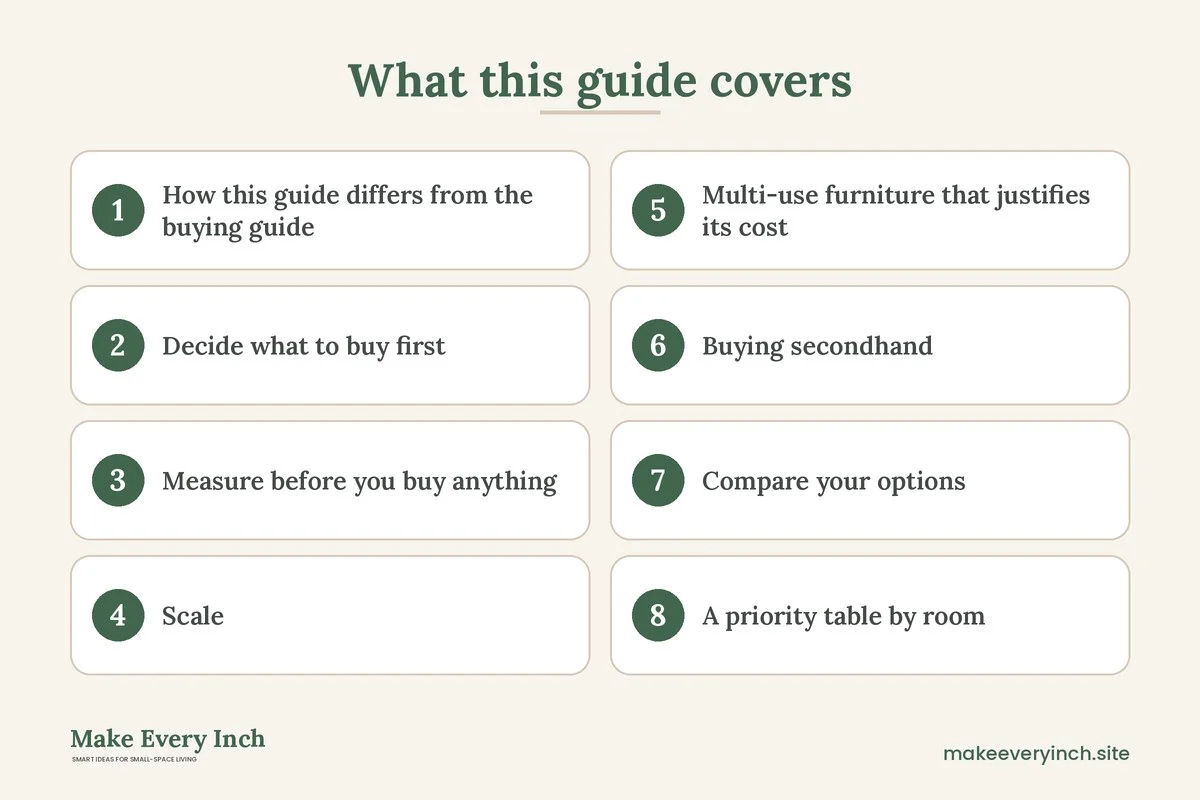
How this guide differs from the buying guide
The main furniture guide on this site sorts pieces by category and explains what to look for in a sofa, a bed, a table and a desk. That is the right tool when you already know what you are buying. This post comes one step earlier. It answers the questions that decide whether you should buy at all: what comes first, what can wait, what can be borrowed, what can be found secondhand and what is worth paying more for. Think of the buying guide as the menu and this post as the plan for the evening.
Another difference is the time frame. A buying guide assumes a single purchase. A budget plan spreads purchases across months, so each choice has to still make sense with pieces you do not own yet. That means choosing a color family, a leg style and a height range that will work together even when the items come from three different places.
Decide what to buy first
The usual mistake is to buy for the look of the room, which means a rug, cushions and a coffee table. Those are the last things a home needs. A better order follows how the body uses the space. Start with the things you use for hours at a time, move to the things you use daily, and leave the things that only decorate until the end.
Tier one: the body pieces
These are the bed, the main seat and a place to eat or work. Sleep, sitting and a flat surface at the right height affect your daily comfort more than anything else. If your budget is tight, spend relatively more here, and accept simple styling elsewhere. A mattress and a supportive base are worth prioritizing because sleep quality depends on them, and they are rarely good as secondhand purchases for hygiene reasons.
Tier two: the storage pieces
Once you can sleep, sit and eat, you need somewhere for the things you own. A dresser or a wardrobe, a shoe solution near the door, and a shelf or two come next. Storage is the tier where cheap and basic works best, because a plain frame with doors does the same job as a fancy one. It is also where secondhand finds shine, since solid wood storage often outlasts new flat-pack versions.
Tier three: the support pieces
Side tables, a console, a lamp, a mirror and a rug. These make the room comfortable, and they are the best candidates for borrowing, making and finding for little. A small room can look finished with a modest number of these if the walls and the lighting are handled well.
Tier four: the decoration
Art, cushions, throws, plants and objects. Buy these slowly and last. Many of them can come from family, thrift shops or your own photographs. For ideas that stretch a tiny allowance, see our guide to small apartment decor under 100.
Measure before you buy anything
A budget stays intact only if nothing has to be returned. Returns cost time, effort and sometimes fees, and a piece that arrives and does not fit is the most common way to lose money on furniture. Measure the room, the doorways, the stairwell and the elevator if there is one. Write the numbers on a single page and keep it on your phone.
The numbers to write down
- Room length and width, plus the position of windows, radiators, vents and outlets.
- Door width and height, and the swing of every door, including closets and the oven.
- The narrowest point on the delivery path, such as a stairwell turn or a hallway corner.
- Ceiling height, which matters for tall bookcases and for anything that stands under a sloped ceiling.
- Baseboard depth, because a piece against the wall sits a little away from it.
Clearance targets that keep a room usable
As a general guide, aim for roughly 30 to 36 inches for a main walkway and about 24 inches for a secondary one. Leave around 18 inches between a sofa and a coffee table, and about 24 to 30 inches on the side of a bed you use to get in and out. Pull-out dining chairs need around 30 to 36 inches behind them if people must pass. Treat these as starting points, because your layout, your height and your habits will move them a little in either direction.
Tape the footprint
Mark each piece on the floor with painter’s tape at its true width and depth. Leave the tape for a day or two and walk around the room as you normally would. If you keep stepping on it, the piece is too big. If you find yourself walking around it with annoyance, move it or choose a smaller one. This costs nothing and prevents the single most expensive error.
Scale: the rule that saves more money than any sale
Small rooms reward furniture that is shallow, raised on legs and light in visual weight. A sofa that is 32 inches deep takes noticeably more floor than one at 36, and a bed with a solid base looks heavier than one on slim legs. These differences are small on paper and large in a room of 10 by 12 feet.
What visual weight means
Visual weight is how heavy a piece looks, not how heavy it is. Exposed legs let your eye see the floor underneath, and that makes the floor look bigger. Light colors recede, while dark, bulky shapes advance. Glass, open metal frames and slim wood make less impression than thick upholstered arms. A cheap piece with a light profile often looks better in a small room than an expensive piece with a heavy one.
Proportions to remember
- Keep a sofa shorter than about two thirds of the wall it sits against when the room is tiny, so the wall can breathe.
- Choose a coffee table roughly two thirds the length of the sofa, and a little lower than the seat.
- Pick a rug large enough that at least the front legs of the seating sit on it, which often means a size such as 5 by 8 feet in a small living room.
- Select a bookcase that is shallow, around 10 to 12 inches deep, rather than a deep one that cuts into the floor.
- Prefer a desk 20 to 24 inches deep for a laptop setup, rather than a large one that needs a corner of its own.
Multi-use furniture that justifies its cost
Furniture that does two jobs can replace two purchases, but only if the second job is one you actually need. A bed with drawers is valuable if you lack a dresser. It is pointless if your closet is large. Ask what the room is missing before you look at what a piece can do.
Seating with storage
An ottoman with a hinged lid holds blankets and doubles as a footrest or an extra seat. A bench with a lift-up seat can serve at the end of the bed or by the door. For more on this category, see our guide to best storage ottomans.
Beds with room beneath
A bed on high legs or with built-in drawers gives you a large hidden zone for out-of-season items. Compare it with simple risers and bins before paying for built-in drawers, because the cheaper route can give similar space. For ideas, see under bed storage ideas and the roundup of best beds with storage.
Tables that change size
A drop-leaf, gateleg or extendable table sits small on weekdays and opens for guests. A narrow console can double as a desk, a bar or a dining surface for two. Nesting tables provide extra surface on demand and disappear when not needed. For an in-depth look, read the guide to the best small dining tables.
Shelves that divide space
An open shelf unit in the middle of a studio can split sleeping from living without a wall. Keep it low enough to see over or open enough to let light through. Anchor any tall shelf, which we cover in the safety section below.
Desks that fold away
A wall-mounted fold-down desk or a slim table that tucks against a wall can create a work zone in a bedroom or a living room. If you rent, check whether drilling is allowed first, and see best desks for small apartments and small bedroom ideas with a desk.
Buying secondhand: a calm inspection routine
Secondhand furniture is where a small budget goes furthest, because older pieces are often solid and fairly priced. The risks are hidden damage, odors and pests, so a short inspection routine is worth following every time. Do this before you pay, and be ready to walk away.
Structure and stability
Sit on it, push on it and lift one corner. A piece that wobbles at the seller’s home will wobble in yours. Check the joints for gaps, cracks or loose screws. Look for dovetail corners on drawers, which tend to indicate better construction than stapled corners. Pull each drawer out fully and make sure it runs on its track without grinding. Look underneath and inside, where problems tend to hide.
Surface and material
Run your hand along the surface for bubbling, peeling veneer and water rings. Press on particleboard edges, because swelling suggests past water damage and cannot be reversed. Solid wood can be sanded and refinished, but veneer over particleboard is hard to fix once the surface is damaged.
Smell and pests
Smell the inside of drawers and cabinets. A musty odor can mean damp, and a strong smoke or perfume smell can be very hard to remove. Look in seams, under cushions and behind panels for signs of insects, such as tiny dark spots, shed skins or webbing. Skip upholstered pieces from unknown sources if you cannot check them carefully, because pests in soft furniture are expensive to deal with. Hard-surfaced pieces are much lower risk.
Safety history
For anything that holds children or heavy items, such as a crib, a bunk or a tall dresser, check for recall notices on the maker’s official site and avoid pieces that lack stable construction. Tall dressers and bookcases need anchoring to the wall, so confirm that you can do that where you live.
Transport and delivery
Measure the piece against your doors and stairwell, and bring blankets, straps and a helper. A piece that does not fit through the entry is not a bargain at any price. Ask whether it can be disassembled, and keep every screw in a labeled bag.
Where to look
Community swap groups, neighborhood listing boards, thrift shops, estate sales, building move-out days and second-time-around stores are common sources. Late spring and end-of-lease periods in student areas often bring more supply, though availability varies by area. Be ready to haggle politely, and compare similar listings before you decide.
Compare your options: new, secondhand and DIY
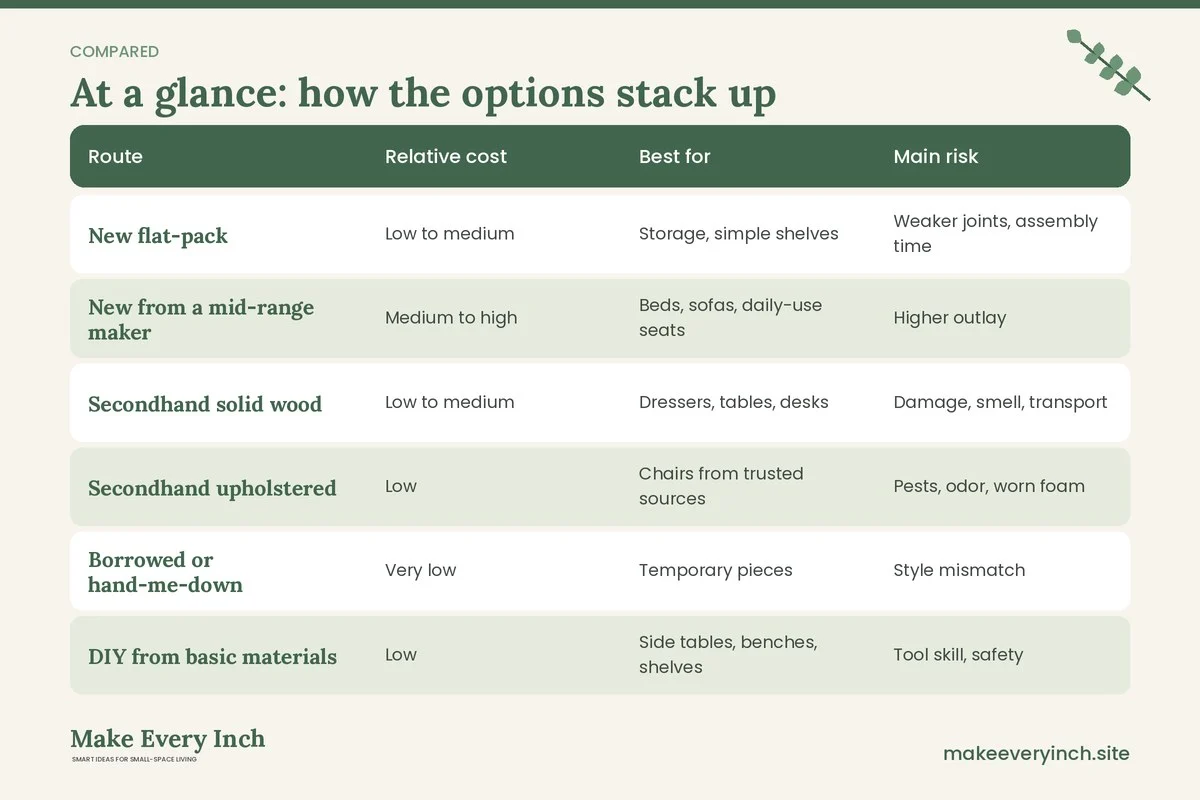
The table below shows how each route typically behaves. These are general patterns, not guarantees, and they will shift by region and season.
| Route | Relative cost | Best for | Main risk | Time needed |
|---|---|---|---|---|
| New flat-pack | Low to medium | Storage, simple shelves | Weaker joints, assembly time | Medium |
| New from a mid-range maker | Medium to high | Beds, sofas, daily-use seats | Higher outlay | Low |
| Secondhand solid wood | Low to medium | Dressers, tables, desks | Damage, smell, transport | Medium to high |
| Secondhand upholstered | Low | Chairs from trusted sources | Pests, odor, worn foam | Medium |
| Borrowed or hand-me-down | Very low | Temporary pieces | Style mismatch | Low |
| DIY from basic materials | Low | Side tables, benches, shelves | Tool skill, safety | High |
| Refinished or repainted | Low to medium | Updating a dated piece | Fumes, mess | High |
A priority table by room
Use the next table to see where money usually pays off and where it can be saved. It is a general pattern, so adapt it to what you already own.
| Room | Spend more on | Save on | Often borrowed or secondhand |
|---|---|---|---|
| Living room | The main seat | Side tables, shelves | Coffee table, bookcase |
| Bedroom | Mattress, bed base | Nightstands, dresser | Dresser, bench |
| Kitchen or dining | A sturdy table, a comfortable chair | Stools, carts | Table, chairs |
| Entry | A solid hook rail or bench | Mirror, tray | Console, shoe bench |
| Work corner | A supportive chair | Desk surface | Desk, shelf |
Three example apartments
These scenarios show how the same budget thinking changes with the layout. The measurements are examples and not recommendations for your room.
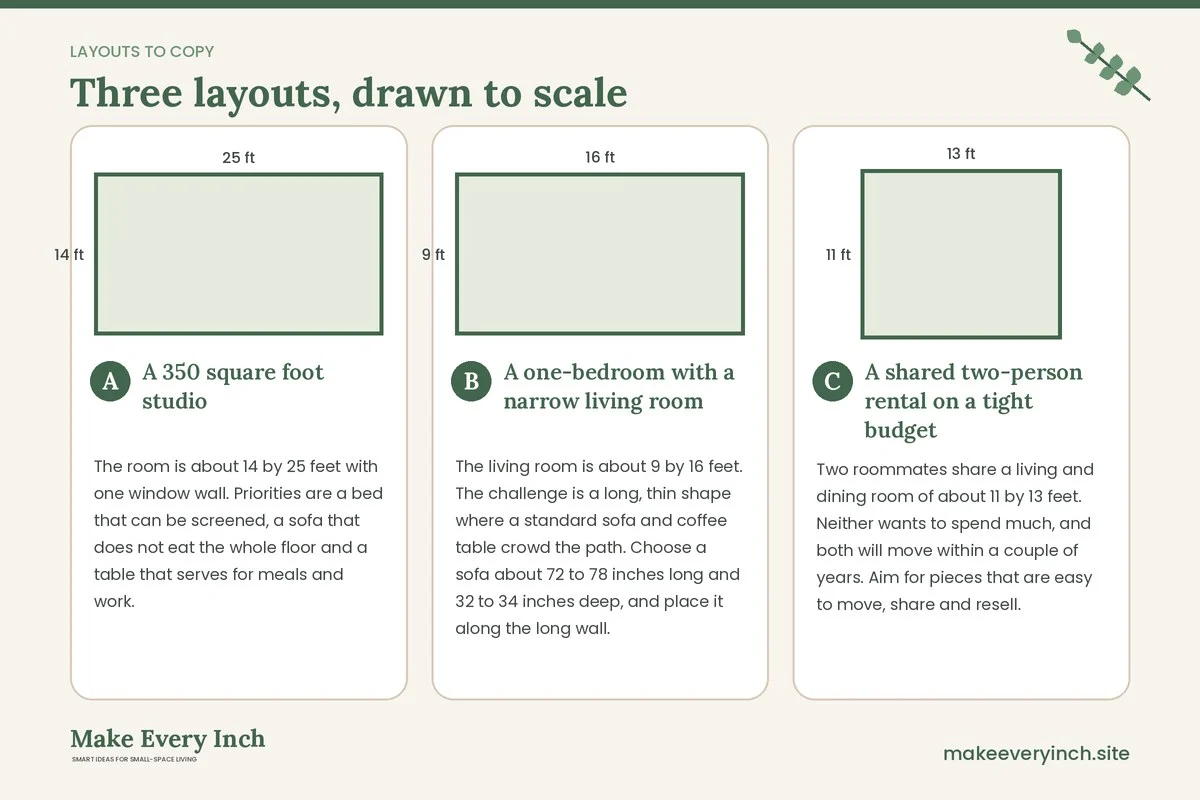
A 350 square foot studio
The room is about 14 by 25 feet with one window wall. Priorities are a bed that can be screened, a sofa that does not eat the whole floor and a table that serves for meals and work. A sensible plan starts with the mattress and a simple frame on legs, which gives under-bed storage and replaces a dresser. A small loveseat or apartment sofa about 60 to 72 inches long comes next. A drop-leaf table by the wall serves for both dining and a laptop. An open shelf unit about 12 inches deep forms a soft divider between the bed and the living zone, anchored to the wall with permission. Secondhand sources can fill the shelf and the table, and the sofa is the piece worth spending more on.
A one-bedroom with a narrow living room
The living room is about 9 by 16 feet. The challenge is a long, thin shape where a standard sofa and coffee table crowd the path. Choose a sofa about 72 to 78 inches long and 32 to 34 inches deep, and place it along the long wall. Skip a large coffee table and use two small nesting tables or a pouf with a tray. Use a console about 10 inches deep behind the sofa or by the entry as a drop zone. The bedroom keeps a bed with drawers and no dresser. A secondhand desk in the corner of the living room can handle remote work. For layout ideas, see narrow living room ideas.
A shared two-person rental on a tight budget
Two roommates share a living and dining room of about 11 by 13 feet. Neither wants to spend much, and both will move within a couple of years. Aim for pieces that are easy to move, share and resell. Use a sofa that comes apart in sections, a lightweight table that folds, and open storage with simple joints. Keep the large purchases neutral so each person can reuse them later. A small bench with storage helps near the door, and a cart in the kitchen handles extra counter space. See small apartment living room ideas on a budget for a room-focused version.
Renting? Furniture that respects the lease
Renters have extra reasons to keep furniture simple. Pieces that stand on their own need no permission. Wall-mounted items need it.
- Choose freestanding shelves and desks over wall-mounted ones.
- Use furniture with felt pads or protective feet on wood and laminate floors.
- Pick pieces that can be taken apart, so they leave through the same door they entered.
- Avoid anything that needs a permanent fixing in a wall.
- When you do need to fasten something, get permission in writing first.
For more rental ideas, see budget renter upgrades and the guide to no-drill storage ideas for renters.
Safety notes for budget furniture
Cheap furniture has the same safety needs as expensive furniture, and the risk is often higher with older pieces and with DIY work.
Anchor anything tall
Dressers, bookcases and tall shelves can tip, especially when drawers are open or when children climb them. Use anti-tip straps or brackets that fit your wall type, and follow the manufacturer’s directions. Never drill into a wall without the landlord’s or building’s permission. If you cannot anchor in a rental, choose lower, wider pieces that are naturally stable, and keep heavy items on the lower shelves.
Use the right tools and protection
If you assemble, sand or refinish furniture, wear safety glasses and a dust mask suited to the job. Use a stud finder before you drill, and look for hidden wiring and pipes. Keep cords and blades away from your body, and clamp work down before cutting or sanding. If you are not comfortable with a power tool, ask someone experienced or choose a no-tool alternative.
Ventilation and finishes
When you repaint or refinish a secondhand piece, work in a space with open windows and a fan that moves air outward. Choose low-VOC or water-based paints and finishes, and follow the label for drying times and protective gear. Old paint on antique or very old furniture may contain lead, so do not sand it dry. Use a test kit if you suspect it, or choose to leave the finish intact and cover it with a different approach.
Electrical items
Check cords for fraying and plugs for scorching. Do not overload a power strip. Keep lamps away from fabric, and choose bulbs rated for the fixture.
Weight limits
Shelves, beds and sofas have rated loads. Do not exceed them, and do not use a flimsy piece as a stepping stool. Spread heavy books across several shelves rather than stacking them in one spot.
Cheap upgrades that make budget pieces look better
A few small changes can lift a basic piece without major spending.
- New hardware: swap dated knobs and pulls for simple ones. This is a small, quick change that can transform a plain dresser.
- Paint or stain: a fresh coat in a calm color unifies mismatched finds. Prepare the surface well, and use a low-VOC product.
- Legs: some sofas, beds and cabinets accept screw-in legs that lift the base and show more floor.
- Slipcovers and throws: cover worn upholstery with a washable fabric.
- Felt pads: protect floors and cut noise.
- Contact paper or veneer: refresh a worn top, though check that the surface is clean and flat first.
- Cushions: a firm pillow or a fresh seat pad can make an old chair comfortable.
For more ideas that make home projects pay off, see diy apartment upgrades and thrifted apartment decor ideas.
Common budget furniture mistakes
Buying the whole room at once
Filling a room in one weekend usually means compromising on quality and fit. Spread purchases over time, and let the room tell you what it needs.
Ignoring the delivery path
A sofa that cannot pass the stairwell becomes a return, a fee or a hard lesson. Measure first.
Choosing the lowest price for daily-use items
A very cheap sofa or chair can lose shape, and a thin mattress can cost you sleep. Daily-use pieces deserve a larger share of the budget.
Buying matching sets
A set can fill a room with too much of one thing. Mix sources and finishes within a shared color family, and the room looks collected and not staged.
Forgetting storage
A room with nowhere to put things looks cluttered no matter how nice the furniture is. Plan storage before decoration, and see small apartment decluttering ideas.
Overlooking the move
If you may move soon, avoid heavy, built-in or oversized pieces. A lighter, modular approach saves effort later.
A simple spending plan
Rather than quoting amounts, divide your budget by share. This keeps the plan useful whatever the total is.
- About half for tier one, the body pieces.
- About a quarter for tier two, the storage.
- About a tenth to a fifth for tier three, the support pieces.
- The rest for decoration, delivery and small repairs.
These ratios are a starting point, not a rule. If you already own a good bed, shift the money toward seating or storage. If you plan to move in a year, keep more in reserve for resale or replacement.
Furniture checklist
Use this list before each purchase.
- I measured the room, the door and the delivery path.
- I taped the footprint on the floor and lived with it for a day.
- The piece fits my buying order and is not decoration disguised as a need.
- It does a second job, or it is the best single-purpose choice.
- Its legs, color and height go with what I already own.
- If secondhand, I checked structure, smell, surface and pests.
- If tall, I know how I will anchor it, and I have permission to do so.
- If I plan to refinish, I have ventilation, low-VOC product and the right protection.
- I know how it leaves my home when I move.
- I compared at least two options before buying.
FAQ
What furniture should I buy first in a small apartment?
Buy the bed and the main seat first, then a surface for meals or work. These are the pieces you use for the most hours, so they affect comfort more than any decorative item. Storage comes next, and decoration comes last.
Is secondhand furniture a good idea for a small space?
Often yes, especially for solid wood storage, tables and desks. Inspect for wobble, damp, smell and pests, and measure before you go. Be more cautious with mattresses and upholstered pieces from unknown sources.
How do I know whether a piece is too big?
Tape its footprint on the floor and leave it for a day or two. Check that you still have roughly 30 to 36 inches for main walkways and around 24 inches for secondary ones. If you keep walking around it, it is too big.
Is multi-use furniture always worth it?
Only when the second job is one you need. A storage bed is useful if you lack a dresser, and a waste of money if you have plenty of closet space. Start from what the room is missing.
How can I make cheap furniture look better?
Change the hardware, add legs, repaint with a low-VOC product, add a washable cover or lay a good rug beneath it. Consistent colors across mismatched pieces make a room look planned.
Do I need to anchor furniture in a rental?
Tall dressers and bookcases should be secured against tipping. Ask your landlord for permission before you drill. If that is not possible, choose low, wide, stable pieces and keep heavy items on the lowest shelves.
What is the difference between this guide and the best furniture guide?
The best furniture guide compares categories and features to help you pick a specific piece. This guide covers the order of purchases, the sizing, the secondhand checks and the way to spread a limited budget across the whole home.
Keep going: Keep going with our budget small space ideas, small kitchen upgrades that cost very little and best furniture for small apartments.
Save this guide for later
Pin the ideas you like to Pinterest so you can come back to them when you plan your space.