Small Mudroom Ideas Without a Mudroom
Quick answer: The best small mudroom ideas without a mudroom turn 3 to 4 feet of wall near the door into a wet-gear zone: a waterproof boot tray on the floor, a narrow bench about 16 to 18 inches high, a row of hooks at 60 to 66 inches, a washable mat and a way for wet items to dry with airflow. Protect the floor, keep the walkway clear and leave room for the door to swing.
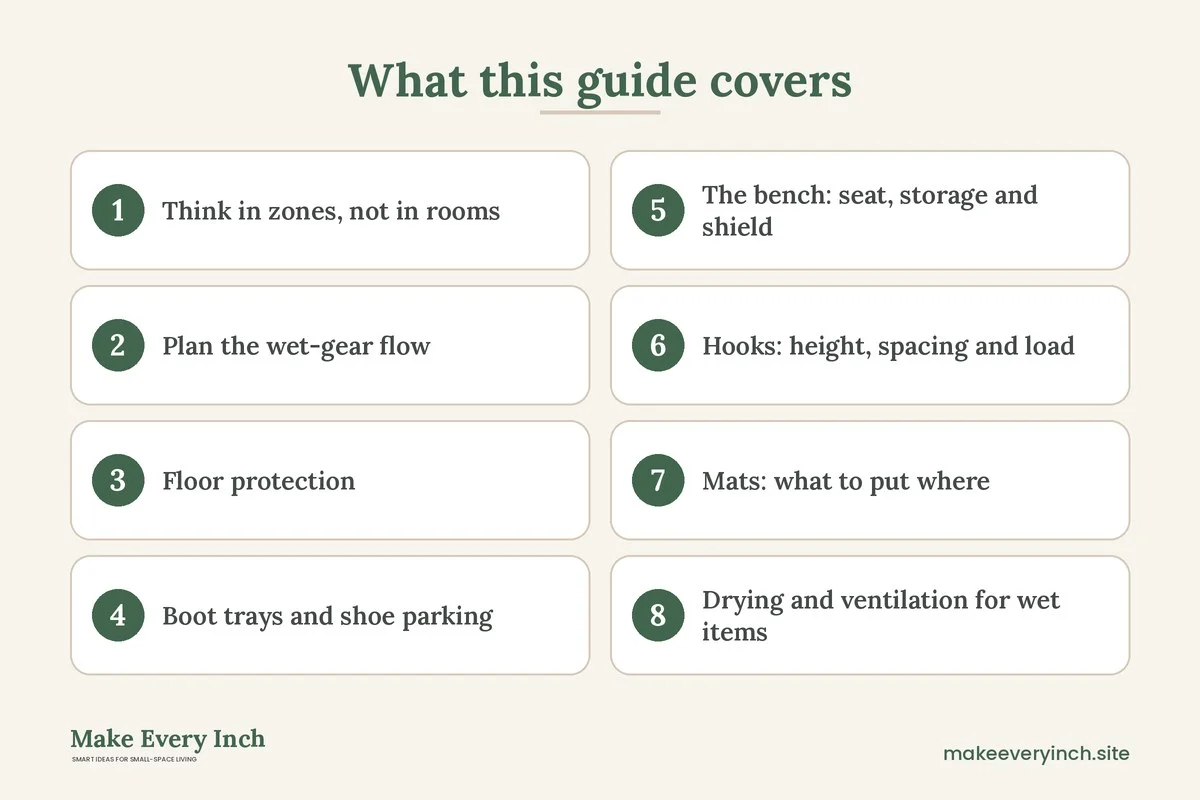
Small mudroom ideas without a mudroom begin with an honest look at what a mudroom is for. It is not really a room at all. It is a set of jobs: a place to take off wet boots, a place to hang a dripping coat, a place to sit while you lace up and a place for the water to go. When a home has no separate room for these jobs, you can still build the same function in a corner, a stretch of hallway or the area just inside the front door. This guide shows how to do it. It covers choosing the spot, the wet-gear flow, floor protection, boot trays, a bench, hooks, mats, drying and ventilation, three example homes, a comparison table, a seasonal routine, mistakes to avoid and a checklist. For the broader topic, read our pillar on small entryway ideas, and for homes with no entry at all, see no-entryway apartment ideas.
Think in zones, not in rooms
A mudroom works because it keeps the dirty part of the day in one place. When you build a mudroom zone, you draw a boundary around the mess so it does not spread to the sofa, the kitchen or the bedroom. The zone has four parts, and each one needs space.
- The landing: a patch of floor where you stand to take off footwear. Plan about 24 by 30 inches per person.
- The wet shelf or tray: where boots and shoes drain.
- The hang line: hooks or a rail for outer layers.
- The seat: a place to sit while you change shoes.
If the space is tiny, merge two parts. A bench can hold the boot tray beneath it and the hook rail above it, which makes a vertical stack in about 30 inches of width.
Pick the right spot
You have a few choices, and the best one depends on the door.
- Directly inside the front door: the most logical place, since it intercepts the mess early. It needs enough room for the door to swing fully.
- A hallway near the entry: a wall in a hall that connects the door to the rest of the home, as long as it leaves about 36 inches of walking width.
- Behind the door: the area behind an inward-opening door is often wasted. Hooks on a door-back rail and a shallow shelf behind the door can use it, if the door is not meant to open flat against the wall.
- A corner: a corner of a living room or a kitchen near the entry can hold a boot tray and a coat tree.
- A nearby closet: a coat closet with the door removed or replaced by a curtain can become an open wet-gear nook. Our guide on small coat storage ideas covers closets in detail.
- A balcony or stairwell landing: where allowed, a covered balcony near the door can hold wet gear. Check local rules and your lease about storing items outside.
Whatever you choose, keep the route from the door to the zone short. The farther someone must walk with muddy shoes, the more mud ends up on the floor.
Measure before you buy
Grab a tape measure and note these figures.
- Door swing clearance: the arc of the door, plus a few inches, must stay clear.
- Wall width available: often 30 to 48 inches in a small home.
- Depth available: 12 to 16 inches for a narrow bench or shelf, up to 18 inches if the path allows.
- Ceiling height: useful for hooks and high shelves.
- Walking width left: at least 30 to 36 inches after the furniture is in place.
Tape the footprint on the floor with painter’s tape and walk through the plan with a bag in your hand. If you bump the bench, make it shallower.
Plan the wet-gear flow
A good zone follows the order of your day. Think of the steps as a short conveyor belt.
1. Arrive: you open the door and step on a mat.
2. Shake off: you shake the umbrella and tap the soles.
3. Sit: you sit to take off boots.
4. Park: the boots go into a tray, and the wet coat goes on a hook.
5. Dry: the items drain and dry, with air moving around them.
6. Leave dry: shoes for indoors, or slippers, sit within reach.
When any step is missing, the mess spreads. For example, without a mat you have wet footprints, and without a tray the water goes into the floor. Without a place to dry, the wet coat goes on a chair.
Floor protection: the unglamorous foundation
The floor under a wet-gear zone takes the most abuse. Water, grit and salt can damage wood, laminate and some tile grout. A few layers of protection keep your floor safe, and they do not need to be expensive.
The three-layer system
- A scraper mat outside: if you have a spot outside the door, a coarse mat removes the biggest chunks of mud and snow.
- An absorbent mat inside: a mat that soaks up water, with a non-slip backing, catches what the scraper missed. Pick one that can be washed or hosed.
- A waterproof tray or mat under footwear: a tray with a raised lip holds melted snow, rain and muddy water. A rubber or plastic boot tray is a simple choice, and some have a pebble surface that lets water drain beneath the boots.
Which floors are most vulnerable?
- Solid wood and laminate: standing water can swell the edges. Wipe spills quickly, and use a tray with a lip.
- Vinyl and tile: these tolerate water better, though grout lines can stain, and wet tile can be slippery.
- Carpet: hard to clean, so use a large washable mat, and consider a tray under every pair.
Keep the mat from becoming a hazard
Wet mats can slip. Choose a mat with a non-slip backing, or add a rug pad rated for the flooring type, and check that the pad does not stain the floor, since some rubber backings can discolor vinyl. The edges of mats should lie flat. A mat that curls is a tripping risk, especially in a narrow hall, so trim or replace it. In a rental, test a small area first.
Boot trays and shoe parking
Boots are the heaviest part of the mudroom job. They are bulky, they are wet and they smell if they stay damp. Plan where they go.
Tray size
Measure the boots you own. A typical adult boot is about 12 to 14 inches long and 5 to 6 inches wide at the sole, but larger boots, and work boots especially, can be 13 inches or more. A tray for two pairs should be about 30 by 15 inches, and a tray for one adult’s pair about 16 by 12 inches. Choose a lip height of around 1 inch. A lip that is too low lets water out, and a lip that is too tall is a tripping hazard in a small space.
Where trays go
- On the floor beside the door: the simplest option, best for a household of one or two.
- Under a bench: a bench with an open lower shelf holds a tray, and the seat keeps drips off your lap. Keep the bench lower shelf at least 4 inches off the floor so air can move beneath it.
- Along a wall with a rack: a low rack holds shoes in tiers, though for wet boots a floor tray is better than a closed rack. See our post on best narrow shoe cabinets and the guide to small shoe storage ideas for dry shoes.
Rotate by season
In winter, boots and waterproof shoes live in the tray, and in summer you can replace them with sandals. Move off-season shoes to a closet or a box under a bed. Our guide to under-bed storage ideas offers ways to store them flat.
The bench: seat, storage and shield
A bench is the heart of a mudroom zone. It gives you a place to sit, a spot to drop a bag and, if chosen well, a place for storage.
Bench sizing
- Seat height: 16 to 18 inches is a comfortable seat for most adults.
- Seat depth: 12 to 15 inches is enough for a narrow bench. A depth of 16 to 18 inches feels more comfortable, but needs more room.
- Seat width: 30 to 36 inches seats one adult, and 42 to 48 inches seats two.
- Space beneath: 8 to 12 inches of clearance fits boots and baskets.
- Space between bench and door swing: at least a few inches more than the full arc of the door.
Choose a material that can handle wet
A wet coat will land on the bench. Use a surface that can be wiped: sealed wood, metal, plastic or a wipeable cushion cover. Avoid raw wood and untreated fabric. If you add a cushion, choose a removable cover that can be washed.
Bench options for tiny entries
- A narrow shoe bench: a slim bench with a shelf, 10 to 12 inches deep.
- A storage bench with a lid: the lid can hold hats and gloves, but wet items should not go inside a closed box.
- A stool or pouf: a small stool tucks under a shelf or a console when not in use.
- A wall-mounted fold-down seat: only with permission and secure fixings.
- A repurposed trunk or a chest: it doubles as a seat, with space for dry items.
For ideas that suit a rental, see no-drill storage ideas for renters. If you plan to build your own, our guide to DIY entryway storage for tiny homes walks through the steps.
Anchoring and safety
Any tall or top-heavy piece, such as a hall tree with a bench and a tall back, must be anchored to the wall with the hardware recommended by the maker, and only with permission if you rent. A wall-mounted bench or shelf should be fastened into studs or rated anchors. Children can climb furniture, so anchoring matters most in homes with young kids. Never drill without checking for hidden wires and pipes.
Hooks: height, spacing and load
Hooks are the cheapest, most effective piece of a mudroom zone, and they are easy to get wrong. A few numbers help.
- Adult hooks: 60 to 66 inches from the floor, so coats hang without dragging.
- Child hooks: 40 to 48 inches, depending on age, so kids can reach them.
- Spacing: 6 to 8 inches between hooks for thin coats, and 8 to 12 inches for thick winter coats.
- Depth: a coat hangs about 3 to 5 inches out from the wall, so a hook zone should have at least 8 to 10 inches of clear space in front of the wall, preferably more.
- Weight: check the rating on hooks, since a wet winter coat with a bag can weigh several pounds.
- Mounting: screws into studs or rated anchors are the sturdiest. A rail with a few hooks spreads the load.
Hook options for renters
Rated adhesive hooks suit lighter coats and bags, though a wet heavy coat is a poor match. An over-the-door hook rack uses no tools, and it fits an inward-opening door. A freestanding coat rack or a hall tree adds hooks without drilling. Read our guide to security-deposit-safe apartment upgrades before choosing.
Two tiers
For a family, add a second row of hooks at a lower height for kids’ bags and jackets. For two adults, one row with a shelf above is enough. Limit each person to two hooks, so the wall does not become a pile.
Mats: what to put where
A mat is your first line of defense, and there are different jobs for different mats.
- The door mat: outside or just inside, a tough mat for scraping.
- The absorbent runner: a long, narrow mat inside the door, about 24 to 30 inches wide, for stepping off the door mat.
- The tray mat: a waterproof mat under the boots.
- The bench mat: a small mat that sits at the foot of the bench, so you do not stand on a cold floor.
Choose washable materials, and wash or hose them regularly, as wet mats grow odors. Dry them fully, and flip them to air both sides. Rolling a damp mat and leaving it in a corner is a recipe for mildew.
Drying and ventilation for wet items
If wet gear stays damp in a closed space it will smell, and mildew can grow. A drying plan is the difference between a mudroom zone and a messy corner.
- Space things out: give each coat its own hook, and do not stack wet items.
- Hang, do not pile: a coat hung on a hook dries faster than one thrown over a chair.
- Lift boots off the floor: a rack or tray with a raised grid lets air move beneath them.
- Open the insoles: remove insoles, pull the tongue forward and loosen the laces so boots dry inside.
- Use air movement: a small fan placed safely, or an open window, helps a lot. Keep a fan away from the water and the tray, and check its cord so nobody trips over it.
- Avoid heat: do not place wet boots or gloves against a radiator, a heater or a hot vent, since heat can damage leather and rubber, and some materials are a fire risk. Keep them at a safe distance and follow the heater’s guidance.
- Use a drying rack: a small folding rack, or a rail, can hold gloves and hats. A boot dryer is an option, and it must be used according to its manual.
- Ventilate the space: if the entry is closed in, try to open a window or door for a few minutes each day, or use an exhaust fan if one exists. Fresh air helps carry moisture away.
- Watch for dampness on walls: if the wall behind the hooks looks dark or smells musty, move the hooks, add air gaps or call a professional.
If you plan to paint the area, choose a low-VOC, scrubbable paint and ventilate while it dries. A wipeable finish makes it easier to clean mud splashes. Our small entryway organization guide covers other ways to keep the zone tidy.
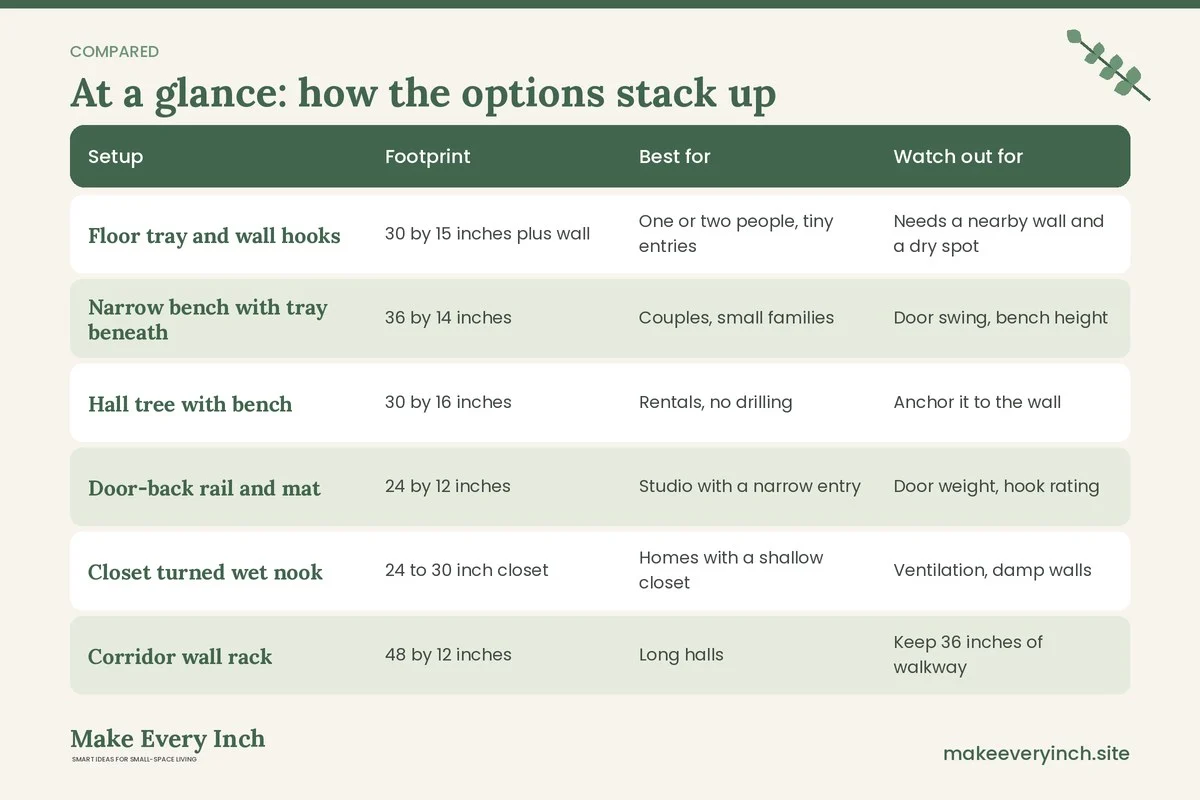
Comparison: mudroom zone setups
| Setup | Footprint | Best for | Watch out for |
|---|---|---|---|
| Floor tray and wall hooks | 30 by 15 inches plus wall | One or two people, tiny entries | Needs a nearby wall and a dry spot |
| Narrow bench with tray beneath | 36 by 14 inches | Couples, small families | Door swing, bench height |
| Hall tree with bench | 30 by 16 inches | Rentals, no drilling | Anchor it to the wall |
| Door-back rail and mat | 24 by 12 inches | Studio with a narrow entry | Door weight, hook rating |
| Closet turned wet nook | 24 to 30 inch closet | Homes with a shallow closet | Ventilation, damp walls |
| Corridor wall rack | 48 by 12 inches | Long halls | Keep 36 inches of walkway |
Three example homes
A studio with the door opening into the room
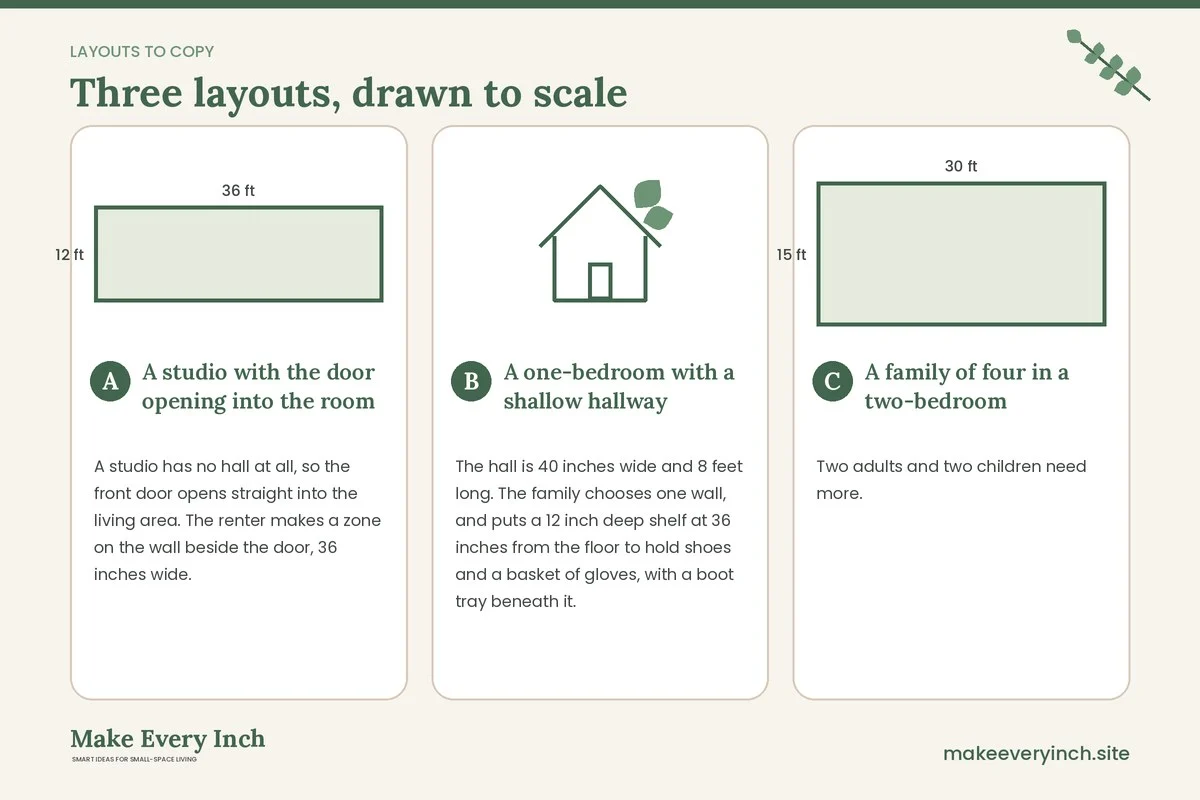
A studio has no hall at all, so the front door opens straight into the living area. The renter makes a zone on the wall beside the door, 36 inches wide. A rubber tray on the floor holds two pairs of boots, a slim 36 by 12 inch bench sits above it with a 6 inch gap, and a hall tree with four hooks stands to one side, anchored to the wall with permission. A runner mat, about 24 by 36 inches, leads in from the door. A folding screen or a tall plant marks the boundary, so the zone reads as a separate area. For more studio tactics, see our diy room divider ideas for studio apartments.
A one-bedroom with a shallow hallway
The hall is 40 inches wide and 8 feet long. The family chooses one wall, and puts a 12 inch deep shelf at 36 inches from the floor to hold shoes and a basket of gloves, with a boot tray beneath it. A rail of five hooks sits at 62 inches. A narrow runner covers the floor, and a clip-on fan helps the wall dry after rainy days. The hall keeps 28 to 30 inches of walking width, which is tight, so the family keeps the shelf shallow and avoids a bench. They add a stool for sitting. Our post on small home drop zone ideas offers ways to organize keys and mail in the same space.
A family of four in a two-bedroom
Two adults and two children need more. The family converts a coat closet into a wet nook by removing the door, adding a bench at 17 inches high, and putting a two-tier hook rail with adult hooks at 63 inches and child hooks at 45 inches. A large boot tray, 30 by 15 inches, sits under the bench. Baskets labelled by person hold hats and gloves. A window in the next room is opened a few minutes each day for airflow. The family reads our guide to small home organization for families to set up routines.
A seasonal routine
A zone needs maintenance, and the effort is small if you spread it out.
- Daily: hang coats, drain umbrellas, put boots in the tray and give the mat a shake.
- Weekly: empty the tray, wipe it with a damp cloth and check the hooks for wet spots.
- Monthly in wet seasons: wash the mats, check the wall behind the hooks and clean the floor under the tray.
- At the change of the season: swap boots for sandals, store off-season items and replace worn mats.
Mistakes to avoid
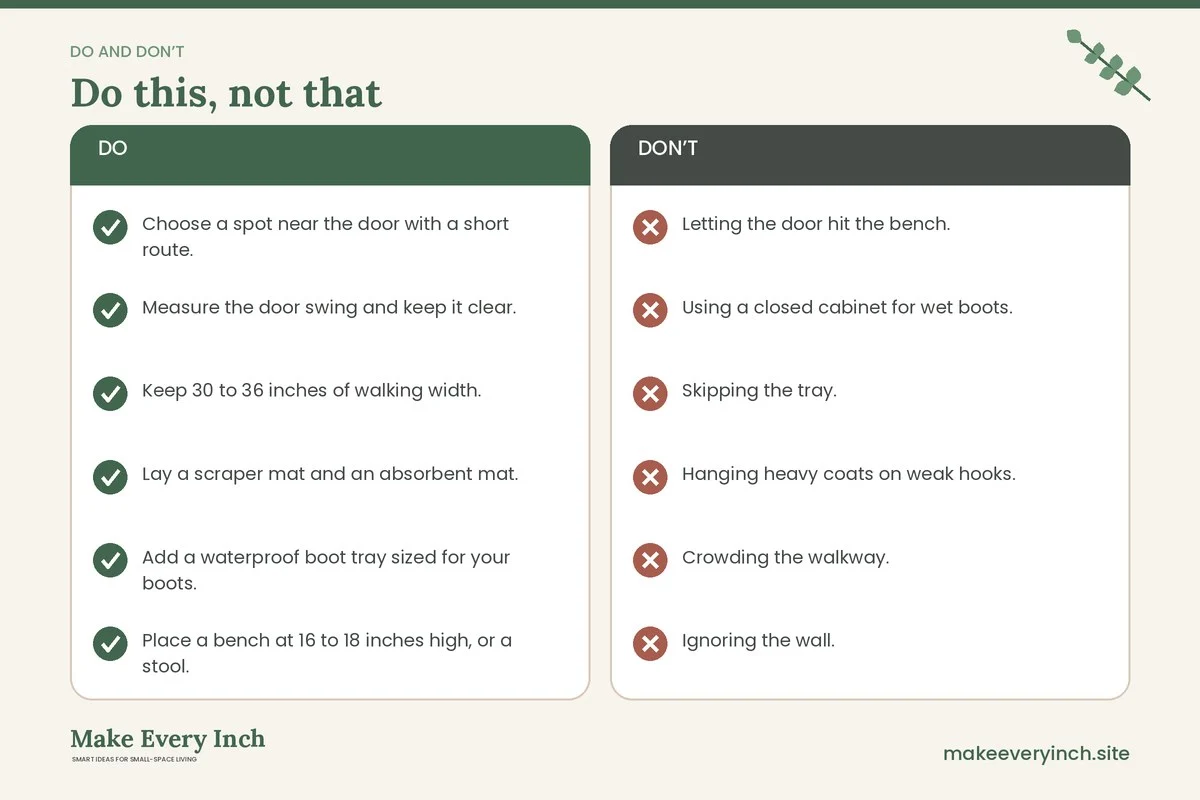
- Letting the door hit the bench. Measure the swing, and leave clearance.
- Using a closed cabinet for wet boots. Moisture stays inside and smells build up.
- Skipping the tray. Without one, water goes into the floor.
- Hanging heavy coats on weak hooks. Check ratings, and fix into studs or rated anchors.
- Crowding the walkway. Leave at least 30 to 36 inches of clear path.
- Ignoring the wall. Wet coats against a wall can leave marks, so use a rail or a wipeable paint.
- Placing the zone near a heat source. Keep wet items away from radiators and heaters.
- Drilling without permission. Renters should ask before using any fixings.
Mudroom zone checklist
- Choose a spot near the door with a short route.
- Measure the door swing and keep it clear.
- Keep 30 to 36 inches of walking width.
- Lay a scraper mat and an absorbent mat.
- Add a waterproof boot tray sized for your boots.
- Place a bench at 16 to 18 inches high, or a stool.
- Fix hooks at 60 to 66 inches for adults and 40 to 48 inches for kids.
- Check the weight rating of every hook and anchor.
- Anchor tall pieces to the wall, with permission.
- Plan airflow for drying, away from heaters.
- Choose washable, wipeable surfaces.
- Set a daily and weekly routine.
FAQ
How much space do I need for a mudroom zone?
A zone can fit in about 36 by 15 inches of floor and a matching stretch of wall. A bench, tray and hooks all fit in that footprint if you stack them vertically.
How do I stop water from damaging my floor?
Use a waterproof tray with a lip under wet boots and an absorbent mat at the door, and wipe up puddles quickly. These steps protect most floors, but check the care guide for your flooring.
Where should wet coats go?
Hang them on a hook with air around them, not over a chair or in a closed closet. If the coat is soaked, hang it on a hanger over a tray or a tub so drips are caught.
Can I make a mudroom zone in a rental?
Yes. A hall tree, a tray, a freestanding rack and an over-the-door hook set need no drilling. Ask before using screws or adhesive.
How do I keep the zone from smelling?
Dry items fully, keep air moving, wash mats regularly and avoid closed boxes for wet gear. Remove insoles and loosen laces so boots dry inside.
What if there is no wall near the door?
Use a freestanding hall tree or a rack that stands on the floor, and put a mat and tray beside it. A folding screen or a plant can mark the zone.
Is it safe to dry boots near a radiator?
Keep them a safe distance from heaters, radiators and vents. Heat can damage materials and may be a fire risk, so let boots dry with airflow instead.
Keep going: Keep going with our guides to small entryway storage, apartment entryway decorating and hallway gallery wall ideas for small homes.
Save this guide for later
Pin the ideas you like to Pinterest so you can come back to them when you plan your space.