Small Dining Room Wall Decor Ideas
Quick answer: The best small dining room wall decor ideas use one large mirror or one oversized art piece rather than many small frames, hang the center of the arrangement near eye level when seated and standing, keep shelves shallow, and choose renter-safe methods such as leaning, adhesive strips rated for the weight and picture ledges that stand on a sideboard. Never drill without permission, and anchor anything heavy.
Small dining room wall decor ideas have to do more work than ideas for a larger room, because the walls are close to the diners. Everything on them is seen from a few feet away, over a plate, at a sitting height. A small dining room also tends to be a place where chairs push back against the wall, steam and grease drift from a nearby kitchen and a lease limits what you can fix to the plaster. That is why the wall needs a plan: a reason for each piece, a scale that suits the room, a method that suits the wall and a respect for safety. This guide covers the rules for hanging height and spacing, ideas built around mirrors, art, shelves and plates, a comparison table, renter-safe methods, three example rooms and a checklist. For the full approach to the room, start with our pillar on small dining room ideas, and pair this post with the companion guide to small dining room lighting ideas, since light decides how every wall piece looks at night.
Start with the wall, not the art
Before choosing a single piece, study the wall. Ask three questions.
First, where do people sit and where do they see? In a dining room, the main viewing positions are the seats at the table, so a wall facing a chair is looked at more than a wall behind it. The wall opposite the entry is looked at by every guest who walks in. Put your best piece there.
Second, what shares the wall? A window, a door, a radiator, a sideboard, a switch plate or a vent changes the available space. Measure the clear area between obstacles, not the whole wall.
Third, what is the wall made of and what do you have permission to do? Plaster, drywall, brick and tile all hold fixings differently, and a lease may ban nails, screws and adhesive alike. Photograph the wall, read the lease and ask in writing if you are unsure. If you cannot make any marks, plan around leaning, standing and tension methods from the start.
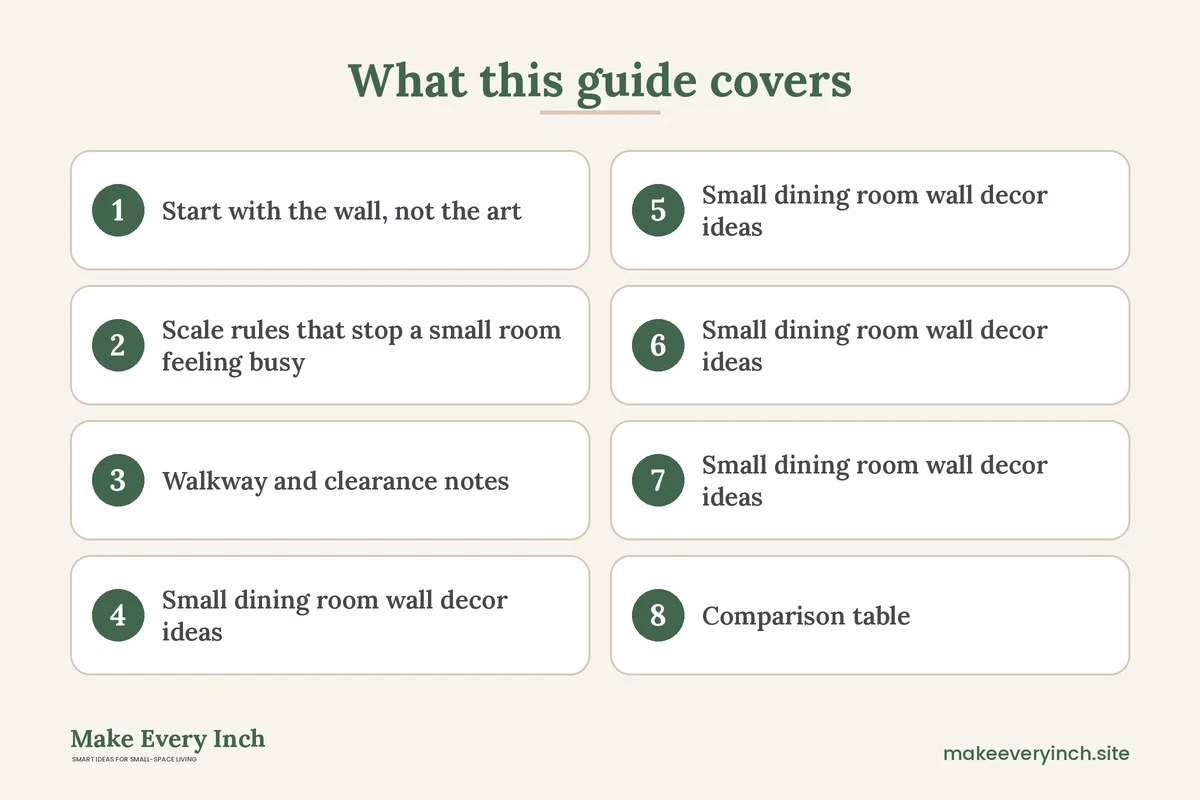
Scale rules that stop a small room feeling busy
Scale is the most common wall problem in a small room. Several guidelines help, and they work as rules of thumb rather than laws.
- One big beats many small. A single large piece makes a small room look calmer than ten small frames scattered along the wall.
- Fill about half to two thirds of the furniture width. Art above a sideboard or a bench generally looks balanced when it is about half to two thirds as wide as the piece below.
- Hang the center near 57 inches from the floor. This is a common gallery height. In a dining room, lowering it by a few inches can suit a wall seen mostly from a seat, but keep it consistent along the wall.
- Leave 6 to 10 inches above a sideboard or bench. Closer than that and the arrangement looks crowded, farther and it floats away.
- Keep gaps between frames at about 2 to 3 inches. A tight, even gap makes a group read as a single shape.
- Mind the chair backs. Chairs push against the wall, so keep art above the height that a chair back or a person’s head can knock, usually above 36 to 40 inches from the floor for anything fragile at the table.
- Keep large shelves shallow. In a small dining room, a shelf that sticks out more than 6 to 8 inches can catch heads and shoulders.
Test the plan with paper. Cut sheets to the size of each piece, tape them to the wall, then sit at the table and stand in the doorway to see how the arrangement looks from each position. Move them until the layout feels right before touching the wall.
Walkway and clearance notes
Wall decor sits near the traffic. Many small dining rooms leave a narrow gap between the table and the wall, and chairs need room to slide out. As a rough guide, people often aim for roughly 36 inches from the table edge to the wall where a chair pulls out, and about 24 to 30 inches for a walkway behind seated diners, though comfortable ranges vary by room and household. Where the gap is tighter than that, keep the wall flat, with a thin frame or a mirror and no shelves, ledges or hooks that stick out.
Small dining room wall decor ideas: mirrors
1. One large mirror opposite a window
A big mirror across from a window bounces daylight into the room and doubles the view. Choose a mirror about half to two thirds the width of the furniture beneath it, or lean a tall one on the floor against the wall if it cannot be hung. A tall leaning mirror is heavy, so make sure it cannot slip, and read the safety notes below.
2. A mirror behind the table
A mirror behind a bench or a sideboard makes a narrow table look longer and brings in light. Keep in mind what it reflects. A mirror that reflects the kitchen mess is not helpful, but a mirror that reflects the window and a plant is.
3. A round mirror above a console
A round mirror softens a square room and echoes the table shape if the table is round. A round shape with a thin frame suits tight spaces.
4. A pair of small mirrors
Two mirrors of the same size, hung with an even gap, add symmetry and are lighter to hang than one large one, which helps with adhesive methods. Check the weight rating on the strips.
5. A mirror on a rail
A picture rail or a stand-up ledge holds a mirror without a hook. It lets you change the arrangement from week to week.
Mirror safety matters. A mirror must be fixed with hardware rated for its weight, never with a hook of unknown strength. Place mirrors out of the way of flying elbows and chairs, and avoid hanging a heavy glass mirror directly above a seat. If you rent, lean it on a sideboard or the floor and use a safety strap or a wall anchor only with permission.
Small dining room wall decor ideas: art
6. One oversized print
A single large piece, framed simply, makes a small dining room look intentional. Choose a piece with a calm palette that suits the food, the walls and the light. Keep the frame slim.
7. A tight grid of identical frames
Four or six frames in the same size, in a grid with even gaps, look tidy and organized. Use a template and a level, and hang the grid as one unit. A grid suits a wall that is otherwise plain.
8. A gallery wall with a clear edge
If you love a salon-style wall, give it a rectangular outline so it reads as one piece. Mix frame sizes but keep one color of frame, and keep the center at the standard height. See our post on hallway gallery wall ideas for small homes for layout methods that also work in a dining room.
9. A fabric hanging or tapestry
A woven piece softens sound in a hard-surfaced room. Hang it from a tension rod, a curtain rod or a lightweight pole on adhesive hooks, depending on the lease. Fabric near a kitchen collects grease and smoke, so keep it away from the stove.
10. Leaning frames on a sideboard
Standing art on a sideboard needs no fixings. Layer two or three frames at different heights. This is the most flexible renter method, and it lets you swap pieces freely.
11. A picture ledge
A narrow ledge holds several frames at once and lets you change them. A ledge needs fixing to the wall, so check the lease. A freestanding ledge on a console is a no-drill version.
12. A removable accent wall
A peel-and-stick covering on one wall behind the table can transform a small room. Test a hidden patch first, read the lease and check how it removes. Our post on removable wallpaper ideas covers the process.
Small dining room wall decor ideas: shelves
13. A shallow floating shelf above the table end
A shelf 5 to 7 inches deep holds a few books, a plant and a lamp. It must be fixed into studs or with the right anchors, so it is a job for an owner or for a renter with permission. Keep the shelf above head height where chairs and people pass.
14. A narrow bookcase against the wall
A freestanding bookcase 8 to 12 inches deep holds dishes and decor, and it doubles as a wall display with no drilling. Anchor tall furniture to the wall with an anti-tip kit when allowed, since a bookcase can tip if a child climbs it. If anchoring is not allowed, choose a low, stable piece and keep the heaviest items on the lowest shelves.
15. A ladder shelf
A leaning ladder shelf is a no-drill display. It should have a stable base and a weight limit, so keep it light and avoid placing it where a chair or a child can tug on it.
16. A rail with hooks
A wall rail with a few hooks can hold mugs, a basket or a tea towel. It needs fixings, so it is for owners or permission holders. An over-door hook or a freestanding rack replaces it for renters. See our guides to no-drill storage ideas for renters and DIY wall storage ideas for small spaces for more options.
17. A plate shelf for display only
A shallow ledge that holds plates upright lets you show off a collection. The plates should be light, secured with a lip and kept away from the table edge so nothing falls on a diner.
Small dining room wall decor ideas: plates, baskets and objects
18. A plate wall
Plates arranged in a loose grid or cluster are a classic dining room decoration. Use plate hangers or adhesive discs rated for the weight. Hang them in a pattern with a clear shape and a consistent gap. Plates are fragile, so hang them away from chair backs and elbows, and do not use plates you eat from as decoration unless they are cleaned well.
19. A basket wall
Woven baskets add warmth and texture and are light enough for adhesive hooks. Keep baskets clear of the stove and grease and dust them regularly.
20. Hanging cutting boards and serveware
Wooden boards, trays and bowls serve as art, and they are light. Hang them by their handles or holes. If they are in use, keep them easy to reach.
21. Clocks and sculptural pieces
A single big clock suits a dining room and acts as art. Choose a quiet movement and a light weight.
22. Branches and dried arrangements
A dried branch on a ledge or a bundle of stems in a vase brings an organic shape. Keep dried material away from candles and heat, since it burns easily.
23. A pegboard or a shelf with a lip
A pegboard wall organizes small items and doubles as decor. It requires fixings, so check the lease. A freestanding pegboard on an easel is a renter option.
Comparison table: hanging methods for a dining wall
| Method | Best for | Fixing needed | Renter friendly | Watch out for |
|---|---|---|---|---|
| Leaning on a sideboard | Frames and mirrors | None | Yes | Stability and kids |
| Adhesive strips | Light frames and hooks | Adhesive | Often | Weight rating and wall finish |
| Tension rod | Fabric and light hangings | None | Yes | Rod rating |
| Picture ledge, freestanding | Changing frames | None | Yes | Surface and footprint |
| Picture ledge, wall mounted | Heavier frame groups | Screws | Needs permission | Studs and anchors |
| Plate hangers | Plates | Hooks or adhesive | Depends | Weight and breakage |
| Floating shelf | Books and plants | Screws and anchors | Needs permission | Depth and head height |
| Anti-tip anchored bookcase | Tall storage | Wall anchor | Needs permission | Tip risk if unanchored |

Renter-safe rules for the dining wall
- Read the lease. Know what it says about nails, adhesive and paint.
- Ask in writing. Many landlords allow small holes or hooks if asked, and a written yes protects your deposit.
- Photograph the wall before you start. Record the original state in good light.
- Test adhesive on a hidden spot. Leave it for a few days, then peel it slowly and check the paint.
- Respect weight limits. Each strip and hook is rated for a maximum weight. Stay well under it.
- Prefer leaning and standing. These need no fixings and are easiest to reverse.
- Remove adhesive slowly. Follow the package instructions for removal, pulling strips parallel to the wall.
- Do not drill without permission. A hole in a wall, a ceiling or tile is often a lease breach and it may harm hidden wires or pipes.
Safety notes
Dining rooms are used by children, elderly relatives and guests, so wall pieces need to be secure.
- Anchor tall furniture. A bookcase, a tall cabinet or a plate rack can tip. Use an anti-tip strap or kit into a stud when allowed, and keep heavy items low.
- Use hardware rated for the weight. Check the label on strips, hooks and anchors, and leave a safety margin.
- Keep heavy pieces away from seats. A mirror or shelf above a seat should be small and securely fixed.
- Check for hidden wires and pipes. Before drilling with permission, use a detector or ask a professional, especially near switches and kitchens.
- Take care with glass. Glass mirrors and framed prints can shatter. Choose frames with shatter-resistant fronts where children are present, and hang them out of reach of flying objects.
- Keep paper, fabric and dried material away from heat. Candles, stoves and bright bulbs can ignite them.
- Mind cords. A picture light or lamp cord must not dangle at chair height.
Color, finish and material
Wall decor also changes how light moves in a small room. Pale walls and light frames keep a small room airy. A dark accent wall can make the room feel cozy, though it absorbs light, so you may need brighter bulbs. Glossy frames and mirrors reflect light, and matte frames absorb it. Use a limited palette of two or three colors for the room, and let one of them repeat in the art, the textiles and the objects on the table. When painting, use low-VOC paint, open the windows and follow the label, and ask the landlord before any repaint. A peel-and-stick covering does not remove the need for ventilation, since adhesives can have an odor.
Three example rooms
A 7 by 9 foot dining nook beside a kitchen
The table is a 30 inch round with two chairs, and the wall behind it is the only free wall. The renter leans a tall 60 inch mirror on the floor against that wall, placed opposite the window, and puts a small shelf unit with a lip on a nearby surface for plants and a lamp. A second wall holds a single large print on adhesive strips rated well above the frame weight. The rest of the wall is left clear. The leaning mirror is stabilized with a safety strap where allowed, and the walkway stays about 30 inches. The room looks larger without a single hole.
A studio dining corner beside the sofa
A rectangular table sits against a wall, with a bench on one side. The wall above it holds a grid of six identical frames hung with a template and a level, and the center sits near 57 inches from the floor. A freestanding bookcase 10 inches deep stands at the end, anchored if the lease allows. A narrow rug defines the zone, and a tapestry on a tension rod hides a bare patch near the window. The grid reads as one piece and keeps the studio calm. See our guide to studio apartment dining area ideas for zoning tips.
A narrow galley dining area
A long, narrow room has a table pushed to one wall. The opposite wall is only a few feet from the chairs, so nothing may stick out. The renter hangs a thin-framed mirror pair on adhesive strips above chair height, and adds slim art. A floor lamp near the window gives a glow without taking wall space. The long wall behind the table holds a picture ledge on the sideboard, not on the wall, so the frames can change. For layout ideas, our post on galley kitchen ideas has helpful notes on narrow spaces.
How to hang a group of frames step by step
1. Measure the wall space and decide on the overall rectangle.
2. Cut paper templates of each frame and tape them to the wall.
3. Sit at the table and stand at the door to review the arrangement.
4. Mark the center at a comfortable height and adjust.
5. Mark each hanging point on the wall with a light pencil or a removable marker, only if allowed.
6. Attach strips or hooks according to the instructions, pressing for the full time listed.
7. Use a level for every piece.
8. Step back, review and adjust before the adhesive sets.
9. Check weekly for the first month that nothing is loosening.
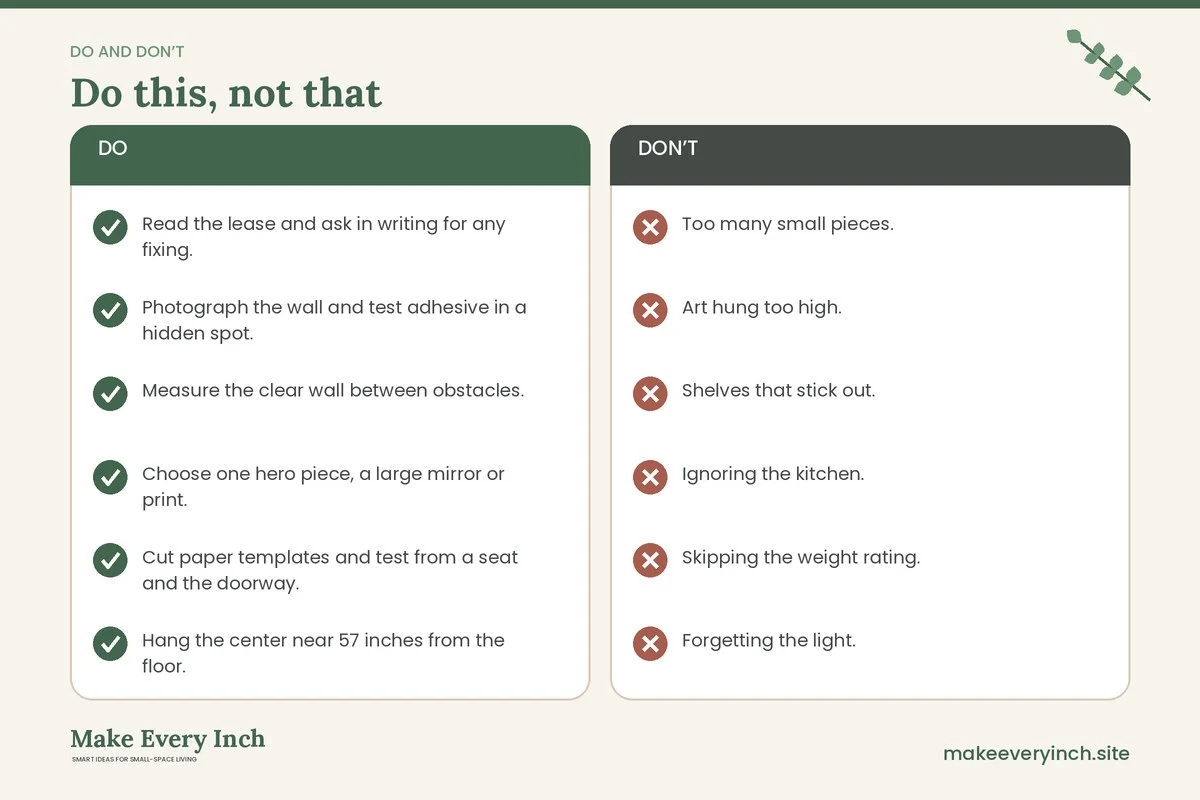
Mistakes to avoid
- Too many small pieces. They create visual noise in a small room.
- Art hung too high. Aim for a comfortable center height.
- Shelves that stick out. They catch heads and chairs.
- Ignoring the kitchen. Grease and steam damage fabric and paper.
- Skipping the weight rating. Adhesive failure risks broken glass.
- Forgetting the light. A great piece looks flat without a lamp or a picture light. See our post on small dining room lighting ideas.
- Drilling without permission. It risks your deposit and hidden pipes.
Linking the wall to the rest of the home
A dining room rarely stands alone. The wall decor should relate to the next room, so the home looks like one place. If the dining area flows into the living room, echo the frame finish and the colors. Our guides to small living room layout ideas and renter-friendly wall decor ideas give more methods. For an organized approach to storage on the wall, read small space organization ideas. If your dining space also serves as a kitchen edge, our small kitchen ideas and small apartment kitchen ideas cover the surrounding layout, and the best small dining tables guide helps match the table to the wall.
Checklist
- Read the lease and ask in writing for any fixing.
- Photograph the wall and test adhesive in a hidden spot.
- Measure the clear wall between obstacles.
- Choose one hero piece, a large mirror or print.
- Cut paper templates and test from a seat and the doorway.
- Hang the center near 57 inches from the floor.
- Keep gaps between frames at about 2 to 3 inches.
- Keep shelves shallow, and above head height at the table.
- Keep the walkway clear, roughly 24 to 36 inches depending on the room.
- Use hardware rated well above the weight.
- Anchor tall furniture when allowed.
- Keep fabric and paper away from the stove and candles.
- Add a lamp or picture light for the wall.
- Do not drill without permission.
FAQ
What is the best wall decor for a small dining room?
A single large mirror or print usually works best because it makes the room look calmer than many small pieces. Add one accent such as a tapestry or a shelf.
How high should I hang art in a dining room?
A common center is about 57 inches from the floor, perhaps a few inches lower when the wall is seen mostly from seats. Keep the arrangement consistent.
How can I decorate a rental dining room without drilling?
Lean mirrors and frames on a sideboard, use adhesive strips within their weight rating, hang fabric on tension rods and use freestanding shelves. Ask your landlord before any fixing.
Are mirrors a good idea in a small dining room?
Yes, if they reflect light or a pleasant view. Fix or lean them safely, and avoid hanging a heavy mirror over a seat.
Can I hang plates on the wall?
Yes, with plate hangers or adhesive discs rated for the weight. Keep them away from chair backs and the table edge.
How deep should dining room shelves be?
In a small room, shallow shelves of around 5 to 8 inches are usually safest. Anything deeper may catch heads or shoulders.
Should I anchor a bookcase in a dining room?
Yes when you can, especially where children are present. If anchoring is not allowed, choose a low, stable piece and keep heavy items on the bottom shelves.
Keep going: Keep planning with our small dining room ideas pillar, the companion guide to small dining room lighting ideas and our no-drill storage ideas for renters.
Save this guide for later
Pin the ideas you like to Pinterest so you can come back to them when you plan your space.