11 Small Space Upgrades Not Worth the Money (and Smarter Swaps)
Quick answer: Small space upgrades not worth money are usually decorative, oversized, single-purpose or tied to one apartment: statement furniture that eats the floor, built-in projects in a rental, lots of small bins, trendy gadgets with one use, wall-to-wall overhauls and anything you cannot return or take with you. Skip or delay them, run a quick regret test, and put the money into lighting, fit and storage you use daily.
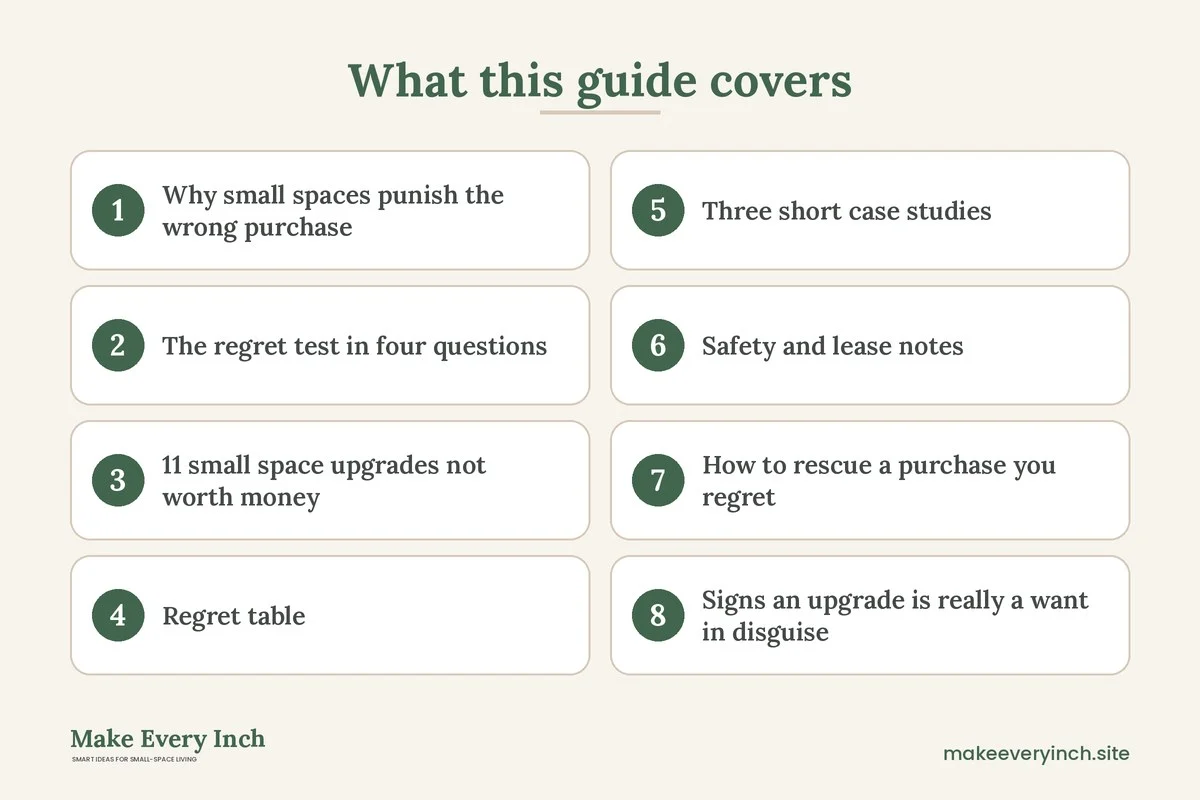
Small space upgrades not worth money tend to look good in photos and disappoint in real life. The reason is simple: a small home punishes mistakes. A piece that is a little too big blocks a path. A gadget with one use takes a shelf for the rest of its life. A project that depends on the walls of one rental becomes a loss when the lease ends. This guide is the other half of the picture: it lists 11 common purchases and projects that often fail to repay the money in a small space, explains what goes wrong, and gives a cheaper or smarter swap for each. It also offers a regret table, a “should I wait” test, three short case studies, safety notes and a checklist. For the positive side, read our sibling guide on small space upgrades worth spending on, and for the wider plan see budget small space ideas.
Why small spaces punish the wrong purchase
In a large home, a mistake disappears into extra room. You can park an unused chair in a spare corner or store a gadget in a garage. In a small home there is no place for a mistake to hide, so each wrong purchase has three costs: the money, the floor space and the daily annoyance of walking around it. A chair that takes 8 square feet takes 8 square feet from a room that might have only 120 to give.
There is also the question of timing. Many upgrades feel urgent right after a move, when the space looks bare and empty. That is when people buy the most. A better approach is to live in the room for a few weeks, note the real friction points and then buy for those. A purchase made from evidence tends to fit; a purchase made from a mood board often does not.
Finally, small spaces change faster than large ones. A desk becomes a dining table, a bedroom becomes an office and a roommate arrives or leaves. Items that are flexible survive these changes, and items that are specific to one layout do not.
The regret test in four questions
Before you buy, ask these. If you answer “no” or “not sure” to two or more, wait.
1. Can I describe where it will go, with measurements? If the answer is “somewhere”, it will end up in the way.
2. Will it still be useful if the room layout changes? If not, it is a gamble.
3. Can I return it or sell it easily? Large, custom or heavy items are hard to return.
4. Is there a free or cheap version of the same fix I have not tried? Rearranging furniture, clearing a surface or borrowing an item first often reveals what you need.
11 small space upgrades not worth money
Furniture that takes more than it gives
1. Oversized statement furniture
A deep sofa with wide arms, a huge sectional or a large accent chair can swallow a room. The look is generous, but the walkway shrinks, and the sofa becomes the only thing in the room. Swap it for a slimmer sofa with raised legs and a smaller chair, and borrow drama from a mirror or a lamp instead. Read how to choose a sofa for a small living room for sizes and small space furniture mistakes to avoid for more.
2. A matching bedroom set
A bed, two nightstands, a dresser and a mirror sold as a set often assume a room of 12 by 14 feet or more. In a small bedroom the set fills every wall and leaves no walkway. Swap it for a bed with storage, a wall shelf or a narrow stool as a bedside surface, and one slim dresser. See nightstand alternatives for small bedrooms and small bedroom furniture that saves space.
3. A large coffee table
A big, low table looks great in a big room. In a small room it blocks the main path and invites clutter. Swap it for nesting tables, a tray on an ottoman or a pair of side tables. If you still want a center piece, keep 16 to 18 inches between table and sofa and 30 inches for the walkway. Our guide on small space side table alternatives shows options.
Projects that depend on one apartment
4. Custom built-ins in a rental
Built-in shelves and cabinets feel like a premium upgrade, but in a rental you leave them behind, and in an owned small home you may end up locked into one layout. They also usually require permission, tools and skills, and they can damage walls. Swap them for freestanding units that move with you, anchored to the wall with permission and the right hardware. Browse small space storage furniture and small space ideas with built in storage for ideas that you can adapt without rebuilding walls.
5. Permanent wall treatments that need a repaint
Bold wallpaper, heavy tile or a dark paint color can make a small room look moodier, but they also cost time and can cost your deposit if the lease requires neutral walls. Do not paint or paper without written permission. Swap for peel-and-stick options in a small area, a large piece of art or a fabric panel, and use low-VOC paint with good ventilation if you do paint. Read removable wallpaper ideas and security deposit safe apartment upgrades.
6. Replacing fixtures you do not own
Changing a light fixture, faucet or cabinet hardware can look cheap and tidy, but electrical and plumbing work belongs to the landlord or a licensed professional. Mistakes can cause shocks, fires or leaks. Swap for plug-in lamps, a lighting strip that plugs into the wall and a portable showerhead filter that you can remove. When a fixture really needs replacing, ask the landlord.
Gadgets and accessories with one job
7. Single-use kitchen gadgets
An egg cooker, a quesadilla maker, a specialty slicer and a popcorn machine might each work, but together they fill a cabinet. In a small kitchen, every item must earn its place. Swap them for a few multi-use tools and a good knife. See small kitchen appliances worth the space to decide which are worth keeping.
8. Matching sets of tiny bins and baskets
A set of 12 identical bins looks organized in a store. At home, the bins become a project: they need labels, they hide things and they take up shelf space. Swap them for a few larger containers sized to your belongings, or use drawer dividers. Measure first. Read small home organization without buying bins before you shop.
9. Over-the-door racks that do not fit
Over-the-door hooks and racks can be useful, but a thick door, a tight frame or a door that must close can cause scraping, noise and a door that will not shut. Swap for adhesive hooks rated for the load on the inside of a closet or a rail that fits. Check the clearance on both sides of the door before you buy. See small closet door storage ideas.
Decor spending that does not change daily life
10. Many small decor pieces
A shelf of little objects looks collected when done slowly, but in a small room it becomes clutter that you must dust. Swap for a few larger pieces, a single art piece or a plant. Our guide on small space styling rules for open shelves shows how to edit.
11. Chasing a trend in a major purchase
Fashion moves faster than furniture. A color or shape that is popular this year may feel dated before the item wears out. Keep trendy colors in cheap, swappable items such as cushions, throws and prints, and keep large items neutral. Read small room color schemes that feel cohesive.
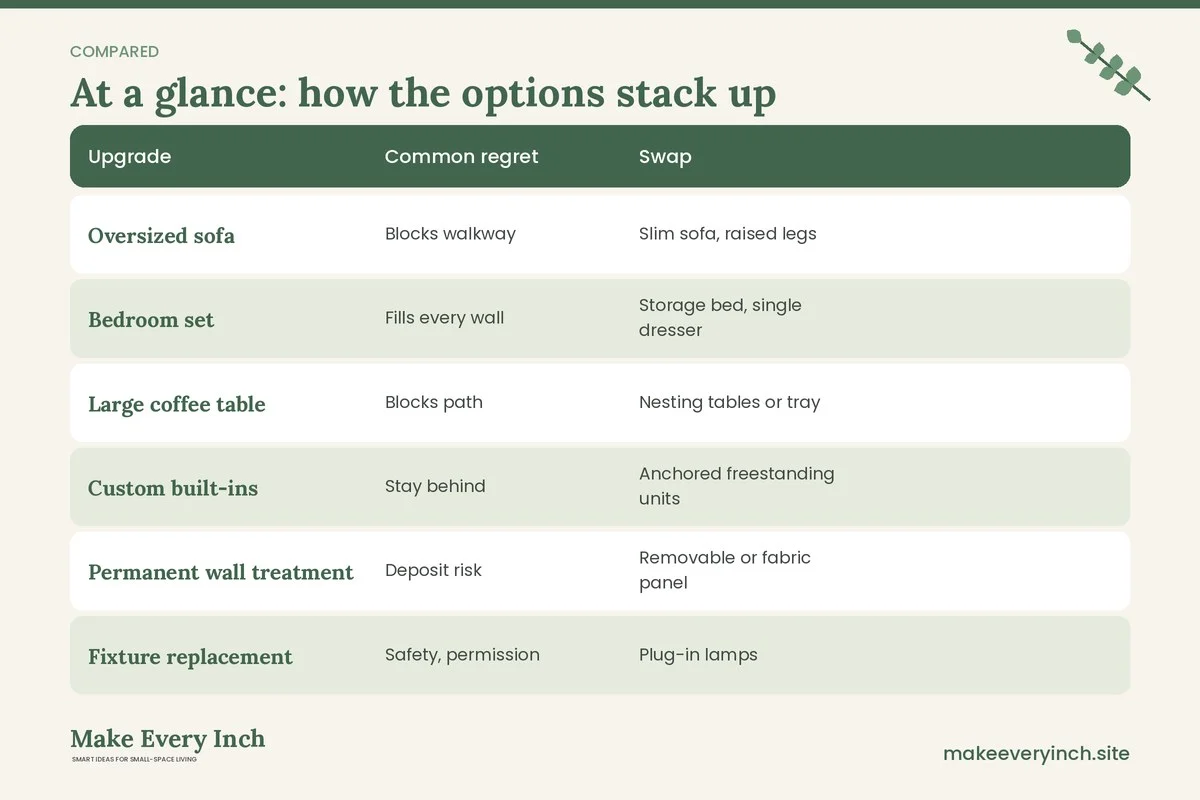
Regret table: what goes wrong and what to do instead
| Upgrade | Common regret | Swap | |
|---|---|---|---|
| Oversized sofa | Blocks walkway | Slim sofa, raised legs | |
| Bedroom set | Fills every wall | Storage bed, single dresser | |
| Large coffee table | Blocks path | Nesting tables or tray | |
| Custom built-ins | Stay behind | Anchored freestanding units | |
| Permanent wall treatment | Deposit risk | Removable or fabric panel | |
| Fixture replacement | Safety, permission | Plug-in lamps | |
| Single-use gadgets | Cabinet clutter | Multi-use tools | |
| Matching mini bins | Hidden items | Larger containers, dividers | |
| Door racks that do not fit | Door will not close | Adhesive hooks, rails | |
| Many small decor pieces | Dusting, clutter | A few large pieces | |
| Trend-driven big purchase | Dated quickly | Neutral base, swappable accents |
This table is a guide, not a ban. Sometimes an item on the list is right for you. A built-in can be perfect in a home you own for years. A coffee table can work in a room that is wide enough. The point is to test before you buy.
Three short case studies
The shared studio
Two people lived in a studio of about 400 square feet and wanted to feel more settled. The first impulse was a large sectional and a media wall. Instead, they measured, taped the footprint on the floor and found that the sectional left only 22 inches of walkway. They kept their old sofa, added a floor lamp and a rug sized to the seating area, and spent the saved money on curtains hung high and a proper bed frame with storage. The room felt larger without a new sofa.
The renter with big plans
A renter planned to build wall-to-wall shelves in a narrow hallway. The landlord said no to drilling. The renter bought a tall freestanding unit, anchored it with permission using a pair of small screws into a stud, and used the rest for a mirror and a cord organizer. The unit moved to the next apartment. The built-in would have stayed behind.
The gadget kitchen
A kitchen of about 6 by 8 feet filled with gadgets over a few months. Counters were crowded, and the family kept moving items to cook. They paused purchases for a month, noted what they used, and gave away or stored the rest. They bought one multi-use appliance and a drawer divider. See small kitchen counter organization for a method.
Safety and lease notes
- Never drill, paint, wallpaper or change fixtures without written permission from your landlord or building.
- Anchor tall furniture to the wall. Cheap or lightweight tall pieces can tip, and a falling shelf is a serious hazard for children and pets.
- Electrical safety: do not overload outlets, and do not replace wiring or fixtures yourself. Use cords rated for the load, and keep them out of walkways.
- Wet areas: use outlets with ground-fault protection (GFCI) near sinks and tubs, and keep plug-in devices dry.
- Ventilation: if you use paint, sealant or adhesives, ventilate well, choose low-VOC products and let them cure.
- Weight limits: read the rated load of hooks, strips and rods. Heavy items need proper hardware.
- Child and pet safety: avoid small parts, loose cords, items that can pinch and shelves that can be climbed.
How to rescue a purchase you regret
Sometimes you have already bought it. Do not let guilt keep it in the way. First, check the return window and the condition requirements. If you cannot return it, try a different position: rotate a piece, move it to another room or use it for a new purpose. A too-large table can become a desk, and a deep shelf can hold bins at the bottom. If it still does not work, sell it or give it away. Treat the loss as the cost of learning, and note the lesson for the next purchase.
You can also reduce regret with a waiting rule. For anything beyond a small amount you choose, wait seven days, then check the four regret questions again. If you still want it, buy it. This pause removes most impulse buys and costs nothing. Our decluttering rules for small homes can help you let go of items that no longer serve.
Signs an upgrade is really a want in disguise
Some purchases feel like problem solving but are really mood fixes. Watch for these signals. You are shopping late at night or right after a stressful day. You describe the item mainly by how it will look, not what it will do. You cannot name the exact spot it will occupy. The listing uses words like “statement” or “transform” more than it gives dimensions. You are buying a third version of something you already own, such as a fourth throw blanket or a second storage basket.
When you notice one of these, save the item to a list instead of buying it. Check the list again after a week. Often the urge fades, or the real problem turns out to be a cluttered surface, a harsh bulb or a chair in the wrong place. A free fix, such as moving a bed six inches or clearing a shelf, can deliver what the purchase promised. If the item is still on your mind after the pause, measure, check the return policy and decide with a clear head.
What to do with the money you save
Putting money aside is not the same as hoarding it. Pick a short list of upgrades that you know pay back: better lighting, curtains hung high, a bed that fits and a few hooks. Fund those first. If you need ideas for low-cost wins, read small kitchen upgrades that cost very little, diy apartment upgrades and budget renter upgrades. Anything left over can stay in savings for a move, a deposit or a better piece later.
FAQ
Which small space upgrades are the biggest waste of money?
Oversized furniture, permanent changes in a rental and single-use gadgets are the most common. They either take too much space, cannot move with you or rarely get used.
Is it ever worth building something custom in a small space?
Yes, when you own the home or have long-term permission, the design fits a specific odd space and the plan is professionally reviewed. For most renters, a freestanding piece is safer.
How can I tell if a gadget is worth the shelf space?
Ask how often you will use it each month and whether another tool can do the job. If you cannot name two uses, skip it.
Are cheap items a waste of money in a small space?
Not always. Cheap hooks, dividers and bulbs are among the best buys. What matters is fit and use, not the price tag. Avoid cheap items that are flimsy in a safety-sensitive role, such as tall shelves without anchors.
Should I wait to buy anything after moving in?
It helps. Living in the space for two to four weeks shows where the friction is. You can still buy essentials like a bed, a light and a way to store clothes at once.
What if I already bought something I do not need?
Check the return policy, try repurposing it, then sell or donate it. Use the regret test next time.
Final checklist
- Measure the space and mark the footprint with tape.
- Ask the four regret questions.
- Wait a week on larger purchases.
- Avoid permanent changes in a rental.
- Anchor tall furniture and keep cords tidy.
- Choose multi-use items over single-use ones.
- Keep trendy colors in swappable accents.
- Spend on lighting, fit and storage first.
Keep going: Keep going with budget small space ideas, compare the positive list in small space upgrades worth spending on, or avoid common pitfalls in small space decorating mistakes to avoid.
Save this guide for later
Pin the ideas you like to Pinterest so you can come back to them when you plan your space.