12 Small Room Paint Ideas for Low Light Spaces
Quick answer: The best small room paint low light strategy is to match the paint to the light you actually have. In a dim room, choose a color with a fairly high light reflectance value, a warm undertone and a low-sheen finish, or lean into a deep, saturated shade on purpose. Test large samples on two walls, look at them morning, noon and night, and always ventilate and use low-VOC paint.
Choosing small room paint low light conditions can handle is one of the trickiest decorating decisions, because the same color can look crisp in a showroom and muddy in your north-facing bedroom. Most advice says “just paint it white,” but white in a dim room often turns gray, flat or blue. This guide takes a more practical route. It shows you how to read the light in your room, how to use light reflectance values, undertones and sheen, what to do with the ceiling and trim, and which 12 paint ideas suit a dark small room. It also includes a comparison table, three example rooms, safety notes for ventilation and leases, a checklist and an FAQ. For the bigger picture, read our main guide to small room decor ideas, and for the companion topic see small room accent wall ideas.
Read the light before you pick a color
Paint does not have a fixed color. It is a surface that reflects whatever light reaches it, so the direction of your windows, the size of the glass and the bulbs in your lamps change what you see. Spend a few days noticing the light before you open a single sample.
- North-facing rooms usually get cooler, steadier, bluish light. Colors with a cool undertone can look even colder, and pale grays can turn dull.
- South-facing rooms usually get warmer, stronger light, so even a moderate color can look brighter than the chip.
- East-facing rooms tend to be bright and warm in the morning and softer by afternoon.
- West-facing rooms tend to be dim in the morning and warm, golden and strong in the evening.
- Rooms with one small window, a deep ground-floor window well, a neighboring wall or a tree outside may be dim all day no matter which way they face.
- Windowless or nearly windowless rooms depend almost entirely on lamps, so the bulb color matters as much as the paint.
Direction is only a rough guide, so do a simple light audit. On a normal day, look at the room at about 9 in the morning, noon, 4 in the afternoon and 8 at night with the lamps on. Note where the brightest and darkest corners are, and whether the light feels warm or cool. A phone light meter app can give a rough comparison between corners, though the numbers vary by device, so use them to compare spots in the same room rather than as exact values.
Also check your bulbs. Light bulbs have a color temperature, written in kelvins. Lower numbers around 2700 look warm and yellow, and higher numbers around 4000 to 5000 look neutral to bluish. If one lamp is warm and another is cool, a paint sample will look different under each. Pick the bulbs you plan to keep before you judge a color. Always match each bulb to the lamp’s rating and never exceed the maximum wattage printed on the socket or the fixture label.
The three paint traits that matter most in a dim room
Light reflectance value
Light reflectance value, often shortened to LRV, is a number from 0 (absorbs all light) to 100 (reflects all light). Many paint makers print it on the back of a sample card or list it on their websites. Higher numbers bounce more light around a dim room. As a very rough guide, colors above about 70 often feel airy, colors between about 40 and 60 feel mid-toned, and colors below about 20 feel deep. These ranges are approximate and different makers measure slightly differently, so treat them as a starting point.
A high LRV helps, but it does not guarantee that a room will feel bright. A pale gray with a high LRV can still feel gloomy if it has a cold undertone and the room gets only bluish north light. That is where undertone comes in.
Undertone
Every neutral leans a little toward another color. A cream may lean yellow, a gray may lean blue or green, and a white may lean pink or gray. In low light, undertones become more obvious, because there is not enough strong light to wash them out. The easiest way to see an undertone is to hold the sample next to a sheet of plain printer paper. Whatever tint the paper makes the paint show is the undertone.
In a dim room, a warm undertone, such as a soft cream, a pale butter, a gentle greige with a hint of beige, a pale peach or a soft clay, usually adds a sense of sun. A cool undertone can work, but it often needs warm lamps and warm textiles to avoid feeling flat.
Finish and sheen
The finish changes how much light the wall bounces back. Flat or matte paint hides bumps and gives a soft look, but it reflects the least light. Eggshell and satin have a gentle glow and are easy to wipe. Semi-gloss is very reflective and best saved for trim and doors. In a small dim room, a low-sheen finish such as eggshell or a washable matte often strikes the best balance between glow and forgiveness. Very glossy walls will show every dent and roller mark, which is a bigger problem in a small room where you stand close to the walls.
12 small room paint ideas for low light
Light and warm, to bring in the sun
1. A warm white or soft cream
A warm white with a yellow or beige undertone is the classic answer for a dim room. It reflects plenty of light and adds a warmth that cool whites lack. Avoid stark, bluish whites in north light, because they often look gray and chilly. Always compare two or three whites in the room before you decide, since the differences are subtle.
2. A pale butter or soft yellow
A very light yellow, kept pale and slightly muted, can feel like a patch of sunlight on the wall. It works best in rooms that never get direct sun, such as a ground-floor bedroom or a hallway. Choose a color with a small amount of gray so it does not turn lemony or loud in strong evening light.
3. A pale peach or blush
Soft peach and warm blush tones add a glow similar to a sunset and flatter skin tones, which is useful in a bedroom or bathroom. Look for versions with a gentle beige base instead of a strong pink, which can read candy-like in a small space.
4. A light greige with a warm base
Greige blends gray and beige. In a dim room choose one that leans slightly to the beige side, because a cooler gray tends to look drab. This idea suits people who want a calm backdrop that works with many furniture colors and decor styles, including those in our guide to apartment decorating styles.
5. A light, clay-tinted neutral
A pale terracotta-leaning neutral, diluted to a very soft level, brings earthiness and warmth without being dark. It works well with natural wood, woven textures and linen.
Soft color with some depth
6. A pale sage or muted green
A light, gray-green shade can feel restful and ties a small room to the outdoors. In low light, green with a touch of yellow looks fresher than green with a touch of blue. Test it next to your bed linens, rugs and plants, because greens shift more than most colors.
7. A dusty blue with a bit of warmth
Blue does not have to be cold. A soft, dusty blue that has a little gray and warmth in its mix can look calm in a dim bedroom, especially with warm lamps and wood tones. Avoid icy, bright blues in north light, as they tend to read cold.
8. A mid-tone color on the lower half of the wall
Painting only the lower half or two thirds of a wall in a mid-tone shade and keeping the upper part light draws the eye along the room and adds interest without darkening the whole space. Choose a clean horizontal line, use painter’s tape, and press down the edge so the paint does not bleed. This is also a good way to add depth to a hallway or narrow room.
Embracing the dark on purpose
9. A deep, saturated color on all four walls
Counterintuitively, a dim room can look intentional and cozy when painted in a deep shade such as inky navy, forest green or charcoal, instead of in a pale color that falls flat. The idea is that the room will feel dark regardless, so you make it moody and enveloping. This works best in rooms used mainly in the evening, such as a bedroom, a media corner or a reading nook. It needs good layered lighting and warm bulbs to prevent the corners from disappearing. Use the same color on trim to blur the edges of the room and avoid a chopped-up look.
10. A single deep wall with light walls elsewhere
If a full dark room feels like too much, pick the wall that faces the window or the one behind the bed, and paint it in a darker shade. The rest of the room stays light. The contrast adds depth and gives the room a focal point, as explained in our post on small room accent wall ideas.
Details that multiply the light
11. A lightly tinted ceiling
White ceilings can look gray in a dim room. A very pale tint of the wall color, or a soft warm white, can keep the ceiling from feeling like a lid. Painting the ceiling slightly lighter than the walls usually keeps the room feeling higher. If your ceiling is low, a flat finish hides roller marks and imperfections in the surface.
12. Reflective touches
Paint is only one part of the picture. A satin-finish door, a lightly glossy trim, a mirror placed to catch the window light and metallic or glass accents spread light farther. Position a mirror opposite or beside the window so it shows the sky, not a blank wall. For options that avoid damaging walls, see our guide to renter friendly wall decor ideas.
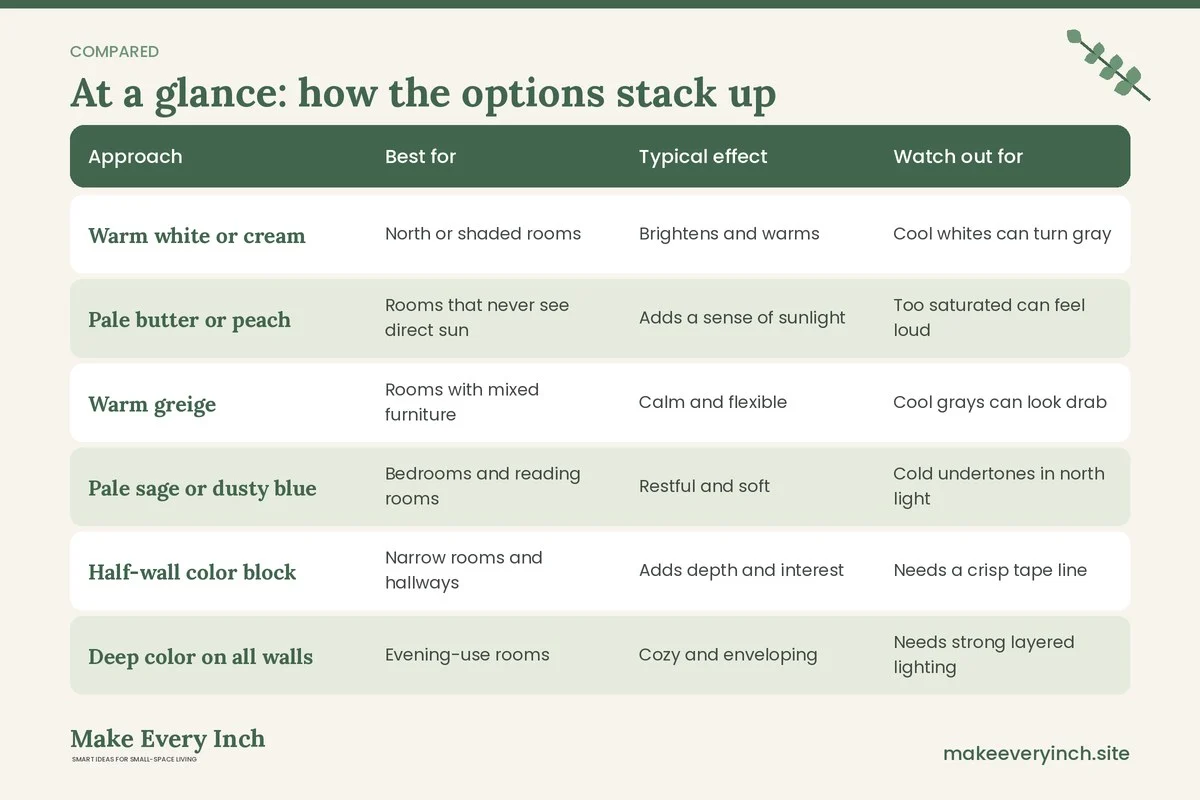
Comparison table: which approach fits your room?
The table below compares the main strategies. The effects described are general tendencies, not guarantees, since every room differs.
| Approach | Best for | Typical effect | Watch out for |
|---|---|---|---|
| Warm white or cream | North or shaded rooms | Brightens and warms | Cool whites can turn gray |
| Pale butter or peach | Rooms that never see direct sun | Adds a sense of sunlight | Too saturated can feel loud |
| Warm greige | Rooms with mixed furniture | Calm and flexible | Cool grays can look drab |
| Pale sage or dusty blue | Bedrooms and reading rooms | Restful and soft | Cold undertones in north light |
| Half-wall color block | Narrow rooms and hallways | Adds depth and interest | Needs a crisp tape line |
| Deep color on all walls | Evening-use rooms | Cozy and enveloping | Needs strong layered lighting |
| Single deep wall | Rooms with a clear focal wall | Adds depth, keeps light walls | Wrong wall can shrink the room |
| Tinted ceiling | Low or dim rooms | Softens the lid effect | Too dark a ceiling lowers it |
How to sample paint correctly in low light
A tiny paper chip tells you almost nothing about a dim room. Use a better method.
- Paint large samples. Paint two squares about 2 feet by 2 feet, or use large peel-and-stick sample boards, on two different walls, one near the window and one in the darkest corner.
- Use two coats. One thin coat lets the old color show through and distorts your view.
- Leave a white border. Painting the sample on a white-edged board or leaving a border of old wall around it stops the old color from changing how your eye reads the new one.
- Look at different times. Check the samples in the morning, at noon, in the late afternoon and at night under your lamps.
- Move the sample. Place a movable board next to the sofa, the curtains and the bedding to see how the color behaves beside real things.
- Wait a day. Paint looks different when it is wet and when it has dried fully, so judge it after it dries.
If you rent, remember that sample paint on a wall still counts as painting. Ask your landlord first, or use movable sample boards instead of painting directly on the wall.
Three example rooms
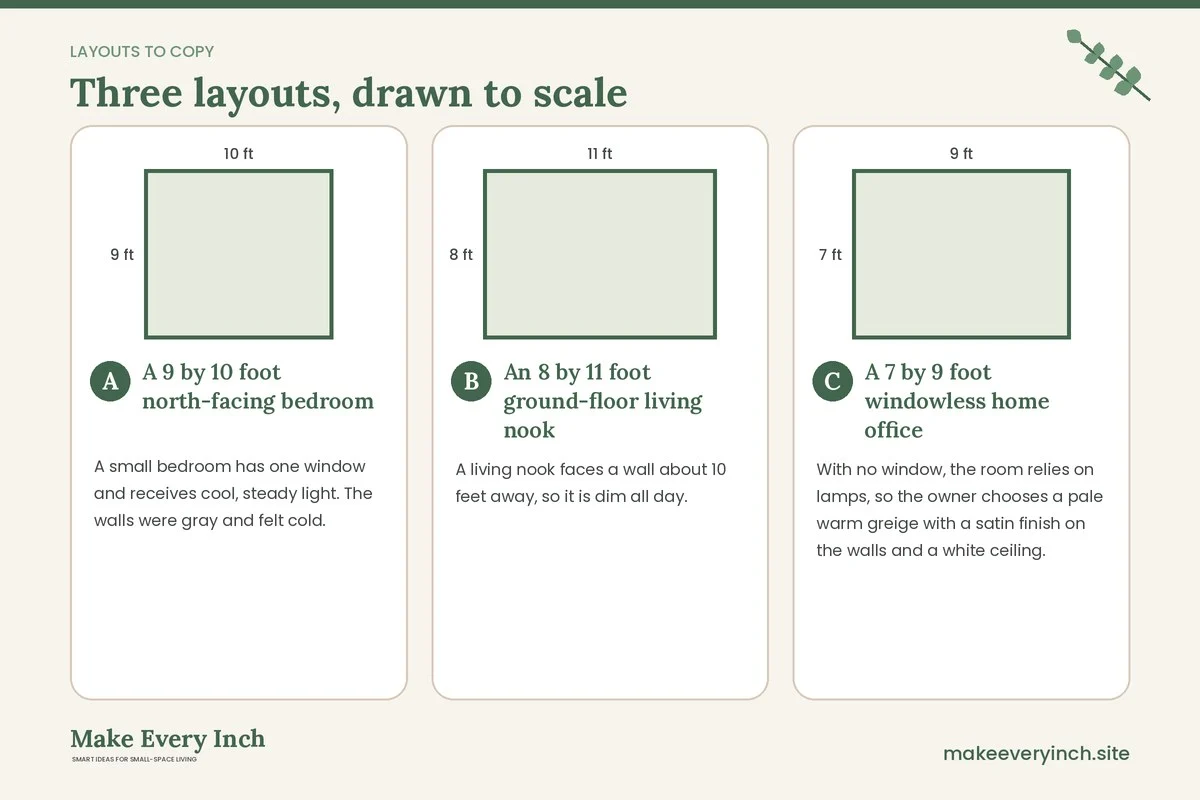
A 9 by 10 foot north-facing bedroom
A small bedroom has one window and receives cool, steady light. The walls were gray and felt cold. A switch to a warm cream with a small amount of beige, an eggshell finish and a ceiling in a slightly lighter tone makes the room feel warmer without needing more daylight. The owner adds two table lamps with warm bulbs and a pale linen curtain that lets as much light through as possible. A mirror leans beside the window. The key lesson here is that a warm undertone and warm bulbs matter more than going as bright as possible. For more bedroom ideas, see our main post on small bedroom ideas and our guide to small bedroom lighting ideas.
An 8 by 11 foot ground-floor living nook
A living nook faces a wall about 10 feet away, so it is dim all day. Instead of fighting the shade, the owner paints the walls and trim in a deep green with a washable matte finish and adds a light, warm rug, brass-toned or glass lamps and cream upholstery. The result feels like a cozy lounge instead of a dull pale room. A floor lamp in one corner and a table lamp near the sofa give layered light. The room works because the dark color was a deliberate choice and the lighting plan supports it. For living room ideas, visit our guide to small living room ideas.
A 7 by 9 foot windowless home office
With no window, the room relies on lamps, so the owner chooses a pale warm greige with a satin finish on the walls and a white ceiling. A desk lamp, a small floor lamp and a plug-in wall light with a tidy cord cover provide layers of light. A single strip of mid-tone color on the lower third of the wall adds interest. The warm tone keeps the space from feeling clinical under artificial light. See our post on renter friendly lighting ideas for lighting that does not need hardwiring.
Color pairings that behave well in dim rooms
Paint does not work alone. A few combinations tend to look balanced in low light.
- Warm white walls, natural wood and green plants: a calm, fresh palette that suits most small rooms.
- Pale butter walls, white trim and soft blue textiles: a gentle, sunny mix for bedrooms.
- Warm greige walls, black metal accents and cream linen: a modern look that stays soft.
- Deep green walls, cream upholstery and warm wood: a cozy evening room.
- Dusty blue walls, white ceiling and warm brass-toned lamps: a restful bedroom palette.
When you choose the sofa, curtains or bedding, hold the fabric against the sample and look at both together under your lamps. If you are mixing several colors, keep to three main ones, one dominant for walls, one for large furniture and one for accents.
Trim, doors and ceilings: the quiet helpers
Trim painted the same color as the wall, in a slightly higher sheen, makes a small room feel seamless and taller. Painting trim bright white against a mid-tone wall adds contrast that can chop the room into pieces, so use it deliberately. Doors can be painted in a satin or semi-gloss finish to catch light. If the ceiling has a texture or stains, a flat finish hides them better than a glossy one.
For the floor, a rug in a light, warm color reflects light back up and softens a dark space. Curtains hung high and wide, so that they stay clear of the glass when open, let in every inch of daylight. Choose sheer or light-filtering fabric during the day if privacy allows.
Safety and etiquette notes for painting
- Ask permission first. Check your lease before painting. Many landlords require written approval, a specific color or repainting before you leave. Never assume that painting is allowed.
- Choose low-VOC paint. Volatile organic compounds are released as paint dries. Labels that say low-VOC or zero-VOC help reduce odor, but they do not remove it, so ventilate regardless.
- Ventilate well. Open windows, use a fan to move air out of the room, and keep the room ventilated while the paint dries. Follow the directions on the can for drying and recoat times. If you are pregnant, have asthma or have pets that are sensitive to fumes, consider asking a professional or keeping them out of the space until the smell has gone.
- Protect your lungs. Sanding old paint can release dust, and in older buildings paint may contain lead. If a building was built before the late 1970s, ask the landlord or a qualified professional before sanding or scraping.
- Use a stable ladder. Place it on a flat floor, never over the top step, and ask someone to hold it for ceilings.
- Keep heat and electricity in check. Remove lamps and covers from the work area. Do not place hot bulbs near drop cloths, rags or paint cans, and never exceed the wattage printed on a lamp. Do not run cords under rugs or through wet areas, and keep cords away from paint buckets and ladders.
- Dispose of rags safely. Follow your local rules for used rags and leftover paint.
Mistakes to avoid
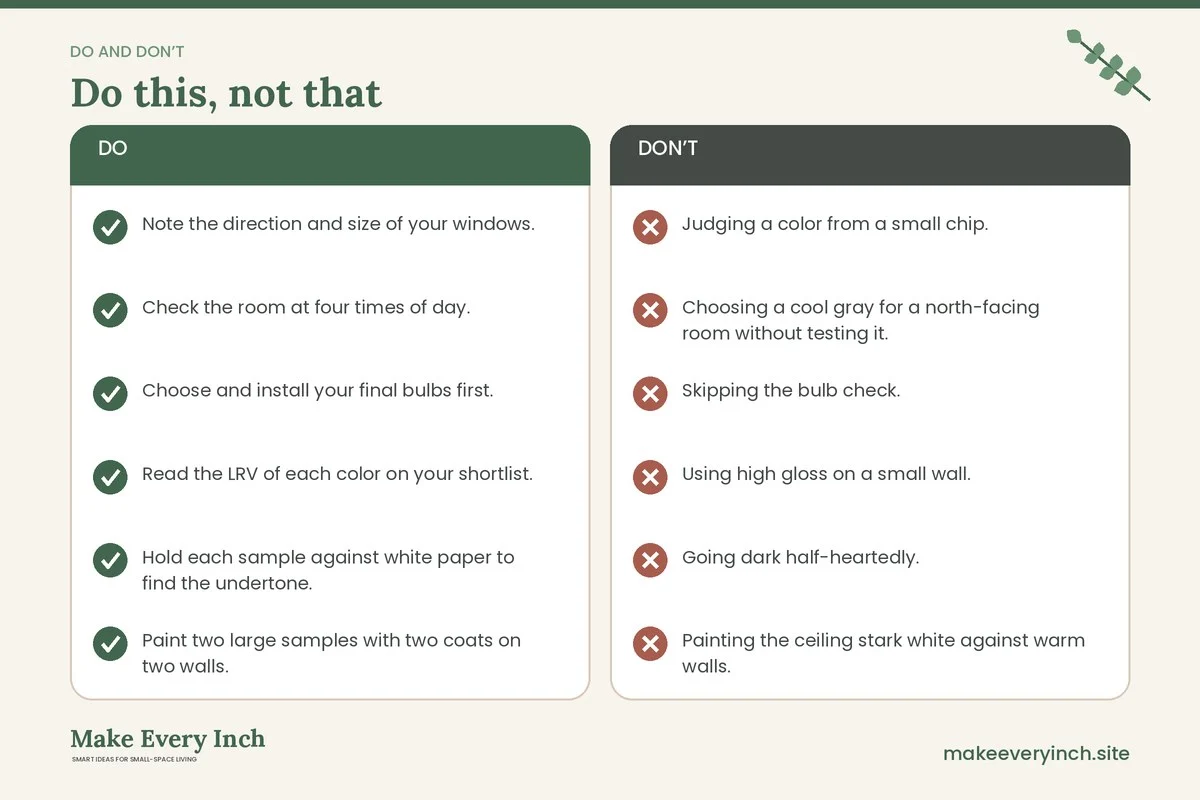
- Judging a color from a small chip. Always use large, dried samples.
- Choosing a cool gray for a north-facing room without testing it. It often looks darker and colder than expected.
- Skipping the bulb check. The wrong bulb can change a good paint color.
- Using high gloss on a small wall. It highlights every flaw.
- Going dark half-heartedly. If you want a deep color, use it fully and add layered lighting.
- Painting the ceiling stark white against warm walls. It can look gray and harsh in dim light.
- Forgetting to ask the landlord. This can cost you your deposit or force a repaint.
Low-light paint checklist
- Note the direction and size of your windows.
- Check the room at four times of day.
- Choose and install your final bulbs first.
- Read the LRV of each color on your shortlist.
- Hold each sample against white paper to find the undertone.
- Paint two large samples with two coats on two walls.
- Judge the samples when dry and at night.
- Pick a low-sheen finish for walls.
- Decide on ceiling and trim colors.
- Check your lease and get approval in writing.
- Buy low-VOC paint and plan ventilation.
- Prepare a stable ladder, tape and drop cloths.
- Add a mirror, a light rug and warm lamps after painting.
FAQ
What is the best paint color for a small room with little light?
There is no single best color, but warm whites, creams, pale butter, warm greige and soft peach tend to brighten dim rooms. A deep color can also work if you commit to it and add good lighting.
Does white paint make a dark room look bigger?
It can, but a cool or stark white may look gray in low light. A warm white with a yellow or beige undertone usually looks brighter.
Should I paint a small dark room dark?
You can. A deep shade can make a dim room feel cozy and intentional instead of dull. It works best in rooms used in the evening and needs warm, layered lighting.
What finish is best for a dim small room?
Eggshell, satin or a washable matte are common choices. They reflect more light than flat paint but show fewer flaws than gloss.
What does LRV mean?
It stands for light reflectance value, a number from 0 to 100 that estimates how much light a color reflects. Higher values reflect more light, though undertone and lighting also affect the result.
Can I paint if I rent?
Only with permission. Check your lease and ask in writing, or use removable options such as those in our guide to removable wallpaper ideas if your landlord agrees to them.
How do I keep the room feeling bright after painting?
Use warm bulbs, a mirror opposite or beside the window, light curtains hung wide and a light-colored rug. See our ideas for furniture that makes small rooms feel bigger as well.
Keep going: Keep exploring with our guide to small room decor ideas, the companion post on small room accent wall ideas and our list of small dining room color schemes.
Save this guide for later
Pin the ideas you like to Pinterest so you can come back to them when you plan your space.