14 Small Room Decor Ideas That Avoid Clutter and Stay Calm
Quick answer: To make small room decor avoid clutter, give every surface a decor limit (for example three objects on a shelf, one group on a dresser), repeat a narrow palette of two or three colors, choose pieces that earn their place by being useful or loved, and keep one calm zone with nothing on it. Light the room evenly, hang art at eye level in a few larger pieces, and rotate seasonal items through a single box.
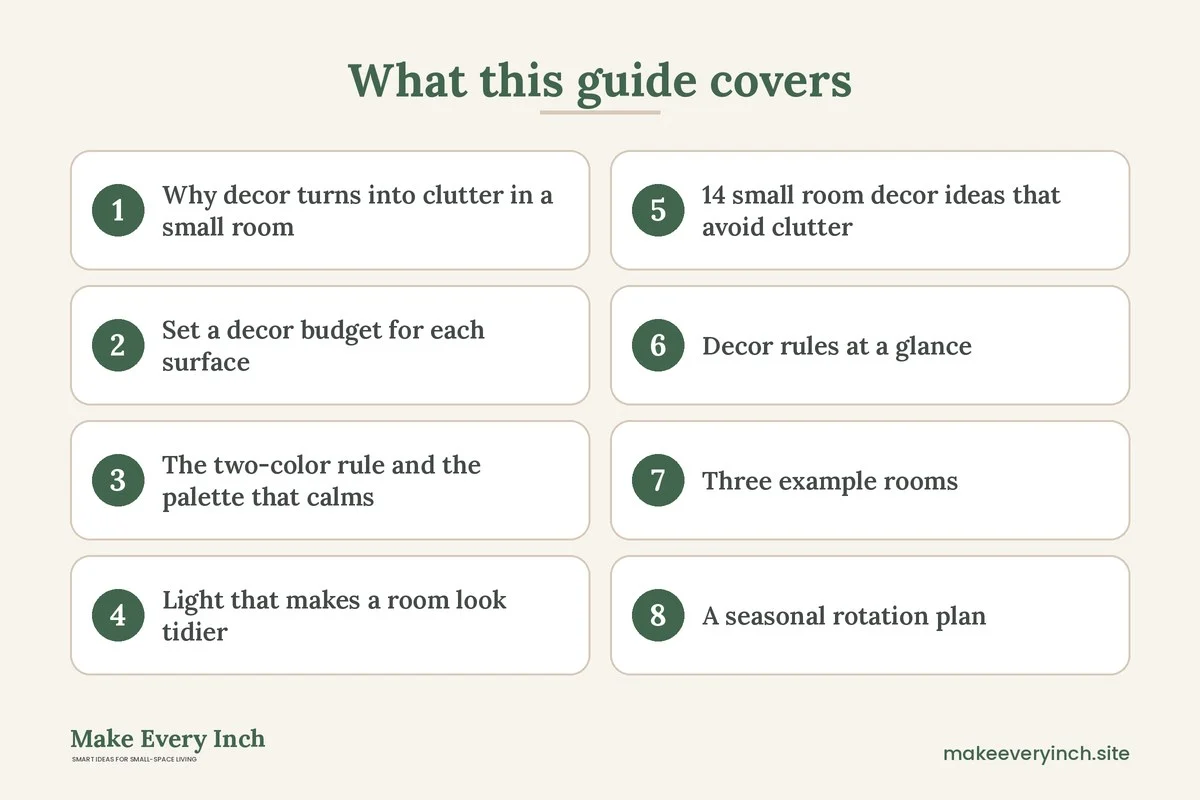
Small room decor avoid clutter is a real balancing act. You want a room that looks personal, with art, plants, textiles and a few souvenirs, but every extra object in a small space competes for attention and for surface area. A 10 by 12 foot room shows a dozen small items at once, and that is when decoration starts to look like mess. This guide gives you a system instead of a vague instruction to “edit”. You will set a decor budget for each surface, learn why color repetition calms a room, see how light can make a room look tidier, and walk through 14 ideas, three example rooms, a rule table, a seasonal rotation plan, a checklist and an FAQ. For the full overview of decorating compact rooms, start with our pillar guide on small room decor ideas, and for the storage side of the problem, read our guide to small space organization ideas.
Why decor turns into clutter in a small room
Decor becomes clutter when three things happen together: there are too many different objects, they have no visual relationship to each other, and they have no clear place to sit. A large room can absorb a scattered collection because there is empty wall and floor around it. A small room has no such buffer, so the same collection reads as noise.
It helps to separate two ideas. Clutter is anything without a home or a purpose. Decor is anything you keep because it adds beauty or meaning. The trouble starts when decor lacks a home. A pretty bowl of loose items on a console is decor until the bowl overflows with receipts, and then it is clutter wearing a nice container. Setting limits is not about owning less beauty. It is about giving each beautiful thing enough room to be seen.
Another common cause is the slow drip. Nobody buys 40 small objects at once. They arrive one at a time, as gifts, as impulse picks and as things that were “just for now”. A decor system works because it makes the drip visible. If a surface has a limit, a new object must replace an old one, and the question of whether you still love the old one gets asked.
Set a decor budget for each surface
A decor budget is a simple cap on the number of visible objects. Count a group of objects with a shared look, such as three candles in matching holders, as one item. The numbers below are starting points, so adjust them to your own taste and to the size of the surface.
- Floating or open shelf: 3 to 5 objects per shelf, with at least a third of the shelf left empty.
- Dresser or sideboard top: one group on one side, a lamp or mirror on the other, and a clear middle section.
- Coffee or side table: one tray with two or three items, or one plant and one coaster stack.
- Windowsill: one or two objects, and nothing that blocks the light you are trying to bring in.
- Desk: the work tools and one personal item. Everything else belongs in a drawer or a box.
- Nightstand: a lamp, a glass, a book, and one small item you like looking at.
- Walls: one large piece or one tight group per wall, rather than many small frames scattered at different heights.
- Floor: a rug, a plant or two and a basket. Nothing that does not move.
Print or write the budget on a note and keep it in a drawer for the first month. When you add something and break a limit, remove the object that matters least. After a few weeks, you will stop needing the note.
The two-color rule and the palette that calms
Color is one of the strongest tools for keeping a small room from feeling busy. A room with twelve different colors in its objects looks cluttered even when it holds few things. A room with a narrow palette looks organized even when it holds more. A simple formula is to choose a main color for the big surfaces, a supporting color for textiles and wood tones, and one small accent that appears three times in different places.
Repetition is the key. If you choose a muted green accent, place it on a cushion, in a vase and in a print. The eye connects the three, and the room reads as a deliberate scheme. If you scatter ten accents, the eye has no place to rest. Neutral objects such as wood, white ceramic, woven baskets and linen pieces blend into almost any scheme and are the safest items for open surfaces.
Be careful with very dark or very busy backdrops behind decor. A strongly patterned wall makes every object in front of it look busier. Soft, low-contrast backgrounds let objects stand out one at a time. If you plan to repaint, choose a low-VOC paint, open windows and run a fan for ventilation, and keep the room clear of pets and children until the paint is dry. In a rental, get written permission before you paint or hang wallpaper. If you do not have permission, our guides on removable wallpaper ideas and renter-friendly wall decor ideas show options that leave the walls as they were.
For color ideas in a specific room, our post on small dining room color schemes shows how to build a tight palette in a room that is often cramped.
Light that makes a room look tidier
Light affects how cluttered a room feels more than most people expect. A single bright overhead fixture throws hard shadows behind every object and makes small items look like a crowd. Layered, softer light removes the shadows and lets a room look calmer.
- Use three sources at different heights. A floor lamp, a table lamp and a small accent light spread the glow so that no corner is dark.
- Keep the bulb warm and consistent. Mixed colors of light make a room look patchy. Choose the same warm tone throughout.
- Light the walls, not just the floor. A gentle wash on a plain wall makes it feel taller and quieter.
- Hide the cords. A tangle of cords is clutter in its purest form. Clip them along baseboards or run them behind furniture. Our guide on renter-friendly ways to hide cords has several options.
Safety matters here. Check the maximum wattage printed on every lamp and never exceed it. Modern LED bulbs run cooler and use less power than older types, but the lamp’s label still sets the limit. Keep bulbs and shades clear of fabric, paper and curtains, and leave a gap between a hot bulb and a shade. Do not daisy-chain extension cords or plug several power strips into each other, and do not run cords under rugs, where heat can build up and damage can go unseen. Space the plugs across a few outlets so that no single socket carries too much. If a plug or cord feels warm, unplug it and have it checked. For lamp ideas that fit rentals, see our post on renter-friendly lighting ideas.
14 small room decor ideas that avoid clutter
Edit the surfaces
1. Leave one surface empty on purpose
Choose one flat surface in each room, such as the dresser top or the coffee table, and keep it nearly bare. An empty surface gives the eye a place to rest and makes the other surfaces look intentional.
2. Group objects in odd numbers
Groups of three, or sometimes five, look composed. Vary the heights, so you might pair a tall vase, a medium bowl and a low candle. Place the group on a tray so that it moves as one piece when you clean.
3. Use trays and boxes as borders
A tray draws a line around a collection. Items inside the line look like a display, and items outside look like strays. A lidded box near the sofa also hides remotes and chargers so they do not break the calm of a surface.
4. Display, don’t pile, books
Stack two or three books flat with a small object on top, or stand them upright in a neat row. Do not leave a pile of unread books by the bed, as it looks like clutter even when each book is lovely.
Walls and art
5. Choose one large piece over many small ones
One 24 by 36 inch print holds a wall better than eight small frames. A single large piece reads as a decision, while many small ones read as a collection that needs sorting. If you prefer a gallery, align the frames to a shared edge and keep a consistent gap of about 2 to 3 inches.
6. Hang art at eye level and low
In a small room, hang the center of a piece around 57 inches from the floor, and bring art lower over a bed, sofa or console, about 6 to 8 inches above the furniture. Art hung too high floats and makes the room feel disconnected.
7. Use a mirror as a light source
A mirror placed opposite a window bounces light across the room and adds depth. Choose a simple frame and avoid hanging a mirror across from a messy spot, because it doubles what it sees. Check the weight of the mirror and use anchors rated well above it. In a rental, lean a heavy mirror against the wall and secure it so it cannot tip, rather than drilling without permission. Never hang a heavy mirror from adhesive strips unless the strips are rated for the full weight, with a wide safety margin.
8. Treat the wall as storage and decor together
A narrow ledge or a rail can hold art, a plant and daily items at once. Pieces that serve a purpose and look good, such as a hook with a handsome bag or a rail with a rack, reduce the number of separate objects. See our guide on renter-friendly wall decor ideas for ways to do this without nails.
Textiles and softness
9. Pick one rug, one throw, two pillows
A small room can carry a rug, one throw and two or three cushions before textiles turn into a pile. Choose them in your palette, with one pattern at most, and fold the throw rather than leaving it in a heap.
10. Hang curtains high and wide
Mount the curtain rod close to the ceiling and extend it beyond the window frame so that the fabric frames the window without covering the glass. The extra height draws the eye up and makes the walls look taller. Choose plain, light fabric to keep the look quiet.
Plants and personal pieces
11. Choose plants with a clear role
One tall plant in a corner, one trailing plant on a shelf, and a small pot on the desk are enough. Many tiny pots look like clutter. Check that each plant is safe for your pets, because some common houseplants are toxic if chewed, and ask a veterinarian or a reliable plant-safety list if you are unsure. Place pots on saucers and keep them away from the edge of shelves.
12. Rotate your keepsakes
Keep a small box for sentimental objects and display only two or three at a time. Swap them every season. This keeps the room personal without turning every shelf into a museum, and each piece gets its time in the light.
Systems that keep decor tidy
13. Give every decor piece a home
If you cannot name where an object lives, either find it a home or let it go. Homes can be small, such as a hook, a tray or a spot on a shelf. A home makes it easy to put the object back after cleaning.
14. Adopt a one-in, one-out habit
When a new decor piece enters the room, an old one leaves. Donate it, gift it or move it to the rotation box. This single habit does more to prevent drift than any organizing session.
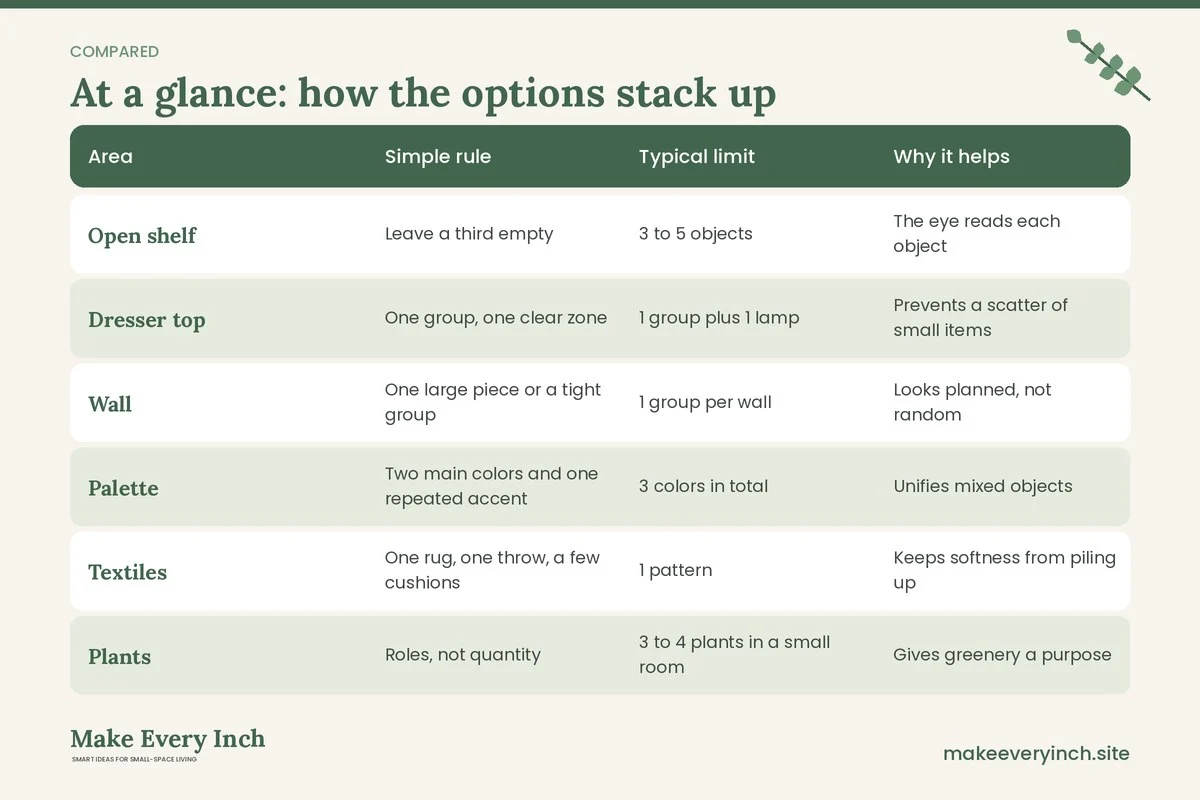
Decor rules at a glance
The table below summarizes the rules above so you can scan it before you shop or rearrange.
| Area | Simple rule | Typical limit | Why it helps |
|---|---|---|---|
| Open shelf | Leave a third empty | 3 to 5 objects | The eye reads each object |
| Dresser top | One group, one clear zone | 1 group plus 1 lamp | Prevents a scatter of small items |
| Wall | One large piece or a tight group | 1 group per wall | Looks planned, not random |
| Palette | Two main colors and one repeated accent | 3 colors in total | Unifies mixed objects |
| Textiles | One rug, one throw, a few cushions | 1 pattern | Keeps softness from piling up |
| Plants | Roles, not quantity | 3 to 4 plants in a small room | Gives greenery a purpose |
| Lighting | Three layers, one bulb tone | Check each lamp’s rating | Removes harsh shadows |
| Keepsakes | Rotate from a box | 2 to 3 on display | Keeps the room personal and calm |
Three example rooms
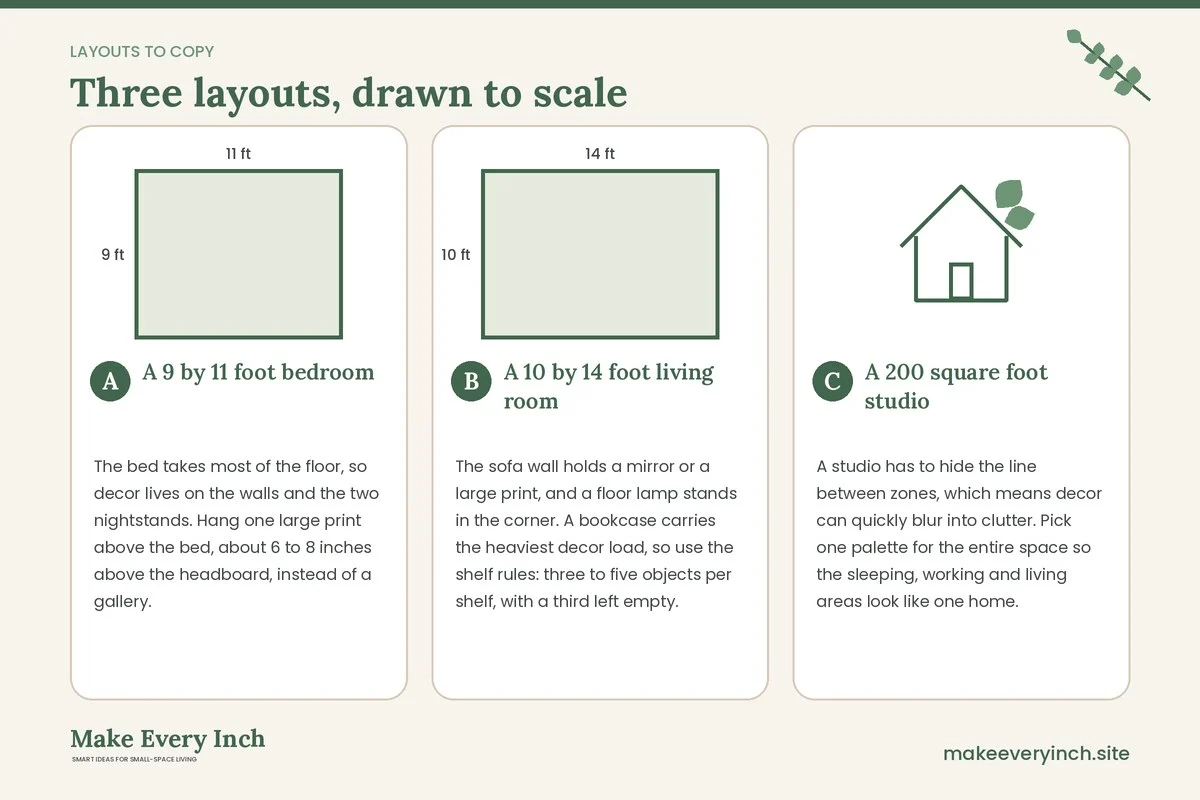
A 9 by 11 foot bedroom
The bed takes most of the floor, so decor lives on the walls and the two nightstands. Hang one large print above the bed, about 6 to 8 inches above the headboard, instead of a gallery. Keep each nightstand to a lamp, a glass and a book. Use a tray on the dresser for a perfume bottle and a small dish, and leave the rest of the top bare. Choose a palette of warm white, a soft green and natural wood. The bedroom stays restful because the only repeated accent, the green, appears in the bedding, a plant and the print. For more bedroom planning, see our guide to small bedroom ideas.
A 10 by 14 foot living room
The sofa wall holds a mirror or a large print, and a floor lamp stands in the corner. A bookcase carries the heaviest decor load, so use the shelf rules: three to five objects per shelf, with a third left empty. The coffee table holds one tray with a candle and a small plant. The rest of the pieces live in a lidded basket by the sofa. A rug anchors the group. Rotate two keepsakes seasonally. For furniture and layout choices in a room like this, read our guide to small living room ideas.
A 200 square foot studio
A studio has to hide the line between zones, which means decor can quickly blur into clutter. Pick one palette for the entire space so the sleeping, working and living areas look like one home. Use one large piece of art for each zone, not many small ones. Keep the desk surface almost bare, and hide the supplies in a lidded box. Use rugs or lamp placement to mark each zone. To plan the storage that keeps the decor visible, take a look at our post on budget small space ideas.
A seasonal rotation plan
A rotation box is the easiest way to keep decor fresh without adding more objects. Choose a sturdy box with a lid that fits under a bed or on a closet shelf. Four times a year, spend 20 minutes on this routine.
- Take out the decor that is on display and wipe it down.
- Choose the items that still feel right, and put them back.
- Swap two or three pieces with items from the box.
- Move any item you have not missed for a year toward donation.
- Check that each surface is within its budget.
If you rent and cannot paint, rotation also lets you change the look of a room without touching the walls. Swap the throw, the cushion covers and the art on the shelf, and the room feels new. Our guide to apartment decorating styles can help you decide on a direction before you start rotating.
Common mistakes
- Decorating before decluttering. Decor on top of clutter makes the clutter look intentional for about a day. Clear the room first.
- Buying many small items. A small object looks cheap and busy in groups. Fewer, larger pieces are calmer.
- Ignoring the vertical space. A bare wall above a console is a missed chance to hold art or a mirror, which takes no floor space.
- Lining everything up in a row. A strict row looks stiff. Vary the heights and leave gaps.
- Hanging art too high. Art that floats near the ceiling disconnects from the furniture and makes a room look chaotic.
- Forgetting the back of the door. The side of a door that faces you every day is a place for a hook or a mirror, not for a pile of bags.
- Overloading a socket. A lamp collection looks cozy, but plug them into more than one outlet and respect the labels.

Budget approach
You can improve a room without a large spend. Start with free steps: clear surfaces, return strays to their homes and group what is left. Then use second-hand shops and online marketplaces for trays, lamps and frames, which are easy to find and easy to mix. Paint a small frame or a thrifted vase in your accent color to tie it into the scheme. For more ways to stretch a small budget, see our guide to budget small space ideas and our overview of small space organization ideas.
Checklist
- Clear every surface, then add back only what you love or use.
- Write a decor budget for each surface.
- Choose two main colors and one accent, and repeat the accent three times.
- Leave one surface almost empty.
- Group objects in odd numbers on trays.
- Swap many small frames for one larger piece or a tight group.
- Hang art with its center at about 57 inches, lower over furniture.
- Check the weight rating on anything you hang and ask permission before drilling.
- Layer three light sources and keep the bulb tone consistent.
- Respect every lamp’s wattage label, and spread plugs across outlets.
- Hide or clip cords along the wall.
- Check each plant for pet safety.
- Keep a rotation box and a one-in, one-out habit.
FAQ
How many decor items are too many in a small room?
There is no single number, but a useful sign is when you can no longer see a surface. If a shelf, dresser or table has no empty space, it is probably too full. Aim to leave about a third of each open shelf empty.
How do I decorate a small room without making it look empty?
Use bigger pieces, richer textures and repeated color rather than many small objects. A rug, a large print, a plant and layered light give a room warmth without adding clutter.
What colors make a small room look less cluttered?
A narrow palette of two or three related colors keeps a room calm, and soft, low-contrast backgrounds help each object stand out. Repeat one accent color so the eye can connect the pieces.
Is it safe to hang a heavy mirror in a small room?
Only if it is anchored properly. Find the weight of the mirror, use hardware rated well above that weight, and attach it to a stud or with an appropriate anchor. In a rental, ask permission before drilling, and otherwise lean the mirror against the wall with a safe backing.
Can I use many lamps instead of an overhead light?
Yes, and layered lamps often look calmer. Just stay within the wattage label on each lamp, avoid overloading a single outlet, and keep cords tidy and out of walkways.
How often should I change my decor?
Once each season is plenty. A short rotation keeps the room fresh and gives you a regular chance to remove what you no longer like.
Keep going: Keep going with our pillar on small room decor ideas, the sibling guide to small space styling rules for open shelves and our tips on small bedroom ideas.
Save this guide for later
Pin the ideas you like to Pinterest so you can come back to them when you plan your space.