Small Space Decorating Mistakes to Avoid: 12 Fixes
Quick answer: The small space decorating mistakes to avoid most often are using too many small items, hanging art too high, relying on one overhead light, matching everything too tightly, skipping a rug, hiding the floor under furniture, and ignoring scale. Fix them by choosing fewer and larger pieces, layering light at three heights, repeating a short color list, and keeping walls and surfaces calm. Check the lease before painting or hanging anything.
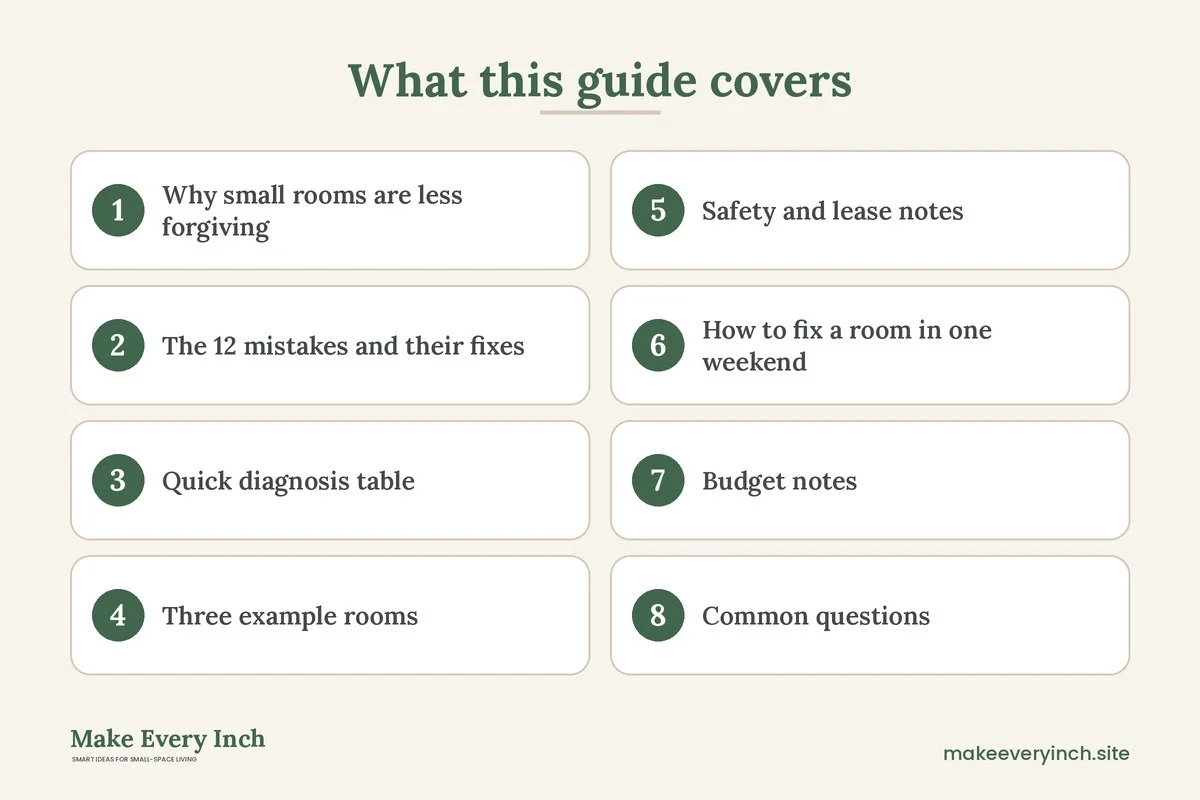
People searching for small space decorating mistakes avoid lists usually have the same quiet worry: they have spent money and time on a room, and it still feels crowded, dim or unfinished. The cause is rarely the square footage. It is usually a handful of decorating habits that work in a large room and backfire in a small one. A small room magnifies every choice, so one oversized sofa, one harsh bulb or one cluttered shelf shows up immediately. This guide walks through 12 common mistakes, explains why each one makes a room feel smaller, and gives a specific fix you can apply this weekend. It also includes a diagnosis table, three example rooms, a safety section and a checklist. For the full picture of styling a compact home, see our pillar guide on small room decor ideas.
Why small rooms are less forgiving
In a large room, a poor decision gets absorbed. There is enough empty floor, wall and air to dilute it. In a small room there is no buffer, so the eye reads everything at once: the color of the walls, the height of the furniture, the shine on the floor, the number of objects on every surface. When those signals disagree, the brain reads the room as busy, and busy reads as small.
That is useful news, because it means you do not need more space to fix the problem. You need fewer competing signals. Most of the mistakes below come down to three ideas. First, scale: pieces that are too small look cluttered, and pieces that are too big block movement. Second, contrast: too many sharp breaks between wall, furniture and floor chop the room into pieces. Third, light: a room that is dark in the corners looks like it ends sooner than it does. Keep those three ideas in mind as you read.
The 12 mistakes and their fixes
Color and surfaces
1. Painting everything white and calling it done
White is a safe choice, and it can look fresh, but a room with flat white walls, white furniture and no variation can feel cold and shapeless. Without any depth the eye has nothing to travel across, and the room may feel like a box.
The fix is to keep a light base and add gentle variation. Choose warm or soft neutrals, vary the finish between walls and trim if you have permission to paint, and add two or three mid tones through textiles. If you cannot paint, create depth with a rug, curtains and a few darker objects. For palette ideas that suit a compact footprint, see our guide to studio apartment color schemes.
2. Going dark everywhere without a plan
Dark walls can make a small room feel enclosed and intimate, and some people love that. The mistake is going dark without planning the light. A deep color on four walls with a single ceiling fixture tends to swallow the room, and the corners vanish.
If you want a dark color, use it on one wall or in a room where you use the space mostly at night. Add layered lamps, keep the ceiling light, and repeat the dark tone in small doses elsewhere so it feels deliberate. Our post on dark apartment ideas covers how to handle low-light rooms with color rather than against it.
3. Using too many colors in small doses
A cushion in one color, a vase in another, a throw in a third and art in a fourth can make a small room read as a collection of unrelated pieces. Each small contrast adds a line to the picture, and too many lines add up to visual noise.
Pick a short list. A common approach is one main neutral, one supporting neutral and one or two accent colors, and then repeat them. Repetition is what makes a small room look planned. If you own a lot of colorful things already, group them: put the red items together on one shelf and the blue ones on another, rather than scattering them.
4. Matching everything too tightly
The opposite error is a showroom set, where sofa, table, shelf and cabinet are all the same finish and shade. A room full of one tone can look flat and heavy, and a small space shows every pound of that sameness.
Mix finishes in a controlled way. Choose two wood tones at most, add one metal finish, and bring in a texture such as linen, rattan or wool. The goal is to give the eye a few different surfaces to rest on while the overall palette stays quiet.
Furniture and scale
5. Buying many small pieces instead of a few right-sized ones
Small rooms seem to call for small furniture, so people buy a tiny chair, a tiny table, a tiny shelf and a tiny bench. The result is a room full of small shapes, and the eye counts every one. Many small pieces also mean many small gaps, and gaps collect clutter.
A better approach is to choose fewer, slightly larger pieces that do more work. One properly sized sofa usually looks calmer than a loveseat plus two chairs. Measure the room, tape the footprint on the floor and live with the tape for a day before you buy. Our guide to small space furniture layout rules explains how to plan clearances, and the post on furniture that makes small rooms feel bigger shows which shapes help.
6. Pushing every piece against the wall
It feels logical to line the perimeter and leave the middle open. In practice this often makes a room look like a waiting area, with a dead center and furniture far from where people actually sit. Some floating of furniture, even by a few inches, can make a room feel more intentional.
You do not need to float everything. Try pulling the sofa a few inches from the wall to create a thin shadow line, or angling a chair slightly. If a pass-through is needed, leave a walkway of roughly 30 to 36 inches, and adjust to your own household. Keep tall pieces anchored, as described in the safety section below.
7. Hiding the floor under furniture
Furniture that sits flat on the floor with no visible legs blocks the floor from view, and a floor you cannot see makes a room feel smaller. Large skirted sofas, boxy cabinets and bed frames that touch the ground all do this.
Choose pieces with visible legs where you can. Seeing a strip of floor underneath a sofa, a bed or a console gives the eye a longer line, and the room feels airier. If you already own low, solid furniture, avoid stacking items beneath it, and keep the strip clear so the effect still works.
Walls, art and mirrors
8. Hanging art too high or too small
Art hung near the ceiling pulls the eye up and away from the furniture, which creates a disconnected look. Tiny frames scattered across a big wall look like stray stamps.
A common guideline is to hang the center of a piece at roughly 57 to 60 inches from the floor, and above a sofa leave about 6 to 10 inches between the frame and the furniture. Group small pieces into one arrangement so they read as a single shape. For layouts and rules, see our guides on renter friendly wall decor ideas and hallway gallery wall ideas.
9. Placing a mirror without thinking about what it reflects
A mirror can open a room, but only if it reflects something worth doubling. A mirror that faces a pile of laundry, a blank wall or a harsh bulb adds nothing, and can make the room feel more crowded.
Place the mirror where it reflects a window, a lamp or an attractive piece of art. Lean a large floor mirror rather than hanging it if the lease is strict. Pay attention to the weight, and use proper support for heavy glass, as covered in the safety section.
10. Covering every wall
When every wall has something on it, the room has no place to rest. Gallery walls, shelves, hooks and decals on all four sides can make a room feel like a storage unit.
Choose one focal wall and leave the others quieter. Negative space is a decorating tool, and in a small room it works like a pause in a sentence. A single large piece on one wall will usually do more than a dozen small ones across four.
Light and layers
11. Relying on one overhead light
A single ceiling fixture flattens a room. It lights the middle, throws shadows in the corners and makes every evening feel like an office. In a small room the dark corners tell the eye where the room stops.
Layer the light at three heights: a general source, task lighting where you read or work, and a low accent source such as a table lamp. Place at least one lamp in a corner, because lit corners push the visual edges of the room outward. For specifics, see our guides to renter friendly lighting ideas, small living room lighting ideas and small bedroom lighting ideas.
12. Skipping the rug, or choosing one that is too small
A bare floor can echo and look cold, and a rug that is too small floats like an island. Both reduce the sense of comfort and make the furniture look unanchored.
Choose a rug large enough that the front legs of the main seating sit on it, and keep the border of bare floor even on all sides. Our companion guide on how to choose rug size for a small living room walks through the measurements.
Quick diagnosis table
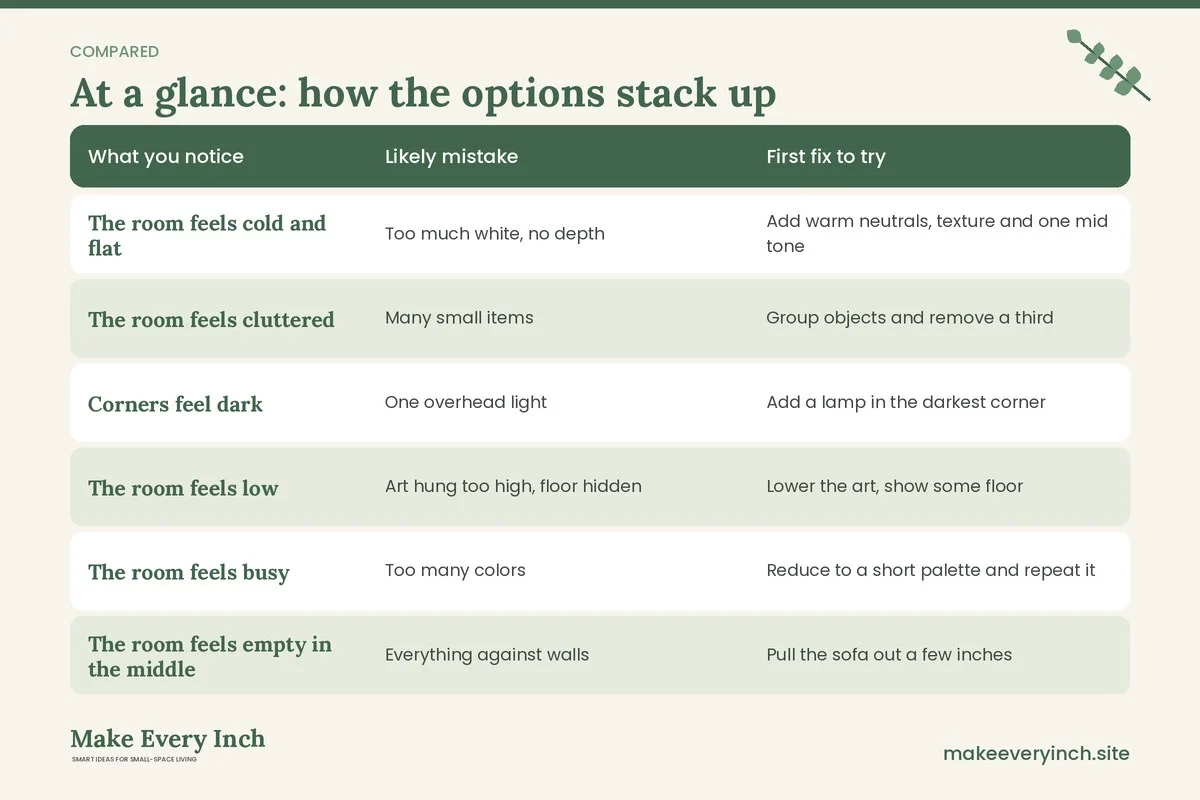
Use the table below to match what you see in your room with the likely cause and the first fix to try.
| What you notice | Likely mistake | First fix to try |
|---|---|---|
| The room feels cold and flat | Too much white, no depth | Add warm neutrals, texture and one mid tone |
| The room feels cluttered | Many small items | Group objects and remove a third |
| Corners feel dark | One overhead light | Add a lamp in the darkest corner |
| The room feels low | Art hung too high, floor hidden | Lower the art, show some floor |
| The room feels busy | Too many colors | Reduce to a short palette and repeat it |
| The room feels empty in the middle | Everything against walls | Pull the sofa out a few inches |
| The room feels heavy | Matching dark furniture | Mix finishes and add lighter pieces |
| The seating feels unmoored | Rug too small | Size up so the front legs sit on the rug |
Three example rooms
A 9 by 12 foot living room
This room had a loveseat, two small chairs, a tiny table, a shelf and nine small frames on one wall. The mistakes were many small pieces, art hung high and one ceiling light. The fix was to swap the three seats for one right-sized sofa and one chair, move the frames into one grouped arrangement at about 57 inches to the center, and add a floor lamp and a table lamp. The room now has fewer shapes, lit corners and a clear walkway.
A studio with a bed against the window wall
Here the wall color was flat white, the bed frame sat low and solid, and the only light was a ceiling fixture. The renter could not paint. The fix was to add warm bedding with texture, a rug that extends beyond the bed, a bedside lamp and a plug-in wall sconce, and to move the storage out from under the bed so the floor could be seen. The room gained depth without a single can of paint. See our guide on studio apartment decorating ideas for more.
A narrow bedroom with dark walls
This bedroom was painted a deep color on all four walls with a single small lamp. It felt like a cave. The fix was to keep the color on the wall behind the bed, add light fabric on the others if repainting was not allowed, and layer a ceiling light, two bedside lamps and a mirror opposite the window. For more, see small bedroom ideas.
Safety and lease notes
Decorating changes should never create hazards. Keep these points in mind before you start.
- Lease first. Check the lease before painting, applying wallpaper or hanging anything. Ask in writing, and keep a copy of the answer. Never drill without permission.
- Paint and ventilation. If you are allowed to paint, consider low-VOC products, open windows, run a fan, and keep pets and children out of the room until the surface is dry. Follow the label.
- Lamps and bulbs. Check the maximum wattage marked on each lamp and use a bulb at or below that limit. Keep bulbs and shades clear of fabric, curtains and bedding, and do not cover a hot lamp with cloth.
- Sockets and power strips. Do not plug several heat-producing or high-load items into one socket or strip. Use a surge protector with a safety switch for electronics only, and never daisy-chain strips.
- Cords. Route cords along walls, not across walkways or under rugs, and keep them away from heat and water.
- Mirrors and art. Heavy mirrors and framed glass need proper hanging hardware rated for the weight, and some walls need anchors suited to the wall type. Leaned mirrors should sit on a non-slip surface and be secured as the manufacturer suggests.
- Tall furniture. Anchor bookcases, dressers and tall shelves to the wall where permitted, especially around children and pets.
- Plants. Some common houseplants are toxic to cats, dogs or children. Check each plant before bringing it home, and place it out of reach if unsure.
How to fix a room in one weekend
You do not need a full makeover. A staged approach prevents overspending and shows what really helps.
Saturday morning: edit
Clear every flat surface and put everything into a box. Return only the items you use or love. Remove a third of the decor, and see how the room feels. Many mistakes disappear when there is simply less competing for attention.
Saturday afternoon: rearrange
Pull furniture away from the wall by a few inches where possible, check walkways of about 30 to 36 inches, and make sure you can see some floor under sofa and bed. Group objects in threes, with different heights.
Sunday morning: light
Add or move a lamp so each corner has a gentle glow. Check wattage ratings, and use warm white bulbs for evening rooms. Turn off the overhead light for a day and notice how the room looks with lamps alone.
Sunday afternoon: walls and textiles
Rehang art to the right height, group small pieces and add one mirror opposite a window if the wall allows. Add a rug of the right size and one textured throw. Stand in the doorway, take a photo, and compare it with a photo from before.
Budget notes
You can avoid most of these mistakes with little or no spending. Rearranging, editing, regrouping and rehanging cost nothing. Lamps, bulbs, textiles and a rug are the items worth investing in first, because they affect light and comfort. Secondhand and borrowed pieces can fill the gaps. For more, see small apartment decor under 100 and budget small space ideas.
Common questions
Do light colors always make a small room look bigger?
Not always. Light colors reflect more light, and that often helps, but a room with no depth can feel flat. Mix soft neutrals, textures and a few darker accents so there is shape and contrast.
Is it ever right to use dark colors in a small space?
Yes. A dark wall can feel cozy and sophisticated if you layer the lighting and repeat the color in small amounts. It tends to work best in rooms used in the evening.
How many decor items are too many?
There is no fixed number. A useful test is whether each surface has an empty area about as large as the objects on it. If not, remove a few.
Should I buy small furniture for a small room?
Not always. Right-sized pieces with legs often look better than many tiny ones. Measure and tape the footprint first.
What is the single biggest improvement?
For many rooms it is lighting. Adding one or two lamps at lower heights and removing harsh glare can change the feel of a room without moving anything else.
How do I avoid damaging a rental?
Use freestanding and removable solutions, and ask for permission before painting, applying wallpaper or hanging heavy items. Our guide to security deposit safe apartment upgrades lists options.
Final checklist
- Measure the room and tape furniture footprints before buying.
- Choose a short color palette and repeat it.
- Mix two wood tones, one metal and one texture at most.
- Show some floor under sofas, beds and consoles.
- Hang art with its center at roughly 57 to 60 inches.
- Layer light at three heights and light the corners.
- Check lamp wattage limits and keep shades clear of fabric.
- Size the rug so the front legs of seating rest on it.
- Leave one wall calm.
- Anchor tall furniture and use proper hardware for mirrors.
- Get written permission before painting, wallpapering or drilling.
Keep going: Next, read the pillar guide on small room decor ideas, work through how to choose rug size for a small living room, and plan your lights with renter friendly lighting ideas.
Save this guide for later
Pin the ideas you like to Pinterest so you can come back to them when you plan your space.