16 Small Laundry Area Ideas for Apartments: Closets and Halls
Quick answer: The best small laundry area apartments plans start with the hookups you already have, then fit the work around them: a closet, a hallway alcove, a kitchen corner or a bathroom wall. Measure the machines with the door open, leave the clearances in the appliance manual, keep the vent path clear, put a shutoff valve within reach and ask your landlord before you change anything.
A small laundry area in an apartment is rarely a room. It is a closet with bifold doors, a stacked unit behind a hallway curtain, a corner of the kitchen or a slice of the bathroom, and sometimes it is nothing at all, only a basket you carry downstairs. The challenge is not decoration. It is fitting a heavy, hot, wet and vibrating job into a few square feet without blocking the vent, the water or the walkway. This guide is about small laundry area apartments of every type, whether you have an in-unit hookup, a shared room down the hall or no machine at all. It covers how to read what you have, the safety basics that apply everywhere, 16 layout and storage ideas, a comparison table, three example homes, a weekly routine, mistakes and a checklist. For the wider storage picture, see our guides to small space organization ideas and small laundry room organization. When you are ready to plan the shelves, our companion post on small laundry room storage ideas goes deeper on the fittings, and the pillar guide to small laundry room ideas covers the whole room.
Work out which kind of laundry situation you have
Before you buy a rack or a basket, name your situation. The right ideas depend on it, and a plan that suits a closet with a stacked unit will fail in a studio with a shared basement room.
- In-unit hookup in a closet. Water supply, drain and power sit in a recess, often behind folding doors. The space is tight, warm and poorly ventilated, so air flow matters as much as storage.
- In-unit hookup in a kitchen or bathroom. The machine shares a wall with other plumbing, which makes the room busy. Splash, steam and cabinet doors all compete for the same few feet.
- Hallway or alcove hookup. More open, usually more visible. Neat storage doubles as decoration here.
- Shared laundry room in the building. You carry everything. The best storage is portable and the best system is one that makes each trip efficient.
- No machine at all. You use a laundromat or a service. Storage for dirty laundry, a drying plan and a packed bag matter most.
- Portable or compact machine. Some apartments allow a small machine that connects to a faucet. Check the lease, the building rules and the electrical limits before you consider one.
Write down which one applies. Then measure it, because the numbers rule out half of the ideas on the internet.
Measure first, and keep the clearances
Take four measurements: the width and depth of the recess or corner, the height to the ceiling or the lowest shelf, the door opening width, and the clearance from the machine to the wall behind. Then read the appliance manual for the manufacturer’s minimum clearances. They vary by machine and by vent type, and the manual wins over any rule of thumb in a blog post. As a loose guide, many setups ask for a few inches behind the machine for hoses and vent, a small gap at each side, and more space above a front-loading door so it can swing open.
Door swing is the most common surprise. A front-loading door often needs 20 to 30 inches of clear floor in front of it to open fully and to load comfortably, though the exact figure depends on the model. If a closet door, a cabinet or a wall blocks the swing, plan to reverse the door if the manual allows it, or choose a different layout. Measure the path from the apartment door to the machine too. A delivery that cannot get through the hallway turns into an expensive problem.
Mark the footprint on the floor with painter’s tape and stand in it. If you cannot bend to load a basket without hitting a shelf, the shelf is too low or the floor space is too small. Moving the plan on paper is free, and moving a machine is not.
Safety basics for any apartment laundry corner
Laundry combines water, electricity, heat and chemicals, so treat safety as the first design layer. These points apply to nearly every small laundry area, and your manual and your building rules should have the final word.
- Dryer clearance and venting. A dryer needs air around it and a clear path for exhaust. Do not block the back or sides with baskets, shelves or stored items beyond what the manual permits. A crushed, kinked or overlong vent hose can trap heat and lint. Do not use plastic or foil vent material unless the manual explicitly allows it, and ask the landlord or maintenance team about the vent route.
- Lint and fire risk. Lint is flammable. Clean the lint screen after every load, and ask a professional or your maintenance team about cleaning the vent line on a regular schedule. Never run a dryer when you are asleep or away, and do not dry items that have been soaked with oils, solvents or flammable cleaners.
- Water leaks and shutoff valves. Find the water shutoff valves for the washer before you need them. You should be able to reach them without moving the machine, and everyone in the household should know where they are. Look at the hoses for bulges and cracks, and replace worn hoses on the schedule your manual or building recommends. A shallow drain pan under the machine is an option where the building allows it.
- GFCI near water. Outlets near sinks and laundry areas are often required to have ground-fault protection in many places. If your outlet looks old, trips often or has no test and reset buttons, report it to the landlord rather than fixing it yourself. Do not run extension cords or power strips to a washer or dryer.
- Weight and vibration of stacked units. A washer is heavy even when empty and much heavier when full of wet laundry, and spin cycles shake. Stacked units should use the manufacturer’s stacking kit, sit on a level, solid floor, and never carry shelves or hung items that add load or vibrate loose. Do not put anything on top that could fall or block the controls.
- Anchoring shelves. Tall shelving in a laundry area should be anchored to the wall, or kept short enough to stay stable. If you rent, never drill without written permission. Use the freestanding options and the ideas in our no drill storage ideas for renters guide.
- Chemicals away from children and pets. Store detergent, bleach, stain removers and softener high or behind a latch, in their original containers with the labels on. Never mix cleaners, and in particular never combine bleach with ammonia or acids, because the fumes can be dangerous. Ventilate the space while you use them.
- Lease permission. Any change to plumbing, venting, wiring or the wall needs approval first. Photograph the corner before you start so you can show the original condition at move-out.
16 small laundry area ideas for apartments
Closet laundry ideas
1. Treat the closet like a cabinet
With the doors closed, a closet laundry should look like storage. Keep the machine front clear, remove anything stored on the floor beside the dryer and use the wall above for a shelf only if the manual allows a gap between the shelf and the top of the machine. If the closet door fits tight, ask about louvered doors, which let air move. Our guide to small closet door storage ideas shows how to use a door without drilling.
2. Open the doors while the dryer runs
Heat and humidity build in a shut closet. Prop the doors open while a load dries, or remove bifold doors with permission and hang a tension curtain instead. A curtain also hides the machines from the living room without sealing them in.
3. A narrow rolling cart in the gap
If you have 6 to 10 inches beside the machines, a slim rolling cart holds detergent, dryer sheets and a lint tray. Roll it out when you need to reach the side. Keep it a safe distance from the dryer vent and from any hot surface, and keep chemicals in the top tier, closed.
4. A shelf above the machines
A shelf mounted above a washer is a classic idea, and in a rental it needs permission. If you can fit a freestanding rack that straddles the machine, choose one that stands on its own feet, is level, and is not taller than the manual and the ceiling allow. Keep heavy bottles low on the rack, and anchor it if the building permits.
Kitchen and bathroom corner ideas
5. A countertop over the washer
In a kitchen, a front-loading washer under a counter doubles as a prep surface. If the space allows, a removable board on top gives you a folding surface. Never leave a board where the dryer vents, and move it before you run a heavy cycle if it could vibrate off. Read the manual before you cover the top of any machine.
6. Hide the machine behind a pocket door or a curtain
A curtain on a tension rod is the simplest screen. A folding screen can also work if it stays several inches clear of the dryer and the vent. A curtain should be a light, washable fabric and should never touch the exhaust or the heat.
7. A bathroom wall for a hamper and drying line
If the machine lives in the bathroom, keep towels and linens nearby but away from the splash zone, and keep the ventilation fan running during and after cycles. Our guides to small bathroom ideas and small bathroom shelving ideas show how to use vertical space around fixtures.
8. A kitchen cabinet for supplies
If the washer is in the kitchen, move supplies to a high cabinet with a child latch and keep them away from food. Label every bottle, and store anything that could be mistaken for a drink or a snack on a separate shelf from groceries. See our guide to small kitchen ideas for more ideas that work in a tight room.
Hallway, alcove and no-hookup ideas
9. A hallway alcove with a curtain
A stacked unit in a hallway alcove can hide behind a washable curtain on a ceiling-friendly rod or a tension rod. Choose a rod that does not block the control panel or the dryer door, and leave a gap for air. A rug runner in front adds a soft landing and keeps the floor dry.
10. A portable folding table
If you fold laundry on the bed or the sofa, a wall-leaning folding table gives you a flat surface for ten minutes. Store it behind a door or under a bed, and put it away after folding.
11. A packed laundromat or shared-room tote
For shared laundry rooms, pack one sturdy bag per load type: darks, lights, towels. Add a small pouch with pods or detergent, stain remover and coins or a payment card. A bag that is ready to grab makes the trip faster, and it keeps chemicals in one sealed place.
12. A drying plan that does not need a dryer
Not every apartment can vent a dryer. A folding drying rack, a door-hung rack or a tension line over the tub gives you a place to dry small loads. Keep the rack away from heaters and the wall, and open a window or run a fan, because damp laundry left in a closed room adds humidity and can lead to mildew. Our post on linen storage ideas without a linen closet covers where to put the folded results.
Storage and sorting ideas
13. A three-bin sorting system
Three slim bins or a three-section hamper handle lights, darks and delicates. Choose lightweight bins that can be carried to a shared room. A sorted hamper cuts the work at the machine.
14. A vertical hanging bar for air-dry items
A tension rod above the machine or inside a closet gives you a bar for air-drying shirts and hanging freshly dried items on hangers. Check the weight rating and leave space above the machine for the lid or door to open.
15. A sealed supply box
Keep detergent, softener and stain remover in a lidded box rather than on open shelves. A lid reduces spills, hides the clutter and keeps containers away from small hands and paws. Choose a box with a handle so you can lift it to a high shelf.
16. A lint and sock station
Place a small lidded bin for lint, a jar for stray socks and a pouch for pocket finds near the machine. This tiny station stops lint from landing on the floor, and an empty-pockets rule is cheaper than repairing a washed phone.
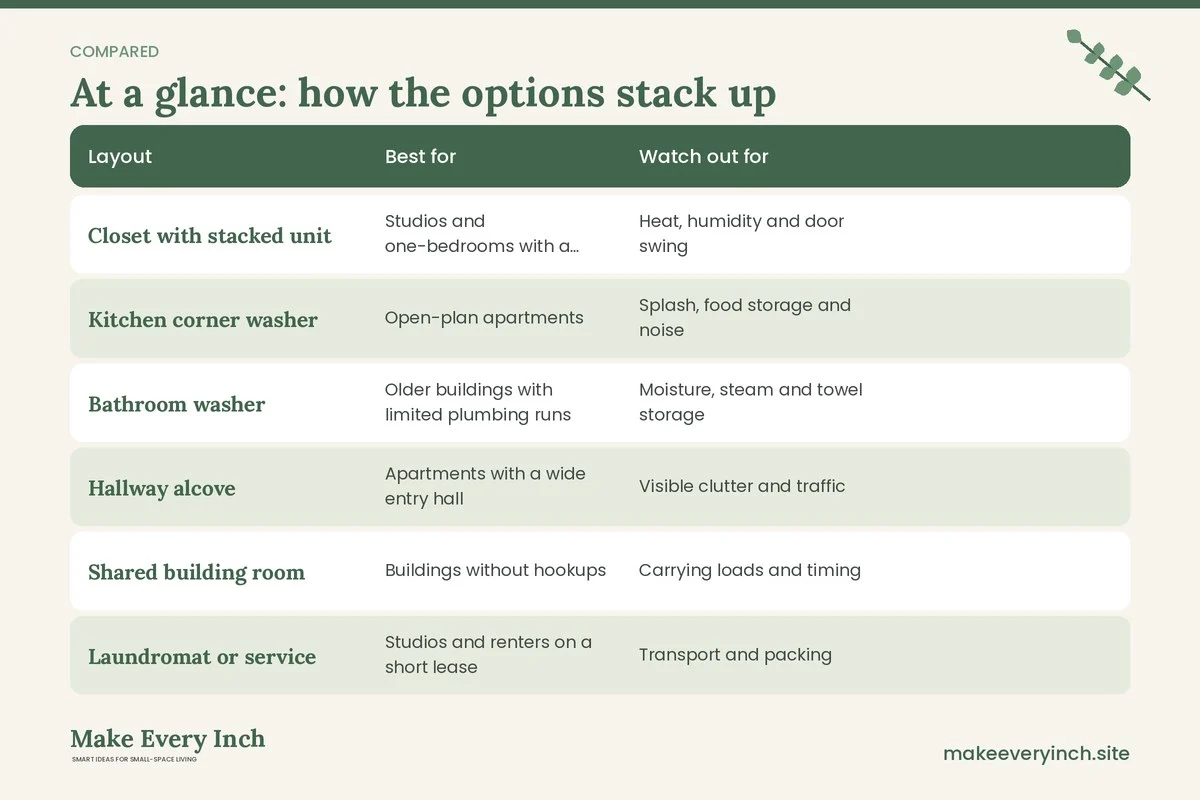
Compare the layouts at a glance
| Layout | Best for | Watch out for | |
|---|---|---|---|
| Closet with stacked unit | Studios and one-bedrooms with a hookup | Heat, humidity and door swing | |
| Kitchen corner washer | Open-plan apartments | Splash, food storage and noise | |
| Bathroom washer | Older buildings with limited plumbing runs | Moisture, steam and towel storage | |
| Hallway alcove | Apartments with a wide entry hall | Visible clutter and traffic | |
| Shared building room | Buildings without hookups | Carrying loads and timing | |
| Laundromat or service | Studios and renters on a short lease | Transport and packing |
Three example apartments
Example 1: A studio with a closet hookup
The unit is a studio with a stacked washer and dryer in a hallway closet, about 28 inches wide. The renter removes nothing from the walls, because the lease bans changes. The plan starts by leaving the door swing and the vent route clear. A slim rolling cart lives in the gap and holds supplies in a lidded box on the top tier, far from the dryer exhaust. The bifold doors stay open during every dry cycle. A hamper with a lid sits in the corner of the room, and a tension rod inside the closet holds a few shirts after they come out. Detergent sits on a high shelf behind a child latch. Everything comes out of the closet in minutes, and the room still looks like a closet.
Example 2: A one-bedroom with the washer in the kitchen
A one-bedroom has a washer-dryer combination under the kitchen counter, with a shutoff valve behind a toe-kick panel. The renter first checks the valve and shows the household where it is. A foldable board stays beside the fridge and goes on top of the machine only when it is not running. A slim cabinet above the fridge holds supplies in a latched box, away from groceries. A drying rack folds behind the door. The rule is that clothes leave the machine the same day, because damp clothes in a warm kitchen smell fast. Pantry, snacks and cleaning supplies share a counter, so the renter labels every bottle clearly.
Example 3: A shared-room building with no hookup
A two-bedroom building has a laundry room on the ground floor. The household uses three bags: darks, lights and towels. Each bag has a small pouch with a stain remover pen and a laundry tab. The household uses a weekly slot on a calendar so two people do not compete for machines. At home, a hamper with three sections sits in the hallway, and a drying rack stands in the bathroom with a fan running. A tidy tote by the door means the trip starts in 30 seconds. Detergent stays in a locked cabinet rather than on the floor, because a child visits on weekends.
A weekly routine that keeps a small laundry area calm
A tiny laundry area breaks down when it accumulates, so build a routine that takes under 15 minutes a week.
- Every load: clean the lint screen, wipe the washer door seal and leave the door ajar so it dries. Check the floor for drips.
- Weekly: wipe the top and the shelves, return supplies to their lidded box and empty the lint bin.
- Monthly: pull the machines forward only if the manual and your lease allow it, look at the hoses and the vent connection, and vacuum the area behind. If you cannot move the machine safely, ask maintenance.
- Twice a year: ask for the dryer vent line to be cleaned, and test the GFCI outlet if your area has a test button.
- Every season: check the stored cleaners for expiration or leaks, and dispose of old products as local rules direct.
Common mistakes in small laundry areas
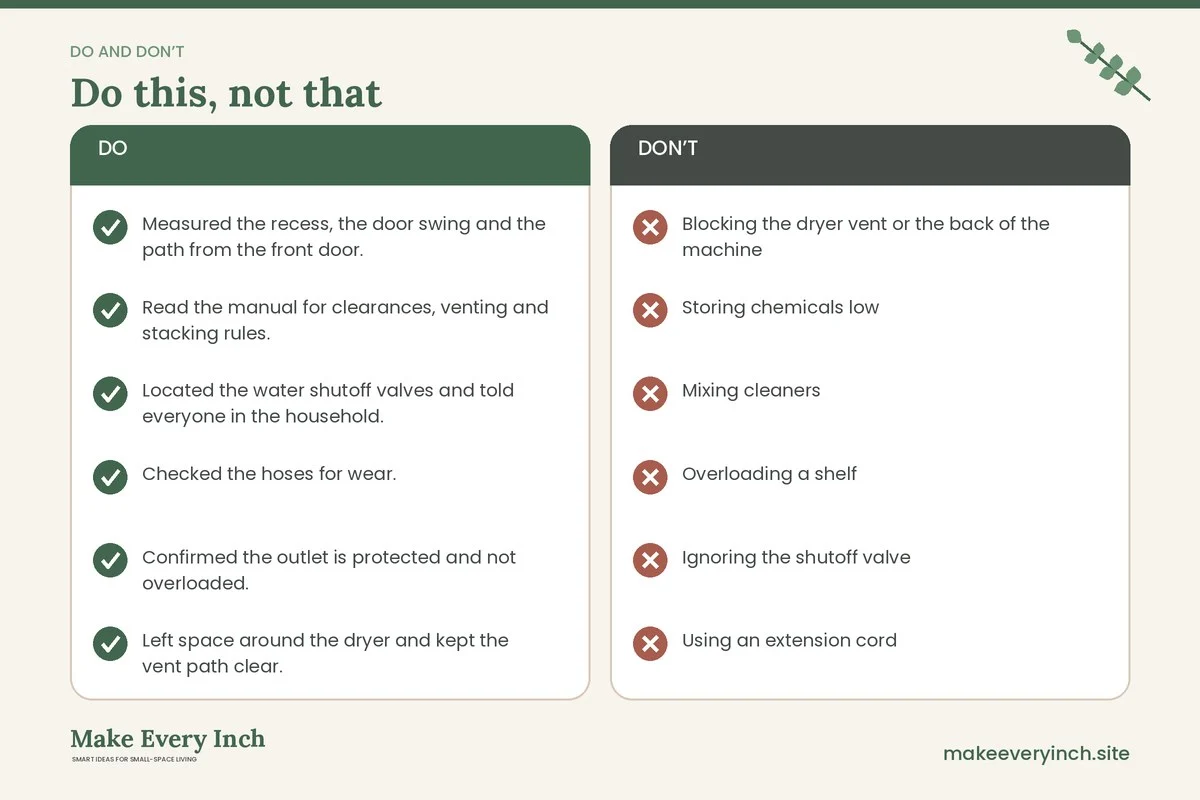
- Blocking the dryer vent or the back of the machine with baskets or bins.
- Storing chemicals low where a child or a pet can reach them.
- Mixing cleaners to get a stronger result.
- Overloading a shelf that sits above vibrating machines.
- Ignoring the shutoff valve until a hose leaks.
- Using an extension cord for a washer or a dryer.
- Letting damp laundry sit in a closed closet, which invites mildew.
- Drilling into a wall without permission, or into a wall that may hide pipes or wires.
- Skipping the manual, which holds the real clearance and venting rules for your model.
Small laundry area apartments on a budget
You do not need new furniture. Start with the free steps: clear the floor, rearrange the supplies, label bottles and clean the lint screen. Then add the cheapest high-impact items: a lidded hamper, a tension rod, a folding rack and a lidded supply box. Compare options in our guides to budget small space ideas and cheap storage ideas for apartments. Prices vary widely by region and store, so decide your budget first and measure before you buy. For the rental angle, see our renter-friendly storage ideas for small apartments.
Checklist before you finish
- Measured the recess, the door swing and the path from the front door.
- Read the manual for clearances, venting and stacking rules.
- Located the water shutoff valves and told everyone in the household.
- Checked the hoses for wear.
- Confirmed the outlet is protected and not overloaded.
- Left space around the dryer and kept the vent path clear.
- Stored chemicals high, latched, labeled and never mixed.
- Asked permission before any drilling, venting or plumbing change.
- Chose freestanding or tension-based storage for a rental.
- Planned a drying method that does not trap humidity.
- Set a lint and cleaning schedule.
FAQ
Can I put a washer and dryer in any apartment closet?
Only if the closet has the right hookups, ventilation and electrical supply, and the building allows it. Check the lease, ask the landlord and read the appliance manual before you buy or move anything.
How much space should I leave around a dryer?
It depends on the model and the vent type. Many manuals ask for a few inches at the back and sides and more space in front for the door. Follow the manual and any local code, and ask maintenance if you are unsure.
Is it safe to store detergent above the washer?
Often yes, if the shelf is stable, the bottles are closed and the products are out of reach of children and pets. Do not stack bottles where vibration can topple them, and never store chemicals near heat from the dryer.
What if my building has no hookup at all?
Use a shared laundry room, a laundromat or a service, and set up a portable system: sorted bags, a supply pouch and a drying rack at home. Ask your landlord whether a compact machine is allowed, and check the plumbing and electrical limits first.
Can I install shelves in a rental laundry area?
Only with permission if you need to drill. Freestanding racks, tension rods and over-door storage are safer options for most leases. See our guide to renter-friendly shelving ideas without drilling.
How do I stop a small laundry area from feeling damp?
Run the exhaust fan or open a window, leave the washer door ajar after cycles, take damp laundry out promptly and keep the closet doors open while the dryer runs. If dampness or mold keeps coming back, report it to your landlord.
Keep going: Plan the whole room with our pillar guide to small laundry room ideas, build the shelves with small laundry room storage ideas, and keep the rest of the home tidy with small space organization ideas.
Save this guide for later
Pin the ideas you like to Pinterest so you can come back to them when you plan your space.