Small Entryway Mirror Ideas: 14 Ways to Size, Place and Secure One
Quick answer: A small entryway mirror works best when it is sized to the wall (about two thirds of the width of the furniture beneath it), centered near 57 inches from the floor, and placed to reflect light or a pleasant view rather than clutter. Choose shatter-resistant or backed glass, anchor tall and leaning mirrors, never drill without permission, and check the weight rating of every hook or strip.
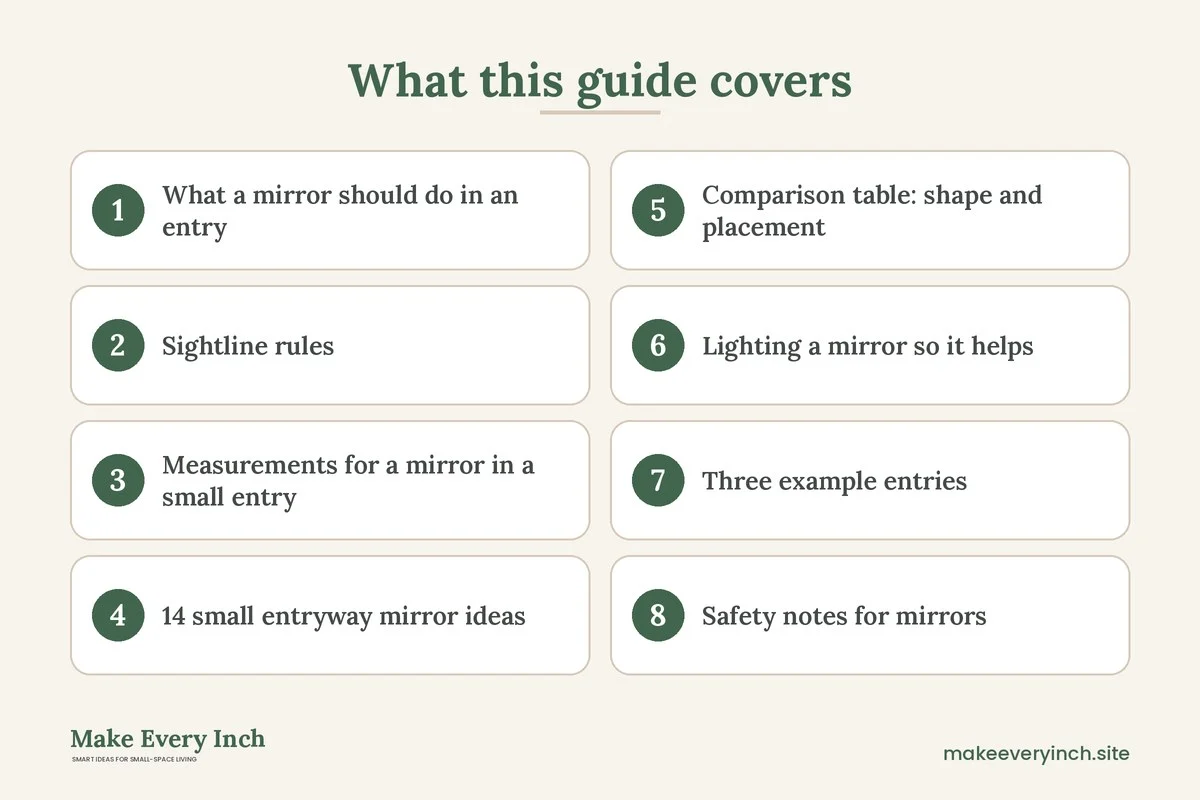
A small entryway mirror is one of the few pieces that does three jobs in a tight space. It gives you a last look before you leave, it bounces light into a dim hall, and it makes a narrow passage feel wider. It is also one of the easiest to get wrong, because a mirror that is too small looks lost, a mirror that is too big can overwhelm a short wall, and a mirror that reflects the wrong thing doubles the clutter you wanted to hide. This guide is about choosing, placing and securing a mirror in an entry, with sightline rules, measurements, 14 ideas, a table of shapes, three example entries, safety notes and a checklist. For the broader plan of the area, start with our pillar guide on small entryway ideas. If you want a room-by-room view of mirrors, read our post on small room mirror placement ideas, and for the gear around the mirror see the companion guide on entryway drop zone ideas for small homes.
What a mirror should do in an entry
Before choosing a style, decide the job. The same mirror does not do everything equally well, and in a small entry you often get one chance.
Light. A mirror across from a window or beside a lamp can carry daylight deeper into a hall. The mirror does not make light, it redirects it, so its position relative to the light source matters more than its size.
Space. A mirror on the long wall of a narrow passage reads as a second corridor, and a mirror at the end of a hall reads as an opening. The effect is visual only, and it is strongest when the reflection shows a bright, uncluttered area.
The last look. Most people want to check their face, collar or hair on the way out. That calls for a mirror whose center is near eye level, and for lighting that falls on the face rather than from behind.
A landing point. A mirror above a console or a shelf anchors the drop zone visually. It turns a row of hooks and a shelf into a composed vignette.
Choose one primary job and one secondary job. A mirror for the last look needs height and clear lighting. A mirror for space needs the right wall and a good reflection. A mirror for light needs the right angle to the window.
Sightline rules: what the mirror will reflect
The first thing a mirror shows is whatever stands opposite. In a small entry that is often a closet door, a stack of shoes or the bed in a studio. Walk to the spot where the mirror will hang, look straight at the position of the mirror, and then move to the doorway and look again. Note what each view shows.
- Good reflections: a window, a light-colored wall, a plant, a piece of art, a lamp or the doorway into a bright room.
- Reflections to avoid: the mess by the door, the back of the sofa, a cluttered shelf, a bed or an open closet, a TV screen and the front door itself when it is dark outside.
- Angles: a mirror directly facing the front door shows the person arriving, which some find unwelcoming, and a mirror on the side wall shows a profile and the space beyond. Try holding a framed mirror in each place, or lean a large cardboard sheet cut to size, before you commit.
If a mirror reflects clutter, either move the mirror, hide the clutter with a closed basket or a cabinet, or choose a smaller mirror above the clutter’s line of sight.
Measurements for a mirror in a small entry
These numbers keep the mirror in proportion and at the right height.
- Center height: hang the center of the mirror at about 57 inches from the floor for general use. If you want a last-look mirror for taller people, move the center up by 2 to 4 inches, and for children use a second low mirror.
- Width over furniture: make the mirror about two thirds of the width of the console, shelf or bench below it. A console of 30 inches pairs well with a mirror of 18 to 22 inches across.
- Gap above furniture: leave 6 to 8 inches between the top of a console and the bottom of the mirror, so the pieces read as a pair.
- Floor mirror: for a full-length look, a mirror 14 to 20 inches wide and 48 to 65 inches tall is enough for a narrow entry, set at a slight lean. The mirror’s lower edge should be within a few inches of the floor.
- Path clearance: a leaning mirror or a stand takes about 3 to 4 inches of depth, plus the base. Keep the clear path at 30 to 36 inches, or 28 inches at the narrowest point of a short run.
- Door swing: keep a floor mirror outside the arc of the door. A door that hits a mirror is a danger.
- Distance from hooks: keep at least 8 inches between a mirror’s edge and the nearest hook so a coat or bag does not hit the glass.
Cut a sheet of paper or card to the mirror’s size and tape it to the wall for a day. If it reads too small, go up by 4 inches. If it feels heavy, go down.
14 small entryway mirror ideas
Above a console or shelf
1. A rectangular mirror above a slim console
The most reliable pairing is a horizontal or vertical rectangle above a console 8 to 10 inches deep. Align the mirror’s center to the console’s center, and let the mirror be about two thirds of its width. A small tray beneath holds keys.
2. A round mirror above a hook rail
A round mirror of 18 to 24 inches above a short rail softens a row of straight lines. Hang it above the hooks, not between them, so a coat does not cover it.
3. A stacked pair of small mirrors
Two small mirrors, one above the other, give a vertical line on a narrow wall. Keep the gap to 2 to 3 inches, and make sure the centers fall near eye level for the most common user.
4. A mirror with a shelf built in
Some mirrors have a narrow shelf at the bottom that holds a key bowl and a lamp. It saves a separate console and works in the tightest entries. Check that the shelf has a lip, so keys do not slide off.
Leaning and freestanding
5. A tall leaning mirror
A full-length leaning mirror suits a renter because it needs no holes. Place it against a stud wall at a slight angle of about 5 to 8 degrees, and add a rubber stop or a wedge at the base so it cannot slide. Secure it to the wall at the top with an anti-tip strap where allowed, and keep it away from children and pets who might push it.
6. A mirror on an easel
A mirror on an easel can be moved to whichever wall suits the day. Check that the legs are stable and the easel is wide enough to resist tipping.
7. A mirror on the back of a door
A narrow mirror on the inside of the entry door, or a hinged one on a closet door, takes no wall space at all. Use hardware rated for the door and check that the door still closes properly. Make sure the mirror is secured, because a door that slams can loosen weak fixings.
Hanging without damage
8. A light mirror on adhesive strips
Small, lightweight mirrors can hang with adhesive strips, but only if the strip rating exceeds the mirror’s weight by a generous margin and the wall surface is clean, dry and smooth. Press for the time recommended and wait before hanging. Do not use strips on textured, damp or freshly painted walls. If the mirror is heavy or glass is thick, choose another method.
9. A mirror hung from an existing picture hook
If a hook or a nail already exists, and the landlord permits its use, hang a mirror from it. Check the weight rating and use a second point to stop the mirror from tilting. Our guide on renter-friendly wall decor ideas lays out more ways to hang without damage.
10. A mirror with a rope or strap hanger
A mirror on a leather strap or rope hangs from a single hook at the top and looks relaxed. It still needs a secure hook and a rating that covers the weight.
Shape and style tricks
11. An arched mirror to lift a low ceiling
An arch draws the eye up and gives a sense of height. In an entry with a low ceiling, choose a vertical arch about 24 to 36 inches tall rather than a wide horizontal one.
12. A mirror with a narrow frame in a light tone
A thin frame keeps a small wall from feeling crowded. A frame in a color that echoes the door or hooks ties the entry together.
13. A cluster of three small mirrors
Three small round mirrors of different sizes, hung with 2 to 3 inches between them, make a sculptural focal point. They work well on a short wall with no furniture below. Keep the cluster within a rectangle about 24 by 24 inches.
14. A mirror beside the door
A mirror on the wall beside the entry door catches the light from the doorway and helps you check yourself at the last second. Mount it so the door does not hit it, with at least 2 to 3 inches of clearance beyond the arc.
Comparison table: shape and placement
| Mirror type | Best wall | Size to aim for | Strength | Watch out for |
|---|---|---|---|---|
| Horizontal rectangle | Above a console | 18 to 22 inches wide | Balances a long surface | Reflecting clutter |
| Vertical rectangle | Narrow wall | 14 to 18 inches wide, 30 to 48 inches tall | Adds height | Needs a secure hanger |
| Round | Above hooks or a bench | 18 to 24 inches | Softens straight lines | Smaller reflection area |
| Arched | Low ceiling | 24 to 36 inches tall | Lifts the eye | Frame style may feel formal |
| Full-length leaning | Free wall | 14 to 20 by 48 to 65 inches | Last look, no holes | Tipping hazard |
| Over-the-door | Back of entry door | 12 to 16 inches wide | No wall space | Door weight, slamming |
| Small cluster | Short wall | 24 by 24 inch group | Focal point | Needs several fixings |
| Mirror with shelf | Tight entry | 20 to 24 inches wide | Adds a landing spot | Shelf can overload |

Lighting a mirror so it helps
A mirror only helps when light reaches it. Use these simple rules.
- Light the face, not the back of the head. Place a lamp or a wall light beside or just above the mirror at about 60 to 66 inches. A light behind you throws a shadow on your face.
- Use warm, soft light. A bulb in a warm range feels welcoming and flatters skin. Pick a bulb type rated for your fixture.
- Avoid glare. A bare bulb opposite a mirror will glare. Use a shade or a diffuser.
- Daylight. If a window is across from the mirror, keep the window clean and keep the curtain light so the reflection is bright. Avoid direct sun on the glass, since it can create a hot spot and fade items nearby.
- Electrical safety. Use a rated fixture or a plug-in lamp, do not run a cord across the walkway, and never overload an outlet. If hardwired work is needed, ask a qualified electrician and the landlord. Our guide to small hallway lighting ideas covers more options, and the post on layered lighting ideas for small apartments shows how to combine them.
Three example entries
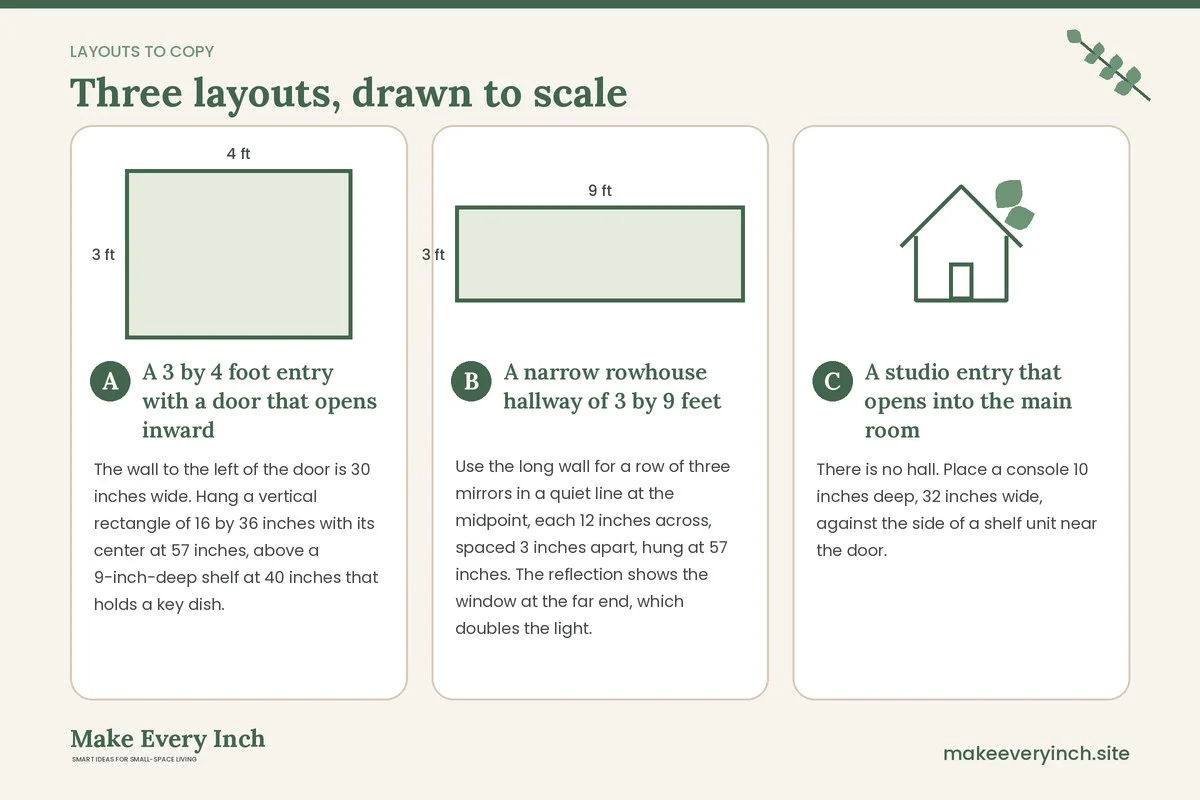
A 3 by 4 foot entry with a door that opens inward
The wall to the left of the door is 30 inches wide. Hang a vertical rectangle of 16 by 36 inches with its center at 57 inches, above a 9-inch-deep shelf at 40 inches that holds a key dish. A short rail with two hooks on the right of the mirror, at 8 inches clearance, holds a coat and a bag. A plug-in sconce on the other side lights the face. The path stays at 30 inches. If the lease bans holes, lean a 14 by 55 inch mirror against the wall with a rubber stop, strap it where allowed, and use an over-the-door rack for coats.
A narrow rowhouse hallway of 3 by 9 feet
Use the long wall for a row of three mirrors in a quiet line at the midpoint, each 12 inches across, spaced 3 inches apart, hung at 57 inches. The reflection shows the window at the far end, which doubles the light. Place a slim bench 12 inches deep below the mirrors, with two baskets underneath. Keep the clear path at 30 inches. Our post on narrow hallway ideas shows more ways to treat a long, tight passage.
A studio entry that opens into the main room
There is no hall. Place a console 10 inches deep, 32 inches wide, against the side of a shelf unit near the door. Above it, hang a round mirror of 22 inches with its center at 57 inches, so the console and mirror read as a landing zone. The reflection shows the window across the room. Place a small lamp on the console and a basket under for shoes. The effect separates the entry from the sleeping area, much as in the plan in our guide on studio apartment entryway ideas.
Safety notes for mirrors
A mirror is glass, and glass needs care in a busy entry.
- Choose safer glass. Look for a mirror with a safety backing film or one labeled as shatter-resistant, particularly in a home with children, pets or a narrow high-traffic hall.
- Check the weight. Weigh the mirror if you can, or read the label. Choose hangers, strips or hooks rated well above that weight, and use two points for anything wide.
- Anchor tall mirrors. A leaning or standing mirror can tip. Use a rubber stop at the base, an anti-tip strap at the top where permitted, and keep it away from the door swing and from where a child plays.
- Never drill without permission. Read the lease and ask the landlord in writing before you drill, even for a small anchor. If the answer is no, use a leaning mirror, a door mirror or a freestanding option. See our post on no-drill storage ideas for renters for more.
- Locate studs and wires. Before any permitted drilling, use a stud finder and check for pipes and cables behind the wall.
- Keep away from heat and damp. Do not hang a mirror directly above a radiator or in a spot that gets splashed by wet coats. Heat can damage the backing, and moisture can cause black spots at the edges.
- Clean with care. Use a soft cloth and a glass cleaner sprayed onto the cloth rather than the mirror, so liquid does not seep behind the glass. Ventilate when you use cleaning products.
- Consider reflections for pets and birds. Some pets react to their reflection, and a large mirror near a window can confuse birds. Observe how your pet behaves and cover or move the mirror if it causes stress.
- Handle broken glass safely. If a mirror breaks, keep children and pets away, wear sturdy gloves and shoes, and wrap the pieces before disposal.
Common mistakes to avoid
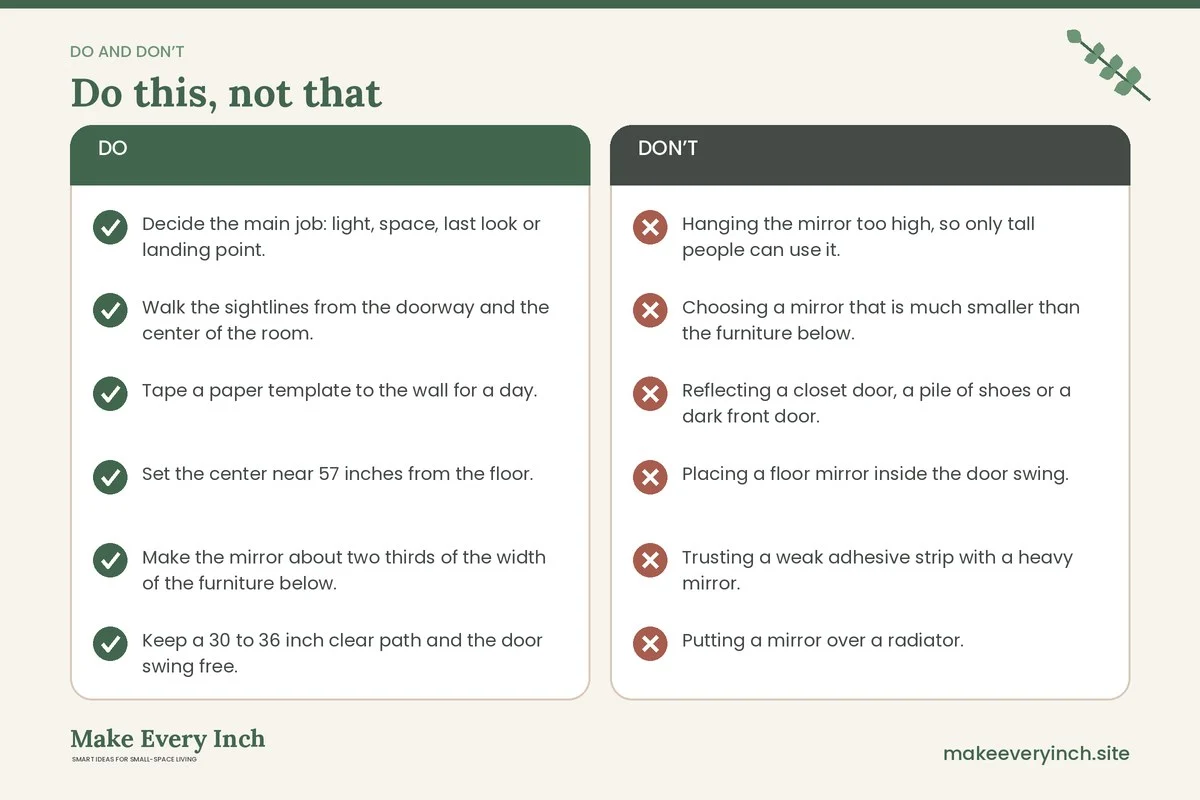
- Hanging the mirror too high, so only tall people can use it.
- Choosing a mirror that is much smaller than the furniture below.
- Reflecting a closet door, a pile of shoes or a dark front door.
- Placing a floor mirror inside the door swing.
- Trusting a weak adhesive strip with a heavy mirror.
- Putting a mirror over a radiator.
- Forgetting to light the face.
- Leaving a tall mirror unanchored in a family home.
Small entryway mirror checklist
- Decide the main job: light, space, last look or landing point.
- Walk the sightlines from the doorway and the center of the room.
- Tape a paper template to the wall for a day.
- Set the center near 57 inches from the floor.
- Make the mirror about two thirds of the width of the furniture below.
- Keep a 30 to 36 inch clear path and the door swing free.
- Check the weight and choose rated fixings.
- Choose safer glass if children or pets are present.
- Anchor any tall or leaning mirror.
- Ask permission before drilling, and photograph the wall.
- Add warm light beside or above the mirror.
- Clean the glass with a cloth sprayed with cleaner.
FAQ
What size should a small entryway mirror be?
Aim for about two thirds of the width of the furniture beneath it, such as 18 to 22 inches over a 30-inch console. On a bare wall, a mirror of 16 by 36 inches or a round of 20 to 24 inches fits most short walls.
How high should I hang an entryway mirror?
Center it at about 57 inches from the floor. Move it up by 2 to 4 inches if the main users are tall, and add a low mirror for children.
Can I hang a mirror in a rental without drilling?
Yes, with a leaning mirror, an over-the-door or door-mounted mirror, a freestanding easel mirror or, for light pieces, adhesive strips rated well above the weight. Check the lease and test a hidden spot first.
Will a mirror really make a small entry look bigger?
It makes the space feel brighter and deeper when it reflects light or a clear view. It does not change the actual size, and it can make clutter look worse if it reflects the wrong thing.
Should a mirror face the front door?
It is a matter of taste and light. A mirror opposite the door reflects whoever enters, while one on the side wall reflects the space beyond. Try both with a template and see which looks better.
What is the safest way to keep a tall mirror from tipping?
Use a rubber stop at the base and an anti-tip strap at the top where the lease and the wall allow, set the lean angle low, and keep it out of the door swing. Our guide on small entryway wall decor ideas has other ways to treat the wall around it.
Keep going: Keep planning with our small entryway bench ideas, the guide on apartment entryway decorating and the post on small entryway organization.
Save this guide for later
Pin the ideas you like to Pinterest so you can come back to them when you plan your space.