15 Small Living Room Ideas with Open Shelving That Stay Tidy
Quick answer: Small living room open shelving works best when shelves are shallow (8 to 12 inches deep), anchored to the wall, and filled with a rule: one third books, one third closed boxes or baskets, one third empty space. Place the lowest shelf at least 16 inches off the floor, keep heavy items between waist and shoulder height, and never skip anchoring tall units or checking the lease before drilling.
Small living room open shelving can make a compact room feel taller, lighter and more personal, or it can turn into a visual pile of clutter that makes the space feel smaller. The difference lies in depth, height, spacing and what you put on the shelves. A shelf that sticks out 16 inches into a room that is only 10 feet wide takes real floor space, while a shelf that is 9 inches deep holds just as many books and barely registers. This guide covers how to choose the right depth, where to place shelves around a sofa and a TV, how to load them safely, 15 ideas, a table of what to put where, three example rooms, styling rules and a checklist. For the wider topic, read our hub on small living room ideas, and for the storage side of the same problem, see our guide to small living room storage ideas.
Decide what the shelves are for
Open shelving does three different jobs in a living room, and each calls for a different design. Before you buy or build anything, decide which job matters most.
The first job is storage. If the room has to hold books, games, media, throws and everyday objects, you need depth, a sturdy build and a place for things to hide. Closed baskets and boxes on open shelves give you storage that looks calm.
The second job is display. If the shelves are mainly for plants, art, ceramics and photos, you can use shallower boards, wider gaps and fewer items. Display shelves can be as narrow as 4 to 6 inches deep when they hold frames and small objects.
The third job is structure. Shelving can divide a studio into a sleeping zone and a living zone, frame a TV, or act as a long, low sideboard that replaces a console. In this role the shelves become part of the layout, so their position matters more than their contents.
Most small living rooms need a mix, but one job should lead. A room with a lot of belongings should lead with storage. A room that is already full of furniture should lead with display. A room that has no walls to spare should lead with structure and use a back-to-back unit. Writing down the lead job in one sentence prevents the common mistake of buying a tall, deep bookcase for a room that needed a slim display ledge.
Measurements that keep the room open
Shelves take up room in two ways: the footprint on the floor or wall, and the visual weight. Both need planning.
- Depth: 8 to 12 inches is the sweet spot for a small living room. Paperbacks need about 6 inches, hardbacks and storage boxes 10 to 12, and large coffee-table books up to 14. A 12 inch deep unit against a wall takes about one square foot per foot of width, which is manageable.
- Walkway beside shelves: keep at least 30 to 36 inches clear in a main path, and 24 inches for a rarely used side path. A freestanding unit beside a doorway should not narrow the door swing.
- Shelf spacing: 10 to 12 inches between shelves for books, 14 to 16 for baskets or boxes, and 16 to 18 for media equipment, plus ventilation space. Adjustable shelves let you change this later.
- Lowest shelf height: at least 12 to 16 inches off the floor on a wall-mounted run, so a robot vacuum, a rug edge or a pet bowl fits underneath and the floor still shows. On a floor unit, a solid base of 4 to 6 inches stops dust and keeps it stable.
- Highest shelf height: for everyday items, stay under 72 inches. Anything above that is for light, rarely used objects, and a stable step stool should be nearby.
- Eye line: the area between 36 and 60 inches off the floor is the zone you see most. Put your best objects here, and let the lower and higher zones carry the plain storage.
- Distance from the sofa: a shelf over the back of a sofa should sit at least 8 to 12 inches above the cushions and be shallow enough that a seated person cannot hit their head when standing up. Many people keep the shelf 6 to 8 inches deep in this spot.
Use painter’s tape on the wall to mark the outline of each shelf before you commit. Live with the tape for a few days, sit in each seat, and walk through the room. Shelves that look tidy on a screen often feel heavy in person.
Safety first: anchoring, loads and lease rules
Open shelving holds weight, and that weight can hurt someone if the unit tips or the fixings fail. A few rules apply to every idea below.
- Anchor every tall unit. Any freestanding bookcase over about 30 inches should be fixed to the wall with the anti-tip hardware that comes with it, or with a strap suited to your wall type. This matters most in homes with children or pets, because a climbing child or a leaping cat can pull a loaded shelf forward. Load heavy items on lower shelves, and keep the top light.
- Respect the weight limit. Every shelf and bracket has a rated load. Add up books, which are heavier than they look, and stay well below the limit. A long span of boards bows over time when it carries a full row of hardbacks, so add a middle support.
- Match the fixing to the wall. Plasterboard, plaster, brick and concrete need different anchors. If you cannot find a stud or a solid fixing point, choose a freestanding unit instead of a floating shelf.
- Check for hidden services. Before drilling, check the wall for cables and pipes with a suitable detector, and avoid areas directly above or beside sockets and switches. If in doubt, ask a qualified person.
- Never drill without permission. In a rental, read the lease. If drilling is banned, use a freestanding unit, a leaning ladder shelf with a wall strap that does not need holes, or the ideas in our guide to renter-friendly shelving ideas without drilling and our no-drill storage ideas for renters.
- Keep electronics ventilated. If a shelf holds a router, a console or a speaker, leave a gap of a few inches around it and do not cover vents. Do not run cables through tight spots where they can be pinched, and do not plug extension strips into each other.
- Mind heat and candles. Keep candles, lamps with hot bulbs and open flames away from shelf boards and fabric. Use battery candles if the shelf is small.
- Plan for child and pet safety. Keep small items, medicines and glass objects on high shelves, and use soft baskets low down. Cord ends should stay out of reach.
If you build or paint your own shelves, work with the window open and choose low-VOC paint or sealant. Allow the finish to cure fully before loading the shelf with fabric or paper.
15 small living room open shelving ideas
Wall-mounted ideas that save floor space
1. A long shelf above the sofa
A single run of shelf, 6 to 8 inches deep, mounted 12 to 18 inches above the back of the sofa, holds a row of frames and a small plant. It adds height without eating floor. Keep the load light, and do not store anything heavy or breakable where a person could knock it while sitting down.
2. Two staggered shelves instead of a bookcase
A pair of shelves set at different heights, one above the other and offset by a few inches, creates a casual look with fewer items. In a rental, check the lease before drilling and choose short boards that can be fixed to the same stud.
3. A picture ledge for rotating art
Picture ledges are 3 to 4 inches deep and hold frames that lean against the wall. They suit renters who want to change the display often, and they keep a narrow wall from feeling bare. Add a lip, so that a frame does not slide off.
4. A floating media shelf under the TV
A wall-mounted shelf below the TV holds a router, a streaming box and a speaker without needing a console on the floor. Leave a gap behind the equipment for airflow, and keep the shelf depth at least a couple of inches deeper than the tallest device. For more layouts, see our guide to small living room TV wall ideas.
5. Corner shelves in a dead corner
A set of corner shelves uses a part of the room that nobody walks through. Stack three or four at 14 to 16 inch intervals, and use the lowest for baskets and the highest for a plant.
Freestanding units that anchor the room
6. A slim bookcase beside the window
A bookcase 10 to 12 inches deep and 60 to 72 inches tall beside a window uses the narrow wall that is easy to waste. It frames the window, and the books give the corner color. Anchor it to the wall, and keep the window clear for light. For options, see our roundup of best narrow bookshelves.
7. A low shelf under the window
A shelf 30 to 36 inches tall running under a window works as a sideboard and a bench seat at once. Add cushions on top for extra seating, and use baskets below for toys, throws or media. Keep the top clear of heavy items that could fall if the window is opened.
8. A ladder shelf that leans
A leaning ladder shelf is shallow at the top and deeper at the bottom, and it needs only a wall strap rather than a large fixing. It suits a small corner and can be moved when you do. Strap it to the wall or fit its anti-tip hardware, because leaning units can slip on smooth floors.
9. A cube unit as a room divider
A cube unit placed behind the sofa divides a studio living zone from the sleeping zone and offers storage from both sides. Leave some cubes open for plants, and fill the sleeping-side cubes with closed boxes for privacy. Check the weight of loaded cubes, and fix the unit to the wall or floor if it is taller than 30 inches.
10. A shelf-and-cabinet mix
Pair open shelves above with a closed cabinet or doors below. The cabinet hides the mess, and the open shelves keep the unit light. This suits families, pet owners and anyone with a lot of small items.
Shelving that works with the layout
11. Shelves flanking the TV
Two narrow units on either side of a wall-mounted TV frame the screen and add storage. Keep them 10 to 12 inches deep, and leave the center wall free for the TV. This looks tidy, and the books on either side soften the dark screen.
12. A reading nook shelf
Beside an armchair, a three-tier open shelf holds books, a lamp and a mug. It acts as a side table for the chair and a library in one footprint. Add a small task light, and see our guide to small living room lighting ideas for light levels.
13. A desk shelf in a living room
A wall shelf above a narrow desk turns a living room corner into a work area. Put the lamp and the files on the shelf, and keep the desk surface clear. Our post on small home office ideas in a living room has layouts for this.
14. Open shelves with a storage ottoman
Put a storage ottoman in front of low shelves so you have a seat, a surface and a place for items that do not suit the shelf. See our guide to the best storage ottomans for what to look for.
15. A shelf wall in a tiny room
When the room is very small, fill one whole wall with shelves from floor to near the ceiling, in one color that matches the wall. The wall becomes a backdrop instead of a bulky object. Use shallow shelves, and leave about 10 percent of the surface empty so the wall breathes.
What to put on each shelf
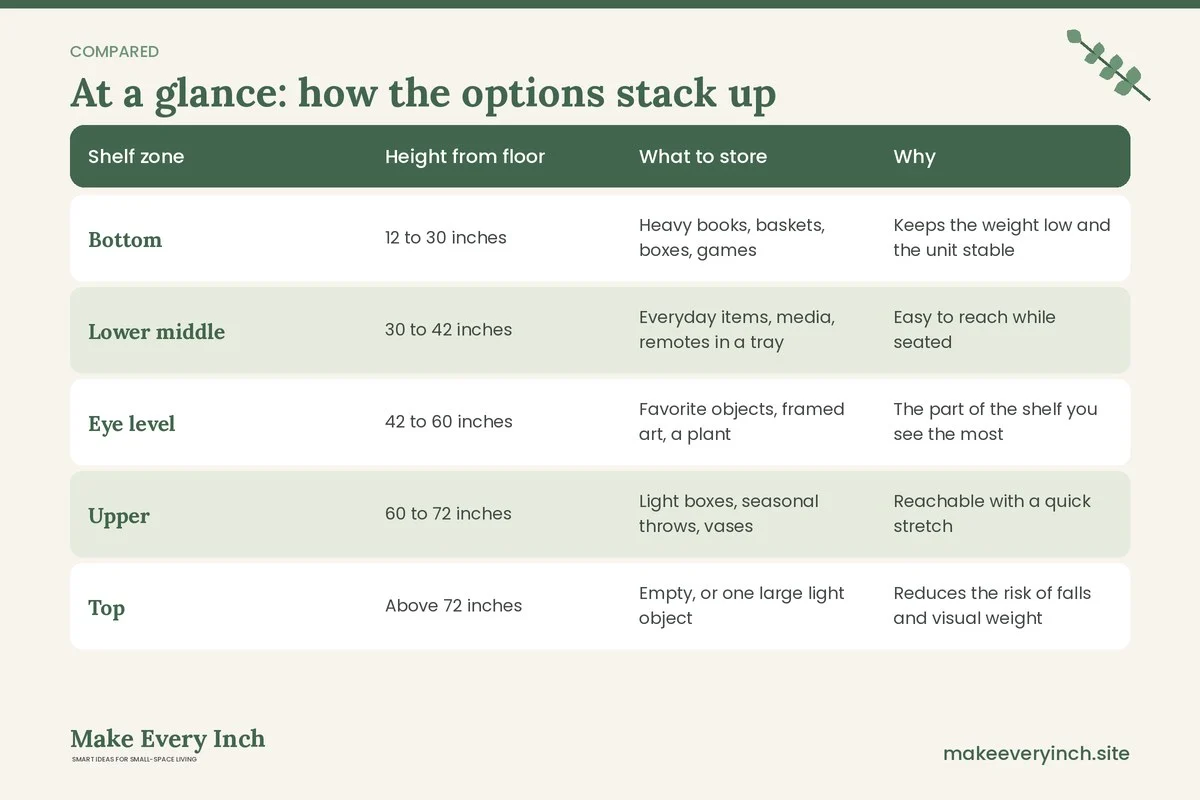
The table below shows a simple system that keeps open shelving looking intentional. Adjust the numbers to your unit.
| Shelf zone | Height from floor | What to store | Why |
|---|---|---|---|
| Bottom | 12 to 30 inches | Heavy books, baskets, boxes, games | Keeps the weight low and the unit stable |
| Lower middle | 30 to 42 inches | Everyday items, media, remotes in a tray | Easy to reach while seated |
| Eye level | 42 to 60 inches | Favorite objects, framed art, a plant | The part of the shelf you see the most |
| Upper | 60 to 72 inches | Light boxes, seasonal throws, vases | Reachable with a quick stretch |
| Top | Above 72 inches | Empty, or one large light object | Reduces the risk of falls and visual weight |
A simple rule helps: about one third books, one third closed containers, and one third empty. The empty space is what makes the shelves read as designed rather than stuffed. Group items in odd numbers, vary heights, and repeat one color or material at least three times across the unit so the eye has a pattern to follow. Lay a few books horizontally to make a platform for a small object.
Three example rooms
A 10 by 12 foot room with a two-seat sofa
The sofa sits on the long wall, and the TV on the opposite wall. A 6 inch deep shelf over the sofa holds frames and a trailing plant. A slim 10 inch deep bookcase stands by the window, anchored to the wall. A floating media shelf under the TV holds the router with a few inches of airflow around it. The walkway is a clear 36 inches. The room gains about 20 linear feet of shelf space and loses almost no floor. A 5 by 8 foot rug under the front legs of the sofa finishes the layout.
A rental living room where drilling is banned
The lease says no holes, so the plan uses freestanding pieces. A leaning ladder shelf in the corner takes the books. A low 30 inch bookcase under the window acts as a sideboard with baskets below. A picture ledge is replaced by frames leaning on the bookcase. A tall cabinet is out because it would need anchoring, so the tallest piece is 48 inches, broad and low enough to stay stable, and heavy items go on the bottom shelves. The result is a room full of storage with no marks on the wall. For more, see our post on small living room ideas for renters.
A studio with a living zone and a sleeping zone
A cube unit 30 inches tall stands behind the sofa and divides the two areas. The living side has open cubes for plants, books and a lamp, and the bed side has closed boxes so the unit hides clutter. A 36 inch path runs along the wall to the kitchen. A tall unit would block light from the window, so the divider stays low. A wall shelf above the sofa holds a few frames. Together the pieces add storage and structure while keeping the room bright. For more, read our guide on small apartment living room ideas for studios.
Styling rules for open shelves in a small room
- Edit before you display. Take everything off the shelf and put back only what you use or love. Return a bit less than you think you can fit.
- Use matching containers. Boxes and baskets in one or two colors hide cables, remotes and toys and create calm. Label them if the room is shared.
- Repeat colors. Pick two or three shades from the room and repeat them on the shelf. Book spines can be turned backward or covered if their colors clash.
- Vary heights and depths. Mix tall, short, flat and round objects so the eye moves. Avoid lining everything up like a shop display.
- Mind the back panel. A painted back panel, in a darker or a lighter tone than the wall, adds depth and makes the objects pop. Use low-VOC paint and ventilate the room, or use removable wallpaper as shown in our guide to removable wallpaper ideas for small rooms.
- Add light. A small plug-in or battery light inside or above the shelf makes the unit glow in the evening. Keep bulbs cool to the touch, and do not trap cables.
- Dust smart. Open shelves collect dust, so use closed boxes for anything you do not want to wipe, and give the shelf a quick pass once a week.
For deeper styling guidance, see our post on small space styling rules for open shelves.
Common mistakes with open shelving
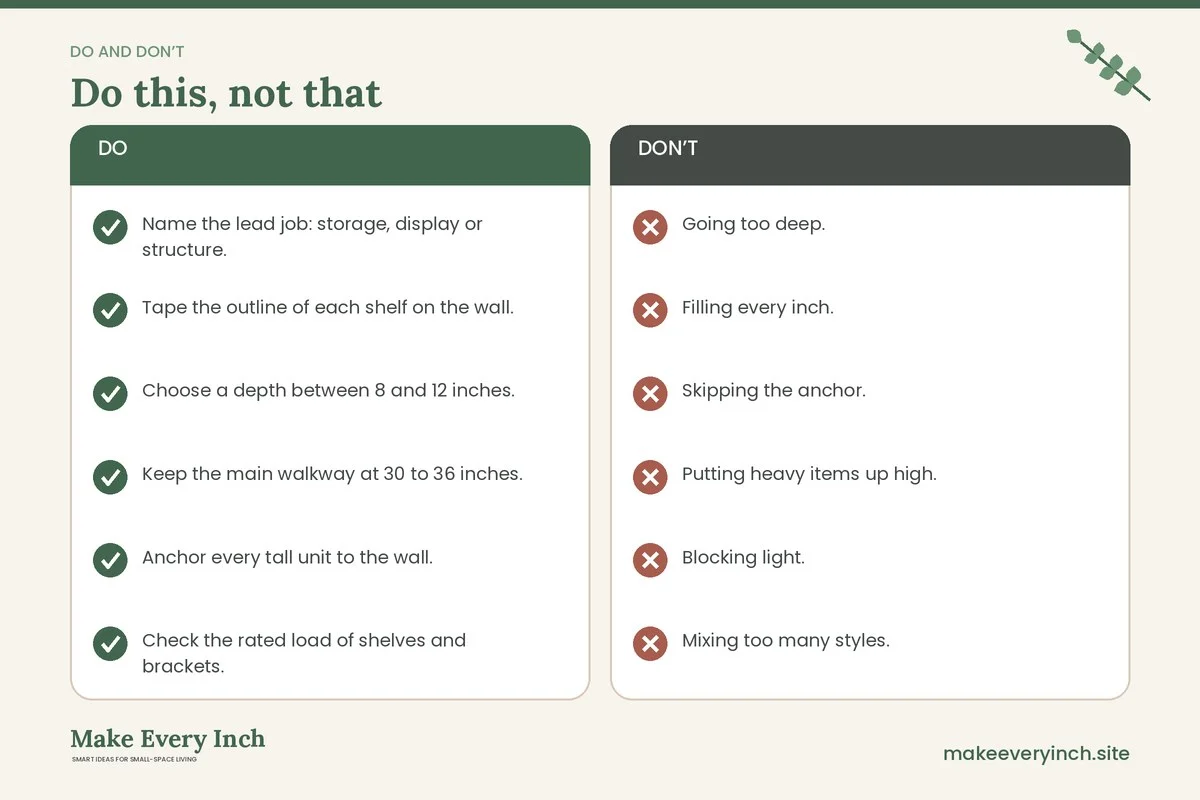
- Going too deep. A 16 inch deep unit sounds roomy but takes a bite out of a small floor. Choose 10 to 12 inches.
- Filling every inch. Full shelves look noisy. Leave gaps.
- Skipping the anchor. A tall bookcase that is not fixed to the wall is a tipping hazard.
- Putting heavy items up high. The weight raises the center of gravity and strains the brackets.
- Blocking light. A tall unit next to a window can shade the room, so keep tall pieces on the side wall.
- Mixing too many styles. Five different materials in one unit look chaotic. Pick two.
- Forgetting the ceiling height. In a room with low ceilings, a unit that stops a foot short of the ceiling looks awkward. Either go to the ceiling or stay clearly below it.
- Ignoring the lease. Drilling without permission can cost a deposit.
Open shelving checklist
- Name the lead job: storage, display or structure.
- Tape the outline of each shelf on the wall.
- Choose a depth between 8 and 12 inches.
- Keep the main walkway at 30 to 36 inches.
- Anchor every tall unit to the wall.
- Check the rated load of shelves and brackets.
- Check the wall for cables and pipes before drilling.
- Confirm the lease allows fixings.
- Keep heavy items low and light items high.
- Leave ventilation space around electronics.
- Use closed boxes for small clutter.
- Aim for one third empty space.
- Keep child and pet hazards out of reach.
- Add a small light for the evening.
FAQ
Is open shelving a good idea in a small living room?
Yes, if the shelves are shallow, anchored and edited. Open shelving keeps the room feeling airy and uses wall space. It suits people who are willing to keep it tidy or to use closed boxes for small items.
How deep should shelves be in a small living room?
Between 8 and 12 inches suits most rooms. Use 4 to 6 inches for picture ledges and display shelves, and 12 to 14 only if you need to hold large books and have the floor space.
Can I use open shelving in a rental?
Often yes, with a freestanding unit or a leaning shelf. Check the lease before making any holes in the wall, and ask in writing if you are unsure. Our guide to renter-friendly shelving lists options.
How do I stop open shelves looking messy?
Edit what you display, use matching boxes, leave a third of the space empty and group items in odd numbers. Put small things in closed containers.
How do I make a tall bookcase safe?
Fix it to the wall with the anti-tip hardware, put heavy items low, and keep the top light. Check that the fixing suits your wall type. If you cannot fix it, choose a shorter, wider unit.
What should I put on shelves above the TV or sofa?
Light items only, such as frames and a small plant. Do not put anything heavy or breakable where it could fall on a person, and keep the shelf shallow.
Keep going: Keep planning with our small living room furniture ideas, small living room layout ideas and small living room ideas with a sectional.
Save this guide for later
Pin the ideas you like to Pinterest so you can come back to them when you plan your space.