Small Hallway Decorating Ideas
Quick answer: The best small hallway decorating ideas keep the walking path clear first and decorate second. Leave at least 36 inches of clear width where you can, and no less than 30 inches in a tight older home. Use a light, warm wall color, a flat runner that grips the floor, a mirror across from a light source, art hung at eye level, and shelves or ledges no deeper than 4 to 8 inches.
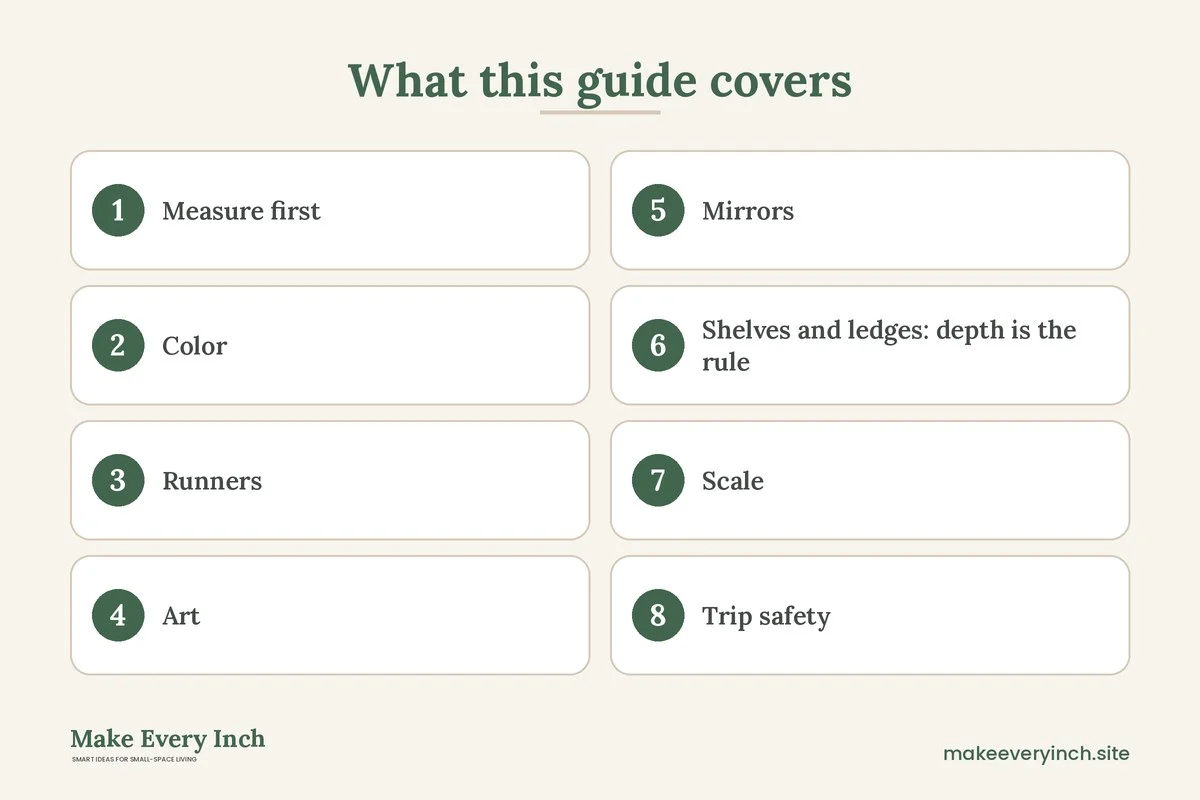
Small hallway decorating ideas work best when you treat the hallway as a path with a few jobs, not as a room to fill. A hallway is where you walk with laundry, groceries, a child on your hip and, sometimes, a stretcher or a mattress. Decoration has to earn its place without narrowing that path or making it easy to trip. This guide shows how to measure the space, choose color, pick a runner that will not slide, hang art and mirrors at the right heights, add shallow shelves, scale everything to a narrow footprint and keep the hallway safe at night. It includes a comparison table, three example hallways, a mistakes list, a checklist and an FAQ. For the bigger picture of how a hallway connects to the front door, see our pillar guide on small entryway ideas, and for layout and furniture questions, read our guide to narrow hallway ideas.
Measure first: clearance comes before style
Every decoration choice in a small hallway depends on three numbers: the width of the hallway wall to wall, the width of the narrowest point, and the amount of clearance you need to keep. Measure all three before you buy anything. Use a tape measure at hip height, because baseboards, door casings and radiators often make a hallway look wider at the floor than it really is where your elbows pass.
Hallway widths vary a lot. Many apartments and older houses have hallways between 30 and 42 inches wide. Newer homes often have 36 to 48 inches. Building codes and accessibility guidelines usually describe clear widths of around 36 inches for a comfortable path, and a bit less is sometimes allowed in older buildings, but local rules differ. If you need to know whether your hallway meets a requirement, check with your landlord, building manager or local code office, because this guide cannot tell you what applies to your building.
Here are the practical clearances to aim for:
- Comfortable path: 36 inches of clear width. Two adults can pass sideways, and you can carry a laundry basket.
- Minimum for one person: about 30 inches. You can walk through, but you will brush the walls.
- Door swing: mark the arc of every door that opens into the hallway. Decoration and furniture cannot sit in that arc.
- Shoulder zone: between about 30 and 60 inches above the floor, the wall is hit by shoulders, bags and elbows. Anything that sticks out more than 2 to 3 inches here gets bumped.
- Head zone: above 72 inches, the wall is safe for deeper items, but they must be fixed securely.
- Floor zone: from the floor to about 4 inches, items catch toes, so keep it flat and uncluttered.
Draw a simple plan on graph paper or in a notes app, and mark each door, light switch, outlet, radiator, vent and thermostat. These are the places you cannot cover or block. Then tape the footprint of anything you plan to add onto the floor or the wall with painter’s tape, and walk through it with a laundry basket. If you catch your hip or your hands, shrink the item or drop it.
A good habit is to decide how much width you are willing to give up. In a hallway that is 36 inches wide, giving up 4 inches on one side for shelves leaves 32 inches, which is still workable. In a hallway that is 32 inches wide, the same shelf leaves 28, and you should choose a 2-inch picture ledge instead. Treat width like a budget and spend it deliberately.
Color: how to make a narrow space feel calm and a little wider
Hallways usually have little daylight, so color has to do more work. The usual advice is to go light, and it mostly holds, but a few details matter.
Choose warm, light neutrals first
Pale warm whites, soft creams, light greige and pale clay tones reflect the light you have and avoid the cold, gray look that a dim hallway can get. Look at samples in the hallway itself, in the morning and in the evening, because the same color looks different with daylight and with warm bulbs. Look for paint with a light reflectance value that is relatively high, since a high value tends to bounce more light, and ask the paint store if you are not sure how to read the number.
Use one color from wall to trim
Painting the walls, the trim and the doors in the same color, or in two very close shades, removes the visual lines that chop a narrow space into strips. The hallway feels like a single calm volume. A satin or eggshell finish on the walls is easier to wipe than a flat one, which matters in a corridor where bags and hands touch the walls every day.
Try a darker color on purpose, not by accident
A deep green, navy or charcoal in a hallway can look rich, especially if the hallway has no windows and leads into brighter rooms. This works best when the walls, trim and ceiling are all in the same deep color, when the lighting is warm and when the hallway is short. A dark color will not make a hallway look bigger, but it can make it feel intentional, like a small jewel box. If you choose this route, test a large sample board first.
Paint the far wall or the end door
If the hallway ends in a wall or a door, painting that end a slightly deeper or more saturated color draws the eye forward and gives the hallway a destination. The effect is subtle, and it works well in a light hallway where the side walls stay neutral.
Safety notes for painting
Paint a hallway with the windows or a door open if you can, or run a fan that vents outdoors. Choose low-VOC or zero-VOC paint, and let it dry fully before you hang anything. In a rental, check the lease first and get written permission before painting, and ask whether you need to repaint at move-out. If you cannot paint, removable wallpaper and large framed art are alternatives, and our guide to removable wallpaper ideas explains how to test an adhesive on a hidden spot first.
Runners: the one rug a hallway really needs
A runner softens footsteps, hides wear and adds pattern at floor level, but it is also the most common trip hazard in a hallway. The right size and the right grip matter more than the pattern.
Size and placement
- Width: leave 3 to 6 inches of bare floor on each side of the runner. In a 36-inch hallway, a runner of 24 to 30 inches wide works. In a 30-inch hallway, choose 20 to 24 inches.
- Length: leave 4 to 6 inches at each end, or stop the runner about 6 inches before a door so the door can swing freely. Measure the door swing with the runner in place, since even a thin runner can catch a door.
- Pile height: pick a low pile or a flat weave. High pile catches doors and toes. A total thickness of about a quarter inch or less is a good target.
Grip and flatness
A runner should not move when you step on it. Use a non-slip rug pad cut slightly smaller than the runner so the edges do not show. Choose a pad made for the floor type you have, because some pads can stain or stick to certain finishes, and the pad maker should list compatible floors. Check that the corners lie flat. If a corner curls, flatten it with a pad or a rug tape that is made for your floor and approved by your landlord. Replace any pad that has lost its grip.
Patterns that work in a narrow space
A runner with a long stripe emphasizes length and can make a short hallway feel longer. A small all-over pattern hides dirt and scuffs. A busy, high-contrast pattern can look dizzying in a narrow space, and it can also make steps or thresholds harder to see. For households with older adults or anyone who has trouble with depth perception, a low-contrast, solid or softly textured runner is safer.
When not to use a runner
If your hallway is under 30 inches wide, if a door swings over the runner, if the floor is uneven or if someone in the home uses a walker or a wheelchair, skip the runner. A washable low-pile mat at the entrance and a painted or sealed floor will serve you better.
Art: hang it at eye level and keep it shallow
Hallway art is meant to be seen in motion, from a few feet away and from an angle. That changes a few rules.
Height and spacing
Hang the center of the art at about 57 to 60 inches from the floor, which is average eye level. Keep frames to a depth of 1 to 1.5 inches in a narrow hallway, and prefer flat frames with a low profile. Avoid deep shadow boxes and heavy sculpture on the wall at shoulder height.
One strong line
A single row of frames at the same height is usually calmer than a salon-style cluster. Use frames of similar width, with gaps of 2 to 3 inches between them, and let the line run along the wall like a gallery rail. If you like variety, keep the frames in the same color and vary the artwork.
Use the end wall
The wall at the end of a hallway is the best place for one large piece. People see it as they walk, and it gives the corridor a focal point. A single piece 24 to 36 inches wide is often enough.
Hanging safely
Use hardware rated for the weight of the frame and the wall type. In a rental, never drill without permission. Our guide to renter-friendly wall decor ideas shows adhesive strips and picture ledges that avoid holes, and the weight limits you should respect. Do not use adhesive to hang heavy glass frames, and avoid hanging anything above a bed or a place where people sleep. Use acrylic glazing instead of glass in a high-traffic hallway, since it is lighter and does not shatter into sharp pieces.
Mirrors: place them to catch light, not clutter
A mirror is the classic small hallway trick, and it works because it doubles light and extends the view. It can also double a mess, so placement matters.
Where to hang one
Place a mirror on the wall opposite a window, a door with a glass panel or a light fixture. The mirror reflects that light down the hallway. If the hallway has no natural light, hang the mirror where a lamp or a sconce is reflected in it. Avoid a mirror that faces a closed door or a pile of coats, because it shows exactly that.
Size and shape
A tall, narrow mirror that is 16 to 24 inches wide and 48 to 60 inches tall fits a slim wall and lets you check an outfit on the way out. A pair of smaller round mirrors can echo each other down the hall. Keep the mirror frame thin, since a thick frame can stick out. For a mirror that leans, choose a freestanding one with a wide, stable base and anchor it to the wall with the anti-tip hardware that the manufacturer supplies.
Mirror safety
Use mounting hardware rated for the weight, and mount heavy mirrors into studs or with wall anchors designed for the load. Mirrors should be securely fixed, because a falling mirror is dangerous. Do not hang a mirror where a door could hit it. In a rental, if you cannot drill, choose a lightweight mirror with a rated adhesive system, or lean a mirror and anchor it in a way your landlord allows. Plan to clean the mirror gently, and check the fixings every few months.
Shelves and ledges: depth is the rule
Shelves make a narrow hallway useful, but depth is the number to watch.
- Picture ledges: 2 to 4 inches deep. They hold frames, small plants and a few books, and they barely narrow the path. They are the safest choice for hallways under 34 inches.
- Slim shelves: 4 to 8 inches deep. They can hold keys in a bowl, a candle in a glass jar and a few books. Use them above shoulder height, or at the end of the hallway where people do not pass.
- Console tables: 8 to 12 inches deep. These suit hallways at least 40 inches wide, with the table placed outside any door swing. A table 8 inches deep leaves 28 inches in a 36-inch hallway, which is tight, so measure carefully.
- Tall bookcases: only in hallways over 44 inches wide, and always anchored to the wall.
Keep things on shelves secure
Do not put heavy or breakable items on shelves at shoulder height. Use museum putty to hold small ceramics, and leave the top 10 to 12 inches of the shelf free. Keep hot items, such as candles, away from the shelf entirely, and use flameless versions in a hallway where people pass closely. Anchor all tall furniture to the wall studs, following the manufacturer’s instructions, so it cannot tip onto someone. Do not drill into a rental wall without permission, and read our guide to no-drill storage ideas for renters and renter-friendly shelving for alternatives.
Keep it functional
A hallway shelf that holds mail, keys and sunglasses solves daily problems, and it is a natural place for a drop zone. Our guide to small home drop zone ideas describes a system for it. If the hallway also serves as an entry, see small coat storage ideas and small shoe storage ideas for ways to store coats and shoes without cluttering the path.
Scale: pick things that fit the corridor
Scale is how big your decorations are compared with the space. In a small hallway, the usual mistake is picking pieces that suit a living room.
- Art: one large piece at the end, or a row of equal frames, not many different sizes.
- Plants: choose trailing plants in a hanging pot at head height or on a high shelf, not a floor-standing pot that takes 12 inches of width. A plant stand that is 8 inches wide is acceptable beside a door only if the path stays at 30 inches or more.
- Furniture: a console of 8 inches deep is a maximum, and a bench is usually too deep. For furniture that fits, see our best narrow shoe cabinets guide.
- Patterns: small and medium patterns work in a corridor. A very large pattern on a wall or a runner can overwhelm the space.
- Textiles: a single piece of textile art or a woven wall hanging can add warmth with almost no depth.
Trip safety: the part of decorating that people skip
A hallway is an escape route, and it is where many household falls happen, especially at night. Decorate with that in mind.
- Keep the path clear. Do not leave shoes, bags, baskets or packages on the hallway floor. Give them a home on a wall hook or a shelf.
- Secure every rug. Use a non-slip pad, check the corners and remove runners that curl or slide.
- Mind cords. Do not run an extension cord across a hallway floor. If you need power, use a lamp near an outlet, or use a cord cover that is rated for the purpose and fixed in place in a way your landlord allows.
- Light the path. A hallway should be lit well enough that you can see the floor at night. Our guide to small hallway lighting ideas covers sconces, plug-in lights and motion-activated lights.
- Mark changes in level. If the hallway has a step or a threshold, make it visible with a contrasting edge or a strip of non-slip tape.
- Think about emergency routes. Do not block a path to an exit. Keep smoke alarms and fire extinguishers visible, and never cover them with decoration.
- Plan for mobility needs. If someone uses a cane, a walker or a wheelchair, aim for wider clearance and avoid runners altogether.
Small hallway decorating ideas compared
The table below compares common hallway decorations by the width they take, how much they change the space and how safe they are. Use it as a filter before you buy.
| Idea | Depth it adds | Best hallway width | Effect | Main caution |
|---|---|---|---|---|
| Light paint, one color | 0 inches | Any | Calm, brighter | Ventilate, ask permission in a rental |
| Dark paint, one color | 0 inches | Short hallway, any width | Cozy, dramatic | Needs warm lighting |
| Low-pile runner | Under 0.25 inch | 32 inches and wider | Softer steps, warmer | Needs a non-slip pad |
| Flat frames in a row | 1 to 1.5 inches | Any | Gallery effect | Hang at eye level |
| Tall slim mirror | 1 to 2 inches | Any with a light source | Doubles light | Secure it to the wall |
| Picture ledge | 2 to 4 inches | 30 inches and wider | Flexible display | Keep objects light |
| Slim shelf | 4 to 8 inches | 36 inches and wider | Small storage | Keep it above shoulder height |
| Console table | 8 to 12 inches | 40 inches and wider | Real storage and a lamp | Keep it outside door swings |
| Wall hooks | 2 to 4 inches | Any | Holds bags and coats | Use rated hooks, keep them high |
| Woven wall hanging | 0.5 to 1 inch | Any | Warmth and sound dampening | Check fire safety near heaters |

Three example hallways
A 30 inch by 8 foot apartment hallway
This is a typical narrow city hallway with three doors and no window. The walls are painted a warm white from baseboard to ceiling, with the trim in the same color. A runner would leave too little bare floor and a door would catch it, so the floor gets a flat washable mat only at the entrance end. A single row of four lightweight frames at 58 inches center runs along one wall, hung with adhesive strips rated for their weight after a test in a hidden spot. A tall, slim mirror, 16 inches wide, hangs at the end opposite a plug-in light, and it brightens the corridor. Nothing sits on the floor and no shelf deeper than a ledge is used. The path stays at 30 inches the whole way.
A 36 inch by 12 foot hallway in a family home
This hallway has a window at one end and four doors. The walls are a pale greige with warm white trim. A flat-weave runner 26 inches wide and 9 feet long sits on a non-slip pad, with 5 inches of bare floor at each side and 6 inches clear of the end doors. A picture ledge 3 inches deep at 56 inches runs along the long wall and holds kids’ artwork that changes every few weeks. A mirror hangs opposite the window, and a pair of hooks near the front end hold school bags at a height children can reach. A basket for mail sits on a shelf above shoulder height. The family keeps a rule that nothing stays on the floor overnight.
A 42 inch by 6 foot entry hallway in an older house
This short hallway links the front door to the living room. The walls are painted a deep green, with trim and ceiling in the same color, and a warm sconce light shows the color well. A console 9 inches deep stands against one wall, outside the door swing, and leaves 33 inches of clear width. It holds a lamp, a tray for keys and a small plant. Above it, a large mirror reflects the light from the sconce. A short runner sits under the console zone and the walking path, with a pad. The tall coat storage is anchored to the wall in a nearby room, not in the hallway. For more entry ideas, see our guide to tiny foyer ideas.
Small hallway decorating ideas: common mistakes
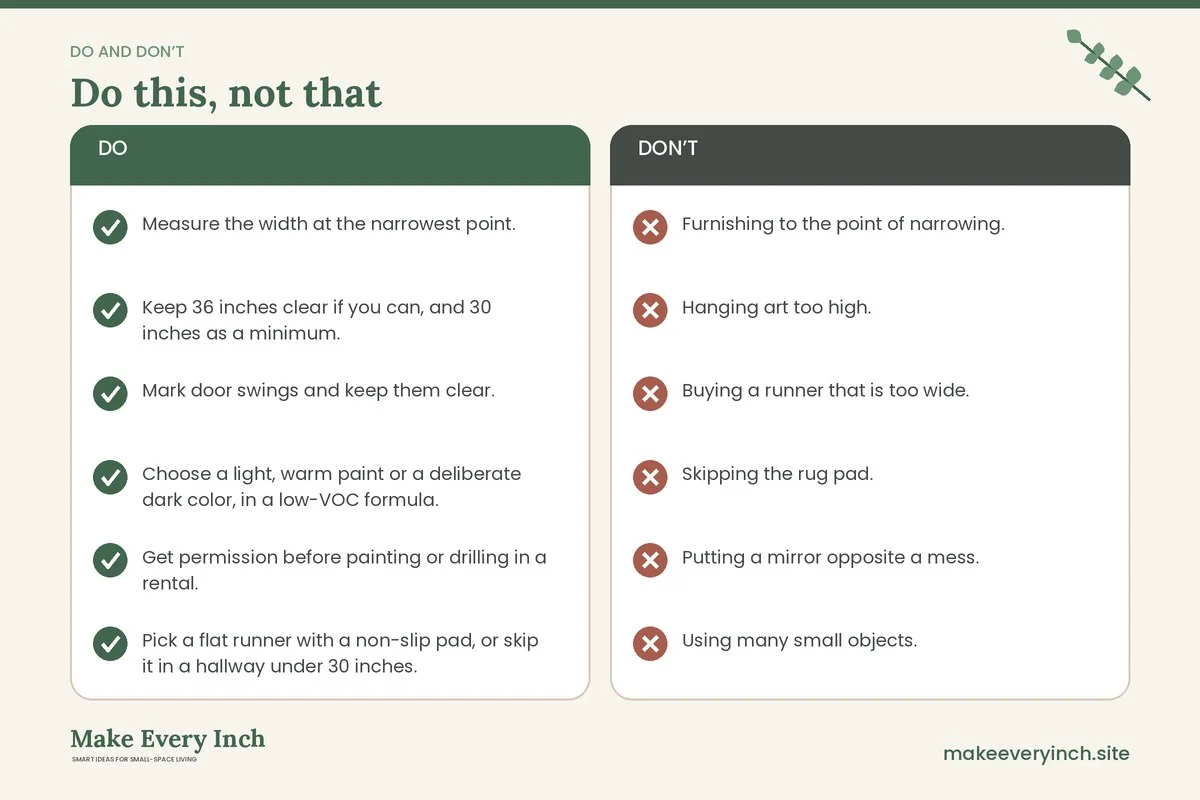
- Furnishing to the point of narrowing. If you have to turn sideways, remove something.
- Hanging art too high. Art hung above 62 inches is hard to see in motion and feels disconnected.
- Buying a runner that is too wide. A runner that nearly touches the walls looks cramped and traps the door.
- Skipping the rug pad. A runner without a pad is a slipping risk.
- Putting a mirror opposite a mess. The mirror shows what is in front of it, so check the view first.
- Using many small objects. A line of little items looks like clutter. Group them on one shelf or tray.
- Forgetting the light. A beautiful hallway in the dark is still hard to use. Plan the light first.
- Blocking exits or alarms. Never put decoration over a smoke alarm or in front of an exit path.
A weekend plan for small hallway decorating ideas
You do not need to do everything at once. Here is a simple order that avoids waste.
- Hour 1: Clear the hallway of everything that does not belong. Measure the width, the door swings and the key points.
- Hour 2: Decide on your color and buy samples. Test them on the wall and look at them at different times of day.
- Day 1: Paint, with ventilation and low-VOC paint, if you have permission. Let it dry fully.
- Day 2 morning: Lay the pad and runner, or place a mat. Check the door swing.
- Day 2 afternoon: Hang the mirror and the art, using templates made from paper. Add one shelf or ledge and a few hooks.
- Evening: Walk through the hallway with the lights on and again with them off, and fix anything that catches.
Hallway decorating checklist
- Measure the width at the narrowest point.
- Keep 36 inches clear if you can, and 30 inches as a minimum.
- Mark door swings and keep them clear.
- Choose a light, warm paint or a deliberate dark color, in a low-VOC formula.
- Get permission before painting or drilling in a rental.
- Pick a flat runner with a non-slip pad, or skip it in a hallway under 30 inches.
- Hang art with the center at 57 to 60 inches.
- Place a mirror opposite a light source and secure it.
- Keep shelves at 2 to 8 inches deep unless the hallway is wide.
- Anchor any tall furniture to the wall.
- Keep the floor free of shoes, bags and cords.
- Light the hallway for night use.
- Keep smoke alarms and exits unobstructed.
FAQ
What color is best for a small hallway?
A warm, light neutral is the safest choice because it reflects light and feels calm. A deep color can also work if you use it on the walls, trim and ceiling together and add warm lighting. Always test a sample in the hallway.
How wide should a hallway be?
A comfortable hallway is about 36 inches wide. Many older homes have hallways of 30 to 34 inches, which still work if you keep the path clear. Local building rules vary, so ask your landlord or local office if you need exact requirements.
Can I put a runner in a very narrow hallway?
Yes, if the hallway is at least about 30 inches wide and the runner is narrow, flat and secured with a non-slip pad. Leave bare floor at both sides and clear any door swing. Skip the runner if it creates a trip risk or if someone uses a walker or a wheelchair.
How do I decorate a hallway without drilling?
Use adhesive strips and hooks rated for the weight, picture ledges that lean, freestanding mirrors anchored as allowed and removable wallpaper on a tested area. Read your lease, and ask your landlord if you are unsure. See our post on security-deposit-safe apartment upgrades.
How high should I hang art in a hallway?
Hang the center of the art at about 57 to 60 inches from the floor. If you hang a row, keep the centers on the same line and the gaps at 2 to 3 inches.
Will a mirror make my hallway look bigger?
It can make the hallway feel brighter and deeper if it reflects light or a pleasant view. It will not change the real width, so keep the path clear.
Is it safe to put shelves in a hallway?
Yes, if they are shallow, mounted securely and kept above shoulder height where possible. Anchor tall furniture to the wall, and do not drill in a rental without permission.
Keep going: Keep going with our guide to small hallway lighting ideas, the roundup of apartment entryway decorating and our ideas for small entryway storage.
Save this guide for later
Pin the ideas you like to Pinterest so you can come back to them when you plan your space.