12 Small Space Storage Benches for Every Room
Quick answer: Small space storage benches room by room work best when the bench is sized to the job: 14 to 18 inches deep and 16 to 19 inches tall for seating, 36 to 48 inches long for entries and dining sides, and 48 to 60 inches long at a bed foot. Pick a soft-close or lift-assist lid, keep a clear 30 inch path around it, and store only what you reach for weekly.
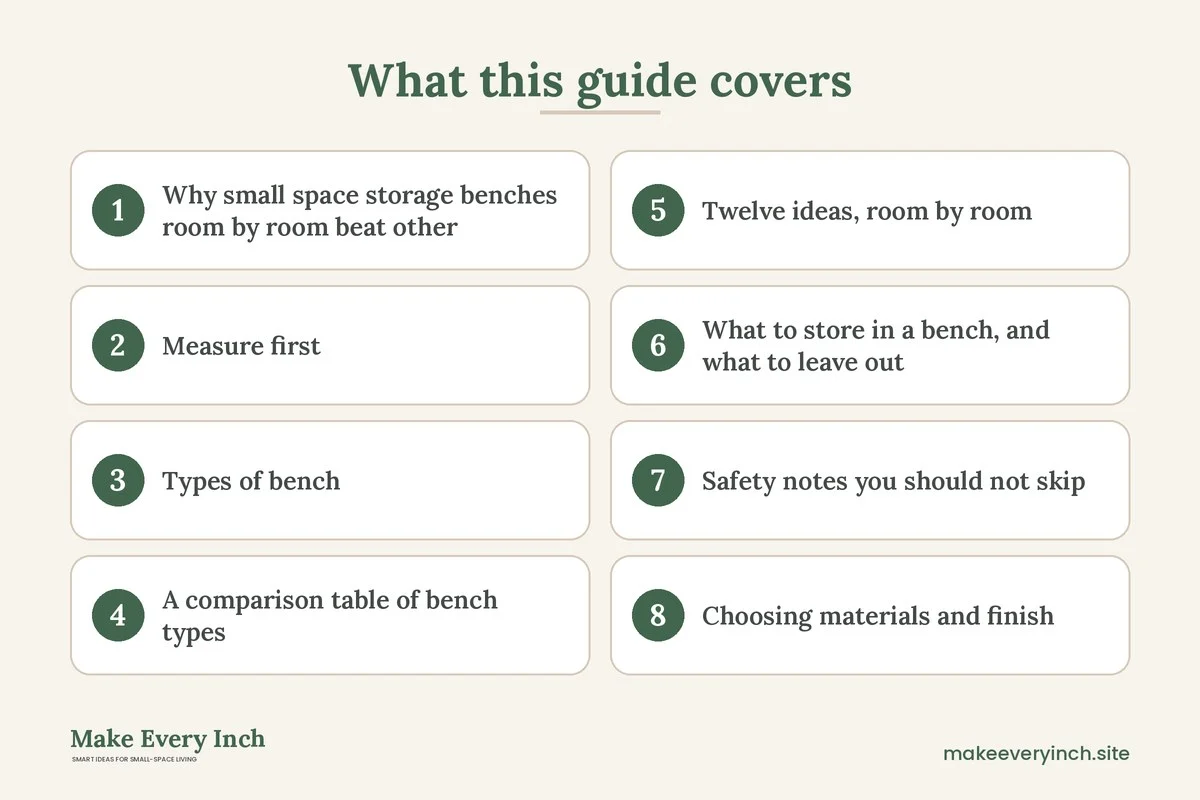
Small space storage benches room by room can solve a surprising number of problems, because one low box that holds things and seats people fits in places where a cabinet and a chair never could. A bench does not need much depth, it can sit under a window or at the foot of a bed, and it turns dead floor into a seat, a step, a landing spot and a hiding place for clutter. The trick is that each room asks something different from it. An entry bench holds shoes and bags, a bedroom bench holds linens and extra blankets, a living room bench holds games and remote controls, and a bathroom bench must tolerate damp. This guide walks through each room, gives measurements, compares the main bench types in a table, lists safety notes, shows three example layouts and ends with a checklist. For the larger picture of choosing furniture for tight homes, start with our pillar guide to the best furniture for small apartments.
Why small space storage benches room by room beat other furniture
Most small rooms run out of two things at once: places to sit and places to put things away. A storage bench answers both with one footprint. A typical bench is about 15 inches deep, which is slimmer than a standard dresser at 16 to 20 inches and far slimmer than an armchair at 30 inches or more. It is also low, so it does not block sight lines or window light, and that helps a room feel larger. A seat at 17 or 18 inches also matches the height of most dining and desk chairs, so the bench can switch jobs.
A bench also has an honest limit. It stores flat, soft or medium-weight items well, and it stores tall, fragile or heavy items badly. You cannot hang a coat inside it, and you should not pile books under a lid that you need to open every day. Think of it as a spot for things you use weekly or seasonally, not daily. If you expect to open it every morning, a drawer or a shelf is a better fit. If you open it once a week, a bench is ideal.
Finally, a bench is flexible about placement. It can run along a wall, sit across the foot of a bed, face a window, fill an alcove or wedge into a corner. That makes it a useful problem solver in rooms with awkward gaps. For layout principles that apply to every piece, read our short guide on small space furniture layout rules.
Measure first: the numbers that decide whether a bench fits
Do these measurements before you shop. A bench that is two inches too long or too deep often ruins the walkway it was meant to improve.
- Depth: 13 to 18 inches suits most small rooms. Under 13 inches feels precarious to sit on. Over 20 inches is more of a chest or an ottoman than a bench.
- Seat height: 16 to 19 inches matches most chairs and keeps knees comfortable. A bench at the foot of a bed can be a bit lower or equal to the mattress height, usually 18 to 25 inches, so that it reads as a deliberate step.
- Length: 30 to 36 inches for a tight entry, 36 to 48 inches for two seats, 48 to 60 inches for a double entry or a dining side, and about two thirds of the bed width for the end of a bed.
- Clear path: at least 30 inches in a main walkway and 24 inches in a rarely used side route. Add 12 to 16 inches in front of a lid that opens upward so you can lift it without stepping back.
- Lid swing: measure the height with the lid fully up. A bench under a low window sill or a shelf must leave room for the lid to open at least 70 to 90 degrees.
- Interior volume: multiply the inside width by depth by height, then subtract about an inch on each side for thickness if the manufacturer only gives outside dimensions. This is a rough guide and will not match a spec sheet.
Mark the bench footprint on the floor with painter’s tape and live with it for two days. Walk the room with a laundry basket and see if you bump the corner. Tape that works for two days will usually work for years. If the room has a radiator, a floor vent or a baseboard heater, keep the bench clear of the heat source and do not block the airflow, because a closed lid next to a hot surface can trap heat and damage stored fabric.
Types of bench: lids, drawers and open cubbies
The structure matters more than the style. Pick based on how you plan to reach what is inside.
Lift-lid benches
A hinged lid reveals one large cavity. This is the best form for bulky soft items such as blankets, spare pillows, throw cushions or off-season scarves. Look for a soft-close hinge or a lift-assist stay that holds the lid open, because a falling lid can pinch fingers. This matters most in a home with children. A lid that you must hold open with one hand while you dig is annoying, so choose a stay that holds. Lids also usually mean a cushion on top, and the cushion should be non-slip.
Drawer benches
Drawers pull forward and let you see the contents. They suit shoes, small tools, gloves and hats, and they work well in an entry. They cost you floor space in front, about the depth of the drawer, so check the path again. A bench with a drawer is slightly more complicated to build, so check that the glides move easily and the drawer stops before it falls out.
Open-shelf and cubby benches
Open shelves under a seat are the simplest. Baskets slide in and out, and shoes can be seen at a glance. This type is the best for ventilation, so it suits damp boots and gym bags, and it is the only type that is bathroom-friendly if the material is water-tolerant. The trade-off is visual clutter, so use matching baskets or bins to calm the look.
Hybrid and flip-top benches
Some benches combine a lid on top and a shelf below, or a fold-up seat above a shoe rack. These are space-efficient but have more moving parts. If you are choosing one, open and close each part several times in the store or at home during a return window, and check that nothing rubs.
Benches with backs or hooks
A bench with a high back or a wall panel and hooks is a mini mudroom. It is useful in a narrow entry, but it needs a wall that can take the weight of coats, so check the mounting guidance and never drill into a rental wall without permission. A freestanding unit with hooks attached to its own frame is the safer choice for renters. For more entry ideas, see our guide to small entryway bench ideas.
A comparison table of bench types
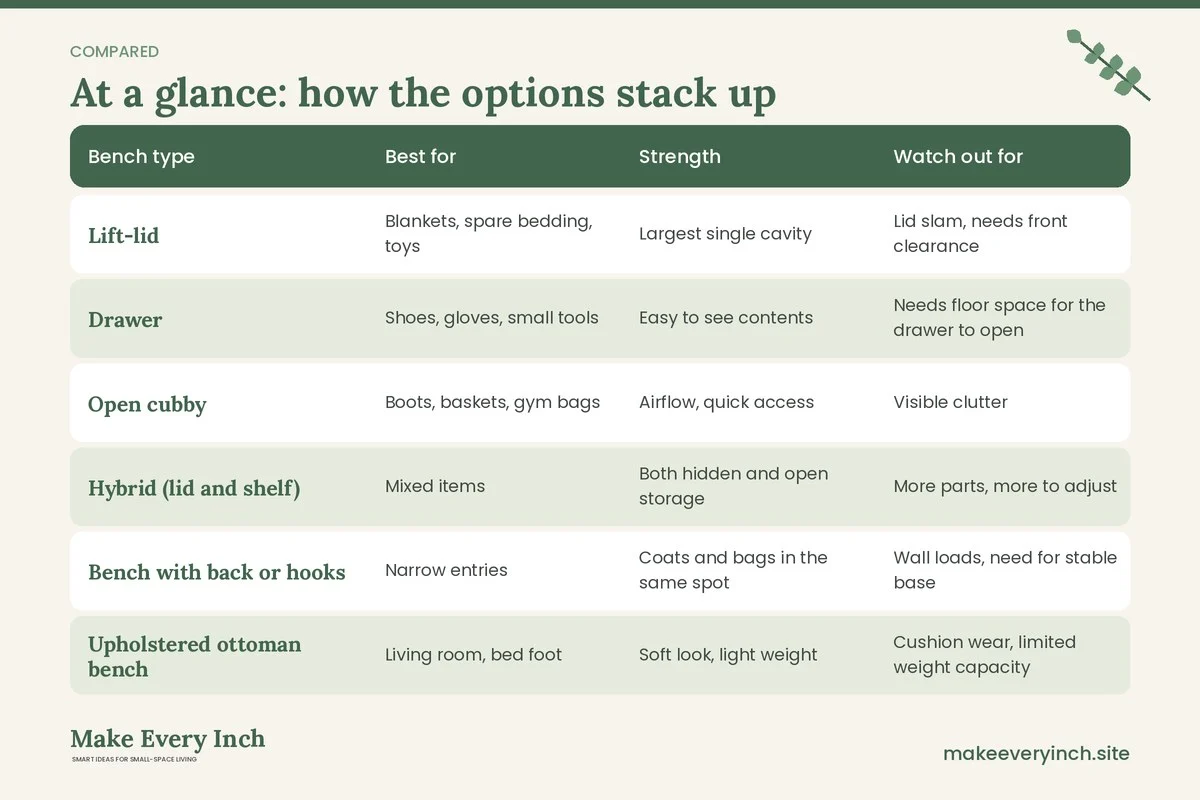
| Bench type | Best for | Strength | Watch out for | |
|---|---|---|---|---|
| Lift-lid | Blankets, spare bedding, toys | Largest single cavity | Lid slam, needs front clearance | |
| Drawer | Shoes, gloves, small tools | Easy to see contents | Needs floor space for the drawer to open | |
| Open cubby | Boots, baskets, gym bags | Airflow, quick access | Visible clutter | |
| Hybrid (lid and shelf) | Mixed items | Both hidden and open storage | More parts, more to adjust | |
| Bench with back or hooks | Narrow entries | Coats and bags in the same spot | Wall loads, need for stable base | |
| Upholstered ottoman bench | Living room, bed foot | Soft look, light weight | Cushion wear, limited weight capacity |
Use the table to pick one type per room, not three. A room with two benches of different styles looks busy, and in a small room it also doubles your visual noise.
Twelve ideas, room by room
Entryway
1. The shoe-and-seat bench
A 36 to 42 inch bench with an open lower shelf holds four to six pairs of shoes and gives you a place to sit while you put them on. Keep it against the wall that the door does not swing into. Leave 30 inches clear from the door arc.
2. The drop-zone bench with baskets
Slide two matching baskets under an open bench: one for mail and keys that go out the door, and one for things that come in. Label the baskets by person or by purpose. This is a minimal drop zone for a hall without a closet. For the wider zone approach, see small home drop zone ideas.
Living room
3. A bench under the window
A 15 inch deep bench under a window stores board games, extra throws and photo albums, and doubles as an extra seat when guests arrive. Keep the cushion modest so it does not block the window handle, and watch for curtain cords near a child’s reach. Move a bench away if a window is the only emergency exit in the room.
4. A bench behind the sofa
In a room where the sofa floats, a low bench behind it can act as a console, a place for a lamp and a spot for extra seating. Keep the bench under the sofa back height, and secure any lamp with a wide base so it does not tip. For more on this setup, see small living room furniture ideas.
5. A coffee-table bench
A long, low bench with a cushion can stand in for a coffee table and hold remote controls, blankets and magazines. Choose rounded corners if children play in the room. If you need a surface more than a seat, put a tray on top.
Bedroom
6. The end-of-bed bench
A bench at the foot of the bed should be about two thirds the width of the mattress and 14 to 17 inches deep. Allow at least 24 inches to walk around it, and 30 if it faces a door. It holds a spare comforter, off-season sweaters and tomorrow’s outfit. If you are comparing it to a bed with built-in storage, read our guide to best storage beds for small bedrooms.
7. The window-seat bench
In a bedroom with a deep sill or an alcove, a bench that fits the width of the alcove gives you a reading spot and storage in one. Measure the alcove at three heights, because walls are rarely square. Keep the lid clear of the radiator.
Dining area
8. The banquette-style bench along a wall
A bench along one long wall of a dining table seats two or three people in the footprint of two chairs, and its hidden storage holds table linens, spare placemats and serving dishes. Allow 18 inches between the seat edge and the table edge. For layouts, see small dining room ideas with a bench.
9. The movable dining bench
A backless bench slides under the table when not in use, which gives you a small dining nook the freedom to open the room. Make sure the legs do not scratch the floor, and add felt pads.
Bathroom and laundry
10. A moisture-tolerant open bench
A bench in a bathroom should have an open slatted frame, a finish that tolerates humidity and feet that lift it off the floor. Use it for rolled towels in baskets, and keep it out of the splash zone of the tub. In a wet area keep any electrical devices away from the bench, and plug powered items into a GFCI-protected outlet. Ventilate after showers so the wood does not swell. For ideas on small baths, see small bathroom storage ideas for tight spaces.
11. The laundry sorting bench
In a laundry corner, a sturdy open bench with two bins underneath handles sorting, and gives you a place to sit while you fold. Never place a bench so close to the dryer vent or the hot exhaust that it blocks airflow. For narrow laundry spaces, see small laundry room ideas for narrow spaces.
Hallway and flex spaces
12. The hall bench for guests
In a long hall, a shallow bench at 12 to 14 inches deep can hold guest slippers, umbrellas and spare bags without narrowing the walkway too much. Keep the hall at least 36 inches wide where possible. Use the bench as a seat for helping children with shoes. See also our narrow hallway ideas and the sibling guide on the best narrow furniture for tight walkways.
What to store in a bench, and what to leave out
Treat storage like a short list. A bench is the right size for the following, and a poor fit for the others.
- Good fits: spare blankets, pillows, off-season scarves and hats, board games, shoes in baskets, gym bags, reusable shopping bags, extra table linens, craft supplies in lidded boxes.
- Questionable fits: books (heavy, and lids may sag), electronics (heat and dust), paper documents (moisture risk), and anything you need every day.
- Leave out: wet items, which cause mildew; cleaning chemicals or paint, which can leak and give off fumes in a closed space; batteries and anything flammable; medication and sharp tools if children or pets can open the lid; food, which attracts pests.
Group items inside the bench in fabric boxes or baskets so that you can lift out one container rather than digging. A good rule is one category per container, with a small label on the end facing out. Cedar blocks or sachets help with moths in textile storage, though they are only a helper and not a substitute for clean, dry fabric. Refresh the contents twice a year.
Safety notes you should not skip
Small benches are friendly pieces, but they have some risks that are easy to manage.
- Lids and fingers. Choose soft-close hinges or lid stays, especially where children play. Never let a child climb inside a closed bench, because a lid can lock or trap them. Remove any latch that can lock from the outside. For a home with young children, keep the bench for adult storage or choose an open style.
- Weight limits. Check the rated load for the bench and do not stand on it unless it says it is designed for that. A bench that is fine for two adults sitting may not be fine for someone standing on the lid to reach a shelf.
- Anchoring. A bench with a tall back, a hook rack or a shelf above it should be anchored to the wall if it is taller than it is deep, or if it carries coats. Use the anchor hardware provided and a stud finder, and ask your landlord before drilling into any rental wall. If you cannot anchor it, keep heavy items low and choose a design that does not tip.
- Cushion materials. Check that foam and fabric come with a clear care label. If a cushion has been off-gassing from new foam, air it out in a ventilated room before you use it.
- Finish and fumes. If you build or refinish a bench yourself, choose a low-VOC paint or sealer, work with the window open and let the piece cure fully before you close items inside it. Fresh paint in a closed lid can trap odor that transfers to fabric.
- Electrical. Do not run extension cords under a bench lid or pinch a cord when the lid closes. If a bench sits near an outlet, leave the outlet accessible.
- Heat and airflow. Keep a bench clear of radiators, floor vents and any heater, and do not block a return air grille.
- Pets. A cat may crawl into an open bench and get shut in. Leave lids closed when you are not looking and check inside before closing.
Choosing materials and finish
The material changes the weight, the sound, how it ages and where it belongs.
- Solid wood and veneered panels: sturdy and repairable, but heavier to move and prone to swelling in a damp bathroom. Choose a sealed finish for wet rooms.
- Metal frames with slats: light, open and useful in entries and baths. They can look cold, so soften with a cushion.
- Upholstered benches: soft and comfortable but harder to clean. Consider a washable or performance cover for a family home.
- Woven or rattan: airy and good for baskets, though a rough weave can snag knits.
- Plastic and resin: moisture-proof and easy to wipe, which suits balconies and laundry rooms, though less attractive in living areas.
If you are comparing your options with ottomans, which share a lid and a seat, our guide to best ottomans with storage for small homes and the roundup on best storage ottomans explain where an ottoman fits better than a bench.
Three example rooms
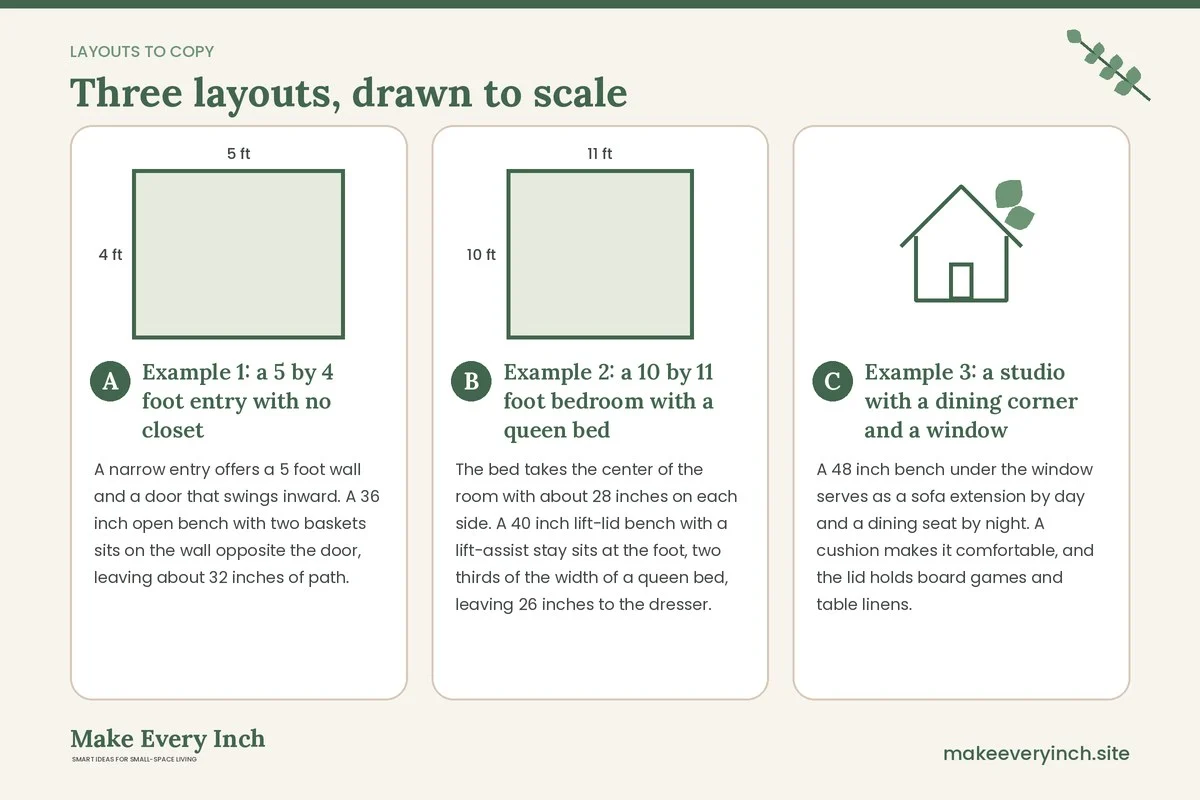
Example 1: a 5 by 4 foot entry with no closet
A narrow entry offers a 5 foot wall and a door that swings inward. A 36 inch open bench with two baskets sits on the wall opposite the door, leaving about 32 inches of path. The top holds a tray for keys, and a freestanding hook rail on a stand beside it holds coats and a bag. The baskets are labeled for each person. The owner decides that shoes beyond four pairs go to a rack in the bedroom. The result is a spot to sit, a place for keys and one clear floor.
Example 2: a 10 by 11 foot bedroom with a queen bed
The bed takes the center of the room with about 28 inches on each side. A 40 inch lift-lid bench with a lift-assist stay sits at the foot, two thirds of the width of a queen bed, leaving 26 inches to the dresser. Inside are a spare duvet, summer sheets and a set of towels in separate fabric boxes. The top holds tomorrow’s clothes. The owner chooses a bench with rounded corners because the walkway at the foot is tight. The bench replaces a basket that used to live in the corner.
Example 3: a studio with a dining corner and a window
A 48 inch bench under the window serves as a sofa extension by day and a dining seat by night. A cushion makes it comfortable, and the lid holds board games and table linens. A small table with two chairs on the other side lets two people dine or four people squeeze in with the bench. The window handle stays free, the curtain cord is tied up out of reach and the bench is kept three inches from the radiator so airflow is not blocked. The room gains seating and storage without adding another cabinet.
Mistakes to avoid
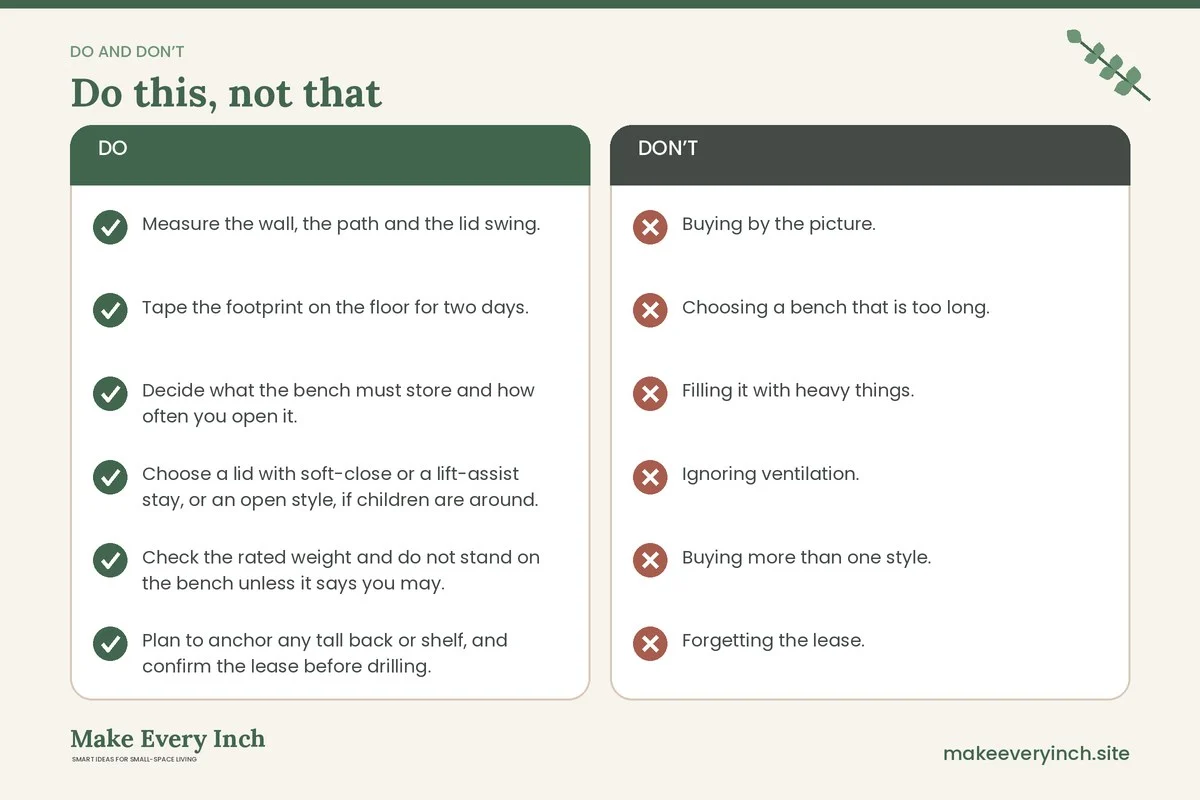
- Buying by the picture. Check depth, height and lid swing against the space, not just the width.
- Choosing a bench that is too long. A long bench eats the walkway. Cut the length before you cut the storage.
- Filling it with heavy things. Books and tools strain lids and hinges. Spread heavy loads across two smaller containers or choose a shelf.
- Ignoring ventilation. Closed fabric storage in a damp room invites mildew. Open the lid from time to time and add a moisture absorber if you notice odor.
- Buying more than one style. A bench in each room is fine, but make them rhyme through color or wood tone.
- Forgetting the lease. If the bench is meant to attach to a wall, check the lease and use freestanding pieces instead of drilling.
- Skipping the tape test. A floor outline in tape reveals problems in two minutes.
For more pitfalls that apply across furniture, see small space furniture mistakes to avoid.
Styling a storage bench so it looks intentional
A bench is a quiet piece, so styling decides whether it looks like furniture or clutter. Keep the top limited to one or two items: a tray, a lamp, a folded throw, a plant on a stable base. Choose a cushion that is the same color family as the walls or the rug so it recedes. In a small room, a bench that matches the wall color almost disappears, while a contrasting color makes it a feature. If you want to add pattern, do it with one pillow rather than a covered cushion.
Place a bench on a rug edge only if the rug is flat and secure, because a bench leg on a thick pile rocks and can trip people. Under a window, leave a small gap for curtains to hang straight. At the foot of a bed, keep the bench a few inches shy of the bed frame so that the sheets do not tangle on it. Along a wall, hang a mirror or a light picture above the bench to give it a purpose, but only on surfaces where you have permission to hang things. A leaning mirror on the floor is a good rental-safe alternative.
A short maintenance routine
Every few months, open the bench, take out the contents and vacuum the inside. Check hinges and screws for looseness and tighten them gently. Inspect for moth holes in wool, mildew spots on fabric or a musty smell, and address any moisture before closing again. Wipe wood with a damp cloth and dry it, and refresh a cushion by turning it. These ten minutes keep a bench looking new and prevent small problems from growing.
Checklist before you buy
- Measure the wall, the path and the lid swing.
- Tape the footprint on the floor for two days.
- Decide what the bench must store and how often you open it.
- Choose a lid with soft-close or a lift-assist stay, or an open style, if children are around.
- Check the rated weight and do not stand on the bench unless it says you may.
- Plan to anchor any tall back or shelf, and confirm the lease before drilling.
- Keep clear of radiators, vents and outlets.
- Choose a moisture-tolerant bench for bathrooms and laundry, and use GFCI-protected outlets nearby.
- Use low-VOC finishes on any DIY work and air out new foam.
- Pick one bench style per home and match it to the room colors.
FAQ
How deep should a storage bench be in a small room?
For most small rooms, 14 to 18 inches deep is enough for seating and storage without blocking the walkway. In a hall, go as shallow as 12 to 14 inches if you keep the hall 36 inches wide. Below 12 inches, a bench feels unstable to sit on.
Can a storage bench replace a coffee table or a dresser?
It can stand in for a coffee table if you add a tray on top, and it can handle some of a dresser’s job for linens. It cannot hang clothes or hold heavy items as easily as a dresser, so most people use it as a supplement rather than a replacement.
Are storage benches safe around children?
Yes, when you choose a soft-close lid or an open style, remove any latch that can lock, and keep the bench away from windows with cords. Teach children not to climb into it, and supervise play near it.
Which storage bench is best for a renter?
A freestanding bench with its own frame, since it needs no drilling. Choose felt feet to protect the floor and leave the wall alone. If you want hooks, choose a unit that stands on its own base, and ask before attaching anything to a wall.
How do I keep a bench from smelling musty?
Store only dry items, leave a small gap at the back for air, add a cedar block or a moisture absorber and open the lid now and then. In humid rooms choose an open slatted bench instead of a closed box.
Where should I put a bench if the room is very narrow?
Put it at the end of the room or in an alcove rather than along the main walkway. A shallow bench of 12 to 14 inches deep on a wall can work in a 36 inch hall. For more ideas, the sibling post on the best narrow furniture for tight walkways covers measurements for the tightest paths.
Keep going: Keep going with our guide to small entryway bench ideas, the roundup of small space storage furniture and the list of hidden storage ideas to match each bench to its room.
Save this guide for later
Pin the ideas you like to Pinterest so you can come back to them when you plan your space.