14 Small Living Room Ideas for Families with Kids and Pets
Quick answer: A small living room for families works best when it is planned by time of day and age, not by furniture. Give play a soft, defined floor zone of about 4 by 6 feet, keep a clear 36 inch path between kitchen and sofa, anchor tall furniture, round off sharp corners, and make tidying a five-minute reset with one low bin per activity. Change the layout as children grow.
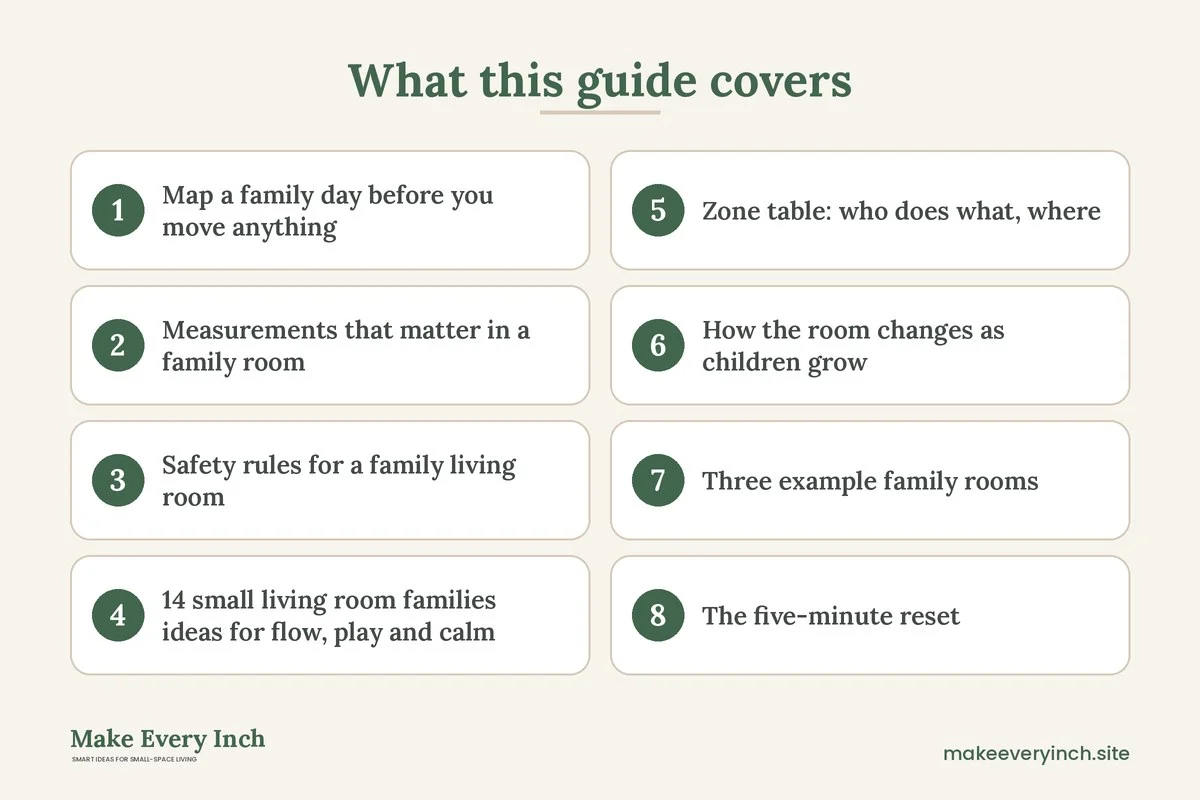
Small living room families face a problem that childless households do not: the same few square meters must serve as a playground, a homework desk, a dining overflow, a pet bed and the one place where adults can finally sit down. The room is used by people of different heights, speeds and bedtimes, and it changes character every few hours. Good planning treats the room as a sequence of scenes rather than a single picture. This guide shows how to map a family day onto a compact floor plan, which measurements keep paths and play areas safe, 14 ideas for zoning and flow, how the room should change from toddler years to teens, a zone table, three example plans, safety rules and a checklist. For the wider topic, start with our hub on small living room ideas. If you want the furniture-first view, read our guide to small living room furniture ideas for families, and for storage, see small living room storage ideas for families.
Map a family day before you move anything
Spend three days noting where everyone is in the living room at six moments: the morning rush, after school or nursery, the late afternoon, dinner, the evening wind-down and the weekend. Write down who is in the room, what they are doing, and what is on the floor. Most families find that the room has two or three real peaks. A common pattern is an active, noisy peak before dinner, with children on the floor, and a calm peak after bedtime, when adults want a clear, quiet space.
Those two peaks pull the design in opposite directions. The noisy peak needs open floor and soft surfaces. The calm peak needs seating, a lamp and no visible toys. The best family rooms do not choose one; they make the switch cheap. Furniture that moves, bins that hide and a rug that defines the play zone let you change the room in five minutes.
Then list the fixed constraints: the door swing, radiators, sockets, the position of the window, the route from the front door to the kitchen, and any wall where a TV or shelves must go. Mark these on a sketch of the room drawn to scale. A scale drawing on squared paper, one square per 6 inches, is quicker than moving a sofa three times.
Measurements that matter in a family room
Families need larger gaps than couples because children move fast and carry things. These numbers are a safe starting point and can be adjusted to your room.
- Main path: 36 inches clear between the entrance, the kitchen and the sofa. If a pushchair or a wheelchair uses the route, aim for 42 inches.
- Floor play zone: about 4 by 6 feet for one or two young children, or 6 by 8 for a group of three or more. A rug of 5 by 8 feet, with no curling edges, defines the space.
- Sofa to coffee table or play zone: 14 to 18 inches if you keep a table, or no table at all when children need the floor. See our guide to small living room ideas without a coffee table for families for that choice.
- Seat height for children: a child seat at 10 to 12 inches for toddlers, 14 to 16 for ages four to eight, and standard 17 to 18 for older children.
- Table height: a children’s activity table at around 18 to 22 inches for ages three to five, 22 to 26 for primary school, rising to desk height for teens.
- Bins and baskets: place the toy bin where a child can reach it without help, which means the rim is at 20 to 24 inches for most pre-schoolers and the bin is light enough to pull out.
- Sight lines: from the sofa or the kitchen doorway, an adult should see the whole play zone. Avoid placing a tall bookcase between them.
- Curtain and blind cords: keep them out of reach and wrapped up, at least 60 inches off the floor, or choose cordless types.
Mark the play zone on the floor with painter’s tape, then place a rug on it and put the sofa and path around it. If the path and the play zone overlap, adults will step on toys and children will be in the way. Separating them is the single best planning move.
Safety rules for a family living room
Safety is the first design constraint, not the last. These rules are a baseline, and you should check the guidance that comes with each product.
- Anchor tall furniture. Bookcases, cabinets, dressers and TV units that are taller than about 30 inches should be fixed to the wall with anti-tip hardware. A climbing child can pull a loaded unit over, so fixing is more important than appearance. Load heavy items at the bottom.
- Secure the TV. A wall-mounted TV needs a fixing rated for its weight and wall type. A TV on a unit needs a wide, stable base or a strap. Keep cables tidy and out of reach.
- Cover or manage sockets and cords. Keep plugs and extension strips behind furniture or in cable boxes with ventilation, and do not daisy-chain strips. Do not run cables across walkways. Use outlet covers if you have young children.
- Round the edges. Corner guards or a round table help in a room with toddlers. Choose rounded or soft-edged coffee tables and ottomans.
- Windows and cords. Keep furniture away from windows so a child cannot climb to the sill. Use cordless blinds or secure cords out of reach.
- Pet safety. Keep pet food and water off the main path, check that plants are non-toxic to cats and dogs, and store medicines and cleaning products out of reach.
- Ventilation and paint. Use low-VOC paint when you refresh walls, ventilate while you paint and let finishes cure before the children use the room. New furniture and rugs may give off odors at first, so air the room.
- Heat and flame. Keep candles, heaters and hot lamp bulbs out of reach, and use a fireguard if the room has a fireplace.
- Do not drill without permission. In a rental, read the lease before fixing anything to the wall. If you cannot fix tall furniture, choose short, wide pieces. See our renter-friendly apartment decorating ideas for ways to improve the room without holes.
- Floor safety. Use a non-slip pad under every rug, and choose rugs with a low pile for play.
14 small living room families ideas for flow, play and calm
Zoning the floor
1. A rug that marks the play zone
A single 5 by 8 foot rug with a non-slip pad tells everyone where play happens. Choose a washable or low-pile rug, a mid-tone color that hides stains and a pattern that hides crumbs. When the children are in bed, the rug stays as part of the room. For guidance, see our post on how to choose a rug size for a small living room.
2. A path that never moves
Pick the route from the door to the kitchen and keep it clear of toys, bins and furniture. Mark it with a runner or simply agree that nothing is placed there. A fixed path stops tripping and cuts the daily tidy-up.
3. A float-the-sofa divider
In an open plan, place the sofa with its back toward the play zone and the kitchen, so the sofa divides the adult space from the toy space. Add a console behind it that is 10 to 14 inches deep for a lamp and a bowl. This only works if the sofa’s back is stable and the console is anchored if it is tall.
4. A corner for babies and toddlers
A play mat in the corner, away from the door, gives a baby a safe space. Use a low shelf as a barrier on one side and a gate if needed. Remove it when the child grows.
Furniture that adapts
5. Nesting tables for homework and snacks
Two or three nesting tables slide out for homework, then tuck away. They give children a surface at their height and leave the room clear for play. Our guide to small living room furniture ideas lists other flexible pieces.
6. A storage ottoman as seat, table and toy box
A soft ottoman with a hinged or removable lid holds toys or blankets and works as a seat. Choose one with a slow-closing hinge or a removable lid to avoid trapped fingers. See our guide to the best storage ottomans.
7. A sofa that survives children
Look for a washable or removable cover, a firm seat, a tight weave and legs that keep the sofa off the floor so you can clean beneath it. Our guide to the best sofas for small apartments lists features to check, and our post on how to choose a sofa for a small living room covers size.
8. A bench with baskets under the window
A low bench, 16 to 18 inches high, with baskets beneath is a reading seat, a toy store and a shoe spot. Keep it away from the window latch, or use a bench with a back so a child cannot climb out.
Storage that kids can use
9. One low bin per activity
Give blocks, cars, art supplies and soft toys each a bin on a low shelf, at child height. Children put things back more often when the bin is open and the shelf is low. Label with pictures for pre-readers. For more depth, read our post on small home toy storage ideas.
10. A toy rotation
Keep a third of the toys in the room and store the rest in a closet or under the bed. Swap them every few weeks. This reduces clutter and keeps play fresh. Rotation works best with a lidded box on the top shelf of a closet, out of reach.
11. A tall unit with closed doors on the bottom
Put open shelves above and doors below. Children can reach the doors, which hide the mess, and adults keep fragile items on the high shelves. Anchor the unit to the wall.
Making the calm peak work
12. Soft lighting for the evening
Replace the overhead light with two lamps, one at each end of the sofa, and a dimmer on the main light if possible. A warm, lower light says the day is ending. Use lamps with sturdy bases and tidy cords. See our post on small living room lighting ideas for families.
13. A basket for the evening sweep
At the end of the day, one big basket receives everything that is left on the floor. The basket lives behind the sofa. The next morning, items go back to their bins. This keeps the five-minute reset realistic.
14. A reading corner for older children
A beanbag or a floor cushion, a lamp and a small shelf turn a corner into a quiet space. It gives older children somewhere to retreat when the room is noisy. For cozy touches, take a look at our guide to cozy small living room ideas for families.
Zone table: who does what, where
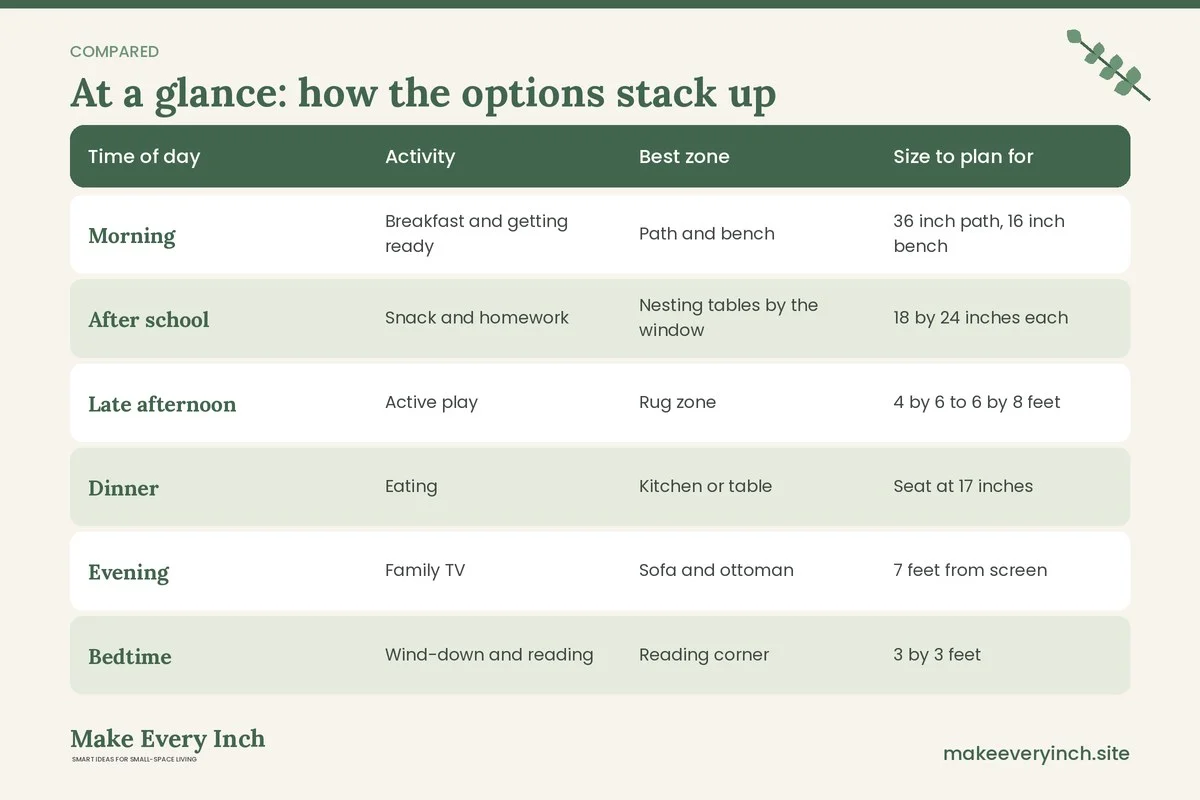
| Time of day | Activity | Best zone | Size to plan for | Safety note |
|---|---|---|---|---|
| Morning | Breakfast and getting ready | Path and bench | 36 inch path, 16 inch bench | Keep bags off the path |
| After school | Snack and homework | Nesting tables by the window | 18 by 24 inches each | Keep cords away from the child |
| Late afternoon | Active play | Rug zone | 4 by 6 to 6 by 8 feet | Non-slip pad, soft edges |
| Dinner | Eating | Kitchen or table | Seat at 17 inches | Clear toys first |
| Evening | Family TV | Sofa and ottoman | 7 feet from screen | TV anchored |
| Bedtime | Wind-down and reading | Reading corner | 3 by 3 feet | Low light, no loose cords |
| Weekend | Guests and games | Whole room | Clear floor | Move small furniture aside |
How the room changes as children grow
Babies and toddlers (0 to 3)
The floor is the main surface. Keep a big, soft rug, round off corners, use gates and fix all tall furniture. Low shelves hold board books and soft toys. Avoid glass tables, and keep small items such as coins, batteries and magnets out of reach. Place the sofa where you can see the baby from the kitchen.
Pre-schoolers (3 to 5)
Children want to build and draw. Add a low table and two stools, with a washable mat beneath. Shelves at child height hold bins for blocks and art. Keep scissors, paints and small parts on a high shelf, and bring them out only for supervised sessions.
Primary school (6 to 11)
The need moves from floor play to table play. A table that doubles as a homework desk and game board suits this stage. Add a small bookshelf and a basket for school bags. The play zone shrinks, and the seating area grows.
Teens (12 and up)
Teens want privacy and a say. Offer a chair or a corner that is theirs, headphones and a lamp. Replace toy bins with media storage, and let the room serve as a hangout. Our guide to small apartment living room ideas for families has more layouts.
Three example family rooms
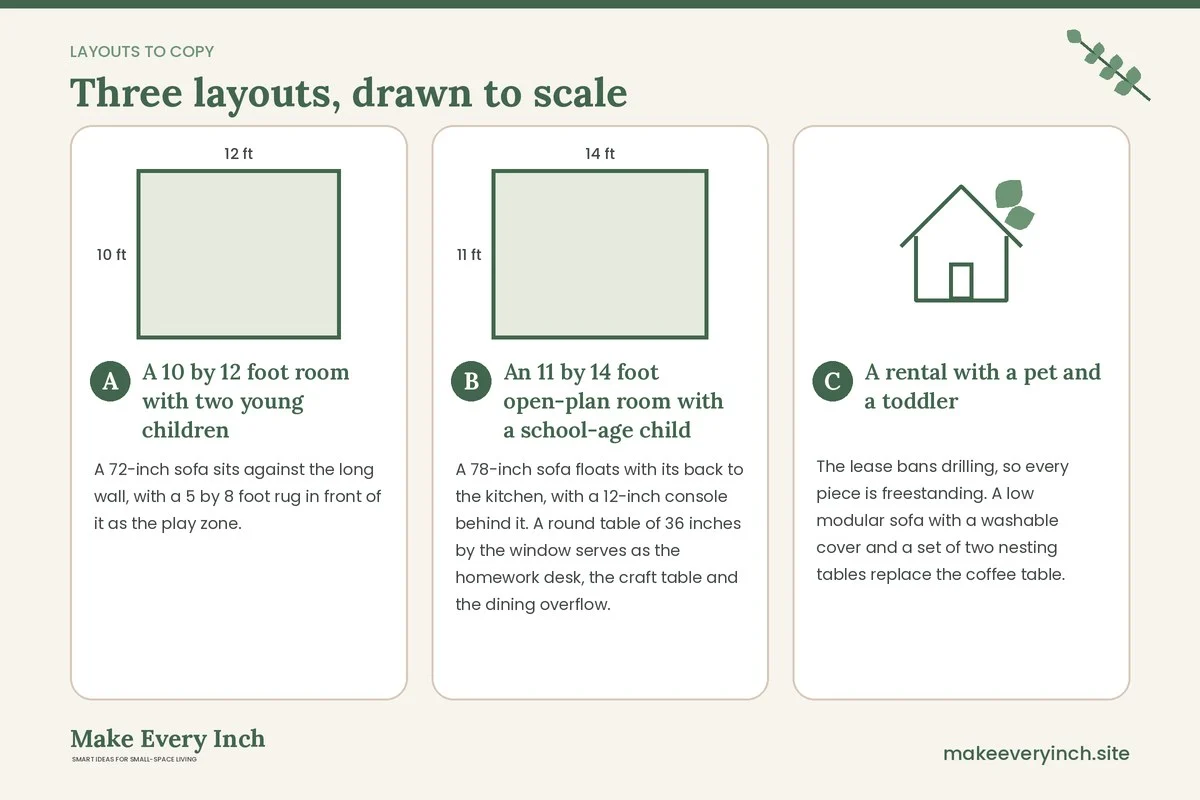
A 10 by 12 foot room with two young children
A 72-inch sofa sits against the long wall, with a 5 by 8 foot rug in front of it as the play zone. A bench under the window holds baskets for toys, and a short, wide bookcase 30 inches tall stands by the door with the books at child height. The main path runs along the left wall at 36 inches. The TV is on the wall and the cable is hidden. At the end of the day, the rug is cleared into the bench baskets. The room reads as a living room in the evening, because nothing tall or hard is left in the middle.
An 11 by 14 foot open-plan room with a school-age child
A 78-inch sofa floats with its back to the kitchen, with a 12-inch console behind it. A round table of 36 inches by the window serves as the homework desk, the craft table and the dining overflow. The child has a shelf of bins on the opposite wall. The path from the front door to the kitchen runs behind the sofa and is 36 inches wide. A 5 by 7 foot rug under the sofa front legs defines the seating zone. Because the table is round, there are no sharp corners, and the sofa back keeps toys out of the kitchen.
A rental with a pet and a toddler
The lease bans drilling, so every piece is freestanding. A low modular sofa with a washable cover and a set of two nesting tables replace the coffee table. A short bookcase of 30 inches, broad and heavy at the bottom, holds the toddler’s books, and a closed cabinet beneath the window holds pet supplies. The pet bed sits in the corner, out of the path, and the pet’s bowl is on a mat beside the cabinet. All plants are on a high shelf and are non-toxic. A gate across the kitchen door keeps the toddler away from the stove. For more on rental-friendly layouts, read our post on small living room ideas for renters.
The five-minute reset
A small family room cannot hide mess, so the reset must be quick. Try this sequence at the end of each day:
- Minute one: throw all loose toys into the evening basket.
- Minute two: put cups, plates and wrappers in the kitchen.
- Minute three: fold or hang blankets and cushions.
- Minute four: return the basket contents to their bins, with the children’s help where possible.
- Minute five: check the path, the sockets and the gate, and turn on the lamps.
Assigning tasks by age helps. A toddler can drop soft toys in a basket, a six-year-old can match blocks to the right bin, and a teen can collect cups. A reset that everyone shares is more likely to survive past the first week.
Common mistakes in family living rooms
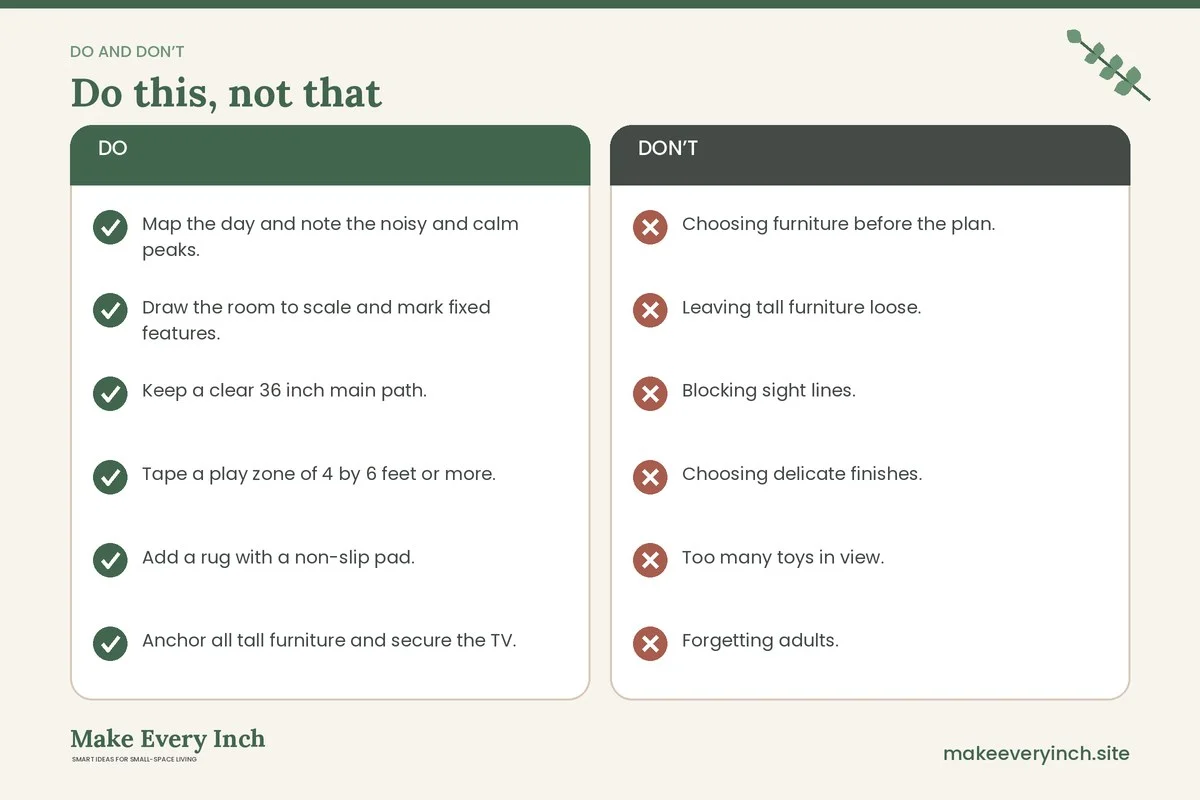
- Choosing furniture before the plan. A big sectional can swallow the play zone. Measure and tape first. If you prefer a sectional, read our post on small living room ideas with a sectional for families.
- Leaving tall furniture loose. This is the most serious error. Anchor every tall unit.
- Blocking sight lines. If you cannot see the play zone from the kitchen, you will keep checking.
- Choosing delicate finishes. Light fabrics, glass tops and sharp corners cause more stress than they are worth.
- Too many toys in view. Rotate them, and keep a third in the room.
- Forgetting adults. A room with only kid zones makes adults feel like guests. Keep one seat, one lamp and one surface for adults.
- No cord plan. Loose cords are a risk for children and pets. Use covers and tidy them away.
Family living room checklist
- Map the day and note the noisy and calm peaks.
- Draw the room to scale and mark fixed features.
- Keep a clear 36 inch main path.
- Tape a play zone of 4 by 6 feet or more.
- Add a rug with a non-slip pad.
- Anchor all tall furniture and secure the TV.
- Round or pad hard corners.
- Move cords and blind cords out of reach.
- Put one low bin per activity at child height.
- Rotate toys and store a third in the room.
- Add two lamps for the evening.
- Keep a basket for the daily sweep.
- Check that plants and products are safe for pets and children.
- Check the lease before making any holes.
- Revisit the layout every year as the children grow.
FAQ
How do I fit a play area into a small living room?
Use a rug of about 5 by 8 feet to define a play zone, keep a separate 36 inch path, and store toys in low bins that vanish at the end of the day. A foldable mat or a rug that rolls away gives you the floor back in the evening.
What is the best layout for a small living room with kids?
A layout with the sofa on one side, an open floor zone in front and a clear path along one wall tends to work well. The sofa can float as a divider in an open plan. Keep sight lines clear to the kitchen.
How do I stop toys from taking over?
Keep a third of the toys in the room, rotate the rest, give each type a bin and set a daily five-minute reset. Open bins at child height make tidying easier.
Do I need a coffee table with children?
Not always. A round table with soft edges, an ottoman or nesting tables can replace it and leave floor for play. Many families remove the table until the children are older.
How can I make a family room safe if I rent?
Choose short, wide freestanding furniture, use corner guards and outlet covers, keep cords tidy and ask your landlord about fixing tall furniture. Do not drill without permission, and never leave a tall unit unsecured near a young child.
What colors work best in a family living room?
Mid-tone, warm colors hide marks, and washable finishes are practical. Use low-VOC paint and ventilate during painting.
Keep going: Keep planning with our small living room layout ideas, small living room makeover ideas for families and small home organization for families.
Save this guide for later
Pin the ideas you like to Pinterest so you can come back to them when you plan your space.