15 Small Balcony Garden Ideas for Beginners to Start Growing
Quick answer: A small balcony garden beginners can keep alive starts with three checks before any shopping: how many hours of direct sun the space gets, how much weight the balcony may carry, and what the lease or building rules allow. Then start with four to six forgiving plants in lightweight pots with drainage, group them on one side, water by feel, and add more only after a full season of success.
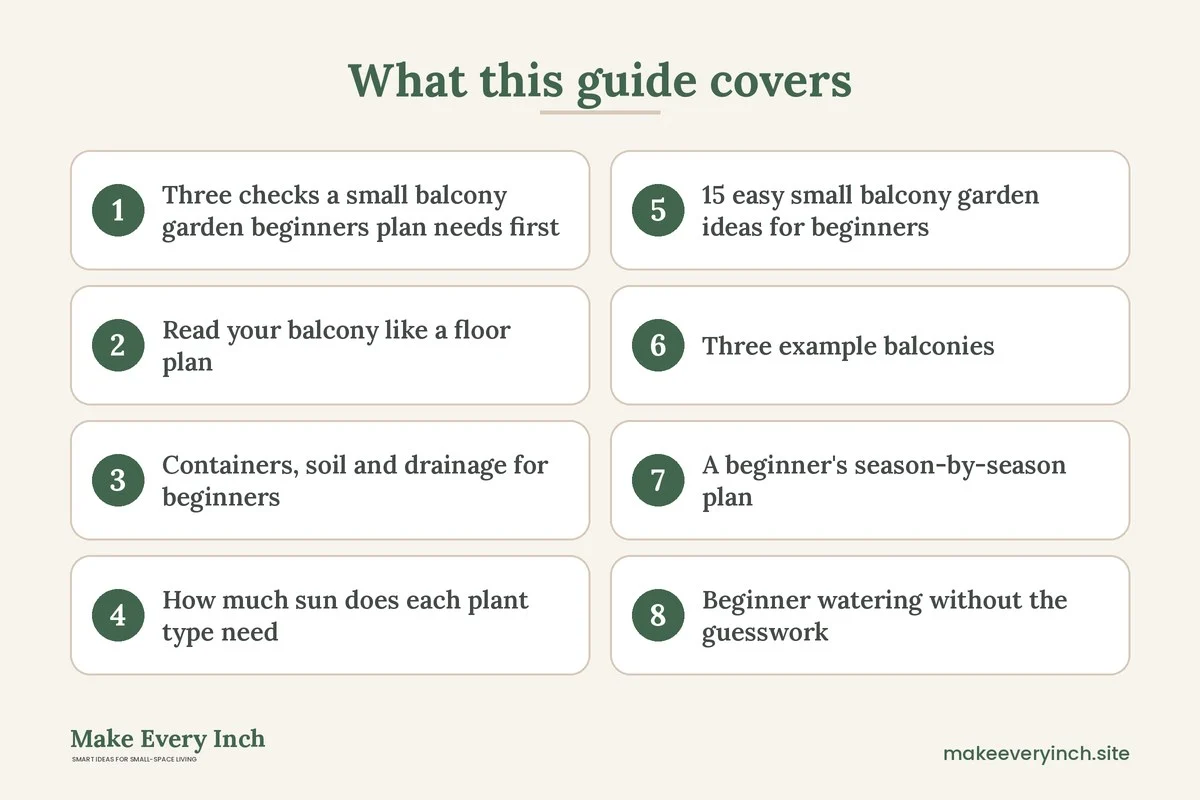
A small balcony garden beginners can keep alive is less about plants and more about planning. Most first gardens fail for the same few reasons: the plants need more sun than the balcony gives, the pots are too small to hold water, the soil is heavy enough to worry about, or the watering routine collapses in the first hot week. This guide fixes those problems in order. It covers the three checks you should make before buying anything, how to read your light, the safe way to think about weight, 15 beginner ideas, a table of plant types by light, three example balconies, a month-by-month plan, a long safety section, common mistakes and a checklist. If you want the bigger picture first, start with our pillar guide on small balcony ideas, and for rules that apply to tenants, read renter friendly small balcony ideas. Plants also pair well with indoor planning, so we link to our small living room ideas and small dining room ideas guides for ways to carry the same greenery inside.
Three checks a small balcony garden beginners plan needs first
Beginners often start at the garden center and work backward. Reverse that. Spend one weekend on three checks, and every later choice becomes easier.
Check 1: Light
Light decides what lives. Stand on the balcony at three points in the day, such as mid-morning, early afternoon and late afternoon, and note whether the sun reaches the floor, the railing and the wall. Count the hours of direct sun on your best spot. As a rough guide, six or more hours is full sun, about four to six hours is part sun, and under four hours is shade. Remember that the sun moves through the year, so a balcony that is bright in summer may be dim in winter, and a roof or the balcony above can block the high summer sun.
Direction also helps, though it depends on where you live. In the northern hemisphere, a south-facing balcony tends to be the brightest and warmest, east gets gentler morning light, west gets strong hot afternoon sun, and north is the dimmest. In the southern hemisphere, these flip. Use direction as a hint and your own observation as the answer.
Check 2: Weight
A garden is heavier than it looks. A pot of wet soil can weigh many times what the empty pot weighs, and several of them add up. Ask your landlord, building manager or condo board whether there is a stated load limit for the balcony, and whether there are rules about containers, planters or anything else you plan to add. Do not guess, and do not assume that because the balcony feels solid it can carry a crowd of full planters. The safety section below returns to this in detail.
Check 3: Rules and permission
Read the lease, the condo rules or the HOA guidelines. Some buildings restrict hanging planters over the railing, ban anything that could drip on a neighbour, limit plant types or require that nothing be attached to the railing. Some require balconies to stay clear for fire egress. Get any permission in writing, and take photos of the balcony before you start. Nothing in this guide should be done in a way that conflicts with those rules.
Read your balcony like a floor plan
Measure the balcony floor length and depth, the railing height, and the width of the door. Draw a simple rectangle on paper and mark where the sun lands, where wind funnels, where the door swings and where water drains. Then decide the job of the balcony. Is it mainly a place to sit, with plants as a border? Is it a pass-through where you only need a plant shelf by the door? Is it a true growing space with a small chair squeezed in? A clear job prevents the common mistake of filling every inch with pots and losing the place to stand.
Keep a clear path from the door to the seat, ideally 24 to 30 inches wide, and keep at least one corner or edge free so you can reach every pot to water it. If the balcony is only 3 or 4 feet deep, a floor-level garden along one wall with a narrow aisle is usually better than plants on both sides.
Containers, soil and drainage for beginners
Plants live or die by their pot. These basics matter more than any single plant choice.
- Drainage holes: every pot needs holes at the bottom. A pot without them holds water and rots roots. If you love a decorative pot without holes, use it as a cover and set a plain pot with holes inside it.
- Saucers and trays: use trays to catch drips, and empty them within an hour or so after watering. Standing water breeds insects and can run toward a neighbour’s balcony or onto the floor and wall.
- Size: a bigger pot holds moisture longer and dries out less quickly than a small one. Many herbs do well in a pot about 8 to 10 inches across. Larger vegetables and shrubs need more soil volume, often 12 to 16 inches or more across.
- Material: plastic, resin and fiberglass pots are lighter than stone or ceramic. Clay breathes but dries quickly and is heavy. Fabric grow bags are light and drain well.
- Soil: use a potting mix made for containers, not soil dug from the ground, which compacts and can bring pests. Lightweight mixes that include materials such as bark or perlite reduce weight and help drainage.
- Feeding: potting mixes run out of nutrients, so a gentle plant food on a schedule printed on the label helps, especially for vegetables and flowers.
How much sun does each plant type need
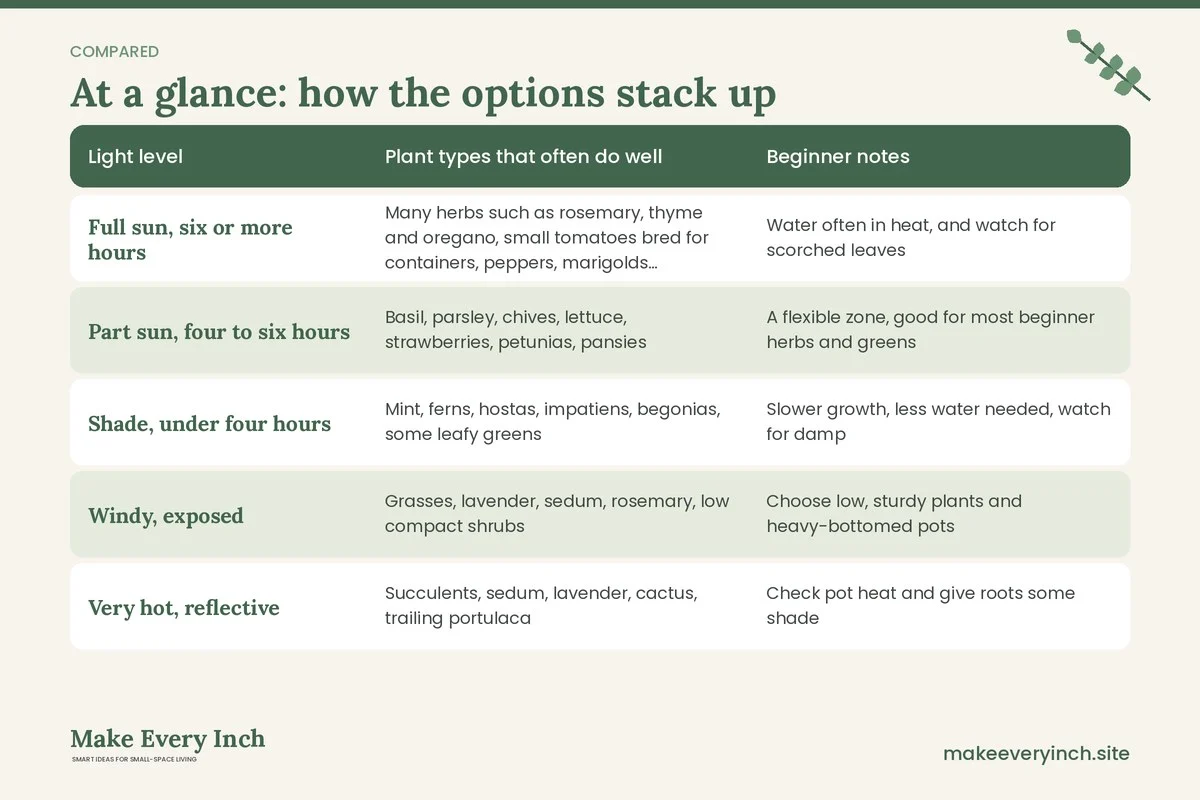
Match plants to light and the garden almost runs itself. This table gives hedged, general guidance. Always read the label on any plant you buy, and check that it is safe for any children or pets who use the balcony.
| Light level | Plant types that often do well | Beginner notes |
|---|---|---|
| Full sun, six or more hours | Many herbs such as rosemary, thyme and oregano, small tomatoes bred for containers, peppers, marigolds, geraniums, succulents | Water often in heat, and watch for scorched leaves |
| Part sun, four to six hours | Basil, parsley, chives, lettuce, strawberries, petunias, pansies | A flexible zone, good for most beginner herbs and greens |
| Shade, under four hours | Mint, ferns, hostas, impatiens, begonias, some leafy greens | Slower growth, less water needed, watch for damp |
| Windy, exposed | Grasses, lavender, sedum, rosemary, low compact shrubs | Choose low, sturdy plants and heavy-bottomed pots |
| Very hot, reflective | Succulents, sedum, lavender, cactus, trailing portulaca | Check pot heat and give roots some shade |
15 easy small balcony garden ideas for beginners
Start small and forgiving
1. A three-pot herb start
Choose three herbs you actually cook with, such as basil, parsley and chives, and grow each in its own pot, since herbs have different water needs. Cooking with what you grow keeps you motivated. Keep mint in its own container because it spreads.
2. One flowering anchor pot
Add one large pot of a hardy flower to give the corner a focal point. Marigolds, geraniums and petunias are often sold as easy starters. A single big pot looks more intentional than ten small ones.
3. A succulent tray for sunny, forgetful weeks
Succulents tolerate missed waterings, which suits busy beginners on a sunny balcony. Plant them in a gritty, fast-draining mix and water only when the mix is dry. They do not like constant rain or standing water, so keep them under cover in wet seasons.
4. Starter plants rather than seeds
Small nursery plants skip the slowest, riskiest stage. Once you have a few weeks of success, try seeds for easy crops such as lettuce, radishes or nasturtiums.
5. A single tomato in a large pot
A compact tomato variety bred for containers can reward you quickly. Give it a big pot, a stake or cage, full sun and steady water. Uneven watering is the most common reason for split or poor fruit.
Use the walls and rails safely
6. A freestanding plant shelf
A narrow tiered shelf holds many small pots in a few square feet of floor. Choose one that is stable, set it against the wall rather than at the railing, and keep heavier pots on the lower shelves. Anchor tall shelves where the building allows, using a method that does not damage the wall, and never rely on the railing for support.
7. A trellis planter against the wall
A planter with a built-in trellis lets a climbing plant such as a sweet pea or a bean grow upward. It uses height instead of floor space. Make sure it stands on its own and is not leaning on the railing.
8. Hanging pots from a freestanding stand
Hanging plants add height without drilling. Use a freestanding stand or a tension pole if the building allows, and avoid hanging anything where it could drop onto people or balconies below. If you are not allowed to attach anything to the rail or ceiling, skip hanging altogether.
9. Rail planters that sit inside the railing
If the building allows planters at the rail at all, choose styles that sit inside the balcony on the floor or on a stand rather than hooking over the outside. Anything that can tip over the edge is a falling object risk.
10. A vertical pocket garden on a freestanding frame
Pocket planters on a freestanding frame suit herbs and small leafy greens. They are light when planted with lightweight mix, but they dry out fast, so check them often.
Make it easy to maintain
11. Group pots by water needs
Put thirsty plants together and drought-lovers together. A tray of succulents and a tray of herbs need different routines. Grouping saves time and prevents over- or under-watering.
12. Self-watering pots or a simple wicking method
Self-watering containers hold a reserve that the plant draws on, which suits beginners and short trips. They are not magic, and still need checking, but they smooth out the ups and downs.
13. A small watering routine station
Keep a watering can, a small trowel, scissors and plant food in one box near the door. A tool that is easy to reach gets used. A pre-set habit, such as watering with your morning coffee, beats good intentions.
14. A compost-free feeding plan
Skip a compost heap on a small balcony, since it can bring pests and odors and may break building rules. Use slow-release plant food or liquid feed on the schedule printed on the label.
15. A season-swap corner
Keep one corner for plants that change with the season, such as spring bulbs, summer flowers, autumn mums or winter greens. This keeps the balcony interesting without a full redesign.
Three example balconies
Example 1: The sunny 4 by 8 foot balcony with a south or west exposure
This narrow balcony gets strong afternoon sun. The plan puts a row of lightweight pots along the wall: a rosemary, a thyme, a lavender, a container tomato and a small sedum tray. A folding chair sits at the end. The aisle stays about 28 inches wide. Because the balcony bakes in summer, the beginner chooses light-colored pots, mulches the soil top with a thin layer to slow evaporation, and waters in the early morning. All pots sit on trays, which are emptied after watering so nothing drips onto the neighbour below.
Example 2: The shady 5 by 6 foot balcony facing north
Here direct sun is scarce, so the plan embraces shade. Ferns, begonias and mint go in medium pots, with a leafy green or two near the brightest edge. A small bistro table is skipped in favor of a single chair and a low stool that doubles as a plant stand. Light-colored cushions and a pale outdoor mat make the space feel brighter. Watering is lighter, about once or twice a week depending on weather, and the grower checks the soil with a finger before adding any.
Example 3: The windy high-rise balcony
Wind dries pots fast and can knock tall things over. This grower picks low, sturdy plants: grasses, lavender, sedum and rosemary, set in heavy-bottomed pots with wide bases. Nothing stands near the railing. Tall plants are kept to the sheltered corner, and any trellis is freestanding and weighted at the base. The grower checks the plants for wind damage after storms and brings lightweight pieces indoors when strong wind is forecast.
A beginner’s season-by-season plan
Seasons vary by climate, so adjust to your local frost dates and weather. This is a general rhythm.
- Early spring: clean the balcony, check drainage, refresh or replace tired potting mix, and plant hardy greens and pansies if the frost risk has passed.
- Late spring: plant herbs, tomatoes and summer flowers once nights are reliably warm. Set up stakes or cages at planting time rather than later.
- Summer: water in the morning or evening, check pots daily in heat, deadhead flowers and harvest herbs often, since regular picking keeps them bushy.
- Autumn: cut back finished plants, plant bulbs and cool-season greens, and bring tender plants indoors before the first frost.
- Winter: reduce watering, protect pots from freeze damage by moving them against the wall or indoors, and plan next year’s layout.
Beginner watering without the guesswork
Overwatering kills more beginner plants than neglect. Push a finger about an inch into the soil. If it feels dry, water slowly until it runs from the drainage holes. If it feels damp, wait. Pots in sun and wind dry faster than pots in shade. Small pots dry faster than large ones. In a heat wave, check daily. In a cool, cloudy week, you may only need to water twice.
Water the soil, not the leaves, which helps prevent mold on some plants. Use a watering can with a gentle spout to avoid splashing soil onto the floor. Try to water in a way that does not send runoff toward the neighbour below, and see the drainage rules in the safety section.
Balcony garden safety and rules
Gardens look harmless, but a balcony is a raised, shared structure. Go through every point here before you add plants, and treat the building’s own rules as the final word.
Weight limits
Balconies and decks have load limits that vary by building. Check the building rules or ask the manager, and do not overload the space. Wet soil is heavy, and people, furniture and pots all add up at once. Spread weight out rather than clustering it in one spot, put the heaviest pots near the wall where the structure is generally strongest, and keep the count of large planters modest. If the building has no stated limit, ask for guidance before adding more than a few medium containers. When in doubt, choose lightweight pots and mixes, and fewer of them.
Railings, children and pets
Railing height, gap spacing and design matter for safety, particularly with children and pets. Plants, pots, stools and benches near the railing can give a child or a pet a step to climb. Keep furniture and planters away from the railing, keep the area right at the railing clear, and never stack pots to make a platform. If children or pets use the balcony, supervise them, and consider whether the balcony is suitable for unsupervised use at all.
Falling objects
A pot that tips off a balcony can seriously injure someone below. Do not place pots on the railing top unless the building allows a purpose-made, secure holder, and even then be cautious. Secure shelves and stands so they cannot tip. Heavy items go low. Bring in or lay down anything light and tall when strong wind is forecast. Keep tools and watering cans off ledges.
Wind and tip-over
Wind on upper floors is stronger than at ground level. Choose low, heavy-based pots, group them to shelter each other, and tie tall plants to stakes. Avoid tall narrow planters in windy spots, and stay away from lightweight hanging items that can swing into a neighbour’s space.
Drainage and water damage
Water that runs off your balcony can stain walls, damage neighbours’ property and cause costly problems. Use trays under pots, empty them after watering, and do not let the floor drain clog with soil or leaves. Water gently. Check how your balcony drains, since some slope toward a drain and some toward the edge. Never block a drain with a pot. If water pools, move the pots and tell the building manager about the drainage problem.
Fire and grills
Many leases and fire codes prohibit grills, open flame and sometimes even candles on balconies. Dried plants, mulch and dead leaves can ignite. Do not light a grill or fire pit unless the rules clearly allow it. Keep cigarette butts away from pots, since potting mix and some mulches can smolder. Do not store fuel or other flammable items on the balcony.
Electrical safety for lights and gadgets
If you add string lights, a plug-in pump or other electrical items, choose products rated for outdoor use and plugged into a protected outlet, ideally one with GFCI protection. Do not overload sockets or daisy-chain extension cords, and keep plugs and connections off the wet floor and out of any watering zone. Turn off and unplug electrical items when away or during storms. Candles near dry plants, curtains or fabric are a fire risk, so consider battery-powered alternatives.
Toxic plants for pets and children
Some popular plants are toxic if chewed or swallowed. Before you buy, check each plant against a reputable poison-control or veterinary list for your region. If children or pets are on the balcony, favor plants listed as non-toxic and keep all plants out of reach. Also keep fertilizers, pesticides and potting mix out of reach, since many are harmful if eaten. Seek urgent advice from a doctor, vet or poison-control service if a plant is swallowed.
Heat on surfaces
In strong sun, metal railings, dark pots and tile floors can get hot enough to burn skin or damage roots. Move pots out of the hottest spot, use lighter colors, and consider a rug or shade to cool the floor. Never leave a pet or child on a hot balcony.
No drilling without permission
Do not drill into the railing, walls, ceiling or floor, and do not attach hooks, brackets or screens without clear written permission. Choose freestanding solutions. If attaching anything is allowed, follow the building’s rules on materials and placement so that you do not damage waterproofing or the structure.
Common beginner mistakes to avoid
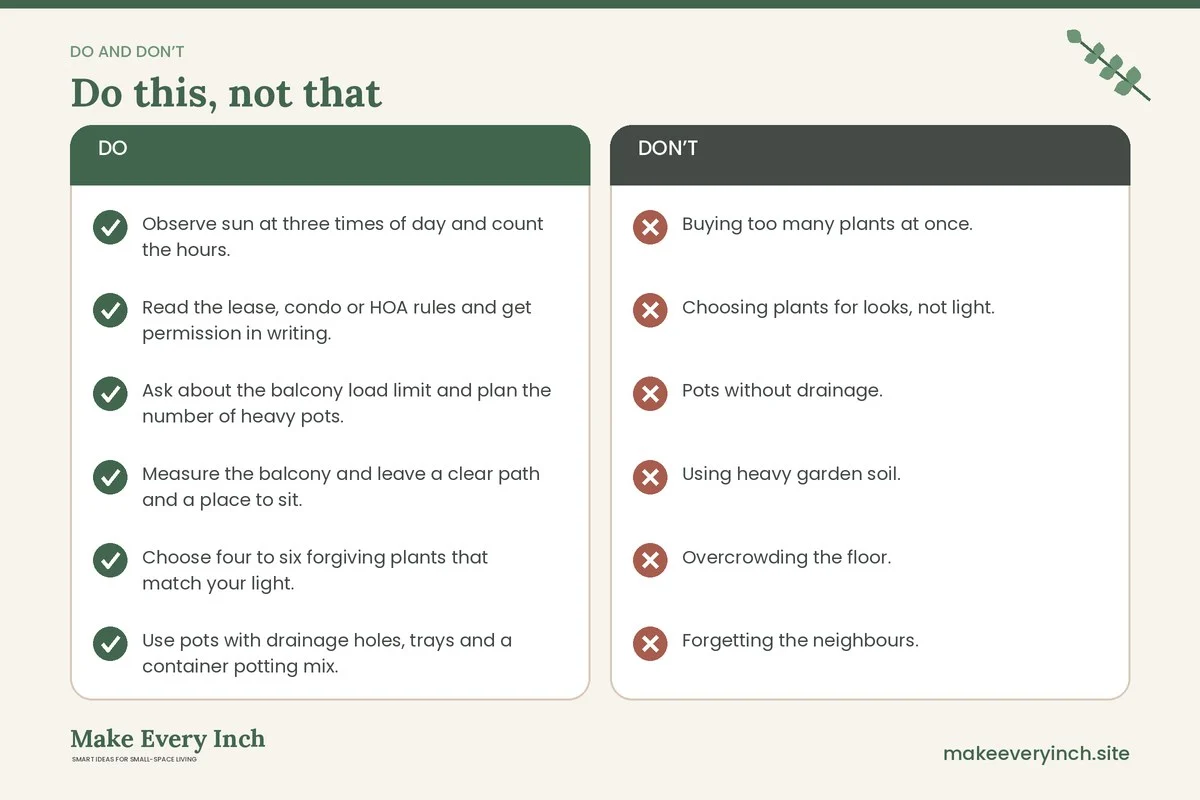
- Buying too many plants at once. Start with four to six. You can always add more.
- Choosing plants for looks, not light. A sun lover in shade will sulk, no matter how well it is watered.
- Pots without drainage. This is the leading cause of root rot.
- Using heavy garden soil. It compacts, drains badly and adds weight.
- Overcrowding the floor. Leave a clear path and a place to stand.
- Forgetting the neighbours. Dripping water, falling leaves and strong smells can cause conflict.
- Skipping the rules. Fines or removal orders are avoidable.
- Ignoring the forecast. Wind, frost and heat waves hurt plants and can move objects.
Questions beginners ask
What is the easiest plant for a small balcony garden beginners can start with?
Many herbs, such as chives, parsley, thyme and mint, are widely considered forgiving, as are hardy flowers such as marigolds and geraniums, and succulents on sunny balconies. The easiest plant is the one that matches your light, so check sun hours first.
How much does a balcony garden weigh?
It depends on pot size, material and how wet the soil is. Wet soil is much heavier than dry, and the totals add up quickly. Ask the building manager for the load limit, favor lightweight pots and mix, and avoid clustering heavy planters in one spot.
Can I grow vegetables on a small balcony?
Often yes, if there is enough sun. Compact tomatoes, peppers, lettuce and herbs are common choices. Vegetables need more sun, water and soil volume than herbs and flowers, so plan for bigger pots and steady watering.
How often should I water?
Check the soil with a finger rather than following a fixed schedule. In hot, sunny or windy weather you may need to check daily, while in cool weather less often. Water slowly until it drains from the bottom, and empty trays afterward.
What if my balcony gets almost no sun?
Choose shade-tolerant plants such as ferns, begonias, impatiens, hostas and mint, and use light-colored surfaces and a mirror-style outdoor decoration if allowed, to bounce light. Expect slower growth and less watering.
Are balcony plants safe for pets?
Not all of them. Many common plants are toxic to cats, dogs and children. Check each plant against a reliable pet-safety list before buying, and keep plants out of reach.
A one-page beginner checklist
- Observe sun at three times of day and count the hours.
- Read the lease, condo or HOA rules and get permission in writing.
- Ask about the balcony load limit and plan the number of heavy pots.
- Measure the balcony and leave a clear path and a place to sit.
- Choose four to six forgiving plants that match your light.
- Use pots with drainage holes, trays and a container potting mix.
- Group pots by water need and keep heavy items low and near the wall.
- Keep furniture and pots away from the railing.
- Check that every plant is safe for any children and pets.
- Use outdoor-rated lights, GFCI protection and no overloaded sockets.
- Skip grills, open flame and compost unless the rules allow them.
- Do not drill or attach anything without permission.
- Set a simple watering routine and check the forecast.
- Review after one season, then expand.
The takeaway
The best small balcony garden beginners can build is small on purpose. Check the light, the weight limit and the rules, choose a few forgiving plants, and give them good pots and a steady routine. Safety comes first on a raised, shared structure, so keep everything away from the railing, secure what could fall, protect the neighbours below and follow the building’s rules. Success in one season gives you the confidence to grow more in the next. If you rent, our renter friendly apartment decorating ideas and no drill storage ideas for renters show how to work within lease limits, while small room decor ideas, best furniture for small apartments and studio apartment ideas help with the rooms behind the balcony door. For planning ideas beyond plants, our guides to small space plants and planters ideas and budget small space ideas are useful companions, and the privacy side of the same space is covered in small balcony privacy ideas.
Keep going: Plan the whole outdoor corner with our small balcony ideas pillar, add screening with small balcony privacy ideas, and keep indoor and outdoor storage tidy with small space organization ideas.
Save this guide for later
Pin the ideas you like to Pinterest so you can come back to them when you plan your space.