15 Small Bedroom Mistakes to Avoid: Layout Errors and Fixes
Quick answer: The small bedroom mistakes avoid most often are oversized beds, blocked walkways, furniture pushed into every corner, one harsh ceiling light, unanchored tall pieces, a rug that is too small and storage that fights the door swing. Measure first, keep 24 to 30 inches of clear path, give the bed breathing room, add layered light and anchor anything tall. Ask your landlord before making holes.
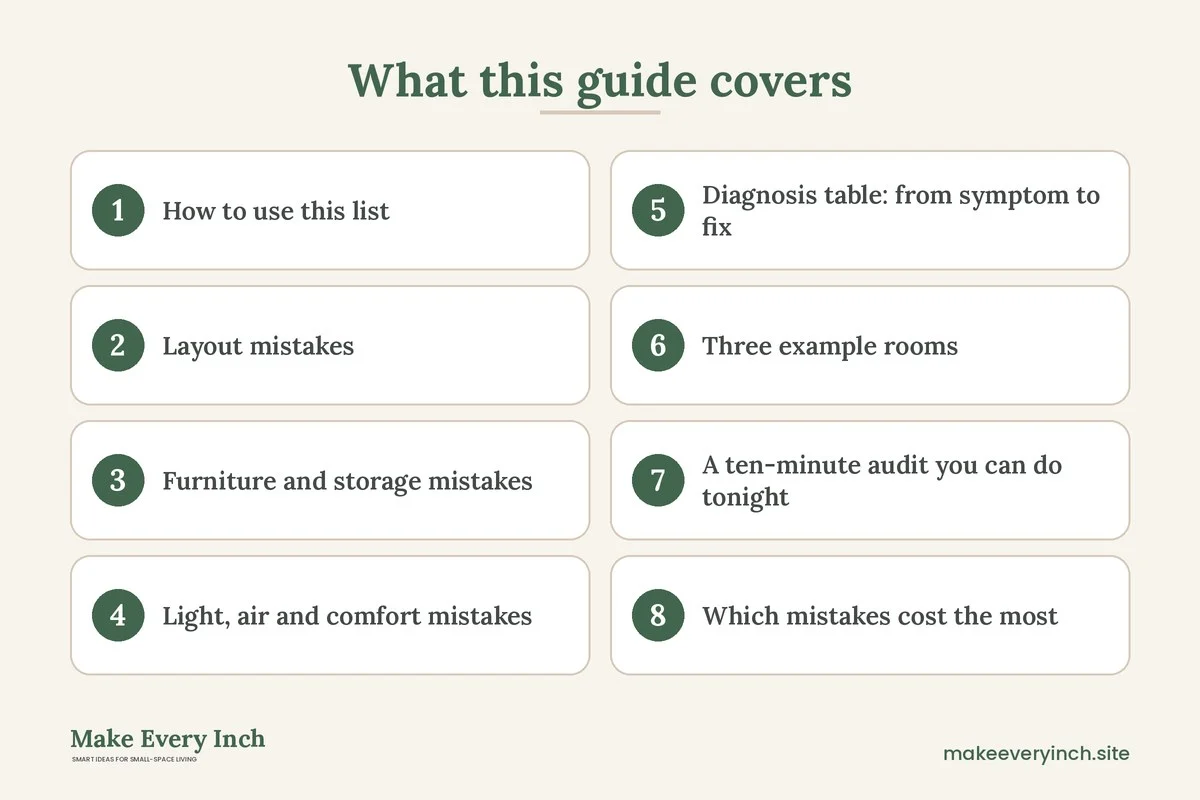
Small bedroom mistakes avoid a lot of frustration once you know what to look for, because most of them show up as a symptom first. You bump your shin on the same corner every morning, the closet door never opens fully, the room feels dark at night or you simply cannot say why it feels cramped. This guide works backward from those symptoms. It lists 15 mistakes with the signs, the reason, a measured fix and a safety note where one applies, then adds a diagnosis table, three example rooms, a ten-minute audit and a checklist. It is about layout, furniture, light, air and storage, so it will not repeat our styling advice from small bedroom decor that does not feel cluttered. For the full set of ideas, begin with the main small bedroom ideas guide.
How to use this list
Read the symptom column first, not the mistake name. People rarely know they have placed a bed badly. They know their room feels tight, noisy, dark or stuffy. Match the symptom to a mistake, apply the fix and re-test with a tape measure and a few minutes of real use. Not every mistake will apply, and some fixes depend on the lease. Where a fix involves drilling, painting or adhesives, check your lease and get written permission before you start.
Take three measurements before you begin. Measure the room wall to wall, the swing arc of the door and any windows, and the width and depth of each large piece. Write them on a sketch. A room of 9 by 10 feet has 90 square feet, and a double bed alone takes up about 40 of those, so the margin for error is small. A sketch costs nothing and prevents most of the layout mistakes below.
Layout mistakes
1. Buying the largest bed that technically fits
Symptom: you squeeze sideways to reach the closet or the window. Why it happens: a queen or king fits on paper but leaves no path. Fix: leave at least 24 inches on the side you use most and 18 inches on the other. In a 9 by 10 foot room, a double often feels easier than a queen, and a low platform frame sits less heavily than a tall one with a thick headboard. Measure the finished frame, not just the mattress, since rails and headboards add several inches. For choosing a size, our post on how to choose a bed for a small bedroom walks through widths and clearances.
2. Pushing every piece against the walls
Symptom: the room has a big empty center that feels like a corridor. Why it happens: the instinct to clear the middle. Fix: try angling or centering the bed on the longest wall so both sides open up, then place the dresser where it does not collide with the door swing. A floating arrangement rarely works in a room under 100 square feet, but even a few inches of gap behind a headboard stops the wall from looking crowded. Review our guide to small bedroom layout ideas for sketches.
3. Ignoring the door and drawer swing
Symptom: a drawer hits the bed or the door only opens halfway. Why it happens: floor plans are drawn with furniture closed. Fix: draw the swing arc of the door, the closet and every drawer on your sketch. Leave 18 to 24 inches in front of a dresser so a drawer can open fully, and 30 to 36 inches in front of a wardrobe. A door that opens outward, a sliding door or a curtain can save about 8 to 10 square feet. If the door can be re-hung, ask the landlord first.
4. Blocking the window or the route to it
Symptom: you cannot open the window without moving something. Why it happens: the window wall seems like a convenient place for a dresser or a bed. Fix: keep the window openable and the path to it clear. An escape route matters in a bedroom, and local codes may set rules for egress windows in sleeping rooms. A low piece under a window is fine as long as it does not block the sash, the latch or the route out. Never place a heavy tall unit where it could block the only exit.
5. Skipping a flow check from the door to the bed
Symptom: you walk around objects on every trip. Why it happens: furniture was placed one piece at a time. Fix: with painter’s tape, mark a path 24 to 30 inches wide from the door to the bed, closet and window. Anything inside the tape moves or shrinks. See small bedroom layout ideas for better flow for plans that keep the path open.
Furniture and storage mistakes
6. Choosing tall, deep furniture because it holds more
Symptom: the room feels heavy on one side. Why it happens: a deep wardrobe looks efficient. Fix: compare depths. A standard wardrobe is often around 24 inches deep, while a shallower unit of 16 to 18 inches saves 6 to 8 inches of floor. A dresser that is tall and narrow often holds the same clothes as a wide, low one and leaves more wall space. Browse small bedroom furniture ideas and best small dressers before you buy.
7. Leaving tall furniture unanchored
Symptom: a dresser or bookcase wobbles when a drawer is pulled. Why it happens: it is not fixed to the wall. Fix: anchor every tall dresser, wardrobe and bookcase with the hardware that suits your wall type, into studs where possible. Tall furniture can tip, which is a serious risk for children and pets who climb. If your lease forbids drilling, ask for permission, since most landlords allow anti-tip anchoring, or choose lower pieces that are stable without it. Never load the top drawers of a dresser heavily if the unit is not secured.
8. Wasting the space under the bed
Symptom: boxes and bags sit in view while the underside is empty. Why it happens: the frame sits too low or storage feels fiddly. Fix: measure the clearance from the floor to the underside of the frame. Even 6 to 8 inches takes flat boxes, and a lifted frame on risers (rated for the weight, with a stable base) can offer 12 inches or more. Our list of under bed storage ideas and best storage beds for small bedrooms covers both.
9. Letting storage fight the closet
Symptom: the closet is stuffed while the floor is full of baskets. Why it happens: storage was added around the closet, not inside it. Fix: do the closet first. Add a second rod, shelf dividers and slim hangers before adding any furniture. Our guide to how to double hanging space in a closet shows the steps, and small bedroom ideas without a closet helps if you have none.
10. Using a desk that is too big, or none at all
Symptom: a laptop lives on the bed or the desk takes a full wall. Why it happens: an office desk was moved into the bedroom. Fix: a depth of 18 to 22 inches works for a laptop, and a wall-mounted or fold-down version frees the floor. Keep work out of the bed zone for better sleep. For options, see small bedroom desk ideas.
Light, air and comfort mistakes
11. Relying on one overhead light
Symptom: the room feels flat, dim in the corners or glaring. Why it happens: the ceiling fixture is the only source. Fix: add a bedside lamp on each side and one low accent. Choose warm bulbs, avoid exceeding the wattage on the lamp, and keep shades clear of the bulb. Use a plug-in sconce if you rent and cannot hardwire. More ideas are in small bedroom lighting ideas.
12. Overloading outlets and hiding cords badly
Symptom: a power strip with several plugs sits under the bed or behind a curtain. Why it happens: there are too few outlets. Fix: use a certified surge protector rated for the load, keep it uncovered and off soft fabric, and do not chain extension cords. Do not run cords under rugs or through hinges. Route cords along the baseboard with removable covers. If you need more outlets, ask a licensed electrician. See renter friendly ways to hide cords.
13. Forgetting ventilation and heat sources
Symptom: the room feels stuffy, damp or too warm at night. Why it happens: furniture blocks vents, radiators or a window. Fix: keep 6 to 12 inches between furniture and heaters or radiators, do not cover vents, and open the window briefly each day. Check the wall behind a bed pushed against an outside wall for damp or mold. If you find any, tell your landlord. When painting, choose low-VOC paint and ventilate until the smell fades.
14. Picking a rug that is too small
Symptom: the rug looks like a postage stamp and the floor feels chopped. Why it happens: a standard size was chosen without checking the bed. Fix: let the rug extend 18 to 24 inches past both sides and the foot of the bed, or at least under the front third of the bed. Use a non-slip pad to avoid trips, and trim any edges that curl. Our post on how to choose rug size for a small living room explains the same logic for another room.
15. Skipping the finishing touches that create calm
Symptom: the room is organized but still feels harsh. Why it happens: nothing softens the surfaces. Fix: curtains hung high and wide, a cotton or wool throw and a few pillows add warmth without taking up floor area. Our cozy apartment bedroom ideas shows how to build that feeling on a small footprint.
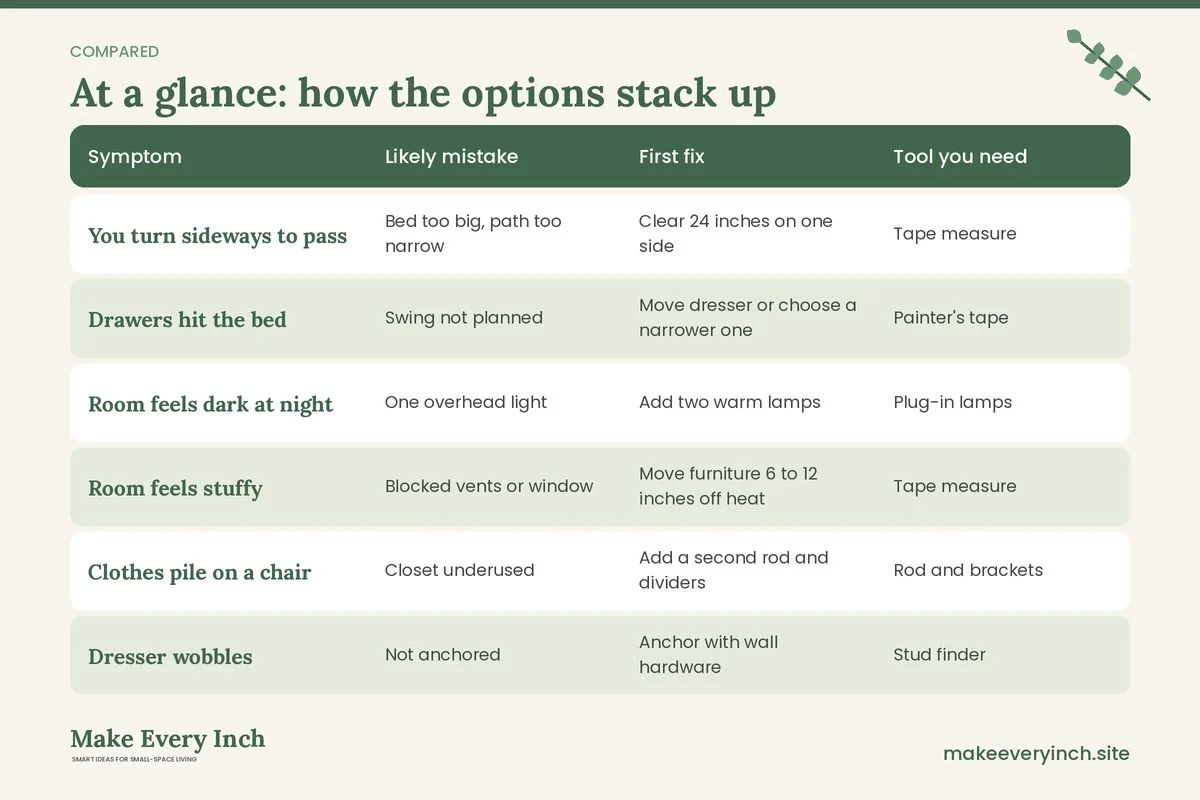
Diagnosis table: from symptom to fix
| Symptom | Likely mistake | First fix | Tool you need | |
|---|---|---|---|---|
| You turn sideways to pass | Bed too big, path too narrow | Clear 24 inches on one side | Tape measure | |
| Drawers hit the bed | Swing not planned | Move dresser or choose a narrower one | Painter’s tape | |
| Room feels dark at night | One overhead light | Add two warm lamps | Plug-in lamps | |
| Room feels stuffy | Blocked vents or window | Move furniture 6 to 12 inches off heat | Tape measure | |
| Clothes pile on a chair | Closet underused | Add a second rod and dividers | Rod and brackets | |
| Dresser wobbles | Not anchored | Anchor with wall hardware | Stud finder | |
| Cords are tangled | Too few outlets | Surge protector and cord covers | Removable clips | |
| Floor feels chopped up | Rug too small | Larger rug with a pad | Rug pad |
Three example rooms
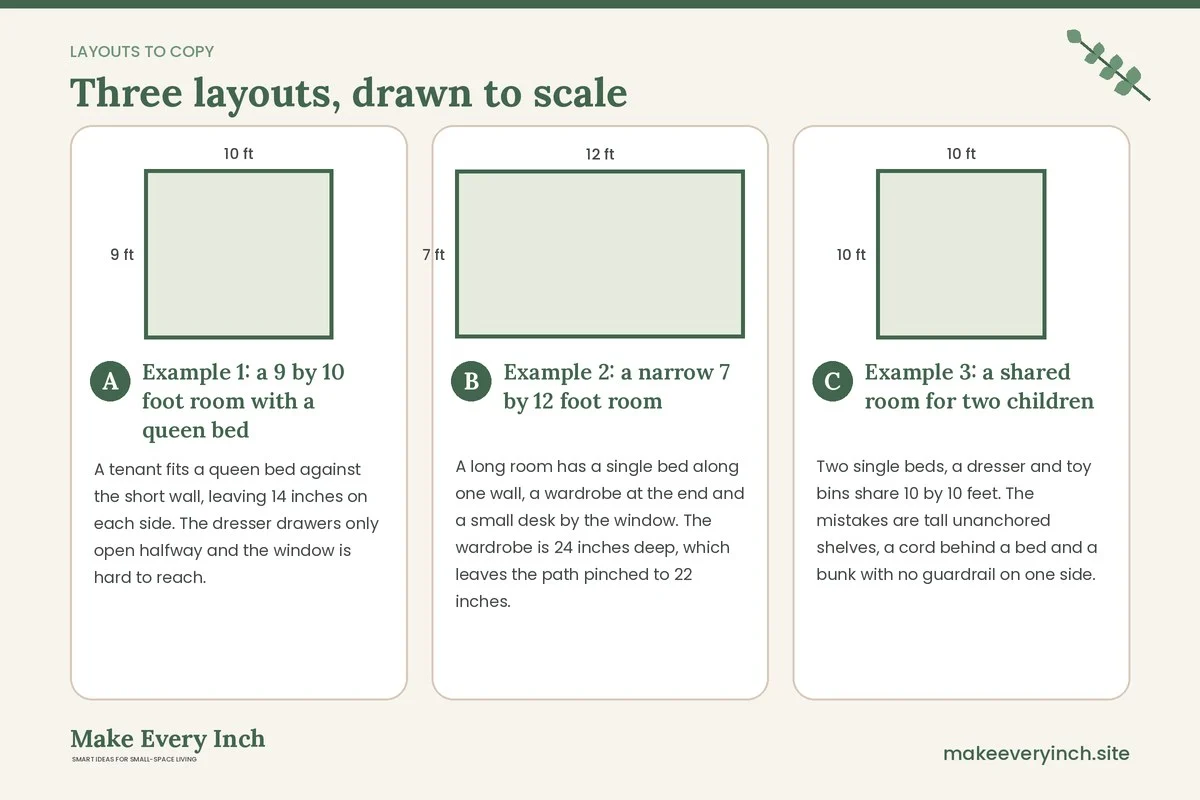
Example 1: a 9 by 10 foot room with a queen bed
A tenant fits a queen bed against the short wall, leaving 14 inches on each side. The dresser drawers only open halfway and the window is hard to reach. The fix is to swap to a double on a low frame, which opens about 6 inches per side, move the dresser to the long wall with 20 inches in front and mark a 24 inch path with tape. The room is no bigger, but the day-to-day movement is easier.
Example 2: a narrow 7 by 12 foot room
A long room has a single bed along one wall, a wardrobe at the end and a small desk by the window. The wardrobe is 24 inches deep, which leaves the path pinched to 22 inches. Replacing it with a 16 inch deep unit and a rod across a recess lifts the path to about 30 inches. The desk becomes a fold-down shelf, which frees the window. Because the wardrobe is tall, the owner anchors it to the wall with the landlord’s permission.
Example 3: a shared room for two children
Two single beds, a dresser and toy bins share 10 by 10 feet. The mistakes are tall unanchored shelves, a cord behind a bed and a bunk with no guardrail on one side. The fix is to anchor every shelf, keep cords out of reach and follow the manufacturer’s guidance for bunks, including guardrails and mattress thickness. Storage bins move to low, open shelves that a child can reach. For more, see small home ideas for shared bedrooms.
A ten-minute audit you can do tonight
- Stand in the doorway and note what you see first.
- Measure the path from door to bed, closet and window.
- Open every drawer and door fully and note what hits.
- Check each tall piece for wobble and anchoring.
- Look at the cords and the power strip.
- Turn off the ceiling light and see how the room looks with lamps only.
- Check that vents, radiators and the window are not blocked.
- Lie on the bed and look at what you see from there.
- Write down the top three problems and fix one this week.
Which mistakes cost the most
Some mistakes are mildly annoying, and some are safety risks. Treat the unanchored tall furniture, the blocked window and the overloaded power strip as first priorities. Next fix anything that makes you walk around obstacles twice a day, such as a narrow path or a drawer that cannot open. Lighting, rugs and soft touches can follow. Fixing in order of risk and frequency spends your energy where it helps most. If a fix involves a rented wall, ask for permission before drilling, painting or using strong adhesives, and take photos of each wall beforehand. Our guide to small bedroom ideas for renters lists options that leave the walls as they were.
Checklist: small bedroom mistakes avoid
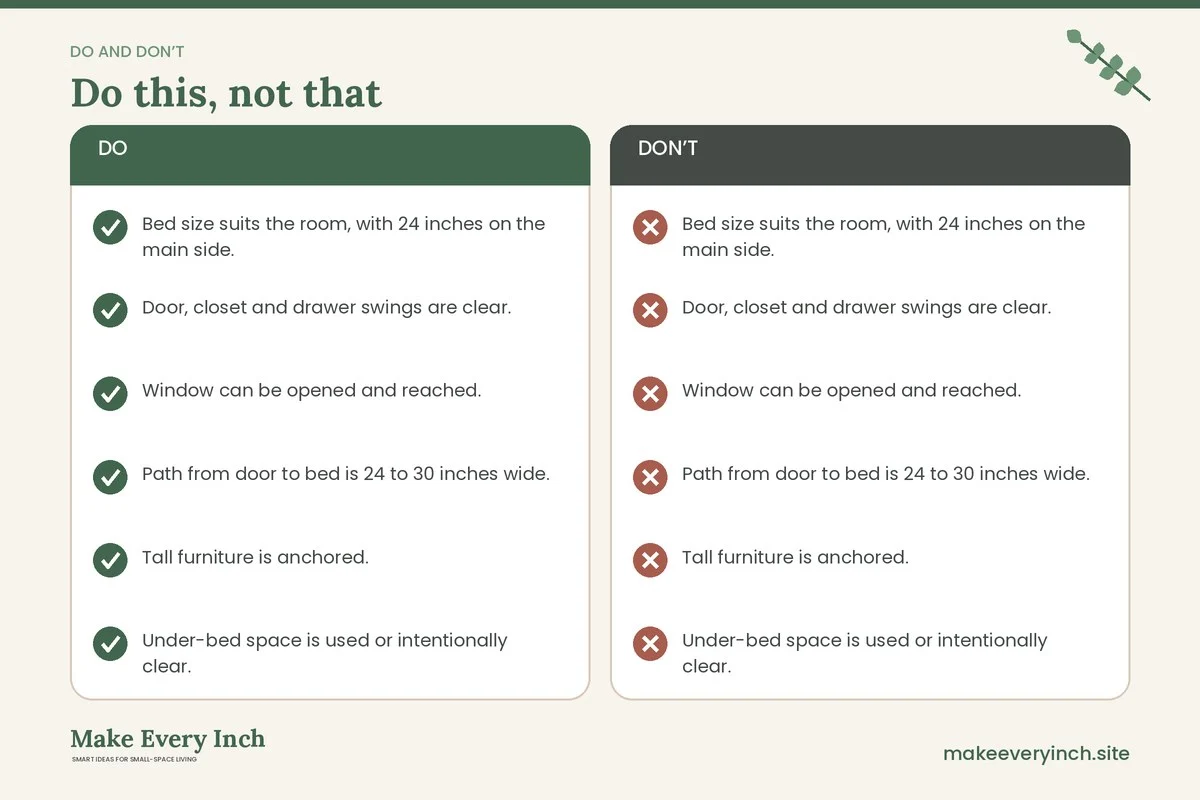
- Bed size suits the room, with 24 inches on the main side.
- Door, closet and drawer swings are clear.
- Window can be opened and reached.
- Path from door to bed is 24 to 30 inches wide.
- Tall furniture is anchored.
- Under-bed space is used or intentionally clear.
- The closet is organized before extra furniture is added.
- Work items live away from the bed.
- Light comes from at least two sources.
- Outlets are not overloaded and cords are tidy.
- Vents, radiators and the window are clear.
- The rug extends past the bed on three sides.
FAQ
What is the single biggest small bedroom mistake?
Choosing furniture before measuring. A bed or wardrobe that is a few inches too large can spoil the whole layout, so draw the room to scale first.
How much space should I leave around the bed?
Aim for 24 inches on the main side and at least 18 inches on the other. Where the room is very small, a bed in a corner leaves one longer side clear.
Is it a mistake to put a bed under a window?
Not always. It can work if the window is not drafty and the headboard does not block the latch. Check the lease and local rules about egress, and keep curtains or blinds cords out of reach of children.
Can I fix these mistakes without spending much?
Many fixes cost little: moving furniture, taping a path, adding a lamp or tidying cords. Our post on small bedroom ideas on a budget lists affordable steps.
Should I paint a small bedroom a light color?
Light colors often help a room look larger, but the right choice depends on sunlight and your taste. Use low-VOC paint, ventilate and get permission if you rent. Our guide to colors that make small rooms look bigger has options.
How do I know if my layout works?
Walk it with your eyes closed for a moment, then with a laundry basket in your arms. If you can do that without bumping, it works.
Keep going: Keep going with small bedroom storage ideas, a plan for small bedroom ideas and a guide to small space furniture mistakes to avoid.
Save this guide for later
Pin the ideas you like to Pinterest so you can come back to them when you plan your space.