19 Small Living Room Ideas for Apartments That Solve Real Building Problems
Quick answer: The best small living room ideas for apartments start with the building, not the furniture. Map the radiator, the door swings, the outlets and the shared walls first, then choose a sofa that fits the clear floor, add lamps because many apartments lack ceiling lights, use a rug to soften noise for neighbors, and keep 30 to 36 inches of walkway. Check the lease before drilling, and anchor any tall piece.
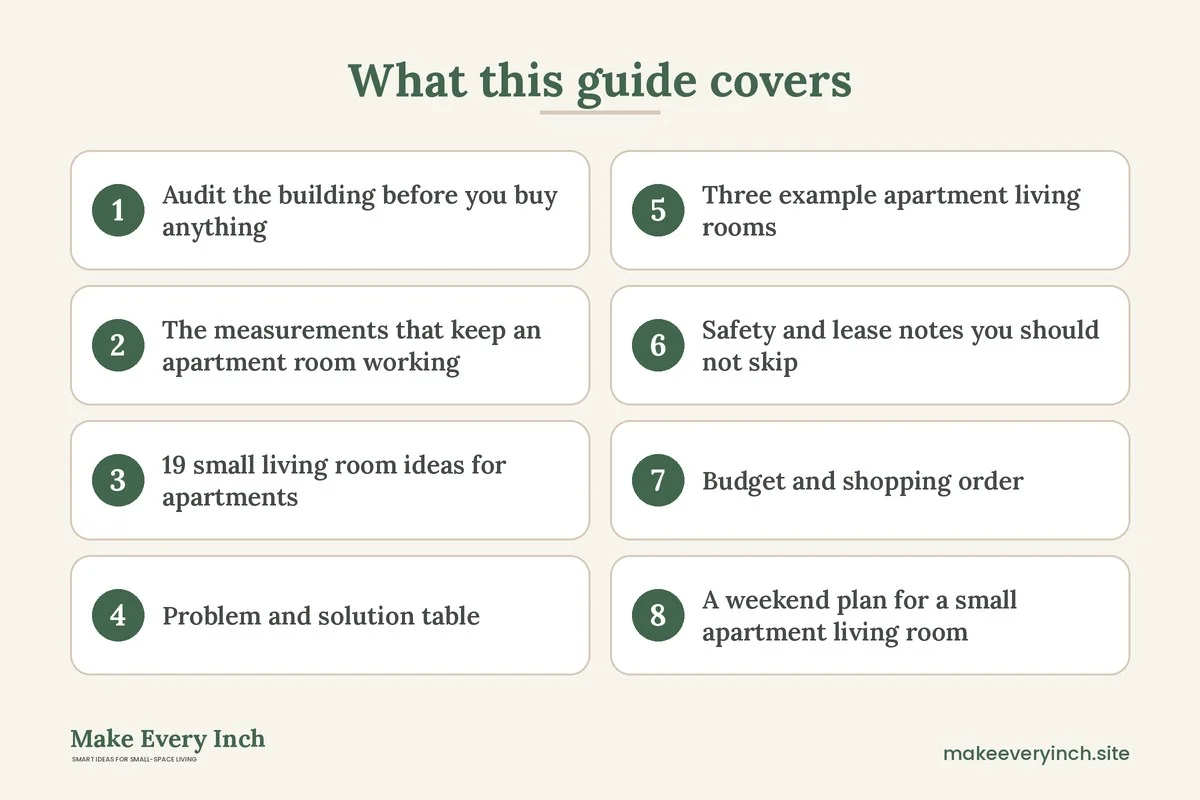
Small living room ideas for apartments are different from small living room ideas for houses, because an apartment living room comes with fixed problems that you cannot remodel. The radiator sits under the only good wall. The front door opens straight into the sofa. There is a single ceiling fixture, or none at all. A neighbor sleeps on the other side of the wall, and the building has a narrow stairwell that limits what you can carry in. This guide treats those constraints as the starting point. It covers a building audit, the measurements that matter, 19 ideas grouped by problem, a table that matches each problem to a fix, three example rooms, safety notes, a weekend plan and a checklist. For the wider overview, read our main small living room ideas pillar, and for the whole home, see small apartment living room ideas.
Audit the building before you buy anything
An apartment living room is defined by things you cannot move. Spend twenty minutes with a tape measure, a notebook and your phone camera, and record the following. This single step prevents most of the expensive mistakes people make when they furnish a small apartment.
Heat sources and vents
Find every radiator, baseboard heater, wall unit and floor or ceiling vent. Furniture that sits directly against a heat source can block airflow, trap heat and, in some cases, scorch fabric or warp wood. As a general rule, leave a gap of at least several inches around a radiator, and never cover a vent with a sofa back or a thick rug. If a radiator sits under the window, choose curtains that stop above it or sill length, and do not drape fabric over the unit. Follow any instruction from your landlord about heating equipment.
Doors, swings and sightlines
Measure how far each door swings and mark the arc on the floor with tape. Include the entry door, a balcony door, a closet door and any bedroom door that opens toward the living room. Furniture must stay outside those arcs, or the door will hit it. Also note what you see when the front door opens. If the answer is the back of a sofa, the kitchen mess or the bathroom door, you have a sightline to manage.
Outlets, switches and light
Mark every outlet and switch on a rough sketch, and note whether any switch controls an outlet for a lamp. Count the ceiling lights. Many older apartments have none in the living room, and many newer ones have a single flat fixture that gives harsh light. This tells you how many lamps you need.
Shared walls, floors and windows
Note which walls are shared with neighbors, and which window faces which direction. Shared walls are where you will want rugs, books and soft furnishings to absorb sound. A north window gives cool, even light, and a south or west window can make the room hot in the afternoon.
The route into the building
Measure the front door, the hallway, the elevator or stairwell turns and the narrowest point on the way up. A 90-inch sofa may fit the room but not the stair landing. Write down the narrowest width, and keep it with you when you shop. Our guide on how to measure furniture for a small room shows a simple method.
The measurements that keep an apartment room working
These numbers apply to most living rooms of 100 to 180 square feet. Treat them as starting points rather than strict rules, and adjust for your own room.
- Main walkway: 30 to 36 inches from the front door to the rest of the apartment. A secondary path can be 24 inches.
- Sofa depth: 30 to 36 inches for a small room. A deeper sofa is comfortable but takes more floor.
- Sofa to wall behind it: 0 to 2 inches if it sits against the wall, or 12 to 14 inches if you place a narrow console behind a floating sofa.
- Sofa to TV: around 6 to 9 feet in a small room, depending on screen size.
- Door swing clearance: at least 2 inches outside the arc, preferably more.
- Gap around a heat source: several inches on all sides, and more if the manufacturer or landlord says so.
- Rug size: often 5 by 8 feet in a small room, with the front legs of the sofa on it.
- Coffee table to sofa: about 14 to 18 inches, close enough to reach and far enough to pass.
Use painter’s tape to mark the sofa, the table and the walkways on the floor. Live with the tape for a day, and walk the route with a laundry basket in your arms. If you bump anything, adjust before you buy.
19 small living room ideas for apartments
Ideas for rooms with a bad entry
1. Turn the sofa back into a front door screen
When the door opens straight into the seating, place the sofa so the back faces the entry, with a narrow console behind it. The sofa back becomes a soft wall, and the console catches keys and mail. Keep at least 30 inches of path along the side. See our small entryway ideas for studio apartments for more on the drop zone.
2. Make a landing strip with a runner and a bench
If there is no entry, define one. A narrow runner, a slim bench and a row of hooks tell people where to stop. Use adhesive hooks rated for the weight of coats, and test them on a hidden spot first.
3. Open a sightline with an open-back shelf
A low, open-back bookcase between the entry and the sofa blocks the view without closing the room. Pick one that is 30 to 40 inches tall so light passes over the top. Secure it to the wall, if the lease allows, or use a low model with a wide base.
Ideas for rooms with heat, vents and windows in the way
4. Float the sofa away from the radiator
Pull the sofa a few inches from the heat source and place a low bench or a slim table on the other side. This keeps airflow clear and protects upholstery. A radiator cover or shelf, if your landlord allows one, can double as a plant ledge. Do not cover the unit with a fabric throw.
5. Short curtains over a low window
When a radiator or a bench sits below a window, use curtains that end at the sill, or a roman shade. Hang the rod close to the ceiling to lift the eye, and use a tension rod if you cannot drill. See our guide to renter-friendly window treatment ideas.
6. A desk or reading chair at the window
The window is the best-lit part of the room. A narrow table and a chair there turn dead space into a work or reading nook. Keep the furniture low so it does not block the light.
7. A mirror across from the window
Lean a large mirror on the wall opposite the window, or beside it, so it catches the light and extends the room. Avoid placing a mirror where it reflects direct afternoon sun onto a surface that could be damaged, and secure a leaning mirror to the wall or keep it behind furniture so it cannot tip. Our guide on small room mirror placement ideas covers the angles.
Ideas for rooms with poor or missing light
8. Three lamps at three heights
When there is no ceiling fixture, plan for a floor lamp, a table lamp and a small accent lamp. Different heights spread the light and avoid a single bright spot. Choose warm bulbs, around 2700 kelvin, for the evening. See our small living room lighting ideas.
9. A plug-in sconce with a cord cover
A plug-in wall light saves table space and adds a glow above a sofa. Hide the cord with a paintable cover. Check the lease first, since some buildings do not allow wall fixings, and use a model that hangs from an adhesive hook only if the weight is low.
10. A floor lamp that arcs over the sofa
An arc lamp brings light to the middle of the room without a ceiling box. Make sure the base is heavy and stable, keep it away from curtains, and use bulbs rated for the fixture.
Ideas for noisy buildings and shared walls
11. A thick rug with a pad
A rug with a pad underneath softens footsteps for the neighbor downstairs and reduces echo. Choose a size that covers the seating area, and use a pad that suits your floor. Check the lease, as some buildings require a minimum percentage of floor covering. For sizes, read our guide on how to choose rug size for a small living room.
12. Bookcases on the shared wall
A full bookcase on the wall you share with neighbors adds mass and absorbs some sound. Fill it with books and soft baskets, and anchor it to the wall studs if you are allowed to drill. If you are not, choose a low bookcase and place heavier items on the lower shelves.
13. Soft layers on the walls and windows
Fabric curtains, a large textile on a tension rod and upholstered furniture all reduce echo. Hard, bare rooms feel louder, and a small room with few soft surfaces can sound harsh.
Ideas for tight layouts and small footprints
14. A sofa with a smaller footprint
Look for a sofa with slim arms, raised legs and a back that is not too deep. Slim arms can save 6 to 10 inches of width compared with a bulky roll arm. Check the stair route before you buy. Our guide on how to choose a sofa for a small living room has a checklist.
15. A nesting set instead of a coffee table
Two nesting tables replace one large table and slide apart for guests. Keep them 14 to 18 inches from the sofa. See our list of best nesting tables for small apartments.
16. A wall-mounted or low TV setup
If the lease allows mounting, use a bracket in the studs and hide the cord with a cover. If it does not, place the TV on a low, narrow console and keep cords tidy. See our small living room TV wall ideas. Never place a TV on furniture that is not rated for its weight, and secure the TV to the unit with straps so it cannot tip, especially around children and pets.
17. Vertical storage in a corner
A tall, narrow shelf in a corner uses height instead of floor. Anchor it with a furniture strap or a wall bracket if you may drill, and put heavy items at the bottom. See our small living room storage ideas.
Ideas for open plans, balconies and shared spaces
18. A rug and a lamp to define the living zone
In an open plan, a rug marks the sofa area and a floor lamp frames it. Keep the front legs of the sofa on the rug, and leave 30 inches clear between the rug edge and the kitchen counter. Our guide to small room rug ideas to define zones explains the layout.
19. A balcony door that stays usable
Keep 36 inches clear in front of a balcony door, and choose a low, light chair near it so the door never gets blocked. Slide-open doors need room for the track, and swing doors need their arc. A narrow shelf by the door can hold plants, and a rug with a flat edge avoids a trip hazard.
Problem and solution table
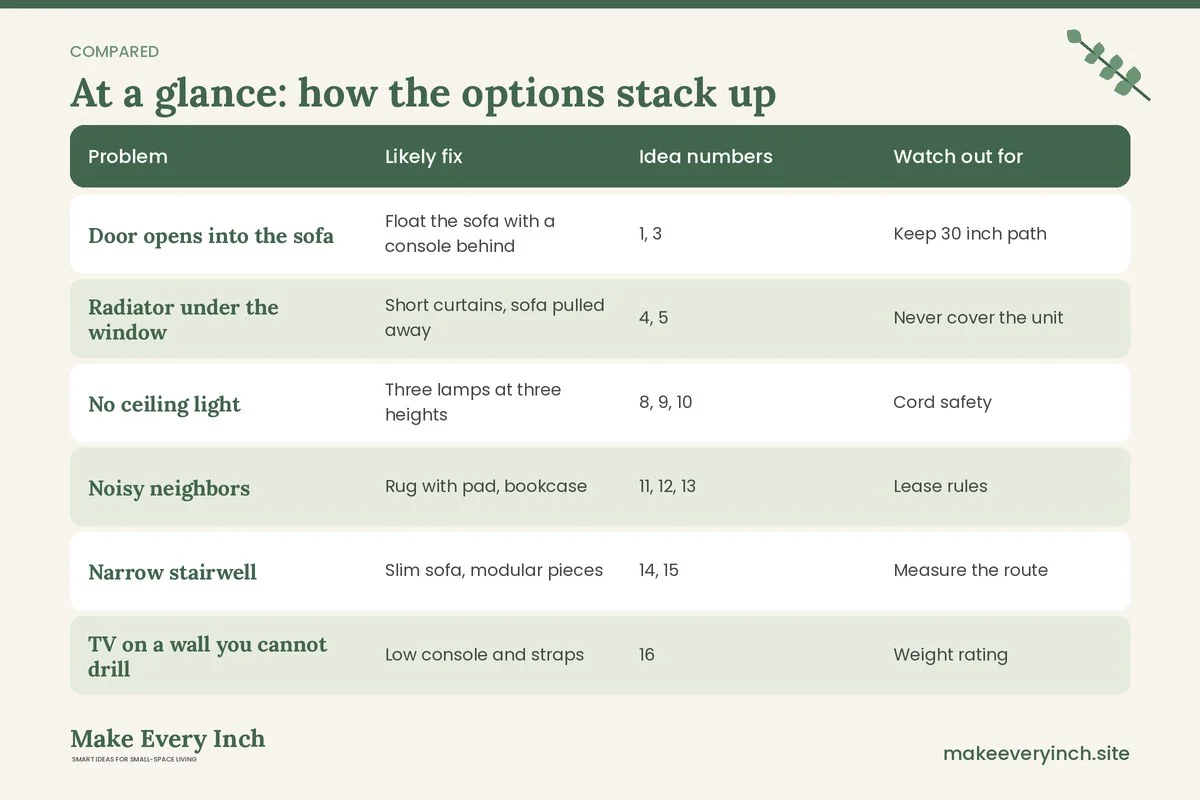
Use this table to match your own apartment’s problem to a likely fix.
| Problem | Likely fix | Idea numbers | Watch out for |
|---|---|---|---|
| Door opens into the sofa | Float the sofa with a console behind | 1, 3 | Keep 30 inch path |
| Radiator under the window | Short curtains, sofa pulled away | 4, 5 | Never cover the unit |
| No ceiling light | Three lamps at three heights | 8, 9, 10 | Cord safety |
| Noisy neighbors | Rug with pad, bookcase | 11, 12, 13 | Lease rules |
| Narrow stairwell | Slim sofa, modular pieces | 14, 15 | Measure the route |
| TV on a wall you cannot drill | Low console and straps | 16 | Weight rating |
| Open plan, no zones | Rug and lamp | 18 | Walkway clearance |
| Balcony door | Low chair and clear arc | 19 | Door swing |
Three example apartment living rooms
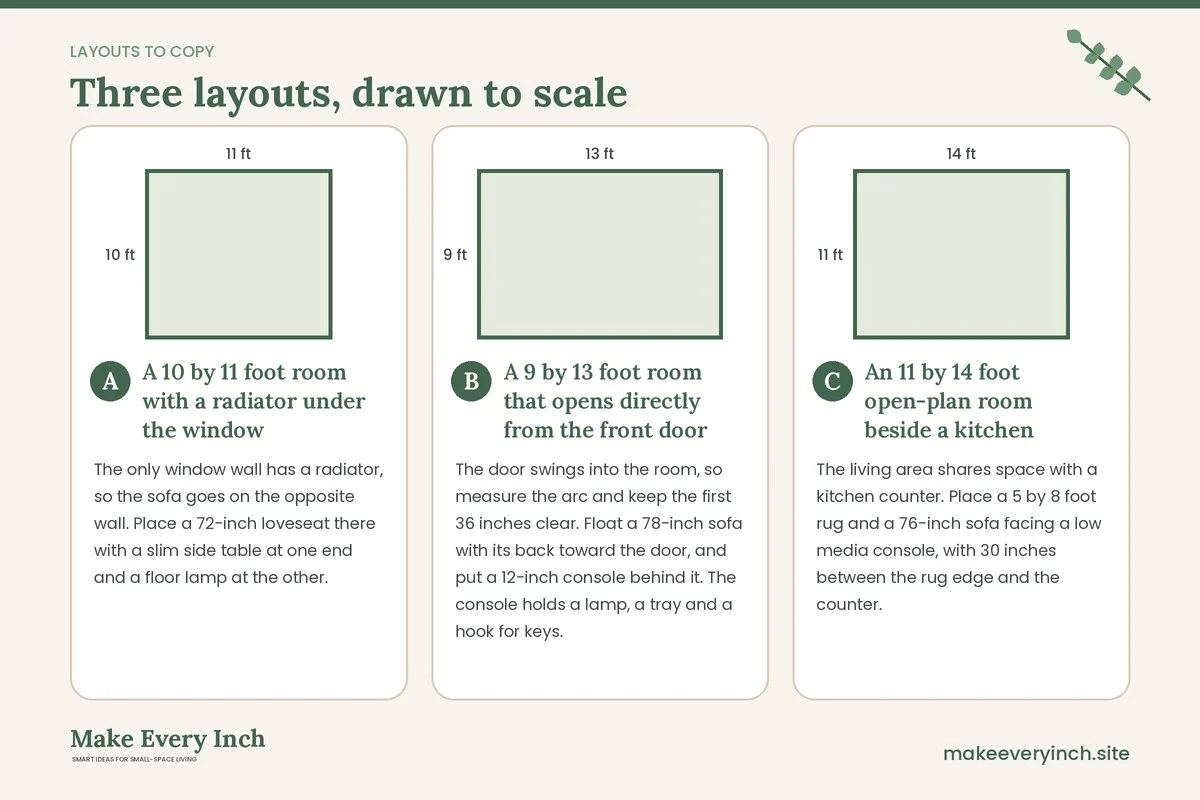
A 10 by 11 foot room with a radiator under the window
The only window wall has a radiator, so the sofa goes on the opposite wall. Place a 72-inch loveseat there with a slim side table at one end and a floor lamp at the other. Hang curtains that stop at the sill, and keep a gap of several inches around the radiator. A 5 by 8 foot rug with a pad sits under the front of the loveseat, and a small round table and a chair fill the corner by the window. The walkway from the door stays at 34 inches. The room works because the heat source is respected and the sofa takes the quiet wall.
A 9 by 13 foot room that opens directly from the front door
The door swings into the room, so measure the arc and keep the first 36 inches clear. Float a 78-inch sofa with its back toward the door, and put a 12-inch console behind it. The console holds a lamp, a tray and a hook for keys. A runner leads from the door to the sofa side, and a low open bookcase on the long wall holds books and baskets. The sofa back screens the seating from the entry. Keep the path along the side at 30 inches, and check that the door opens fully without touching the console.
An 11 by 14 foot open-plan room beside a kitchen
The living area shares space with a kitchen counter. Place a 5 by 8 foot rug and a 76-inch sofa facing a low media console, with 30 inches between the rug edge and the counter. Use a floor lamp behind the sofa, a table lamp on the console and a plug-in sconce near the entry. A narrow bookcase on the shared wall absorbs sound and stores media. The sofa back becomes a visual divider from the kitchen, and a round pouf can be pulled up as a footrest or an extra seat. Keep the cooktop and any open flame clear of fabric.
Safety and lease notes you should not skip
Tall furniture and anchoring
Bookcases, tall shelves, dressers and TV units can tip, which is a real danger for children and pets. Anchor tall pieces to wall studs with the hardware supplied, if your lease allows drilling. If it does not, choose lower furniture, keep heavy items on the bottom shelves and use anti-tip straps that attach without drilling where available. Ask your landlord in writing before you drill.
Electrical load and cords
Do not plug several high-power devices into one strip, and do not run cords under rugs, where they can overheat or be damaged. Use cord covers on the floor, and keep cords clear of walkways. Check that lamps are rated for their bulbs. Read our guide on renter-friendly ways to hide cords for tidy options that do not damage walls.
Ventilation and paint
If you repaint a wall with permission, choose a low-VOC paint and open windows while it dries. New furniture and rugs can release odors, so air the room for a few days before you settle in. Ventilation also helps a closed-up apartment feel fresher.
Heat and fabrics
Keep curtains, throws, lamps and paper away from radiators, heaters and hot bulbs. Maintain space around vents so air can circulate.
Child and pet safety
Secure TVs and shelves, cover unused outlets if small children live there, and avoid dangling cords. Some plants are harmful to pets, so check before you place them in the room.
Budget and shopping order
You rarely need to buy everything at once. Buy the thing that fixes your biggest problem first. For many apartments this is lighting, then a rug, then the sofa or table. Measure twice, check the delivery route and keep your receipts until you know the piece fits. Second-hand furniture often suits small rooms, but check the route and the dimensions before you commit. If you want a cheaper path, read our sibling guide to small living room ideas on a budget.
A weekend plan for a small apartment living room
Saturday morning
Do the building audit. Measure the room, mark door arcs, note the outlets, and photograph the walls and floor. Sketch the room on paper and write down the narrowest point of the route in.
Saturday afternoon
Tape the layout on the floor. Try two layouts, and live with each for an hour. Walk through, sit down, reach for a mug and open every door.
Sunday morning
Place the rug, the lamps and the main furniture. Move the sofa away from heat sources, and check that every door opens fully. Attach any anti-tip straps if allowed.
Sunday afternoon
Style the room. Add a mirror, a plant that suits your light, a throw and a few books. Remove one item that does not earn its place. Take a photo to check that the room feels calm.
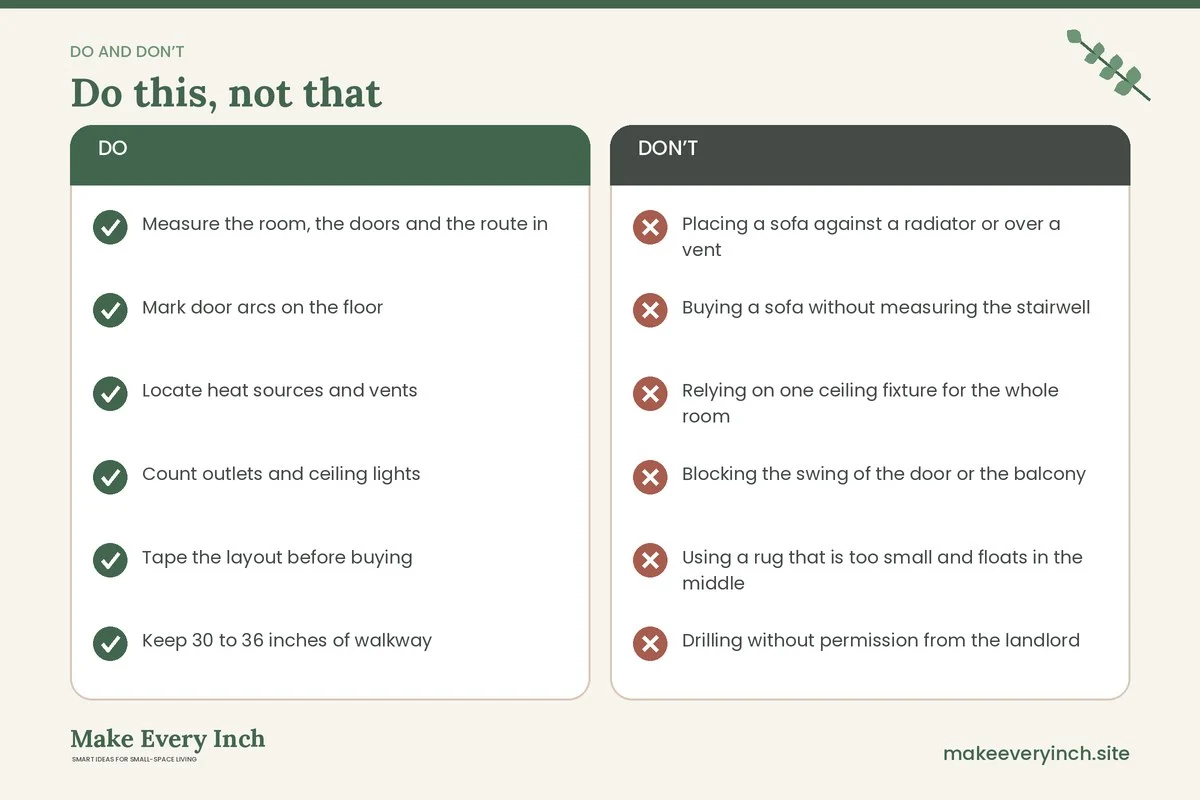
Mistakes to avoid
- Placing a sofa against a radiator or over a vent
- Buying a sofa without measuring the stairwell
- Relying on one ceiling fixture for the whole room
- Blocking the swing of the door or the balcony
- Using a rug that is too small and floats in the middle
- Drilling without permission from the landlord
- Skipping anti-tip straps on tall shelves
- Running cords under rugs
- Filling every wall with furniture and leaving no calm surface
Apartment living room checklist
- Measure the room, the doors and the route in
- Mark door arcs on the floor
- Locate heat sources and vents
- Count outlets and ceiling lights
- Tape the layout before buying
- Keep 30 to 36 inches of walkway
- Add three lamps at three heights
- Use a rug with a pad
- Check the lease before drilling
- Anchor tall pieces or choose low ones
- Keep cords tidy and out of walkways
- Photograph the room at move-in for your records
FAQ
How do I arrange a small living room in an apartment?
Start with the fixed things: doors, windows, heat sources and outlets. Place the sofa on the quietest wall, keep a 30 to 36 inch walkway, and add a rug and lamps to define the seating area.
What size sofa fits a small apartment living room?
Often a 68 to 80 inch sofa or loveseat with slim arms. Measure the room and the route into the building first, since the stairwell may limit what you can bring in.
Can I put furniture in front of a radiator?
Leave a gap of several inches, and never cover the unit with fabric. Blocking heat wastes energy and can damage upholstery. Check your landlord’s guidance.
How can I make an apartment living room quieter for neighbors?
Use a thick rug with a pad, add a full bookcase on a shared wall, and use curtains and upholstered pieces. Check the lease, which may require floor covering.
What can I do if my apartment has no ceiling light?
Use three lamps at different heights, such as a floor lamp, a table lamp and a small accent lamp. Plug-in sconces add more light without using table space.
Do I need permission to hang a TV or shelves?
Usually yes. Ask your landlord in writing before drilling. If drilling is not allowed, use a low console with straps for the TV and freestanding shelves with a wide base.
How do I make a small living room look bigger?
Keep the floor visible, use raised legs, hang curtains high, lean a mirror opposite the window and limit the palette to a few calm tones.
How do I fit a dining spot into the living room?
Use a drop-leaf or round table near the window, and tuck stools under it. Our guide on how to fit a dining area into a small living room has plans.
Keep going: Keep planning with our small living room ideas for renters, small living room layout ideas and studio apartment ideas.
Save this guide for later
Pin the ideas you like to Pinterest so you can come back to them when you plan your space.