15 Small Living Room Ideas on a Budget You Can Do in Order of Impact
Quick answer: The best small living room ideas on a budget are the ones that change the room before you spend anything: rearrange furniture, clear the floor, edit surfaces, move lamps and borrow pieces from other rooms. Then add low-cost upgrades in order of impact: warm lighting, a right-sized rug, curtains hung high, a mirror and thrifted or secondhand furniture. Measure first, buy last, and check the lease before painting or drilling.
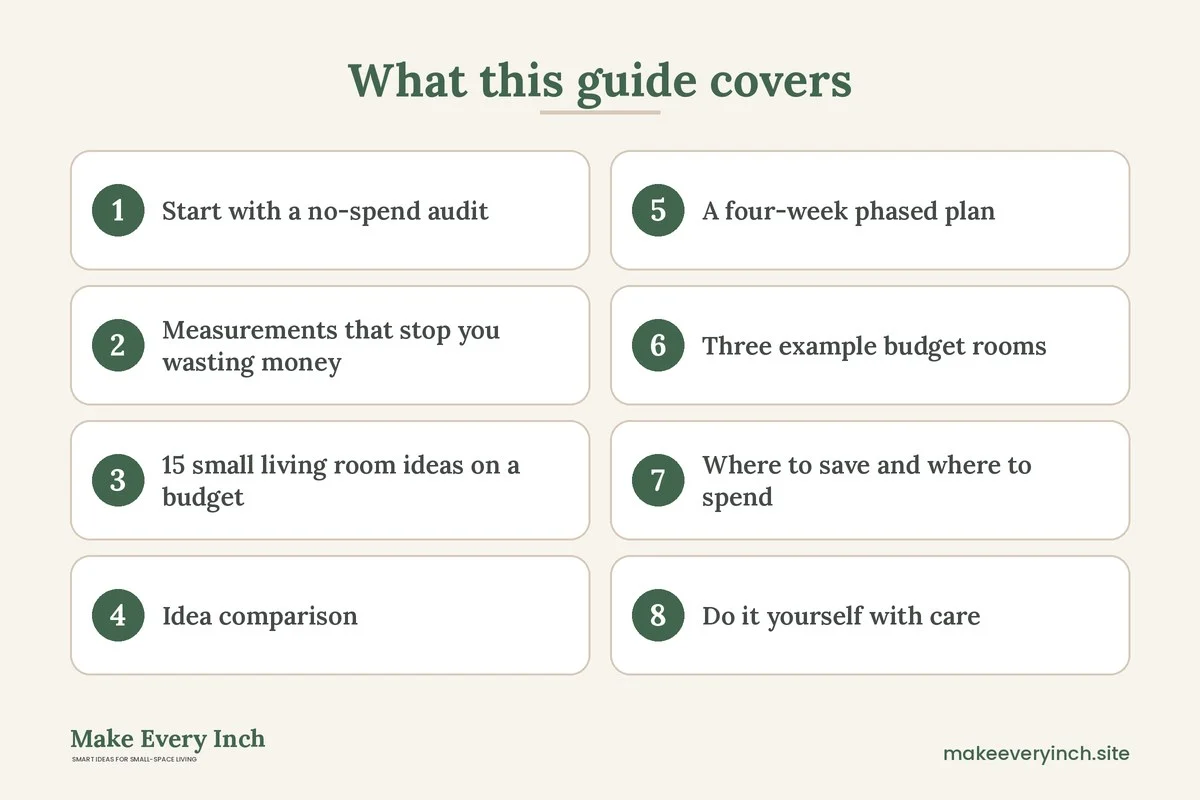
Small living room ideas on a budget work best when you treat spending as the last step, not the first. Most small rooms feel cramped because of layout, light and clutter, and none of those problems need a shopping trip to solve. This guide ranks 15 ideas by how much they change the room per unit of effort, starting with free changes and moving toward modest purchases. It covers a no-spend audit, the measurements that stop you wasting money, the 15 ideas, a table that compares effort and impact, a phased plan you can follow over a month, three example rooms, safety notes, mistakes and a checklist. We deliberately avoid quoting prices, because they vary by place and season, and instead group ideas into free, low and moderate effort. For the main overview, read our small living room ideas pillar, and for a version aimed at apartment constraints, see small living room ideas for apartments.
Start with a no-spend audit
Before opening a shopping app, spend one evening answering four questions. The answers decide where your limited money goes, and they often reveal that you already own most of what the room needs.
What annoys you most?
Sit in the room for ten minutes and write down every irritation. Common answers are a dark corner, nowhere to put a drink, a sofa that blocks the door, a TV with cords hanging down and a pile of things with no home. Rank the list. The top item gets money and attention first, and the bottom items may simply disappear when you rearrange.
What do you already own?
Walk through the whole home. A bedroom lamp, a spare stool, a bookcase in the closet, a large mirror in the hall and a pillowcase set can all serve the living room. Borrowing from other rooms costs nothing and lets you test an idea before buying a similar item.
What does the room really hold?
List what lives in the room: seating for how many, a TV or not, a work spot or not, storage for what. Many small rooms hold furniture for a larger life than the one that happens there. If you have a chair no one sits in, a table that only collects mail or a shelf of items you no longer use, you may have a free solution in subtraction.
What can you not change?
Note the lease rules on painting and drilling, the position of outlets and radiators and the swing of doors. Spending money on something you later cannot install is the most common budget mistake in a rental.
Measurements that stop you wasting money
Measuring is a budget tool. A piece that does not fit is the most expensive piece of all, because you pay for it twice when you return or replace it. Keep these numbers handy.
- Main walkway: 30 to 36 inches clear from the door through the room.
- Sofa to coffee table: about 14 to 18 inches.
- Rug size: often 5 by 8 feet in a small room, with at least the front legs of the sofa on the rug.
- Curtain rod height: hang it close to the ceiling, or 4 to 6 inches above the window frame, and let panels fall to the floor.
- Lamp spacing: one light source on each side of the room, at different heights, rather than a single bright light.
- TV height: the center of the screen near eye level when seated, often 40 to 44 inches from the floor.
- Door and stair route: the narrowest point along the way in, which limits sofa length.
Use painter’s tape to mark any new piece on the floor, and cut cardboard to the size of a table or shelf and stand it in place. If the cardboard blocks a path or looks too bulky for a day, the real piece will too. Our guide on how to measure furniture for a small room shows the method in detail.
15 small living room ideas on a budget
Free changes first
1. Rearrange before you buy
Try three layouts: the sofa on the long wall, the sofa floating with its back to the entry and the sofa angled in a corner. Tape each one on the floor and sit in it for an hour. Many small rooms feel bigger after the largest piece moves 12 inches. See our small living room layout ideas for plans to try.
2. Clear the floor and the surfaces
Remove everything from the floor that is not furniture, and clear every flat surface, then return only what you use daily. Visible floor is the cheapest way to make a room feel larger. Put the removed items in a box for a month, and donate what you did not miss.
3. Shop your own home
Move a lamp from the bedroom, a mirror from the hall, a throw from a closet and a stool from the kitchen. Treat the living room as a stage and your home as the prop closet. You may find that you need less than you thought.
4. Rotate the furniture’s job
A bench that was at the foot of the bed can serve as a coffee table with a tray. A bookcase can become a room divider. A kitchen cart can hold drinks beside the sofa. Reusing furniture in a new role keeps spending near zero.
5. Edit the wall decor
Cluster the art you own into one calm grouping instead of spreading small frames around the room. Fewer, larger arrangements look more intentional. If you do not want to drill, lean frames on a shelf or a console. Read our guide to renter-friendly wall decor ideas for options that need no tools.
Low-effort upgrades with the biggest payoff
6. Warm up the lighting
Swap a harsh bulb for a warm one, around 2700 kelvin, and add a second and third light at different heights. A small room with three soft pools of light looks bigger and cozier than one with a single bright fixture. Make sure each bulb is rated for its lamp and keep shades away from the bulb. See our small living room lighting ideas on a budget.
7. Hang curtains high and wide
Mount the rod close to the ceiling and let the panels extend a few inches beyond the window on each side. This makes the window look larger and the ceiling taller. Use a tension rod if you cannot drill. Choose light fabric that lets daylight in. Our guide to renter-friendly window treatment ideas covers rods and fabrics.
8. Lean a big mirror opposite the window
A large mirror bounces daylight and doubles the sense of depth. Lean it against the wall rather than hanging it if you cannot drill, and keep the base secured so it cannot slide or tip. Do not place it where it reflects direct sun onto fabrics or surfaces that could be damaged. See our small room mirror placement ideas.
9. Paint a small, high-impact area, if permitted
If your lease allows painting, one wall or a bookcase back in a low-VOC paint changes the room more than any accessory. Ventilate while it dries and keep the room aired for a few days after. If painting is not allowed, use a removable approach, such as a large piece of fabric on a tension rod or art leaned in layers. See our post on small room paint ideas for low light.
10. Hide the cords
A tangle of cords makes any room feel messy. Gather them with ties, run them along the baseboard in a paintable cover and use a power strip with a cover box. Never run cords under rugs, and never overload one outlet. Our guide to renter-friendly ways to hide cords has tidy options.
Moderate purchases that earn their place
11. A right-sized rug
A rug that is too small makes a room look chopped up. A 5 by 8 foot rug with the front legs of the sofa on it ties the seating together. Look for flat-weave rugs, which sit well under furniture, and use a pad to prevent slipping. See our guide on how to choose rug size for a small living room.
12. A secondhand sofa or chair
Used furniture is often the best value in a small room, because older pieces tend to be sturdy and slim. Check the frame, the stability of the legs and the smell, and measure the route into your home. Cover a dated sofa with a washable slipcover to refresh it. For help choosing, read our guide on how to choose a sofa for a small living room.
13. Nesting tables
Two nesting tables replace a single coffee table and a side table, and they tuck away when you need the floor. Look for sturdy legs and rounded corners. See our list of best nesting tables for small apartments for features worth checking.
14. A tall, narrow shelf in a corner
Vertical storage costs less than a wider unit and takes less floor. Anchor it to the wall if you can, or choose a low one, and keep heavy items on the bottom shelves. See our small living room storage ideas for ways to fill it neatly.
15. A plant or two
A few plants add life for a small spend. Choose ones that suit your light, and check that they are safe for pets and children. A single large plant in a corner makes more impact than several small ones scattered around.
Idea comparison: effort, impact and risk
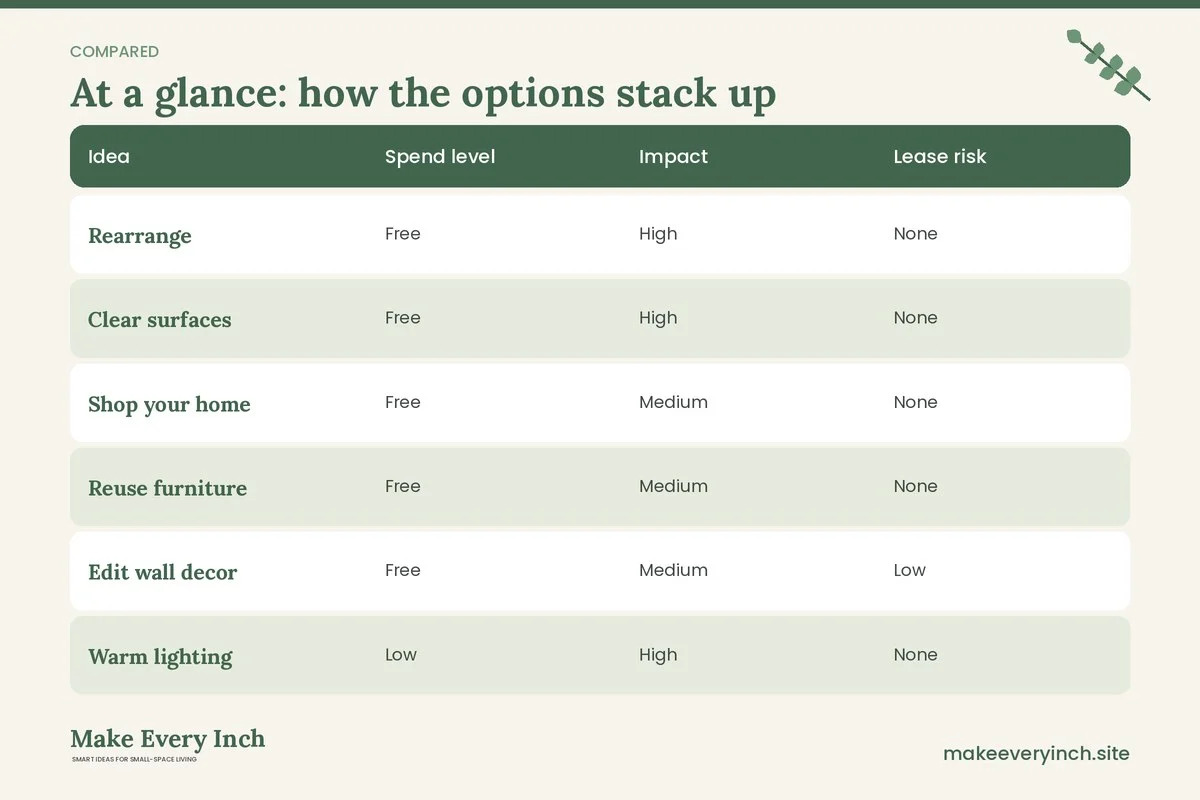
The table below compares the 15 ideas by how much effort they need, how much they change the room and what to watch for. Cost is shown as a range of effort rather than a price.
| Idea | Spend level | Impact | Lease risk | Watch out for |
|---|---|---|---|---|
| Rearrange | Free | High | None | Door swings |
| Clear surfaces | Free | High | None | Keep daily items |
| Shop your home | Free | Medium | None | Matching styles |
| Reuse furniture | Free | Medium | None | Stability |
| Edit wall decor | Free | Medium | Low | Weight limits |
| Warm lighting | Low | High | None | Bulb ratings |
| High curtains | Low | High | Low | Rod weight |
| Leaning mirror | Low | High | None | Tipping |
| Small paint area | Low | High | Needs permission | Low-VOC, ventilation |
| Hide cords | Low | Medium | Low | Overload |
| Right-sized rug | Moderate | High | None | Trip edges |
| Secondhand sofa | Moderate | High | None | Route and frame |
| Nesting tables | Moderate | Medium | None | Stability |
| Tall corner shelf | Moderate | Medium | Needs permission | Anchoring |
| Plants | Low | Medium | None | Pet safety |
A four-week phased plan
A budget works better when you spread it out. Making one change a week lets you see what each one does and stops you buying things you do not need.
Week one: free changes
Do the no-spend audit, rearrange, clear the floor and the surfaces, and shop your home. Live with the new layout for the whole week. Write down what still annoys you.
Week two: light
Swap bulbs for warm ones, move lamps to create three pools of light and hang or lean a mirror. Test the room in the evening. Most of the cozy feeling comes from this step.
Week three: soft layers
Add or resize the rug, hang curtains high and add a throw and cushions from your own stock. Keep the color palette to three or four tones, such as a light neutral, a mid tone and one accent. If you need a new item, find it secondhand first.
Week four: the one purchase
Decide on a single item that fixes the biggest remaining problem, such as a sofa, a table or a shelf. Measure the space, cut cardboard and check the route. Buy it only when you are sure. Then stop and enjoy the room for a month before you buy anything else.
Three example budget rooms
A 10 by 12 foot room, rearranged and lit
The owner starts with a sofa on the short wall, which blocks the window and leaves a narrow path. By moving the sofa to the long wall and floating a stool by the window, the walkway grows to 34 inches. A lamp from the bedroom and a warm bulb replace a bright ceiling light. A leaning mirror from the hall sits opposite the window. The only purchase is a rug of 5 by 8 feet, chosen secondhand. The room looks larger because the floor is clearer and the light is softer.
An 11 by 13 foot rental with no drilling allowed
The lease bans nails and paint. The renter uses a tension rod for high curtains, leans a large canvas on a console, hangs a tapestry from adhesive hooks rated for its weight and hides cords in a paintable cover. A thrifted loveseat of 70 inches, with a washable slipcover, replaces a bulky sofa. A pair of nesting tables serves as a coffee table. Everything can leave with the tenant, which keeps the deposit safe. For more, read our small living room ideas for renters.
A 9 by 14 foot narrow room
The room is long and thin, so the owner keeps the sofa on one long wall and uses a slim console on the other. A round table sits near the window instead of a rectangular one, so the path stays clear. Curtains hang high to draw the eye upward, and a tall, narrow shelf stands in a corner, anchored to the wall with permission. The owner borrowed the lamps, the mirror and the plants from other rooms. Total new purchases are a rug and a shelf.

Where to save and where to spend
Some items repay a little more care than others. Spend your limited money on the items you touch and use every day, such as the seat of the sofa, a bulb and lamp that suit your eyes and a rug pad that keeps the rug in place. Save on items that are decorative and easy to swap, such as frames, cushion covers, vases and baskets, which you can find secondhand or make yourself. Avoid cheap items that wear out fast and need replacing, like very thin shelves that bow, wobbly side tables or flimsy rods that cannot hold curtains. A modest, sturdy piece is better than a trendy one that fails in a year.
Do it yourself with care
Simple projects can stretch a budget. Sand and paint a secondhand table, make a cushion cover from fabric, build a rug from a thick runner or stack crates as a shelf. Follow safety basics. Wear a mask and use gloves when sanding or painting, ventilate the room, choose low-VOC paint and check old furniture for lead paint if it dates from before the 1980s. Do not build tall free-standing shelves without a stable base and an anchor. Do not add electrical wiring or modify a lamp cord yourself. Use ready-made, rated products for anything involving power. For more, see our guide to DIY apartment upgrades.
Safety notes for budget rooms
Anchor tall pieces
Secondhand bookcases and shelves can tip. Anchor them to the wall studs if the lease allows, or choose a low model, and place heavy items low. Secure the TV with straps. Children and pets make this more important.
Check electrical items
Inspect secondhand lamps for frayed cords, cracked sockets and missing plugs. Do not use any lamp that is damaged. Use bulbs at or below the rated wattage. Do not overload outlets or strips.
Watch the weight limits
Adhesive hooks and strips have limits. Use them for light items, check the rating and do not hang a large mirror over a sofa or a bed on adhesive.
Air and fumes
Air out secondhand furniture and new rugs before bringing them into a closed room, and use low-VOC finishes on any paint or refinishing project.
Lease permission
Never drill or paint without permission. Photograph the room at move-in, and keep records of what you changed.
Mistakes to avoid on a budget
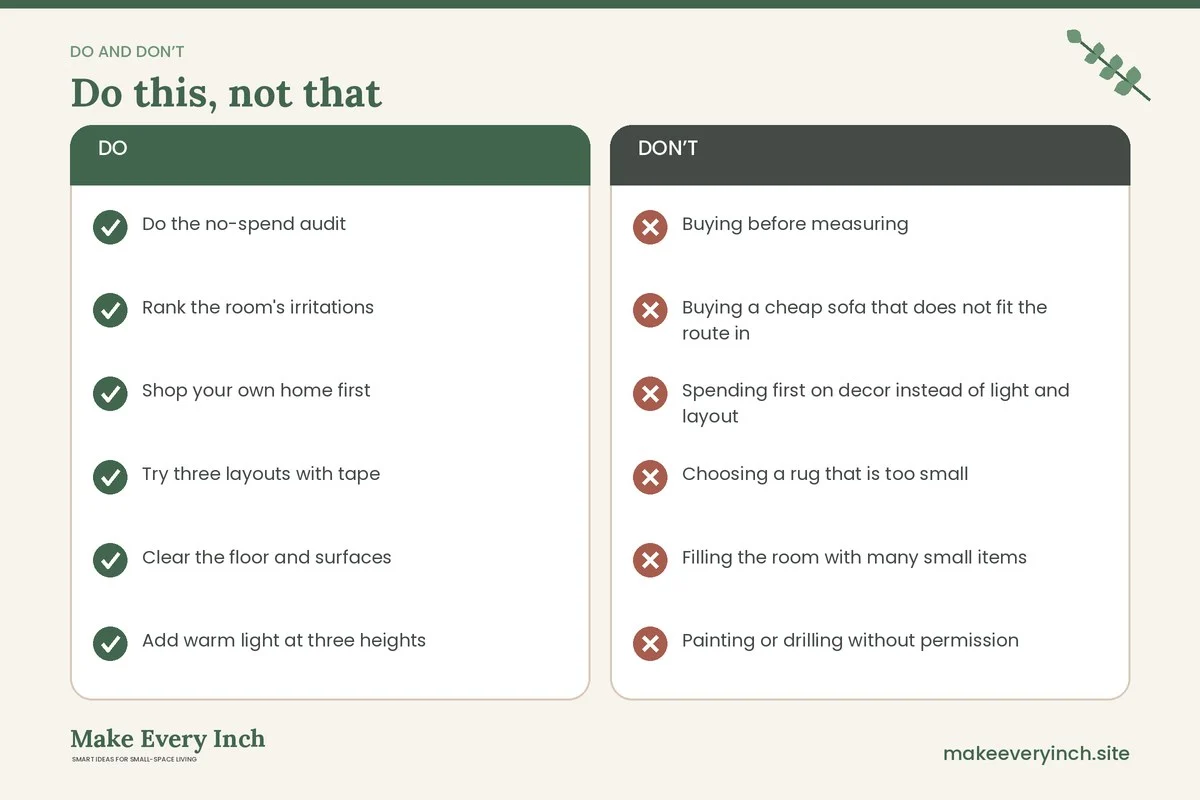
- Buying before measuring
- Buying a cheap sofa that does not fit the route in
- Spending first on decor instead of light and layout
- Choosing a rug that is too small
- Filling the room with many small items
- Painting or drilling without permission
- Using damaged secondhand lamps
- Skipping anchoring on tall shelves
- Chasing every trend, then replacing items a year later
Budget living room checklist
- Do the no-spend audit
- Rank the room’s irritations
- Shop your own home first
- Try three layouts with tape
- Clear the floor and surfaces
- Add warm light at three heights
- Hang curtains high
- Lean a mirror opposite the window
- Measure for a 5 by 8 foot rug
- Set one purchase at a time
- Anchor tall furniture
- Check the lease before painting or drilling
FAQ
What is the cheapest way to make a small living room look bigger?
Rearrange the furniture, clear the floor, add warm lighting, hang curtains high and lean a mirror opposite the window. None of these needs a large spend.
What should I buy first for a small living room?
Buy the item that fixes your biggest annoyance. For many rooms this is lighting or a right-sized rug. Avoid buying decor before you fix layout and light.
Is secondhand furniture a good idea for a small room?
Often yes, because older pieces tend to be sturdy and slim. Check the frame, stability and smell, measure the route into your home and avoid damaged electrical items.
How do I decorate a rental living room on a budget?
Use leaning art, tension rods, rugs, lamps and removable options, and ask before drilling or painting. See our guide on renter-friendly decor ideas on a budget.
How can I add storage without spending a lot?
Use a tall, narrow shelf, baskets, an ottoman with a lid and the space under the sofa. Our guide to cheap storage ideas for apartments has more options.
Should I paint to save money?
Painting a small area can have a big effect for a modest outlay, but only with permission. Use low-VOC paint and ventilate the room.
How do I avoid wasting money on furniture that does not fit?
Measure the room and the route, tape the footprint on the floor and cut cardboard to size. Test it for a day before you buy.
How do I plan the order of purchases?
Fix layout first, then light, then soft layers and last the single largest piece. Our guide to how to furnish a small apartment on a budget breaks down a full home.
Keep going: Keep planning with our small living room furniture ideas on a budget, small living room makeover ideas on a budget and small living room storage ideas on a budget.
Save this guide for later
Pin the ideas you like to Pinterest so you can come back to them when you plan your space.