Small Bedroom Ideas with a King Bed
Quick answer: Small bedroom ideas with a king bed begin with the math. A standard king is about 76 by 80 inches, so a room of at least 11 by 12 feet can hold one with walkways, while a 10 by 10 foot room is very tight. Leave 24 to 30 inches on each open side, swap nightstands for wall shelves or sconces, pick a slim headboard and measure the door path before you buy.
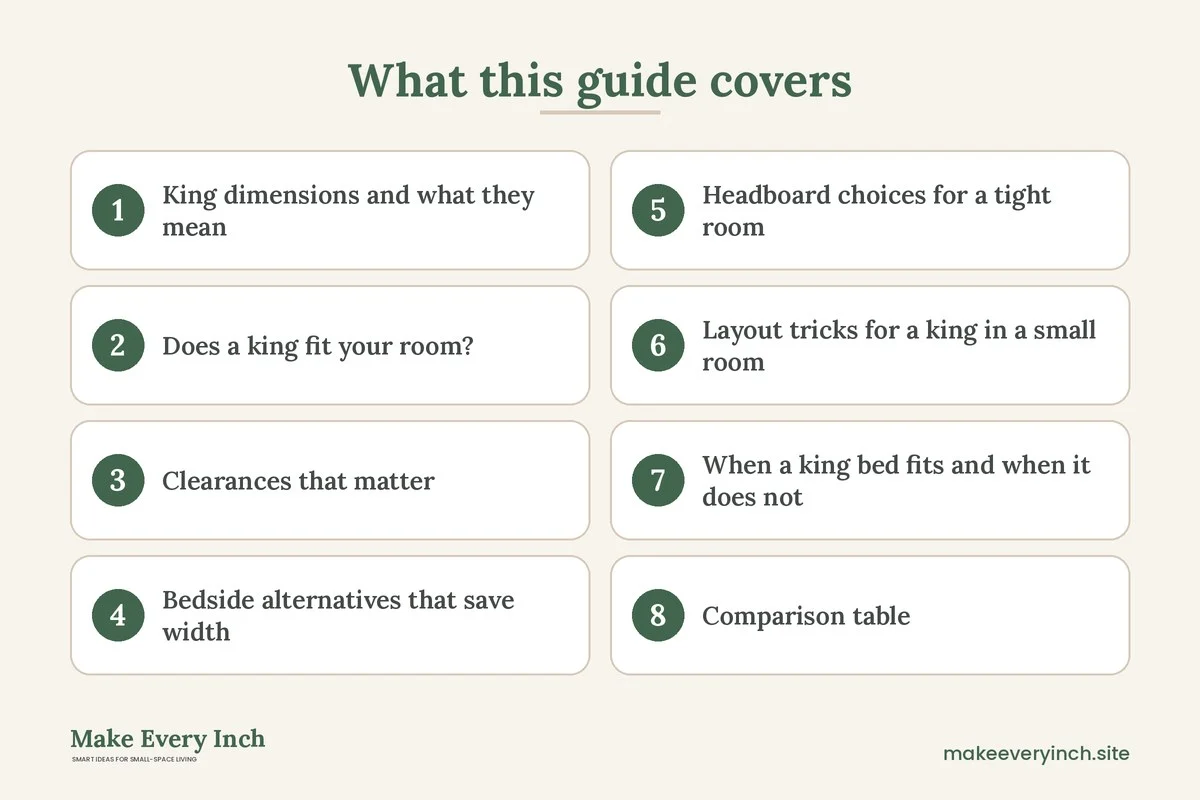
Small bedroom ideas with a king bed sound like a contradiction, but plenty of people sleep better on a wide mattress and live in a modest room. The question is not whether a king is allowed. It is whether the numbers work, and what you give up to make them work. A king is about 76 inches wide, which is 16 inches wider than a queen, and that extra width disappears from your walkways, your bedside space and sometimes your closet access. This guide starts with the dimensions and the room sizes where a king fits, fits with sacrifices or does not fit. It then covers clearances, bedside alternatives, headboard choices, layout tricks, a comparison table, three example rooms, delivery and safety notes and a checklist. For the overall picture, read our pillar guide to small bedroom ideas and the companion post on small bedroom layout ideas. If you are still comparing sizes, see our post on small bedroom ideas with a queen bed, and if storage is your next problem, read small bedroom storage ideas that save floor space.
King dimensions and what they mean
Bed sizes vary a little between makers, and mattress, frame and bedding all add to the footprint. Use these numbers as planning guides and check the actual product before you commit.
- Standard king (sometimes called an eastern king): about 76 by 80 inches, which is 6 feet 4 inches by 6 feet 8 inches.
- California king: about 72 by 84 inches. It is narrower and longer, and often suits a narrow, long room better.
- Queen: about 60 by 80 inches, included here for comparison.
- Frame allowance: add 2 to 6 inches on each side and at the foot for a frame, a bed skirt or a platform edge. A storage base or a wide upholstered frame may add more.
- Headboard depth: a flat panel adds 1 to 3 inches, while a thick upholstered headboard can add 4 to 8 inches.
A king with a typical frame is about 80 to 84 inches wide and 84 to 88 inches long. Put that in a 10-foot-wide room, which is 120 inches, and you have 36 to 40 inches left for everything else. Divided between two sides, that is 18 to 20 inches each, which is a squeeze. In a 12-foot room, the same math leaves 60 inches for two 30-inch walkways, which is comfortable. The difference between 10 and 12 feet is the difference between a tight shuffle and an easy morning.
Mattress weight matters too. A king mattress is heavy and awkward, and many weigh between 80 and 150 pounds depending on type. That affects delivery, stairs and the frame you choose. Check the frame’s weight rating and the manufacturer’s guidance for the mattress type.
Does a king fit your room?
Measure the room wall to wall, not from the baseboard, and note the position of the door, the window and any radiator or vent. Then use this rule of thumb: a room’s short side should be at least 11 feet for a king to leave a comfortable path on both sides, and 10 feet is workable with trade-offs. Below that, a king usually crowds the room.
Here are common cases.
- Under 10 by 10 feet: a king is generally a poor fit. It leaves less than 20 inches on the sides, and the door may hit the bed. A queen or a full is usually wiser.
- 10 by 10 to 10 by 12 feet: a king can fit, but expect trade-offs. You will likely lose nightstands and a dresser in the room, and one side may be pushed against a wall.
- 11 by 12 feet: a king fits with a 24- to 30-inch path on both sides, a slim dresser and wall-mounted bedside storage.
- 12 by 12 feet or larger: a king fits with room for a dresser, a chair or a small desk.
- Long and narrow rooms: consider a California king. Its 72-inch width saves 4 inches of walkway space.
If you are on the borderline, tape the bed on the floor. Use painter’s tape to mark 80 by 84 inches, then add a tape line for each walkway. Walk the route from the door to the window, to the closet and around the bed. Leave the tape down for a few days. If the shape feels cramped in daily life, a smaller bed will serve you better. The tape test is free and avoids a costly mistake.
Clearances that matter
A bed is not just a rectangle on the floor. You need to get in and out, make it, open doors and reach storage. These guides keep the room workable.
- Side walkways: 24 to 30 inches on each side is comfortable. 18 to 20 inches is the practical minimum for one side, such as against a wall that you rarely use.
- Foot of the bed: 24 to 36 inches if there is a path to the closet or the window. A bench at the foot needs 12 to 18 inches of depth on top of that.
- Door swing: the door should open at least 90 degrees without hitting the bed. If it does not, consider an outward-opening door, a sliding door or a smaller bed.
- Dresser drawers: leave 30 to 36 inches in front of a dresser so drawers open and you can stand.
- Closet doors: hinged doors need their swing area plus space to stand. Sliding or bi-fold doors need less.
- Window access: keep a clear route to the window for ventilation and for emergency escape. Do not block it with a headboard or tall furniture where local safety guidance requires access.
- Heating and cooling: keep a few inches between the bed and any radiator, vent or heater, and do not cover them with bedding or furniture.
The most useful trick is the one-side rule. In a tight room, push one side of the king against a wall and use the other side as the main path. This gains up to 30 inches of floor space at the cost of one person climbing in from the foot. That trade suits a single sleeper far better than a couple, so decide before you commit.
Bedside alternatives that save width
A king bed with two matching nightstands needs a lot of wall. Each nightstand is 16 to 24 inches wide, so the full set adds 32 to 48 inches to a 76-inch bed. In a 10- to 11-foot room that is simply too much. These alternatives keep a surface by the bed without eating the walkway.
1. Wall-mounted shelves
A shelf 6 to 8 inches deep and 16 to 20 inches wide holds a lamp, a phone and a glass of water. Mount it at about the height of the top of the mattress, and attach it to studs or with anchors suited to the load. Never drill without permission if you rent. See our post on renter-friendly shelving for lease-safe options.
2. Wall sconces and plug-in lights
Lighting off the bedside surface frees the surface for other uses. Use a plug-in sconce with a cord cover rather than hardwiring, unless a qualified electrician does the work. Keep cords tidy, off the walkway and away from the bed.
3. A narrow ledge or picture rail
A ledge 3 to 4 inches deep running across the wall above the headboard holds a phone, glasses and a small light. It takes no floor and works for both sides.
4. A slim stool or a side table with a small top
A round stool or a tall, narrow table, 10 to 12 inches across, serves as a bedside without the bulk of a nightstand. It can slide away when you make the bed.
5. A shared bench or console at the foot
If the bedside space is too narrow, put a bench at the foot of the bed for clothes and a console elsewhere for chargers. Mixed-up surfaces keep the sides clear.
6. A headboard with built-in shelves
A headboard with a shallow shelf, 4 to 6 inches deep, keeps essentials within reach. Check that it does not push the bed forward.
7. A single nightstand on the open side
When one side is against the wall, put the only nightstand on the other side. Add a wall shelf on the wall side for the second sleeper if needed.
For more on keeping the floor free, see our guide to small bedroom furniture ideas.
Headboard choices for a tight room
A king headboard is a large visual object, and its depth and height both matter in a small room.
- No headboard, painted or decal. A painted arch or a band of color behind the bed gives the look of a headboard with zero depth. Use low-VOC paint, keep the window open while it dries and let the room air before sleeping. In a rental, ask first, or use removable wall decals.
- Slim wood or metal panel. A flat frame of 1 to 3 inches adds style without losing space. Metal frames look lighter, and wood adds warmth.
- Wall-mounted headboard. A panel fixed to the wall leaves the floor beneath the bed free for cleaning and storage. It needs sturdy fixings and the right anchors, so check the wall type and the weight.
- Upholstered headboard. Soft, comfortable and often 4 to 8 inches deep. In a tight room, choose a slim or tufted-flat version, or one that tucks against the wall.
- Storage headboard. Useful, but check the depth and the weight, and make sure it does not block outlets.
- A tall headboard. A tall panel makes the ceiling look higher and fills the wall. In a room with a low ceiling or a sloped wall, a lower profile works better.
- A shared visual solution. A large piece of art, a leaning mirror, or a fabric hanging on a rod above the bed can replace a headboard entirely. See our guide to renter-friendly wall decor ideas for options that do not damage walls.
Remember to check the room’s electrical outlets before positioning the headboard. Do not cover sockets, and leave access to switches. If a headboard blocks an outlet, use a short extension cord properly rated for the load, and never run it under a rug.
Layout tricks for a king in a small room
1. Center it on the wall, or push it to one side
Centering looks balanced and gives equal paths. Pushing it to one wall gains floor space, but one person climbs in from the foot. Choose by whether you sleep alone.
2. Place the head of the bed against the shortest wall
Putting the head on the short wall leaves the long walkway at the sides. Putting it on the long wall leaves a short walkway at the foot. Compare both with tape.
3. Avoid placing the foot in line with the door
A bed whose foot points straight at the doorway blocks the view and the path. Angle the layout so the door opens onto a clear path, or place the bed on the wall beside the door.
4. Use the corner
Placing the bed in a corner makes room for a dresser or a desk on the opposite wall. This is a one-side layout, so it suits one sleeper or a couple who accept climbing in from the foot.
5. Choose a low-profile frame
A low frame keeps the room open, particularly under windows. A platform bed without a footboard looks lighter, and the lack of a foot panel gives a bit more room.
6. Replace the dresser with a tall, narrow chest
A chest 16 to 20 inches deep and 48 to 54 inches tall holds as much as a dresser. Pair it with the under-bed zone. For ideas, read our guide to the best small dressers.
7. Use the under-bed zone
A king base has a large volume below. Drawers, bins and rolling boxes hold off-season clothing. See our post on under-bed storage ideas for sizes and containers.
8. Hang storage, don’t stack it
A wall-hung rail, over-door racks and wall shelves take the load off the floor. For an overview of the strongest options, read our guide to vertical storage ideas.
9. Go light on color and bulk
Pale walls, a bed in a similar tone and a simple duvet shrink the visual weight of the bed. A heavy dark bedspread on a king will dominate the room. Use fewer decorative cushions, and choose a throw you can fold away.
10. Add a mirror
A large mirror opposite a window bounces light and makes the room feel deeper. Mount it securely, or lean it against the wall on a stable base. Tall mirrors can tip, so anchor them.
When a king bed fits and when it does not
A king is a good choice if you are tall, if you share the bed and sleep better with space, or if you have a child or a pet who joins you. It is a poor choice if the room is under about 10 by 11 feet, if the door swings into the bed, or if the bed blocks the closet or the window.
Ask yourself these questions.
- Can I walk around three sides without turning sideways?
- Does the door open fully?
- Can I open the dresser drawers and the closet?
- Can I get the mattress up the stairs and through the door?
- Will I still have a place to sit and put on shoes?
If you answer no to more than one, consider a queen, or a California king for a long, narrow room. A queen saves 16 inches of width, which is roughly one whole walkway. If you worry about sleeping space, consider a queen bed with a wider mattress topper or a separate sleeping arrangement such as two twin extra-long beds pushed together, which are the same width as a king but can be moved separately.
Comparison table: king in different room sizes
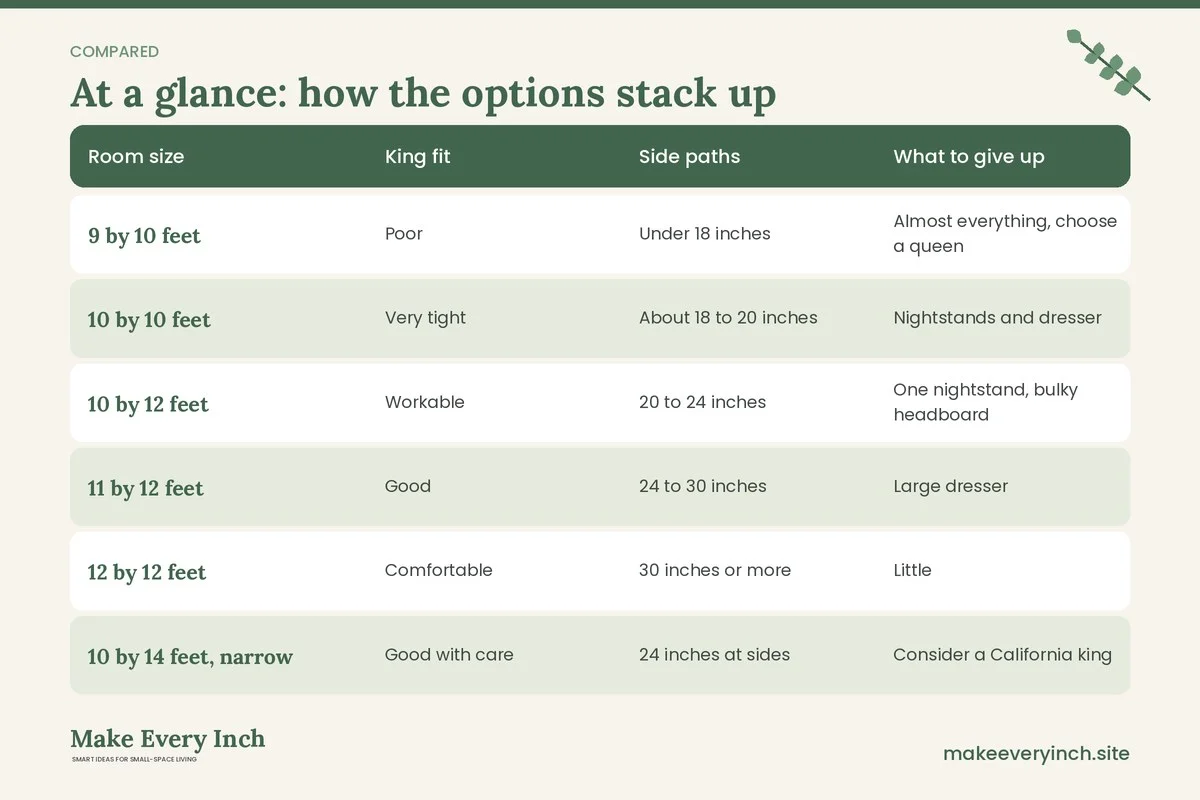
The table is a planning guide. Real rooms have doors, windows and furniture, so always confirm with tape and a tape measure.
| Room size | King fit | Side paths | What to give up |
|---|---|---|---|
| 9 by 10 feet | Poor | Under 18 inches | Almost everything, choose a queen |
| 10 by 10 feet | Very tight | About 18 to 20 inches | Nightstands and dresser |
| 10 by 12 feet | Workable | 20 to 24 inches | One nightstand, bulky headboard |
| 11 by 12 feet | Good | 24 to 30 inches | Large dresser |
| 12 by 12 feet | Comfortable | 30 inches or more | Little |
| 10 by 14 feet, narrow | Good with care | 24 inches at sides | Consider a California king |
Three example rooms
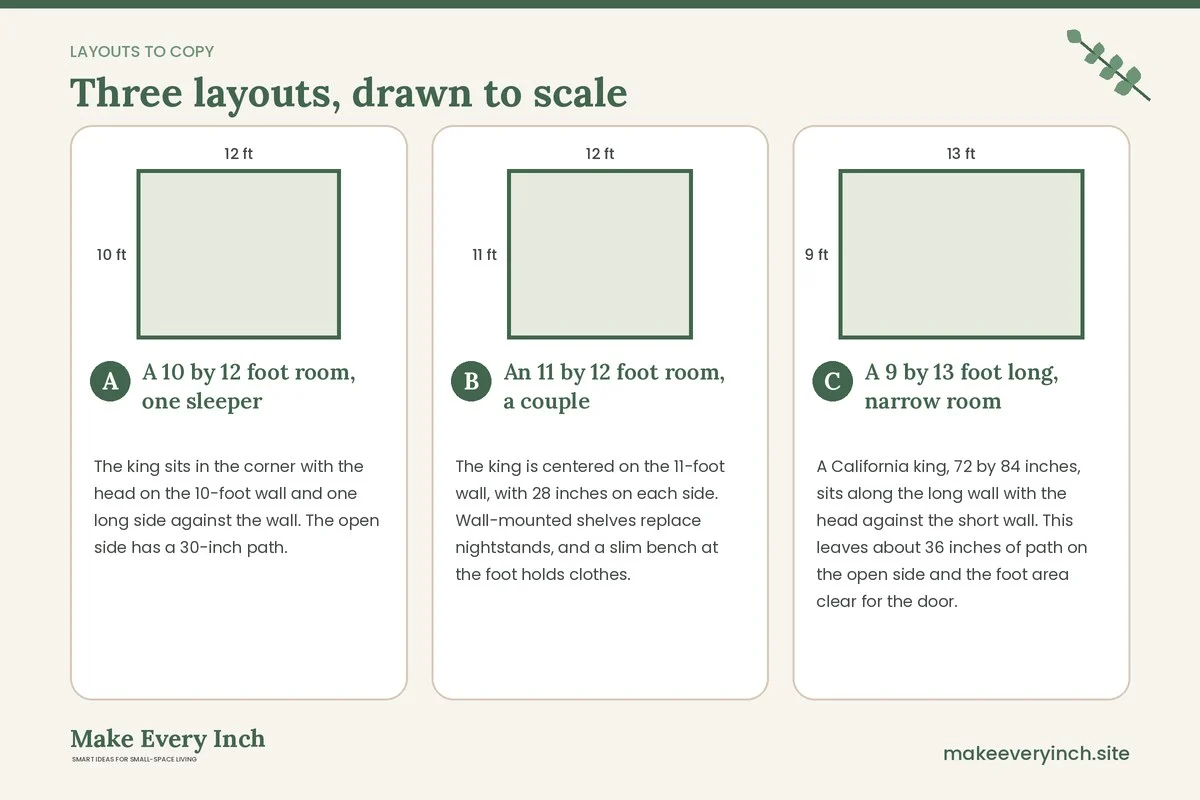
A 10 by 12 foot room, one sleeper
The king sits in the corner with the head on the 10-foot wall and one long side against the wall. The open side has a 30-inch path. There is a wall shelf instead of a nightstand, a tall 18-inch-deep chest at the foot wall, and a plug-in sconce above the pillow. A slim wood headboard keeps the depth under 3 inches. The room feels full but livable, and it works because only one person uses the bed.
An 11 by 12 foot room, a couple
The king is centered on the 11-foot wall, with 28 inches on each side. Wall-mounted shelves replace nightstands, and a slim bench at the foot holds clothes. A tall dresser, 16 inches deep, sits on the opposite wall with 34 inches of clearance. The door opens fully without touching the bed. Sconces and a mirror keep the room bright. See our guide to small bedroom ideas for couples for more on sharing a room.
A 9 by 13 foot long, narrow room
A California king, 72 by 84 inches, sits along the long wall with the head against the short wall. This leaves about 36 inches of path on the open side and the foot area clear for the door. A stool replaces the nightstand and a rail on the wall carries a few clothes. The long shape suits the longer mattress and keeps the walkway to the window clear.
Delivery, setup and safety
- Measure the route. Check doors, stair turns, hallways and elevators before you order. A king mattress can be folded, rolled or compressed by some makers, but follow their instructions.
- Check the frame weight rating. A king with two adults, bedding and a heavy mattress can exceed a light frame’s limit.
- Assemble on a flat floor. Use all supports, including a center leg, and tighten fixings after a few weeks.
- Anchor tall pieces. Tall dressers and bookcases next to the bed should be anchored to the wall.
- Do not hang heavy items over the bed. A mirror or a shelf above the pillow must be securely fixed, and heavy objects should be kept elsewhere.
- Never drill without permission. In a rental, get written approval before wall fixing, or use freestanding or adhesive options within weight ratings.
- Mind cords and outlets. Keep cords out of walkways, avoid covering sockets and do not overload a power strip.
- Ventilate. Keep the bed a few inches from the wall if there is damp, and air the room. Choose low-VOC paint for any wall work.
- Fire safety. Keep bedding and furniture clear of heaters and make sure smoke alarms are working.
Common mistakes
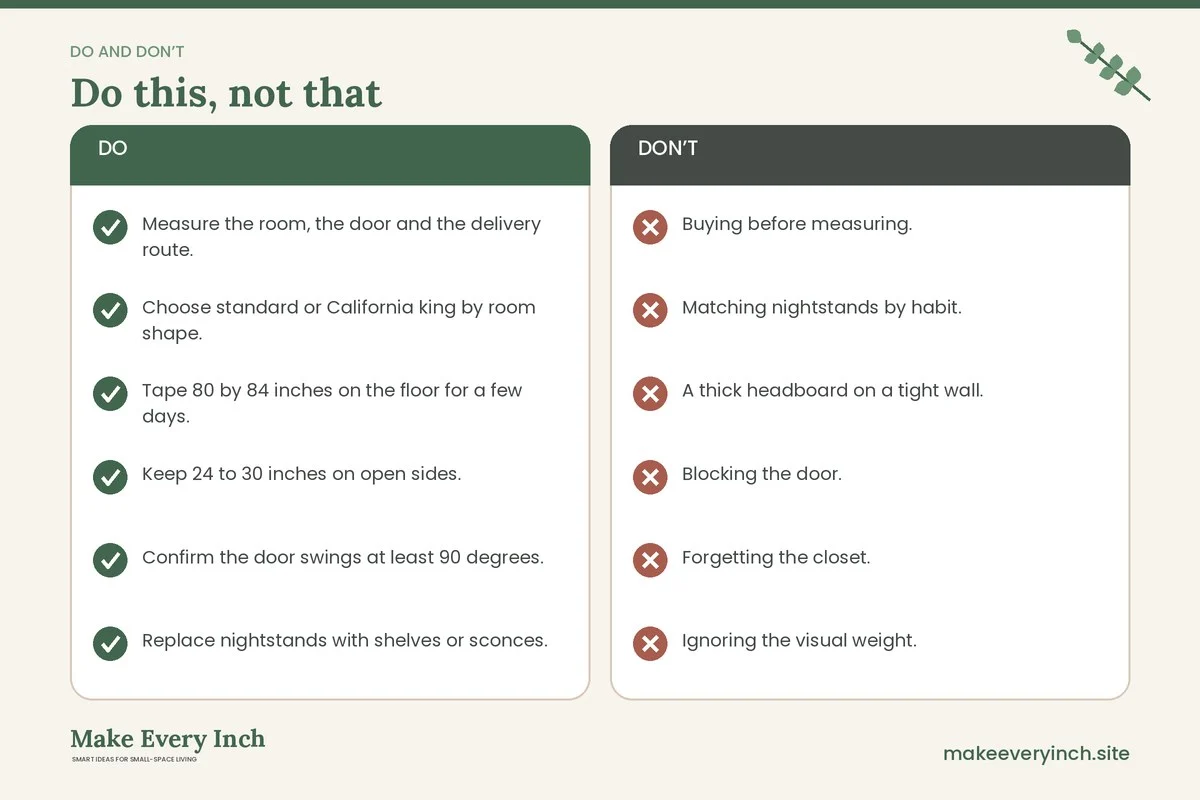
- Buying before measuring. Measure the room and the route.
- Matching nightstands by habit. Two big nightstands can add nearly 4 feet to the bed.
- A thick headboard on a tight wall. A few inches of depth matter in a small room.
- Blocking the door. If the door can’t open fully, the bed is too large for that spot.
- Forgetting the closet. Make sure you can still open it.
- Ignoring the visual weight. A big, dark bed in a small room feels heavy.
- Overlooking bedding. A king needs king-size bedding, and storing spare sets takes space.
King bed checklist
- Measure the room, the door and the delivery route.
- Choose standard or California king by room shape.
- Tape 80 by 84 inches on the floor for a few days.
- Keep 24 to 30 inches on open sides.
- Confirm the door swings at least 90 degrees.
- Replace nightstands with shelves or sconces.
- Choose a slim headboard of 1 to 3 inches.
- Use the under-bed zone for storage.
- Anchor tall furniture.
- Check the frame weight rating.
- Keep windows, vents and outlets clear.
- Get permission before any drilling.
FAQ
What is the smallest room a king bed can fit in?
A king can technically fit in a room around 10 by 10 feet, but it is very tight. Most people find 11 by 12 feet the practical minimum for comfortable walkways on both sides.
Is a king too big for a 10 by 10 room?
Usually yes, since it leaves under 20 inches on the sides and may block the door. A queen or a full is easier to live with.
Should I choose a California king?
It can suit a long, narrow room because it is 4 inches narrower, but it is also 4 inches longer. Check that you have the length.
How do I fit nightstands with a king?
Replace them with wall shelves, sconces, a ledge or a single nightstand on the open side. You keep the function without the width.
What headboard works best in a small room?
A slim panel, a painted or decal headboard or a wall-mounted one adds style with little depth. Avoid thick upholstered models if space is tight.
Can I put a king bed in a corner?
Yes, if one sleeper uses it or if you accept climbing in from the foot. It frees floor space on the opposite side.
Keep going: Keep planning with our small bedroom lighting ideas, small bedroom ideas budget and small bedroom makeover ideas.
Save this guide for later
Pin the ideas you like to Pinterest so you can come back to them when you plan your space.